Introduction
The Mankayan mineral district of northern Luzon, Philip-pines, is one of the richest mining districts in the Philippine archipelago. The region hosts several porphyry copper and epithermal precious and base-metal deposits, including the Lepanto high-sulfidation Cu-Au deposit and the adjacent Far Southeast porphyry Cu-Au deposit (Fig. 1). Several previous studies have documented the geologic (Garcia, 1991) and ge-netic relationship between the epithermal and porphyry sys-tems (Arribas et al., 1995; Mancano and Campbell, 1995; Hedenquist et al., 1998; Imai, 2000; Chang et al., 2011), the latter based on fluid inclusion, stable isotope, and geochrono-logical data. These studies have shown that the two deposits are genetically linked, and that the primary source of fluids responsible for both alteration and mineralization in the Lep-anto system originated at depth within the Far Southeast por-phyry system.
Detailed studies of fluid inclusions in enargite have been instrumental in determining the genetic relationship between the Lepanto and Far Southeast orebodies (Mancano and Campbell, 1995; Lindaas et al., 1998). Enargite and luzonite occur as the most abundant sulfosalts in the Lepanto orebody, and also occur as an overprint to the upper parts of the Far Southeast porphyry system. Enargite is predominant in the southeastern part of the Lepanto deposit, near the Far South-east system, whereas luzonite is dominant to the west (Imai, 1999). Studies have shown that fluid inclusions in the enargite record the overall progressive cooling and dilution of miner-alizing fluids to the northwest, away from the Far Southeast
porphyry system (Mancano and Campbell, 1995), and a more recent study of zoning in the earlier-formed alunite (Chang et al., 2011) is consistent with this northwesterly cooling. This district therefore provides an ideal site at which to examine trace element substitution in enargite, particularly in relation to zonation in or around ore deposits. Few other studies have examined the trace element variability in enargite, or other sulfosalts, in detail and these rely on electron microprobe data (e.g., Ackerman and Petersen, 1987; Takagi and Brimhall, 1998; Camprubi et al., 2001). In some cases, the concentra-tion of elements such as Ag, Sb, Sn, V, and Pb within enargite have been shown to vary with distance from the center of the deposits.
The development of laser ablation-inductively coupled plasma-mass spectroscopy (LA-ICP-MS) offers a reliable method for microanalyses of a diverse suite of elements at low detection limits. Several studies have applied this technology to the examination of trace elements in sulfides, and pyrite in par-ticular (e.g., Norman et al., 2001; Morey et al., 2008; Cook et al., 2009; Pass et al., 2009), but the trace element chemistry of enargite, particularly across a deposit, has not yet been investi-gated with LA-ICP-MS. The objectives of this study are, there-fore, to determine the suitability of LA-ICP-MS techniques for enargite trace element analysis, and to examine the range concentrations for a selection of trace elements. This study uses the same sample suite from the Mankayan district that was studied by Mancano and Campbell (1995) and Lindaas et al. (1998); our results define the zonation of trace elements in enargite across the Lepanto orebody. In addition, our study is the first to report trace element variability in enargite within an orebody and correlate the results with data from fluid in-clusion infrared microthermometry on the same samples.
SCIENTIFIC COMMUNICATIONS
TRACE ELEMENT GEOCHEMISTRY OF ENARGITE IN THE MANKAYAN DISTRICT, PHILIPPINES
C. L. DEYELL†,1,*ANDJ. W. HEDENQUIST2
1 CODES, the Australian Research Council’s Centre of Excellence in Ore Deposits, University of Tasmania,
Private Bag 126, Hobart, Tasmania 7001, Australia
2 Department of Earth Sciences, University of Ottawa, Ottawa, Ontario K1N6N5, Canada
Abstract
We report the first laser ablation-inductively coupled plasma-mass spectroscopy (LA-ICP-MS) study of trace element substitution in enargite. Results indicate significant variability in the composition of enargite samples from a single ore system. Samples come from the Mankayan district, Philippines, which hosts the Lepanto high-sulfidation Cu-Au deposit, now mined out, and the adjacent Far Southeast porphyry Cu-Au deposit; the genetic relationship between these deposits has been documented in previous studies. LA-ICP-MS analyses indicate significant incorporation of Sb and Fe in enargite (locally exceeding 1 wt %). Other elements such as Bi, Sn, Se, Te, Ag, and Zn occur at concentrations exceeding 0.1 wt percent. The distribution of selected trace elements in enargite correlates with previously published variations in fluid inclusion homogenization and melting temperatures and gas compositions. The spatial distribution of data indicates enargite is enriched in Au and Te close to the Far Southeast porphyry. Enargite is enriched in Silver, Fe, and Pb in the center of Lep-anto, and Zn (± Cd) is enrich the ore distal to the Far Southeast porphyry. Locally elevated Sb contents occur in samples from subsidiary branch vein structures and may indicate that mineralizing fluids along these struc-tures were modified compared to those that formed the main orebody.
† Corresponding author: e-mail, [email protected]
Geology and Ore Deposits in the Mankayan District The Mankayan district is located within the Luzon Central Cordillera. Significant porphyry and epithermal mineraliza-tion occurs in both the Mankayan and Baguio districts of the cordillera (Fig. 1; Arribas et al., 1995; Hedenquist et al., 1998; Claveria et al., 1999; Sajona et al., 2002; Chang et al., 2011; Cooke et al., 2011; Hollings et al., 2011; Waters et al., 2011). Mineralization occurred in both districts during the last 3 m.y. (Arribas et al., 1995; Waters et al., 2011; Cooke et al., 2011).
The geology of the Mankayan district consists of Creta-ceous to early Tertiary basement, comprising the Lepanto metavolcanic rocks (tectonized pillow basalts and basaltic to andesitic lava flows) and the Apaoan volcaniclastic rocks (Rin-genbach et al., 1990; Garcia, 1991). These units are overlain unconformably by the Balili sequence (polymictic volcanic conglomerates), that is, middle to late Miocene in age (Gar-cia, 1991). A large Miocene tonalite intrusion forms the west-ern margin of the mineral district (Gonzalez, 1956; Fig. 1). Mineralization is temporally and spatially related to Pliocene-Pleistocene quartz diorite intrusions and dacitic volcanic rocks (Fig. 2). The Imbanguila hornblende dacite (2.2–1.8 Ma; Ar-ribas et al., 1995) predates mineralization and is the principal host for the Lepanto orebody. The unaltered Pleistocene Bato hornblende-biotite dacite postdates mineralization.
The Far Southeast porphyry Cu-Au deposit is centered on a shallow quartz diorite stock, dated at 1.45 Ma (Arribas et al., 1995), that intruded the basement Balili volcaniclastic unit. Mineralization is related to quartz stockwork veins with chal-copyrite, pyrite, and minor bornite, Bi-Te–bearing tennantite, and rare native gold (Garcia, 1991; Imai, 2000). Fluid inclu-sion data indicate early quartz veins formed from hypersaline (50–55 wt % NaCl equiv) fluids at temperatures ~450° to 550°C (Hedenquist et al. 1998; Imai, 2000), with the associ-ated biotite dassoci-ated at 1.41 Ma (n = 6; Arribas et al., 1995). Quartz-alunite alteration occurs over the top of the porphyry and extends northwest, where it hosts the Lepanto orebody. Alunite within this alteration has been dated at 1.42 Ma (n= 5; Arribas et al., 1995), identical in age (within analytical error) to the biotite alteration at depth.
At Lepanto, Cu-Au mineralization (Figs. 1, 2) is largely controlled by the northwest-trending Lepanto fault. Mineral-ization is also controlled by the unconformity between the Imbanguila dacite and the underlying basement rocks (Gon-zalez, 1956; Garcia, 1991). The ore interval is deepest at the southeast end, as deep as 700 m elevation, but the level of enargite ore is as shallow as 1,200 m to the northwest, follow-ing the unconformity (Fig. 2). Near the southeastern end of the deposit, the oblique intersection of the Lepanto fault with east-west–trending branch faults, which splay from the main
Lepanto fault, results in a significantly wider ore zone (~400 m compared to ~100 m at its northwestern end; Hedenquist et al., 1998; Claveria, 2001).
Alteration and mineralization at Lepanto are typical of high-sulfidation epithermal deposits. The ore is hosted by strongly leached and silicified zones (with textures of both massive and vuggy quartz) that are surrounded by halos of quartz-alunite (± pyrophyllite, kaolinite, dickite, and dias-pore; Chang et al., 2011). Enargite and luzonite are the pri-mary Cu sulfosalts, along with abundant pyrite, and lesser chalcopyrite and tetrahedrite-tennantite, sphalerite, galena, and tellurides (calaverite and petzite). Rare Bi selenides and Sn-bearing phases (colusite) are also present (Claveria, 2001). Gold mineralization is associated predominantly with tennan-tite-tetrahedrite and chalcopyrite, and generally appears to be paragenetically later than the enargite-luzonite (Gonzalez, 1956; Claveria, 2001).
A genetic relationship between the Far Southeast and Lep-anto orebodies has been demonstrated previously by narrow age constraints, as well as fluid inclusion and stable isotope data (Arribas et al., 1995; Mancano and Campbell, 1995; Hedenquist et al., 1998; Lindaas et al., 1998; Imai, 2000). Mancano and Campbell (1995) examined the microther-mometry of fluid inclusions hosted in enargite along a section from the Far Southeast porphyry to the Lepanto orebody (Table 1). They showed a distinct cooling trend away from the porphyry center, with an accompanying decrease in salinities (from averages of 3.3 to 1.6 wt % NaCl equiv, with a total
range from 4.5 to 0.2 wt %). Lindaas et al. (1998) examined the composition of fluid inclusion gases (N2-CH4-Ar-H2S-CO2-CH4) in enargite, again from Far Southeast through to the Lepanto orebody, using the same sample suite as Man-cano and Campbell (1995). They report higher N2/Ar and H2S/Ar ratios in samples from the branch veins, combined with slightly higher salinities and homogenization tempera-tures (Th) of fluid inclusions from the same samples (Man-cano and Campbell, 1995), and suggested upward flow of fluid along the branch fault intersections in the Lepanto ore-body (Lindaas et al., 1998), in addition to the general north-westward flow of mineralizing fluids outward from the Far Southeast orebody (Mancano and Campbell, 1995).
Methods of Analysis
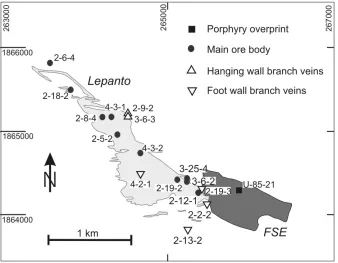
The sample suite used in this study is the same as that ex-amined by Mancano and Campbell (1995) and Lindaas et al. (1998). Enargite crystals (Table 1) were taken from samples collected along the main Lepanto high-sulfidation orebody, from the top of the Far Southeast porphyry to the distal margins of the high-sulfidation deposit 2 km to the north-west, as well as samples from the hanging-wall and footwall branch veins (Fig. 3). Samples consisted of individual enar-gite grains, all less than 1 cm in length, with rare associated pyrite. Only one sample (U-85-21) had any visible mineral inclusions (tennantite).
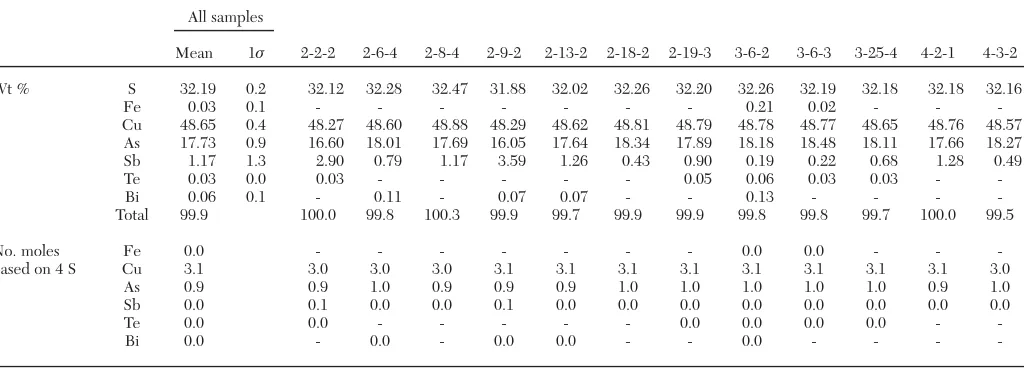
A subset of the enargite samples (n = 12) was analyzed by electron probe microanalysis (EPMA) at the University of
Tasmania to determine their major and selected trace ele-ment compositions, with an average of five analyses per sam-ple (using 50nA and 5-µm spot size). These samsam-ples were an-alyzed for seven elements (S, Fe, Cu, As, Sb, Te, and Bi); 64 points were analyzed in total (Table 2). The entire sample suite (n = 17) was analyzed by LA-ICP-MS techniques, also at the University of Tasmania. Details of LA-ICP-MS methodology, including descriptions of instrumentation,
sam-ple preparation, laser analysis, data reduction, and interpreta-tion are documented by Large et al. (2009) and Danyu-shevsky et al. (in press).
In this study, the enargite samples were analyzed by LA-ICP-MS for a total of 17 elements: Ti, V, Fe, Zn, Se, Zr, Mo, Ag, Cd, Sn, Sb, Te, Ba, W, Au, Pb, and Bi (Table 3). Spot size varied between 60 and 100 µm, depending on the enargite grain size. Multiple enargite grains were analyzed from each
TABLE1. Enargite Samples from the Mankayan District, Philippines
Sample UTM UTM Elevation Location1 Mean Th2 Max Th2 Mean Tm2 Min Tm2
no. northing easting (m) (°C) (°C) (°C) (°C)
2-2-2 1864100 265475 950 FW 249 267 –1.6 –2
2-5-2 1864955 264395 1030 MOB –1.7 –1.7
2-6-4 1865811 263591 1030 NOA 166 196 –1 –1.2
2-8-4 1865160 264220 1070 MOB 207 207 –1.3 –1.3
2-9-2 1865195 264520 950 HW 225 238 –1 –2.7
2-12-1 1864250 265365 700 MOB 230 259 –1 –1.7
2-13-2 1863810 265240 900 FW 206 245 –1.2 –1.8
2-18-2 1865480 263845 1000 MOB 198 214 –1.4 –2.2
2-19-2 1864415 265115 700 MOB 201 223 –1 –1.7
2-19-3 1864290 265405 1100 FW 209 241 –1.5 –2.3
3-6-2 1864390 265225 950 MOB 248 254 –1.3 –1.5
3-6-3 1865175 264520 1000 HW 231 245 –1.3 –2
3-25-4 1864425 265230 850 MOB 220 252 –1.3 –1.9
4-2-1 1864460 264675 1030 FW 224 237 –1.7 –2
4-3-1 1865165 264325 1030 MOB 194 232 –1.2 –2.2
4-3-2 1864732 264673 1030 MOB 207 219 –1.8 –2.3
U-85-21 1864274 265846 592 FSE 285 294 –1.9 –2.6
Note: Also shown are corresponding fluid inclusion homogenization (Th) and ice melting temperatures (Tm) from Mancano and Campbell (1995) 1 FW = footwall, HW = hanging wall, MOB = main orebody (Lepanto), NOA = northern extension zone, FSE = Far Southeast orebody 2 Data from Mancano and Campbell (1995)
[image:4.612.126.464.437.700.2]sample, and the number of analyses per grain was dependent on crystal size. Data reduction and quantification used stoi-chiometric Cu as the internal standard, based on the near-sto-ichiometric Cu/S ratios returned by EPMA analysis (Table 2). Detection limits (averaged over all analyses) for the LA-ICP-MS data are given in Table 4.
Analytical Results
EPMA results
EPMA analyses (Table 2) indicate near-stoichiometric enargite compositions of Cu, As, and S for the majority of samples analyzed. The Sb contents are variable, with values up to 5.7 wt percent (sample 2-9-2). In general, EPMA values of minor elements Bi, Te, and Fe are below detection (with average detection limits of 16, 28, and 70 ppm, respectively).
The distribution of Sb to As ratios in the enargite (Fig. 4) is variable. High Sb/As ratios occur in the branch vein struc-tures, whereas this ratio is generally low in the main Lepanto orebody.
LA-ICP-MS results
A summary of enargite LA-ICP-MS data for each sample is given in Table 4. There is significant variability in most ele-ments analyzed, and particularly in Fe, Te, V, and Mo (Table 4; Fig. 5). Nearly all elements are consistently above ICP-MS detection limits (Table 3; Fig. 5), with the exception of Cd, with mean values (2.3 ppm) close to detection.
A direct comparison between the LA-ICP-MS and EPMA data cannot be made because the sample volume of the two techniques is significantly different. Both Bi and Te are con-sistently below detection for EPMA analyses, although locally very high values are reported in LA-ICP-MS results. The larger beam size, 60 to 100 µm for LA-ICP-MS analysis, com-pared with the EPMA beam (5 µm), provides a better esti-mate of the bulk composition of individual enargite grains and can be used to sample across small zones of compositional variability.
The compositional variability between multiple LA-ICP-MS analyses of individual enargite crystals is due either to mineral inclusions, fluid inclusions, and/or growth zones. However, most samples exhibit relatively simple composi-tional patterns determined from LA-ICP-MS (Fig. 6a, b). Very few silicate inclusions are present, with the exception of rare Zr-bearing phases. The most common inclusion types are minor Au (± Ag, Te), as discussed below, as well as inclusions containing variable combinations of Bi-Te-Sn-Fe (Fig. 6c).
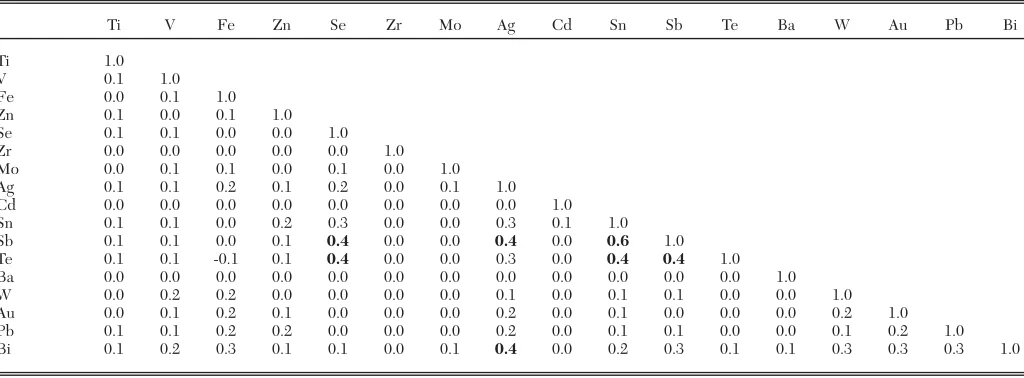
Complex growth zoning was also noted locally. This com-positional variability is due primarily to different combina-tions of Fe-Bi-Te-Sb-Sn-Se, but overall there are very few consistent elemental correlations in the enargite. As indicated in Table 5, Sb correlates weakly with Sn, and to a lesser extent with Te. Weak correlations also occur between Ag-Sb, Ag-Bi, Te-Se, and Te-Sb (Table 5).
Discussion
Nature of Au in enargite
The nature of Au in the enargite is of particular interest at Lepanto because Au was a significant contributor to the eco-nomic viability of the mine. Both Cu and Au were mined from the deposit during large-scale mining operations from 1936 to 1996, with an average grade over the life of produc-tion of 3.4 g/t Au, 14 g/t Ag, and 2.9 wt percent Cu, the latter largely from enargite (Chang et al., 2011). Previous studies have shown that the Au occurred mostly as electrum or in as-sociation with tellurides, selenides, and Bi- and Sn-bearing phases (Tejada, 1989; Claveria and Hedenquist, 1994; Clave-ria, 2001). In this study, Au is above detection in most enar-gite samples, with maximum values up to 70 ppm (Fig. 5).
Three distinct forms of Au occurrence are recognized in the Lepanto enargite. In most cases, the Au exhibits smooth LA-ICP-MS traces in analytical traverses across enargite (Fig. 7b) and therefore it is thought to be structurally bound within the enargite crystal lattice (e.g., Danyushevsky et al., in press). Rare inclusions of native gold with elevated concentrations of
TABLE2. Summary of Electron Microprobe (EPMA) Data for Selected Enargite Samples
(data for each sample represents the mean of multiple data points)
All samples
Mean 1σ 2-2-2 2-6-4 2-8-4 2-9-2 2-13-2 2-18-2 2-19-3 3-6-2 3-6-3 3-25-4 4-2-1 4-3-2
Wt % S 32.19 0.2 32.12 32.28 32.47 31.88 32.02 32.26 32.20 32.26 32.19 32.18 32.18 32.16
Fe 0.03 0.1 - - - 0.21 0.02 - -
-Cu 48.65 0.4 48.27 48.60 48.88 48.29 48.62 48.81 48.79 48.78 48.77 48.65 48.76 48.57 As 17.73 0.9 16.60 18.01 17.69 16.05 17.64 18.34 17.89 18.18 18.48 18.11 17.66 18.27 Sb 1.17 1.3 2.90 0.79 1.17 3.59 1.26 0.43 0.90 0.19 0.22 0.68 1.28 0.49
Te 0.03 0.0 0.03 - - - 0.05 0.06 0.03 0.03 -
-Bi 0.06 0.1 - 0.11 - 0.07 0.07 - - 0.13 - - -
-Total 99.9 100.0 99.8 100.3 99.9 99.7 99.9 99.9 99.8 99.8 99.7 100.0 99.5
No. moles Fe 0.0 - - - 0.0 0.0 - -
-based on 4 S Cu 3.1 3.0 3.0 3.0 3.1 3.1 3.1 3.1 3.1 3.1 3.1 3.1 3.0
As 0.9 0.9 1.0 0.9 0.9 0.9 1.0 1.0 1.0 1.0 1.0 0.9 1.0
Sb 0.0 0.1 0.0 0.0 0.1 0.0 0.0 0.0 0.0 0.0 0.0 0.0 0.0
Te 0.0 0.0 - - - 0.0 0.0 0.0 0.0 -
-Bi 0.0 - 0.0 - 0.0 0.0 - - 0.0 - - -
[image:5.612.55.568.97.281.2]T
ABLE
3. Summary of LA-ICP-MS Data for Mankayan Enargite Samples
TABLE4. LA-ICP-MS Detection Limits (values in ppm)
Element Ti V Fe Zn Se Zr Mo Ag Cd Sn Sb Te Ba W Au Pb Bi
Mean 0.38 0.03 4.14 0.33 1.3 0.02 0.32 0.03 1.03 0.09 0.17 0.2 0.08 0.03 0.04 0.03 0.02
1σ 0.2 0.0 2.0 0.1 0.1 0.0 0.3 0.0 1.0 0.1 0.2 0.1 0.0 0.0 0.0 0.0 0.0
Note: Data shown are average values for all analyses in this study
FIG. 4. Map showing 100*Sb/As ratios in enargite, based on mean wt percent EPMA results. Gray circles represent sam-ples taken from hanging-wall and foot wall branch veins; white circles are from the main Lepanto orebody and northern ex-tension zone. Sample locations are superimposed on shaded areas showing the maximum extents of the Lepanto (light gray) and Far Southeast orebodies (dark gray), projected to surface.
FIG. 5. Range of enargite LA-ICP-MS trace element data for all analyses in this study (as ppm). The mean of all analyses
FIG. 6. Photomicrographs and raw LA-ICP-MS element data (shown as element counts over time) for selected enargite samples. (A) Sample 2-12-1. (B) Sample 2-19-2. (C) Sample U-85-21. Scale bar = 100 µm. Black circles on photographs in-dicate the locations of associated LA-ICP-MS analyses.
0 20 40 60 80 100 120
Time(s)
100
10
100000
Counts
0 20 40 60 80 100 120
Time(s)
100
10
100000
Counts
0 20 40 60 80 100 120
Time(s)
100
10
Ag, Te, and Pb also occur in the enargite (Fig. 7a). The third occurrence of Au is as complicated growth zones and/or multi-element inclusions within the enargite (Fig. 7c). In these analyses of growth zones and/or inclusions, there is a strong association of Au with anomalies of Fe-Ag-Pb-Bi ± Sn, Mo.
Comparison with fluid inclusion measurements
Direct comparison of the enargite LA-ICP-MS data (Table 4) and fluid inclusion homogenization and melting tempera-ture measurements can be made for the same samples, using the data from Mancano and Campbell (1995) (Table 1). In most samples, there is poor correlation between the datasets and few trends are present, due to the large range of LA-ICP-MS results for individual elements within a single enargite sample. However, selected elements show some trends with respect to either homogenization temperature (Th) or fluid salinity (Tm) (Fig. 8).
Correlations of Pb and Te (Fig. 8a, b) to fluid inclusion ho-mogenization temperatures show opposite trends. Average Pb concentrations are lowest (<1 ppm) in samples with the highest recorded Thmeasurements, and gradually increase to a maximum (>10 ppm) at Th values of ~210°C (Fig. 8a); Chang et al. (2011) found a similar pattern in terms of Pb hav-ing the highest concentration in alunite samples that are dis-tal, which formed at the lowest temperature. In contrast, Te values exhibit an overall positive trend with respect to Th(Fig. 8b). However, relatively lower Te concentrations occur at the highest Th value, corresponding to enargite mineralization that overprints the Far Southeast porphyry in a hydrothermal breccia (sample U85-21).
Similar trends are observed between Bi and Se with respect to fluid inclusion Tmmeasurements (Fig. 8c, d). A strong neg-ative correlation occurs between Bi and increasing fluid salin-ity (lower Tmvalues; Fig 8c), i.e., low Bi correlates with high salinity, perhaps due to Bi remaining in high salinity solutions. In contrast, Se concentrations exhibit a weak positive correla-tion with respect to fluid salinity, with the lowest Se values corresponding to the lowest salinity measurements.
Sb substitution in enargite
The nature and temperature dependence of Sb substitution in enargite is well documented in studies of phase relation-ships between enargite and the luzonite-famatinite solid-so-lution series (e.g., Skinner, 1960; Maske and Skinner, 1971; Pósfai and Buseck, 1998). Studies have shown that Sb can substitute in the enargite crystal structure up to a maximum of about 20 mol percent Cu3SbS4(Springer, 1969). In the pre-sent study, Sb contents of the enargite are low, averaging about 4 mol percent Cu3SbS4, and only a few analyses had val-ues above 10 mol percent Cu3SbS4 (Table 2). The highest Sb/(Sb+As) ratios occur in the branch vein structures (Fig. 9), but there is no consistent zonation in Sb values away from the Far Southeast deposit or the Lepanto main orebody. A com-parison of Sb/(Sb+As) ratios in samples from the deposit to fluid inclusion homogenization temperatures (Fig. 9) indi-cates that there is a broad trend of increasing Sb/(Sb+As) with decrease in temperature in samples from the main Lepanto orebody and northern extension zone. However, there is no similar trend in samples from the branch veins, which have variable Sb/(Sb+As) over a range of temperatures. These data suggest that temperature is not the only factor that deter-mines Sb concentrations in enargite at Lepanto. Given the re-sults of the fluid inclusion gas study and the recognition of ad-ditional fluid input along the branch structures (Lindaas et al., 1998), we suggest that the variation in Sb/(Sb+As) content of the enargite can be attributed to different fluid pathways and different fluid compositions, as well as temperature. Min-eralizing fluids within the branch veins had generally higher Sb/(Sb+As) ratios compared to the predominantly northwest-ward flowing fluids sourced from the Far Southeast porphyry (e.g., Hedenquist et al., 1998).
Spatial distribution of trace elements in enargite
Trace element substitution in Cu sulfosalts has previously been shown to vary with distance from some epithermal ore-bodies, although specific element enrichments or depletions appear to vary between deposits (e.g., Ackerman and Pe-tersen, 1987; Takagi and Brimhall, 1998; Camprubi et al.,
TABLE5. Correlation Matrix Showing “r” Values of Elements Based on Average LA-ICP-MS Results
Ti V Fe Zn Se Zr Mo Ag Cd Sn Sb Te Ba W Au Pb Bi
Ti 1.0
V 0.1 1.0
Fe 0.0 0.1 1.0
Zn 0.1 0.0 0.1 1.0
Se 0.1 0.1 0.0 0.0 1.0
Zr 0.0 0.0 0.0 0.0 0.0 1.0
Mo 0.0 0.1 0.1 0.0 0.1 0.0 1.0
Ag 0.1 0.1 0.2 0.1 0.2 0.0 0.1 1.0
Cd 0.0 0.0 0.0 0.0 0.0 0.0 0.0 0.0 1.0
Sn 0.1 0.1 0.0 0.2 0.3 0.0 0.0 0.3 0.1 1.0
Sb 0.1 0.1 0.0 0.1 0.4 0.0 0.0 0.4 0.0 0.6 1.0
Te 0.1 0.1 -0.1 0.1 0.4 0.0 0.0 0.3 0.0 0.4 0.4 1.0
Ba 0.0 0.0 0.0 0.0 0.0 0.0 0.0 0.0 0.0 0.0 0.0 0.0 1.0
W 0.0 0.2 0.2 0.0 0.0 0.0 0.0 0.1 0.0 0.1 0.1 0.0 0.0 1.0
Au 0.0 0.1 0.2 0.1 0.0 0.0 0.0 0.2 0.0 0.1 0.0 0.0 0.0 0.2 1.0
Pb 0.1 0.1 0.2 0.2 0.0 0.0 0.0 0.2 0.0 0.1 0.1 0.0 0.0 0.1 0.2 1.0
[image:9.612.53.565.84.273.2]FIG. 7. Raw LA-ICP-MS element data (se-lected elements only) for se(se-lected Au-bearing enargite samples showing variability of Au occur-rences. (A) Sample 3-25-4; (B) Sample 3-6-3; and (C) Sample 4-3-2.
0 20 40 60 80 100 120
Time(s)
1000000
100000
10000
1000
100
10
Counts
0 20 40 60 80 100 120
Time(s)
10000000
1000000
100000
10000
1000
100
10
Counts
0 20 40 60 80 100 120
Time(s)
10000000
1000000
100000
10000
1000
100
10
0.01 0.1 1 10 100
150 180 210 240 270 300
mean Th (°C)
Pb (
p
pm)
A
0.1 1 10 100 1000 10000
150 180 210 240 270 300
mean Th (°C)
Te (ppm)
B
1 10 100 1000 10000
-2 -1.75 -1.5 -1.25 -1 -0.75
mean Tm (°C)
Bi (ppm)
C
0.1 1 10 100 1000 10000
-2 -1.75 -1.5 -1.25 -1 -0.75
mean Tm (°C)
Se (
p
pm)
D
FIG. 8. Comparison of selected LA-ICP-MS trace element contents of enargite (a: Pb, b: Te; c: Bi, d: Se) with fluid in-clusion homogenization (Th) and average melting (Tm) temperatures. Fluid inclusion data from Mancano and Campbell
(1995).
0.1 1 10 100
150 170 190 210 230 250 270
mean Th (°C)
Sb/Sb+
As *100
MOB & NOA
FW & HW
FIG. 9. Scatter plot showing enargite EPMA 100*Sb/(Sb+As)
(el-ement levels as wt %) compared to mean fluid inclusion homoge-nization temperatures (Th) from Mancano and Campbell (1995).
2001). Similar results are recorded in the Mankayan district, where several elements are preferentially enrich or deplete the ore relative to their distance from the Far Southeast por-phyry (Fig. 10). Enargite samples close to the Far Southeast porphyry system are relatively enriched in elements such as Au, Te, and, to a lesser extent, V (Fig. 10a, b). The main Lep-anto orebody is preferentially enriched in Ag near the core of the epithermal deposit (Fig. 9a), along with Fe and, to a lesser extent, Pb (Fig. 10c). The only elements that enrich the northwestern distal extent of the Lepanto deposit are Zn and, to a lesser extent, Cd (Fig. 10e, f).
The distribution of elements between enargite samples in the main Lepanto orebody is also different to that within the branch vein structures. Elements such as Sn and Te show lit-tle variability between the main orebody and branch vein structures. Only enargite is enriched in Sb within the branch vein structures, based on both EPMA (Table 2) and LA-ICP-MS analyses (Table 4), whereas concentrations of Au and Zn are highest in enargite from the main Lepanto orebody and the overprint to the Far Southeast system (Fig.10a, e). These data are consistent with the conclusions of Lindaas et al. (1998), who suggested a distinct upflow of mineralizing flu-ids along the branch vein structures. As noted above, this branch vein fluid may have had a slightly different composi-tion to the fluid originating from the Far Southeast porphyry and that flowed along the Lepanto fault, with lower Au but higher Sb contents. This may have been caused by a differ-ent fluid ascdiffer-ent path, a greater degree of wall-rock interac-tion, or both.
Our results indicate that the trace element content of enargite is influenced by a range of factors and does not solely reflect the composition of the mineralizing fluids, nor the temperature.
Conclusions
We report the first LA-ICP-MS study of trace element sub-stitution in enargite. The methodology described by Danyu-shevsky et al. (in press) for analysis of pyrite and other sulfides is also applicable to enargite. Results indicate significant vari-ability in trace element compositions of enargite samples from a single ore deposit. The LA-ICP-MS technique has sig-nificant advantages over EPMA analysis, as ICP-MS detec-tion limits are one to two orders of magnitude lower than electron microprobe levels.
Results from this study of the Lepanto deposit indicate sig-nificant incorporation of Sb in enargite, averaging 1.3 wt cent; by contrast, the average of Fe is typically <0.1 wt per-cent. Other elements such as Bi, Sn, Se, Te, Ag and Zn are also present at values exceeding 0.01 wt percent. In general, the most abundant trace elements recorded in the enargite are those that also form discrete sulfosalt, selenide, and tel-luride accessory phases in the deposit (e.g., Claveria and Hedenquist, 1994; Arribas et al., 1995; Claveria, 2001).
The distribution of some trace elements in the enargite samples from Lepanto can be related to systematic variations in fluid inclusion homogenization and melting temperatures (Mancano and Campbell, 1995), as well as broad changes in fluid inclusion gas chemistry (Lindaas et al., 1998). General trends in the spatial distribution of some elements suggest en-richment in Au and Te (in particular) close to the Far South-east porphyry system, where the paleotemperatures were the highest (Mancano and Campbell, 1995); however, there is sig-nificant variability in some elements between individual grains and/or samples. Enargite is enriched in elements such as Ag and, to a lesser extent, Fe and Pb in the center of the Lepanto orebody, whereas Zn (± Cd) enrich the enargite dis-tal to the Far Southeast porphyry, where temperatures were lower (Mancano and Campbell, 1995). Locally, elevated Sb and Sb/(Sb+As) ratios in the enargite occur in samples from the branch vein structures. These data, combined with varia-tions in elements such as Au and Zn, are consistent with the conclusion of Lindaas et al. (1998), that mineralizing fluids in-troduced along the branch veins were distinctly different compared to those that flowed from the Far Southeast por-phyry northwest along the Lepanto fault to form the main orebody, where 70 percent of the ore originated.
Our results have implications for exploration around enar-gite-rich high sulfidation ore deposits. Lateral variations in the trace element geochemistry of enargite, from distal Zn enrichment to proximal Ag, Fe, and Pb enrichment, may help to locate the center of hydrothermal activity, thereby provid-ing explorers with the best chance of locatprovid-ing any cogenetic porphyry-style mineralization.
Acknowledgments
This study was funded by a NSERC PDF fellowship to C. Deyell, with analytical expenses funded through CODES, Centre of Excellence in Ore Deposits, Hobart. We thank D. Mancano for providing the polished samples from his original study of fluid inclusions in enargite, D. Steele for assistance with electron microprobe analyses, L. Danyushevsky for as-sistance with interpretation of LA-ICP-MS data, and S. Gilbert for technical assistance with the LA-ICP-MS instru-ment. LCMC is acknowledged for approving the use of updated geological maps and information. Comments and contributions by D. Cooke and N. White are gratefully ac-knowledged. Critical reviews by James Pope and David John are appreciated.
REFERENCES
Ackerman, D.R., and Petersen, E.U., 1987, Mineral chemistry of tennantite in the Trixie mine, East Tintic district, Utah [abs.]: Geological Society of America Abstracts, v. 19 (7), p. 657.
Arribas, A., Jr., Hedenquist. J.W., Itaya, T., Okada, T., Concepción, R.A., and Garcia, J.S., Jr., 1995, Contemporaneous formation of adjacent porphyry and epithermal Cu-Au deposits over 300 ka in northern Luzon, Philippines: Geology, v. 23, p. 337–340.
Camprubi, A., Canals, A., Cardellach, E., Prol-Ledesma, R. M., and Rivera, R., 2001, The La Guitarra Ag-Au low-sulfidation epithermal deposit, Temascaltepec district, Mexico; vein structure, mineralogy, and sulfide-sul-fosalt chemistry: Society of Economic Geologists Special Publication 8, p. 133–158.
Chang, Z., Hedenquist, J.W., White, N.C., Cooke, D.R., Roach, M., Deyell, C.L., Garcia, J. Jr., Gemmell, B., McKnight, S., and Cuison, A.L., 2011, Ex-ploration tools for linked porphyry and epithermal deposits: Example from the Mankayan intrusion-centered Cu-Au district, Luzon, Philippines: ECO -NOMICGEOLOGY, v. 106, p. 1365–1398.
Claveria, R.J.R., 2001, Mineral paragenesis of the Lepanto copper and gold and the Victoria gold deposits, Mankayan mineral district, Philippines: Re-source Geology, v. 51, p. 97–106.
Claveria, R.J.R., and Hedenquist, J.W., 1994, Paragenesis of Au and related minerals in the Lepanto Cu-Au deposit [abs.]: Resource Geology, v. 44, p. 267.
Claveria, R.J.R., Cuison, A.G., and Andam, B.V., 1999, The Victoria gold de-posit in the Mankayan mineral district, Luzon, Philippines: Australasian In-stitute of Mining and Metallurgy (PacRim ’99), v. 4-99, p. 73–80. Concepción, R.A., and Cinco, J.C., Jr., 1989, Geology of the Lepanto-Far
Southeast gold-rich copper deposit: International Geological Congress, Washington, D.C., Proceedings, v. 1, p. 319–320.
Cook, N.J., Ciobanu, C.L., and Mao, J, 2009, Textural control on gold distri-bution in As-free pyrite from the Dongping, Huangtuliang and Hougou gold deposits, North China craton (Hebei Province, China): Chemical Ge-ology, v. 264, p. 101–121.
Cooke, D.R., Deyell, C.L., Waters, P.J., Gonzales, R.I., and Zaw, K., 2011, Evidence for magmatic-hydrothermal fluids and ore-forming processes in epithermal and porphyry deposits of the Baguio district, Philippines: ECO -NOMICGEOLOGY, v. 106, p. 1399–1424.
Danyushevsky, L.V., Robinson P., Gilbert, S., Norman, M., Large, R., Mc-Goldrick, P., and Shelley, J.M.G., 2010, A technique for routine quantita-tive multi-element analysis of sulphide minerals by laser ablation ICP-MS: Geochemistry: Exploration, Environment, Analysis, in press.
Garcia, J.S., Jr., 1991, Geology and mineralization characteristics of the Mankayan mineral district, Benguet, Philippines: Geological Survey of Japan, Report 277, p. 21–30.
Gonzalez, A.G., 1956, Geology of the Lepanto copper mine, Mankayan, Mountain province: Philippines Bureau of Mines Special Projects Series, no. 16, p. 17–50.
Hedenquist, J.W., Arribas, A., Jr., and Reynolds, T.J., 1998, Evolution of an intrusion-centered hydrothermal system: Far Southeast-Lepanto porphyry and epithermal Cu-Au deposits, Philippines: ECONOMICGEOLOGY, v. 93, p.
373–404.
Hollings, P., Cooke, D.R., Waters, P.J., and Cousens, B., 2011, Igneous geo-chemistry of mineralized rocks of the Baguio district, Philippines: Implica-tions for tectonic evolution and the genesis of porphyry-style mineraliza-tion: ECONOMICGEOLOGY, v. 106, p. 1317–1333.
Imai, A., 1999, Pyrite disease in luzonite from the Lepanto Cu-Au deposit, Mankayan, Philippines: Further example of disease texture and its origin: Resource Geology, v. 49, p. 163–168.
——2000, Mineral paragenesis, fluid inclusions and sulfur isotope systemat-ics of the Lepanto Far Southeast porphyry Cu-Au deposit, Mankayan, Philippines: Resource Geology, v. 50, p. 151–168.
Large, R.L., Danyushevsky, L., Hollit, C., Maslennikov, V., Meffre, S., Gilbert, S., Bull, S., Scott, R., Emsbo, P., Thomas, H., Singh, B., and Fos-ter, J., 2009, Gold and trace element zonation in pyrite using a laser imag-ing technique: Implications for the timimag-ing of gold in orogenic and Carlin-style sediment-hosted deposits: ECONOMICGEOLOGY, v. 104, p. 635–668.
Lindaas, S.E., Chomiak, B.A., Campbell, A.R., and Norman, D.I., 1998, Enargite-hosted fluid inclusion gases from the Lepanto Philippines, high-sulfidation Cu-Au deposit [abs.]: Geological Society of America, Abstracts with Programs, v. 30, p. 20.
Mancano, D.P., and Campbell, A.R., 1995, Microthermometry of enargite-hosted fluid inclusions from the Lepanto, Philippines, high-sulfidation Cu-Au deposit: Geochimica et Cosmochimica Acta, v. 59, p. 3909–3916. Maske, S., and Skinner, B.J., 1971, Studies of the sulfosalts of copper: I.
Phases and phase relations in the system Cu-As-S: ECONOMICGEOLOGY, v.
66, p. 901–918.
Morey, A. A., Tomkins, A.G., Bierlein, F.P., Weinberg, R.F., and Davidson, G.J., 2008, Bimodal distribution of gold in pyrite and arsenopyrite; exam-ples from the Archean Boorara and Bardoc shear systems, Yilgarn craton, Western Australia: ECONOMICGEOLOGY, v. 103, p. 599–614.
Norman, M., Clark, D., Solomon, M., McGoldrick, P.J., Davidson, G., and Large, R., 2001, Trace element compositions of sulphides by laser ablation ICPMS; applications to ore deposit research and mineral exploration, in Williams, P.J., ed., A hydrothermal odyssey—extended conference ab-stracts: Contributions of the Economic Geology Research Unit, Townsville, Australia, v. 59, p. 154–155.
Pass, H.E., Danyushevsky, L., Gilbert, S., and Cooke, D.R., 2009, LA-ICPMS analyses of PGEs in pyrite and Cu-sulfides from Mt Polley alkalic porphyry Cu-Au deposit, Canada, inWilliams, P.J., et al., eds., Smart Sci-ence for Exploration and Mining: Proceedings of the 10th Biennial SGA meeting, Townsville, Australia, 2009: Townsville, Economic Geology Re-search Unit, v. 2, p. 738–740.
Pósfai, M., and Buseck, P.R., 1998, Relationships between microstructure and composition in enargite and luzonite: American Mineralogist, v. 83, p. 373–382.
Ringenbach, J.C., Stephan, J.F., Maleterre, P., and Bellon, H., 1990, Struc-ture and geological history of the Lepanto-Cervantes releasing bend on the Abra River fault, Luzon Central Cordillera, Philippines: Tectonophysics, v. 183, p. 225–241.
Sajona, F.G., Izawa, E., Motomura, Y., Imai, A., Sakakibara, H. and Watan-abe, K., 2002, Victoria carbonate-base metal gold deposit and its signifi-cance in the Mankayan mineral district, Luzon, Philippines: Resource Ge-ology, v. 52, p. 315–328.
Skinner, B.J., 1960, Assemblage enargite-famatinite, a possible geother-mometer: Geological Society of America Bulletin, v. 71, p. 1975. Springer, G., 1969, Compositional variations in enargite and luzonite:
Miner-alium Deposita, v. 4, p. 72–74.
Takagi, T.K., and Brimhall, G. H, 1998, Effect of trace element content on the optical properties of enargites and their distribution in the Agua Rica copper deposit, Argentina [abs.]: Geological Society of America, 1998 An-nual Meeting, Abstracts with Programs, v. 30, p. 75.
Tejada, M.L.G., 1989, Characteristics and paragenesis of luzonite in the Lep-anto copper-gold deposit, Mankayan, Benguet, Philippines: Unpublished M.Sc. thesis, Manila, Philippines, University of the Philippines, 89 p. Waters, P.J., Cooke, D.R., Gonzales, R.I., and Phillips, D., 2011, Porphyry
and epithermal deposits and 40Ar/39Ar geochronology of the Baguio district,