Pv
RON2, a new
Plasmodium vivax
rhoptry neck
antigen
Arévalo-Pinzón
et al
.
R E S E A R C H
Open Access
Pv
RON2, a new
Plasmodium vivax
rhoptry
neck antigen
Gabriela Arévalo-Pinzón
1,2,3, Hernando Curtidor
1,2, Liliana C Patiño
1,2, Manuel A Patarroyo
1,2*Abstract
Background:Rhoptries are specialized organelles from parasites belonging to the phylumApicomplexa; they secrete their protein content during invasion of host target cells and are sorted into discrete subcompartments within rhoptry neck or bulb. This distribution is associated with these proteins’role in tight junction (TJ) and parasitophorous vacuole (PV) formation, respectively.
Methods:Plasmodium falciparumRON2 amino acid sequence was used as bait for screening the codifying gene for the homologous protein in thePlasmodium vivaxgenome. Gene synteny, as well as identity and similarity values, were determined forron2and its flanking genes amongP. falciparum,P. vivax and other malarial parasite genomes available at PlasmoDB and Sanger Institute databases.Pvron2gene transcription was determined by RT-PCR of cDNA obtained from theP. vivaxVCG-1 strain. Protein expression and localization were assessed by Western blot and immunofluorescence using polyclonal anti-PvRON2 antibodies. Co-localization was confirmed using antibodies directed towards specific microneme and rhoptry neck proteins.
Results and discussion:The first P. vivaxrhoptry neck protein (named here PvRON2) has been identified in this study.PvRON2 is a 2,204 residue-long protein encoded by a single 6,615 bp exon containing a hydrophobic signal sequence towards the amino-terminus, a transmembrane domain towards the carboxy-terminus and two coiled coila-helical motifs; these are characteristic features of several previously described vaccine candidates against
malaria. This protein also contains two tandem repeats within the interspecies variable sequence possibly involved in evading a host’s immune system.PvRON2 is expressed in late schizonts and localized in rhoptry necks similar to what has been reported forPfRON2, which suggests its participation during target cell invasion.
Conclusions:The identification and partial characterization of the firstP. vivaxrhoptry neck protein are described in the present study. This protein is homologous toPfRON2 which has previously been shown to be associated withPfAMA-1, suggesting a similar role forPvRON2.
Background
Of the five Plasmodium parasite species producing human malaria, Plasmodium vivax causes 100 to 300 million clinical cases per year [1,2], representing ~40% of the population suffering from this disease. Although P. vivaxmalaria has been considered to be less severe than that produced by Plasmodium falci-parumin clinical terms, several factors have highlighted the need to search for new effective control measures to counteract P. vivax infections, i.e. its ability to cause chronic infections by inducing dormant forms present
in the liver (hypnozoites), increased severe manifesta-tions caused by this parasite species and the emergence of strains resistant to chemotherapeutic agents, such as chloroquine [3,4]. Due to the difficulty of carrying out a
P. vivax continuous culturein vitro, this parasite has been relatively less studied compared to other Plasmo-diumspecies. To overcome this problem, a comparative approach has been undertaken aimed at identifying and characterizing inP. vivaxparasite molecules involved in target cell invasion previously described for other Plas-modiumspecies (mainly P. falciparum), and in recent transcriptome studies of the P. vivaxintraerythrocytic development cycle [5].
The Plasmodium parasite life-cycle is very complex, beginning with a larva-like structure (or sporozoite)
* Correspondence: [email protected]
1
Fundación Instituto de Inmunología de Colombia FIDIC, Carrera 50 # 26-20, Bogotá, Colombia
Full list of author information is available at the end of the article
being injected by theAnophelesmosquito during its bite in the search for a blood meal. The sporozoites then migrate to the liver and invade hepatocytes, where they rapidly reproduce and transform into thousands of pear-like structures (merozoites). During the asexual erythrocytic phase, which is responsible for the clinical manifestations of the disease, merozoites invade red blood cells (RBCs) very quickly through a process mediated by multiple receptor-ligand interactions [6]. A large number of parasite proteins associated with this type of interaction are stored in a set of specialized api-cal organelles known as rhoptries, micronemes and dense granules [7,8]. After initial contact with the RBC, the parasite redirects its apical pole over the erythrocyte membrane and sequentially releases the contents from micronemes, rhoptries and then the dense granules [9]. These molecular events lead to tight junction (TJ) and parasitophorous vacuole (PV) formation, as well as the biochemical and functional remodelling of host cell architecture [10].
A TJ is characteristic of members belonging to the phylum Apicomplexaand can be seen as a ring-shaped electro-dense structure by electron microscope; this connects to the parasite’s actin-myosin motor [11] to propel the parasite within the nascent PV, where it will reside during the intraerythrocytic development cycle [12]. Several microneme- and rhoptry-derived proteins, such as reticulocyte-binding protein homologues (RH) [13,14], erythrocyte-binding ligands (EBL) and the MCP-1 protein [15] either form part or are associated with the TJ.
Apical merozoite antigen 1 (AMA-1) is derived from micronemes and is essential in invasion of most Api-complexa studied so far [16,17]. It has been recently described that it is associated with proteins derived from the rhoptry neck in Toxoplasma gondii, such as RON-2, -4, -5 and -8 in the TJ. A TJ organizational model described by Besteiroet alin 2009 [18], proposed that the parasite directly inserts some RON proteins (also identified as AMA-1 associated proteins (AAPs)) into the host cell membrane, thus acting as additional
TgAMA-1 receptors. A clear interaction between the
TgRON2 C-terminal region and the AMA-1 ectodomain (forming a crucial bridge between TgAMA-1 and the rest of the AAPs) has been recently demonstrated through different protein-protein interaction assays. Moreover, inhibition assays using recombinant proteins have shown that the RON2 and AMA-1 interaction is critical for the entry to host cells [19,20].
Previous comparative analysis between T. gondiiand
P. falciparum genomes has revealed the presence of homologues forTgRON2, TgRON4 andTgRON5 pro-teins in P. falciparum: PfRON2 (Pf14_0495), PfRON4 (Pf11_0168) and PfRON5 (MAL8P1.73), respectively.
PfRON2 [21], PfRON4 [22] and PfRON5 [23] are located in the rhoptry neck and co-immunoprecipitate with PfAMA-1 [21,22,24,25]. Furthermore, thePfRON2 protein and the PfAMA-1 ectodomain interaction has already been characterized, as well as its importance for erythrocyte invasion, suggesting that the mechanism described inT. gondiicould be conserved among differ-ent members of the phylumApicomplexa[19].
Studies with parasite lines expressingPfAMA-1 protein mutants have shown that the Y251 residue, located inside the hydrophobic channel, is absolutely essential for
PfAMA1/AAP complex formation [25]. Interestingly, an invasion inhibition antibody known as 4G2, that recog-nizes the domain II loop ofPfAMA-1 [26], prevents
PfAMA1/AAP complex assembly through steric hin-drance and/or by inducing aPfAMA-1 conformational change which interferes with the AAP binding site [25,27]. Likewise, the R1 peptide derived from a random phage display peptide library and known for being a powerful inhibitor of merozoite invasion of human RBCs [28] acts by binding to thePfAMA-1 hydrophobic chan-nel and blockingPfAMA1-AAPs complex formation [29]. These data suggest that the interaction of a vaccine can-didate molecule such asPfAMA-1 with new rhoptry neck components is critical during invasion of erythrocytes and a better understanding of the molecular mechanisms involved in this process might thus help in developing new anti-malarial strategies.
Taking into account the importance and implication of RONs in different parasites belonging to the phylum
Apicomplexaand based on previous studies carried out inP. falciparum, the identification and characterization of the first P. vivax rhoptry neck protein (PvRON2), which is homologous to PfRON2, are described in the present study. This protein is 2,204 amino acids-long (~220 kDa molecular mass), displaying an apical expres-sion in P. vivax late schizonts, which suggests its role during invasion of target cells.
Methods
Bioinformatics methods
The search for aPfRON2 homologous gene inP. vivax
was carried out using the tBlastn tool in theP. vivax Sal-1 strain genome [30]. The sequence having the greatest score was selected aspvron2putative gene. PlasmoDB and Sanger Institute [31] databases were scanned for
pvron2andpfron2homologous genes in partial genomes from otherPlasmodiumspecies (Plasmodium knowlesi,
Plasmodium chabaudi,Plasmodium yoeliiand Plasmo-dium berghei). Identity and similarity values between
P. falciparum - P. vivax and the other species were obtained with ALignX and ClustalW tools [32]. The pre-sence of a signal peptide was assessed by using SignalP [33] and anchor regions were predicted using the
Arévalo-Pinzónet al.Malaria Journal2011,10:60 http://www.malariajournal.com/content/10/1/60
PredGPI and TMHMM servers [34]. Repeat sequences and domains were predicted with the sequence tandem repeats extraction and architecture modelling software (XSTREAM, variable‘X’), the simple modular architec-ture research tool (SMART) and GlobPlot tools [35-37]. Bepipred tool [38] and ANTHEPROT software [39] were used for linear B epitope selection.
Nucleic acids source and extraction
TheP. vivax Colombia Guaviare 1 (VCG-1) strain was used as DNA, RNA and protein source. The strain was cultured through successive passes in Aotus spp
monkeys from FIDIC’s Primate Station in Leticia, Ama-zonas, as previously described [40] and according to the conditions established by the Ministry of the Environ-ment’s official Institute, Corpoamazonía (resolution 00066, September 13th 2006). Three to four mL of P. vivaxVCG-1-infected monkey’s blood were extracted; a schizont-rich sample was then obtained by discontinu-ous Percoll gradient (GE Healthcare, Uppsala, Sweden) according to a previously described protocol [41]. A Wizard genomic DNA purification kit (Promega, Wis-consin, USA) was used for genomic DNA extraction (gDNA) following the manufacturer’s specifications. Total RNA was extracted by the Trizol method [42] and then treated with RQ1 RNase-free DNase (Promega, Wisconsin, USA). Five microlitres of RNA were used as cDNA synthesis template using the Superscript III enzyme (Invitrogen, Carlsbad CA) and oligo (dT) pri-mers in a 5-min cycle at 65°C, followed by 60 minutes at 50°C and a final 15-min cycle at 70°C.
Primer design, cloning andpvron2gene sequencing The pvron-2 nucleotide sequence (PVX_117880), reported in the PlasmoDB database, was used as tem-plate for designing three sets of primers with GeneRun-ner v3.05 software. PvRON2-pEXP-F1 5’-ATG ATA AGTA CAA GGG AGG CAA AA-3’ and PvRON2-pEXP-R1 5’-ATA TCT TTT GTT TCT CGT CCT G-3’
primers were used for amplifyingregion I, consisting of amino acids 18 to 742. PvRON2-pEXP-F2 5’-ATG AAC CCAT TAG TAT ATC ACG TG-3’ and PvRON2-pEXP-R2 5’-CAG CAG TTT CAT CTTG GCC-3’were used for amplifyingregion II, consisting of amino acids 701 to 1560.Region III(amino acids 1517 to 2203) was amplified with PvRON2-pEXP-F3 5’-ATG ACC AGG GCT GAG AAA TTC G-3’and PvRON2-pEXP-R3 5’ -CAC CTG TAT GCG GGC GTA-3’. Two primers were used for amplifying the PvAMA-1 ectodomain (43-487 amino acids): PvAMA-1D 5’-ATG CCT ACC GTT GAG AGA AGC A-3’ and PvAMA-1R 5’-TAG TAG CAT CTG CTT GTT CG-3’.
PCR amplification was carried out using GoTaq Flexi DNA polymerase enzyme (Promega) in a 25 μL final
reaction, according to manufacturer’s instructions. Amplification conditions were as follows: a 7-min cycle at 95°C, followed by 35 cycles of 1 min at 58°C, 3 min at 72°C and 1 min at 95°C, and finally, a 10-min exten-sion step at 72°C. Products were visualized on a 1% agarose gel and then purified with a Wizard PCR preps kit (Promega). PCR products obtained from cDNA were cloned in the pEXP5-CT/TOPO expression vector using TOPO TA cloning (Invitrogen, Carlsbad CA). Positive clones were analysed by enzymatic restriction and sequenced in an ABI PRISM 310 Genetic Analyser (PE Applied Biosystems).
Peptide synthesis and polyclonal antibody production Two linear B-cell epitope peptides were selected for pro-ducing polyclonal antibodies against thePvRON2 protein based on the following parameters: (1) high average values for Parker’s antigenicity, hydrophilicity and solvent accessibility obtained with Antheprot software [39], (2) high values in results obtained with the Bepipred tool (at default 0.35 threshold and 75% specificity) [38] and (3) selected peptides had to be located in different por-tions of the protein, with the aim of detecting different fragments in case the PvRON2 protein was proteolyti-cally processed. Selected peptides were synthesized by solid-phase peptide synthesis (SPPS) using the tert-butoxycarbonyl (t-Boc) strategy [43] and numbered according to our institute’s serial numbering system as: 35519 (CG734YGRTRNKRYMHRNPGEKYKG753GC) and 35520 (CG1674KLQQEQNELNEEKERQRQEN1693GC).
Peptide 37870, derived from the N-terminal region of PvAMA-1 protein (CG23
RNQKPSRLTRSANNVL-LE40GC), and 32416, derived from PvRhopH3 protein (CG792SAGVGTVSTHSPATAARMGL811GC), were synthesized by SPPS. Peptide 37870 has been shown to be immunogenic in mice [44] and peptide 32416 has pre-viously been used for polyclonal antibody production in rabbits, followed by localization experiments for the
PvRhopH3 protein [45]. Synthesized peptides were ana-lysed by reverse phase high performance liquid chromato-graphy (RP-HPLC) and MALDI-TOF mass spectrometry (Auoflex, Bruker Daltonics, Bremen, Germany). Cysteine and glycine were added to the N- and C-termini during synthesis to allow peptide polymerization. These peptides were inoculated in mice and the obtained sera were used for co-localization experiments as explained below.
Two New Zealand rabbits were selected (numbered 89 and 90) for obtaining polyclonal antibodies against
20 and 40 were administered using the same peptides emulsified in Freund’s incomplete adjuvant (FCI). Rabbits’ sera were collected on day 60 and used for further assays.
7-8 week old BALB/c strain mice were intraperitone-ally (i.p.) immunized with 100 μg of peptide 37870 or
peptide 32416, emulsified in FCA. Three boosters were given on days 30, 45 and 60 with 100 μg of
FCI-emulsified peptide. These animals were bled 15 days after the last immunization and their sera were collected for further assays. Immunizations and animal bleeding were carried out following Colombian Ministry of Health recommendations for handling live animals used in research or experimentation.
Immunoblotting and immunofluorescence
Saponin-treated parasite lysate was separated by 10% SDS-PAGE and proteins were then transferred to a nitrocellulose membrane. The membrane was blocked with a 5% milk solution in 0.05% PBS-Tween for one hour to eliminate unspecific binding. The membrane was cut into stripes for individual incubation with pre-immune and hyper-pre-immune sera (anti-PvRON2 polyclo-nal antibodies) in 1:20 dilution for 90 min, followed by incubation with phosphatase-coupled anti-rabbit IgG (PIERCE, Rockford, IL, USA) in a 1:5,000 dilution for 60 min. A BCIP/NBT kit (Promega) was used as a revealing solution, according to the manufacturer’s instructions.
Plasmodium vivaxVCG-1 thick smears were used for immunofluorescence assays and fixed with 4% v/v for-maldehyde for 10 min. The slides were then permeabi-lized for 10 min with 1% v/v Triton and blocked with a 1% BSA/PBS solution at 37°C. The slides were washed several times with PBS and incubated with 300 μL of
anti-PvRON2 polyclonal serum (primary antibody) in a 1:40 dilution with either anti-PvAMA-1 in a 1:20 dilu-tion or anti-PvRhopH3 in the same dilution for 60 min. Fluorescein-labelled anti-rabbit IgG (FITC) (Vector Laboratories, Burlingame, CA, USA) and rhodamine-labelled anti-mouse IgG (Millipore, Billerica, MA, USA) were used as secondary antibody for 60 min, followed by three PBS washes. Parasite nuclei were stained with a 2 μg/mL solution of 4’,6-diamidino-2-phenylindole
(DAPI) for 20 minutes at room temperature and fluores-cence was visualized in a fluoresfluores-cence microscope (Olympus BX51) using an Olympus DP2 camera and Volocity software (Perkin Elmer, Waltham, MA, USA).
Results and Discussion
pvron2identification and orthologous genes
The PfRON2 protein amino acid sequence (PF14_0495) was used as template for scanning theP. vivaxcomplete genome, available in PlasmoDB (version 6.5), in the search for the homologous PvRON2 encoding gene.
tBlastn analysis revealed a nucleotide sequence having a high probability of containing thepvron2 gene located in reading frame -2 between 2,221,529-2,214,921 bp, contig CM000453. High similarity (61.7%) and identity (47.8%) values were found between PfRON2 and
PvRON2 protein amino acid sequences, suggesting that these two proteins share a common origin. pvron2
neighbouring genes located upstream and downstream were also analysed, as well as their intron-exon organi-zation; identity and similarity values were determined by comparing P. falciparumandP. vivaxprotein sequences (Figure 1). Similarity and identity values were found ran-ging from 60.4%-98.3% and 42.7-96.6%, respectively, in the analysed chromosomal region.
PfRON2 and PvRON2 orthologues were found in
P. knowlesi (PkRON2: PKH_125430), P. chabaudi
(PcRON2: PCAS_131900), P. berghei(PBANKA_131570) and P. yoelii (Py06813) when the PfRON2 amino acid sequence was used as template for Blastp analysis for some Plasmodiumspecies partial genomes.Plasmodium
speciesron2genes were located in homologous chromo-somal regions, as shown by their high similarity and iden-tity values (35%-88% and 16%-75%, respectively) at amino acid level, similar ORF orientation and intron-exon pat-tern. P. yoelii pyron2downstream genes (Figure 1) were excluded from analysis, given that this genome has not been completely assembled.
PvRON2 is encoded by a single exon and transcribed in blood-stage parasites
Plasmodium falciparumtranscriptome analysis revealed that PfRON2 begins its transcription after 35 hours, reaching its maximum peak of expression 45 hours into the erythrocytic cycle [46]. PCR amplification of
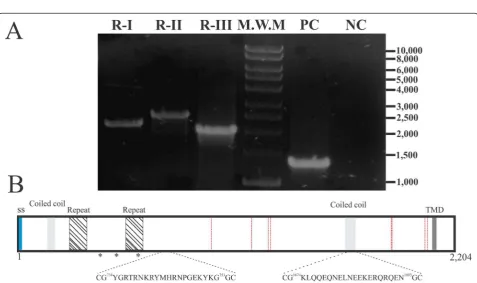
PvRON2 encoding sequence confirmed the transcript’s presence in P. vivax VCG-1 strain parasites during the blood stage (Figure 2A). This agreed with the results obtained from P. vivax transcriptome analysis which showed that PvRON2 is transcribed between hour 35 (TP7) and 40 (TP8) in the intraerythrocytic cycle, similar to other proteins involved in invasion such as
PvMSP-1 [5]. When pvron2 gene gDNA and cDNA sequences were compared, obtained from the three amplification products overlapping by around 100 bp, both are identical, thus confirming that this gene con-sisted of a single 6,615bp exon. Recombinant clone sequences were analysed using CLC DNA Workbench (CLC bio) and the consensus sequence was deposited in the GenBank with the ID: HQ825321.
Two substitutions and the insertion of a nucleotide triplet were found when VCG-1 strain and Sal-1 refer-ence strain nucleotide sequrefer-ences were compared. Substi-tutions in positions 1,241 and 1,814 produced a change from valine to glycine (V414G) and histidine to proline
Arévalo-Pinzónet al.Malaria Journal2011,10:60 http://www.malariajournal.com/content/10/1/60
Figure 1Schematic representation ofron2chromosomal localization (grey) and adjacent ORFs (white) inPlasmodium falciparum, vivax, knowlesi, chabaudi, bergheiandyoelii. The accession numbers for each ORF in PlasmoDB are shown. The length of the represented chromosomal fragment and its localization within the genome in each species is shown on the right. Identity and similarity values at the amino acid level betweenP. falciparumandP. vivax, as well as betweenP. vivaxandP. knowlesiare pointed out.
[image:6.595.59.537.381.664.2](H605P), respectively. The addition of a glutamic acid (E)-encoding triplet (AAG) was found in position 1,487-1,489nt (residue 496). Interestingly, these changes were located in an interspecies variable region, spanning around residues 50 to 850 [21], suggesting that this region might be subjected to selective immune pressure. Bioinformatics analysis ofPvRON2 protein sequence ThePvRON2 complete protein sequence in the VCG-1 strain consists of 2,204 residues having a putative hydro-phobic signal sequence within its first 17 amino acids and a transmembrane domain (TMD) towards the C-terminus between residues 2,087-2,109. The RON2 protein has similar lengths in other species, ranging from 1,990 amino acids in P. chabaudi to 2,232 in
P. yoelii, as well as a similar domain organization, including a signal peptide, a TMD and containing eight conserved cysteines (Figure 2B) probably related to common protein structural features.
PvRON2 contains two coiled coil a-helical motifs
(residues 145-184 and 1,651-1,703) (Figure 2B), charac-terized by seven amino acid repeats (abcdefg) n with
hydrophobic residues located in positions a andd, and residues (generally polar) in the remaining sites which have been involved in protein-protein interactions. These coiled coil motifs have been identified in several important P. falciparum vaccine candidates such as LSA-1, MSP-3, MSP6 and MSP11 [47,48]; such motifs are recognized by naturally-acquired antibodies and are also immunogenic in mice [49]. Interestingly, pep-tide 35520 (containing part of the second coiled coil
a-helical motif) has induced an antibody response in
rabbits. Additionally, PvRON2 has two tandem repeat (TR) regions located within the interspecies variable sequence. Eight 11 amino acid long repeats (GADGK-GYGPYG) are located between residues 258 and 345, and the second tandem (GGYGNGGHE) is located between residues 542-628, having 9 repeats (Figure 2B). TRs were mostly found in RON2 sequences from different Plasmodium species and, even though the DNA and protein sequences from the repeats varied widely amongst RON2 proteins, there was close to 40% similarity between PvRON2 and PkRON2 repeats. Such similarity between Pv and Pk was in agreement with a close evolutionary relationship between simian malarial parasites and the human P. vivax parasite. TRs have been identified in different malarial antigens such as the P. falciparum circumsporozoite protein (CSP), the ring-infected erythrocyte surface antigen (PfRESA) and the knob-associated histidine rich pro-tein (KAHRP). These TRs could downregulate antibody isotype maturation and high-affinity antibody produc-tion in the specific case of malaria by acting as B-cell superantigens, predominantly inducing a polyclonal
thymus-independent humoral response. T-independent antibody responses are usually short lived, predomi-nantly composed of IgM and IgG3 and have low affi-nity, suggesting that these repeats are used during invasion to distract the immune response, acting as decoys or“smokescreens”, thereby masking the critical epitopes [50,51]. Given all the above-mentioned data, it would be important to assess the functional and immunological implications of these repeat regions in
PvRON2.
PvRON2 is expressed inP. vivaxschizonts
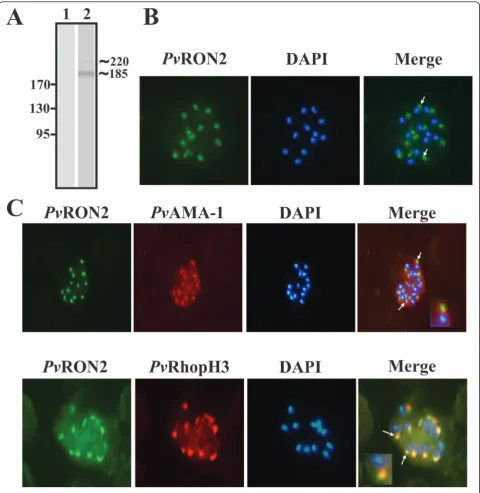
Polyclonal antibodies were produced against the protein by immunizing rabbits with polymeric PvRON2-derived peptides to assessPvRON2 expression and cellular loca-lization in P. vivax schizonts. Polyclonal antibodies detected two bands at around ~220 kDa and ~185 kDa (Figure 3A), suggesting that PvRON2 can undergo pro-teolytic processing, by contrast with that reported for
PfRON2 [21]. The predicted size for PvRON2 (240 kDa) is slightly larger than that obtained from mobility on SDS-PAGE (220 kDa). Interestingly, similar behaviour has been described for TgRON2, suggesting anomalous migration [52].
In many cases, it has been found that rhoptry proteins are initially synthesized as pre-proteins and maturate during transport [53]. It could be hypothesized that such cleavage could serve to activatePvRON2 by reveal-ing a functional domain or releasreveal-ing the protein of para-site surface or RBC membrane to allow successful invasion. Additionally, pulse-chase analysis has shown thatTgRON2 is expressed as a pro-protein (~150 kDa) which is cleaved to produce a ~120 kDa mature protein. Even though it is not known which specific proteases act in TgRON2 maturation, it has been suggested that this protein can be cleaved by subtilisin 2 (TgSUB2) [18]. Studies carried out with important P. falciparum
adhesins located on merozoite membrane, micronemes or rhoptries, such as AMA-1, merozoite surface protein (MSP), EBL, RBL and thrombospondin-related anon-ymous protein (TRAP) families, contain a putative rhomboid cleavage site within their TMD and putative SUB-2 cleavage sites. COS-7 cell system studies have revealed that A1427 residue substitution in the EBA-175 protein has prevented PfROM4-mediated shedding, avoiding the release of EBA-175 from the merozoite sur-face [54]. Similarly, substituting the GA motif (residues which destabilize a-helices) closest to the TMD
extra-cellular end abolished specific cleavage (also predicted as the site required for rhomboid recognition). Interest-ingly, PvRON2 sequence analysis revealed a putative rhomboid cleavage site between 2,101-2,104; this agreed with the fact that sera recognized two fragments from the protein, but additional studies are needed for
Arévalo-Pinzónet al.Malaria Journal2011,10:60 http://www.malariajournal.com/content/10/1/60
assessing the importance of such processing, as well as the identity of the responsible protease.
Immunofluorescence analysis of P. vivax schizonts showed that PvRON2 had a dotted pattern typical of apical organelles, such as rhoptries and micronemes (Figure 3B). To examine their localization in detail, dual
[image:8.595.58.539.88.582.2]labelling was performed using mouse polyclonal antibo-dies againstPvAMA-1 andPvRhopH3. It was found that there was no co-localization between thePvAMA-1 pro-tein (microneme marker) andPvRON2 (Figure 3C), sug-gesting that PvRON2 is not present in micronemes. By contrast, there was a small area of central localization
betweenPvRhopH3 (rhoptry bulb marker) andPvRON2 suggesting that even thoughPvRON2 is located in the rhoptries, it is not located in the rhoptry bulb, probably forming part of the rhoptry neck, as has been described forPfRON2 and TgRON2 proteins [18,21]. Recently, a study that characterized the timing of expression and subcellular location ofPlasmodiumhomologues in some
T. gondiirhoptry proteins showed that P. bergheiRON2 protein is located in merozoite and sporozoite rhoptries, and presents a timing of expression comparable to the one found in RAP2/3. These data strongly suggest an essential role of RON2 protein during the invasion and infection establishment in sporozoites [55].
Conclusions
As has been shown in the present study, RON2 is a highly conserved protein among differentPlasmodium
species. pvron2gene consists of a single exon and is transcribed and expressed in schizonts rhoptries at the end of the erythrocytic cycle. Its similarity toPfRON2 (which forms a complex with PfAMA-1), as well as its localization and expression time during the schizont stage suggest a similar role in host cell invasion for
PvRON2, as that attributed toPfRON2.
Acknowledgements
We would like to thank Luisa Fernanda Zuleta and Oswaldo Escobar for their technical support, Jason Garry for reviewing this manuscript and especially to Prof. Manuel Elkin Patarroyo for his invaluable comments and suggestions.
Author details
1
Fundación Instituto de Inmunología de Colombia FIDIC, Carrera 50 # 26-20, Bogotá, Colombia.2Universidad del Rosario, Carrera 24 # 63C-69, Bogotá,
Colombia.3Pontificia Universidad Javeriana, Carrera 7 # 40-62, Bogotá,
Colombia.
Authors’contributions
GAP carried out bioinformatics analyses, molecular biology assays and wrote the initial manuscript. HC synthesized and purified the peptides used for rabbit and mice immunizations and analysed data. LCP carried out immunoassays. MAP evaluated and coordinated assays, and revised the final manuscript. All authors read and approved the final manuscript.
Competing interests
The authors declare that they have no competing interests.
Received: 12 February 2011 Accepted: 14 March 2011 Published: 14 March 2011
References
1. Price RN, Tjitra E, Guerra CA, Yeung S, White NJ, Anstey NM:Vivax malaria: neglected and not benign.Am J Trop Med Hyg2007,77:79-87. 2. Greenwood BM, Fidock DA, Kyle DE, Kappe SH, Alonso PL, Collins FH,
Duffy PE:Malaria: progress, perils, and prospects for eradication.J Clin Invest2008,118:1266-1276.
3. Krotoski WA, Garnham PC, Cogswell FB, Collins WE, Bray RS, Gwasz RW, Killick-Kendrick R, Wolf RH, Sinden R, Hollingdale M, Lowrie RC Jr, Koontz LC, Stanfill PS:Observations on early and late post-sporozoite tissue stages in primate malaria. IV. Pre-erythrocytic schizonts and/or hypnozoites of Chesson and North Korean strains ofPlasmodium vivax
in the chimpanzee.Am J Trop Med Hyg1986,35:263-274.
4. Baird JK:Resistance to therapies for infection byPlasmodium vivax.Clin Microbiol Rev2009,22:508-534.
5. Bozdech Z, Mok S, Hu G, Imwong M, Jaidee A, Russell B, Ginsburg H, Nosten F, Day NP, White NJ, Carlton JM, Preiser PR:The transcriptome of
Plasmodium vivaxreveals divergence and diversity of transcriptional regulation in malaria parasites.Proc Natl Acad Sci USA2008,
105:16290-16295.
6. Cowman AF, Crabb BS:Invasion of red blood cells by malaria parasites.
Cell2006,124:755-766.
7. Blackman MJ, Bannister LH:Apical organelles of Apicomplexa: biology and isolation by subcellular fractionation.Mol Biochem Parasitol2001,
117:11-25.
8. Preiser P, Kaviratne M, Khan S, Bannister L, Jarra W:The apical organelles of malaria merozoites: host cell selection, invasion, host immunity and immune evasion.Microbes Infect2000,2:1461-1477.
9. Carruthers VB, Sibley LD:Sequential protein secretion from three distinct organelles ofToxoplasma gondiiaccompanies invasion of human fibroblasts.Eur J Cell Biol1997,73:114-123.
10. Aikawa M, Miller LH, Johnson J, Rabbege J:Erythrocyte entry by malarial parasites. A moving junction between erythrocyte and parasite.J Cell Biol1978,77:72-82.
11. Miller LH, Aikawa M, Johnson JG, Shiroishi T:Interaction between cytochalasin B-treated malarial parasites and erythrocytes. Attachment and junction formation.J Exp Med1979,149:172-184.
12. Ward GE, Miller LH, Dvorak JA:The origin of parasitophorous vacuole membrane lipids in malaria-infected erythrocytes.J Cell Sci1993,106(Pt 1):237-248.
13. Baum J, Chen L, Healer J, Lopaticki S, Boyle M, Triglia T, Ehlgen F, Ralph SA, Beeson JG, Cowman AF:Reticulocyte-binding protein homologue 5 - an essential adhesin involved in invasion of human erythrocytes by
Plasmodium falciparum.Int J Parasitol2009,39:371-380.
14. Duraisingh MT, Triglia T, Ralph SA, Rayner JC, Barnwell JW, McFadden GI, Cowman AF:Phenotypic variation ofPlasmodium falciparummerozoite proteins directs receptor targeting for invasion of human erythrocytes.
EMBO J2003,22:1047-1057.
15. Klotz FW, Hadley TJ, Aikawa M, Leech J, Howard RJ, Miller LH:A 60-kDa
Plasmodium falciparumprotein at the moving junction formed between merozoite and erythrocyte during invasion.Mol Biochem Parasitol1989,
36:177-185.
16. Hehl AB, Lekutis C, Grigg ME, Bradley PJ, Dubremetz JF, Ortega-Barria E, Boothroyd JC:Toxoplasma gondiihomologue of plasmodium apical membrane antigen 1 is involved in invasion of host cells.Infect Immun 2000,68:7078-7086.
17. Triglia T, Healer J, Caruana SR, Hodder AN, Anders RF, Crabb BS, Cowman AF:Apical membrane antigen 1 plays a central role in erythrocyte invasion byPlasmodiumspecies.Mol Microbiol2000,
38:706-718.
18. Besteiro S, Michelin A, Poncet J, Dubremetz JF, Lebrun M:Export of a
Toxoplasma gondiirhoptry neck protein complex at the host cell membrane to form the moving junction during invasion.PLoS Pathog 2009,5:e1000309.
19. Lamarque M, Besteiro S, Papoin J, Roques M, Vulliez-Le Normand B, Morlon-Guyot J, Dubremetz JF, Fauquenoy S, Tomavo S, Faber BW, Kocken CH, Thomas AW, Boulanger MJ, Bentley GA, Lebrun M:The RON2-AMA1 interaction is a critical step in moving junction-dependent invasion by Apicomplexan parasites.PLoS Pathog2011,7:e1001276.
20. Tyler JS, Boothroyd JC:The C-Terminus ofToxoplasmaRON2 provides the crucial link between AMA1 and the host-associated invasion complex.
PLoS Pathog2011,7:e1001282.
21. Cao J, Kaneko O, Thongkukiatkul A, Tachibana M, Otsuki H, Gao Q, Tsuboi T, Torii M:Rhoptry neck protein RON2 forms a complex with microneme protein AMA1 inPlasmodium falciparummerozoites.Parasitol Int2009,
58:29-35.
22. Morahan BJ, Sallmann GB, Huestis R, Dubljevic V, Waller KL:Plasmodium falciparum: genetic and immunogenic characterisation of the rhoptry neck protein PfRON4.Exp Parasitol2009,122:280-288.
23. Curtidor H, Patino LC, Arevalo-Pinzon G, Patarroyo ME, Patarroyo MA:
Identification of thePlasmodium falciparumrhoptry neck protein 5 (PfRON5).Gene2011,474:22-28.
24. Alexander DL, Arastu-Kapur S, Dubremetz JF, Boothroyd JC:Plasmodium falciparumAMA1 binds a rhoptry neck protein homologous to TgRON4, Arévalo-Pinzónet al.Malaria Journal2011,10:60
http://www.malariajournal.com/content/10/1/60
a component of the moving junction inToxoplasma gondii.Eukaryot Cell 2006,5:1169-1173.
25. Collins CR, Withers-Martinez C, Hackett F, Blackman MJ:An inhibitory antibody blocks interactions between components of the malarial invasion machinery.PLoS Pathog2009,5:e1000273.
26. Collins CR, Withers-Martinez C, Bentley GA, Batchelor AH, Thomas AW, Blackman MJ:Fine mapping of an epitope recognized by an invasion-inhibitory monoclonal antibody on the malaria vaccine candidate apical membrane antigen 1.J Biol Chem2007,282:7431-7441.
27. Treeck M, Tamborrini M, Daubenberger CA, Gilberger TW, Voss TS:Caught in action: mechanistic insights into antibody-mediated inhibition of
Plasmodiummerozoite invasion.Trends Parasitol2009,25:494-497. 28. Harris KS, Casey JL, Coley AM, Masciantonio R, Sabo JK, Keizer DW, Lee EF,
McMahon A, Norton RS, Anders RF, Foley M:Binding hot spot for invasion inhibitory molecules onPlasmodium falciparumapical membrane antigen 1.Infect Immun2005,73:6981-6989.
29. Richard D, MacRaild CA, Riglar DT, Chan JA, Foley M, Baum J, Ralph SA, Norton RS, Cowman AF:Interaction betweenPlasmodium falciparum
apical membrane antigen 1 and the rhoptry neck protein complex defines a key step in the erythrocyte invasion process of malaria parasites.J Biol Chem2010,285:14815-14822.
30. PlasmoDB: Plasmodium genomics resource.[http://www.plasmodb.org]. 31. Wellcome trust Sanger Institute.[http://www.sanger.ac.uk].
32. Combet C, Blanchet C, Geourjon C, Deleage G:NPS@: network protein sequence analysis.Trends Biochem Sci2000,25:147-150.
33. Nielsen H, Engelbrecht J, Brunak S, von Heijne G:Identification of prokaryotic and eukaryotic signal peptides and prediction of their cleavage sites.Protein Eng1997,10:1-6.
34. Pierleoni A, Martelli PL, Casadio R:PredGPI: a GPI-anchor predictor.BMC Bioinformatics2008,9:392.
35. Linding R, Russell RB, Neduva V, Gibson TJ:GlobPlot: Exploring protein sequences for globularity and disorder.Nucleic Acids Res2003,
31:3701-3708.
36. Letunic I, Goodstadt L, Dickens NJ, Doerks T, Schultz J, Mott R, Ciccarelli F, Copley RR, Ponting CP, Bork P:Recent improvements to the SMART domain-based sequence annotation resource.Nucleic Acids Res2002,
30:242-244.
37. Newman AM, Cooper JB:XSTREAM: a practical algorithm for identification and architecture modeling of tandem repeats in protein sequences.BMC Bioinformatics2007,8:382.
38. Larsen JE, Lund O, Nielsen M:Improved method for predicting linear B-cell epitopes.Immunome Res2006,2:2.
39. Geourjon C, Deleage G, Roux B:ANTHEPROT: an interactive graphics software for analyzing protein structures from sequences.J Mol Graph 1991,9:188-190, 167.
40. Pico de Coana Y, Rodriguez J, Guerrero E, Barrero C, Rodriguez R, Mendoza M, Patarroyo MA:A highly infectivePlasmodium vivaxstrain adapted toAotusmonkeys: quantitative haematological and molecular determinations useful forP. vivaxmalaria vaccine development.Vaccine 2003,21:3930-3937.
41. Andrysiak PM, Collins WE, Campbell GH:Concentration ofPlasmodium ovale- andPlasmodium vivax-infected erythrocytes from nonhuman primate blood using Percoll gradients.Am J Trop Med Hyg1986,
35:251-254.
42. Chomczynski P:A reagent for the single-step simultaneous isolation of RNA, DNA and proteins from cell and tissue samples.Biotechniques1993,
15:532-534, 536-537.
43. Merrifield RB:Solid phase peptide synthesis. I. The synthesis of a tetrapeptide.Journal of American Chemical Society1963,85:2149-2154. 44. Yandar N, Pastorin G, Prato M, Bianco A, Patarroyo ME, Manuel Lozano J:
Immunological profile of aPlasmodium vivaxAMA-1 N-terminus peptide-carbon nanotube conjugate in an infectedPlasmodium berghei
mouse model.Vaccine2008,26:5864-5873.
45. Mongui A, Perez-Leal O, Rojas-Caraballo J, Angel DI, Cortes J, Patarroyo MA:
Identifying and characterising thePlasmodium falciparumRhopH3
Plasmodium vivaxhomologue.Biochem Biophys Res Commun2007,
358:861-866.
46. Bozdech Z, Llinas M, Pulliam BL, Wong ED, Zhu J, DeRisi JL:The transcriptome of the intraerythrocytic developmental cycle of
Plasmodium falciparum.PLoS Biol2003,1:E5.
47. Fidock DA, Gras-Masse H, Lepers JP, Brahimi K, Benmohamed L, Mellouk S, Guerin-Marchand C, Londono A, Raharimalala L, Meis JF, Langsley G, Roussilhon C, Tartar A, Druilhe P:Plasmodium falciparumliver stage antigen-1 is well conserved and contains potent B and T cell determinants.J Immunol1994,153:190-204.
48. Gondeau C, Corradin G, Heitz F, Le Peuch C, Balbo A, Schuck P, Kajava AV:
The C-terminal domain ofPlasmodium falciparummerozoite surface protein 3 self-assembles into alpha-helical coiled coil tetramer.Mol Biochem Parasitol2009,165:153-161.
49. Villard V, Agak GW, Frank G, Jafarshad A, Servis C, Nebie I, Sirima SB, Felger I, Arevalo-Herrera M, Herrera S, Heitz F, Backer V, Druilhe P, Kajava AV, Corradin G:Rapid identification of malaria vaccine candidates based on alpha-helical coiled coil protein motif.PLoS One2007,2:e645. 50. Kemp DJ, Coppel RL, Anders RF:Repetitive proteins and genes of malaria.
Annu Rev Microbiol1987,41:181-208.
51. Ramasamy R:Molecular basis for evasion of host immunity and pathogenesis in malaria.Biochim Biophys Acta1998,1406:10-27. 52. Alexander DL, Mital J, Ward GE, Bradley P, Boothroyd JC:Identification of
the moving junction complex ofToxoplasma gondii: a collaboration between distinct secretory organelles.PLoS Pathog2005,1:e17. 53. Sadak A, Taghy Z, Fortier B, Dubremetz JF:Characterization of a family of
rhoptry proteins ofToxoplasma gondii.Mol Biochem Parasitol1988,
29:203-211.
54. O’Donnell RA, Hackett F, Howell SA, Treeck M, Struck N, Krnajski Z, Withers-Martinez C, Gilberger TW, Blackman MJ:Intramembrane proteolysis mediates shedding of a key adhesin during erythrocyte invasion by the malaria parasite.J Cell Biol2006,174:1023-1033.
55. Tufet-Bayona M, Janse CJ, Khan SM, Waters AP, Sinden RE, Franke-Fayard B:
Localisation and timing of expression of putativePlasmodium berghei
rhoptry proteins in merozoites and sporozoites.Mol Biochem Parasitol 2009,166:22-31.
doi:10.1186/1475-2875-10-60
Cite this article as:Arévalo-Pinzónet al.:PvRON2, a newPlasmodium vivaxrhoptry neck antigen.Malaria Journal201110:60.
Submit your next manuscript to BioMed Central and take full advantage of:
• Convenient online submission
• Thorough peer review
• No space constraints or color figure charges
• Immediate publication on acceptance
• Inclusion in PubMed, CAS, Scopus and Google Scholar
• Research which is freely available for redistribution