Alcoholic liver disease presents at
advanced stage and progresses faster compared to
non-alcoholic fatty liver disease
Mohamed Shoreibah,* Evan Raff,** Joseph Bloomer,* Donny Kakati,* Khalid Rasheed,*** Yong-Fang Kuo,**** Ashwani K. Singal*
* Division of Gastroenterology and Hepatology, UAB, Birmingham, AL, USA. ** Department of Internal Medicine, UAB, Birmingham, AL, USA. *** Department of Internal Medicine, UAB Montgomery Program, Montgomery, AL, USA. **** Department of Biostatistics, UTMB, Galveston, TX, USA.
A B S T R A C T A B S T R A C T A B S T R A C T A B S T R A C T A B S T R A C T
Background and objective. Background and objective.Background and objective. Background and objective.
Background and objective. Steatohepatitis is a common cause of liver disease due to alcohol (ALD) or non-alcoholic fatty liver disease (NAFLD). We performed this study to compare natural history of ALD and NAFLD. Material and methods.Material and methods.Material and methods.Material and methods.Material and methods. Retrospecti-ve analysis of ALD or NAFLD patients managed at our center (2007-2011). ALD diagnosed by excluding other liRetrospecti-ver diseases (except HCV) and alcohol abuse of > 40 g/d in women and > 60 g/d in men for > 5 years. NAFLD diagnosed by excluding other liver disea-ses and a history of alcohol use of < 10 g/d. Cirrhosis was diagnosed using biopsy for uncertain clinical diagnosis. Results.Results.Results.Results.Results. Com-pared to patients with NAFLD (n = 365; mean age 50 yrs; 43% males; 53% diabetic), ALD patients (n = 206; mean age 51 yrs; 68% males; 24% diabetic) presented more often with cirrhosis or complications(46vs. 12%; P< 0.0001) with a higher MELD score (13 ± 7 vs. 8 ± 8; P<0.0001). On logistic regression, ALD diagnosis was associated with presence of cirrhosis by over 4-fold (4.1 [1.8-9.1]) even after excluding 23 patients with concomitant HCV. Over median follow up of about 3 and 4 yrs among ALD and NAFLD pa-tients respectively, ALD papa-tients more frequently developed cirrhosis or its complications including HCC with worse transplant free survival (90 vs. 95%; P = 0.038). Conclusions.Conclusions.Conclusions.Conclusions.Conclusions. Compared to NAFLD, ALD patients present at an advanced stage of liver disease with a faster progression on follow-up. Prospective multicenter studies are needed to identify potential barriers to early referral of ALD patients as basis for development of strategies to improve outcome of patients with ALD.
Key words. Key words.Key words. Key words.
Key words. Steatohepatitis. Cirrhosis. HCC. NAFLD.
March-April, Vol. 15 No. 2, 2016: 183-189
INTRODUCTION
Alcoholic liver disease (ALD) related to alcohol abuse and non-alcoholic fatty liver disease (NAFLD) related to metabolic syndrome,are leading causes of liver cirrhosis and indications for liver transplantation after hepatitis C virus (HCV) infection.1,2 Both these diseases share the
liv-er disease pathophysiology with seemingly similar histo-logic finding of steatohepatitis. However, the clinical phenotype and risk factors of these diseases are different.3-5
The spectrum of liver disease from ALD or NAFLD-may range from fatty liver, asymptomatic elevation of liver enzymes, cirrhosis with its complications, and
hepatocellular carcinoma.5,6 The worldwide mortality
from alcoholic liver disease (ALD) is about 4% of
mortality and about 5% of disability.7 With rising
epi-demic of obesity, about 12-30% of NAFLD patients may have non-alcoholic steatohepatitis (NASH) with a poten-tial for development of cirrhosis in about 25% of these patients.3,8-10
Early referral with management and control of underly-ing risk factors(alcohol abstinence for ALD and obesity with metabolic syndrome for NAFLD) is crucial in
dis-ease prevention and improve outcomes.3,5,11 However, data
are scant comparing ALD and NAFLD patients for initial presentation and natural history on follow-up. To test our hypothesis that ALD and NAFLD differ in presentation and natural history, we performed this retrospective analy-sis of patients with steatohepatitis related liver disease seen and managed at our center.
The Official Journal of the Mexican Association of Hepatology, the Latin-American Association for Study of the Liver and
the Canadian Association for the Study of the Liver
Manuscript received: Manuscript received:Manuscript received:
Manuscript received:Manuscript received: February 22, 2015. Manuscript accepted:Manuscript accepted:Manuscript accepted:Manuscript accepted:Manuscript accepted: May 21, 2015.
MATERIAL AND METHODS
Study population
The study was approved by the Institutional Review Board at our center. Patients seen in the liver clinic during at a single tertiary referral center (2007-2011) with the di-agnosis of ALD or NAFLD were retrospectively analyzed. Of 607 patients in our database seen for a diagnosis of ALD (ICD-09 code 571.0-571.3) or NAFLD (ICD-09 code 571.5, 571.8, 571.9), 36 obese patients with metabolic syn-drome and consuming alcohol in excess of 10 g/d were ex-cluded from further analysis.3,12
Definitions
• Alcoholic liver disease. Exclusion of other liver dis-eases (except HCV) and documenting history of alco-hol abuse with minimum intake of > 40 g/d in women and > 60 g/d in men for over 5 years.7,13
• Non-alcoholic fatty liver disease. Presence of fatty liver on liver imaging and/or elevated liver enzymes along with exclusion of other liver diseases and docu-mented alcohol use of < 10 g/d.3,12 Patients undergoing
liver biopsy and showing features of steatohepatitis were diagnosed with NASH.
• Alcohol use.Defined in g/d as calculated from average number of drinks consumed per day in mL. One drink defined as 12 ounces of beer, 5 ounces of wine, and 1.25 ounces of hard liquor was considered equivalent to 15 g of pure alcohol.7
Data extraction at presentation
Medical charts of 571 patients (365 NAFLD) were re-viewed for patient demographics (age, gender and race, body mass index or BMI); dates of onset of symptoms and of diagnosis; comorbidities (diabetes, hypertension, dysli-pidemia, cholecystectomy); metabolic syndrome; and alcohol intake in g/d. BMI was calculated using patient’s height and weight at the time of presentation was classi-fied based on WHO criteria as normal (BMI 19 - 24.9), overweight (25 - 29.9), mild obesity (30 - 34.9), moderate
obesity (35 - 39.9), and morbid obesity (≥ 40).
Cholecys-tectomy was defined with history of cholecysCholecys-tectomy and/ or absent gall bladder on ultrasound examination of the ab-domen. Metabolic syndrome was defined with presence of 3 or more of the following comorbidities: diabetes (patient being on medications or fasting blood sugar level >110 mg/dL), hypertension (patient being on antihyper-tensive medications or BP > 130/85 mm Hg), abdominal obesity (waist circumference > 40 inches in men or > 36 inches in women), low HDL (< 45 mg/dL in men or
< 55 mg/dL in women), elevated triglycerides (>150
mg/dL).14 As body mass index (BMI) is linearly
associ-ated with increasing prevalence of metabolic syndrome,
we used obesity (BMI ≥ 30) as surrogate for waist
circum-ference in defining the metabolic syndrome.15 Data were
also recorded for laboratory values: liver chemistry with model for end-stage disease (MELD) score; endoscopic findings: portal hypertensive gastropathy and esophageal varices; and liver histology: steatosis, lobular inflamma-tion, hepatocyte ballooning, and fibrosis. Steatosis was graded based on proportion of hepatocytes containing fat as grade 0 (up to 5%); grade I (5 to < 33%); grade II (33 to < 66%); and grade III (> 66%). Similarly, lobular inflam-mation and hepatocyte ballooning were graded as none, mild to moderate, or severe. The stages of fibrosis were recorded as follows:16
• Stage 0: no fibrosis. • Stage 1: portal fibrosis. • Stage 2: peri-portal fibrosis. • Stage 3: bridging fibrosis. • Stage 4: cirrhosis.
NAFLD Activity Scorewas calculated using respective scores for steatosis, lobular inflammation, and hepatocyte
ballooning.17 In the absence of liver biopsy, ALD and
NAFLD were diagnosed based on the clinical criteria detailed in the definitions section and exclusion of other liver diseases.
Study outcomes
• Disease stage at presentation. Diagnosis at presen-tation was stratified based on presence or absence of cirrhosis or its complications. Cirrhosis was defined using clinical, hematological, and imaging criteria and/ or biopsy when available.18
• Development of cirrhosis or its complications.
Follow-up information was collected for development of cirrhosis and liver disease complications (ascites, hepatic encephalopathy, variceal bleeding, or HCC). Patients diagnosed with cirrhosis at or within first 6 months of their presentation were excluded in order to consider for time gap in coding for cirrhosis diagnosis. Similarly, for assessing development of complications of cirrhosis, patients diagnosed with respective com-plication at or within 1 month of their presentation were excluded. Cirrhosis was diagnosed based on clin-ical or imaging evidence(ultrasonography, computed tomography, or magnetic resonance imaging) or biopsy for uncertain clinical diagnosis. HCC was diagnosed based on AASLD guidelines and criteria using CT/
• Patient survival.Charts were reviewed for the sur-vival status and confirmed with National Death Index using the social security number.
Time to development of specific outcome was calcu-lated from date of its occurrence and date of diagnosis of respective disease (ALD or NAFLD).
Statistical analyses
Baseline characteristics were compared for patients
with ALD or with NAFLD using χ2 and Student’s t tests
for categorical and continuous variables respectively. Lo-gistic regression analysis was used to assess whether liver
disease etiology (ALD vs. NAFLD) was predictive of
cir-rhosis presentation. Factors different between the two groups and clinically relevant were entered into the mod-el. Cumulative curves were generated comparing ALD and NAFLD for development of outcomes (cirrhosis, com-plications of liver disease, and patient survival) after ad-justing for age, gender, and MELD score from stratified cox proportional hazard models. Patients lost to follow-up and those without the event at the time of their last fol-low-up were censored. P values < 0.05 were considered significant. Analyses were performed using the Statistical Analyses Software (SAS Institute, Cary, NC).
RESULTS
Comparison at initial presentation: ALD vs. NASH.
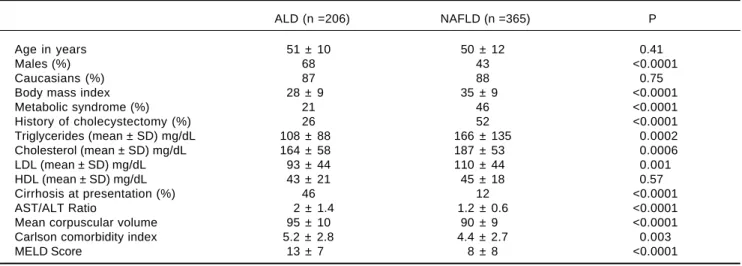
• Baseline characteristics. On analysis of 571 pa-tients, patients with NAFLD (n = 365) compared to
those with ALD differed for being older, females, and higher BMI (Table 1). About 94% of NAFLD patients were either overweight or obese compared to 62% of ALD patients (P < 0.0001). Prevalence of metabolic syndrome was higher among NAFLD as compared to ALD patients with a higher proportion
of diabetes mellitus (53 vs. 24%, P < 0.0001) and
hypertension (60 vs. 49%, P = 0.011). Prevalence of
cholecystectomy at the time of presentation was 2 fold higher among NAFLD as compared to ALD
pa-tients (52 vs. 26%, P < 0.0001). A total of 23 (12
ALD) patients had concomitant HCV infection. Compared to ALD, NAFLD patients had higher lev-els of serum triglycerides and total cholesterol with no differences on serum HDL levels (Table 1). On the other hand, ALD patients as compared to NAFLD had higher AST/ALT ratio and mean cor-puscular volume (MCV) (Table 1).
• Disease status at initial presentation. Patients with ALD compared to NAFLD were more likely to have cirrhosis at initial presentation, as evaluated on imaging (ultrasound, computerized tomography, or magnetic resonance imaging) or biopsy when availa-ble, with a higher comorbidity index and MELD score (Table 1). Proportion of patients at the time of initial presentation were higher in ALD patients as
compared to NAFLD for ascites (36 vs. 10%; P <
0.0001), hepatic encephalopathy (7 vs. 3%; P = 0.03),
and variceal hemorrhage (10 vs. 4%; P = 0.004).On
lo-gistic regression analysis, diagnosis of ALD was asso-ciated with the presence of cirrhosis by over three fold (3.3 [1.3 - 8.2]). Other associations of cirrhosis at presentation were presence of metabolic syndrome and AST/ALT ratio (Table 2). Data remained
un-Table 1. Baseline characteristics at presentation comparing alcoholic liver disease (ALD) patients with non-alcoholic fatty liver disease (NAFLD).
ALD (n =206) NAFLD (n =365) P
Age in years 51 ± 10 50 ± 12 0.41
Males (%) 68 43 <0.0001
Caucasians (%) 87 88 0.75
Body mass index 28 ± 9 35 ± 9 <0.0001
Metabolic syndrome (%) 21 46 <0.0001
History of cholecystectomy (%) 26 52 <0.0001
Triglycerides (mean ± SD) mg/dL 108 ± 88 166 ± 135 0.0002 Cholesterol (mean ± SD) mg/dL 164 ± 58 187 ± 53 0.0006
LDL (mean ± SD) mg/dL 93 ± 44 110 ± 44 0.001
HDL (mean ± SD) mg/dL 43 ± 21 45 ± 18 0.57
Cirrhosis at presentation (%) 46 12 <0.0001
AST/ALT Ratio 2 ± 1.4 1.2 ± 0.6 <0.0001
Mean corpuscular volume 95 ± 10 90 ± 9 <0.0001 Carlson comorbidity index 5.2 ± 2.8 4.4 ± 2.7 0.003
MELD Score 13 ± 7 8 ± 8 <0.0001
changed after excluding 23 patients (12 ALD) with concomitant HCV infection.
• Endoscopic findings. Endoscopic findings in 269 (137 NAFLD) showed higher prevalence in patients with ALD compared to NAFLD for portal
hyperten-sive gastropathy (53 vs. 33%; P = 0.007) and
esopha-geal varices (75 vs. 55%; P = 0.004). Prevalence of large varices was similar between ALD and NAFLD patients (6.8 vs. 8%; P = 0.36).
• Histological findings. Histological data was available on 167 patients (136 NAFLD). These patients com-pared to 404 not subjected to liver biopsy differed for
higher proportion with NASH diagnosis (81 vs. 57%,
P < 0.0001) and history of cholecystectomy (49 vs. 29%, P = 0.0001). A higher proportion of patients with NAFLD compared to ALD patients had steatosis (75
vs. 33%, P < 0.0001). Steatosis prevalence was higher
for grades I - II (51 vs. 19%, P < 0.0001) and
simi-lar for grade III (16 vs. 13%, P = 0.87). NAFLD
pa-tients compared to ALD had higher prevalence of
lobular inflammation (70 vs. 29%, P < 0.0001), and
hepatocyte ballooning (49 vs. 13%, P = 0.0002) (Figure
1) with a higher NAFLD activity score (3.7 ± 1.5 vs.
2.8 ± 1.9; P = 0.045). Prevalence of fibrosis was
simi-lar between NAFLD and ALD patients (77 vs. 71%; P
= 0.34). However, a higher proportion of ALD pa-tients as compared to NAFLD had advanced fibrosis or cirrhosis (55 vs. 48%; P = 0.022) (Figure 1).
Comparison of disease progression: ALDvs. NAFLD
• Development of cirrhosis and its complications.
Patients were followed for up to 10 years from the time of disease diagnosis for development of cirrhosis or its complications. Cumulative curves were generated af-ter adjusting for MELD score, age, and gender using cox proportional hazard regression model.
In a cohort of 268 patients (201 NAFLD) without cir-rhosis at or within 6 months of presentation, cumula-tive probability of cirrhosis development was higher in ALD patients (67 vs. 34%; P < 0.0001) (Figure 2A). A total of 33 cirrhotic (20 ALD) developed HCC with
higher cumulative probability in ALD patients (22 vs.
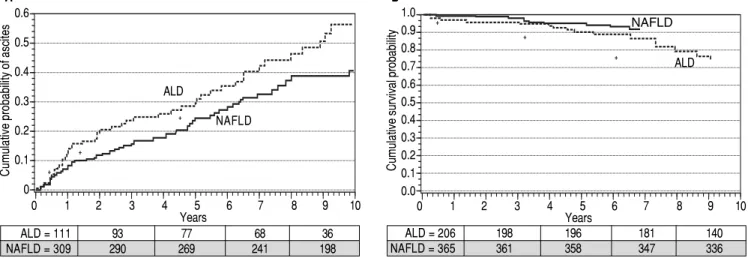
16%; P < 0.0001) at 10 years of follow-up (Figure 2B). In a cohort of 420 patients without ascites at or within a month of presentation, 113 (51 ALD) developed as-cites. Cumulative probability of ascites was higher
among ALD patients (49 vs. 24%; P = 0.003) at 10 years
of follow-up (Figure 3A). A total of 122 (55 ALD) and 43 (20 ALD) patients developed hepatic encephalopa-thy and variceal bleeding respectively in out of 511 patients without hepatic encephalopathy and 508 patients without variceal bleeding at or within month of initial Table 2. Predictors of presence of cirrhosis among patients with steatohepatitis related liver disease.
Predictor Odds ratio 95% confidence interval P
ALD vs. NAFLD etiology 4.09 1.75 - 9.53 0.0011
Age 0.99 0.96 - 1.01 0.34
Male gender 1.2 0.6 - 2.2 0.6
Body mass index 0.99 0.95 - 1.03 0.69
History of cholecystectomy 0.56 0.3 - 1.1 0.084
Metabolic syndrome 2.8 1.3 - 5.8 0.0064
Carlson comorbidity Index 0.51 0.43 - 0.62 < 0.0001
AST / ALT ratio 1.9 1.2 - 3.1 0.013
Mean corpuscular volume 0.99 0.96 - 1.01 0.34
MELD score 0.96 0.92 - 1.004 0.077
ALD: alcoholic liver disease. NAFLD: non-alcoholic fatty liver disease. MELD: Model for End-Stage Disease.
Figure 1. Figure 1. Figure 1. Figure 1.
Figure 1. Histological findings comparing 31 alcoholic liver disease (ALD) and 136 non-alcoholic fatty liver disease (NAFLD) patients. Results show that ALD patients have higher prevalence of advanced fibrosis or cirrhosis compared to NAFLD patients (55 vs. 48%, P = 0.022). On the other hand NAFLD patients have higher prevalence of a) steatosis (75 vs. 33%, P < 0.0001) and b) inflammatory activity with lobular inflammation (70 vs.
29%, P < 0.0001) and hepatocyte ballooning (49 vs. 13%, P = 0.0002).
Steatosis Lobular Hepatocyte Advanced inflammation ballooning fibrosis or cirrhosis 80 70 60 50 40 30 20 10 0 Percentage
presentation. Although, probability of development of both these complications was also higher at 10 years among ALD patients compared to NAFLD, MELD adjusted cumulative probability was similar comparing ALD and NAFLD patients for hepatic
encephalopa-thy(30 vs. 25%; P = 0.22)and variceal bleeding (13 vs.
10%; P = 0.12)(adjusted curves not shown).
• Overall survival and need for liver transplantation.
A total of 35 patients (21 ALD) died on follow-up of up to 10 years with worse survival in ALD patients after
ad-justing for baseline MELD score (90 vs. 95%; P = 0.038)
(Figure 3B). A total of 35 patients received liver transplant (19 ALD) with no difference between the groups (P = 0.26). Five year post-transplant survival was also similar in the two groups (75 vs. 86%; respectively = 0.46).
• Subgroup analysis among ALD patients. Com-pared to 78 non-obese patients with ALD, 128 obese ALD patients had higher prevalence of esophageal
varices (91 vs. 68%, P = 0.001) with similar prevalence
of cirrhosis (56 vs. 51%, P = 0.56) at the time of initial
Figure 3. Figure 3.Figure 3.
Figure 3.Figure 3. Adjusted * curves comparing alcoholic liver disease (ALD, black line) and non-alcoholic fatty liver disease (NAFLD, gray line) for cumulative pro-bability of development of ascites (AAAAA) and for patient survival (BBBBB). For assessment of ascites on follow up, patients with cirrhosis at or within a month of diag-nosis were excluded. Over median follow-up periods of 3 and 4 years for ALD and NAFLD patients respectively, ALD patients have higher probability of development of ascites (49 vs. 24%, P = 0.003). Similarly, over median follow-up periods of 2.8 and 3.9 years respectively for ALD and NAFLD, probability of survival was lower among ALD patients (90 vs. 95%, P = 0.038). Numbers in the table below each curve represent the number of patients at 0, 3, 5, 7, and 10 years respectively. * Estimated from the stratified cox proportional hazard regression adjusted for etiology (ALD or NAFLD), age, gender, and MELD score.
A A A A
A BBBBB
0.6 0.5 0.4 0.3 0.2 0.1 0
0 1 2 3 4 5 6 7 8 9 10
Years
ALD = 111 93 77 68 36
NAFLD = 309 290 269 241 198
Cumulative probability of ascites
1.0 0.9 0.8 0.7 0.6 0.5 0.4 0.3 0.2 0.1 0.0
ALD = 206 198 196 181 140
NAFLD = 365 361 358 347 336
Cumulative survival probability
0 1 2 3 4 5 6 7 8 9 10
Years
Figure 2. Figure 2.Figure 2.
Figure 2.Figure 2. Adjusted * curves comparing alcoholic liver disease (ALD, black line) and non-alcoholic fatty liver disease (NAFLD, gray line) for cumulative pro-bability of development of cirrhosis (AAAAA) and hepatocellular carcinoma or HCC (BBBBB). For assessment of liver cirrhosis on follow up, patients with cirrhosis at or within 6 months of diagnosis were excluded. Over median follow-up periods of 2 and 3.4 years for ALD and NAFLD patients respectively, ALD patients have higher probability of development of cirrhosis (67 vs. 34%, P < 0.0001). Similarly, over median follow-up periods of 2.8 and 3.5 years respectively for ALD and NAFLD, cumulative probability of HCC was higher among ALD patients (13 vs. 9%, P = 0.001). Numbers in the table below each curve represent the number of patients at 0, 3, 5, 7, and 10 years respectively. * Estimated from the stratified cox proportional hazard regression adjusted for etiology (ALD or NAFLD), age, gender, and MELD score.
A A A A
A BBBBB
1.0 0.9 0.8 0.7 0.6 0.5 0.4 0.3 0.2 0.1 0.0
0 1 2 3 4 5 6 7 8 9 10
Years
ALD = 61 55 32 26 12
NAFLD = 207 193 170 149 130
Cumulative probability of cirrhosis
0.3
0.2
0.1
0
ALD = 184 173 166 155 144
NAFLD = 181 177 172 170 152
Cumulative probability of HCC
0 1 2 3 4 5 6 7 8 9 10
Years
NAFLD ALD
NAFLD
ALD NAFLD
ALD NAFLD
presentation. On follow-up, there were no differences on the disease progression comparing the obese and non-obese alcoholics.
DISCUSSION
Principal findings
Main findings from this study are that ALD patients as compared to NAFLD.
• Present at an advanced stage of liver disease with cirrhosis and/or its complications.
• Have higher prevalence forportal gastropathy and/ orvarices on endoscopy and advanced fibrosis or cirrhosis on liver biopsy.
• Progress faster after adjusting for MELD score with more frequent development of cirrhosis and/or its complications; and
• Have worse patient transplant free survival.
Strengths and weaknesses
Many studies have compared ALD and NAFLD for clinical and histological features with results similar to
what we observed in our current analysis.1,20-23 To our
knowledge, comparison of these two diseases for initial liver disease stage and natural history on follow-up has not been examined before. Single center retrospective medi-cal chart review with strict case definitions and detailed information is also a strength of our study. However, our study suffers from limitations of a retrospective study de-sign including lack of follow-up information on alcohol abstinence, body mass index, and control of comorbidities such as diabetes, hypertension, and dyslipidemia. Our study findings also need external validation given the po-tential referral bias with about 2/3rd of our cohort of stea-tohepatitis related liver disease due to NAFLD. Further, liver biopsy was more often performed among NAFLD compared to ALD patients. This is likely to be biased due to NAFLD patients more often presenting without cir-rhosis compared to ALD patients and cholecystectomy more often performed among NAFLD patients, at which time surgeons took the liver biopsy from abnormal ap-pearing liver.
Interpretation of study results
Increasing awareness on NAFLD may partly explain less prevalent advanced disease in NAFLD patients. Whether higher prevalence of advanced disease in ALD is secondary to provider or patient referral bias remains a testable hypothesis. Faster progression of ALD in
com-parison to NAFLD may be speculated to be due to varia-tions in the natural history of the two diseases or differ-ences in control of risk factor/s for respective liver disease etiology. Lack of follow-up information on alcohol absti-nence, patient compliance, and control of metabolic syn-drome limited this analysis. Concomitant hepatitis C virus (HCV) infection is known to synergistically act with alcohol in causing higher prevalence of cirrhosis and faster
progression of liver disease.24 Although, concomitant
HCV tended to be more prevalent in ALD compared to
NAFLD (4 vs. 2.8%, P=0.1), in a cohort after excluding
concomitant HCV, odds for presence of cirrhosis at the time of initial clinic visit were over 3 fold higher with diagnosis of ALD compared to NAFLD. ALD patients compared to NAFLD had worse transplant free survival. However, post-transplant survival was similar as reported in previous studies.1,20
Potential implications for clinicians and policy makers
ALD contributes to significant morbidity and mortality worldwide among young and middle aged population with a huge economic burden and impact on the quality
adjust-ed life years.7Alcohol related liver disease compared to
other liver diseases had remained under researched for
many years.25 Our study findings could be related to
factors such as barriers to referral of ALD patients and to alcohol abstinence. There is an urgent need for well-designed prospective studies to identify referral barri-ers of ALD patients and develop strategies to overcome these. The future seems bright and encouraging with the decision of National Institute of Alcohol and Alcoholism to preserve clinical and translational research on ALD.
CONFLICTS OF INTEREST
None of the authors have any financial, professional, or personal conflicts to disclose.
FUNDING SOURCE
Faculty development award by the American College of Gastroenterology to Ashwani K. Singal.
REFERENCES
1. Singal AK, Guturu P, Hmoud B, Kuo YF, Salameh H, Wiesner RH. Evolving frequency and outcomes of liver transplanta-tion based on etiology of liver disease. Transplantation
2013; 95: 755-60.
3. Chalasani N, Younossi Z, Lavine JE, Diehl AM, Brunt EM, Cusi K, Charlton M, et al. The diagnosis and management of non-alcoholic fatty liver disease: Practice guideline by the American Association for the Study of Liver Diseases, American College of Gastroenterology, and the American Gastroenterological Association. Am J Gastroenterol 2012; 14: 811-26.
4. Adams LA, Waters OR, Knuiman MW, Elliott RR, Olynyk JK. NAFLD as a risk factor for the development of diabetes and the metabolic syndrome: an eleven-year follow-up study.
Am J Gastroenterol 2009; 104: 861-7.
5. O’Shea RS, Dasarathy S, McCullough AJ. Alcoholic liver disease.Am J Gastroenterol 2010; 105: 14-32; quiz 3. 6. Gao B, Bataller R. Alcoholic liver disease: pathogenesis
and new therapeutic targets. Gastroenterology 2011; 14: 1572-85.
7. Singal AK, Anand BS. Recent trends in the epidemiology of alcoholic liver disease. Clinical Liv Dis 2013; 2: 53-6. 8. Younossi ZM, Stepanova M, Negro F, Hallaji S, Younossi Y,
Lam B, Srishord M. Nonalcoholic fatty liver disease in lean in-dividuals in the United States. Medicine 2012; 91: 319-27. 9. Bambha K, Belt P, Abraham M, Wilson LA, Pabst M, Ferrell L,
Unalp-Arida A, et al. Ethnicity and nonalcoholic fatty liver dis-ease. Hepatology 2012; 55: 769-80.
10. Williams CD, Stengel J, Asike MI, Torres DM, Shaw J, Contre-ras M, Landt CL, et al. Prevalence of nonalcoholic fatty liver disease and nonalcoholic steatohepatitis among a largely middle-aged population utilizing ultrasound and liver biopsy: a prospective study. Gastroenterology 2011; 140: 124-31. 11. Stepanova M, Rafiq N, Younossi ZM. Components of
meta-bolic syndrome are independent predictors of mortality in pa-tients with chronic liver disease: a population-based study.
Gut 2010; 59: 1410-5.
12. Liangpunsakul S, Chalasani N. What should we recommend to our patients with NAFLD regarding alcohol use? Am J Gastroenterol 2012; 107: 976-8.
13. Corrao G, Bagnardi V, Zambon A, Torchio P. Meta-analysis of alcohol intake in relation to risk of liver cirrhosis. Alcohol Alcohol 1998; 33: 381-92.
14. Grundy SM. United States Cholesterol Guidelines 2001: ex-panded scope of intensive low-density lipoprotein-lowering therapy. Am J Cardiol 2001; 88: 23J-27J.
15. Ford ES, Giles WH, Dietz WH. Prevalence of the metabolic syndrome among US adults: findings from the third National Health and Nutrition Examination Survey. JAMA 2002; 287: 356-9.
16. Brunt EM, Janney CG, Di Bisceglie AM, Neuschwander-Tetri BA, Bacon BR. Nonalcoholic steatohepatitis: a proposal for grading and staging the histological lesions. Am J Gastroen-terol 1999; 94: 2467-74.
17. Kleiner DE, Brunt EM, Van Natta M, Behling C, Contos MJ, Cummings OW, Farrell LD, et al. Design and validation of a histological scoring system for nonalcoholic fatty liver disease. Hepatology 2005; 41: 1313-21.
18. Rockey DC, Caldwell SH, Goodman ZD, Nelson RC, Smith AD, American Association for the Study of Liver D. Liver biopsy. Hepatology 2009; 49: 1017-44.
19. Bruix J, Sherman M, American Association for the Study of Liver D. Management of hepatocellular carcinoma: an update.
Hepatology 2011; 53: 1020-2.
20. Charlton MR, Burns JM, Pedersen RA, Watt KD, Heimbach JK, Dierkhising RA. Frequency and outcomes of liver trans-plantation for nonalcoholic steatohepatitis in the United States. Gastroenterology 2011; 141: 1249-53.
21. Dunn W, Sanyal AJ, Brunt EM, Unalp-Arida A, Donohue M, McCullough AJ, Sxhwimmer JB. Modest alcohol consumption is associated with decreased prevalence of steatohepatitis in patients with non-alcoholic fatty liver disease (NAFLD). J Hepatol 2012; 57: 384-91.
22. Chalasani N, Younossi Z, Lavine JE, Diehl AM, Brunt EM, Cusi K, Charlton M, et al. The diagnosis and management of non-al-coholic fatty liver disease: practice Guideline by the American Association for the Study of Liver Diseases, American Col-lege of Gastroenterology, and the American Gastroenterologi-cal Association. Hepatology 2012; 55: 2005-23.
23. Sorbi D, Boynton J, Lindor KD. The ratio of aspartate ami-notransferase to alanine amiami-notransferase: potential value in differentiating nonalcoholic steatohepatitis from alcoholic liver disease. Am J Gastroenterol 1999; 94: 1018-22.
24. Singal AK, Anand BS. Mechanisms of synergy between alcohol and hepatitis C virus. J ClinGastroenterol 2007; 41: 761-72.
25. Shah VH. Alcoholic liver disease: the buzz may be gone, but the hangover remains. Hepatology 2010; 51: 1483-4.
Correspondence and reprint request:
Ashwani K. Singal, MD, MS Assistant Professor Division of Gastroenterology and Hepatology University of
Alabama Birmingham, AL