He M, et al. , 2016; 15 (4): 482-491
482
Meta-analysis of the clinical value of oxymatrine on
sustained virological response in chronic hepatitis B
Min He,*,** Yu Wu,*,** Mengmeng Wang,** Wenwen Chen,** Jian Jiang**
* Co-first author. ** Department of Clinical Pharmacology, Shuguang Hospital Affiliated to Shanghai University of TCM, Shanghai, China.
A B S T R A C T A B S T R A C T A B S T R A C T A B S T R A C T A B S T R A C T
Introduction. Introduction.Introduction. Introduction.
Introduction. Oxymatrine (OMTR) is widely used for the treatment of chronic hepatitis B (CHB) in China. Several recent reports revealed that OMTR together with interferon yielded a higher sustained virological response (SVR) than interferon alone. Aim.Aim.Aim.Aim.Aim. To elucidate this topic using meta-analysis of data from published randomized controlled trials (RCTs). Material and methods.Material and methods.Material and methods.Material and methods.Material and methods. The Cochrane Central Register of Controlled Trials, Medline, Science Citation Index, EMBASE, China National Knowledge Infra-structure, Wanfang Database and China Biomedical Database were searched to identify RCTs that evaluated SVR to interferon therapies and interferon plus OMTR therapies in CHB patients. Results. Results. Results. Results. Results. The literature search yielded 238 studies, and 11 RCTs comprising 968 patients matched the selection criteria. Overall, SVR was significantly higher in patients treated with interferon plus OMTR than in patients treated with interferon alone (SVR: 60.7 vs. 39.8%; relative risk: 1.56; 95% confidence interval: 1.37-1.77; p < 0.05). Combined therapy of interferon plus OMTR were also superior to interferon therapies alone in achieving the end-of-treatment viral response, alaninetransaminase normalization, HBeAg loss, and HBeAg seroconversion. Conclusions.Conclusions.Conclusions.Conclusions. CombinedConclusions. therapy of interferon plus OMTR may yield a higher SVR than interferon therapies. The exact outcome needs to perform rigorously designed, multicenter, and large randomized controlled trials.
Key words. Key words.Key words. Key words.
Key words. Antiviral therapy. Clinical trials. HBV DNA.
July-August, Vol. 15 No. 4, 2016: 482-491
ORIGINAL ARTICLE
INTRODUCTION
Chronic infection of hepatitis B virus (HBV) poses serious public health problems because of the high preva-lence rates and adverse long-term clinical outcomes, in-cluding premature deaths from hepatic decompensation, cirrhosis, and hepatocellular carcinoma (HCC).1
Approximately 350 million people around the world are chronically infected with HBV. The majority of countries in Asia has low-income economies and is at high ende-micity of HBV infection.2 It is estimated in China that
there are 120 million chronically infected carriers; up to 12 million people suffer from chronic hepatitis B (CHB), and about 300,000 people die each year.3 The
goal of therapy for chronic hepatitis B (CHB) is to im-prove quality of life and survival by preventing progres-sion of the disease to cirrhosis, decompensated cirrhosis, end-stage liver disease, HCC and death. This goal can be achieved if HBV replication can be suppressed in a
sustaining manner.1 According to European Association
for the Study of the Liver Clinical Practice Guidelines in 2012, a more realistic and desirable end point of CHB therapy is the induction of sustained or maintained viro-logical remission. But the treatment rate among diag-nosed patients with CHB in Asia is low (4 vs. 20% in USA, 17-28% in Europe and 8% in Japan) due to high cost.2 However treatment of chronic HBV infection is a
complex task, a more important and most critical chal-lenge is the high cost of medical care and antiviral drugs in Asia.2 Although new generations of anti-HBV drugs
are available, interferon is still widely used in Asia due to the high cost of new antiviral drugs. It is necessary to deeply exploring various new strategies including appropriate combination therapy to achieve optimal cur-ative effect for CHB patients.
Oxymatrine (OMTR) (MW: 264.31), a kind of alkaloid extracted from a Chinese herb Sophora alopecuraides L., had also been found to be capable of inhibiting of HBV
The Official Journal of the Mexican Association of Hepatology, the Latin-American Association for Study of the Liver and
the Canadian Association for the Study of the Liver
Manuscript received: Manuscript received: Manuscript received: Manuscript received:
and relieving hepatic fibrosis.4-7 It has been approved for
the treatment of hepatitis B by China Food and Drug Ad-ministration, and is listed as one of the recommended anti-HBV agents in the Guideline for Prevention and Treatment of CHB jointlyproposed by the Chinese Soci-ety of Hepatology and the Chinese SociSoci-ety of Infectious Diseases. Interferon plus OMTR therapies are considered to have better incremental cost-effectiveness ratio and thus are a common treatment plan for CHB in China.8
Re-cent reports revealed that combination of OMTR with In-terferon raise SVR than InIn-terferon monotherapy. However, convincing evidence of Interferon plus OMTR therapies is still needed. In addition, these studies, pub-lished in Chinese, cannot be accessed by non-Chinese speaking scientists.
The aim of this study was to elucidate this topic using meta-analysis of data from published randomized control-led trials (RCTs). The results should provide some useful information for clinical treatment and future research of CHB.
MATERIAL AND METHODS
Eligibility criteria
The inclusion criteria were the following:
• Clinical diagnosis must meet the diagnostic criteria for CHB (Chinese Commission of Infectious and Parasit-ic Diseases, Viral Hepatitis Prevention and Treatment Programs).
• The included RCT studies were designed to compare the therapeutic effects of interferon therapies with in-terferon plus OMTR therapies in CHB patients; pa-tients co-infected with hepatic cellular cancer and/or other viral infection (HAV, HCV, HDV, HEV) were excluded.
• Patients were treated for at least 24 weeks, and
• The publications could be written in any language. Re-ports of duplicated studies were excluded by examin-ing the author list, parent institution, sample size and results.
Outcome measure
The primary outcome was SVR, and other measures including the end-of-treatment viral response (ETVR), alanine transaminase (ALT) normalization, HBeAg loss, HBeAg seroconversion and occurrence of adverse events. The SVR was defined as the lack of detectable HBV RNA for at least 24 weeks after the end of therapy. ETVR was defined as undetectable HBV RNA at the end of therapy.
Information sources and searches
A search of the literature was conducted for studies that reported the therapeutic effects of interferon with or without OMTR therapies in CHB patients. The Co-chrane Central Register of Controlled Trials, Medline, Science Citation Index, EMBASE, China National Knowledge Infrastructure, Wanfang Database and China Biomedical Database were searched to identify RCTs published in the field of antiviral therapy for CHB. The keywords used in literature searches included the follow-ing: chronic hepatitis B, hepatitis B virus, HBV, Oxy-matrine, interferon, peginterferon, PEGylated interferon, treatment and trial.
Study selection and data collection
Two authors (Min He and Yu Wu) independently screened titles and abstracts for potential eligibility and the full texts for final eligibility. We extracted the data from the included trials independently for quantitative analyses, and any disagreement was subsequently resolved by discus-sion. The quantitative data included the sample size; the pre-treatment patient characteristics, including the age range and gender; the type of interferon (α-2a, α-2b or 1b); the doses of OMTR; SVRs; ETVRs; ALT normalization; HBeAg loss; HBeAg seroconversion and adverse effects.
Assessment of study quality
Two authors (Mengmeng Wang and Wenwen Chen) independently assessed the quality of the included stud-ies according to the descriptions provided by the au-thors of the included trials. Disagreements were resolved by discussion with Jian Jiang. The methodo-logical quality of the trials was assessed by the method of Jadad 5.9 The scores range from one to five, one or
two being considered as low quality trials, and three to five as high quality.
Statistical analysis
Meta-analysis was performed using fixed effect or ran-dom effect methods, depending on the absence or pres-ence of significant heterogeneity. Statistical heterogeneity was assessed using the I2 statistic, and subgroup and
He M, et al. , 2016; 15 (4): 482-491
484
RESULTS
Literature search
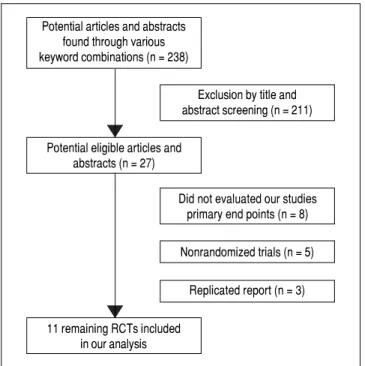
Figure 1 shows the results of the study screen. The lit-erature search yielded 238 studies, 11 of which matched the selection criteria.10-20 There was unanimous agreement
between the two authors regarding the selection of rele-vant articles (Min He and Yu Wu).
Patient characteristics and study quality
All RCTs included were published as full-length arti-cles. The patients included in the eleven trials were
randomly assigned to accept interferon plus OMTR therapies or interferon therapies alone. Of the 968 pa-tients, 488 patients had therapy with interferon plus OMTR, and 480 patients had therapy with interferon alone. All studies were single-centre trials. The baseline characteristics of the eleven included trials are summa-rized in tables 1 and 2. Information on the methodologi-cal quality was incomplete in the majority of eligible RCTs. The methodological quality of all eligible RCTs was not high.
Comparison of
interferon plus OMTR therapies and interferon therapies alone
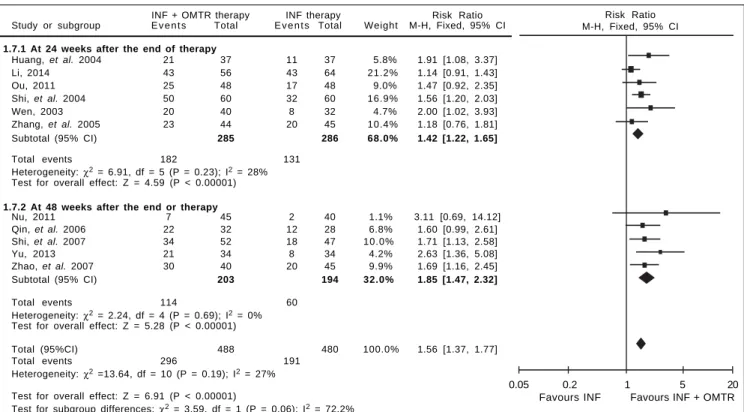
In this study, the combined therapy of interferon plus OMTR were superior to interferon therapies alone. Pa-tients treated with interferon plus OMTR achieved higher SVR and ETVR than patients treated only with in-terferon (SVR: 60.7% (296/488) vs. 39.8 % (191/480); RR: 1.56; 95% CI: 1.37-1.77; p < 0.05. ETVR: 64.7 %( 295/456)
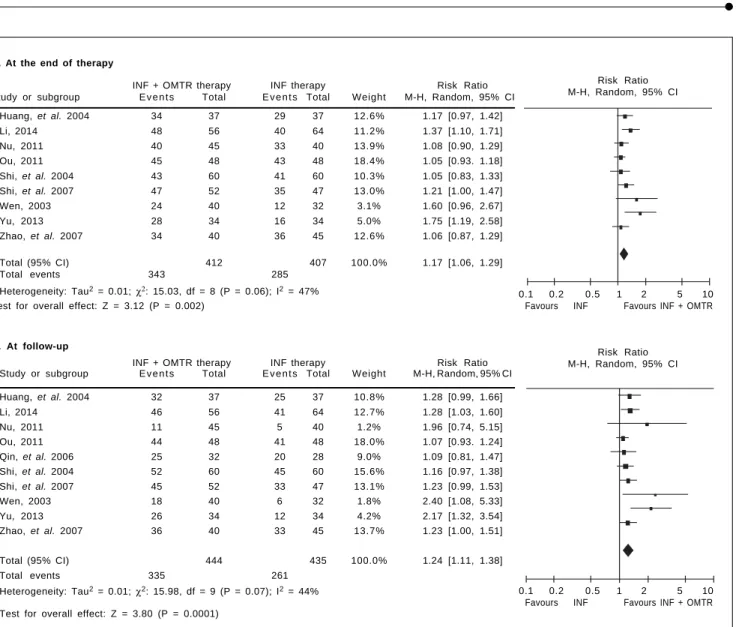
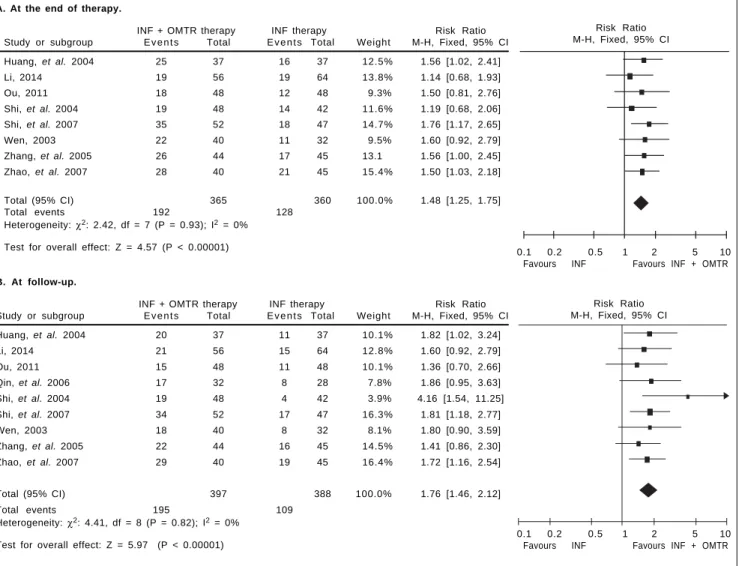
vs. 46.2% (209/452); RR: 1.42; 95% CI: 1.26-1.60; p < 0.05) (Figures 2-3). Patients treated with combined ther-apy also achieved significantly higher ALT normalization and HBeAg loss at both the end of treatment and follow-up (ALT normalization: at the end of therapy: 83.3% (343/412) vs. 70.0% (285/407); RR: 1.17; 95% CI: 1.06-1.29; p < 0.05. Follow up: 75.5% (335/444) vs. 60.0% (261/ 435); RR: 1.24; 95% CI: 1.11-1.38; p < 0.05. HBeAg loss: At the end of therapy: 52.6% (192/365) vs. 35.6%(128/360); RR: 1.48; 95% CI: 1.25-1.75; p < 0.05. Follow up: 49.1% (195/397) vs. 28.1% (109/388); RR: 1.76; 95% CI: 1.46-2.12; p < 0.05 (Figures 4-5). HBeAg seroconversion at follow up was also higher in patients treated with com-bined therapy compared to the patients treated with in-terferon alone, but at the end of therapy there is no difference (At the end of therapy: 30.6% (44/144) vs. Table 1. Characteristics of the trials included in the meta-analysis.
References Sample size Gender Age Duration Follow-up Jadad
(treatment/control) (male/female) (weeks) (weeks)
Huang, et al. (2004) 37/37 62/12 39.3 24 24 1
Li (2014) 56/64 97/23 32 (18 ~ 45) 48 24 1
Nu (2011) 45/40 50/35 41.4 (17 ~ 68) 24 48 1
Ou (2011) 48/48 38/58 20 ~53 24 24 1
Qin, et al. (2006) 32/28 -/- 19 ~ 54 24 48 1
Shi, et al. (2004) 60/60 85/35 16 ~ 59 24 24 1
Shi, et al. (2007) 52/47a 81/24 18 ~ 46 24 48 2
Wen (2003) 40/32 -/- 23 ~ 65 24 24 1
Yu (2013) 34/34 47/21 35.5 (18 ~ 50) 48 48 1
Zhang, et al. (2005) 44/45 48/41 16 ~ 58 24 24 1
Zhao, et al. (2007) 40/45 -/- 35.8 (14 ~ 58) 24 48 2
aSix patients were discontinued and data not shown.
Figure 1. Figure 1. Figure 1. Figure 1.
Figure 1. Analysis of the search results.
Replicated report (n = 3) Nonrandomized trials (n = 5)
11 remaining RCTs included in our analysis Potential articles and abstracts
found through various keyword combinations (n = 238)
Potential eligible articles and abstracts (n = 27)
Did not evaluated our studies primary end points (n = 8)
485
, 2016; 15 (4): 482-491
References Intervention
Treatment (OMTR plus interferon therapies) Control (interferon therapies)
Huang, et al. (2004) Interferon α-2b (5 MU qd alt), OMTR capsules (200 mg tid) Interferon α-2b (5 MU qd alt)
Li (2014) Interferon α-2b (beginning 4 weeks, 5 MU/day; the remaining weeks, Interferon α-2b (beginning 4 weeks, 5 MU/day; 5 MU qd alt), OMTR capsules (200 mg tid) the remaining weeks, 5 MU qd alt)
Nu (2011) Interferon α-2b (5 MU/day), OMTR (beginning 12 weeks, Interferon α-2b (5 MU/day) OMTR injection 600 mg/day; the remaining weeks, OMTR capsules 200 mg tid)
Ou (2011) Interferon α-2b (beginning 2 weeks, 5 MU/day; the remaining weeks, Interferon α-2b (beginning 2 weeks, 5 MU/day; 5 MU qd alt), OMTR (beginning 8 weeks, OMTR injection 600 mg/day; the remaining weeks, 5 MU qd alt)
the remaining weeks, OMTR capsules 200 mg tid)
Qin, et al. (2006) Interferon α-1b (beginning 4 weeks, 5 MU/day; the remaining weeks, 5 MU qd alt), Interferon α-1b (beginning 4 weeks, 5 MU/day; OMTR (beginning 12 weeks, OMTR injection 600 mg/day; the remaining weeks, the remaining weeks, 5 MU qd alt)
OMTR capsules 200 mg tid)
Shi, et al. (2004) Interferon α-1b (beginning 2 weeks, 5 MU/day; the remaining weeks, 5 MU qd alt), Interferon α-1b (beginning 2 weeks, 5 MU/day; OMTR (beginning 8 weeks, OMTR injection 600mg/day; the remaining weeks, the remaining weeks, 5MU qd alt)
OMTR capsules 200 mg tid)
Shi, et al. (2007) Interferon α-2b (beginning 2 weeks, 3 MU/day; the remaining weeks, 3 MU qd alt), Interferon α-2b (beginning 2 weeks, 3 MU/day; OMTR (beginning 4 weeks, OMTR injection 600 mg/day; the remaining weeks, the remaining weeks, 3 MU qd alt)
OMTR capsules 200 mg tid)
Wen (2003) Interferon α-2b (5 MU qd alt), OMTR injection (400 mg/day) Interferon α-2b (5 MU qd alt)
Yu (2013) Interferon α-2a (3 MU qd alt), OMTR capsules (beginning 24 weeks, 200mg tid) Interferon α-2a (3 MU qd alt)
Zhang, et al. (2005) Interferon α-2b (beginning 15 days, 5 MU/day; the remaining days, 5 MU qd alt), Interferon α-2b (beginning 15 days, 5 MU/day; OMTR (beginning 40 days, OMTR injection 600 mg/day; the remaining days, the remaining days, 5 MU qd alt)
OMTR capsules 200 mg tid)
Zhao, et al. (2007) Interferon α-2b (5 MU qd alt),OMTR capsules(200 mg tid) Interferon α-2b (5 MU qd alt)
He M, et al. , 2016; 15 (4): 482-491
486
INF + OMTR therapy INF therapy Risk Ratio Study or subgroup E v e n t s Total E v e n t s Total Weight M-H, Fixed, 95% CI
1.7.1 At 24 weeks after the end of therapy
Huang, et al. 2004 21 37 11 37 5.8% 1.91 [1.08, 3.37]
Li, 2014 43 56 43 64 21.2% 1.14 [0.91, 1.43]
Ou, 2011 25 48 17 48 9.0% 1.47 [0.92, 2.35]
Shi, et al. 2004 50 60 32 60 16.9% 1.56 [1.20, 2.03]
Wen, 2003 20 40 8 32 4.7% 2.00 [1.02, 3.93]
Zhang, et al. 2005 23 44 20 45 10.4% 1.18 [0.76, 1.81]
Subtotal (95% CI) 285 286 68.0% 1.42 [1.22, 1.65]
Total events 182 131
Heterogeneity: χ2 = 6.91, df = 5 (P = 0.23); I2 = 28%
Test for overall effect: Z = 4.59 (P < 0.00001)
1.7.2 At 48 weeks after the end or therapy
Nu, 2011 7 45 2 40 1.1% 3.11 [0.69, 14.12]
Qin, et al. 2006 22 32 12 28 6.8% 1.60 [0.99, 2.61]
Shi, et al. 2007 34 52 18 47 10.0% 1.71 [1.13, 2.58]
Yu, 2013 21 34 8 34 4.2% 2.63 [1.36, 5.08]
Zhao, et al. 2007 30 40 20 45 9.9% 1.69 [1.16, 2.45]
Subtotal (95% CI) 203 194 32.0% 1.85 [1.47, 2.32]
Total events 114 60
Heterogeneity: χ2 = 2.24, df = 4 (P = 0.69); I2 = 0%
Test for overall effect: Z = 5.28 (P < 0.00001)
Total (95%CI) 488 480 100.0% 1.56 [1.37, 1.77]
Total events 296 191
Heterogeneity: χ2 =13.64, df = 10 (P = 0.19); I2 = 27%
Test for overall effect: Z = 6.91 (P < 0.00001)
Test for subgroup differences: χ2 = 3.59, df = 1 (P = 0.06); I2 = 72.2%
Figure 2. Figure 2. Figure 2. Figure 2.
Figure 2. SVR: comparison of interferon plus OMTR therapies and interferon therapies. RR: relative risk. CI: confidence interval; test for heterogeneity: χ2 statistic with its degrees of freedom (d.f.) and p-value; inconsistency among results: I2 test for overall effect; Z statistic with p-value.
Figure 3. Figure 3. Figure 3. Figure 3.
Figure 3. ETVR: comparison of interferon plus OMTR therapies and interferon therapies. RR: relative risk. CI: confidence interval; test for heterogeneity: χ2 statistic with its degrees of freedom (d.f.) and p-value; inconsistency among results: I2 test for overall effect; Z statistic with p-value.
0.05 0.2 1 5 20
Favours INF Favours INF + OMTR Risk Ratio
M-H, Fixed, 95% CI
0.1 0.2 0.5 1 2 5 10
Favours INF Favours INF + OMTR INF + OMTR therapy INF therapy Risk Ratio
Study or subgroup E v e n t s Total E v e n t s Total Weight M-H, Fixed, 95% CI
1.2.1 Interferon ααααα-2b
Huang, et al. 2004 26 37 17 37 8.2% 1.53 [1.02, 2.30]
Li, 2014 47 56 45 64 20.3% 1.19 [0.98, 1.45]
Nu, 2011 17 45 13 40 6.6% 1.16 [0.65, 2.08]
Ou, 2011 30 48 21 48 10.1% 1.43 [0.97, 2.11]
Shi, et al. 2007 36 52 19 47 9.6% 1.71 [1.16, 2.53]
Wen, 2003 24 40 10 32 5.4% 1.92 [1.08, 3.40]
Zhang, et al. 2005 27 44 18 45 8.6% 1.53 [1.00, 2.35]
Zhao, et al. 2007 28 40 22 45 10.0% 1.43 [1.00, 2.05]
Subtotal (95% CI) 362 358 78.8% 1.44 [1.26, 1.64]
Total events 235 165
Heterogeneity: χ2 = 5.87, df = 7 (P = 0.56); I2 = 0%
Test for overall effect: Z = 5.34 (P < 0.00001)
1.2.2 Interferon ααααα-1b
Shi, et al. 2004 35 60 29 60 14.0% 1.21 [0.86, 1.69]
Subtotal (95% CI) 60 60 14.0% 1.21 [0.86, 1.69]
Total events 35 29
Heterogeneity: Not applicable
Test for overall effect: Z = 1.09 (P = 0.28)
1.2.3 Interferon ααααα-2a
Yu, 2013 25 34 15 34 7.2% 1.67 [1.09, 2.56]
Subtotal (95% CI) 34 34 7.2% 1.67 [1.09, 2.56]
Total events 25 15
Heterogeneity: Not applicable
Test for overall effect: Z = 2.34 (P = 0.02)
Total (95% CI) 456 452 100% 1.42 [1.26, 1.60]
Total events 295 209
Heterogeneity: χ2 = 7.10, df = 9 (P = 0.63); I2 = 0%
Test for overall effect Z = 5.80 (P < 0.00001)
Test for subgroup differences: χ2 = 1.45, df = 2 (P = 0.48), I2 = 0%
Figure 4. Figure 4.Figure 4.
Figure 4.Figure 4. ALT normalization: comparison of interferon plus OMTR therapies and interferon therapies. RR: relative risk. CI: confidence interval; test for hete-rogeneity: χ2 statistic with its degrees of freedom (d.f.) and p-value; inconsistency among results: I2test for overall effect; Z statistic with p-value.
24.5%(37/151); RR: 1.31; 95% CI: 0.91-1.88; p = 0.15. Follow up: 42.6% (75/176) vs. 25.1% (45/179); RR: 1.73; 95% CI: 1.27-2.36; p < 0.05) (Figure 6). In this meta-analysis for SVR, ETVR, HBeAg loss and HBeAg sero-conversion, there was no apparent heterogeneity, but for ALT normalization (Figure 4).
Safety profile evaluation
Six included trials11,15-17,19,20 reported side effects, and
one included trials15 clearly reported treatment
discon-tinuation. Adverse events were also reported in the included trials (including thrombocytopenia, neutrope-nia, fever, headache, fatigue, depression and nausea). The overall adverse events were no difference in pa-tients treated with interferon plus OMTR than in
patients treated with interferon alone, according to the reports of the included trials.
Sensitivity analyses
Excluding one of subgroup did not change the pooled estimate. The sensitivity analysis revealed that the RR for the outcome measure remained stable.
Publication bias
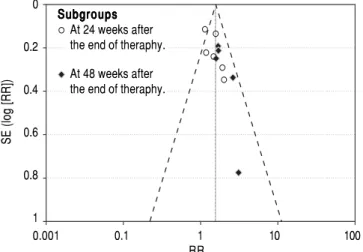
We performed funnel plot analysis for SVRs to explore publication bias. Eleven trials were included for the comparison of interferon plus OMTR and interferon therapies, and ten of these trials included in the meta-analy-sis lay within the 95% CI line and one trial lay outside the
A. At the end of therapy
INF + OMTR therapy INF therapy Risk Ratio Study or subgroup E v e n t s Total E v e n t s Total Weight M-H, Random, 95% CI
Huang, et al. 2004 34 37 29 37 12.6% 1.17 [0.97, 1.42]
Li, 2014 48 56 40 64 11.2% 1.37 [1.10, 1.71]
Nu, 2011 40 45 33 40 13.9% 1.08 [0.90, 1.29]
Ou, 2011 45 48 43 48 18.4% 1.05 [0.93. 1.18]
Shi, et al. 2004 43 60 41 60 10.3% 1.05 [0.83, 1.33]
Shi, et al. 2007 47 52 35 47 13.0% 1.21 [1.00, 1.47]
Wen, 2003 24 40 12 32 3.1% 1.60 [0.96, 2.67]
Yu, 2013 28 34 16 34 5.0% 1.75 [1.19, 2.58]
Zhao, et al. 2007 34 40 36 45 12.6% 1.06 [0.87, 1.29]
Total (95% CI) 412 407 100.0% 1.17 [1.06, 1.29]
Total events 343 285
Heterogeneity: Tau2 = 0.01; χ2: 15.03, df = 8 (P = 0.06); I2 = 47%
Test for overall effect: Z = 3.12 (P = 0.002)
B. At follow-up
INF + OMTR therapy INF therapy Risk Ratio Study or subgroup E v e n t s Total E v e n t s Total Weight M-H, Random, 95% CI
Huang, et al. 2004 32 37 25 37 10.8% 1.28 [0.99, 1.66]
Li, 2014 46 56 41 64 12.7% 1.28 [1.03, 1.60]
Nu, 2011 11 45 5 40 1.2% 1.96 [0.74, 5.15]
Ou, 2011 44 48 41 48 18.0% 1.07 [0.93. 1.24]
Qin, et al. 2006 25 32 20 28 9.0% 1.09 [0.81, 1.47]
Shi, et al. 2004 52 60 45 60 15.6% 1.16 [0.97, 1.38]
Shi, et al. 2007 45 52 33 47 13.1% 1.23 [0.99, 1.53]
Wen, 2003 18 40 6 32 1.8% 2.40 [1.08, 5.33]
Yu, 2013 26 34 12 34 4.2% 2.17 [1.32, 3.54]
Zhao, et al. 2007 36 40 33 45 13.7% 1.23 [1.00, 1.51]
Total (95% CI) 444 435 100.0% 1.24 [1.11, 1.38]
Total events 335 261
Heterogeneity: Tau2 = 0.01; χ2: 15.98, df = 9 (P = 0.07); I2 = 44%
Test for overall effect: Z = 3.80 (P = 0.0001)
0.1 0.2 0.5 1 2 5 10
Favours INF Favours INF + OMTR Risk Ratio
M-H, Random, 95% CI
0.1 0.2 0.5 1 2 5 10
Favours INF Favours INF + OMTR Risk Ratio
He M, et al. , 2016; 15 (4): 482-491
488
Figure 5. Figure 5. Figure 5. Figure 5.
Figure 5. HBeAg loss: comparison of interferon plus OMTR therapies and interferon therapies. RR: relative risk. CI: confidence interval; test for heterogeneity: χ2 statistic with its degrees of freedom (d.f.) and p-value; inconsistency among results: I2 test for overall effect; Z statistic with p-value.
95% CI line (Figure 7). These results implied the exist-ence of some publication bias.
DISCUSSION
Therapy for CHB must ensure a degree of virological suppression that will then lead to biochemical remission, histological improvement and prevention of complications. ETVR and SVR have different meanings in virological re-sponses. SVR evaluates the long-term efficacy of antiviral drugs, which is also a desirable end point of CHB therapy.
In order to completely and objectively evaluating the efficacy of antivirus therapy, ETVR and SVR are necessary. The definitions of virological responses vary according to the timing (on or after therapy) and type of therapy.1
Viro-logical responses on Interferon therapy are usually
evaluat-ed at the end of therapy and at least 24 weeks after the end of therapy.
However, treatment of chronic HBV infection is a complex task; together with a lack of awareness of the dis-ease among patients, high cost and lack of reimbursement are obstacles to measuring SVR in China’s clinical study. Fortunately, some recent studies have reported SVR.
In this study, we have summarized the available evi-dence from RCTs comparing interferon therapies with interferon plus OMTR therapies for the treatment of CHB. Our results suggest that combination therapies of interfer-on plus OMTR may achieve significantly higher SVR than interferon therapies alone. Combination therapies of in-terferon plus OMTR have also shown superior ETVRs, ALT normalizations, HBeAg loss and HBeAg seroconver-sion. Our meta-analysis data suggested that combined
0.1 0.2 0.5 1 2 5 10
Favours INF Favours INF + OMTR Risk Ratio
M-H, Fixed, 95% CI
0.1 0.2 0.5 1 2 5 10
Favours INF Favours INF + OMTR Risk Ratio
M-H, Fixed, 95% CI
A. At the end of therapy.
INF + OMTR therapy INF therapy Risk Ratio Study or subgroup E v e n t s Total E v e n t s Total Weight M-H, Fixed, 95% CI
Huang, et al. 2004 25 37 16 37 12.5% 1.56 [1.02, 2.41]
Li, 2014 19 56 19 64 13.8% 1.14 [0.68, 1.93]
Ou, 2011 18 48 12 48 9.3% 1.50 [0.81, 2.76]
Shi, et al. 2004 19 48 14 42 11.6% 1.19 [0.68, 2.06]
Shi, et al. 2007 35 52 18 47 14.7% 1.76 [1.17, 2.65]
Wen, 2003 22 40 11 32 9.5% 1.60 [0.92, 2.79]
Zhang, et al. 2005 26 44 17 45 13.1 1.56 [1.00, 2.45]
Zhao, et al. 2007 28 40 21 45 15.4% 1.50 [1.03, 2.18]
Total (95% CI) 365 360 100.0% 1.48 [1.25, 1.75]
Total events 192 128
Heterogeneity: χ2: 2.42, df = 7 (P = 0.93); I2 = 0%
Test for overall effect: Z = 4.57 (P < 0.00001)
B. At follow-up.
INF + OMTR therapy INF therapy Risk Ratio Study or subgroup E v e n t s Total E v e n t s Total Weight M-H, Fixed, 95% CI
Huang, et al. 2004 20 37 11 37 10.1% 1.82 [1.02, 3.24]
Li, 2014 21 56 15 64 12.8% 1.60 [0.92, 2.79]
Ou, 2011 15 48 11 48 10.1% 1.36 [0.70, 2.66]
Qin, et al. 2006 17 32 8 28 7.8% 1.86 [0.95, 3.63]
Shi, et al. 2004 19 48 4 42 3.9% 4.16 [1.54, 11.25]
Shi, et al. 2007 34 52 17 47 16.3% 1.81 [1.18, 2.77]
Wen, 2003 18 40 8 32 8.1% 1.80 [0.90, 3.59]
Zhang, et al. 2005 22 44 16 45 14.5% 1.41 [0.86, 2.30]
Zhao, et al. 2007 29 40 19 45 16.4% 1.72 [1.16, 2.54]
Total (95% CI) 397 388 100.0% 1.76 [1.46, 2.12]
Total events 195 109
Heterogeneity: χ2: 4.41, df = 8 (P = 0.82); I2 = 0%
Figure 6. Figure 6.Figure 6.
Figure 6.Figure 6. HBeAg seroconversion: comparison of interferon plus OMTR therapies and interferon therapies. RR: relative risk. CI: confidence interval; test for heterogeneity: χ2 statistic with its degrees of freedom (d.f.) and p-value; inconsistency among results: I2 test for overall effect; Z statistic with p-value.
therapy of interferon plus OMTR therapy may be benefi-cial for treating CHB patients, with higher SVR, and do not result in any additional safety problems. However, we were unable to make firm conclusions because the cases we found were of generally poor quality. Published
Figure 7. Figure 7.Figure 7.
Figure 7.Figure 7. The funnel plot based on the data of SVR.
0.001 0.1 1 10 100
RR 0
0.2
0.4
0.6
0.8
1
SE (log [RR])
studies from China were found to be more highly con-densed than typical articles published in the Western liter-ature, with key details of study design omitted, especially details concerning random assignment.
From this, we learned that oxymatrine combined with interferon may augment the efficacy of interferon. How-ever, a better understanding of drug synergism between oxymatrine and interferon is needed. Sophora alopecuraides L. has been widely used for the treatment of liver disease in China. Oxymatrine is extracted from Sophora
alo-pecuraides L., one of the most pharmacologically active
components in Sophora alopecuraides L.21 Oxymatrine has
anti-HBV effect and its effect be determined in cell lines, in animals and in double-blind, randomized, multicenter clinical trials.4-6,22,23 It should be mentioned here that as
the anti-HBV effect of OMTR is mediated through Heat-stress cognate 70 (Hsc70) down-regulations (an in-direct effect). Hsc70 is a host protein which supports HBV DNA replication.22 OMTR is a selective inhibitor
of Hsc70 expressions.22,23 OMTR significantly
sup-pressed HBV de novo synthesis at the reverse transcrip-tion staging from pgRNA to DNA.22 The anti-HBV effect
A. At the end of therapy
INF + OMTR therapy INF therapy Risk Ratio Study or subgroup E v e n t s Total E v e n t s Total Weight M-H, Fixed, 95% CI
Li, 2014 16 56 19 64 50.4% 0.96 [0.55, 1.68]
Shi, et al. 2004 6 48 4 42 12.1% 1.31 [0.40, 4.34]
Zhao, et al. 2007 22 40 14 45 37.5% 1.77 [1.05, 2.97]
Total (95% CI) 144 151 100.0% 1.31 [1.91, 1.88]
Total events 44 37
Heterogeneity: χ2: 2.46, df = 2 (P = 0.29); I2 = 19%
Test for overall effect: Z = 1.45 (P = 0.15)
B. At follow-up
Lamivudine + OMTR Lamivudine Risk Ratio Study or subgroup E v e n t s Total E v e n t s Total Weight M-H, Fixed, 95% CI
Li, 2014 17 56 18 64 38.7% 1.08 [0.62, 1.88]
Qin, et al. 2006 15 32 6 28 14.7% 2.19 [0.98, 4.87]
Shi, et al. 2004 19 48 4 42 9.8% 4.16 [1.54, 11.25]
Zhao, et al. 2007 24 40 17 45 36.8% 1.59 [1.01, 2.50]
Total (95% CI) 176 179 100.0% 1.73 [1.27, 2.36]
Total events 75 45
Heterogeneity: χ2: 6.20, df = 3 (P = 0.10); I2 = 52%
Test for overall effect: Z = 3.50 (P = 0.0005)
0.1 0.2 0.5 1 2 5 10
Favours INF Favours INF + OMTR
0.1 0.2 0.5 1 2 5 10
Favours Favours lamivudine
lamivudine + OMTR
Risk Ratio M-H, Fixed, 95% CI
Risk Ratio M-H, Fixed, 95% CI
He M, et al. , 2016; 15 (4): 482-491
490
of OMTR was mediated through destabilizing Hsc70 mRNA; Hsc70 mRNA 3’UTR sequence was the element responsible for the destabilization effect of OMTR.22
Be-side the inhibition of viral replication, OMTR can also enhance specific immune responses against HBV. OMTR influences Toll-Like Receptor 9 (TLR9) signal-ing transduction, and synergistically improve the im-mune efficacy of the TLR9 ligand against CHB.24 And
OMTR has also been revealed to have fibrotic, anti-inflammatory and protecting hepatocytes.7,25-27 These
in-itial studies and their positive findings suggested that OMTR is associated with higher SVR in the treatment of CHB patients when combined with interferon. Moreo-ver, the price for OMTR is lower. The low cost of OMTR is one of the most important reasons for its wid-er use in China. The most critical challenge and obstacle is the high cost of medical care and antiviral drugs for CHB. Interferon plus OMTR therapies may be a good choice for interferon users especially in low-income countries. Although the quality of included trials in study was poor, based on the above results, we believed that that further trials of oxymatrine and its combination therapy in CHB are justified.
It must be noted that this meta-analysis had some limi-tations. Firstly, the methodological quality of the trials was not high. Secondly, the asymmetric funnel plot implied that publication biases may occur. Thirdly, the diversity of treatment dose and the small sample number and the lack of long-term follow-ups degraded the validity of the evi-dence of the clinical trials. We believe that it is possible that further investigation in well-designed trials may help answer the question of whether oxymatrine combined with interferon are more effective than interferon alone for treating CHB.
The Guideline of Prevention and Treatment of Chronic Hepatitis B in China recommended duration of interferon treatment was 24 ~ 48 weeks for CHB. Patients in nine trials included were treated for 24 weeks and in the remaining trials included were treat-ed for 48 weeks. The recommendtreat-ed duration of OMTR treatment was 24 weeks for CHB according to a randomized double blind and placebo-controlled multi-center trial of OMTR therapy for CHB. So duration of OMTR treatment is 24 weeks in ten included trials.
CONCLUSIONS
Combined therapy of interferon plus OMTR may yield a higher SVR than interferon monotherapy. Consid-ering that this meta-analysis had the limitations in some ways, the firm conclusions need to perform rigorously designed, multicenter, and large randomized controlled trials.
CONFLICT OF INTEREST
None declared.
ACKNOWLEDGEMENTS
This study was supported by the National Key New Drugs Creation Project, Innovative Drug Research and Development Technology Platform (No. 2012ZX09303009-001), the Specialized Research Fund for the Doctoral Program of Higher Education (No. 20123107120002) and the National Natural Science Foun-dation of China (No. 81403168).
ABBREVIATIONS
• ALT: alanine transaminase. • CHB: chronic hepatitis B. • CI: confidence interval.
• ETVR: end-of-treatment viral response. • HBeAg: hepatitis B e antigen.
• HBV: hepatitis B virus.
• HCC: hepatocellular carcinoma. • Hsc70: heat-stress cognate 70. • INF: interferon.
• OMTR: oxymatrine.
• RCTs: randomized controlled trials. • RR: relative risk.
• SVR: sustained virological response. • TLR9: toll-like receptor 9.
REFERENCES
1. European Association for the Study of the Liver. EASL clini-cal practice guidelines: Management of chronic hepatitis B virus infection. J Hepatol 2012; 57: 167-85 [PubMed: 22436845].
2. Liaw YF. Antiviral therapy of chronic hepatitis B: Opportuni-ties and challenges in Asia. J Hepatol 2009; 51: 403-10 [PubMed: 19467727].
3. Sun J, Hou JL. Management of chronic hepatitis B: experi-ence from China. J Viral Hepat 2010; 17: 10-7 [PubMed: 20586929].
4. Lu LG, Zeng MD, Mao YM, Fang JY, Song YL, Shen ZH, Cao AP. Inhibitory effect of oxymatrine on serum hepatitis B virus DNA in HBV transgenic mice. World J Gastroenterol 2004; 10: 1176-9 [PubMed: 15069721].
5. Xu WS, Zhao KK, Miao XH, Ni W, Cai X, Zhang RQ, Wang JX. Effect of oxymatrine on the replication cycle of hepatitis B virus in vitro. World J Gastroenterol 2010; 16: 2028-37 [PubMed: 20419842].
6. Lu LG, Zeng MD, Mao YM, Li JQ, Wan MB, Li CZ, Chen CW, et al. Oxymatrine therapy for chronic hepatitis B: a randomized double-blind and placebo-controlled multi-center trial. World J Gastroenterol 2003; 9: 2480-3 [PubMed: 14606080].
to chronic viral hepatitis: a randomized, double blind, place-bo-controlled, multicenter clinical study. World J Gastroen-terol 2004; 10: 3269-73 [PubMed: 15484298].
8. Jin XH, Wang YG. Cost effectiveness analysis of three methods in the treatment of chronic viral hepatitis B. Strait Pharmaceutical J 2008; 20: 139-40. Available at: http:// epub.cnki.net/kns/brief/result.aspx?dbPrefix=CJFQ
9. Jadad AR, Moore RA, Carroll D, Jenkinson C, Reynolds DJ, Gavaghan DJ, McQuay HJ. Assessing the quality of reports of randomized clinical trials: is blinding necessary? Control Clin Trials 1996; 17: 1-12 [PubMed: 8721797].
10. Huang YQ, Lin ZH, Ji SM, Xu ZJ, Wang CG. Clinical study of the interferon α-2b combined with oxymatrine in the treat-ment of chronic hepatitis B. Chin J Infect Dis 2004; 22: 259-262. Available at: Available at: http://epub.cnki.net/kns/brief/ result.aspx?dbPrefix=CJFQ
11. Li WH. Clinical study of Interferon-a combined with oxy-matrine in the treatment of patients with HbeAg- positive hepatitis B. J Prac Hepatol 2014; 17: 186-7. Available at: http://epub.cnki.net/kns/brief/result.aspx?dbPrefix=CJFQ 12. NuEGL YBLYM. Clinical study of the interferon combined
with oxymatrine in the treatment of chronic hepatitis B. Chi-nese Community Doctors 2011; 13: 214. Available at: http:// epub.cnki.net/kns/brief/result.aspx?dbPrefix=CJFQ
13. OuYang GS. Clinical study of Interferon combined with oxy-matrine in the treatment of patients with HbeAg- positive hepatitis B. National Medical Frontiers of China 2011; 6: 17-8. Available at: http://epub.cnki.net/kns/brief/result.aspx? dbPrefix= CJFQ
14. Qin ZX, Zhang GC, Wang L, Zhu SF. Kushenin in combination with α-2b interferon for chronic hepatitis B: Observation of pro-spective efficacy. J Chinese Physician 2006; 18: 858-9. Availa-ble at: http://epub.cnki.net/kns/brief/result.aspx?dbPrefix=CJFQ 15. Shi YZ, Li CX. Clinical study of the interferon combined with
oxymatrine in the treatment of chronic hepatitis B. Clinical Medicine of China 2004; 20: 417-8. Available at: http:// epub.cnki.net/kns/brief/result.aspx?dbPrefix=CJFQ 16. Shi ZJ, Zhang HT, Zhang XY. Kushenin in Combination with
α-2b Interferon for chronic hepatitis B: Observation of Cura-tive Efficacy. China Pharmacy 2007; 18: 2139-40. Available at: http://epub.cnki.net/kns/brief/result.aspx? dbPrefix =CJFQ 17. Wen XM. Clinical study of the interferon α-2b combined with oxymatrine in the treatment of chronic hepatitis B. Secondary Medical Education 2003; 21: 136-7. Available at: http:// epub. cnki .net/ kns/brief/ result.aspx?dbPrefix =CJFQ
18. Yu JG. Clinical study of the interferon a-2a combined with oxymatrine in the treatment of chronic hepatitis B. Chinese Hepatology 2013; 18: 205-6. Available at: http://epub.cnki. net/kns/brief/result.aspx?dbPrefix=CJFQ
19. Zhang XD, Sun MZ, Li XF, Liu ZJ. Observation of the thera-peutic effects of interferon combined with Kushenin in the
treatment of chronic hepatitis B. China Pharmacy 2005; 16: 450-1. Available at: http://epub.cnki.net/kns/brief/result.aspx ?dbPrefix=CJFQ
20. Zhao WL, Hu QM, Yang ZM, Zhang W. Clinical study of Inter-feron-α combined with oxymatrine in the treatment of pa-tients with chronic hepatitis B. Journal of Yangtze University (Natural Science Edition) Medicine V 2007; 4: 161-2. Avail-able at: http://epub.cnki.net/kns/brief/result.aspx?dbPrefix=C JFQ
21. Cui X, Wang Y, Kokudo N, Fang D, Tang W. Traditional Chi-nese medicine and related active compounds against hepati-tis B virus infection. Biosci Trends 2010; 4: 39-47 [PubMed: 20448340].
22. Wang YP, Liu F, He HW, Han YX, Peng ZG, Li BW, You XF, et al. Heat stress cognate 70 host protein as a potential drug target against drug resistance in hepatitis B virus. Antimi-crob Agents Chemother 2010; 54: 2070-7 [PubMed: 20176893].
23. Wang YP, Zhao W, Xue R, Zhou ZX, Liu F, Han YX, Ren G, et al. Oxymatrine inhibits hepatitis B infection with an advan-tage of overcoming drug-resistance. Antiviral Res 2011; 89: 227-31 [PubMed: 21277330].
24. Yao N, Wang X. In vitro immunomodulatory activity of oxy-matrine on toll-like receptor 9 signal pathway in chronic hep-atitis B. Am J Chin Med 2014; 42: 1399-410 [PubMed: 25406654].
25. Chai NL, Fu Q, Shi H, Cai CH, Wan J, Xu SP, Wu BY. Oxy-matrine liposome attenuates hepatic fibrosis via targeting he-patic stellate cells. World J Gastroenterol 2012; 18: 4199-206 [PubMed: 22919254].
26. Dong YH, Xi HL, Tian F, Kang AJ, Zhang NL, Yu M, Yu YY, et al. Effects of oxymatrine on serum levels of Th1/Th2 type cytokines in HBsAg transgenic mice. Zhonghua Shi Yan He Lin Chuang Bing Du Xue Za Zhi 2004; 18: 277-80 [PubMed: 15640867].
27. Gu XB, Yang XJ, Hua Z, Lu ZH, Zhang B, Zhu YF, Wu HY, et al. Effect of oxymatrine on specific cytotoxic T lymphocyte surface programmed death receptor-1 expression in pa-tients with chronic hepatitis B. Chin Med J (Engl) 2012; 125: 1434-8 [PubMed: 22613649].
Correspondence and reprint request:
Jian Jiang, M.D.
Department of Clinical Pharmacology, Shuguang Hospital Affiliated to Shanghai University of TCM, No. 528 Zhangheng
Road, Pudong New Area, Shanghai, China Tel.: +86 21 20256536