The efficacy of anti-viral therapy on hepatitis B virus-associated
glomerulonephritis: A systematic review and meta-analysis
Zhou Yi,* Yuan Wei Jie,* Zhu Nan*
* Department of Nephrology The First People’s Hospital, Shanghai Jiaotong University, Shanghai, China.
ABSTRACT
Objectives. To assess the efficacy of anti-viral therapy on hepatitis B virus associated glomerulonephritis (HBV-GN). Design, setting, participants, & measurements. We searched PubMed, Embase and Cochrane Li-brary for prospective controlled trials which assessed the efficacy of anti-viral therapy on HBV-GN in adult or pediatric patients between January, 1970 and October, 2010. Results were summarized using fixed-effects model because of an absence of heterogeneity among the studies (I2 = 0%). Results. Six trials with a total of 159 patients were included; among them five trials were specified as hepatitis B virus-associated membranous glomerulonephritis (HBV-MN). In adult patients, the incidence of proteinuria remission, not only total remission (complete remission CR + partial remission PR) (2.97 to 109.93, P = 0.002) but also CR (1.18 to 16.11, P = 0.03), significantly increased in the anti-viral treatment. In pediatric patients, only the incidence of total remission (1.77 to 17.75, P = 0.003) was increased significantly; the incidence of CR was not pooled with clinical and statistical heterogeneity (I2 = 81.5%, P = 0.004).Combine the data from adult and pediatric patients with HBV-MN, the same results were found. All the results of proteinuria remission kept with virologic response (VR), including HBeAg conversion (5.68 to 40.04, P < 0.00001) and reduction of HBV-DNA (5.60 to 463.16, P = 0.0005). Conclusions. Antiviral therapy including IFN and lamivudine is effecti-ve on remission of proteinuria, HBeAg clearance, and HBV-DNA reduction.
Key words. Hepatitis B virus-associated glomerulonephritis. Nephropathy. Membranous nephropathy therapy IFN la-mivudine.
Correspondence and reprint request: Dr. Yuan Wei Jie Division of Nephrology, Shanghai First People’s Hospital,
Shanghai Jiaotong University, 100 HaiNing Road, Shanghai 200080, China Tel.:+86 13801777273. Fax:+86 (021)55061090
E-mail: [email protected]
Manuscript received: January 06, 2011. Manuscript accepted: February 05, 2011.
INTRODUCTION
With the increment of incidence on extrahepatic infection, the effective treatment for renal related hepatitis B-virus (HBV) infection has attracted more attention recently.1-4 Epidemiological studies
have shown that chronic carriage of HBV in some individuals (particularly pediatric patients) leads to the development of nephritic syndrome with a strong male predominance, the commonest histologi-cal type being membranous nephropathy (MN).5,6
Although the natural history of the disease tends of-ten to remission with preservation of renal func-tion, there is considerable morbidity and significant
mortality,5,6 The risks of developing chronic renal
fa-ilure, protracted disease course, and significant morbidity have pushed investigators to search for specific and effective therapy for this disease.
Various therapeutic approaches have been used for HBV-GN including corticosteroids, thymic extracts, acyclovir, interferon (IFN), and lamivudine. It has been argued that corticosteroid and immuno-suppressive agents are unfavorable for HBV-GN sin-ce they inhibit the immune system and activate latent HBV, finally lead to active replication of HBV and deterioration of renal lesions.7,8 Anti-viral drug
has been recommended as the most important thera-py of HBV-GN. However, the literature about anti-viral therapy of HBV-GN was predominantly comprised by small clinical trials and case reports, and thus its efficacy remains poorly established.
SUBJECTS AND METHODS
Data Sources and Search
PubMed, Embase and Cochrane Library were searched using the crossed MESH terms: ‘hepatitis B virus’ or ‘hepatitis B’, ‘glomerulonephritis’ or ‘ne-phropathy’ or ‘membranous ne‘ne-phropathy’, ‘IFN’, ‘lamivudine’. All articles were identified by a search from June 1966 to October 2010. Bibliographies of relevant studies, reference list in ISI Web of Knowledge, proceedings of major recent meetings on nephrology and hepatology and “Related Articles” in PubMed were used to identify additional studies.
Identified abstracts and titles were screened inde-pendently by 2 investigators (Z Y., J.Y.W.) for in-clusion in further analysis. All articles identified by the reviewers were retained. In the second round of screening, the full text for the articles was exami-ned. The agreement between reviewers for article eli-gibility was 100% in second screening.
Criteria for inclusion
Controlled clinical trials, cohort studies, and case-control studies were enrolled in this systematic review. Inclusion criteria were:
• The diagnosis of HBV-GN was established based on renal biopsy.
• Studies reported the results of anti-viral (IFN or lamivudine) therapy of HBV-GN.
• The primary and secondary outcomes were re-mission of proteinuria (or clinical response) and clearance of hepatitis B e-antigen (orVR), respec-tively.
Criteria for exclusion
Exclusion criteria were:
• Patients in the studies had evidence of other se-condary glomerulonephritis or other viral infec-tions such as hepatitis C virus.
• Studies were on therapy of HBV-GN with Chine-se herbal drugs.
• Studies reported inadequate data on measures of response.
Study outcome measures
The primary outcome in this systematic review was remission of proteinuria as a measure of
effica-cy. Clinical responses were divided into CR and PR, which were respectively defined as disappearance of proteinuria (< 0.3 g/d) and reduction in urine pro-tein excretion. Secondary outcome was the clearan-ce of hepatitis B e-antigen (HBeAg). Sustained clinical responses and VR were defined as remission of proteinuria and HBeAg clearance occurring over the follow-up period (at least 6 months after comple-tion of therapy), respectively. These definicomple-tions are standards currently used in the scientific literature.
Data collection and quality assessment
Two reviewers selected the studies independently, and extracted data and outcomes according to the inclusion criteria. We extracted data elements from each trial, including: type of study, sample size, mean age, dosage and duration of anti-viral (IFN or lamivudine) therapy and the duration of follow-up. For trials that did not provide complete data, we contacted the corresponding author for it.
The quality of the trials was evaluated using the Jadad score,9 including randomization, description
of withdrawals and dropouts, and whether the trial is double blinded. The maximum score is 5. The qua-lity of allocation concealment was graded as adequa-te (A), unclear (B), inadequaadequa-te (C), or not used (D) according to the application of randomization.
Data analysis and synthesis
The primary outcome measurement was the pooled estimate of the risk ratio (RR) for HBV-GN who received anti-viral therapy compared to those who did not. We calculated the Mantel-Hansel risk ratio for assessing efficacy of anti-viral therapy on HBV-GN. The average effects and 95% confidence inter-vals (CIs) were obtained using a fixed-effects model. To assess heterogeneity across trials, we used the Cochrane statistic test, with a P value < 0.1 consi-dered significant. Mild, moderate, and severe hetero-geneity was defined by I2 values at > 25, 50, and 75%, respectively.
A funnel plot was used to assess the presence of publication and other reporting biases by plotting the standard error against the log risk ratio. Using Egger’s linear regression method, we examined the association between the study size and estimated therapy effects. P ≤ 0.05 was considered significant.
ca-Table 1. Baseline characteristic of clinical studies included in the analysis.
Study Case Area Age rang M:FF Type of study Jadad
(Mean)
Lin, et al. 40 Taiwan, <14ys(6) 29M:11F Open-randomized 3
1995 China trail
Rhimmal, 39 Africa 5-14 ys(8.7) 22M:17F Prospective, 1
et al.2002 open-label
observational study
Yang, 33 Wenzhou, 3-16ys(8) 28M:5F Corhort study 1
et al.2003 China
Tang, 22 Hong Adults(48) 14M:8F Corhort study 1
et al.2005 Kong, China
Panomsak, 24 Thailand 23-74ys(43) 14M:F10F Corhort study 1
et al.2006
Lai, 21 Hong 15-53ys(30) 17M:4F Corhort study 2
et al.1991 Kong,China
M: Male. F: Female.
rried out with RevMan 5.0.25 (The Nordic Cochrane Centre, The Cochrane Collaboration, 2008). The study was performed in accordance to the recom-mendations by Preferred Reporting Items for Syste-matic reviews and Meta-Analyses (PRISMA) work-group.
RESULTS
Eligible studies
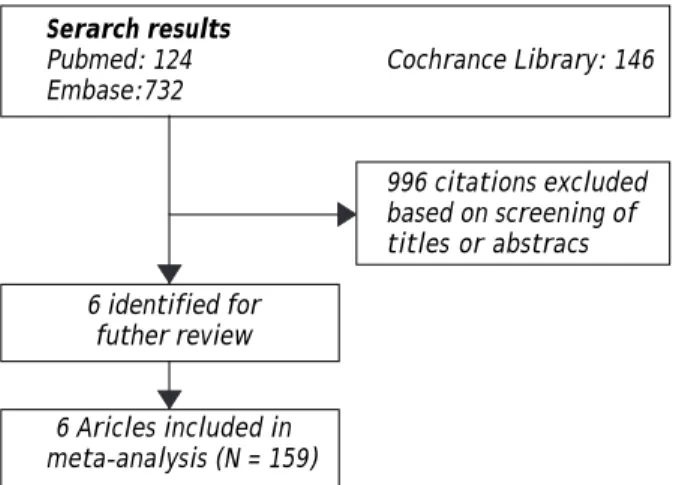
The electronic search yielded 1002 citations (Fi-gure 1). Of these, 6 clinical trials,10-15 with a total of
159 patients, satisfied the inclusion criteria. Study characteristics were shown in Table 1. One of them
was randomized controlled trial,10 others were
co-hort studies. Among the 6 articles, 4 (66.7%) were from China, corresponding to the high incidence of HBV-GN in China and the low incidence in Europe and North American. Three studies, with 82 pa-tients, aimed at children (< 18 years old) while the other three aimed at adult patients. From a total of 159 patients, males were slightly predominant (2.25:1).
Study designs were shown in Table 2, which in-cluded histological type, the details of invention me-thods like dose and duration of anti-viral drugs, incidence of CR and PR, and duration of follow-up. The major histological type of 5 articles is MN while others included IgA nephropathy (IgAN), membra-nous nephropathy (MN), minimal change disease (MCD), (focal segmental glomerulosclerosis (FSGS) and mesangiocapilary proliferative glomerulonephri-tis (MPGN). Among the 159 patients (72 in treat-ment group with 5 dropped out, 87 in control group with 3 dropped out), 67 patients were on the thera-py of anti-viral drugs and 84 patients were in the control group. IFN (1-10Mu tiw) by subcutaneous route was given in most of (2/3, 66.7%) clinical trials, and lamivudine therapy (100 mg qd) in two studies. The mean duration of follow-up was 3-108 months, which is variant between trials.
Publication bias
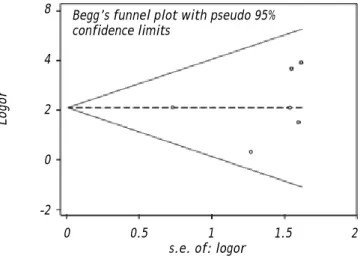
Visual inspection of the funnel plot (Figure 2) revealed symmetry, suggesting the absence of
pu-Figure 1. Flowchart of meta-analysis study selection.
Serarch results
Pubmed: 124 Cochrance Library: 146 Embase:732
996 citations excluded based on screening of titles or abstracs
6 identified for futher review
blication bias. Meanwhile, Egger’s test and begg’s test also support this observation (P = 0.704). It is concluded that publication bias may be accep-tably low.
Efficacy of anti-viral
therapy of HBV-GN in adult patients
Six studies were conducted in evaluation efficacy of anti-viral therapy on HBV-GN. The clinical mani-festations and development of HBV-GN tend to be different in pediatric and adult patients,16 so we
per-formed a sub-analysis between these two groups. The pediatric patient is defined as the patients
who-se age is 18 years old or younger, which was uwho-sed in most trials.
Three studies12,14,15 were conducted in adult
pa-tients. All trials were cohort studies. In Tang’s trial,12
10 HBV-MN patients had been treated with lamivudi-ne (100 mg p.o., Q.D.). In Panomask’s study,14
pa-tients with IgAN were treated with interferon-α2a and lamivudine in addition to an initial month of predniso-lone therapy. Five patients in Lai’s study15 who had
persisted proteinuria in the nephrotic range (> 3.0 g of urinary protein per day) for at least 12 months after diagnosis were randomly selected for the group of re-combinant human interferon alfa-2b. These five pa-tients first received a 2-week course of prednisolone (40 mg per day orally), followed by interferon therapy in a dose of 3 million units given subcutaneously three times a week for 12 weeks.
These three trails comprised 34.3% of the total 151 patients. The total number of CR and PR were 14 and 22, respectively. First, we evaluated the effi-cacy of anti-viral on total remission, which included CR and PR (Figure 3). In the absence of clinical and statistical heterogeneity (I2 = 0%, P = 0.57), the three trials were pooled. The pooled RR was 18.06 (2.97 to 109.93, P = 0.002), confirming the efficacy on clinical remission by anti-viral therapy on HBV-GN in adult patients. Secondly, we tended to know the anti-viral therapy on CR (Figure 4). The pooled RR was 4.37(1.18 to 16.11, P = 0.03) with no clini-cal and statisticlini-cal heterogeneity (I2 = 21.7%, P = 0.28), emphasizing the good effect of anti-viral on CR in adult patients.
Table 2. Design of 6 included clinical studies in the analysis.
Study N Renal biopay Antiviral therapy CR PR VR Follow up Dropped- out
Lin, 40 MN IFN-α 5-8Mu tiw *12w 20/20 0 16/20 3 None
et al.1995 months
Rhimmal, 39 36MN,2MP IFN-α 10Mu tiw*16w 10/19 4/19 10/19 40 weeks None
et al.2002 GS,1 NA
Yang, 20 MN IFN 1-3Mu tiw* 3/6 2/6 5/6 1-6 years 5
et al.2003 (12w-24w)
Tang, 22 MN Lamivudine 100 mgqd 7/10 2/10 5/7 49.2±16.5 None
et al.2005 months
Panomsak, 14 IgA/MN/ 1 month of prednisone 2/7 5/7 1/7 5-10 months 3 et al.2006 FSGS/MPGS followed by IFN in 1 case
or 6 lamivudine in 6case
Lai, 16 MN 2 weeks of prednisone 1/5 4/5 1/5 12-108 None
et al.1991 followed by rIFNα-2b months
3Mu tiw
n: n:n: n:
n: Numbers of the anti-viral therapy and the placebo. MN: MN: MN: MN: MN: Membranous glomerulonephriti. MPGN:MPGN:MPGN:MPGN:MPGN: Membranoproliferative glomerulonephritis. NA:NA:NA:NA:NA: Infor-mation needed not available. IFN: IFN: IFN: IFN: Interferon. CR: IFN: CR: CR: CR: Complete remission. PR: CR: PR: PR: PR: PR: Partial remission. VR:VR:VR:VR:VR: Virologic response.
Figure 2. Funnel plot with pseudo-95% confidence limits for assessment of publication bias. OR: odd radio. SE: log OR.
0 0.5 1 1.5 2
s.e. of: logor 8
4
2
0
-2
Logor
Figure 3. CR and PR of anti-viral therapy on HBV-GN in adult and pediatric patients, respectively. OR: Odd ratio. CR: Comple-te remission. PR: Partial remission.
Efficacy of anti-viral
therapy of HBV-GN in pediatric patients
The other three studies10,11,13 were conducted in
pediatric patients, which comprised 65.7% of the to-tal patients. The histological types in three studies were all HBV-MN. In Lin’s open, randomized trial study,10 all were pathologically proven HBV-MN and
showed no response to corticosteroid therapy as they represented by a persistent heavy proteinuria. 20 HBV-MN patients were treated with recombinant IFNa (5 subjects, body weight < 20 kg; 8 subjects, body weight ≥ 20 kg) by subcutaneous (s.c.)injection three times a week for 12 months. In Rhimma’s prospective, open-labeled, observational study,11
IFNα 2b in a dose of 10 million units/m2 (maximum
10 million units/dose) was administered subcuta-neously 3 times/week for 16 weeks. In Yang’s stu-dy,13 interferon was used to treat HBV-MN,
compared with placebo group and prednisone group. The pooled RR of the incidence of total remission in HBV-MN was 5.6 (1.77 to 17.75, P = 0.003) with no clinical and statistical heterogeneity (I2 = 0%, P = 0.45), which meant the good efficacy of anti-viral therapy in increasing the incidence of total remis-sion in pediatric patients (Figure 3). However, in the presence of clinical and statistic heterogeneity
Figure 5. CR and PR of anti-viral therapy on HBV-MN in adult and pediatric patients, respectively. OR: odd ratio. CR complete remission; PR partial remission.
(I2 = 81.5%, P = 0.004) in the analysis of CR, we could not pooled the efficacy of anti-viral therapy on CR (Figure 4).
Efficacy of anti-viral
therapy of HBV-MN in adult patients
HBV-MN is the most common histological type in HBV-GN. In our study, we also performed a syste-matic review on efficacy of anti-viral therapy in HBV-MN patients. A sub-group analysis for pedia-tric patients was mentioned as above. We had been found that anti-viral therapy was benefit for increa-sing the incidence of total remission in pediatric pa-tients. Then we made the same analysis in adult patients.
Five studies, included 137 patients, studied the effi-cacy of anti-viral therapy on HBV-MN. Two stu-dies12,15 were adult patients and the other three10,11,13
than control groups. CR is a more meaningful index in evaluating efficacy of anti-viral therapy. Then we divided the clinical remission into total remission and CR. We found that all of the adult patients who recei-ved anti-viral therapies were helpful for total remis-sion and CR. In pediatric patients, anti-viral therapy was only benefit for total remission. Because of the existence of clinical and statistical heterogeneity in the analysis of CR in pediatric patients, we could not pool the results, which meant more trials should be carried out. Meanwhile, we also had found that the incidence of HBeAg seroconversion and the decline level of HBV-DNA were higher in therapy groups than in control groups, which kept with the remis-sion of proteinuria. These results suggest that anti-viral therapy is of value in remission of proteinu-ria, and provides some benefit in seroconversion of HBeAg and clearance of HBV-DNA.
Some factors, such as the type of anti-viral drugs, may be related to the efficacy of anti-viral therapy. In our meta-analysis, 4 of 6 trials used IFN to treat HBV-GN; the other 2 trials used lamivudine. Among lamivudine-based trials, 2/3 had showed the benefit of lamivudine therapy. Among IFN-based trials, only 1/4 had showed the benefit. Hossein, et al.’s16
analy-sis of 119 patients from 10 studies also showed that lamivudine therapy was significantly associated
Figure 6. CR of anti-viral therapy on HBV-MN in adult and pediatric patients, respectively. OR: odd ratio. CR complete remis-sion.
Virologic response after anti-viral therapy
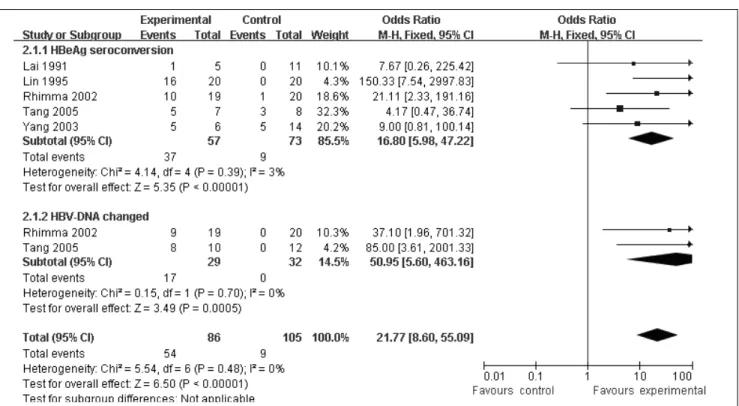
In order to evaluate the effect of anti-viral thera-py on VR, we extracted the proportion of HBeAg se-roconversion and the decline level of HBV-DNA, and made a systematic analysis (Figure 7). All the six studies had been included in the analysis. In the absence of clinical and statistical heterogeneity (I2 = 0%, P = 0.48), the six trials were pooled. The pooled RR was 15.14 (5.68 to 40.04, P < 0.00001), confirming the efficacy on HBeAg seroconversion by anti-viral therapy on HBV-GN. Two studies had showed the declined level of HBV-DNA. The pooled RR of the decline of HBV-DNA was 50.9 (5.60 to 463.16) with no clinical and statistical heterogeneity (I2 = 0%, P = 0.70), which meant the decline rate of HBV DNA in anti-viral therapy group was signifi-cant higher than control group (P = 0.0005). The results showed that VR kept with the remission of proteinuria.
DISCUSSION
with better outcome compared with IFN therapy; all patients receiving lamivudine had partial or comple-te remission, and none of them lost their kidneys. Moreover, when they repeated analysis with pa-tients receiving only steroids and interferon, we did not find such a relationship.
Dosage and treatment duration may be another important factor impact the clinical outcome. Among lamivudine-based therapy, lamivudine (100 mg p.o., daily) for 12 months was commonly used. In Lai, et al.’s17 study, they suggested that
long-term lamivudine therapy should be used only for pa-tients who do not experience remission under supportive treatment, or for those with relapse of nephrosis after lamivudine withdrawal, which in turn, to prevent lamivudine-resistant mutations and hepatitis flare-ups. Moreover, cost related issues needs to be evaluated further. In IFN-based therapy, dosage and duration were not unified. Lin, et al. showed that IFNa therapy given by subcutaneous (s.c.) injection with less than 3 million units three times per week injection for six months was ineffec-tive. In contrast, when the dose of IFNa was increa-sed to 5 million units or given more than three times per week, the disappearance of proteinuria and HBeAg seroconversion was noted.18 Among the
4 INF-based trials included in our meta-analysis,
only one trial, in which recombinant IFNa were in-creased to 5-8 million units, showed the significantly benefit of IFN therapy.
Like primate glomerulonephritis, different histolo-gical type had different efficacy to the therapy. In our meta-analysis, histological diagnosis in 5 trials was MN. Only pathologic types in Panomsak, et al.14
in-cluded IgA nephropathy (29%), MN (21%), FSGS (11%), membranoproliferative GN (11%), and post-in-fectious GN (11%). Remission rates both complete and partial in this trial were higher than in the lite-rature with an average rate of 75% (30-60%), not-withstanding treatment. We thought that anti-viral therapy in IgA nephropathy had higher than MN; however, this point needs more trials to be verified.
Several questions merit investigation in this area. Most patients had different clinical characte-ristics such as magnitude of proteinuria, histologi-cal type, and age range; then could they be treated with the same therapy? We found trials in our analysis all included patients with proteinuria ran-ged from 3.0-10 g/day. Anti-viral therapy had played a major role in the remission of proteinuria and re-duction of HBeAg and HBV-DNA. Still, more trials are needed to evaluate the efficacy of anti-viral the-rapy in HBV-GN patients with proteinuria < 3.0 and with different clinical presentation.
Lamivudine resistant-HBV mutation is a new pro-blem, which could affect the efficacy of anti-viral therapy. Recently, the incidence of lamivudine resis-tant-HBV mutant strain is approximately 20% per year. In addition, recurrence of proteinuria after cessation of lamivudine is another problem.18
Ente-cavir is more preferable in long-term use because of lower incidence of drug-resistant mutation, 0.8% over 5 years.19 Takayasu, et al.’s20 case report was
the first report on the clinical effects of entecavir in HBV-related MN showing HBeAg seroconversion and HBV clearance within 4 months, and subse-quent complete remission of proteinuria. Entecavir may be replacement of lamivudine.
More attention should be given to the use of predi-nose. Among six studies, three studies had a drug his-tory of short-term(2-4 weels) predinsolone, which may affect the relusts of anti-viral treatment. However, we thought short-term predinsolone had no response with the results, which is accord with Lin’s study.
Our meta-analysis has several limitations. First, the quality of a meta-analysis depends on the quality of the individual studies, which in this study was low. Second, the limited number of available studies made the conclusion with less force. Also, publica-tion bias may pose a limitapublica-tion. Third, Usually, it may not be easy to have neutral or negative studies published while positive studies do. Moreover, the time of treatment was not long enough to evaluate its effects on chronic HBV-GN.
CONCLUSION
The efficacy of antiviral therapy (including IFN and lamivudine) on HBV-GN is good. Antiviral the-rapy is effective on remission of proteinuria, HBeAg clearance, and HBV-DNA reduction. More randomi-zed controlled trials should be taken to stratified the factors which be related to efficacy of anti-viral therapy.
DISCLOSURES
None.
CONFLICT OF INTEREST STATEMENT
None declared.
REFERENCES
1. Bhimma R, Coovadia HM, Adhikari M: Hepatitis B virus-as-sociated nephropathy in black South African children. Pe-diatr Nephrol 1998; 12: 479-84.
2 . Combes B, Stastny P, Shorey J, Eigenbrodt EH, Ba-rrera A, Hull AR, Carter NW. Glomerulonephritis with deposition of Australia antigen-antibody complexes in glomerular basement membrane. Lancet 1971; ii: 234-7.
3. Gocke DJ, Hsu K, Morgan C, Bombardien S, Locksmith M, Christian CL: Association between polyarteritis and Aus-tralia antigen. Lancet 1970; ii: 1149-56.
4. Levy Y, Gorevic PD, Kassab HJ, Zucker-Franklin D, Franklin EC. Association between hepatitis B virus and es-sential mixed cyroglobulinemia. N Engl J Med 1977; 296: 1501-8.
5. Bhimma R, Coovadia HM. Hepatitis B virus-associated ne-phropathy. Am J Nephrol 2004; 24: 198-211.
6. Johnson RJ, Couser W. Hepatitis B infection and renal di-sease: clinical, immunopathogenetic and therapeutic con-siderations. Kidney Int 1990; 37: 663–76.
7. Walters S, Levin M. Infectious diseases and the kidney. In: Barratt TM, Avner ED, Harmon WE (ed.). Pediatric Ne-phrology. 4th Ed. Philadelphia, PA: Lippincott Williams & Wilkins; 1999, p. 1088-90.
8. Appel GB, Radhakrishnan J, D’Agati V. Secondary glomeru-lar disease. In: Brenner BM (ed.). The Kidney. 6th Ed. Phi-ladelphia, PA: WB Saunders; 2000, p. 1411.
9. Khan KS, Daya S, Jadad AR. The importance of quality of primary studies in producing unbiased systematic re-views. Arch Intern Med 1996; 156: 661-6.
10. Lin CY. Treatment of hepatitis B virus-associated mem-branous nephropathy with recombinant alpha-interferon. Kidney International 1995; 47: 225-30.
11. Bhimma R, Kramvis A, Charles KM. Treatment of hepatitis B virus-associated nephropathy in black children. Pediatr Nephrol 2002; 17: 393-9.
12. Tang S, Lai FM, Lui YH, et al. Lamivudine in hepatitis B-as-sociated membranous nephropathy. Kidney International 2005; 68: 1750-8.
13. Yang Q, Zhuang JQ, Lin RX, et al. Clinicopathological Fea-tures and Treatment of Hepatitis B Virus Associated Mem-branous Nephropathy in Children. Zhongguo Zhongxiyi Jiehe Shenbing Zazhi 2003; 54: 706-8.
14. Panomsak S, Lewsuwan S, Eiam-Ong S, Kanjanabuch T. He-patitis-B virus-associated nephropathies in adults: a clini-cal study in Thailand. J Med Assoc Thai 2006; 89(Suppl. 2): S151-S156.
15. Lai KN, Li PK, Lui SF, et al. Membranous nephropathy rela-ted to hepatitis B virus in adults. N Engl J Med 1991; 324: 1457-63.
16. Hossein K, Saeed T. Hepatitis B virus-associated Ne-phropathy: An International Data Analysis. IJKD 2010; 4: 101-5.
17. Lai MY, Yang WC, Lee SD,et al. Long-term lamivudine the-rapy is not reasonable for HBV-associated nephropathy. Advance Access publication.2005.doi:10.1093/ndt/ gfk001.
1 8. Mesquita M, Lasser L, Langlet P. Long-term (7-year) treatment with lamivudine monotherapy in HBV-as-sociated glomerulonephritis. Clin Nephrol 2008; 70: 69-71.
19. Ohtake T, Kobayashi S. Hepatitis B virus-related membra-nous nephropathy treated with entecavir. Nephrology 2010; 15: 266-7.