Aplastic Anemia and
Severe Myelosuppression with Boceprevir or
Simeprevir-Containing Hepatitis C Virus Treatment
Alicia Senín,* Teresa Broquetas,** Sabela Lens,*** Nuria Cañete,** María-Carlota Londoño,*** Mariana Ferraro,* Xavier Forns,*** Antonio Salar,* Jose A. Carrión**
* Department of Clinical Hematology, Hospital del Mar, Barcelona, Spain. ** Liver Unit, Gastroenterology Department, Hospital del Mar, IMIM (Hospital del Mar Medical Research Institute), Barcelona, Spain. *** Liver Unit, Hospital Clinic, IDIBAPS, CIBERehd, Barcelona, Spain.
March-April, Vol. 16 No. 2, 2017: 312-317
INTRODUCTION
Protease inhibitors (PIs) have improved sustained vi-rological response (SVR) in patients with chronic hepati-tis C virus (HCV) when used in combination with
peg-interferon and ribavirin (PR).1 Hematological adverse
events with PR, like interferon (IFN)-related central my-elosuppression or ribavirin (RBV)-related hemolytic
ane-mia are usually mild.2 Few cases of hematological serious
adverse events (SAEs) in HCV infected patients receiving antiviral treatment with PR have been reported in the lit-erature: two cases of severe aplastic anemia related to IFN-alfa and two cases of pure red cell anemia (PRCA)
associated with peg-IFN and RBV, respectively.3,4
Addition of the new PIs to PR has shown a high
fre-quency of mild hematological toxicity.5,6 Our group has
recently described severe pancytopenia or aplastic anemia in seven patients during triple therapy with telaprevir
(TVR).7 Of note, these hematological complications
re-sulted in a high mortality rate (three out of seven patients died). Interestingly, only one of these seven patients had both risk factors (low levels of platelet < 100 x 109/L and
albumin < 35 g/L) for developing adverse events, previ-ously described in cirrhotic patients of the CUPIC co-hort.8
We here report two cases of severe agranulocytosis/ aplastic anemia using boceprevir (BOC) or simeprevir (SMV) in IFN-based combination and 2 additional cases of severe myelosupression with IFN-free thera-py with sofosbuvir and simeprevir (SMV) plus RBV (Table1 summarises main clinical and laboratory fea-tures).
The Official Journal of the Mexican Association of Hepatology, the Latin-American Association for Study of the Liver and
the Canadian Association for the Study of the Liver
Manuscript received: Manuscript received: Manuscript received: Manuscript received:
Manuscript received: April 20, 2016. Manuscript accepted:Manuscript accepted:Manuscript accepted: August 13, 2016.Manuscript accepted:Manuscript accepted:
DOI:10.5604/16652681.1231593.
A B S T R A C T A B S T R A C T A B S T R A C T A B S T R A C T A B S T R A C T
The addition of the new protease inhibitors (PIs) to peg-interferon (IFN) and ribavirin (RBV), approved for chronic hepatitis C, has clearly improved sustained virological response (SVR) rates although several adverse events have been reported with this regimens, including mild hematological toxicity. Moreover, severe pancytopenia and aplastic anemia during triple therapy with telaprevir has re-cently been described in seven patients. We report here two cases of severe agranulocytosis/aplastic anemia using boceprevir or simeprevir in interferon-based combination and 2 additional cases of severe myelosupression in IFN-free therapy with sofosbuvir and simeprevir plus RBV. Our observations suggest that PIs could have a sort of class-effect in developing severe hematologic toxicity or, at least, an additive interaction with other potentially myelotoxic agents such as IFN or RBV that are used in the classical regi-mens against HCV. Unfortunately, the mechanisms behind this phenomenon are currently unknown. In conclusion, given the life-threatening character of these complications, close monitoring is mandatory in patients under PIs based therapy to promptly detect serious hematological toxicities and to carefully evaluate treatment discontinuation. Prospective studies assessing the usefulness of RBV in the era of new IFN-free combinations are needed.
Key words. Key words.Key words. Key words.
CASE STUDIES
Case 1
This patient was a 42 year-old man with HCV-related cirrhosis (genotype 1a/1b IL28CC), without esophageal varices. His baseline blood tests were normal with the ex-ception of thrombocytopenia (114 x 109/L). He started lead-in with PR and at week 4, BOC was added. RBV dose was decreased and erythropoietin (EPO) was started due to hemoglobin (Hb) reduction (103 g/L). At week 8, he had undetectable viral load (VL) and neutrophil count
showed grade 1 neutropenia (1800 cells/μL). At week 12,
he was admitted to hospital because of fever and
pancyto-penia (neutrophils of 0 cells/μL, Hb of 81 g/L and platelets
of 39 x 109/L). Antiviral treatment was withdrawn and
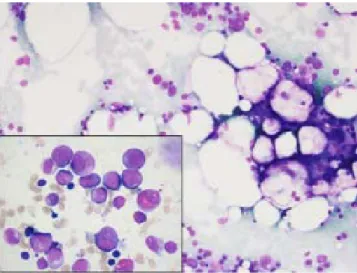
anti-biotics were initiated. A bone marrow aspiration showed agranulocytosis (Figure 1). He required granulocyte colo-ny stimulating factor (G-CSF) for 5 days, EPO and plate-let transfusions (Figure 2). Five days after admission, his neutrophil count recovered and, at last follow-up, the pa-tient has a normal blood cell count.
Case 2
This patient was a 64-year-old man without comorbid-ities and HCV infection (genotype 1b ILB28CT) with ad-vanced fibrosis (10.4 kilopascals) on transient elastography
Table 1. Main clinical and laboratory features at baseline and during follow-up.
PEGIFN a2 180 mg/wk + RBV 800 mg/day
RBV 1200 mg/day +
BOC SMV SOF 400 mg/day +
800 mg/8h 150 mg/day SMV 150 mg/day
Case 1 Case 2 Case 3 Case 4
Age 42 64 53 58
Gender Male Male Female Male
Charlson index 3.2 5.4 4.3 6.8
Features at baseline:
Hemoglobin (g/L) 153 167 167 109
Neutrophils (cell/μL) 4390 3590 6740 2250
Platelets (x109/L) 114 133 133 89
Reticulocyte (%) 0.2 0.1 <1 <1
Bilirubin (mg/dL) 0.58 0.64 0.60 0.37
Albumin (g/L) 43 38 43 25
INR 1.18 1.03 1.40 0.93
Liver stiffness (kPa) 20.9 (F4) 10.4 (F3) 27 (F4) 14.3 (F4)
CP score (points) 5 - 6 7
MELD (points) 8 - 13 9
Features at pancytopenia:
IPs therapy (wk) 12 12 24 12
Hematologic toxicity (wk) 12 12 4 6
Treatment interruption YES YES YES NO
Undetectable VL (wk) 8 4 4 4
Diagnostic AG A A Non-Hem An AG; Non-Hem An
BMB or BMA YES YES YES YES
Hb (g/L) 108 61 55 66
Neutrophils (cell/μL) 0 0 2000 600
Platelets (x109/L) 39 9 140 161
EPO agent Epoetin alfa Epoetin alfa Epoetin alfa Darbepoetin alfa
EPO agents (wk) 2 39 6 15
G-CSF (days of therapy) 5 40 0 135
RBC (units) 0 21 8 6
Platelets (units) 2 36 0 0
Complication Infection Septic shock - Infection (herpes)
(E. coli-anal fisure)
SVR 12/24wk YES NO YES YES
Outcome Recovered No response Recovered Death
(TE). Baseline tests were normal except for thrombocyto-penia (133 x 109/L). At week 4 after starting PR plus SMV, VL was undetectable. Hemoglobin levels dropped from 164 to 115 g/L, thus EPO alpha was started. At week 8,
neu-tropenia appeared (620 cells/μL) and G-CSF was given. At
week 12, blood tests showed severe pancytopenia with Hb of 75 g/L, neutrophils of 0 cells/μL and platelet count of 15 x109/L. HCV treatment was discontinued and red blood cells and platelet transfusions were initiated. The patient developed fever and was admitted to the hospital. Inten-sive fluid therapy and broad-spectrum antibiotic was start-ed. A bone marrow aspiration showed severe hypocellularity and a bone marrow biopsy confirmed the diagnosis of aplastic anemia. An extensive work-up was in-itiated and other causes of acquired bone marrow failure such us myelodysplastic syndrome, leukemia, megaloblas-tic anemia, paroxysmal nocturnal hemoglobinuria and viral hemophagocytic syndrome were excluded. Then, it is rea-sonable to associate antiviral treatment as the most plausi-ble cause of hematological toxicity in this case. Treatment with cyclosporine and prednisone was started at 21 days from admission. Though still pancytopenic, he was dis-charged after 49 days of hospitalization. At last follow-up, 8 months after discontinuing HCV treatment, he is still receiving immunosuppressive therapy, EPO and transfu-sions. Fortunately, VL remains undetectable.
Case 3
This patient was a 53-year-old woman with genotype 1a HCV-related cirrhosis with esophageal varices and cry-oglobulinemia. She had previously received a first course of PR developing severe anemia. Five years later, the pa-tient started RBV, SOF and SMV. At week 4, she achieved undetectable VL but anemia (Hb of 72 g/L) was found, re-quiring RBV dose reduction, red blood cell transfusion and EPO. At week 6, anemia worsened (Hb of 55 g/L) while neutrophils and platelets remained normal. Labora-tory tests excluded hemolysis and vitamin deficiency. RBV and SMV were withdrawn, and daclatasvir (DCV) was added to SOF. A bone marrow examination performed 5 days later, showed incipient recovery of erythroid precur-sor cells in bone marrow. Three weeks later, Hb levels re-turned to normal. She could finish 16 weeks of treatment maintaining undetectable VL and normal blood counts.
Case 4
This patient was a 58-year-old man with genotype 1b HCV cirrhosis associated to type 2 cryoglobulinemia with lymphoplasmacytic lymphoma. The patient had received rituximab for his lymphoma twice, both times reaching re-mission. He received a first course of PR without
show-Figure 1. Figure 1. Figure 1. Figure 1.
Figure 1. Bone marrow aspiration showing moderate hypocellularity and fat replacement. H&E, 200x. In the inset, promyelocytes and myelocytes consistent with early granulocytic recovery in bone marrow. H&E, 1000x.
Figure 2. Figure 2. Figure 2. Figure 2.
Figure 2. Hemoglobin (A)(A)(A)(A)(A), neutrophils (B)(B)(B)(B)(B) and platelets (C)(C)(C)(C)(C) profiles over a 20 weeks period from starting oral anti-hepatitis C triple therapy in case 1 with highlighted relevant clinical events. EPO: Erythropoietin. RBC: red blood cell units of transfusion. G-CSF: granulocyte colony stimulating factor.
140 120 100 80 60 40 20 0 180
120
60
0
5
4
3
2
1
0
0 2 4 6 8 10 12 14 16 18 20 Week of treatment
Hospital dischange EPO, RBC transfusions, GCSF Treatment stopped
Hospital admission A
AA A A
B BB B B
C CC C C
Hemoglobin (g/L)
Neutrophils (cells/μL)
ing viral response. Eight years later, treatment with SMV and SOF plus RBV was started. At week 4, he achieved un-detectable VL but developed grade 3 anemia. Dose of RBV was decreased and red blood cell transfusions and EPO were administrated. At week 6, the patient presented with
neutropenic fever (neutrophils of 600 cells/μL) and severe
anemia (Hb of 66 g/L). Broad-spectrum antibiotics plus G-CSF were started and RBV was stopped. Bone marrow aspiration ruled out recurrence of the lymphoproliferative disorder. White cells counts recovered in a week. At week 12, anti-HCV therapy was completed and anemia fully re-covered at week 15. Unfortunately, at week 23, the patient developed refractory status epilepticus secondary to an en-cephalitis by BK virus and died.
DISCUSSION
In the last few years, new antiviral agents have been ap-proved for the treatment of HCV, including first and sec-ond generation PIs. Several PIs-based regimens have improved antiviral efficacy but can cause severe adverse events (AEs) including bacterial infections and clinical
de-compensation of liver disease.9 In addition, severe
pancy-topenia and aplastic anemia during triple therapy,
including TVR, have been recently reported.7 This severe
toxicity has shown a high risk of mortality, being impera-tive the close monitoring of these patients. Recently, sec-ond generation PIs (SMV) have shown a better safety profile and lower risk of developing severe anemia than TVR, a first generation PI.10
IFN, in addition to its well-known antiviral effect, ex-erts antiproliferative activity on many cell types, including
hematopoietic cells.4 This property may lead to cytopenias
that can interfere with the successful clinical application of IFN.
In contrast, RBV is a cytotoxic agent and its accumula-tion in erythrocytes produces oxidative membrane dam-age, leading to an accelerated extravascular hemolysis by
the reticulo-endothelial system.11 At a low dose, it
de-creases half-life of red cells with a reversible effect when the drug is discontinued, and at high doses, RBV also
in-hibits the release of red cells from the bone marrow.12
However, only few cases of severe hematologic toxicity induced by IFN/RBV therapy have been reported in HCV patients after many years of use in the daily practice.13,14
We here report 4 cases of severe hematological toxicity in HCV patients receiving first or second generation PIs with or without IFN, but always with RBV. Interestingly, two of these cases receiving IFN-containing combination were also under BOC or SMV, a first and a second gener-ation PI, respectively.
Causes of hematological toxicity like drug toxicity (EPO, antibiotics, anti-inflammatory drugs,
anticonvul-sants), vitamin deficiency, autoimmune reactions, hemol-ysis, bone marrow infiltration or malignancy were ruled out by specific diagnostic test or absence of temporal rela-tionship. EPO-related anemia could also be discarded since all our patients fully recovered their red cell counts while maintaining EPO administration, and in addition, to the best of our knowledge, no other cytopenias have been reported with this agent.
Of note, all patients had advanced fibrosis or cirrhosis, but none of them was decompensated and only one of the
patients treated without IFN had platelets < 100 x 109/L
and albumin < 35 g/L at the beginning of treatment. In this study, we report 2 patients under triple therapy with PR and PIs who developed aplastic anemia or agran-ulocytosis, two life-threatening hematologic complica-tions. Interestingly, one patient was receiving BOC, first generation PIs and the other one SMV, a second genera-tion PI. Although the associagenera-tion with PIs cannot be total-ly proved, our observations suggest a sort of class-effect of PIs in the development of severe hematological toxicity. However, an alternative explanation could be an additive toxic effect of PIs to the well-known IFN/RBV hemato-logical toxicity or an interaction of the drug combination in susceptible patients.
It is known that genetic variants leading to inosine tri-phosphatase (ITPA) deficiency protect against hemolytic
anemia in HCV-infected patients receiving RBV,15 but the
mechanism sustaining severe anemia during PIs based therapy is still unknown. Recent reports investigating the molecular mechanisms of anemia in anti-HCV triple ther-apy have shown that TVR-S isomer concentration is
relat-ed to the concentration of RBV in plasma.16 It is supposed
that TVR can produce a boosting effect on plasma RBV and its intra-erythrocytic concentration, finally leading to a toxic effect. So that, it has been suggested a bimodal pat-tern: an early phase mainly due to acquired spherocytic-like hemolytic anemia and a late phase showing hyporegenerative features, most likely related to the
com-bined effects of PR and PIs on erythropoiesis.17
initiated severe bicytopenia at 6 weeks of starting thera-py. RBV was held in both patients, but SMV and SOF were maintained in one, and SMV was changed to DCV in the other. Although both patients required red blood cell transfusions and EPO, anemia rapidly improved in the following weeks.
This prompt recovery of anemia after RBV withdrawal in our patients suggests that RBV probably is the main causative agent of anemia in IFN-free regimens. Howev-er, given the low incidence of PRCA due to RBV in the literature and the resolution of anemia after changing SMV for DCV in our case 4, we cannot completely rule out a possible additive toxic effect of SMV. Considering the high antiviral activity of SMV and SOF, we suggest that RBV might be avoided with these new regimens, especial-ly in those patients with advanced liver disease and in those with mild cytopenias previous starting HCV
treat-ment.18 However, further studies are needed to evaluate
the role of RBV in these new IFN-free regimens.
These cases of severe and life-threatening adverse events have occurred in our center in a period of scarcely 2 years in which about 170 patients received treatment with PIs. This observation highlights an unexpected high incidence of hematologic toxicity, something not previ-ously observed by our group despite decades of treatment with PR. Moreover, these hematologic complications en-tail large amounts of health resources, including the use of support treatment with G-CSF and EPO, transfusions, broad spectrum antibiotics, antifungals and even long-term hospitalization. In order to optimize resource use, we recommend a close cooperation between hematology and hepatology teams,19 as we previously suggested.20
In conclusion, severe hematological adverse events in patients treated with PIs and RBV are more frequent than expected, an observation suggesting either a possible class effect of PIs in the development of these toxicities or an interaction to the drug combination in susceptible pa-tients. Given the life-threatening character of these com-plications in some patients, we highly recommend to promptly discontinue RBV if blood cells significantly drop and to avoid it in cases with increased risk of devel-opment of hematological toxicity. In addition, close coop-eration between hematologists and hepatologists is also advisable.
ABBREVIATIONS
• BOC: boceprevir.
• DCV: daclatasvir. • EPO: erythropoietin.
• G-CSF: granulocyte colony stimulating factor.
• Hb: hemoglobin.
• HCV: chronic hepatitis C virus.
• IFN: peg-interferon.
• ITPA: inosine triphosphatase. • Pis: protease inhibitors.
• PR: peg-interferon and ribavirin.
• PRCA: pure red cell anemia. • RBV: ribavirin.
• SAEs: serious adverse events. • SMV: simeprevir.
• SVR: sustained virological response.
• TE: transient elastography.
• TVR: telaprevir.
• VL: viral load.
AUTHOR CONTRIBUTIONS
ASe and TB have equally contributed as junior co-au-thors and ASa and JAC have equally contributed as senior co-authors. ASe, TB, ASa and JAC were involved in acqui-sition of data; analysis and interpretation of data; drafting the manuscript; critical revision of the manuscript for im-portant intellectual content.
SL, NC, MCL, MF, XF were involved in acquisition of data; critical revision of the manuscript for important intellectual content.
FINANTIAL SUPPORT
ASe is a recipient of a grant from the SEHH (Sociedad Española de Hematología y Hemoterapia).
ETHICS APPROVAL
The study was reviewed and approved by the Hospital del Mar Institutional Review Board.
INFORMED CONSENT
All study participants, provided informed written con-sent prior to study enrollment.
CONFLICT OF INTEREST
The authors declare no conflict of interest.
REFERENCES
1 McHutchison JG, Manns MP, Muir AJ, Terrault NA, Jacobson IM, Afdhal NH, Heathcote EJ, et al. Telaprevir for previously treated chronic HCV infection. N Engl J Med 2010; 362: 1292-303.
2. European Association For The Study Of The Liver. EASL Clinical Practice Guidelines: Management of hepatitis C virus infection. J Hepatol 2013; 63: 199-236.
chronic hepatitis C virus infection: a case report. J Med Case Rep 2010; 4: 268.
4. Hoffmann A, Kirn E, Krueger GR, Fischer R. Bone marrow hypoplasia and fibrosis following interferon treatment. In Vivo 1994; 8: 605-12.
5. Jacobson IM, McHutchison JG, Dusheiko G, Di Bisceglie AM, Reddy KR, Bzowej NH, Marcellin P, et al. Telaprevir for pre-viously untreated chronic hepatitis C virus infection. N Engl J Med 2011; 364: 2405-16.
6. Poordad F, McCone JJr, Bacon BR, Bruno S, Manns MP, Sulkowski MS, Jacobson IM, et al. Boceprevir for untreated chronic HCV genotype 1 infection. N Engl J Med 2011; 364: 1195-2206.
7. Lens S, Calleja JL, Campillo A, Carrion JA, Broquetas T, Perello C, de la Revilla J, et al. Aplastic anemia and severe pancytopenia during treatment with peg-interferon, ribavirin and telaprevir for chronic hepatitis C. World J Gastroenterol 2015; 21: 5421-6.
8. Hézode C, Fontaine H, Dorival C, Larrey D, Zoulim F, Canva V, de Ledinghen V, et al. Triple therapy in treatment-experi-enced patients with HCV-cirrhosis in a multicentre cohort of the French Early Access Programme (ANRS CO20CUPIC) -NCT01514890. J Hepatol 2013; 59: 434-41.
9. Londono MC, Perello C, Cabezas J, Canete N, Lens S, Marino Z, Gambato M, et al. The addition of a protease inhibitor in-creases the risk of infections in patients with hepatitis C-re-lated cirrhosis. J Hepatol 2015; 62: 311-16.
10. Ogawa E, Furusyo N, Kajiwara E, Nomura H, Kawano A, Takahashi K, Dohmen K, et al. Comparative safety study on severe anemia by simeprevir- versus telaprevir-based triple therapy for chronic hepatitis C. J Gastroenterol Hepatol 2015; 30: 1309-16.
11. De Franceschi L, Fattovich G, Turrini F, Ayi K, Brugnara C, Manzato F, Noventa F, et al. Hemolytic anemia induced by ribavirin therapy in patients with chronic hepatitis C virus in-fection: role of membrane oxidative damage. Hepatology 2000; 31: 997-1004.
12. Canonico PG, Kastello MD, Spears CT, Brown JR, Jackson EA, Jenkins DE. Effects of ribavirin on red blood cells. Toxi-col Appl PharmaToxi-col 1984; 74: 155-62.
13. Miura Y, Kami M, Yotsuya R, Toda N, Komatsu T. Pure red-cell aplasia associated with pegylated interferon-alpha-2b plus ribavirin. Am J Hematol 2008; 83: 758-9.
14. Tanaka N, Ishida F, Tanaka E. Ribavirin-induced pure red-cell aplasia during treatment of chronic hepatitis C. N Engl J Med 2004; 350: 1264-5.
15. Fellay J, Thompson AJ, Ge D, Gumbs CE, Urban TJ, Shianna KV, Little LD, et al. ITPA gene variants protect against anae-mia in patients treated for chronic hepatitis C. Nature 2010; 464: 405-8.
16. Cusato J, Allegra S, De Nicoló A, Boglione L, Fatiguso G, Mo-hamed Abdi A, Cariti G, et al. Intracellular and Plasma Trough Concentration and Pharmacogenetics of Telaprevir. J Pharm Pharm Sci 2015; 18: 171-6.
17. Lupo F, Russo R, Iolascon A, Ieluzzi D, Siciliano A, Toniutto P, Matté A, et al. Protease inhibitors-based therapy induces acquired spherocytic-like anemia and ineffective erythropoi-esis in chronic HCV patients. Liver Int 2016; 36: 49-58. 18. Lawitz E, Sulkowski MS, Ghalib R, Lawitz E, Sulkowski MS,
Ghalib R, Rodriguez-Torres M, et al. Simeprevir plus sofos-buvir, with or without ribavirin, to treat chronic infection with hepatitis C virus genotype 1 in non-responders to pegylated interferon and ribavirin and treatment-naive patients: the COSMOS randomised study. Lancet 2014; 384: 1756-65. 19. Romero-Gómez M, Berenguer M, Molina E, Calleja JL.
Man-agement of anemia induced by triple therapy in patients with chronic hepatitis C: challenges, opportunities and recommen-dations. J Hepatol 2013; 59: 1323-30.
20. Carrión JA, Gonzalez-Colominas E, García-Retortillo M, Cañete N, Cirera I, Coll S, Giménez MD, et al. A multidiscipli-nary support programme increases the efficiency of pegylat-ed interferon alfa-2a and ribavirin in hepatitis C. J Hepatol 2013; 59: 926-33.
Correspondence and reprint request:
Alicia Senín, M.D.
Department of Clinical Hematology, Hospital del Mar, 25-29 Passeig Maritim, 08003 Barcelona, Spain.