in Optical Networks with Particle Swarm
Optimization
Alcides B´aez∗ and Diego Pinto†
Catholic University of Encarnaci´on, Itap´ua Campus ∗[email protected]
National University of Asunci´on Politechnical School, San Lorenzo Campus
†
Abstract. Large bandwidth on hand in WDM networks is the best choice for increasing traffic demand; although, routing and wavelength assignment (RWA) problems still remain a challenge. This work proposes a novel method to solve multicast-RWA problems, using multi-objective Particle Swarm Optimization (PSO), implementing four competitive ap-proaches of state-of-the-art. Such algorithms minimize simultaneously the hop count, the number of splitting power light, the number of split-ter node and the balancing of multicast tree for a given set of multicast demands. This way, a set of optimal solutions (known as Pareto set) is obtained in one run of the algorithms, withouta priorirestrictions. Sim-ulation results prove the viability of the PSO proposal and the advantage compared on classical approaches as Multicast Open Shortest Path First routing algorithm and Least Used wavelength assignment algorithm.
1
Introduction
Wavelength Division Multiplexing (WDM) technology applied to optical net-works has largely solved the problem of underemployed bandwidth for fiber optics, what is especially useful in already large deployed infrastructure. WDM divides potential bandwidth in different wavelengths avoiding electronic bot-tleneck [1]. The selection of paths and wavelengths for the interconnection of source-destination pairs (lightpath) is another problem related to optical net-works. This problem is known as Routing and Wavelength Assignment (RWA). This work focuses on static traffic for Wide Area Networks (WANs), where changes in the reserved bandwidth only occur occasionally and there is no real time restriction; therefore, calculation may be afforded to find a good solution.
to solve a virtual static topology design [3]. Considering a restriction on the wave-lengths, they looked for an optimization of the generated traffic weighted sum, the hop count and other objective functions. In [4], Chlamtac et al. presented an evolutionary algorithm for the simultaneous optimization of the number of wavelengths and the mean delay, considering wavelengths and continuity con-flicts. Varela and Sinclair proposed a single-objective Ant Colony Optimization (ACO) approach for the routing problem, while the wavelength assignment is solved by means of a greedy method [13].
This work proposes the resolution of a more challenging problem,multicast Routing and Wavelength Assignment (multicast-RWA). Multicast-RWA is one central problem in Optical Telecommunication due to its use in different critical applications as high definition TV (HDTV), IP routing, traffic grooming and 1+1 optical layer protection [2]. In this context, the lightpath is generalized to a light-tree, seeking to optimize simultaneously: a) the hop count, b) the number of splitting power light, c) the number of splitter node and d) the balancing of light-tree under the minimal power light at destination and the wavelength con-tinuous constraints [2]. The most important approach that solved multicast-RWA problem, Xin and Rouskas [12], proposed a heuristic to balance multicast-tree subject to the minimal power light at destination and the wavelength continuous constraint.
For the resolution of a multicast-RWA, this work proposes to implement four competitive multi-objective PSO algorithms proposed by (1) Coello and Lechuga (CL) [7], (2) More and Chapman (MC) [8], (3) Hu and Eberhart (HE) [9] and (4) Mostaghim and Teich (MT) [10]. These PSO algorithms have been chosen due their proven success in solving different multi-objective combinatorial optimization problems [11]. In our best knowledge, the proposed approach to the problem in question has not been addressed yet.
The remainder of this work is organized as follows: section 2 presents the for-mal definition of a multi-objective optimization problem. The multicast-RWA problem formulation is given in section 3. The basic concept of PSO algorithm is shown in section 4, and the our approach is presented in section 5. The envi-ronment and experimental results are presented in section 6. Finally, section 7 gives the conclusions and guidelines for future research.
2
Multi-objective Optimization
A Multi-Objective Optimization Problems (MOP) generally consists of a set of
n decision variables, a set of k objective functions and a set of m restrictions [7]. Objective functions and restrictions are function of the decision variables. Therefore, MOP generally optimizes:
z=f(x) = (f1(x), f2(x), . . . , fk(x)) (1)
subject to
where x = (x1, x2, . . . , xn) ∈ X is a decision vector, X denotes the decision
space of f(x), z = (z1, z2, . . . , zk)∈ Z is an objective vector whileZ denotes
the objective space off(x). The feasible solution setΩ⊂X is defined as a set of decision vectors x that satisfies g(x). A vector u ∈ Ω is said to dominate
v ∈ Ω (denoted by u ≻ v) if u is at least as good as v in every objective function and strictly better in at least one objective function. For a given MOP, the Pareto optimal set P∗ is defined as the set of non-dominated solutions of Ω. The objective space of P∗, known as Pareto Front, is denoted as P F∗, i.e. P F∗=f(P∗).
Performance figures [7] used in this work aim to compare different approaches in a multi-objective context, and are presented following next:
Contributed Solution: CSa=|P Fa∩P F∗|/|P F∗| (3)
Values of CSa close to 1.0 indicates that many solutions from P Fa belong to P F∗, where P F
a is a Pareto Front calculated by algorithm a.
Extension: EXa = b
X
i=1
max(d(pi, qi))|p, q∈F Pa
!1/2
(4)
wherebis the number of objectives andd(p, q) is Euclidean distance between two points in the objective space. In general, an algorithm whose calculated front obtains the highest value in thisEXa metric is the best one.
Error: ERa= 1−(|P Fa∩P F∗|)/(|P Fa|) (5)
If all solutions ofP Fa belong toP F∗ then the error ofP Fa is zero.
3
Problem Formulation
In the present work an optical network is modeled as a graph G = (V, E, C), where V is the set of nodes, E the set of optical links between a pair of nodes andC the set of wavelengths available for each link belonging toE. Let:
cij∈C maximum number of available wavelengths at link (i, j)∈E; m= (s, D) multicast requestmwith source nodesand destination nodesD,
wheres∈V andD⊂V −s;
M set of multicast requests,M ={m1, m2, . . . , m|M|}
| · |denote cardinality;
lm light-tree connecting a nodesto a set of destination nodes D
with a wavelength assigned to each link;
λlmij wavelengthλassigned to link (i, j)∈lm;
pathsd(m) path between a source node and a destination node of requestm;
note thatpathsd(m)⊂lm;
ptm power of transmitted light by source nodes∈m;
it is possible consideredptm= 1 as normalized value. prm(d) power of received light in a destination noded∈Dm;
pmm average of power light received in set of destination nodeDm,
i.e.pmm=|Dm1 |
P
d∈Dmprm(d).
A multicast-RWA problem can be expressed as a MOP searching for the best solutionLM which simultaneously minimize the following objective functions:
1- Hop Count:
y1=
X
m∈V
|lm| (6)
2- Number of Splitting:
y2=
X
i∈V;lm∈LM
ϕlmi where ϕlmi =
1 if nodeiis a bifurcation node oflm
0 otherwise
(7) 3- Number of Splitter Node1:
y3=
X
i∈V;lm∈LM
&
ϕlmi
|LM|
'
(8)
4- Balancing of light-trees:
y4=maxm∈M{σm} where σm=
1 |Dm|
X
d∈Dm
(prm(d)−pmm)2 (9)
Subject to optical layer constraint:
a. Wavelength assigned:two multicast requests can not be assigned with the same wavelengthλon the same optical link (i, j):
λlmaij 6=λlmb
ij ∀(i, j)∈E (10)
b. Wavelength continuity:the same wavelengthλ should be assigned on all optical link of light-tree:
λ=λlmij ∀(i, j)∈lm (11)
c. Minimal power at destination:the power light received at destination node should be bigger than the minimum power sensitivity (prmin) defined by optical
technology [12]:
prm(d)≥prmin,∀d∈m∧ ∀m∈M (12)
In general,prm(d)≤ptm because the splitter nodes divide the power light
according at number of exit branches. This loss of power is solved partially by power amplifier [2].
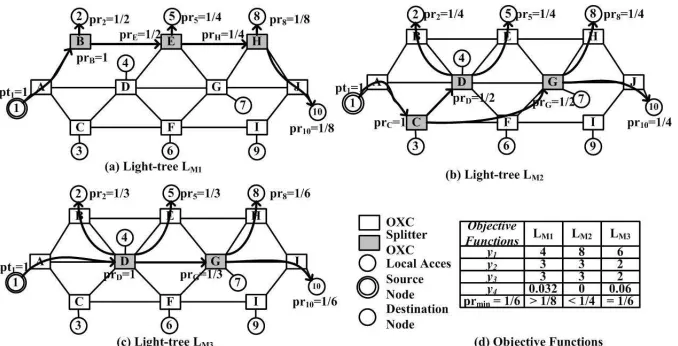
The following example is presented to clarify the problem formulation and the objective functions. Figure 1 shows a small optical network with possible
1
solutions LM for a multicast requestsM ={m}, wherem={{0},{2,5,8,10}}.
Table 1.d summarizes the calculations for the objective functions (equation 6 to 9). Notice that, a simple node without splitting is called OXC (Optical Cross-Connect) [2].
Fig. 1. Routing and wavelength assignment for LM. Note that light-tree LM1 does
not have the minimum of power light and became a unfeasible solution (pr8< prmin). Light-treesLM2andLM3got a good power light on their destination node, additionally,
their are trade-off solutions. On stage (a), the nodes B, E and H are splitter nodes and that divide the input power received where we can see from the minimum power at the nodes 8 and 10 (pr8=pr10= 1/8).
4
Particle Swarm Optimization
PSO metaheuristic is a class of algorithm inspired in the foraging behavior of swarm of different animal species as fishes, birds and others [11]. PSO proved to be successful in the resolution of combinatorial optimization problems [8]-[11]. For a mono-objective optimization approach, the basic elements for an PSO algo-rithm attiteration are: a population of current particlesPt=nxt
1, xt2, . . . , xt|P|
o
, a memory of best solutions calculated by each particle in its history Pt
lb =
n
yt
1, y2t, . . . , y|tP|
o
and the global best solution st
global calculated by all
parti-cles. A particle is a position in the decision space given by coordinates whose new position is made in two steps: first, it calculates a particle velocity and next it is obtained a new particle according following equation (see [8]-[11]):
vt+1
xt+1
i =xti+v t+1
i ∀i∈ {1,2, . . . ,|P|} (14) v is the particle velocity,r1 andr2 are random numbers between (0, 1),c0is an inertial factor,c1andc2are learning factors. Typically,c0 = 1,c1 =c2= 2 [8].
5
Proposed Approach
When a multi-objective optimization problem (MOP) is considered, PSO algo-rithm is extended to multi-objective PSO (MOPSO) approach [8]-[11]. The main difference between PSO and MOPSO is a set of solutionsP F which stores better solutions in trade-off, i.e. let bes, s′ ∈F P then s6≻s′ ands′ 6≻s. Ideally, the P F set is near to Pareto Front at end of an iteration.
PSO and MOPSO are optimization approaches of general purpose. To solve a multicast-RWA problem, each particle should represent a set of light-trees or a solutionLM. In this context, it is necessary to define a structure of particle and
and how to calculate a new solutionLM. This work proposes a novel approach
to generate a new light-tree based in the PSO concept but in a constructive way. This mechanics is different to the classic PSO for continuous problems given in equations (13) and (14). Let be: Lc
M a current solution, LlM a best local
solution,LgM a best global solution, andY ϕ
mij a binary variable. If (i, j)∈lmϕij
thenYmijϕ = 1 and otherwiseYϕmij = 0 consideringϕ∈ {current, local, global}.
A new light-treeLnew, for a set of multicast request M, is obtained according to Algorithm 1.
Basically, theMulticast-PSOalgorithm constructs a new light-tree beginning at a source node and then adds new links up to all destination nodes. In this construction process, each link is selected according to the probability obtained by the weights assigned. The weight of a link (kij,(i, j) ∈ E) depends on the
cognitive factors (c0, c1, c2) and the number of trees that the link belongs. All optical layer constraints (equations (10) to (12)) are satisfied in the process (see line 10 Algorithm 1).
Considering the above described, the following Algorithm 2 shows the per-formance of a generic MOPSO. In each iteration it builds a new set of solutions which replaces the old solutions (line 11). Depending on the MOPSO algorithm implemented, a solution LgM is selected from the set of Pareto Front F Pknown
in line 8. A new set of solution Pnew is calculated iteratively using
Multicast-PSO algorithm (line 7 to 9). After being assessed the new set of solutions, they updated the best set of solutionsPlocal and the Pareto FrontP Fknown. Finally,
when the end-condition is reached, the algorithm returns a set of good solutions given for theP Fknown. For space constraint, details on MOPSO approaches
im-plemented (CL, MC, HE, MT) and MOSPF-LU (state-of-the-art) will be omitted (see references [7]-[10]).
6
Environment and Experimental Results
Multicast-PSO[G,M,Lc
M,LlM,L g
M,c0,c1,c2,prmin] 1: Lnew← ⊘
2: for allm∈M do
3: Assign tolnew
m a wavelength (λ
′
) least used 4: R← ⊘,R←sm
5: for all(i, j)∈E do
6: kij←1 +c0·Ymijc +c1·Ymijl +c2·Ymijg /* assign weights
7: whileR6=⊘andDm6⊂lnewm do 8: n←Randomly to select a node of R 9: for alli∈V do
10: if (n, j)∈/lnew
m and (n, j)λ′ = free andprm(j)≥prminthen
11: Nn←Nn∪i
12: if Nn=⊘then
13: R←R−n/* delete node without valid neighborhood nodes
14: else
15: Calculate of selection probabilityP r(j∈Nn) =knj/(Pg∈Nnkng)
16: Select a nodet∈Nn by the roulette method /* see [7]
17: lnew
m ←lnewm ∪(n, t) /* building the tree 18: Delete links (i, j)∈lnew
m not used in any path (pathsd(m)) 19: Lnew←Lnew∪lnew
m 20: return Lnew
Algorithm 1: Pseudocode for Multicast-PSO approach proposed by this paper.
MOPSO[G,M,c0,c1,c2,prmin] 1: Initialize randomlyPcurrent
2: UpdatePlocalwith particles ofPcurrent 3: F Pknown← ⊘
4: UpdateF PknownwithPcurrent 5: whileend-condition = falsedo
6: Pnew← ⊘
7: for alli∈ {1,2, . . . ,|P|}do
8: Select a solutionLgM ofF Pknown
9: BuildPnew(i) according toPcurrent(i),Plocal(i) andLgM{Multicast-PSO} 10: Evaluatey= (y1, y2, y3, y4) of thePnew
11: UpdatePlocalwith particles ofPnew 12: UpdateF Pknownwith particles ofPnew 13: Pcurrent←Pnew
14: return F Pknown
compiler v4.9.9.2. The MOPSO algorithms implemented are: (1) Coello and Lechuga (CL) [7], (2) More and Chapman (MC) [8], (3) Hu and Eberhart (HE) [9] and (4) Mostaghim and Teich (MT) [10]. Furthermore, in order to verify the effectiveness of the implemented algorithms, classical algorithms reported in the literature were also implemented: the Multicast Open Shortest Path First (MO-SPF) routing algorithm and Least Used (LU) wavelength assignment algorithm [5].
For simulations, we considered three sets of multicast demandsM for low, half and high load and five classical networks topologies [14]: (a) GINAnet (15 nodes and 44 links), (b) NSFnet (14 nodes and 42 links), (c) EUROFRANCEnet (43 nodes and 75 links), (d) ARPANET (21 nodes and 25 links) and (e) NTTnet (55 nodes and 69 links). This is a total 15 different instances. In each network topology was considered 10 wavelength per fiber (cij = 10 ∀(i, j)∈ E). The
following default parameters were used:|P|= 20 particles andc0=c1=c2= 1 adopted experimentally. For all algorithms the stop criterion was 100 iterations. A set of near optimal solutions (F Pknown) was found for each multicast set M by means of the following procedure:
1. each algorithm was run 5 times;
2. each solution of those 5 runs was saved in a set;
3. all dominated solutions were deleted from this set, creating a set F Pknown
that may be considered as a good approximation ofF P∗(Pareto Front true).
In order to measure the quality of the solutions calculated by algorithms in 5 runs, each solution setM from each run was compared againstF Pknown. Note
that, all experimental test consist of 375 runs in total (3 loads, 5 topologies, 5 algorithms and 5 runs).
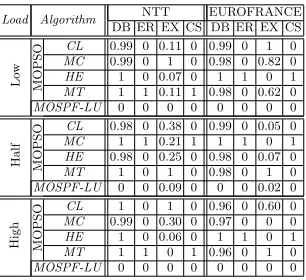
The experimental results to small network topologies are shown in Table 1 while the Table 2 presents the results for large network topologies. Average results for all experimental are exposed in Table 3. The best value corresponds to one in all result tables (normalized values). Destination nodes blocked correspond to column DB. Other columns indicate figures performances (ER, EX, CS) that were presented in Section 2.
Table 1.Experimental results for different traffic loads and small networks.
Load Algorithm GINA NSF ARPANET
DB ER EX CS DB ER EX CS DB ER EX CS
Lo
w
MOPSO
CL 1 0.14 1 1 1 0.02 0.79 0.71 0.96 0.41 0.66 0.41
MC 1 0.12 0.97 0.89 1 0 1 0.63 1 0.33 0.30 0.33
HE 1 0.12 0.82 0.84 1 0.03 0.81 0.75 1 0.98 0.89 0.98
MT 1 1 0 0 1 1 0 0 1 1 1 1
MOSPF-LU 0 0 0 0 1 0.08 0 1 0 0 0 0
Half MOPSO
CL 1 0.43 0.61 1 1 0.15 0.81 1 0.92 1 0.31 1
MC 1 0.32 1 0.73 1 0.13 1 0.91 0.92 0 0.38 0
HE 1 0.27 0.51 0.63 1 0.14 0.73 0.93 0.84 0 0.69 0
MT 1 1 0 0 1 1 0 0 1 0 1 0
MOSPF-LU 0 0 0.53 0 0 0 0.32 0 0 0 0.22 0
High MOPSO
CL 0.35 0 0.49 0 0.86 0 0.08 0 1 1 0.68 1
MC 0.95 0.10 1 1 0.96 0.10 1 1 0.96 0 0 0
HE 0.72 0 0.10 0 0.87 0 0.32 0 0.95 0 0.42 0
MT 1 1 0 0 1 1 0 0 0.93 0 0.39 0
[image:9.612.233.386.299.439.2]MOSPF-LU 0 0 0 0 0 0 0.44 0 0 0 1 0
Table 2.Experimental results for different traffic loads and large networks.
Load Algorithm NTT EUROFRANCE
DB ER EX CS DB ER EX CS
Lo
w
MOPSO
CL 0.99 0 0.11 0 0.99 0 1 0
MC 0.99 0 1 0 0.98 0 0.82 0
HE 1 0 0.07 0 1 1 0 1
MT 1 1 0.11 1 0.98 0 0.62 0
MOSPF-LU 0 0 0 0 0 0 0 0
Half MOPSO
CL 0.98 0 0.38 0 0.99 0 0.05 0
MC 1 1 0.21 1 1 1 0 1
HE 0.98 0 0.25 0 0.98 0 0.07 0
MT 1 0 1 0 0.98 0 1 0
MOSPF-LU 0 0 0.09 0 0 0 0.02 0
High MOPSO
CL 1 0 1 0 0.96 0 0.60 0
MC 0.99 0 0.30 0 0.97 0 0 0
HE 1 0 0.06 0 1 1 0 1
MT 1 1 0 1 0.96 0 1 0
MOSPF-LU 0 0 0 0 0 0 0 0
Table 3.Average of all experimental.
Algorithm DB ER EX CS Ranking
CL 0.94 0.35 0.96 0.82 0.77
MC 0.99 0.34 1 1 0.83
HE 0.97 0.39 0.64 0.82 0.70
MT 1 1 0.68 0.40 0.77
MU 0.07 0.01 0.31 0.13 0.13
7
Conclusions and Future Work
in all tested cases. In particular, no MOPSO algorithm is superior when the all multi-objective performance figures are considered.
Even though the feasibility of using PSO based algorithms was clearly es-tablished for the multicast-RWA problem, a lot of work remains to be done for other topologies and different traffic demands. Also, comparisons of the proposed methods to other metaheuristics and integer linear programming could be done. Furthermore, other objective functions as the quantity of transceivers may also be easily optimized with the proposed approach.
References
1. A. Hamad, and A. Kamal, “A survey of multicasting protocols for broadcast-and-select single hop networks”, IEEE Network16(4), 36–48 (2002).
2. G. Rouskas, “Optical Layer multicast: rationale, building blocks, and challenges”, IEEE Network17(1), 60–65 (2003).
3. M. Saha, and I. Sengupta, “A genetic algorithm based approach for static virtual design in optical networks”, in Proc. of IEEE Idicom 2005 Conference, (Chennai, India, 2005).
4. I. Chlamtac, A. Ganz, and G. Karni, “Lightpath com-munications: an approach to high bandwidth optical wans”, IEEE Transactions on Communications 4(5), 1171-1182 (1992).
5. B. Mukherjee, D. Banerjee, S. Ramamurthy, and A. Mukherjee, “Some principles for designing a wide-area wdm network”, IEEE/ACM Transactions on Networking
4(5), 684-696 (1996).
6. N. Banerjee, V. Metha, and S. Pandey, “A genetic algorithm approach for solving the routing and wavelength assignment problem in wdm network”, inProceedings of 3rd IEEE/IEE International Conference on Networking, (Paris, France, 2004), pp. 70–78.
7. C. Coello and M. S. Lechuga. MOPSO: A Proposal for Multiple Objective Particle Swarm Optimization. In Congress on Evolutionary Computation (CEC2002), vol. 2, pp. 1051-1056, Piscataway, New Jersey, 2002.
8. J. Moore and R. Chapman. Application of Particle Swarm to Multiobjective Op-timization. Department of Computer Science and Software Engineering, Auburn University, 1999.
9. X. Hu and R. Eberhart. Multiobjective Optimization using Dynamic Neighbor-hood Particle Swarm Optimization. In Congress on Evolutionary Computation (CEC2002), vol. 2, pp. 1677-1681, Piscataway, New Jersey, 2002.
10. S. Mostaghim and J. Teich. Strategies for Finding Good Local Guides in Multiob-jective Particle Swarm Optimization (MOPSO). In 2003 IEEE Swarm Intelligence Symposium Proceedings, pp. 26-33, Indianapolis, Indiana, USA, 2003.
11. J. Lima and B. Bar´an. Applied of Particle Swarm Optimization to the bi-objective Traveling Salesman Problem. VIII Argentine Symposium on Artificial Intelligence 2006 ASAI-2006, Mendoza, Argentina, September 2006, (in Spanish).
12. Y. Xin and G. N. Rouskas. Multicast Routing under Optical Layer Constraint. IEEE INFOCOM 2004, Hong Kong, March, 2004.
13. G. Varela, and M. Sinclair, “Ant colony optimization for virtual-wavelength-path routing and wavelength”, inProceedings of Congress on Evolutionary Computation, (Washington, USA, 1999), pp. 1809-1826.