Problem Based Learning and Software
Simulation Tools: A Case of Study in Computer
Science First Year Students
Javier Giacomantone1, Tatiana Tarutina2, and Armando De Giusti1 1 Instituto de Investigaci´on en Inform´atica (III-LIDI),
Facultad de Inform´atica - Universidad Nacional de La Plata
{jog,degiusti}@lidi.info.unlp.edu.ar
2 Departamento de F´ısica, Facultad de Ciencias Exactas
Universidad Nacional de La Plata
Abstract. In this work an adapted problem based learning strategy is presented for the particular case of first year computer science univer-sity students. A pilot study was conducted to determine the validity of the proposed alternatives in one particular undergraduate course, Com-puter Organization. The main problems detected in first year students involve deficiencies in the learning process, resulting in a lack of critical thinking and problem solving skills that are essential in Computer Sci-ence related disciplines. The main objective of testing different models, through problem based oriented learning alternatives and intensive use of simulation software, was to assess how students develop self learning, problem analysis, problem solving and communication skills.
Keywords: Problem based learning, software simulation, cooperative learning, computer organization
1
Introduction
Graduates of computer science programs are expected to face scientific and tech-nological advances and to be able to solve problems in scientific research or in-dustry. It means that self-learning skills, creative thinking, cooperative work, and communication skills are needed [1]. Their acquisition is a gradual process that is posible to achieve trough a self-directed learning and lifelong learning process. It is a challenge for a teacher not only to develop their own subject material but to promote and guide the student to develop these fundamental abilities.
results of a pilot pedagogical experience that has been carried out in a first year course, Computer Organization. The main objective of this work was to test the influence of different learning strategies and the use of software simulation tools, in a more deep approach to learning, where students have more control and responsibility over the learning process [4]. Computer Organization is a course in the first year of a Computer Science degree program at University of La Plata, Argentina. It covers fundamental topics such as number systems and number representation, digital circuits, Von Neuman model, basic concepts of digital memories and an introduction to assembly programming language. This introductory course aims to provide strong foundations to allow the students to understand, and effectively solve problems in a field that has a high rate of technology change.
A traditional learning strategy (TLS) consists of three hour theoretical lec-tures and three hours of problem solving a week during a semester. In this work an alternative thread is proposed oriented to problem based learning (PBL)[5], [6] and intensive use of software simulation tools [7], called modified new learn-ing strategy (MNLS). A pilot experience was carried out in two stages. The first stage evaluated the results of TLS and a new learning strategy (NLS) that produced valuable information for the second stage approach (MNLS).
This paper is organized as follows: Section 2 briefly describes the main ideas behind PBL approaches. Section 3 presents the particular case of study. In sec-tion 4 results are presented. Finally conclusions and future works are given in section 5.
2
PBL and Principal Constrains
Important developments in Computer Science and engineering education in re-cent years has been oriented to Problem-based learning strategy (PBL) [8], [2], [1], [9]. PBL was first applied in the Medicine School at McMaster Univer-sity (Canada) as an innovative educative proposal. Although it was successfully adopted by other prestigious medical schools like Harvard Medical School, the particularities and necessary adaptations to engineering and computer science programs remains an active research area.
A traditional simplified teaching scheme involves theoretical knowledge first taught to the students followed by practical lectures explaining how to solve problems applying the previously learnt theoretical concepts. Finally the teacher sets an exam to test the basic knowledge and skills acquired by the students. The main characteristics of TLS are to set the teacher as the transmitter of linear and rational knowledge and the student as a passive receiver defining a structure environment of individual learning. The assessment responsibility resides entirely on the lecturer.
to short term surface learning. In a PBL approach, small groups of students work collaboratively to solve a particular problem, with no previous preparation, with the student being the center of the learning process, constructing knowledge as an active participant in a flexible and cooperative environment. The teacher guides and facilitates the whole learning scheme. The assessment is now shared among the student, the group and of course the teacher. PBL promotes self-learning, developing problem-solving skills, cooperative self-learning, and improving oral and written communication.
Certain constrains or boundary conditions should be addressed before any attempt to apply PBL, an adapted PBL scheme or a mixture method between TLS and PBL could be applied to a particular course. One of the important con-strains is the number of students, as PBL requieres small groups, and therefore, problems or projects need to be designed carefully involving many resources. It has been pointed out that open end problems are recommended from the begin-ning, reinforcing the main characteristics of PBL. Nevertheless if PBL is to be applied to a first year undergraduate level [11], no technical background or par-ticular skill should be assumed and a work example strategy [12] and progressive difficulty tasks [13] would be more convenient.
3
Case of Study: Computer Organization
Computer Organization is a course held in the first semester of the first year of the Computer Science program. This article describes results based on a pilot experience developed to test two different learning strategies.
The first and second stages of this study were based on a set of selected topics of the course syllabus where students presented mayor difficulties to model and solve problems. The first stage of the experiment was carried out with two groups of 30 students. The first group was named Traditional Learning Strategy group (TLS) and was the control group. The TLS group assisted a 3 hour formal lecture once a week and another 3 hour solving problems class a week. These students learned theoretical concepts and received instruction how to understand and solve specific related problems.
The second group of 30 students was divided into five teams and followed another course thread named new learning strategy (NLS). The NLS group was faced with more general problems and was challenged to work collaboratively in each of the five teams to solve them. In order to find a solution to the proposed problem they needed to build up the necessary body of theoretical concepts, search bibliography and organize the work among them. Finally each group had to present their results. The teacher guided the work, but the learning was centered in the student. The problems in TLS test how previously learnt theoretical concepts are applied to them. The problems in NLS help to develop the necessary skills and build the required background knowledge.
the different ideas of each member about previous knowledge necessary to solve the problem. When an attempt to explain the task and the specific problem is done the team had to specify, search and study all the new knowledge necessary to solve the problem. A posible solution is a result of repeating this process where two fundamental steps are feedback and brainstorming, a term used to define the discussion and exchange of ideas and hypothesis within the group. The tasks were carefully prepared not only to study the fundamental topics of interest in Computer Organization but also to use intensively the software simulation tools both to explore posible solutions and to grasp theoretical concepts.
The second stage also had two groups of 30 students but a different or mod-ified new learning strategy (MNLS) was adopted based on the results of the first stage. Two main modifications were included, a worked example approach and a more gradual transition difficulty level between tasks [14]. A project was included as an additional task integrating previous concepts rather than an adapted Project Based Learning strategy (PjBL). Finally in the second stage a rotation team membership was included to balance the leadership tendency.
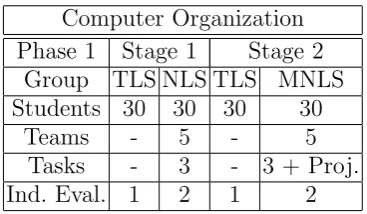
In table 1 the characteristics of the groups on stage 1 and stage 2 are sum-marized.
[image:4.595.216.400.536.643.2]The traditional learning thread suggested two optional software simulation tools to be used by the students. NLS and MNLS groups extensively used a dig-ital circuit design software, Digdig-ital Works demo version, written by D. J. Barker at the University of Teesside and a didactic graphical simulator, called MSX88, based on Intel 8086 family [15]. Recent research has shown the convenience of an integrated software simulation tool for Computer Organization and Architecture [7]. Further research is necessary to establish the particular needs of a similar tool for Computer Organization under a particular learning scheme like MNLS. An ideal design of these pedagogical alternatives should consider independent groups each one following a particular thread such as TLS, NLS or MNLS , and particular resources assigned to each one. In the first phase consisting of stages one and two, the main objectives were to gather information in order to, in a future second phase, improve the learning approach under more controlled experimental conditions.
Table 1.Group Characteristics
Computer Organization
Phase 1
Stage 1
Stage 2
Group TLS NLS TLS MNLS
Students 30
30
30
30
Teams
-
5
-
5
Tasks
-
3
-
3 + Proj.
4
Learning Results and Student Feedback
The assessment scheme had three parts: independent evaluation, student feed-back and comparative tests. First, continuous and progressive evaluation was carried out with NLS and MNLS student groups. It was continuous because the evaluation was carried out at the end of each different proposed task, and progressive because the later tasks and the final project had more weight than the earlier ones. The main objective of progressive test was to determine how efficiently the accumulative skills were acquired.
Second, students were asked to complete an anonymous questionnaire to summarize their opinion of the learning experience. Finally, an exam with the same set of problems was presented both to NLS, MNLS and to the control groups. The tests were carefully designed not to alter the normal schedule of the course and not to overload the students subject to the experience with activities. The purpose was to evaluate certain learning strategy adapted to the particular case of study and to a particular restrictive set of students.
Table 2 presents partial results for the five teams of students and three tasks of stage 1. Stage 2 included a final project and an individual evaluation was carried out in both stages.
Table 2.Evaluation results on stage 1 and stage 2
Teams
Stage 1 (NLS)
Stage 2 (MNLS)
A-I-T A-I-T
Task-1 Task-2 Task-3 Task-1 Task-2 Task-3 P NLS MNLS
T1
B
C
B
B
B
A
B
4
5
T2
D
C
B
C
B
B
B
2
5
T3
B
B
A
A
B
A
A
6
6
T4
C
B
A
B
D
B
B
4
4
T5
C
C
B
A
A
B
B
5
5
Approved Individual Test
70 % 83 %
Fail Individual Test
30 % 17 %
was necessary to balance the intervention of more outspoken students as well as to facilitate the discussion.
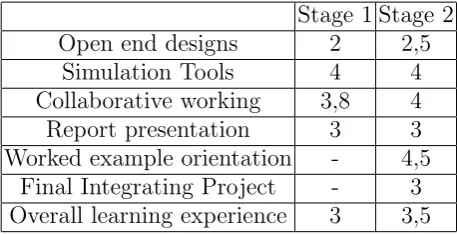
Table 3.Average marks from students opinion. The scale from 0 to 5 is used.
Stage 1 Stage 2
Open end designs
2
2,5
Simulation Tools
4
4
Collaborative working
3,8
4
Report presentation
3
3
Worked example orientation
-
4,5
Final Integrating Project
-
3
Overall learning experience
3
3,5
The information on students learning experience came from the teacher con-structive communication with each group and from an anonymous questionnaire completed by the students. Moreover, the list of five statements was presented to the students of stage 1 that they had to mark from 0 to 5 indicating their agreement about the contribution to the learning experience from negative to positive respectively. Students of stage 2 had two more statements that corre-spond to additional activities that were included in the second stage. The results are given in table 3.
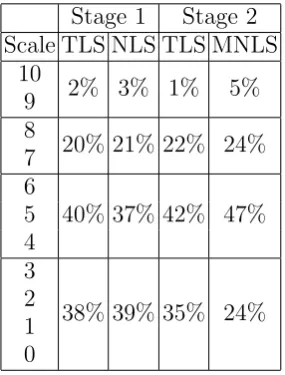
Individual evaluation of each student to solve particular problems was carried out among TLS, NLS and MNLS and the results are summarized in table 4 indicating the percentage of students of each group that obtained a mark on a scale from 1 to 10 with 4 being the minimum mark needed to approve the exam. The MNLS group obtained the better grades than TLS in both stages. A detailed analysis of each of the exercises and the obtained results revealed that in TLS groups good results were correlated with similar problems to the ones taught in the traditional lecture scheme but failed when a new situation that needs the same background knowledge were presented. The students of MNLS group were able to identify this uncorrelated type of problem and model a solution based on their background knowledge.
5
Conclusions and Future Work
This paper discusses a PBL approach particularly adapted to study Computer Organization in a first year Computer Science degree. Comparing results with non-PBL strategy reveals that average grades were higher than in the traditional learning group, especially in stage 2 greatly improved by the feedback of stage 1.
Table 4.Results of individual evaluation gathered by groups. The scale indicates that students with the mark below 4 didn’t pass the individual exam
Stage 1
Stage 2
Scale TLS NLS TLS MNLS
10
9
2% 3% 1%
5%
8
7
20% 21% 22% 24%
6
5
40% 37% 42% 47%
4
3
2
1
0
38% 39% 35% 24%
apply any PBL related method. In stage 2 the problems presented to the student were prepared with increasing level of difficulty and using worked examples.
The presented case of study indicates that PBL can be successfully applied to first year students improving basic problem model and solving skills. It has been observed that students in the MNLS group were motivated and developed self-driven learning skills.
Future work involves evaluating the proposed method for larger number of students, improving the progressive complexity criteria on tasks and including simulation tools for the particular need of Computer Organization students, like number system representation software simulation and educational simplified architecture software simulator. Further research should consider working with independent groups for TLS and MNLS not only for the preselected topics but for the complete course syllabus.
References
1. Costa, L.R.J, Honkala, M., Lehtovuori A.: Applying the Problem-Based Learning Approach to Teach Elementary Circuit Analysis. IEEE Transactions on Education, vol. 50, No. 1, 41–48 (2007)
2. Garc´ıa Famoso, M.: Problem-based learning: a case study in computer science. Proceedings of the Third International Conference on Multimedia and Information Technologies in Education, 817–821, Spain (2005)
3. Dattatreya, G.R.: A Systematic Approach to Teaching Binary Arithmetic in a First Course. IEEE Transactions on Education, vol. 36, No. 1, 163–168 (1993)
5. Schmidt, H. G.:Problem-based learning: Rationale and description. Medical Edu-cation, vol. 17, 11–16 (1983)
6. Ditcher, A. K.:Effective teaching and learning in higher education, with particular reference to the undergraduate education of profesional engineers. International Journal of Engineering Education, vol. 17, No. 1, 24–29 (2001)
7. Garc´ıa, M.I., Rodr´ıguez, S., P´erez, A., Garc´ıa A.: p88110: A Graphical Simula-tor for Computer Architecture and Organization Courses. IEEE Transactions on Education, vol. 52, No. 2, 248–256 (2009)
8. Linge, N., Parsons, D.: Problem-Based Learning as an Effective Tool for Teaching Computer Network Design. IEEE Transactions on Education, vol. 49, No. 1, 5–10 (2006)
9. Montero, E., Gonz´ales, M.J.: Student Engagement in a Structured Problem-Based Approach to Learning: A First Year Electronic Engineering Study Module on Heat Transfer. IEEE Transactions on Education, vol. 52, No. 2, 214–221 (2009) 10. Schmidt, H. G.:Foundations of problem-based learning: some explanatory notes.
Medical Education, vol. 27, 422–432 (1993)
11. Noor, M.:Implementing a problem based learning for undergraduate course: A first experience. The Learning Conference. Institute of Education, University of London, UK (2003)
12. Sweller, J.:The worked example effect and human cognition. Learning and Instruc-tion, vol. 16, No. 2, 165–169 (2006)
13. Merill, M. D.:A Task-Centered instructional Strategy. Journal of Research on Tech-nology in Education, vol. 40, No. 1, 33–50 (2007)
14. Sweller, J.:Cognitive load during problem solving: Effects on learning. Cognitive Science, vol. 12, No. 2, 257–285 (1988)