Outcomes for Cirrhotic Patients with Hepatitis C Virus 1b
Treated with Asunaprevir and Daclatasvir Combination
Akihiro Tamori, Hoang Hai, Sawako Uchida-Kobayashi, Masaru Enomoto, Ritsuzo Kozuka, Hiroyuki Motoyama, Etsushi Kawamura, Atsushi Hagihara, Yuga Teranishi, Kanako Yoshida, Hiroyasu Morikawa, Yoshiki Murakami, Norifumi Kawada
Department of Hepatology, Osaka City University Graduate School of Medicine, Osaka, Japan. September-October, Vol. 16 No. 5, 2017: 734-741
INTRODUCTION
Chronic hepatitis C (CHC) stemming from infection with the hepatitis C virus (HCV) affects ~170 million people worldwide and is the most common cause of chronic liver disease. Of all HCV-infected individuals, 20-30% eventually develop liver cirrhosis or hepatocellular carcinoma (HCC).1 The elimination of HCV is important
for preventing HCC, particularly in aged patients with ad-vanced fibrosis or CHC.2,3
Since 2010, direct-acting antiviral (DAA) regimens with or without interferon (IFN) have been evaluated and ap-proved for anti-HCV therapy. In Japan, the protease inhib-itors telaprevir, simeprevir, and vaniprevir have been approved for use as DAA combination therapy with pegylated interferon and ribavirin.4-7 Asunaprevir (ASV)
and daclatasvir (DCV) combination therapy was devel-oped as the first IFN-free anti-HCV therapeutic regimen in 2014. To date, this regimen has been approved by regu-latory authorities in several countries across the Asia-Pa-cific region, including Korea, Taiwan, Australia, Singapore, and Mexico. In a phase III clinical trial in Ja-pan, 168 (91.3%) of 214 patients without resistance-associ-ated substitutions (RASs) at Y93 in the nonstructural protein (NS) 5A achieved sustained viral response (SVR).8
On the other hand, only 13 (43.3%) of 30 patients with RAS at Y93 achieved SVR. Therefore, the Japanese guide-lines for HCV management recommend ASV + DCV combination therapy for patients without RAS at NS5A of HCV genotype 1b.9 In this phase III trial, 20 (90.9%) of 22
compensated cirrhotic patients achieved SVR. In a global phase III trial outside Japan, SVR12 was achieved by 171
The Official Journal of the Mexican Association of Hepatology, the Latin-American Association for Study of the Liver and
the Canadian Association for the Study of the Liver
Manuscript received: Manuscript received: Manuscript received: Manuscript received:
Manuscript received: February 08, 2017. Manuscript accepted:Manuscript accepted:Manuscript accepted:Manuscript accepted:Manuscript accepted: March 23, 2017.
DOI:10.5604/01.3001.0010.2732.
A B S T R A C T A B S T R A C T A B S T R A C T A B S T R A C T A B S T R A C T
Background. Background.Background. Background.
Background. The efficacy and safety of asunaprevir + daclatasvir combination therapy for treatment of hepatitis C virus (HCV) in compensated cirrhotic patients was not fully evaluated in real-world. Outcomes were assessed in cirrhotic patients with sustained vi-ral response (SVR). Material and methods. Material and methods. Material and methods. Material and methods. Material and methods. A total of 145 patients without resistance-associated substitutions (RASs) at L31 and Y93 in the nonstructural protein 5A of HCV genotype 1b, consisting of 49 hepatic cirrhotic and 96 non-cirrhotic patients, were en-rolled to the therapy. The patients were treated with 100 mg asunaprevir twice daily plus 60 mg daclatasvir once daily for 24 weeks. The primary endpoint was SVR 24 weeks after completing treatment. In addition, we evaluated the improvement of liver function and development of HCC for 1 year from the end of treatment (EOT). Results. Results. Results. Results. Results. The SVR24 rate was 96% (47/49) in the cirrhotic group and 96% (91/95) in the non-cirrhotic group (p = 0.69). During treatment, grade III/IV adverse events occurred more frequently in cir-rhotic patients (10/49; 20.4%) than in non-circir-rhotic patients (10/96; 10.4%) (p = 0.099). After EOT, alanine aminotransferase and AFP levels were significantly decreased in cirrhotic patients with SVR. In addition, serum levels of albumin and platelet counts were significantly increased. On the other hand, the rates of HCC recurrence (43%) and development (7.4%) were higher in cirrhotic pa-tients than in the non-cirrhotic papa-tients (12.5% and 1.1%, respectively). Conclusion. Conclusion. Conclusion. Conclusion. RAS-oriented asunaprevir/daclatasvir thera- Conclusion. py has a strong anti-HCV effect in patients with HCV genotype 1b. However, careful management is necessary in patients with cirrhosis.
Key words. Key words.Key words. Key words.
(84%) of 206 cirrhotic patients and by 371 (85%) of 437 non-cirrhotic patients.10 There was no significant
inci-dence of serious adverse effects (AEs). However, the mean age of enrolled patients was 5-6 years younger in the global study than in the Japanese trial. In addition, these phase III trials excluded cirrhotic or non-cirrhotic patients with a history of curative treatment for HCC. DAA therapy has now been approved for patients with a past history of HCC in Japan. It is necessary to evaluate the preventive ef-fects of ASV + DCV therapy on the recurrence of HCC.
This study evaluated the anti-HCV effect and safety of ASV + DCV combination therapy for compensated cir-rhotic patients compared to non-circir-rhotic patients. In ad-dition, the development of HCC and liver function after therapy were evaluated in cirrhotic patients.
MATERIAL AND METHODS
Patients
Before commencing treatment, we checked the RAS in NS5A of 350 patients with HCV genotype 1b (not shown). A total of 145 patients without RAS on L31 and Y93 within the NS5A domain were enrolled for treatment with ASV + DCV combination therapy, consisting of 49 hepatic rhotic patients and 96 non-cirrhotic patients. Hepatic cir-rhosis was defined as histological examination F4 or > 15.0 kPa according to transient elastography. The enrolled patients were aged 40-86 years old and were chronically infected with HCV genotype 1b with a serum HCV RNA viral load > 3 log copies/mL at baseline. Patients were ex-cluded if they had medical contraindications for ASV and DCV, a history of DAA use, a history of drug use, decom-pensated cirrhosis, a Child-Pugh score > 6, or evidence of other significant liver diseases, including hepatitis B virus, autoimmune liver diseases, alcoholic liver disease, and vi-able HCC. None of the patients showed evidence of in-fection by human immunodeficiency virus (HIV). This study was performed in accordance with the 1975 Decla-ration of Helsinki (2004 version), and written informed consent was obtained from all patients prior to treatment. The study protocol was approved by the Ethics Commit-tee of each hospital and by the Ethics CommitCommit-tee of Osaka City University Graduate School of Medicine (No. 2905). The trial was registered in UMIN (No. 000015806).
Study design
The patients were treated with 100 mg ASV (Sun-vepra®, Bristol-Myers Squibb, Tokyo, Japan) twice per day plus 60 mg DCV (Daklinza®, Bristol-Myers Squibb) once daily for 24 weeks. A total of 110 (76%) of the 145 pa-tients were admitted to the hospital for 3-7 days at
initia-tion and were educated regarding DAA therapy by a hospi-tal pharmacist. A serum liver function test and an imaging test were performed regularly for 1 year from the end of treatment (EOT), in addition to the evaluation of serum HCV viral load.
Virological evaluations
HCV-RNA was determined by TaqMan HCV assay (COBAS® TaqMan® HCV assay, Roche Molecular Di-agnostics, Tokyo, Japan) with a lower limit of quantifica-tion of 15 IU/mL and an upper limit of quantificaquantifica-tion of 6.9 x 10⁷ IU/mL (1.2-7.8 log IU/mL). The HCV genotype
was determined using an HCV genotype primer kit (Insti-tute of Immunology Co., Ltd., Tokyo, Japan). RAS in the NS3/4A protease and the NS5A were evaluated using the direct sequencing method according to a previously re-ported protocol.11 Resistance analysis focused on amino
acid polymorphisms Q80, R155, A156, D168, and V170 within NS3/4 A and of L28, R30, L31, Q54, P58, Q62, A92, and Y93 within the NS5A domain.
Virological response to the therapy was defined as fol-lows: relapse showing undetectable HCV-RNA at EOT but detectable HCV RNA after EOT and re-elevation of HCV RNA at any time during treatment after a virological response (breakthrough). Patients in whom HCV-RNA remained stable during treatment were defined as non-responders.
Evaluations
The rate of SVR24, defined as undetectable HCV-RNA at 24 weeks after completion of treatment, was used to evaluate primary efficacy. In addition, the improvement of liver function and HCC development were used as sec-ondary evaluations after treatment. During the follow-up period, clinical, biochemical, and quantitative serum HCV-RNA assessments were evaluated at 1- to 3-month intervals. Safety evaluations included adverse event report-ing, laboratory test values, and physical examinations. All methods used for assessing treatment efficacy were de-fined according to previously published guidelines.12
SNP genotyping
We examined genetic polymorphisms in the interleukin 28B (IL28B) gene in patients that consented to genetic anal-ysis.13 Whole blood was collected from patients and
the 7500 Fast Real-Time PCR System (Applied Biosystems, Foster City, CA). All samples were also subjected to direct sequencing to confirm the genotype. The primers and pro-cedures used were as described previously.13,14
Statistical analysis
Data analyses were conducted using JMP software (ver. 9.0; SAS Institute, Cary, NC). Differences between groups were evaluated by Wilcoxon’s two-sample test for numer-ical variables or Fisher’s exact test for categornumer-ical variables. Variables with p < 0.1 in univariate analyses were subject-ed to stepwise multivariate logistic regression analyses. In the two-tailed test, p < 0.05 was taken to indicate statisti-cal significance.
RESULTS
Patients at baseline
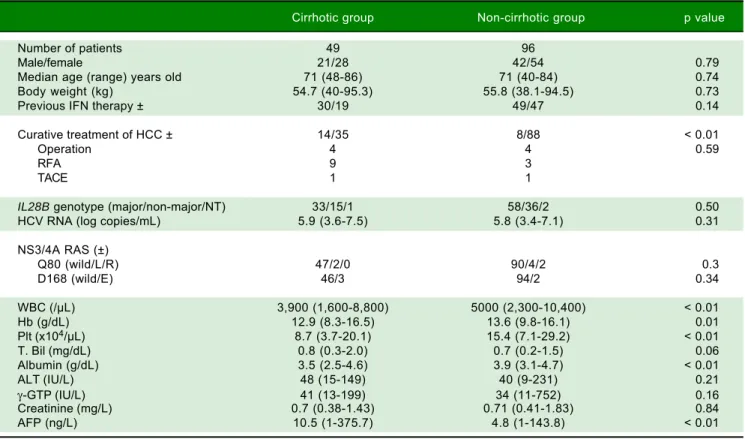
The clinical background of 49 hepatic cirrhotic and 96 non-cirrhotic patients are shown in table 1. The cirrhotic
group contained 21 females and 28 males, and the non-cir-rhotic group had 41 females and 54 males (p = 0.79). The median age was 71 years old (range: 48-86 years old) in the cirrhotic group, and 71 years old (range: 40-84 years old) in the non-cirrhotic group (p = 0.74). Previous IFN-based therapies were performed in 30 patients (61%) in the cirrhotic group and 49 (51%) in the non-cirrhotic group. The cirrhotic group had 14 (29%) patients with curative treatment for HCC, whereas the non-cirrhotic group had 8 (8%) patients with curative treatment for HCC (p < 0.02). There were significant differences in WBC, hemo-globin, platelet counts, and AFP levels at baseline between the cirrhotic and non-cirrhotic groups. The mean HCV-RNA level was 6.1 ± 0.5 log copies/mL in the cirrhotic group and 6.1 ± 0.8 log copies/mL in the non-cirrhotic group (p = 0.31). RASs in the HCV NS3/4A gene were de-tected in 15 (31%) of 49 patients in the cirrhotic group: Q80L, 2, D168E, 3, and V170I, 15. RASs were detected in 33 (34%) of 96 patients in the non-cirrhotic group: Q80L, 4, Q80R, 2, R155K, 1, D168E, 2, and V170I, 30. No differ-ences in the distribution of the IL28B genotypes were de-tected between the two groups.
Table 1. Baseline characteristics of patients with L31 and Y93 in NS5A of HCV genotype 1b infection in cirrhotic and non-cirrhotic groups.
Cirrhotic group Non-cirrhotic group p value
Number of patients 49 96
Male/female 21/28 42/54 0.79
Median age (range) years old 71 (48-86) 71 (40-84) 0.74
Body weight (kg) 54.7 (40-95.3) 55.8 (38.1-94.5) 0.73
Previous IFN therapy ± 30/19 49/47 0.14
Curative treatment of HCC ± 14/35 8/88 < 0.01
Operation 4 4 0.59
RFA 9 3
TACE 1 1
IL28B genotype (major/non-major/NT) 33/15/1 58/36/2 0.50
HCV RNA (log copies/mL) 5.9 (3.6-7.5) 5.8 (3.4-7.1) 0.31
NS3/4A RAS (±)
Q80 (wild/L/R) 47/2/0 90/4/2 0.3
D168 (wild/E) 46/3 94/2 0.34
WBC (/μL) 3,900 (1,600-8,800) 5000 (2,300-10,400) < 0.01
Hb (g/dL) 12.9 (8.3-16.5) 13.6 (9.8-16.1) 0.01
Plt (x104/μL) 8.7 (3.7-20.1) 15.4 (7.1-29.2) < 0.01
T. Bil (mg/dL) 0.8 (0.3-2.0) 0.7 (0.2-1.5) 0.06
Albumin (g/dL) 3.5 (2.5-4.6) 3.9 (3.1-4.7) < 0.01
ALT (IU/L) 48 (15-149) 40 (9-231) 0.21
γ-GTP (IU/L) 41 (13-199) 34 (11-752) 0.16
Creatinine (mg/L) 0.7 (0.38-1.43) 0.71 (0.41-1.83) 0.84
AFP (ng/L) 10.5 (1-375.7) 4.8 (1-143.8) < 0.01
98 98 96 97 96 96 Treatment responses in
the cirrhotic and non-cirrhotic groups
RVR rates were 79% (38/48) in the cirrhotic group and 86% (78/91) in the non-cirrhotic group (p = 0.45). The rates at the EOT were 98% (48/49) in the cirrhotic group and 98% (94/96) in the non-cirrhotic group (p = 0.55). The SVR24 rates were 96% (47/49) in the cirrhotic group and 96% (91/95) in the non-cirrhotic group (p = 0.69).
There were no significant differences in the treatment re-sponse rate between the two groups (Figure 1). Viral breakthrough occurred in one patient in the cirrhotic group and two patients in the non-cirrhotic group (p = 0.55). At baseline RASs at D168E and V170I in the HCV NS3/4A were detected in two (31%) of three patients with viral breakthrough. Viral relapse occurred in one patient in the cirrhotic group and two patients in the non-cirrhot-ic group (p = 0.55). In three patients with relapse, ASV + DCV therapy was stopped due to adverse effects. At base-line RASs in the HCV NS3/4A were not detected in all of patients with viral relapse.
Adverse events and treatment discontinuation
Treatment was discontinued for various reasons in the cirrhotic group, as follows (one patient each): ALT eleva-tion, hepatic coma, institutional pneumonia, severe bron-chitis, and HCC development. In the non-cirrhotic group, treatment was discontinued due to ALT elevation in five patients, prothrombin time elongation in two pa-tients, trauma in one patient, and self-discontinuation in one patient.
Grade III/IV adverse events occurred more frequently in the cirrhotic group (10/49; 20.4%) than in the non-cir-rhotic group (10/96; 10.4%) (p = 0.099). ALT elevation is an AE of DCV/ASV therapy, particularly in Japanese pa-tients. The ALT level was elevated by more than twice the normal upper limit in 9 of 49 cirrhotic patients and 19 of 96 non-cirrhotic patients. There were no differences in the incidence of ALT elevation between the two groups (Table 2). DAA therapy was stopped in one cirrhotic pa-tient and five non-cirrhotic papa-tients due to ALT elevation
98 98 79 86
Rate of patients with undectetable
serum HCV RNA (%)
100
80
60
40
20
0
RVR EOTR SVR4 SVR12 SVR24
Figure 1. Figure 1.Figure 1. Figure 1.
Figure 1. Rapid virological response (RVR), end-of-treatment response (EOTR), sustained virological response 12 weeks after completing treatment (SVR12), and SVR 24 weeks after completing treatment (SVR24) in cirrhot-ic and non-cirrhotcirrhot-ic groups. RVR rates were 79% (38/48) in the cirrhotcirrhot-ic group and 86% (78/91) in the non-cirrhotic group. EOT rates were 98% (48/ 49) in the cirrhotic group and 98% (94/96) in the non-cirrhotic group. SVR12 and SVR24 rates were 96% (47/49) and 96% (47/49) in the cirrhotic group, and 97% (92/95) and 96% (91/95) in the non-cirrhotic group, respectively. The rates at all-time points were not significantly different between the cir-rhotic and non-circir-rhotic groups.
Table 2. Adverse events with and without treatment discontinuation in cirrhotic and non-cirrhotic groups.
Cirrhotic (n = 49) Non-cirrhotic (n = 96) p value
Discontinuation due to AEs 5 (10.2%) 10 (10.4%) 0.96
Serious AEs 10 (20%) 10 (10.4%) 0.099
ALT elevation > fivefold from UNL 2 5
Bleeding in digestive tract 2 0
Hepatic coma 1 0
Elongation of prothrombin time 0 2
Renal impairment 1 0
Interstitial pneumonia 1 0
Bronchitis 1 0
Fever 1 1
HCC recurrence 1 0
Diarrhea 0 1
Trauma 0 1
Other reasons for discontinuation
Viral breakthrough 1 1
Self-discontinuation 0 1
Figure 2. Figure 2. Figure 2. Figure 2.
Figure 2. Change from baseline ALT lev-els during ASV + DCV treatment in cirrhot-ic and non-cirrhotcirrhot-ic groups. * Treatment was stopped due to ALT elevation.
ALT (IU/L)
400 350 300 250 200 150 100 50 0
Pre 2W 4W 6W 8W 10W 12W 14W 16W 18W 20W 22W
ALT (IU/L)
400 350 300 250 200 150 100 50 0
Cirrhotic patients
Non-cirrhotic patients
Figure 3. Figure 3. Figure 3. Figure 3.
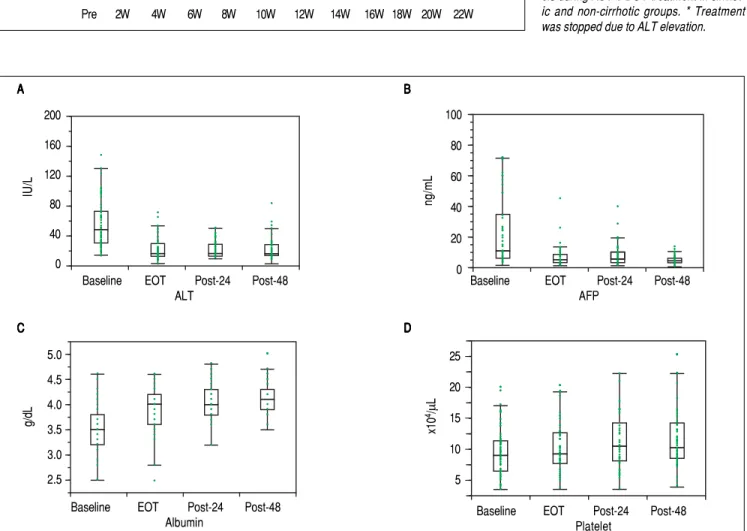
Figure 3. Changes in ALT, AFP, and serum levels of albumin and platelet count in cirrhotic patients that achieved SVR due to ASV + DCV therapy. Com-pared to baseline, ALT and AFP levels were significantly decreased after treatment. Albumin levels and platelet count were increased.
5.0
4.5
4.0
3.5
3.0
2.5
IU/L
200
160
120
80
40
0
Baseline EOT Post-24 Post-48 Platelet
Baseline EOT Post-24 Post-48 ALT
Baseline EOT Post-24 Post-48 Albumin
A A A A
A BBBBB
ng/mL
100
80
60
40
20
0
C C C C C
g/dL 4x10/
μ
L
25
20
15
10
5
Baseline EOT Post-24 Post-48 AFP
(Figure 2). One non-cirrhotic patient died after ASV + DCV therapy due to events that were not related to the treatment.
Prognosis of liver function and
development of HCC after therapy in cirrhotic patients
First, liver biochemical markers were evaluated in 47 cirrhotic patients that achieved SVR. Compared to the baseline, ALT and AFP levels were significantly decreased at EOT, post-24th week, and post-48th week (p < 0.01). In addition, albumin levels were gradually increased after ASV + DCV therapy (Figure 3).
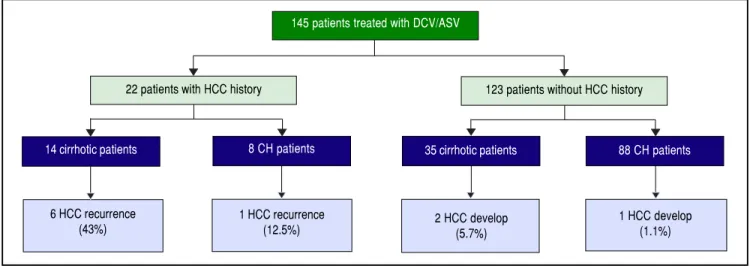
In all, 22 patients had received curative treatment for HCC before ASV + DCV therapy. After confirming the lack of HCC recurrence by contrast computed tomogra-phy or magnetic resonance imaging, ASV + DCV therapy was started. Over 48 weeks from the end of anti-HCV therapy, recurrence of HCC was observed in 6 (43%) of 14 cirrhotic, and 1 (12.5%) of 8 non-cirrhotic patients. On the other hand, HCC developed in 2 (5.7%) of 35 cirrhot-ic, and 1 (1.2%) of 88 non-cirrhotic patients (Figure 4). HCC recurrence and occurrence were observed more frequently in the cirrhotic group than in the non-cirrhotic group.
DISCUSSION
In the present study, 96% of cirrhotic and non-cirrhotic patients without RAS in NS5A achieved SVR after ASV + DCV therapy. RAS-oriented ASV + DCV therapy was also reasonable for HCV genotype 1b patients with cirrhosis. Previous reports have indicated SVR rates of 88.3-93.7% in
patients without RAS in NS5A.15-17 The anti-viral effect
observed in our study was slightly higher than those re-sults. In our study, 76% patients started treatment at admis-sion, and were instructed regarding DAA by a hospital pharmacist. Only 2 (1.7%) of 115 patients did not achieve SVR in the admitted group, and 4 (11%) of 35 patients without admission failed to achieve SVR (p = 0.039). These results suggest that admission with commencement of DAA be recommended, particularly in Japan.
On the other hand, AEs (adverse events) of grade III/IV occurred more frequently in cirrhotic patients than in non-cirrhotic patients during treatment. Elevation of ALT was a unique AE associated with ASV + DCV therapy. There were no differences in the incidence of serious ALT elevation between cirrhotic and non-cirrhotic groups. Bleeding in the digestive tract and hepatic coma were serious AEs seen only in the cirrhotic group. Com-pared to the Japanese phase III trial, there were some dif-ferences in AEs in the present study. These difdif-ferences may have been due to the characteristics of the enrolled patients in terms of their age, gender, cirrhosis status, and history of HCC. Taken together, these results suggest that careful management is necessary for cirrhotic patients be-fore and during ASV + DCV therapy.
A follow-up study showed that ALT levels and AFP levels decreased significantly after EOT in cirrhotic pa-tients that achieved SVR. In addition, serum levels of albu-min and platelet count significantly increased compared to baseline measurements. Our data are consistent with pre-vious reports. Miyaki, et al. showed that serum fibrosis markers are improved in SVR patients.18 Mandorfer, et al.
reported that DAA therapy decreases portal pressure in SVR patients with moderate hepatic fibrosis as determined
145 patients treated with DCV/ASV
14 cirrhotic patients
6 HCC recurrence (43%)
22 patients with HCC history 123 patients without HCC history
8 CH patients 35 cirrhotic patients 88 CH patients
1 HCC recurrence
(12.5%) 2 HCC develop(5.7%)
1 HCC develop (1.1%)
Figure 4. Figure 4.Figure 4.
by measuring hepatic venous pressure gradient.19 These
data suggest that the elimination of HCV by DAA therapy improved liver function in cirrhotic patients.
On the other hand, the incidence rates of HCC devel-opment and recurrence were higher in cirrhotic patients. Conti, et al. reported that HCC was detected during 24-weeks of follow-up in 17 (29%) of 59 patients with previ-ous HCC and 9 (3%) of 285 cirrhotic patients without HCC.20 Our observations are in line with those of other
previous studies.21 Both the observation period and the
in-cidence of HCC in our study were double those in these previous studies. Previous Japanese studies of IFN-based therapy showed that age and fibrosis at baseline were closely related to HCC development in SVR patients.3,22
Although the reasons for the high incidence of HCC de-velopment in patients treated with DAA are not clear, greater age and more-advanced fibrosis might be related to the development of HCC.
IFN-based therapy without DAA showed a preventive effect on the development of HCC in patients with HCV, even in those who did not achieve SVR. It was speculated that IFN had two effects, i.e., antivirus and antitumor ef-fects. On the other hand, DAAs were designed as specific inhibitors of HCV and did not have direct antitumor sup-pressive effects. Minami, et al. compared the rate of HCC development between a DAA treatment group, an IFN-based therapy group, and a control group. The rate of early recurrence was not different between the three groups.23 It
is important to monitor cirrhotic patients that achieve SVR with DAA therapy.
The present study had several limitations. First, the number of patients enrolled in the study was low, al-though the number was greater than in the phase III clini-cal trial. In September 2015, a 12-week IFN-free regimen was approved for HCV genotype 1 in Japan.24,25 It is
diffi-cult to implement a study in a larger cohort because pa-tients prefer therapies with shorter durations. Second, there were no decompensated cirrhotic patients in the present study, as anti-HCV therapy is not approved for such patients in Japan. Finally, the follow-up period was insufficient to evaluate prognoses in cirrhotic patients with SVR. SVR is an important process but is not the goal of treatment in cases of chronic viral liver disease. It is necessary to evaluate long-term prognoses in cirrhotic pa-tients with HCV, including the prevention of HCC de-velopment and the prevention of hepatic failure.
Taken together, our findings suggest that ASV + DCV therapy can achieve a high SVR rate in Japanese cirrhotic patients with NS5A wild-type HCV genotype 1b and also improve liver function, including albumin and AFP lev-els. However, AEs occur frequently in cirrhotic patients, particularly the recurrence and occurrence of HCC after therapy.
ACKNOWLEDGMENTS
This study was supported in a part by Japan Society for the Promotion of Science grant 15k09019 (AT). We would like to thank Ms. Yoko Yasuhara, Ms. Tomoko Hirano and Ms. Sanae Deguchi for collecting the data.
ABBREVIATIONS
• AEs: adverse events.
• ALT: alanine aminotransferase. • EOTR: end of treatment response. • HCC: hepatocellular carcinoma. • HCV: hepatitis C virus.
• IL28B: interleukin 28 B.
• RAS: resistance-associated substitution. • RVR: rapid virological responders. • SVR: sustained viral response. • UNL: upper normal limit.
CONFLICTS OF INTEREST
All authors declare that we have nothing to disclose re-garding funding or conflict of interest with respect to the study reported in this manuscript.
REFERENCES
1. Pearlman BL. Protease inhibitors for the treatment of chronic hepatitis C genotype-1 infection: the new standard of care.
Lancet Infect Dis 2012; 12: 717-28.
2. Imai Y, Tamura S, Tanaka H, Hiramatsu N, Kiso S, Doi Y, Ina-da M, et al. Reduced risk of hepatocellular carcinoma after interferon therapy in aged patients with chronic hepatitis C is limited to sustained virological responders. J Viral Hepat
2010; 17: 185-91.
3. Asahina Y, Tsuchiya K, Tamaki N, Hirayama I, Tanaka T, Sato M, Yasui Y, et al. Effect of aging on risk for hepatocel-lular carcinoma in chronic hepatitis C virus infection. Hepa-tology 2010; 52: 518-27.
4. Hézode C, Forestier N, Dusheiko G, Ferenci P, Pol S, Goeser T, Bronowicki JP, et al. Telaprevir and peginterferon with or without ribavirin for chronic HCV infection. N Engl J Med
2009; 360: 1839-50.
5. Hayashi N, Izumi N, Kumada H, Okanoue T, Tsubouchi H, Yatsuhashi H, Kato M, et al. Simeprevir with peginterferon/ ribavirin for treatment-naïve hepatitis C genotype 1 patients in Japan: CONCERTO-1, a phase III trial. J Hepatol 2014; 61: 219-27.
6. Tamori A, Yoshida K, Kurai O, Kioka K, Hai H, Kozuka R, Mo-toyama R, et al. Randomized trial of combined triple therapy comprising two types of peginterferon with simeprevir in pa-tients with HCV genotype 1b. Hepatol Res 2016; 46: 1311-20.
8. Kumada H, Suzuki Y, Ikeda K, Toyota J, Karino Y, Chayama K, Kawakami Y, et al. Daclatasvir plus asunaprevir for chronic HCV genotype 1b infection. Hepatology 2014; 59: 2083-91.
9. JSH Guidelines for the Management of Hepatitis C Virus In-fection: 5.1th edition 2016. In Japanese http://www.jsh.or.jp/ files/uploads/HCV_GL_ver5.1_Oct08_final.pdf
10. Kao JH, Jensen DM, Manns MP, Jacobson I, Kumada H, Toy-ota J, Heo J, et al. Daclatasvir plus asunaprevir for HCV genotype 1b infection in patients with or without compensat-ed cirrhosis: a poolcompensat-ed analysis. Liver Int 2016; 36: 954-62.
11. Shepherd SJ, Abdelrahman T, MacLean AR, Thomson EC, Aitken C, Gunson RN. Prevalence of HCV NS3 pre-treatment resistance associated amino acid variants within a Scottish cohort. J Clin Virol 2015; 65: 50-3.
12. AASLD and IDSA. Recommendations for Testing, Managing, and Treating Hepatitis C 2014. Available at http:// www.hcvguidelines.org
13. Tanaka Y, Nishida N, Sugiyama M, Kurosaki M, Matsuura K, Sakamoto N, Nakagawa M, et al. Genome-wide association of IL28B with response to pegylated interferon-alpha and ribavirin therapy for chronic hepatitis C. Nat Genet 2009; 41: 1105-9.
14. Hai H, Tamori A, Enomoto M, Morikawa H, Uchida-Kobayashi S, Fujii H, Hagihara A, et al. Relationship between inosine tri-phosphate genotype and outcome of extended therapy in hepatitis C virus patients with a late viral response to pegylated-interferon and ribavirin. J Gastroenterol Hepatol
2014; 29: 201-7.
15. Iio E, Shimada N, Abe H, Atsukawa M, Yoshizawa K, Tak-aguchi K, Eguchi Y, et al. Efficacy of daclatasvir/asunapre-vir according to resistance-associated variants in chronic hepatitis C with genotype 1. J Gastroenterol 2017; 52: 94-103.
16. Ogawa E, Furusyo N, Yamashita N, Kawano A, Takahashi K, Dohmen K, Nakamuta M, et al. Effectiveness and safety of daclatasvir plus asunaprevir for HCV genotype 1b pa-tients aged 75 and over with or without cirrhosis. Hepatol Res 2016 [in print].
17. Morio K, Imamura M, Kawakami Y, Morio R, Kobayashi T, Yokoyama S, Nagaoki Y, et al. Real-World Efficacy and Safety of Daclatasvir and Asunaprevir Therapy for Hepatitis C Virus-Infected Cirrhosis Patients. J Gastroenterol Hepatol
2016 [in print].
18. Miyaki E, Imamura M, Hiraga N, Murakami E, Kawaoka T, Tsuge M, Hiramatsu A, et al. Daclatasvir and asunaprevir
treatment improves liver function parameters and reduces liver fibrosis markers in chronic hepatitis C patients. Hepatol Res 2016; 46: 758-64.
19. Mandorfer M, Kozbial K, Schwabl P, Freissmuth C, Schwarzer R, Stern R, Chromy D, et al. Sustained virologic response to interferon-free therapies ameliorates HCV-in-duced portal hypertension. J Hepatol 2016; 65: 692-9. 20. Conti F, Buonfiglioli F, Scuteri A, Crespi C, Bolondi L,
Carace-ni P, Foschi FG, et al. Early occurrence and recurrence of hepatocellular carcinoma in HCV-related cirrhosis treated with direct-acting antivirals. J Hepatol 2016; 65: 727-33.
21. Reig M, Mariño Z, Perelló C, Iñarrairaegui M, Ribeiro A, Lens S, Díaz A, et al. Unexpected high rate of early tumor recur-rence in patients with HCV-related HCC undergoing interfer-on-free therapy. J Hepatol 2016; 65: 719-26.
22. Oze T, Hiramatsu N, Yakushijin T, Miyazaki M, Yamada A, Oshita M, Hagiwara H, et al. Post-treatment levels of α -feto-protein predict incidence of hepatocellular carcinoma after interferon therapy. Clin Gastroenterol Hepatol 2014; 12: 1186-95.
23. Minami T, Tateishi R, Nakagomi R, Fujiwara N, Sato M, Enooku K, Nakagawa H, et al. The impact of direct-acting antivirals on early tumor recurrence after radiofrequency ablation in hepatitis C-related hepatocellular carcinoma. J Hepatol
2016; 65: 1272-3.
24. Mizokami M, Yokosuka O, Takehara T, Sakamoto N, Korena-ga M, Mochizuki H, Nakane K, et al. Ledipasvir and sofosbu-vir fixed-dose combination with and without ribasofosbu-virin for 12 weeks in treatment-naive and previously treated Japanese patients with genotype 1 hepatitis C: an open-label, ran-domised, phase 3 trial. Lancet Infect Dis 2015; 15: 645-53.
25. Kumada H, Chayama K, Rodrigues L Jr., Suzuki F, Ikeda K, Toyoda H, Sato K, et al. Randomized phase 3 trial of om-bitasvir/paritaprevir/ritonavir for hepatitis C virus genotype 1b-infected Japanese patients with or without cirrhosis.
Hepatology 2015; 62: 1037-46.
Correspondence and reprint request:
Akihiro Tamori, M.D., Ph.D.
Department of Hepatology, Osaka City University Graduate School of Medicine, 1-4-3 Asahimachi, Abeno-ku, Osaka