The mystery of the
Hawaii liver disease cluster in summer 2013:
A pragmatic and clinical approach to solve the problem
Rolf Teschke,* Alexander Schwarzenboeck, Christian Frenzel,
Johannes Schulze,*** Axel Eickhoff,* Albrecht Wolff****
* Department of Internal Medicine II, Division of Gastroenterology and Hepatology, Klinikum Hanau, Teaching Hospital of the Medical Faculty, Goethe University Frankfurt/ Main, Germany. ** Department of Medicine I, University Medical Center Hamburg Eppendorf, Germany. *** Institute of Industrial, Environmental and Social Medicine, Medical Faculty, Goethe University Frankfurt/Main, Germany. **** Department of Internal Medicine II, Division of Gastroenterology, Hepatology and Infectious Diseases, Friedrich Schiller University Jena, Germany.
A B S T R A C T A B S T R A C T A B S T R A C T A B S T R A C T A B S T R A C T
Background and aim. Background and aim.Background and aim. Background and aim.
Background and aim. In the fall of 2013, the US Centers for Disease Control and Prevention (CDC) published a preliminary re-port on a cluster of liver disease cases that emerged in Hawaii in the summer 2013. This rere-port claimed a temporal association as sufficient evidence that OxyELITE Pro (OEP), a dietary supplement (DS) mainly for weight loss, was the cause of this mysterio-us clmysterio-uster. However, the presented data were inconsistent and required a thorough reanalysis. Material and methods.Material and methods.Material and methods.Material and methods.Material and methods. To further investigate the cause(s) of this cluster, we critically evaluated redacted raw clinical data of the cluster patients, as the CDC re-port received tremendous publicity in local and nationwide newspapers and television. This attention put regulators and physicians from the medical center in Honolulu that reported the cluster, under enormous pressure to succeed, risking biased evaluations and hasty conclusions. Results.Results.Results.Results.Results. We noted pervasive bias in the documentation, conclusions, and public statements, also poor quality of case management. Among the cases we reviewed, many causes unrelated to any DS were evident, including decompensated liver cirrhosis, acute liver failure by acetaminophen overdose, acute cholecystitis with gallstones, resolving acute hepatitis B, acute HSV and VZV hepatitis, hepatitis E suspected after consumption of wild hog meat, and hepatotoxicity by acetaminophen or ibupro-fen. Causality assessments based on the updated CIOMS scale confirmed the lack of evidence for any DS including OEP as culprit for the cluster. Conclusions.Conclusions.Conclusions.Conclusions.Conclusions. Thus, the Hawaii liver disease cluster is now best explained by various liver diseases rather than any DS, including OEP.
Key words. Key words. Key words. Key words.
Key words. Centers for Disease Control and Prevention. Food and Drug Administration. Hawaii Department of Health. Honolulu Queen’s Medical Center. OxyELITE Pro.
January-February, Vol. 15 No. 1, 2016: 91-118
INTRODUCTION
A 2014 article in the
New England Journal of Medicine
pro-voked interest and controversy when it reported that
epi-demiologists at the US Centers for Disease Control and
Prevention (CDC) had confirmed what a liver-transplant
surgeon in Honolulu had suspected: OxyELITE Pro
(OEP), a popular over-the-counter dietary supplement
(DS) for weight loss, was responsible for a cluster of cases
of severe hepatitis and acute liver failure (ALF) in the
summer of 2013.
1OEP had been withdrawn from the
shelves,
1and in September of 2013, the Hawaii
Depart-ment of Health (HDOH), with the CDC and the US
Food and Drug Administration (FDA), had initiated a
public health investigation.
2Patients of this Hawaii cluster mostly became ill in the
summer of 2013 - highly suggestive of a seasonal outbreak
by zoonical, bacterial, or viral pathogens like hepatitis A
virus (HAV) or hepatitis E virus (HEV);
3such geographic
clusters are rarely caused by DS or drugs with national
distribution. HEV genotypes 1-4 occur in humans, types 3
and 4 in animals.
4-6Infected animals may transmit HEV
in-fections to humans,
4-12with farmers, hunters, and outdoor
enthusiasts at high risk of contracting HEV from infected
The Official Journal of the Mexican Association of Hepatology, the Latin-American Association for Study of the Liver and
the Canadian Association for the Study of the Liver
Manuscript received: Manuscript received:Manuscript received:
animals,
4-13including rats in their Hawaiian
communi-ties.
13A diagnosis of HEV can be easily missed because
analyses by HEV polymerase chain reactions (PCR) are
rarely employed in the US
14while results by US HEV
an-tibody assays are heavily disputed and considered invalid
due to lacking test sensitivity, specificity,
4and FDA
ap-proval.
4,14Another Hawaiian dilemma exists since cases of
drug induced liver injury (DILI) and herb induced liver
injury (HILI) are not secure without appropriate testing
for infections by HEV.
4,15,16These HEV related diagnostic
problems in Hawaii may explain why HEV was not
men-tioned by regulatory assessors
2or clinicians of the Queen’s
Medical Center (QMC) in Honolulu.
2,17The HDOH, CDC, and FDA did not disclose details
of their interviews, chart reviews, or approaches to
ex-clude alternative causes, nor did they specify the algorithm
they used to assess causality.
2More critically, the
proce-dural irregularities of the officials and physicians started
with the supposed temporal association between the use of
OEP and the liver disease in Hawaii.
2,17This assumption
implicated OEP as the sole possible culprit, foreclosing a
subsequent careful, unbiased case assessment.
2,17The
un-expectedly high local and nationwide print press and TV
publicity put assessors under enormous pressure to
suc-ceed. Such intense publicity on an unsettled clinical topic
is unusual in the scientific community, the time pressure
forces errors and is risky for regulators,
2physicians,
17and
patients.
18The CDC report also noted that the
investiga-tion was ongoing and the data were preliminary,
2but the
final CDC report has not been published.
The scientific community had high expectations that
cli-nicians of the Honolulu QMC would provide more robust
data on their mysterious liver disease cluster cases, but such
expectations were not met by their report, which lacks
transparency and is marred by ambiguity.
17These
short-comings led us to independently reassess a single
particu-larly challenging and inconsistent case
18from the cluster,
17comparing the patient’s raw data
18to the published case
data.
17Our reanalysis revealed that the claims made by the
public officials
2and the Honolulu physicians
17are not
sub-stantiated.
18For example, the patient was not “previously
healthy” but instead was multimorbid and multimedicated
by drugs and DS,
18not disclosed by officials
2and
physi-cians.
17In retrospect, this patient’s liver disease is best
ex-plained as recurrent toxic hepatitis, likely caused by
overdoses of naproxen.
18Additional possible diagnoses
in-cluded DILI by other drugs and symptomatic acute
chole-cystitis.
18Convincing evidence is lacking for any of the four
used DS as the culprit, including the OEP
18that was
initial-ly singled out.
17This case is no longer mysterious and best
explained by alternative causes, such as naproxen overdoses.
Encouraged by these unexpected case findings
18and in
search of the real culprits in additional cases of the disease
cluster, we undertook a pragmatic and clinical approach to
solve this Hawaii mystery. Therefore, we reassessed raw
data of other patients of this Hawaii liver cluster and
found numerous alternative causes and major
confound-ers, which clearly dismissed the initial diagnoses of liver
injury by OEP.
2,17Diagnostic workup requires careful and
unbiased analyses especially in patients with specific
treat-ment options. For example, acetaminophen (AAP)
over-dose can effectively be treated by N-acetylcysteine to
restore hepatic glutathione levels,
19severe HEV infections
by ribavirin,
4,6,20hepatitis B virus (HBV) infections by
nucleos(t)ide analogues,
21herpes simplex virus (HSV) and
varicella zoster virus (VZV) hepatitis infections by
aciclo-vir,
22and cytomegalovirus (CMV) infections by
intrave-nous ganciclovir.
23It appears that some cluster patients
could have benefited from the correct diagnosis and
ap-propriate therapy.
MATERIAL AND METHODS
Initially, anonymized raw data of the cases for
re-analy-sis were kindly requested from the corresponding
au-thor
17but our request was declined; only brief case
summaries were provided as well as details of the
ex-tremely high Council for International Organizations of
Medical Sciences (CIOMS) scorings for each patient,
al-lowing a further CIOMS analysis and comparison with
documented data. Subsequently, we received redacted
files that were obtained from the HDOH under Hawaii’s
freedom-of-information act as well as few additional
records filed as part of a public lawsuit in Hawaii. All
medical files and raw data had patient names and other
per-sonal identifying information redacted prior to
submis-sion to us for reanalysis. Documents of patients of the
Hawaii liver disease cluster included clinical files,
pa-tient’s records, files of their primary care provider (PCP),
insurance reports, drug and DS information files,
custom-er purchase records, and othcustom-er information provided at
tri-al. The clinical assessment focused on completeness of
data, evaluation of documented clinical test results and the
clinical conclusions of the treating physicians which were
derived from the results documented in these files.
As-sessment also included consistency of documented data
with published information.
RESULTS AND DISCUSSION
Analysis of
regulatory assessments
•
Regulatory case assessments.
In their preliminary
because of multiple ingredients, product variability,
and lack of tests to confirm specific exposure to a
product. These and other obvious confounders of the
suspected OEP cases were not appropriately handled by
the CDC report
2or the clinical report.
17,18Assumed
hepatitis outbreaks demand professional regulatory and
clinical case management with sophisticated and
struc-tured approaches, broad clinical experience and
exper-tise in hepatology - in addition to intuition,
commitment, and empathy. Trained physicians with
appropriate board certification should provide support
and must be open to critical discussions of alternative
explanations among all assessors to resolve the
culprit(s) of this mysterious cluster phenomenon. A
prerequisite is impartiality prior to any public
state-ment; otherwise, public statements may predetermine
one single explanation without the possibility of
cor-rections. Risks are high for the involved regulatory
agencies and physicians, if their public claims do not
hold as promised. Without careful work, the correct
clinical diagnosis and therapy may be missed. Finally,
published claims that a product is potentially
hepato-toxic may induce liver patients to report having used
this product prior to their illness to claim financial
compensation, although they have never consumed this
product and lack proof of purchase.
Clearly, the case has to be defined and assessed under
appropriate regulatory and clinical standards, which
was attempted in this cluster.
2More importantly, no
control group had been defined and assessed by
regula-tory and clinical standards.
2,17•
Regulatory case criteria.
According to HDOH,
CDC, and FDA,
2a case was defined as acute hepatitis
of unknown etiology, occurring after March 31, 2013,
in a person who had consumed a DS within the
previ-ous 60 days and had a serum alanine aminotransferase
(ALT) four times the upper limit of normal (ULN)
and a total bilirubin level ≥ 2 x ULN; negative
serolo-gies for infections including viral hepatitis were
man-datory.
2However, this case definition is imprecise and
problematic for various reasons;
2it was not used in the
clinical report.
17It disregards the period from
cessa-tion of DS use to disease onset, thus weakens the
crite-rion of a strict temporal association; commonly,
tentative hepatotoxicity is assumed only if liver disease
is manifested within a short time window after the last
use of the product, usually two weeks or less (slowly
metabolized compounds, within a maximum four
weeks).
24-26Also, hepatotoxicity commonly is not
con-sidered for ALT values < 5 x ULN
24-26to avoid
inclu-sion of patients with unspecific ALT elevations.
Furthermore, the agencies did not specify how they
excluded preexisting liver diseases, nor how they
eval-uated infections including viral hepatitis.
2Thus, they
ignored some crucial elements for assessing causality
in suspected HILI and DILI.
16,24-26To exclude various
viral hepatitis forms, anti-HAV IgM is tested for HAV;
anti-HBc IgM and HBV-DNA for HBV; anti-HCV
and HCV RNA for hepatitis C virus (HCV); PCR
analyses for viral DNA and titer changes of specific
IgM and IgG antibodies are mandatory to exclude
in-fections by HEV, CMV, Epstein Barr virus (EBV),
HSV, and VZV.
16,24,25The agencies reported exclusion
of several etiologies such as autoimmune hepatitis, but
they did not disclose the diagnostic exclusion criteria,
2as required.
16,25Regulators also interviewed patients,
but again details of structured questionnaires to
cir-cumvent bias were not provided.
2In addition,
regula-tors reported reviewing the medical charts of the
patients.
2This commonly implies that the clinical
diag-nosis of hepatotoxicity by OEP is approved by the
assessing regulators, being correct and well documented.
The scientific community has high expectations for
re-ports from health agencies, including the HDOH,
CDC, and FDA. These should adhere to data
transpar-ency and impartiality. Instead, in the Hawaii liver
dis-ease cluster, the agencies have not made clear which
viruses were actually excluded and whether they used a
causality assessment method,
2like the updated scale of
CIOMS,
16to be applied individually to each
comedi-cated product. HEV exclusion is a key item of both the
updated CIOMS scale and the checklist of alternative
causes in hepatotoxicity cases.
16The reported cluster
was not further specified,
1but obviously included at
least the initial seven patients with assumed use of
OEP,
2which later was reclassified as “new” OEP. As
defined by the authors, “new” OEP refers to versions
in which aegeline had replaced the DMAA
(1,3-dimethylamylamine HCl) in the “old” OEP.
17The
re-port did not consider the old OEP but only the new
OEP as the assumed hepatotoxic product, which was
used briefly for 2 weeks minimum and 6 weeks
maxi-mum by all 8 patients.
17•
Missing control cohort.
In the fall of 2013, the
should not have reported any DS consumption within
the previous 60 days but fulfil the regulatory criteria
for hepatotoxicity, e.g. serum ALT > 4 x ULN and
to-tal bilirubin < 2 x ULN, with a valid diagnosis and
es-tablished cause of the patients’ liver disease for
comparison.
Pragmatic
clinical case analyses
The present analyses of four patients of the mysterious
Hawaii liver disease cluster is based on documents
con-taining data that are condensed and presented as narratives
for each patient in table 1. The aim of these case analyses is
to retrieve and evaluate additional case data to identify
possible culprit(s).
2,17Analytical approaches are similar to
those applied in previous assessments of HILI and DILI
cases.
16Due to uncertainties,
2,17,18the reanalysis of the raw
data from these complex cases was focused on some
im-portant factors, including confirmed product purchase and
consumption; the types of DS products used, possible
temporal associations to liver disease; validity of case
in-formation; overall case data quality; confounding
varia-bles; complete exclusion of alternative causes;
comorbidity; comedication; and firmness of causality.
Due to lack of a valid diagnostic biomarker, the diagnosis
of DILI or HILI is a diagnosis of exclusion.
24-26Genetic
risk factors are important
27but are not specifically evaluated
in this study.
Specific diagnostic issues
of case narratives
Similar to our first analyzed single Honolulu case,
18in
all four cases of this analysis, patients had multiple diseases
and medications (Tables 1 and 2). In other words, they
were not “previously healthy” as claimed.
2,17For
compari-son, case narratives of these four patients (Table 1)
fol-lowed the order of the recent report.
17All case data are
submitted to a causality assessment using the updated
CIOMS scale (Table 2), also called Roussel Uclaf
Causal-ity Assessment Method (RUCAM), which is quantitative,
structured and liver specific.
16Detailed consideration was
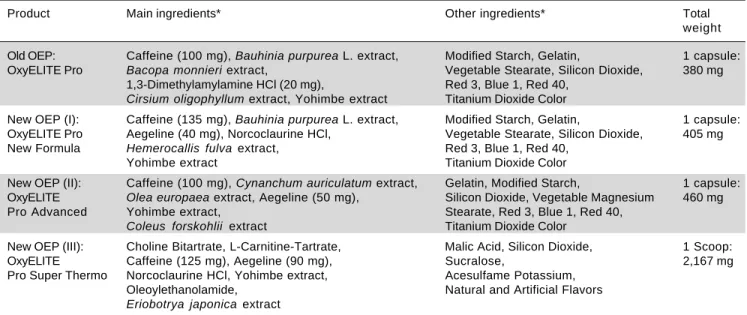
given to the different OEP formulas, containing DMAA or
aegeline (Table 3).
17The quality of case data for completeness and details
in-cluded was insufficient (Tables 1 and 4). This applies also
to Wilson disease that was not validly excluded by
labora-tory analyses and clinical assessments, considering that
ceruloplasmin alone is not an appropriate diagnostic
pa-rameter. For transparency, case data included in the
present study (Tables 1, 2, and 4) are compared to case data
and their interpretations in prior publications,
2,17as
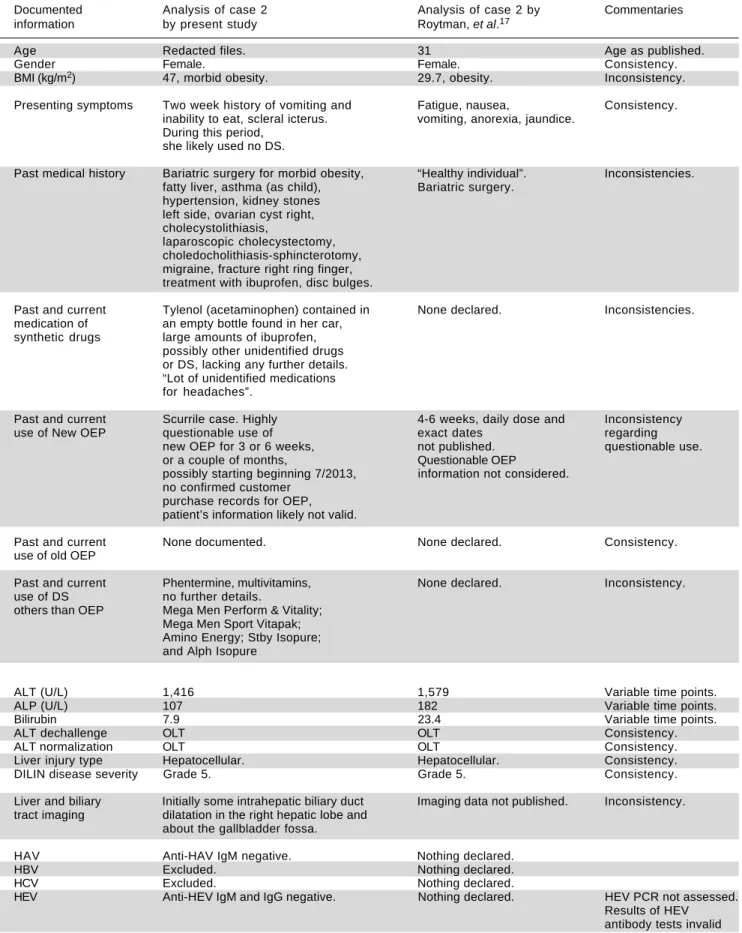
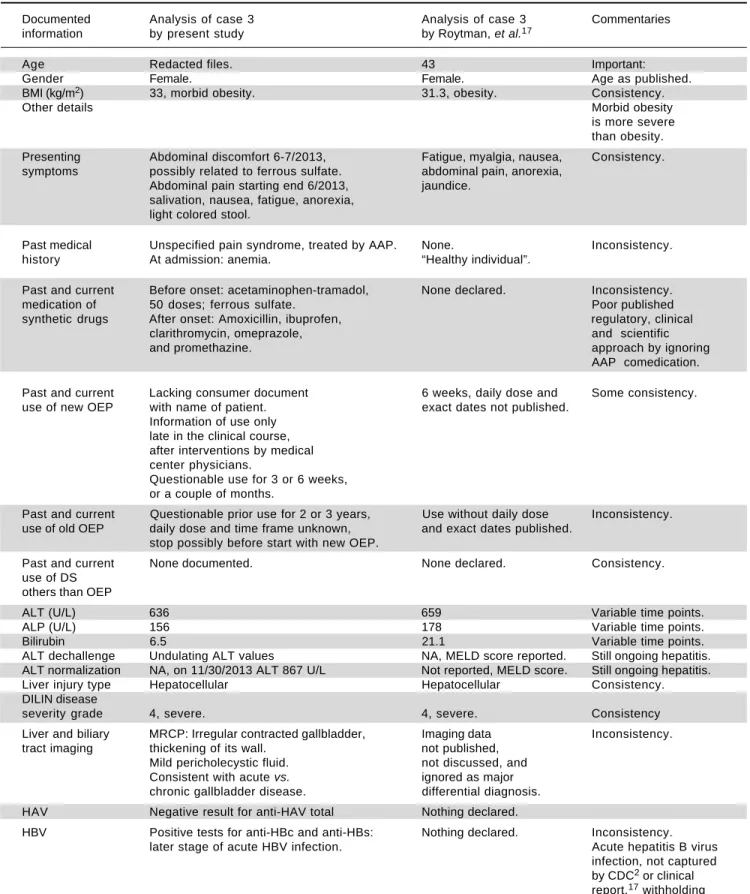
pre-sented for each individual case (Tables 5-8). This approach
provides for each case a final main diagnosis and a list of
alternative and other relevant diagnoses. To overcome the
shortcomings of the previous reports by regulators and
physicians,
2,17we have presented as many details as
possi-ble (Tapossi-bles 1 and 5-8).
Certainly, alcohol and hepatotoxic drugs including AAP
and ibuprofen are key components for a critical discussion
(Tables 1-8). Since these liver diseases occurred in the
summertime, were clustered geographically and localized
to Hawaii, infectious and toxic causes should be
consid-ered, including hepatitis A,
3,29hepatitis E,
2-15leptospiro-sis,
30,31aflatoxicosis,
32-40pyrrolizidine alkaloids (PA),
41-44green tea extracts,
45noni juice,
46and kava.
48-52•
Hepatitis A.
HAV infection is a well-known problem
in Hawaii, and health officials have alerted the public
about this disease.
28This possibility was not
specifical-ly addressed and publicized by the regulators
2or
phy-sicians.
17In the updated CIOMS scale, HAV is to be
excluded during clinical assessment of patients with
suspected liver injury, at least by anti-HAV IgM
analy-sis.
16This test certainly detects infection with short
in-cubation times
29but may miss longer and latent disease
courses like those in the cluster cases due to very
broad time frames allowed as inclusion criteria by the
regulators.
2For these long times,
2HAV IgM and IgG
antibodies
29would have been better suited to exclude
HAV infections (Tables 5-8).
2,17In the four assessed
cluster cases, HAV was likely excluded by anti-HAV
IgM in cases 1 and 2, by total anti-HAV in case 3, and by
both parameters in case 4 (Tables 5-8).
•
Hepatitis E.
With well-documented HEV reservoirs
Table 1. Cases 1-4 and their narratives, case details and analyses.
• CASE 1.
Narrative, case details and analyses
Male patient with liver cirrhosis and ascites of clinically unassessed etiology but possibly related to alcohol or acetami-nophen use, or HEV. Significant outdoor activities with HEV risk: hunter, wild hog meat consumer, and coffee farmer. History of illicit drug and heavy alcohol use/ abuse some years ago, with present monthly use of 6-12 beers or a 6 pack of beer and 1-2 shots of hard liquor each time the patient drank. First symptoms of illness emerged within 24 hours after a restaurant meal. At hospital admission on 8/25/2013: ALT 1970 U/L, AST 1308 U/L, ALP 107 U/L, and bi-lirubin 33.6 mg/dL. PMH: asthma (drugs), morbid obesity, atopy, allergic hypersensitivity, impetigo, eczema, debilitating fungal infections on both feet until 2013 with open sores and scabbing: Vicodin (acetaminophen-hydrocodone); Bactrim. Percocet (acetaminophen-oxycodone) in early 2013 for pain in neck and paresthesia in the arm, possibly an early extrahepatic, neurological manifestation of HEV myelitis with polyradiculopathy,4,6 bilateral brachial neuritis,6 or
peripheral neuropathy,4 which can overshadow the liver injury.4 Used overall 14 DS, with some information for four
DS: old OEP use for one year, intermittently on an off and on basis and stopped 3 weeks prior to admission; subse-quently, new OEP, Amplified Wheybolic Extreme-60, and Versa-1 were used for only one week until symptoms emerged two weeks prior to admission. According to purchase records and additional medical records, he consumed since March 2013 prior to liver illness these ten DS: Pro Performance AMP Wheybolic Extreme 60, Clk/Super Hd Combo Kit; Ripped Freak; Kre-Alkalyn EFX; Pump-HD; Green Coffee Bean; Super HD; CLK; and Beyond Raw Chocolate Re-Grow.
Clinical features and laboratory results are highly suggestive of HEV infection, but lacking results of HEV PCR and anti-HEV IgG; invalid negative anti-anti-HEV IgM as assessed by a not FDA approved test. Valid HAV exclusion. Anti-HBs posi-tive after HBV immunization. Negaposi-tive anti-CMV IgM and anti-VZV IgM. Posiposi-tive anti-CMV IgG and anti-VZV IgG without assessed IgG titer changes in the further course; possibly resolving acute hepatitis by CMV and VZV coinfection. Val-id exclusion of EBV, HCV, and HSV. ALT decrease not continuously straight but variable and undulating with intermit-tent spikes, possibly caused by small and limited HEV episodes or intermitintermit-tent acute cholecystitis bouts. Positive Murphy sign, imaging data with up to 1 cm thickening of the gallbladder wall and surrounding fluids, suggestive of acute acalculous cholecystitis with discussed surgical consultation. Liver histology without suggestion of possible culprit(s). No antiviral therapy (HEV). Patient required OLT: decompensated liver cirrhosis with ascites, confirming prior CT result. Explanted liver not assessed for HEV PCR. After OLT, increased LFTs by rejection or HEV episodes.
CIOMS assessments
Poor case data quality. CIOMS is basically applicable only to acute and not chronic liver injury such as decompensated liver cirrhosis. With the updated CIOMS scale,16,25 tentative causality is excluded for old and new OEP, all additional DS,
and AAP (Table 2). Intermittent use of the old OEP impedes a valid scoring; the large interval of 2-3 weeks between old OEP stop and admission impedes a valid assessment of the natural dechallenge course of ALT. Alternative diagnoses include highly probable virus infection such as HEV, possible acute acalculous cholecystitis, or others.
Final diagnosis
Decompensated liver cirrhosis; highly probable hepatitis E.
Decompensated liver cirrhosis of clinically unassessed etiology, preexisting and likely due to alcohol, acetaminophen, or HEV. HEV highly probable, suggested by high ALT values, lack of ALT dechallenge, and patient’s specific HEV risks. Pre-sumably, physicians missed the tentative HEV diagnosis and effective antiviral drug therapy by ribavirin prior to OLT.
Alternative and other relevant diagnoses
1. Suspected acetaminophen hepatotoxicity. Acetaminophen hepatotoxicity and liver cirrhosis with alcohol as predis-posing factor remained unconsidered by regulatory2 or clinical assessments,17 as was the possible specific
treat-ment by N-acetylcysteine to circumvent ALF and OLT.
2. Possible acute acalculous cholecystitis. Clinical symptoms emerged 24 hours after a restaurant meal, compatible with this diagnosis and supported by thickening of the gallbladder wall and surrounding fluids, reported as sugges-tive of acute acalculous cholecystitis.
3. Possible resolving acute hepatitis by CMV and VZV coinfection. 4. Exclusion of hepatitis A-C, EBV, and HSV.
5. Excluded liver injury causality for old OEP.
6. Decompensated liver cirrhosis with excluded causality for new OEP and 13 other DS New OEP was used for 1 week as documented in the files or for 2 weeks as published.17
7. Morbid obesity.
8. Significant asthma under therapy with synthetic drugs, causally unrelated to liver disease.
9. Suspected HEV related cervical myelitis or cervical spinal syndrome, treated by acetaminophen-oxycodone. 10. Fungal infection on both feet, treated by acetaminophen-hydrocodone and Bactrim.
• CASE 2.
Narrative, case details and analyses
Female patient with initial admission on 8/25/2013 and later transferal to the liver transplantation center due to ALF with liv-er transplantation on 9/9/2013. The day prior to admission: ALT 1416 U/L, AST 936 U/L, ALP 107 U/L, bilirubin 7.9 mg/dL. Two week history of vomiting and inability to eat prior to admission, yellowing of her eyes. Significant PMH: asthma (as child), hypertension, kidney stones left side, ovarian cyst right, sphincterotomy for choledocholithiasis, cholecystolithiasis, laparoscopic cholecystectomy in 2008, migraine, fracture right ring finger, treatment with ibuprofen, disc bulges, gastric vertical sleeve in 2012 that resulted in a 90-pound weight loss. The patient mentioned multivitamins prescribed by her PCP for vertical gastric sleeve as a consequence of morbid obesity, but denied despite multiple specific questionings use of any synthetic drug, DS, herb, or illicit drug at numerous occasions prior to OLT, as documented in the files. However, her statements are at variance to those of her partner, who informed the hospital staff that she has been taking a lot of medi-cations for headaches. He found an empty bottle of migraine medimedi-cations (in the car) that had Tylenol (i.e. acetaminophen), caffeine and something else. He also said that she has been taking a large amount of ibuprofen for migraines. There is also the note that she might have used new OEP for 3 or 6 weeks or a couple of months, possibly also since beginning of July 2013 and until two weeks before admission (vomiting, inability to eat) and phentermine for weight loss. Consumers purchase documents for OEP were not provided. The purchase records and medical records only support the consump-tion of the following DS prior to liver illness: Mega Men Perform & Vitality; Mega Men Sport Vitapak; Amino Energy; Stby Isopure; and Alph Isopure. The information on this case is inconsistent, fragmentary, and difficult to assess since it ap-pears that the patient did not tell correct details; results of this assessment are therefore tentative.
Firm exclusion of hepatitis A - C and hepatitis by CMV, HSV, and VZV. High titers for anti-EBV IgG, suggestive of re-solving acute EBV infection with already normal IgM; IgG titers not assessed in the further course to confirm the resolving EBV infection. Anti-HEV IgM and IgG negative, but applied antibody tests not described with their characteristics of sensitivity and specificity. HEV PCR not done in blood, stool, and liver. Upon ultrasound examination, initially some intrahepatic biliary duct dilatation in the right hepatic lobe and about the gallbladder fossa, but not persisting. Liver his-tology: Massive confluent necrosis associated with ballooning hepatocytes and cholestasis; periportal and perisinusoidal fibrosis. Final comment: The sinusoidal fibrosis is indicative of an underlying chronic process, likely NASH associated with patient’s prior BMI of 47. The etiology of the acute liver failure is uncertain, but pathologist’s report of liver histology: consideration of acetaminophen (AAP) toxicity is warranted given the patient’s history of gastric sleeve/gastric bypass procedure – a known risk factor for such toxicity.
CIOMS assessments
Insufficient data quality. Causality assessment with the updated CIOMS scale16,25 provides excluded causalities for the
new OEP, phentermine, multivitamins, and various DS, a probable causality for acetaminophen, a possible causality for ibuprofen, and a likely causality for the multiple unidentified headache medicines (Table 2).
Final diagnosis
Acute liver failure by accidental chronic acetaminophen overdose.
This diagnosis was clinically missed, and timely specific therapy by N-acetylcysteine was withheld which could have prevented OLT. In his liver histology report, the pathologist reminded the physicians that consideration of AAP toxicity is warranted, a suggestion ignored by the physicians. Mainstream opinion suggests this kind of treatment in any case of acute liver failure, independent of the cause. Updated CIOMS score with a tentative probable causality for AAP.
Alternative and other relevant diagnoses
1. Acute liver failure by the known potentially hepatotoxic nonsteroidal antiinflammatory drug ibuprofen.
Ibuprofen is a known hepatotoxic drug, with a tentative possible causality level for the case according to the scale of the updated CIOMS (Table 2). Some key features are poorly documented.
2. Possible resolving acute EBV infection.
Documented are high anti-EBV IgG titers, suggesting a resolving acute EBV infection in which IgM has vanished. Titers of anti-EBV IgG were not followed in the further course to confirm or disprove the assumed resolving acute EBV infection.
3. Nonalcoholic steatohepatitis due to morbid obesity and following bariatric surgery. Diagnosis based on liver histology result. Fatty liver (2008).
4. Uncertain hepatotoxicity by “a lot of unidentified medications for headaches”.
The partner of the patient reported that she used a lot of unidentified medication for headaches (UMH); mainly due to poor data, CIOMS score provided a tentative excluded causality.
5. Possible, not sufficiently excluded hepatitis E.
High ALT values and clinical features are compatible with and suggestive of HEV infection. HEV exclusion is frag-mentary and likely done using antibody tests that are not FDA approved due to overt problems of specificity and sensitivity. HEV PCR was not assessed in blood, stool, and the explanted liver.
6. Excluded hepatotoxicity causality for multivitamins.
7. Excluded hepatotoxicity causality for phentermine and multiple DS. 8. Excluded hepatotoxicity causality for new OEP.
CIOMS causality for the new OEP is excluded (Table 2). As for the other products, cessation of the new OEP use like-ly was 2 weeks prior to admission, since the patient experienced severe abdominal symptoms including intractable vomiting and inability to eat. Therefore, ALT decline after OEP cessation cannot be validly scored. In addition, new OEP use by the patient is more than questionable and not substantiated by consumer purchase proof.
9. Firm exclusion of hepatitis A, hepatitis B, hepatitis C, CMV, HSV, and VZV. Appropriate exclusion was done.
10. Migraine (2006).
Medications are documented, but not all are specified.
11. Choledocholithiasis, sphincterotomy, cholecystolithiasis, laparoscopic cholecystectomy (2008). 12. Hypertension (2006).
Specific drug therapy is likely but not documented. 13. Kidney stones left side (2009).
Lack of relationship to acute liver failure. 14. Disc bulges (1999).
Specific drug therapy is likely but not documented. 15. Asthma as child.
• CASE 3.
Narrative, case details and analyses
The female patient used ferrous sulfate in 6/-7/2013, which is not hepatotoxic in normal doses: prescription is well doc-umented, but not the indication, likely blood loss anemia of unknown etiology. On 6/12/2013, start with 50 doses of trama-dol-acetaminophen with unknown daily dose and duration, likely for pain relief, which may have emerged as initial symptoms of the later established acute hepatitis by HBV and VZV coinfection. Normal blood tests in 7/2013 claimed, but details not documented. On 8/12/2013, admission with diagnosis of obstructive jaundice, anemia, and abnormal LFTs. Subsequent diagnoses included acute liver failure (lacking criteria), hepatitis, or simple transaminitis. Treatment prior to admission documented for amoxicillin, clarithromycin, omeprazole, ibuprofen, and promethazine, all prescribed 8/1-3/ 2013, but not mentioned for tramadol-acetaminophen or OEP; OEP use was mentioned only late in the clinical course. In-consistently described use of new OEP for 3 or 6 weeks, or a couple of months, possible prior use of old OEP for 3 and 2 years; proof of purchase not documented, also no documentation in the PCP files. On admission, AST 736 U/L, ALT 636 U/L, ratio AST/ALT constantly > 1, ALP 156 U/L, and bilirubin 6.5. Hgb 9.9 g/dL, cholesterol 272 mg/dL, BMI 33 kg/m2. Without
specific treatment, her liver values failed to decline, as ALT was with 867 U/L on 11/30/2013 even higher than at admission, suggesting ongoing hepatitis. Unclear outcome in face of missed diagnosis and lacking specific therapy. Imaging report suggests acute versus chronic gallbladder disease. Immunization records: empty. Hepatitis B serologies obtained after admission and later establish acute hepatitis B virus infection: anti-HBs were twice positive within 4 weeks, while anti-HBc undulated and was positive, negative, and finally negative/positive. Hepatitis B surface antigen was already negative. Coinfection with acute VZV infection, confirmed by positive anti-VZV IgM and IgG. Firmly ex-cluded: hepatitis A - C, EBV, CMV, and HSV. Anti-HEV IgM negative by a kit from Focus Diagnostics that has not been approved by the FDA. HEV PCR assessment was not done, neither in blood nor in stool. Liver histology includes micro-granulomata and shows acute confluent necrosis, analyzed by the pathologist with the knowledge of prior OEP use, evaluation thereby possibly biased: findings are described as consistent with DMAA supplement use - although DMAA supplement use by the patient is questionable and DMAA is not known as a hepatotoxic chemical, thereby lacking any typi-cal histology features.
CIOMS assessments
Challenging evaluation by the updated CIOMS scale16,25 due to poor data, but provides hepatotoxicity causality gradings
of excluded for old and new OEP, of unlikely for ferrous sulfate, of possible for AAP, and of excluded for additional drugs (Table 2).
Final diagnosis
Acute hepatitis by HBV and VZV coinfection.
The medical records substantiate the diagnosis of acute HBV and VZV coinfection: anti-HBs and anti HBc were posi-tive; HBV immunization is not documented. Acute VZV hepatitis is ascertained by positive tests for anti-VZV IgM and IgG; microgranulomata are described in virus hepatitis including VZV. Both infections might have been occurred around or after June 2013. In June, the patient was on a trip in California for one week. Both diagnoses were missed, also po-tential therapy; prolonged clinical course under lacking therapy. Recovery was not documented in the files and not published.17
Alternative and other relevant diagnoses
1. Acute cholecystitis.
dis-ease. Clinical signs including prolonged abdominal pains and prolonged increase of LFTs are compatible with chole-cystitis. No therapy is documented in the files.
2. Possible DILI by acetaminophen.
The use of acetaminophen-tramadol is well documented with an appropriate temporal association, suggesting a clinically possible hepatotoxicity by AAP. Associated clinical data are poor and impede a realistic CIOMS based evaluation (Table 2).
3. Excluded DILI by medications such amoxicillin, and clarithromycin, omeprazole, ibuprofen, and promethazine. The CVS record provides abundant medications that have been prescribed in the past years for the patient who was obviously not healthy.
However, the above listed medications were used after symptoms emerged, lacking a temporal association. 4. Excluded hepatotoxicity by old and new OEP.
Inconsistent, poorly documented data of old and new OEP use, lacking purchase proof on the patient’s name. Pos-sible actual use of new OEP for 3 weeks, 6 weeks, or a couple of months. PosPos-sible prior intake of old OEP for 3 and 2 years. Excluded causality for old and new OEP (Table 2).
5. Insufficiently excluded hepatitis E.
Hepatitis E was insufficiently excluded by an anti-HEV IgM test that is not approved by the FDA. HEV PCR assess-ment was not done, neither in blood nor in stool.
6. Firm exclusion of hepatitis A and C, EBV, CMV, and HSV. Through appropriate valid analyses, all five infections have been excluded with the required degree of certainty.
7. Obesity, hypercholesterolemia.
BMI 33 kg/m2, obesity. Cholesterol 272 mg/dL.
8. Blood loss anemia of yet not assessed etiology. Hgb 9.9 g/dL.
9. Slight claustrophobia.
• CASE 4.
Narrative, case details and analyses
The symptoms of the female patient started with pruritus on 5/18/2013 and progressed to jaundice, dark urine, nausea, stomach pain, and rash, before LFTs were assessed. On 6/12/2013: ALT 1750 U/L, AST 1847 U/L, ALP 190 U/L, bi-lirubin 14.1 mg/dL. ALT declined slowly, undulating and with spikes, suggesting some hepatitis or cholecystitis epi-sodes. Morbidities include hypertension, hypercholesterolemia, anxiety, insomnia, mild cataracts, polyp in rectum, pseudomelanosis coli. Her PCP’s medical files also documented problems with hot flushes and revealed multimorbidity treated by numerous drugs at various times, but scattered documentation prevails and impedes realistic associations between drug use and liver disease. Documented drug use includes phentermine and azithromycin, and in May 2013 one month before liver illness, she received prescriptions for Hydroxyzine hydrochloride, Kenalog ointment, methyl-prednisolone, diazepam, and clindamycin. Earlier in the year, the patient was prescribed Lisinopril every other day, bet-amethasone-clotrimazole, and acetaminophen-hydrocodone (Vicodin). Regarding documented use of herbs and DS, she has been on numerous undefined herbal supplements for months. This patient’s medical history states that the pa-tient was taking the DS Amberen, Garcinia cambogia, Cellucor Super HD, Raspberry Ketone Chews, Vita Chews, and HCA Supreme. The medical records also noted that the patient may have taken some other DS, but she does not know the names of all of these. At the time of illness, the patient reported being on multiple undefined herbal supplements for months. The purchase history of DS before the liver illness includes not only OEP but also Vitamin Code Raw Calcium, Mega V products energy products, Hydro Pure, Amp 100% Whey Protein, Pre-Diet Cleanse, Meta Ignite, R3 Extreme Chrome, C4 Xtreme Blue, CLK, Compound 20, and many others. After the liver illness, this patient continued to purchase dietary supplements, including new OEP in 9/2013 as well as Hydroxycut, which also might have been used before, Total Body Rapid Cleanse Renew, Keto-Xt, and Premium Detox 7 day Cleanser. Therefore, DILI or HILI cannot be estab-lished as diagnosis due to lack of a temporal association and poor documentation. Prolonged and high dosed aciclovir therapy for genital herpes.
Abdominal ultrasound with contracted gallbladder and wall thickness of 8 to 9 mm, multiple stones, or sludge. Negative Murphy sign. MRCP: spleen 10.8 cm, trace periscystic fluid and ascites. Autoimmune parameters negative. Negative re-sults for anti-HAV IgM, anti-HAV total, Monoscreen EBV antibody test, HBs Ag, anti-HBc IgM, and anti HCV; HBV and HCV PCR not done. Anti-CMV IgM negative, anti-CMV IgG positive but titer changes in the further course not assessed. HEV, HSV, and VZV not assessed. Liver histology report mentions severe cholestasis and that the most likely etiologies in-clude adverse drug reaction, acute viral hepatitis, and AIH, testing for HEV can be considered.
CIOMS assessments
Using the updated CIOMS scale,16,25 causality for the old and new OEP, and many additional DS is excluded, and
un-likely for drugs including AAP (Table 2).
Final diagnosis
Acute HSV hepatitis; acute cholecystitis with multiple gallbladder stones.
evaluation of this summertime cluster by ignoring an
important alternative cause.
2,17The patients’ files do
not reveal a stringent and transparent regulatory or
clinical protocol to resolve the HEV issue in the
clus-ter patients. It appears that HEV antibody tests were
ordered only haphazardly. Anti-HEV IgM analyses,
which have only a short diagnostic window,
4were
sometimes performed during the late phase of liver
ill-ness when HEV IgM antibodies may have already
van-ished. Additionally, HEV antibody tests in the US lack
FDA approval
4,14and are plagued by poor sensitivity
and specificity.
4It is unclear whether these test
charac-teristics are related to the various HEV genotypes,
4-6raising the question whether all relevant HEV
geno-types are detected by the available HEV antibody tests.
For one patient (case 3) (Table 4), the patient’s files
identify a kit from Focus Diagnostics used for
anti-HEV IgM testing, with the information source
availa-ble in the legend of taavaila-ble 4; since all patients were
cared for at a single medical center, this kit likely was
used in all other patients, although not approved by the
FDA. The manufacturer recommends that this test
should not be used for diagnosis without confirmation
by other medically established means; this restriction
specifically applies to tests for hepatitis E antibody
types IgM and IgM, IgG. Consequently, all HEV
anti-body test results in the cluster cases are insecure and
are to be questioned (Tables 1, 2, and 4-8).
In other countries, validated HEV antibody tests are
ap-proved and marketed.
15These antibody tests should be
used in the Hawaii cluster patients to retrospectively
test retained patients’ biological material of blood,
ob-tained at various time intervals to investigate HEV
infec-tions; concomitantly, PCR analyses should be done in
retained blood, stool and liver specimens. Actual testing
is also essential in the patient with the clinically
suspect-ed HEV infection (case 1) who still has increassuspect-ed liver
function tests following orthotopic liver transplantation
(OLT), which might be ascribed to rejection events or
still ongoing HEV infection episodes. Missing a HEV
diagnosis might result in delaying or withholding an
ef-fective therapy in severe HEV infections beyond the
Alternative and other relevant diagnoses
1. Resolving acute CMV hepatitis.
Anti-CMV IgG titers increased with normal IgM titers, a constellation compatible with a resolving acute CMV infec-tion where IgM had already disappeared. It was forgotten to determine IgG in the further clinical course with as-sessment of quantitative titers to evaluate titer changes.
2. Acute hepatitis, preferentially hepatitis E (not yet excluded).
Liver histology suggests acute virus hepatitis and testing for HEV, but clinicians ignored this advice. 3. Insufficiently excluded HBV, HCV, and VZV.
PCR analyses were forgotten for HBV and HCV, their exclusion is incomplete. VZV infection was not excluded. Firm exclusion of EBV.
4. Liver injury with excluded causality for drugs, including acetaminophen, diazepam, lisinopril, and clindamycin. Various drugs or DS are good candidates, but basic documentation is insufficient and does not allow a firm conclu-sion. There was lack of a tox-screening regarding acetaminophen. OEP use may have been started before symp-toms such as pruritus.
5. Hepatotoxicity with excluded causality for dietary supplement(s) such as Garcinia cambogia or multiple others. 6. Hepatotoxicity with excluded causality for old and new OEP.
7. Pseudomelanosis coli.
The endoscopic diagnosis of pseudomelanosis coli implies a constipation problem, substantiated by the documented use of cleansing products with possible hepatotoxic adverse effects.
8. Essential hypertension under drug therapy.
Drug treatment by lisinopril every other day, unknown duration. 9. Menopause: drug therapy (?).
Documented at one place is the wish of the patient to get drug therapy, but it is not documented whether this was provided.
10. Hypercholesterolemia; drug therapy (?). Poor documentation.
11. Anxiety.
Possible therapy with diazepam. 12. Migraine: drug therapy (?).
Therapy not documented.
13. Cancer of left breast, with local simple mastectomy. No association to liver disease.
point of self-limitation and complete cure
4,6,20and may
further harm the affected patient.
Of particular diagnostic importance but likely not yet
recognized by regulators
2or physicians
17are
extrahe-patic neurological symptoms prior to or early in a HEV
disease.
4,6Neurological manifestations and
complica-tions of HEV are described in detail as
polyradiculopa-thy,
4,6bilateral brachial neuritis,
6or peripheral
neuropathy.
4These neurological findings likely are
caused by a localized cervical myelitis by hepatitis E
vi-ruses and may overshadow the liver injury symptoms.
4Among the analyzed cluster patients, the case files for
one patient (case 1) (Tables 1 and 5) documented a
pre-scription of Percocet (acetaminophen-oxycodone) in
early 2013 for neck pain and paresthesia in the arm, but
this severe neurological symptomatology was not
fur-ther investigated and later not considered in
connec-tion with a possible HEV infecconnec-tion.
For most cluster cases, hepatitis is well documented as
initial diagnosis, based on clinical symptoms and
sup-porting laboratory values. For instance, ALT values of
1,970 U/L are extremely high and suggestive of an acute
infection by a hepatitis virus such as HEV in case 1
(Tables 1 and 5). This unusually high ALT value certainly
Table 2. Cases 1-4 with causality assessments for various DS and drugs using the updated CIOMS scale.
Items Case 1 with Case 2 with DS Case 3 with DS Case 4 with
various DS and drugs and drugs and drugs DS and drugs
1. Time to onset from the beginning of the drug
• 5-90 days +2 +2 +2 +2 ? ? ? +2 +2? ? ? ? +2? +2 +2 - +2? ? ?
• < 5 or > 90 days. +1 +1? ? ? ? ? ? ? - ?
2. Time to onset from cessation of the drug
• ≤ 15 days +1 ?
-3. Course of ALT after cessation of the drug
• Decrease ≥ 50% within 8 days +3
• Decrease ≥ 50% within 30 days +2 ? +2 +2 +2 +2 +2 +2 +2 +2 +2
• No information 0 0? 0 0 0 0 0 0 0 0 0 0
• Decrease ≥ 50% after the 30th day 0 ? • Decrease < 50% after the 30th day
or recurrent increase -2
4. Risk factor ethanol
• Alcohol use
(drinks/d: > 2 for woman, > 3 for men) +1 • No alcohol use
(drinks/d: ≤ 2 for woman, ≤ 3 for men) 0 0 0 0 0 0 0 0 0 0 0 0 0 0 0 0 0 0 0 0 0
5. Risk factor age
• ≥ 55 years +1
• < 55 years 0 0 0 0 0 0 0 0 0 0 0 0 0 0 0 0 0 0 0 0 0
6. Concomitant drug(s)
• None or no information 0 0
• Concomitant drug with incompatible
time to onset 0 0 0 0 0 0 0 0
• Concomitant drug with compatible or
suggestive time -1 ? ? ? ? ? ?
• Concomitant drug known as hepatotoxin to -2 -2 ? -2 -2 -2 -2 -2 -2 -2 ? ? ? ?
onset and with compatible or suggestive time to onset
• Concomitant drug with evidence for is -3 role in this case
(positive rechallenge or validated test)
7. Search for non drug causes
a) Group I (6 causes):
• Anti-HAV-IgM - - -
-• Anti-HBc-IgM / HBV-DNA - - -
-• Anti-HCV / HCV-RNA - - -
-• Hepato-biliary sonography/colour Doppler - - - + + + +
sonography of liver vessels/ endosonography/CT/MRC
• Alcoholism (AST/ ALT ≥2) - - -
-• Acute recent hypotension history - - -
(particularly if underlying heart disease)
b) Group II:
• Complications of underlying
disease(s) such as sepsis; - - -
-or: autoimmune hepatitis, chronic hepatitis B or C, primary biliary cholangitis or sclerosing cholangitis, genetic liver diseases
• Infection suggested by titer/titer changes and PCR for
- CMV (Anti-CMV-IgM / IgG), PCR - - - + + + +
- EBV (Anti-EBV-IgM / IgG), PCR - - -
-- HEV (Anti--HEV--IgM / IgG), PCR - - -
-- HSV (Anti--HSV--IgM /IgG), PCR - - -
-- VZV (Anti--VZV--IgM / IgG), PCR - - - + + + + +
c) Evaluation of group I and II
• All causes
- group I and II - reasonably ruled out +2 +2 +2 +2 +2 +2
• The 6 causes of group I ruled out +1
• 5 or 4 causes of group I ruled out 0 0 0 0 0
• Less than 4 causes of group I ruled out -2
• Non drug cause highly probable -3 -3 -3 -3 -3 -3 -3 -3 -3 -3 -3 -3 -3 -3 -3 -3
8. Previous information on hepatotoxicity of the drug
• Reaction labelled in
the product characteristics +2 +2 +2 +2 +2? 2 2 +2?
• Reaction published but unlabelled +1
• Reaction unknown 0 0 0 0 0 0 0 0 0 0 0 0 0
9. Response to readministration
• Doubling of ALT with the drug alone +3 • Doubling of ALT with the drugs +1
already given at the time of first reaction • Increase of ALT but less than N in the same -2
conditions as for the first administration
• Other situations 0 0 0 0 0 0 0 0 0 0 0 0 0 0 0 0 0 0 0 0 0
Total score for product(s) -2 -1 -1 -1 -3 -1 0 +6? +4? 0 +2? -3 -1? +3 +1 -1 -1 +1? -1 +1?
Clinical case documentation is extremely poor, impeding substantially a sophisticated evaluation. Causality assessment was provided for cases 1-4, with case details pre-sented in table 1. Causality for various DS and drugs is accomplished by using the updated scale of Council for International Organizations of Medical Sciences (CIOMS), considering the items for the hepatocellular type of liver injury according to published criteria16,25 and using the updated CIOMS scale available for this specific type of
Table 4. Consistent information regarding the four patients with liver disease (cases 1-4).
Completeness of presented Individual cases of the Hawaii liver disease cluster
case data information 1 2 3 4
Brand names of used products Most Few Most Most
Daily product(s) dose Rarely - - Rarely
Date of product(s) start Rarely - -
-Date of product(s) end Rarely - Rarely
-Date of symptoms + + + +
Temporal association ? +/? - ?
Time on product(s) Rarely ? ?
-Time to onset Rarely ? ?
-ALT value + + + +
ALP value + + + +
Hepatotoxicity criteria + + + +
ALT dechallenge - + - +
ALT normalization ?/ OLT OLT - +
Liver and biliary tract imaging + + + +
HAV + + + +
HBV + + + Incomplete
HCV + + + Incomplete
HEV* Invalid Invalid Invalid Not done
CMV + + + Incomplete
EBV + + + Incomplete
HSV + - + Not done
V Z V + - + Not done
Comedication by drugs and DS others than OEP + + + +
Data of all four cluster cases were submitted to an analysis of data completeness, details including the various tests are presented in the table1. * HEV: for at least case 3, her files provide the information that anti-HEV IgM testing was done with a kit from Focus Diagnostics, for more information about this kit see: https://www.focusdx.com/focus/1-reference_laboratory/search_frame.asp?f=8. As stated on the website, this kit has not been cleared or approved by the FDA; this test should not be used for diagnosis without confirmation by other medically established means. This restriction specifically applies to hepatitis E antibody (IgM) and (IgM, IgG). Physicians and regulators appear to have ignored these important disclaimers in the test’s labeling. ALP: alkaline phosphatase. ALT: alanine aminotransferase. CMV: cytomegalovirus. DS: dietary supplement. EBV: Epstein Barr virus. HAV: hepatitis A virus. HBV: hepatitis B virus. HCV: hepatitis C virus. HEV: hepatitis E virus. HSV: herpes simplex virus. OEP: OxyELITE Pro. OLT: orthotopic liver transplantation. VZV: varicella zoster virus. Table 3. Formulas of OEP products used by the patients of the present analysis (cases 1-4).
Product Main ingredients* Other ingredients* Total
weight
Old OEP: Caffeine (100 mg), Bauhinia purpurea L. extract, Modified Starch, Gelatin, 1 capsule:
OxyELITE Pro Bacopa monnieri extract, Vegetable Stearate, Silicon Dioxide, 380 mg
1,3-Dimethylamylamine HCl (20 mg), Red 3, Blue 1, Red 40,
Cirsium oligophyllum extract, Yohimbe extract Titanium Dioxide Color
New OEP (I): Caffeine (135 mg), Bauhinia purpurea L. extract, Modified Starch, Gelatin, 1 capsule:
OxyELITE Pro Aegeline (40 mg), Norcoclaurine HCl, Vegetable Stearate, Silicon Dioxide, 405 mg
New Formula Hemerocallis fulva extract, Red 3, Blue 1, Red 40,
Yohimbe extract Titanium Dioxide Color
New OEP (II): Caffeine (100 mg), Cynanchum auriculatum extract, Gelatin, Modified Starch, 1 capsule:
OxyELITE Olea europaea extract, Aegeline (50 mg), Silicon Dioxide, Vegetable Magnesium 460 mg
Pro Advanced Yohimbe extract, Stearate, Red 3, Blue 1, Red 40,
Coleus forskohlii extract Titanium Dioxide Color
New OEP (III): Choline Bitartrate, L-Carnitine-Tartrate, Malic Acid, Silicon Dioxide, 1 Scoop:
OxyELITE Caffeine (125 mg), Aegeline (90 mg), Sucralose, 2,167 mg
Pro Super Thermo Norcoclaurine HCl, Yohimbe extract, Acesulfame Potassium,
Oleoylethanolamide, Natural and Artificial Flavors
Eriobotrya japonica extract
is not suggestive of DILI by OEP as assumed before.
2,17For established DILI, mean serum ALT values of 398 ±
442 U/L (SD) were published as opposed to mean serum
ALT values of 1410 ± 799 U/L (SD) in patients with
proven acute HEV.
15These liver enzyme patterns may
dissociate DILI from HEV and should have been
recog-nized early in the actual cluster management.
2,17Misiden-tifying HEV as DILI has been reported for various
countries,
14,15including the US.
14Therefore, it seems
jus-tified to demand that DILI
4,14,15and HILI cases
16,24are
not liver injury cases unless HEV is firmly excluded, a
re-quirement also for the present Hawaii cluster patients.
2,17•
Leptospirosis.
Leptospirosis is a common problem in
Hawaii due to infected rats and mice.
30,31It usually
af-fects the liver and the kidneys but was not explicitly
discussed or considered
2,17and rarely excluded in the
cluster cases by appropriate tests (Tables 1 and 5-8).
•
Aflatoxicosis.
Aflatoxins may cause epidemic toxic
hepatitis by contaminated food in humid and hot
are-as.
32-40It was not considered in the cluster cases by
epi-demiologists, regulators,
2or clinicians.
17•
Pyrrolizidine alkaloids.
PAs were not discussed
al-though they have caused toxic hepatitis epidemics
de-scribed following consumption of PA containing
plants.
41-44•
Green tea.
Green tea extracts also are potentially
hepatotoxic,
45not adequately considered as possible
causes for the cluster patients by the regulators
2and
clinicians.
17•
Noni juice.
Morinda citrifolia,
a typical Hawaiian plant,
and the Noni juice prepared from the fruits of this tree
is potentially hepatotoxic,
46not yet considered as
pos-sible cause.
2,17•
Kava.
Awa is the Hawaiian name of kava
(Piper
methys-ticum),
a shrub grown in the South Pacific region and
Hawaii. Kava prepared from its rhizomes is a popular
traditional beverage in Hawaii
47with potential rare
hepatotoxicity,
48-52which remained unconsidered in
previous evaluations by the epidemiologists,
regula-tors,
2and clinicians.
17Procedural shortcomings
Clinicians used for their analysis of the cluster cases
17the
old CIOMS scale, published in 1993
53,54rather than the
up-dated, current CIOMS scale with specific items including
HEV evaluation (Table 2).
16,25,55-57Case data were presented
incompletely (Table 4) in their report
17as shown in the
present study (Tables 5-8). CIOMS based case assessment
likely was done retrospectively
17rather than prospectively as
recommended; for this purpose the CIOMS method was
updated to support clinicians with a robust assessment
framework for causality evaluation early in the clinical
course.
14,24We also strongly recommended early prospective
clinical evaluation by the updated CIOMS scale, ideally
when the diagnosis is suspected and the symptoms are
un-folding, rather than retrospectively.
14This also ensures
col-lection of complete case data sets, to be presented as itemized
CIOMS key points that allow individual scores and avoid
nontransparent summarized scores as those published.
17The published CIOMS-based analyses erroneously
at-tributed total CIOMS scores of 6-7 for their cases 1-4.
17Such high scores commonly are a privilege of cases with
excellent and complete data sets but are not achievable
with poor case data as reassessed (Tables 1, 2, and 5-8).
Multiple unpublished and ignored potentially hepatotoxic
drugs as comedication
17reduced the scoring, as do
incom-plete case data and poor dechallenge data (Tables 1, 2, and
5-8). Patients’ files also commonly fail to document valid
ALT decreases by ≥ 50% within 8 days after cessation of
drug or DS use and not just after admission (Table 2), or
exclusion of most likely alternative causes was insufficient
(Tables 1, 2, and 5-8), which again reduces considerably
individual and total scores (Table 2). The incorrect or
even lacking transfer of basic data from the medical
records and files (Tables 1, 2, and 5-8) into the
publica-tion
17is indeed remarkable.
The incomplete case data presentation (Tables 1 and 4-8)
is not expected from reputed regulatory agencies or medical
centers. Problems focus on case data retrieving, selection,
documentation, interpretation, and public presentation.
2,17Major shortcomings also are evident for the documented
clinical case management that was not appropriately
strin-gent. In particular, there was no documented procedural
ap-proach about how to verify or exclude alternative and
treatable liver diseases such as CMV, HEV, HSV, VZV, and
acetaminophen overdose. Ordered arbitrarily, most test
results were presented inconsistently. Pathologists were
in-formed on OEP use prior to their evaluation of liver
speci-mens, possibly leading to biased assessment and a tendency
not to seek thoroughly for alternative causes.
17Nevertheless,
two exemptions are documented, one pathology report
suggested hepatotoxicity by acetaminophen overdose for
case 2 (Tables 1 and 6); the other report judged features
compatible with HEV and recommended exclusion of HEV
in case 4 (Tables 1 and 8). These suggestions would call for
additional diagnostic efforts to consider possible effective
treatments but were disregarded by the physicians
17who
were focused on OEP as culprit (Table 1). Other major
dis-crepancies between the published account and the facts
doc-umented in the medical records are summarized (Tables 2
and 5-8).
Table 5. Comparison of documented vs. published details of case 1.
Documented Analysis of case 1 by present study Analysis of case 1 Commentaries
information by Roytman, et al.17
Age Redacted files. 22 Important:
age as published.
Gender Male. Male. Consistency.
BMI (kg/m2) 42.9 as maximum before old OEP use, 39.2, obesity. Morbid obesity is more
Other details 290-300 lbs, 178 cm. Morbid obesity. severe than
Consumer of wild hog meat, simple obesity.
hunter, and coffee farmer.
Presenting symptoms Myalgia, arthralgia, generalized Myalgia, nausea, vomiting, Consistency. abdominal pain, vomiting, problems of abdominal pain, jaundice.
bowel movements and voiding.
Past medical history Asthma, suspected prior alcohol “Healthy individual”. Inconsistency.
abuse, morbid obesity, suspected Asthma. cervical spinal syndrome or
neurological HEV prodromi, atopia, fungal infections on both feet.
Past and Inhalation and synthetic medications None declared. Obvious inconsistencies,
current medication for asthma. Vicodin difficult to reconcile.
of synthetic drugs (acetaminophen-hydrocodone), Poor published
Percocet (acetaminophen-oxycodone); regulatory, clinical and
Bactrim (Trimethoprim and scientific approach.
Sulfamethoxazole).
Past and current New OEP was used with 2 weeks, daily dose and Some consistency.
use of new OEP unknown daily dose for one week exact dates not published. until symptoms emerged
two weeks prior to admission.
Past and current Intermittent use of old OEP for 18 months until 2 weeks Inconsistency.
use of old OEP one year on an off and on basis prior to symptoms,
and stopped 3 weeks prior but daily dose and
to admission, one capsule exact dates not published. before breakfast.
Past and current Versa-1 and Amplified Wheybolic Versa-1, Inconsistencies due to
use of DS others Extreme-60 were used with otherwise none declared. the omission to
than OEP unknown daily doses for one week publish all other herbal DS.
until symptoms emerged 2 weeks Daily doses unknown.
prior to admission. Pro Performance AMP Wheybolic
Extreme 60; Clk/Super Hd Combo Kit; Ripped Freak; Kre-Alkalyn EFX; Pump-HD; Green Coffee Bean; Super HD; CLK; Beyond Raw Chocolate Re-Grow.
ALT (U/L) 1,970 1,970 Consistency.
ALP (U/L) 107 146 Variable time points.
Bilirubin 33.6 41.6 Variable time points.
ALT dechallenge Undulating ALT values prior to OLT OLT Consistency.
ALT normalization OLT OLT Consistency.
Liver injury type Hepatocellular Hepatocellular Consistency.
DILIN disease
Liver and Thickening of the gallbladder wall and Imaging data not Inconsistency. biliary tract imaging surrounding fluids, suggestive of acute published, not discussed,
acalculous cholecystitis, and ignored as major
discussed surgical consultation. differential diagnosis.
HAV Anti-HAV IgM negative. Nothing declared.
HBV Anti-HBs positive, HBV Nothing declared.
vaccination documented in the files.
HCV Excluded. Nothing declared.
HEV Negative anti-HEV IgM; Nothing declared. Insufficient HEV
anti-HEV-IgG and assessment.
HEV PCR not assessed. Used anti-HEV IgM test
lacks FDA approval, likely from Focus Diagnostics. See legend to table 4.
CMV Anti-CMV IgG positive Nothing declared. Possible resolving
without assessed titer acute CMV infection
changes in the further course.
EBV Excluded. Nothing declared.
HSV Excluded. Nothing declared.
V Z V Anti-VZV IgG positive Nothing declared. Possible resolving
without assessed titer
changes in the further course. acute VZV infection.
Recovery After OLT After OLT Consistency.
RUCAM/CIOMS score
for old OEP Score -2, excluded causality. Score +7, probable causality Published score +7
for new OEP Score -1, excluded causality. for undefined product: is not justified due to
for Versa-1 Score -1, excluded causality. old OEP, new OEP, or Versa-1? existing alternative
for Amplified According to published text: cause(s) and
Wheybolic Score -1, excluded causality. likely new OEP. comedication by .
Extreme- 60 synthetic drugs
For all additional Score -3, excluded causality. Hepatotoxicity by
10 DS the old OEP is also
excluded since liver disease emerged 4- 8
For AAP Score -1, excluded causality. weeks after
discontinuation of the old OEP, which was not regularly used but intermittently on an off and on basis and thereby is not qualified
for CIOMS assessment.
Diagnoses Final diagnosis Initially assumed diagnosis
Decompensated liver cirrhosis by Acute hepatotoxicity Inconsistencies.
alcohol, AAP, or HEV; by new OEP Published report does not
highly probable virus infection mention the
such as HEV. decompensated liver
cirrhosis, which can hardly develop after a 2 week use of the new OEP.17
Alternative and other Alternative
relevant diagnoses diagnoses Inconsistencies.
1. Suspected acetaminophen None analyzed,
hepatotoxicity, connected none mentioned,
with alcohol use. none discussed.
2. Possible acute acalculous cholecystitis.
3. Possible resolving acute hepatitis by CMV and VZV coinfection.
4. Exclusion of hepatitis A-C, EBV, and HSV.
5. Excluded liver injury causality for old OEP.
6. Decompensated liver cirrhosis with excluded causality for new OEP and 13 other used DS.
7. Morbid obesity.
8. Significant asthma under therapy with synthetic drugs, causally unrelated to liver disease.
9. Suspected HEV related cervical myelitis or spinal syndrome, treated by acetaminophen-oxycodone.
10. Fungal infection on both feet, treated by acetaminophen-hydrocodone and Bactrim.
11. Previously diagnosed with ringworm, unrelated to liver disease.
Causality for all products was assessed using the updated CIOMS scale (Table 2).16,25 AAP: acetaminophen. ALP: alkaline phosphatase. ALT: alanine
amino-transferase. BMI: body mass index. CIOMS: Council for International Organizations of Medical Sciences. CMV: cytomegalovirus. DILI: drug induced liver injury. DS: dietary supplement. EBV: Epstein Barr virus. HAV: hepatitis A virus. HBV: hepatitis B virus. HCV: hepatitis C virus. HEV: hepatitis E virus. HSV: herpes simplex virus. OEP: OxyELITE Pro. OLT: orthotopic liver transplantation. PCR: polymerase chain reaction. RUCAM: Roussel Uclaf Causality Assessment Method. VZV: varicella zoster virus.