Acute and fulminant hepatitis induced by flutamide:
Case series report and review of the literature
Javier Brahm,*,†,|| Magdalena Brahm,** Roberto Segovia,†,|| Ricardo Latorre,*,†Rodrigo Zapata,‡,§ Jaime Poniachik,* Erwin Buckel,|| Luis Contreras¶
* Department of Gastroenterology, Hospital Clínico Universidad de Chile, North Campus. † Department of Gastroenterology, Clínica Las Condes. ‡ Department of Gastroenterology, Hospital Salvador, University of Chile, Eastern Campus. § Department of Gastroenterology, Clínica Alemana.
|| Liver Transplant Unit, Clínica Las Condes. ¶ Department of Pathology, Clínica Las Condes. ** Medical Student, Universidad de Chile.
ABSTRACT
Flutamide is a non-steroidal anti-androgenic drug, commonly used in the treatment of advanced prostate cancer, acne and hirsutism. This drug may induce various degrees of liver injury, including acute liver fa-ilure (ALF), with further need for liver transplantation. Here, we present a report of 10 consecutive pa-tients seen in a period of 14 years, with acute liver toxicity induced by flutamide (in most cases severe hepatotoxicity): 3 men and 7 women, with a mean age of 75 and 29 years old, respectively. All men recei-ved flutamide as treatment of advanced prostate carcinoma and they developed hepatotoxicity without ALF, and three months after withdrawal of the drug, they recovered completely. In contrast, in 7 young female with liver toxicity caused by flutamide as treatment of various hyperandrogenic conditions (acne and hirsutism), ALF was observed in 5 patients, all of them requiring urgent liver transplantation, with ex-cellent outcome and survival in 4 of them. Based on the above, we believe that flutamide treatment should be preferentially avoided in young female patients with benign pathologies, or if it is used, patients should be warned of its potential severe complications. Also, serial liver tests should be closely monitored and, in case of elevations, the drug should be immediately withdrawn.
Key words. Flutamide. Hepatitis. Fulminant hepatitis. Liver transplant. Liver toxicity.
Correspondence and reprint request: Javier Brahm, M.D. Sección de Gastroenterología
Hospital Clínico Universidad de Chile
Santos Dumont 999. Independencia, Santiago, Chile Tel.: 56-2-9788350. Fax: 56-2-9788349
E-mail: [email protected]
Manuscript received: September 13, 2010. Manuscript accepted: November 09, 2010. INRODUCTION
Flutamide (4’- nitro-3’ – fluoromethylisobutyra-milide) is a non-steroid anti-androgenic drug, used since 1989 in USA to treat advanced prostate carci-noma. This drug acts preventing the binding of cir-culating suprarenal androgens to androgenic receptors located in the prostate and in prostate cancer cells.1 More recently, it has been also used in young women presenting diverse forms of hyperan-drogenism (acne, hirsutism, alopecia).2,3 Side effects of this drug may include gastrointestinal problems (mainly diarrhea), hematological alterations, gyne-comastia and muscle cramps.4 However, the most
severe clinical side effect is acute hepatitis, which may evolve into a fulminant form (acute liver failu-re: ALF), associated with high mortality rate and eventually requiring liver transplantation.5
This current report presents the data of a 10 conse-cutive patients with hepatotoxicity induced by flutami-de, including severe forms of the disease, evaluated by the authors during the last fourteen years.
PATIENTS AND METHODS
Retrospective analysis of 10 consecutive patients with severe hepatotoxicity associated with flutamide intake, seen between July 1996 and May 2010. The history and clinical charts, laboratory tests, clinical evolution and histopathological studies when availa-ble (liver explants) in the cases of ALF with liver transplantation, were reviewed.
(in four cases), acne (in two cases) and alopecia (in one case) (Tables 1 and 2).
In all our cases, other causes for acute or chronic hepatitis were excluded through viral markers (for Hepatitis A, B, C), other viral markers in selected cases (Cytomegalovirus, Epstein Barr virus, Hepati-tis E virus, etc.), auto-antibodies (antinuclear antibodies and anti-smooth muscle antibodies), quantification of serum immunoglobulin (IgA, IgG and IgM), ceruloplasmine level, lack of alcohol in-take in the history, or the concomitant use of other medications potentially hepatotoxic. Images were performed in all cases, and abdominal ultrasound or computed tomography of the abdomen provided no further relevant findings.
Clinical and laboratory data are presented in ta-bles as means (range)
RESULTS
Considering the whole group of patients (n = 10), the liver tests abnormalities were detected after a mean of 88 days (range 40-180 days) of initiation of flutamide treatment.
When considering only men (n = 3), the mean oral dose used was 750 mg/day. The maximum means of abnormal liver tests were: Bilirubin 14.3
mg/dL (range 0.6-40), AST 821 UI/mL (range 200-2040), ALT 947 UI/mL (range 159-2410) and pro-thrombin time 88% (range 73-199) (Table 1). Laboratory tests abnormalities returned to normal values in all patients within a 90-day period after drug withdrawal.
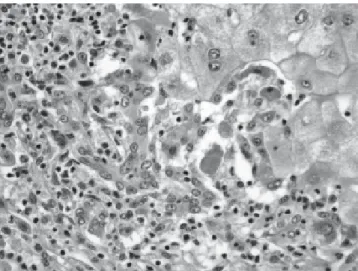
In contrast, doses used in women (n = 7) were lower and between 125 to 250 mg/day, but mean laboratory tests abnormalities were significantly more intense: Bilirubin 24.8 mg/dL (range 4.2-44), AST 1425 UI/mL (range 390-2778), ALT 1404 UI/ mL (range 590-3360) and prothrombin time: 28.7% (range 10-90). Five women (5 out of 7: 71%), evolved into ALF and required liver trans-plantation urgently. The other two cases normali-zed liver test abnormalities within a period of 90 days after flutamide withdrawal (Table 2). The histopathological evaluation of the explanted li-vers showed massive or sub-massive necrosis (Fi-gures 1 and 2) and the mean weight of their explanted livers was 515 g (range 337-856). Four of the five liver transplanted women have had a good outcome with a mean survival follow-up of 29 months post-transplantation (range 4-53) at the date of presentation of this report (Table 3). One woman died due to postoperative complicatio-ns in the immediate post tracomplicatio-nsplant period.
Table 2. Hepatotoxicity induced by flutamide in women (n = 7).
Indications Age Days Hepatic alterations (maximum) Outcome after
for treatment of ingestion Bili AST ALT PT Hepatitis withdrawal of flutamide
1. Hirsutism 44 90 4.2 390 605 90% Acute Good (1)
2. Hirsutism 27 60 27 1064 1803 10% Fulminant Good (2)
3. Hirsutism 32 60 25 1189 925 38% Acute Good (3)
4. Hirsutism 20 180 20 850 590 15% Fulminant Good (4)
5. Acne 22 180 25 1,576 1,116 14% Fulminant Good (5)
6. Acne 21 65 29 2,778 3,360 10% Fulminant Good (6)
7. Alopecia 38 90 44 2,130 1,430 24% Fulminant Died (7)
PT: PT: PT: PT:
PT: Prothrombin time (%). Bili: Bilirrubin (mg/dL). AST: AST: AST: AST: Aspartate aminotransferase (IU/ml). ALT: AST: ALT: ALT: ALT: Alanine aminotransferase (IU/ml). (1) ALT: (1) (1) (1) (1) 1 month. (2) (2) (2) (2) (2) 4 months post transplant. (3) (3) (3) (3) 3 months. (4) (3) (4) (4) (4) (4) 7 months post transplant. (5) (5) 53 months post transplant. (6) (5) (5) (5) (6) (6) (6) (6) 53 months post transplant. (7) (7) (7) (7) (7) Post operative period. Table 1. Hepatotoxicity induced by flutamide in men (n = 3).
Indications Age Days Hepatic alterations (maximum) Outcome after
for treatment of ingestion Bili AST ALT PT Hepatitis withdrawal of flutamide
1. Prostate cancer 77 40 2.4 200 159 100% Acute Good (1)
2. Prostate cancer 80 65 0,6 225 273 90% Acute Good (2)
3. Prostate cancer 67 50 40 2,040 2,410 73% Acute Good (3)
DISCUSSION
Flutamide is an anti-androgenic drug, usually well tolerated in most patients and completely ab-sorbed in the digestive tract. Its androgenic effect is mediated by blockade of androgenic receptors. Among its side effects, diarrhea is commonly mild, but its liver toxicity may be severe and potentially lethal. This drug has been traditionally used in pa-tients with advanced prostate cancer (in a usual dose of 250 mg/8 hours, orally), and during the last
decade in young female patients with hyperandroge-nism (hirsutism and acne). Doses used in hirsutism are usually lower than in prostate cancer patients (between 250-500 mg/day). However, even lower do-ses (62.5-125 mg/daily) used in young women with acne may also show beneficial effects. This drug is metabolized in the liver, resulting in 2-3 small meta-bolites that are excreted in the urine.7
Diagnosis of liver induced damage by flutamide and other drugs is still based upon clinical criteria, considering a temporal relation between the initia-tion of the potentially hepatotoxic drug, and the de-velopment of various degrees of liver injury and its full recovery upon withdrawal of the medication.8-10
In our study, we found a clear temporal relation between flutamide ingestion and liver damage, with the exclusion of other known causes for acute and chronic liver diseases (including viral infections and other potentially hepatotoxic drugs). Clinical reco-very without liver transplantation after drug withdrawal was observed in all the 3 male patients, but in only 2 out of 7 women, as previously repor-ted, that hepatotoxicity may be more severe in wo-men than in wo-men.9,10 Women are more susceptible than men to acute liver injury from drugs and other xenobiotics. The biological mechanisms for this sex difference are unknown, but known sex differences in steroid hormone levels and immune response could play a role.
In general, it is considered that the incidence of flutamide-induced liver toxicity is low, with the war-ning that this drug should be avoided in patients with previous hepatic diseases.6 The first clinical re-ports on hepatotoxicity induced by flutamide were published between 1989 and 1991, as sporadic ca-ses.11-15 Hepatic toxicity induced by flutamide was systematically studied for the first time in 1992, ob-serving liver test alterations (defined as AST and ALT increases at least four times over the upper li-mit of normal) in 4 out of 1,091 (0.36%) consecutive patients with advanced prostate cancer exposed to flutamide. They received oral flutamide in a dose of 750 mg/daily for long periods of time and with a se-rial control of liver tests.16 Afterwards, complemen-tary studies have allowed to estimate an incidence of 3 cases of hepatotoxicity per 10,000 treated pa-tients, although other authors have suggested an in-cidence of up to 6-9% of significant liver toxicity.5,17 From the time of marketing of flutamide in the USA (February 1989) through March of 1991, the US Food and Drug Administration (FDA) received re-ports of 19 patients who developed serious hepato-toxicity while using flutamide. All of them received
Figure 1. Microphotography of the liver of a patient with
acute hepatitis with massive necrosis. Hepatocytes appear ne-crotic, with collapse of the stroma, small bile ductular proli-feration and mononuclear inflammatory infiltrate. HE 40 X.
Figure 2. Microphotography of the liver of a patient with
flutamide for prostate cancer or benign prostatic hy-pertrophy. Fourteen patients had resolution of liver test abnormalities after discontinuing or decreasing the dose of flutamide, but five patients died of pro-gressive liver disease and autopsies showed hepato-cellular necrosis and variable degrees of cholestasis.17
During the last decade, attempts have been made to reduce the potential risk of hepatotoxicity indu-ced by flutamide through the administration of redu-ced doses, particularly in the case of women with hirsutism,18 and in adolescents and young women with hyperinsulinemic hyperandrogenism (a variant of polycystic ovarian syndrome).19-21 Addition of mini-doses of flutamide combined with metformin and oral contraceptives, with a clinical and labora-tory follow-up of 3 to 9 months was associated to additional clinical benefits without reports of hepa-totoxicity. In a recent communication, Ibañez et al.22 did not find any hepatotoxicity in a group of 190 young women with hyperandrogenism that re-ceived low doses of flutamide for up to 54 months.
The pathogenesis of drug-induced liver injury by flutamide encompasses probably a wide spectrum of mechanisms, some of which are still poorly understood.Most drug induced liver injuries, are unpredictable or idiosyncratic (like in flutamide), which may be allergic (with fever, rush, eosinophi-lia) or non-allergic (without allergic features). Liver damage in flutamide hepatotoxicity, is usually expre-ssed as a mixed injury with an increase in serum le-vel of both transaminases (ALT and AST) and the ALT/alkaline phosphatase ratio is usually between 2 and 5.10,23,24 Moller et al.12 have suggested an idio-syncratic damage produced by interference of meta-bolic processes in hepatocytes, cell destruction by direct toxic effect upon essential structures or in-duction of an immunological reaction that would de-termine necrosis and cholestasis. In the majority cases reported of flutamide hepatotoxicity, neither rash nor fever has been clinically observed. In a few cases, eosinophilia has been described as the only sign of hypersensibility.
Both environmental factors and genetic differen-ces in cellular responses to intracellular stress (oxi-dative or organelle specific) and the innate immune response may explain the individual susceptibilities to drug-induced liver injury.25 A study performed in rats suggested that these alterations were mediated by metabolites derived from the P450 system which induced mitochondrial damage.26
In this clinical case series report, we have found an important number of patients with flutamide
he-patotoxicity. In Chile we have no accumulative data of the number of patients receiving flutamide each year. It is our impression that since the Chilean po-pulation has a strong Amerindian genetic compo-nent, it may have a different susceptibility to drug induced liver injury as well. It has been shown for other diseases like intrahepatic cholestasis of preg-nancy (ICP), that Chile has one of the highest inci-dences of ICP in the World, and that multiple factors probably interact with an increased genetic predis-position to alter the membrane compredis-position of bile ducts and hepatocytes and increase their sensitivity to sex steroids and other medications.27 ICP and drug-induced cholestasis are two clinically impor-tant forms of acquired cholestatic liver disease. The understanding of the underlying mechanisms of ac-quired cholestasis has recently made significan pro-gress by the identification of canalicular ATP-binding cassette (ABC) transporters as likely targets for these forms of cholestasis. Genetic va-riants (and mutants) of the genes encoding for the phosphatidylcholine translocator MDR3 and BSEP and for the farnesoid X receptor have been associa-ted with ICP.27 More recently keratin variants (KRT8 and KRT18) have been shown to represent important susceptibility genes for ALF development. Presence of K8/K18 variants predisposes to adverse ALF outcome, and some variants segregate with unique ethnic and race backgrounds.28
Recent data has described in more detail some risk factors for drug induced liver injury (DILI), in-cluding the association of several candidate genes and the development of DILI in the susceptible pa-tient. Human leukocyte antigen-B*5701 is closely linked to the hypersensitivity reaction with abaca-vir, and this screening has been incorporated into HIV treatment. Other candidate genes conferring specific susceptibility to DILI have been identified for medications such as: flucloxacillin, amoxicillin-clavulanate, ximelagatran and isoniazid, but others are under study.29 Preventing DILI through the identification of genetic markers will soon be incor-porated in clinical practice.30
It is noteworthy that in our clinical series, all se-vere cases correspond to women (women 5/7 vs. men 0/3), which may be associated with the influence of host factors. Regarding this, it is necessary to add that in our study all women were young (mean age 29, range: 20-44). This could be ascribed to the fact that in young women, exposure to the drug resulted in a hyper-acute inflammatory response probably through immunologic mechanisms, whose clinical manifestation would be an ALF. The histopathologi-cal study of 5 cases (through the explanted liver) confirmed the diagnosis of ALF (with massive or sub-massive hepatic necrosis), allowing the exclusion of other conditions and chronic pathologies, particular-ly autoimmune diseases. The required treatment in severe cases was liver transplantation, with a favora-ble evolution in four of the 5 cases. Fulminant hepa-titis cases have been reported in the literature as isolated cases, mainly in men receiving flutamide due to prostate cancer,12,17,32-35 usually without need for liver transplantation, as in the present series.
In summary, the data presented in this report su-ggests that serial liver test monitoring should be done in all patients with prostate cancer under flu-tamide therapy. Furthermore, because of the possi-bility of severe liver injury (fulminant hepatitis needing hepatic transplant) in young women using flutamide for benign pathologies (acne, hirsutism, alopecia), its use should be critically reconsidered because of the potential risk of a lethal complication
ABBREVIATIONS
• ••
•• PT: PT: PT: PT: PT: Prothrombin time (%). •
••
•• Bili:Bili:Bili:Bili:Bili: Bilirrubin (mg/dL). •
••
•• AST:AST:AST:AST:AST: Aspartate aminotransferase (IU/mL). •
••
•• ALT:ALT:ALT:ALT:ALT: Alanine aminotransferase (IU/mL).
REFERENCES
1. Crawford ED, Eisenberger MA, McLeod DG, Spaulding JT, Benson R, Dorr FA, et al. A controlled trial of leuprolide with and without flutamide in prostatic carcinoma. New Engl J Med 1989; 321: 419-24.
2. Rittmaster RS. Hirsutism. Lancet 1997; 349: 191-5. 3. Cassero-Branco C, Moyano D, Gómez O, Baasch J.
Long-term safety and tolerability of flutamide for the treat-ment of hirsutism. Fertil Steril 2009; 91: 1183-8.
4. Manso G, Thole Z, Salgueiro E, Revuelta P, Hidalgo A. Spon-taneous reporting of hepatotoxicity associated with an-tiandrogens: Data from the spanish pharmacovigilance system. Pharmaco Epidemiol Drug Saf 2006; 15: 253-9. 5. Cetin M, Demirci D, Unal A, Altinbas M, Guven M,
Uluhizar-ci K. Frequency of flutamide induced hepatotoxiUluhizar-city in pa-tients with prostatic carcinoma. Hum Exp Toxicol 1999; 18: 137-40.
6. Brodgen RN, Clissold SP. Flutamide. A preliminary review of its pharmacodynamic and pharmacokinetic properties and therapeutic efficacy in advanced prostatic cancer. Drugs
1989; 38: 185-203.
7. Benichou C. Criteria of drug-induced liver disorders. Re-port of an international consensus meeting. Hepatology
1997; 26: 664-9.
8. Navarro VJ, Senior JR. Drug-related hepatotoxicity. N Engl J Med 2006; 354: 731-9.
9. Lee WM. Drug-induced hepatotoxicity. N Engl J Med
2003; 349: 474-85.
10. Pu YS, Liu CM, Kao JH, Chen J, Laim MK. Antiandrogen he-patotoxicity in patients with chronic viral hepatitis. Eur Urol 1999; 36: 293-7.
11. Hart W, Strickr BH. Flutamide and hepatitis [letter]. Ann Intern Med 1989; 110: 943-4.
12. Moller S, Iversen P, Franzmann MB. Flutamide-induced liver failure. J Hepatol 1990; 10: 346-9.
13. Coppere H, Perrud Y, Gerard F, Jouffre C, David A, Bar-thelemy C, et al. Un cas d‘hepatite aigue au flutamide. [A case of acute hepatitis caused by flutamide (Letter)].
Gastroenterol Clin Biol 1990; 14: 105-6.
14. Alperine M, Cohen L, Cocheton JJ, Lecomte I, Meyniel D. Hepatite aigue due au flutamide (acute hepatitis caused by flutamide) [Letter]. Presse Med 1991; 20: 1459-60. 15. Corkery JC, Bihrle W 3rd, McCaffrey JA, Whitcomb FF,
Levy C, Ellis R. Flutamide-related fulminant hepatic failure [Letter]. J Clin Gastroenterol 1991; 13: 364-5.
16. Gomez JL, Dupont A, Cusan L, Tremblay M, Subruv R, Le-may M, et al. Incidence of liver toxicity associated with the use of flutamide on prostate cancer patients. Am J Med 1992; 92: 465-70.
17. Wysowski DK, Feiman JP, Tourtelot JB, Horton LM. Fatal and non fatal hepatotoxicity associated with flutamide.
Ann Intern Med 1993; 118: 860-4.
18. Muderris II, Bayram F, Guven M. Treatment of hirsutism with lowest-dose flutamide (62.5 mg/day). Gynecol Endo-crinol 2000; 14: 38-41.
19. Ibañez L, Valls C, Cabré S, Zegher F. Flutamide-metformin plus ethilnylestradiol-diopirenone for lipolysis and anti-atherogenesis in young women with ovarian hyperandro-genism: the key role of early, low dose flutamide. J Clin Endocrinol Metab 2004; 89: 4716-20.
20. Ibañez L, Zegher F. Ethinylestradio-drospirenone, fluta-mide-metformin, or both for adolescents and young wo-men with hyperinsulinemic hyperandrogenism: opposite effects on adipocytokines and body adiposity. J Clin En-docrinol Metab 2004; 89: 1592-7.
21. Ibañez L, Zegher F. Flutamide-metformin plus ethinyles-tradio-dropirenone for lipolysis and anti-atherogenesis in young women with ovarian hyperandrogenism: the key role of metformin and the start and after more than one year of therapy. J Clin Endocrinol Metab 2005; 90: 39-43. 22. Ibáñez L, Jaramillo A, Ferrer A, de Zegher F. Absence of
hepatotoxicity after long-term, low-dose flutamide in hy-perandrogenic girls and young women. Hum Reprod 2005; 20: 1833-6.
23. Chung CY, Schiano TD. Drug hepatotoxicity. Aliment Pharmacol Ther 2007; 25: 1135-51.
24. Andrade RJ, Robles M, Fernández-Castañer A, López-Orte-ga S, López-VeLópez-Orte-ga MC, Lucena MI. Assessment of drug-in-duced hepatotoxicity in clinical practice: A challenge for gastroenterologists. World J Gastroenterol 2007; 13: 329-34.
26. Fau D, Eugene D, Berson A, et al. Toxicity of the antian-drogen flutamide in isolated rat hepatocytes. J Pharmacol Exp Ther 1994; 269: 954-62.
27. Pauli-Magnus C, Meier PJ, Stieger B.Genetic determinants of drug-induced cholestasis and intrahepatic cholestasis of pregnancy. Semin Liver Dis 2010; 30: 147-59.
28. Strnad P, Zhou Q, Hanada S, Lazzeroni LC, Zhong BH, So P, Davern TJ, Lee WM. Acute Liver Failure Study Group, Omary MB. Keratin variants predispose to acute liver fa-ilure and adverse outcome: race and ethnic associations.
Gastroenterology 2010; 139: 828-35.
29. Daly K. Drug-induced liver injury: past, present and futu-re. Pharmacogenomics 2010; 11: 607-11.
30. Daly AK, Day CP. Genetic association studies in drug-indu-ced liver injury. Semin Liver Dis 2009; 29: 400-211.
31. Caballería E, Aragó JU, Sanchis A. Hepatotoxicity due to flutamide. Med Clin 1994; 102: 434-8.
32. Lübert C, Wiese M, Haupt R, Ruf RQ. Toxic hepatitis and li-ver failure under therapy with flutamide. Internist 2004; 45: 333-40.
33. García-Cortes M, Andrade RJ, Lucena MI, Sanchez-Marti-nez H, Fernandez MC, Ferrer T, et al. Flutamide-induced hepatotoxiciy: report of a case series. Rev Esp Enferm Dig
2001; 93: 423-32.
34. Fernández CM, Morano LE, Montes J, Fachal C. Fallo hepá-tico fulminante con evolución fatal inducido por flutamida.
Med Clin 1997; 108: 237-8.