Risk and Prognosis of Acute Liver Injury Among
Hospitalized Patients with Hemodynamic Instability:
A Nationwide Analysis
Najeff Waseem,*,† Berkeley N. Limketkai,‡ Brian Kim,§ Tinsay Woreta,*,|| Ahmet Gurakar,* Po-Hung Chen*
* Division of Gastroenterology & Hepatology, Johns Hopkins University School of Medicine, Baltimore, MD, USA.
† George Washington School of Medicine and Health Sciences, Washington, DC, USA. ‡ Division of Gastroenterology & Hepatology, Stanford University School of Medicine, Stanford, CA, USA. § Division of Gastrointestinal & Liver Diseases, Keck School of Medicine of the University of Southern California, CA, USA. || Division of Gastroenterology, Texas Tech University Health Sciences Center School of Medicine, Lubbock, TX, USA.
January-February, Vol. 17 No. 1, 2018: 119-124
INTRODUCTION
Critically ill patients with hemodynamic instability are often at risk for acute liver injury (ALI) from a number of different causes with varying levels of clinical signifi-cance. ALI in this population can range from idiopathic or iatrogenic elevations in aminotransferases to distinct clini-cal entities such as hepatic congestion, sepsis-associated cholestasis, or at worst hypoxic hepatitis (HH). ALI has important ramifications for critically ill patients as liver dysfunction is associated with poorer outcomes inde-pendently of other organ dysfunction.1
Congestive hepatopathy is often seen in patients with impaired forward flow leading to increased venous
pres-sure in the inferior vena cava and hepatic veins. Patho-physiologically, this leads to congestion and dilatation of hepatic sinusoids, followed by perisinusoidal edema and atrophy of hepatocytes. If sufficiently sustained, this can lead to collagen deposition and areas of liver fibrosis.2
Congestive hepatopathy is a spectrum of disorders, how-ever, as passive congestion can be present without affect-ing liver function in some patients, while in others venous congestion can predispose the liver to hypoxic events.3
Sepsis-associated cholestasis, also sometimes referred to under the umbrella of Intensive Care Unit (ICU) jaun-dice, is the observation of elevated levels of bilirubin in critically ill patients. The etiology of hyperbilirubinemia is often difficult to pinpoint. Sepsis alone can cause
jaun-The Official Journal of the Mexican Association of Hepatology, the Latin-American Association for Study of the Liver and
the Canadian Association for the Study of the Liver
Manuscript received: Manuscript received:Manuscript received:
Manuscript received:Manuscript received: January 21, 2016. Manuscript accepted:Manuscript accepted:Manuscript accepted:Manuscript accepted:Manuscript accepted: May 29, 2017.
DOI:10.5604/01.3001.0010.7543
A A A A
A B S T R A C TB S T R A C TB S T R A C TB S T R A C TB S T R A C T
Introduction and aim. Introduction and aim.Introduction and aim. Introduction and aim.
Introduction and aim. Critically ill patients in states of circulatory failure are at risk of acute liver injury, from mild elevations in aminotransferases to substantial rises consistent with hypoxic hepatitis or “shock liver”. The present study aims to quantify the national prevalence of acute liver injury in patients with hemodynamic instability, identify risk factors for its development, and determine predictors of mortality. Material and methods.Material and methods.Material and methods.Material and methods.Material and methods. The 2009-2010 Nationwide Inpatient Sample was interrogated using ICD-9-CM codes for hospital admissions involving states of hemodynamic lability. Multivariable logistic regression was used to evaluate the risks of acute liver injury and death in patients with baseline liver disease, congestive heart failure, malnutrition, and HIV. Results. Results. Results. Results. Results. Of the 2,865,446 patients identified in shock, 4.60% were found to have acute liver injury. A significantly greater proportion of patients with underlying liver disease experienced acute liver injury (22.03%) and death (28.47%) as compared to those without liver disease (3.18% and 18.82%, respectively). The odds of developing acute liver injury were increased in all baseline liver diseases studied, including all-cause cirrhosis, hepatitis B, hepatitis C, alcoholic liver disease, and non-alcoholic fatty liver disease, as well as in congestive heart failure and malnutrition. All-cause cirrhosis and alcoholic liver disease, however, conferred the greatest risk. Similar trends were seen with mortality. HIV was not a predictor for acute liver injury. Conclusion. Conclusion. Conclusion. Conclusion. Conclusion. Liver injury is a major concern among patients with protracted circulatory instability, especially those suffering from underlying liver disease, heart failure, or malnutrition.
Key words. Key words.Key words. Key words.
dice, especially in gram-negative infections, as hepato-cytes lose the ability to process bilirubin and are predis-posed to cell death.4 This liver dysfunction, however, can
also worsen with antibiotics, the use of positive ventila-tion, or any major surgery in addition to sepsis/shock states alone.1
Finally, critically ill patients can suffer from HH, also known as ischemic hepatitis or “shock liver”. It is defined as a dramatic but transient increase in serum aminotrans-ferases to 20 times the upper limit of normal in the setting of acute cardiac, circulatory, or respiratory failure without other identifiable causes of liver damage like viral or drug-induced hepatitis.5 The prevalence of HH in critical care
units ranges from 1%6-8 to as high as 12%9 as reported in
several small studies.5 Hypoxic damage of the liver is
asso-ciated with an in-hospital mortality of 56%6 and one-year
mortality near 75%.7,8 In predisposed patients, the
theo-rized length of hypotension needed for ischemic injury to the liver can be as short as 15 to 20 min.10
The present study analyzes a national sample of hospital discharges to both quantify the frequency of ALI on a large scale and estimate the risk of mortality based upon the presence of medical comorbidities in hemodynamically unstable patients.
MATERIAL AND METHODS
Data source
All data were gathered from the Nationwide Inpatient Sample (NIS) between 2009 and 2010. The NIS is the larg-est national database of hospital discharges in the United States, estimating a 20% stratified sample of non-federal, acute care hospitals participating in the Healthcare Cost and Utilization Project but excluding rehabilitation and long-term care facilities.11 Included in each discharge
record are patient demographics, primary and secondary diagnoses and procedures, length of stay, expected pay-ment source, and hospital characteristics (e.g., region, size, and teaching status). We used the Clinical Modifica-tion of the InternaModifica-tional ClassificaModifica-tion of Diseases, Ninth Revision (ICD-9-CM) diagnosis codes to identify pa-tients with ALI in the NIS using an algorithm previously validated by Myers, et al.12
Predictor and outcome variables
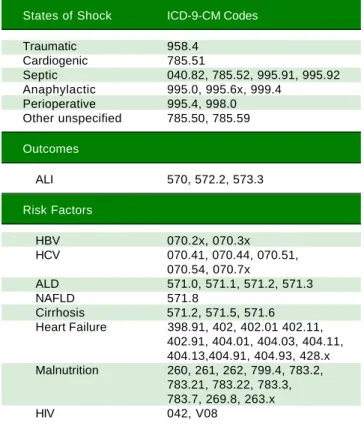
ICD-9-CM diagnostic codes (Table 1) were used to identify all inpatient admissions listed in the NIS involv-ing traumatic shock, cardiogenic shock, septic shock, ana-phylactic shock, postoperative shock, and other unspecified states of shock or hemodynamic lability. In
accordance with the previously validated methodology by Myers, et al.,12 primary outcomes were development of
ALI (ICD-9-CM codes 570, 572.2, 573.3) and death. These records were also analyzed for potential risk factors in-cluding all-cause cirrhosis, hepatitis B virus (HBV), hepa-titis C virus (HCV), alcoholic liver disease (ALD), non-alcoholic fatty liver disease (NAFLD), heart failure, malnutrition, and human immunodeficiency virus (HIV).
Statistical analysis
Data analysis was performed in accordance with the stratified and weighted sampling design of the NIS. Preva-lence of the primary outcomes with and without liver dis-ease and congestive heart failure (CHF) were compared using the χ2 test. Multivariable logistic regression was
used to estimate the relative odds of the outcomes given the aforementioned potential risk factors, adjusting for age, gender, health insurance, hospital size, hospital teach-ing status, and geographic region. All controlled covariates were chosen a priori for their potential to confound. Analy-ses were performed using SAS software (release 9.3; SAS
Table 1. Clinical Modification of the International Classification of Diseases, Ninth Revision (ICD-9-CM) codes used in this study.
States of Shock ICD-9-CM Codes
Traumatic 958.4
Cardiogenic 785.51
Septic 040.82, 785.52, 995.91, 995.92
Anaphylactic 995.0, 995.6x, 999.4
Perioperative 995.4, 998.0
Other unspecified 785.50, 785.59
Outcomes
ALI 570, 572.2, 573.3
Risk Factors
HBV 070.2x, 070.3x
HCV 070.41, 070.44, 070.51,
070.54, 070.7x
ALD 571.0, 571.1, 571.2, 571.3
NAFLD 571.8
Cirrhosis 571.2, 571.5, 571.6
Heart Failure 398.91, 402, 402.01 402.11,
402.91, 404.01, 404.03, 404.11, 404.13,404.91, 404.93, 428.x
Malnutrition 260, 261, 262, 799.4, 783.2,
783.21, 783.22, 783.3, 783.7, 269.8, 263.x
HIV 042, V08
Institute, Cary, NC) and Stata/IC version 13.1 (Stata Corp, College Station, Texas). P values < 0.05 were con-sidered statistically significant.
Ethical considerations
The NIS contains entirely anonymous, publically available data with no threat of compromise to patient confidentiality. The study protocol was reviewed and ap-proved by the Johns Hopkins Institutional Review Board (number NA_00086245).
RESULTS
There were 2,865,446 admissions in 2009 and 2010 that satisfied the inclusion criteria of shock or hemodynamic instability. The mean age of patients included was 65.1 years, with 50.1% of the population male and most patients insured with Medicare (Table 2). Among the included co-hort, 4.60% were found to have ALI and 19.55% died. The overall frequency of concomitant liver disease was 7.54%, including all-cause cirrhosis 2.97%, HBV 0.39%, HCV 2.40%, ALD 1.80%, and NAFLD 0.58%. Concurrent
diag-nosis of CHF was noted in 23.93% of these admissions (Table 2).
Of the patients with any form of liver disease, 22.03% suffered from ALI and 28.47% death compared to 3.18% and 18.82% respectively of patients without liver disease (P < 0.001) (Figure 1). A similar pattern was observed in CHF patients as 5.14% suffered from ALI and 24.43% death compared to 4.44% and 18.01% respectively in those with-out CHF (P < 0.001) (Figure 2).
In multivariable analysis, the odds of developing ALI were increased with predisposing liver diseases including all-cause cirrhosis [adjusted odds ratio (aOR) 9.44, 95% confidence interval (CI) 8.96-9.94], underlying HBV (aOR 1.77, 95% CI 1.52-2.06), HCV (aOR 1.67, 95% CI 1.53-1.82), ALD (aOR 11.14, 95% CI 10.49-11.53-1.82), and NAFLD (aOR 2.63, 95% CI 2.34-2.95). Odds of developing ALI were also increased with heart failure (aOR 1.34, 95% CI
Figure 2. Figure 2. Figure 2. Figure 2.
Figure 2. Frequency of ALI and death in CHF patients. ALI: Acute Liver Injury. CHF: Congestive Heart Failure.
Table 2. Demographics of patients admitted for shock.
Mean age (95% CI) 65.1 (64.7-65.8)
Gender
Male 50.1 (%)
Female 49.9
Insurance
Medicare 62.3 (%)
Medicaid 32.8
Other 26.1
Hospital size
Small 12.2 (%)
Medium 23.5
Large 64.3
Teaching hospital 45.1 (%)
Hospital region
Northeast 18.5 (%)
Midwest 21.7
South 38.9
West 20.9
Concurrent diagnosis
Cirrhosis 2.97 (%)
HBV 0.39
HCV 2.40
ALD 1.80
NAFLD 0.58
All Liver Disease 7.54
CHF 23.93
HIV 1.27
CI: Confidence interval. HBV: Hepatitis B virus. HCV: Hepatitis C virus. ALD: Alcoholic liver disease. NAFLD: Non-Alcoholic Fatty Liver Disease. HIV: Human immunodeficiency virus.
5.14% 4.44%
24.43%
18.01% 30
25
20
15
10
5
0
Patients (%)
ALI Death
CHF No CHF
All p values < 0.001 Figure 1.
Figure 1. Figure 1. Figure 1.
Figure 1. Frequency of ALI and death in liver disease patients. ALI: Acute Liver Injury.
22.03%
3.18%
28.47%
18.82% All P values < 0.001
30
25
20
15
10
5
0
Patients (%)
ALI Death
1.29-1.39) and malnutrition (aOR 1.44, 95% CI 1.37-1.50), but not with HIV (aOR 0.90, 95% CI 0.81-1.01).
Similarly, increases in odds of mortality were seen with most underlying liver disease, heart failure, malnutrition, and HIV (Table 3). Odds of mortality were increased in all underlying liver conditions including all-cause cirrhosis (aOR 2.68, 95% CI 2.57-2.78), HBV (aOR 1.72, 95% CI 1.50-1.96), HCV (aOR 1.71, 95% CI 1.63-1.80), ALD (aOR 2.90, 95% CI 2.77-3.03), but not in NAFLD (aOR 0.74, 95% CI 0.66-0.83). Odds of mortality were also increased in heart failure (aOR 1.27, 95% CI 1.24-1.30), malnutrition, and HIV (aOR 1.62, 95% CI 1.47-1.77).
DISCUSSION
Our use of the NIS allowed the study of millions of hospital admissions to characterize the risk of underlying liver disease in the development of ALI and death in pa-tients with shock. ALI was identified in 4.60% of all ad-missions included in this study. In patients without baseline liver pathology, however, the prevalence of ALI was only 3% in contrast to 22% with underlying liver dis-ease. The likelihood of ALI and death was elevated in cir-rhosis, viral hepatitis, and ALD, as well as in CHF and malnutrition.
This dramatic increase in ALI supports the idea of a secondary liver injury in those who are patho- physiologi-cally predisposed - an entity now recognized as acute-on-chronic liver failure (ACLF). The first consensus definition of ACLF proposed by the Asian Pacific Associ-ation for the Study of the Liver in 2009 defined ACLF as “an acute hepatic insult manifesting as jaundice and coagu-lopathy, complicated within 4 weeks by ascites and/or en-cephalopathy in a patient with previously diagnosed or undiagnosed chronic liver disease”.13 Subsequent
defini-tions have included modifiers such as high 28-day mortal-ity14 and the presence of organ failure.15 The susceptibility
of the liver to ACLF depends on both the etiology of the
acute insult16 and, as seen in these results, the etiology of
the underlying liver disease.
Of the risk factors included in this analysis, all-cause cirrhosis had among the largest increases in odds of ALI and death. These results support previous studies suggest-ing cirrhosis portends a poorer outcome in HH as well as other forms of ALI.9,17 Cirrhotic livers are predisposed to
poor oxygen consumption as a result of portosystemic shunting and impaired functional blood flow.18 These
pa-tients are therefore more sensitive to hemodynamic shifts causing ALI in states of shock.
Also notable was ALD, which had the highest adjusted odds ratios in both outcomes. Alcohol induces a hyper-metabolic state with elevated oxygen demand in the cen-trilobular zones of the liver, thereby increasing susceptibility to hypoxia during times of low hepatic blood flow.19,20 Chronic alcohol use also leads to the
up-regulation of cytochrome P450 2E1 (CYP2E1), a vital en-zyme in the hepatic metabolism of drugs and certain toxic metabolites, which in turn may exacerbate damage to the liver in times of severe stress.21
Viral hepatitides including HBV and HCV also por-tended increased risks of liver injury and death, though less drastically than ALD. Given the natural history of viral hepatitis infection, patients sampled range on the disease spectrum from clinically silent or mild liver disease to chronic inflammation, fibrosis, and eventual cirrhosis.22,23
As stated above, cirrhosis itself may predispose the liver to circulatory damage, but we know of no existing studies that measured whether chronic HBV or HCV infection in-dependently reduced the hepatic capacity for extracting oxygen from systemic circulation. Further laboratory studies are needed to better explore this relationship.
Patients with NAFLD were found to have increased odds of ALI, but curiously a lower odds of mortality. In NAFLD, there is reduced portal vein flow velocity,24
which could explain why in times of shock such livers might be more prone to damage, as is the case in cirrhosis.
Table 3. Odds of developing ALI or death based on risk factors.*
Risk Factor ALI Death
aOR 95% CI aOR 95% CI
Cirrhosis 9.44 8.96 - 9.94 2.68 2.57 - 2.78
HBV 1.77 1.52 - 2.06 1.72 1.50 - 1.96
HCV 1.67 1.53 - 1.82 1.71 1.63 - 1.80
ALD 11.14 10.49 - 11.82 2.90 2.77 - 3.03
NAFLD 2.63 2.34 - 2.95 0.74 0.66 - 0.83
Heart Failure 1.34 1.29 - 1.39 1.27 1.24 - 1.30
Malnutrition 1.44 1.37 - 1.50 1.27 1.23 - 1.30
HIV 0.90 0.81 - 1.01 1.62 1.47 - 1.77
One potential explanation for the lower odds of mortality is that patients with NAFLD are more likely to have meta-bolic syndrome and be prescribed statins. In one study, statin therapy was associated with a reduction in 28-day mortality for all patients admitted to the ICU, including those with HH, possibly owing to a protective effect of statins in ischemia/reperfusion injury.25
Non-liver diseases like heart failure were also found to have moderate increases in odds of ALI and death. The risk of liver damage conferred by CHF has been well-stud-ied,3,7,8 and our results support the findings that heart failure
portends a higher risk of ALI. This is most likely due to chronic venous congestion affecting the liver directly in ad-dition to CHF patients having preexisting impaired blood flow exacerbated by times of hemodynamic lability.
Malnutrition also confers a greater risk of ALI and death, and malnutrition leading to liver injury has been studied previously with elevation of liver enzymes in ano-rexia nervosa. One study posited that in addition to circu-latory abnormalities experienced in states of malnutrition, anorexia patients had depleted glycogen stores and au-tophagosomes on liver biopsy indicative of malnutrition-induced cell death.26 Furthermore, vitamin D deficiency
has been associated with hepatic steatosis.27 The risk of
ALI and death conferred by malnutrition is likely multi-factorial, ultimately leading to increased susceptibility to hepatic injury induced by bodily stressors.
HIV, unlike heart failure and malnutrition, did not lead to increased risk for ALI, but did lead to an increased risk of death. HIV monoinfection has been associated with he-patic fibrosis,28 and chronic liver disease can occur in HIV
patients with co-morbid viral hepatitis and/or alcohol abuse.29 However, these scenarios may not occur with
suf-ficient frequency to significantly influence the likelihood of developing ALI. The increased risk of death is consist-ent with previous literature showing that HIV infection portends poorer outcomes including mortality in patients suffering from septic shock or circulatory compro-mise.30,31
The present analysis has some limitations, mostly those inherent to the use of administrative data. First, the accura-cy of ICD-9-CM codes is susceptible to variations in re-gional and national coding practices. The ALI coding algorithm was previously validated by Myers, et al. to have both excellent sensitivity and specificity.12 However, that
study was conducted using a large Canadian health regis-try, so its results may not be wholly reproducible in a U.S.-based cohort. The NIS also does not contain person-ally identifiable information or link to individual medical records; therefore, it is not possible to further confirm an ALI diagnosis by examining the precise liver enzyme ab-normalities. Second, our study inclusion criteria grouped various hemodynamic lability processes (i.e., cardiogenic
shock, septic shock, anaphylactic shock, etc.) into one broad category, but there are physiologic differences be-tween these clinical classifications that may additionally modify the risk for developing ALI. These subtleties may be further explored in future studies. Despite these short-comings, our use of the NIS in analysis permitted a robust sample size that sufficiently powered statistical tests for even relatively uncommon conditions, and minimized the referral bias associated with single-center tertiary hospital studies.
In conclusion, the present analysis illustrated that in the setting of protracted circulatory instability, hospital-ized patients with baseline liver disease or heart failure had increased risks of ALI and death. Not all pre-existing disorders conferred the same level of risk; future studies may help elucidate the differences in pathophysiological mechanisms including most interestingly ALD and NAFLD. Given the relative frequency and poor prognosis of ALI in critically ill patients, early identification of indi-viduals with high risk features highlighted in this study may be crucial to providing the optimal care that improves the consequent outcome.
ABBREVIATIONS
• ACLF: Acute-on-Chronic Liver Failure. • ALD: Alcoholic Liver Disease.
• ALI: Acute Liver Injury. • aOR: Adjusted Odds Ratio. • CHF: Congestive Heart Failure. • HBV: Hepatitis B.
• HCV: Hepatitis C. • HH: Hypoxic Hepatitis. • ICU: Intensive Care Unit.
• NAFLD: Non-alcoholic Fatty Liver Disease. • NIS: Nationwide Inpatient Sample.
CONFLICT OF INTEREST DISCLOSURES
None.
FUNDING/SUPPORT
Not applicable.
PREVIOUS PRESENTATION
Digestive Disease Week 2013, Orlando, FL.
AUTHOR CONTRIBUTIONS
Analysis and interpretation of data: NW, BL, BK, TW, PC. Drafting of the manuscript: NW, PC.
Critical revision of the manuscript for important intel-lectual content: NW, BL, BK, TW, AG, PC.
Statistical analysis: BL, PC. Obtained funding: not applicable.
Administrative, technical, or material support: AG. Study supervision: PC.
FUNDING SOURCES
Not applicable.
REFERENCES
1. Brienza N, Dalfino L, Cinnella G, Diele C, Bruno F, Fiore T.
Jaundice in critical illness: promoting factors of a concealed
reality. Intensive Care Med 2006; 32: 267-74.
2. Kavoliuniene A, Vaitiekiene A, Cesnaite G. Congestive
hepatopathy and hypoxic hepatitis in heart failure: a
cardiol-ogist's point of view. Int J Cardiol 2013; 166: 554-8.
3. Seeto RK, Fenn B, Rockey DC. Ischemic hepatitis: clinical
pres-entation and pathogenesis. Am J Med 2000; 109: 109-113.
4. Chand N, Sanyal AJ. Sepsis-induced cholestasis.
Hepatolo-gy 2007; 45: 230-41.
5. Fuhrmann V, Jager B, Zubkova A, Drolz A. Hypoxic hepatitis
- epidemiology, pathophysiology and clinical management. Wien Klin Wochenschr 2010; 122: 129-39.
6. Fuchs S, Bogomolski-Yahalom V, Palitel O, Ackerman Z.
Ischemic hepatitis. Clinical and laboratory observations of 34
patients. J Clin Gastroenterol 1998; 26: 183-6.
7. Henrion J, Schapira M, Luwaert R, Colin L, Delannoy A,
Hel-ler FR. Hypoxic hepatitis: clinical and hemodynamic study in
142 consecutive cases. Medicine (Baltimore) 2003; 82:
392-406.
8. Birrer R, Takuda Y, Takara T. Hypoxic Hepatopathy:
Patho-physiology and Prognosis. Int Med 2007; 46: 1063-70.
9. Fuhrmann V, Kneidinger N, Herkner H, Heinz G, Nikfardjam
M, Bojic A, Schellongowski, P, et al. Hypoxic hepatitis: un-derlying conditions and risk factors for mortality in critically ill
patients. Intensive Care Med 2009; 35: 1397-405.
10. Birrer R, Takuda Y, Takara T. Hypoxic hepatopathy:
patho-physiology and prognosis. Intern Med 2007; 46: 1063-70.
11. HCUP NIS Database Documentation. Healthcare Cost and Uti-lization Project (HCUP). June 2015. Agency for Healthcare Research and Quality, Rockville, MD. Available from: w w w . h c u p - u s . a h r q . g o v / d b / n a t i o n / n i s / nisdbdocumentation.jsp.
12. Myers RP, Leung Y, Shaheen AA, Li B. Validation of ICD-9-CM/ICD-10 coding algorithms for the identification of patients with acetaminophen overdose and hepatotoxicity using
ad-ministrative data. BMC Health Serv Res 2007; 7: 159.
13. Sarin SK, Kumar A, Almeida JA, Chawla YK, Fan ST, Garg H, de Silva HJ, et al. Acute-on-chronic liver failure: consen-sus recommendations of the Asian Pacific Association for
the study of the liver (APASL). Hepatol Int 2009; 3: 269-82.
14. Sarin SK, Kedarisetty CK, Abbas Z, Amarpurkar D, Bihari C, Chan AC, Chawla YK, et al. Acute-on-chronic liver failure: consensus recommendations of the Asian Pacific
Associa-tion for the study of the liver (APASL) 2014. Hepatol Int
2014; 8: 453-71.
15. Moreau R, Jalan R, Gines P, Pavesi M, Angeli P, Cordoba J, Durand F, et al. Acute-on-chronic liver failure is a distinct
syndrome that develops in patients with acute
decompesna-tion of cirrhosis. Gastroenterol 2013; 144: 1426-37.
16. Shi Y, Yang Y, Hu Y, Wu W, Yang Q, Zheng M, Zhang S, et al. Acute-on-chronic liver failure precipitated by hepatic inju-ry is distinct from that precipitated by extrahepatic insults. Hepatol 2015; 62: 232-42.
17. Henrion J, Colin L, Schmitz A, Schapira M, Heller FR.
Ischemic hepatitis in cirrhosis. Rare but lethal. J Clin
Gas-troenterol 1993; 17: 35-9.
18. Molino G, Avagnina P, Ballare M, Torchio M, Niro AG, Aurucci PE, Grosso M, et al. Combined evaluation of total and
func-tional liver plasma flows and intrahepatic shunting. Dig Dis
Sci 1991; 36: 1189-96.
19. Israel Y, Videla L, Bernstein J. Liver hypermetabolic state af-ter chronic ehtanol consumption: hormonal inaf-terrelations and
pathogenic implications. Fed Proc 1975; 34: 2052-9.
20. Thurman RG, Sungchul JI, Matsumura T, Lemasters JJ. Is hy-poxia involved in the mechanism of alcohol-induced liver inju-ry? Fundam Appl Toxicol 1984; 4: 125-33.
21. Wang X, Wu D, Yang L, Gan L, Cederbaum AI. Cytochrome P450 2E1 potentiates ethanol induction of hypoxia and HIF-1
in vivo. Free Radic Biol Med 2013; 63: 175-86.
22. Sharma SK, Saini N, Chwla Y. Hepatitis B virus: inactive
car-riers. Virol J 2005; 2: 82.
23. Seeff LB. Natural history of chronic hepatitis C. Hepatology
2002; 36: S35-S46.
24. Erdogmus B, Tamer A, Buyukkaya R. Portal vein
hemody-namics in patients with non-alcoholic fatty liver disease.
To-hoku J Exp Med 2008; 215: 89-93.
25. Drolz A, Horvatits T, Michl B, Roedl K, Schellongowski P, Holzinger U, Zauner C, et al. Statin therapy is associated with reduced incidence of hypoxic hepatitis in critically ill
pa-tients. J Hepatol 2014; 60: 1187-93.
26. Rautou PE, Cazals-Hatem D, Moreau R, Francoz C, Feldmann G, Lebrec D, Ogier-Denis E, et al. Acute liver cell damage in patients with anorexia nervosa: a possible role of
starvation-induced hepatocyte autophagy. Gastroenterol 2008; 135:
840-8.
27. Eliades M, Spyrou E. Vitamin D: a new player in non-alcoholic
fatty liver disease? World J Gastroenterol 2015; 21:
1718-27.
28. Price JC, Seaberg EC, Badri S, Witt MD, D’Acunto K, Thio CL. HIV monoinfection is associated with increased aspartate aminotransferase-to-platelet ratio index, a surrogate marker
for hepatic fibrosis. J Infect Dis 2012; 205: 1005-13.
29. Castellares C, Barreiro P, Martin-Carbonero L, Labarga P, Vispo ME, Casado R, Galindo L, et al. Liver cirrhosis in HIV-infected patients: prevalence, aetiology and clinical outcome. J Viral Hepat 2008; 15: 165-72.
30. Thyrault M, Gachot B, Chastang C, Souweine B, Timsit JF, Bedos JP, Regnier B, et al. Septic shock in patients with the
acquired immunodeficiency syndrome. Intensive Care Med
1997; 23: 1018-23.
31. D'Ascenzo F, Cerrato E, Biondi-Zoccai G, Moretti C, Omede P, Sciuto F, Bollati M, et al. Acute coronary syndromes in hu-man immunodeficiency virus patients: a meta-analysis inves-tigating adverse event rates and the role of antiretroviral
therapy. Eur Heart J 2011; 33: 875-80.
Correspondence and reprint request:
Po-Hung Chen, M.D. 4940 Eastern Avenue, Suite A-505.
Baltimore, Maryland 21224. USA. Tel.: 410-550-1793. Fax: 410-550-7861