ESCUELA DE CIENCIAS DE LA EDUCACIÓN
MENCIÓN INGLÉS
DISTANCE SYSTEM
The use of supplementary materials for teaching children in EFL classes
Research done in order to achieve
the Bachelor’s Degree in Teaching
English as a Foreign Language
AUTHORS:
Baldeón Herrera, Sofía Liseth Erazo Flores Karen Vanesa
ADVISOR:
Mgs. Orlando Vicente Lizaldes Espinosa
ii CERTIFICATION
Mgs. Orlando Lizaldes
CERTIFIES THAT:
This research work has been thoroughly revised by the graduation committee. Therefore, authorizes the presentation of this thesis, which complies with all the norms and internal requirements of the Universidad Técnica Particular de Loja.
Loja, March 2012
……….
iii CONTRATO DE CESIÓN DE DERECHOS DE TESIS DE GRADO
Nosotras, Sofía Baldeón y Karen Erazo declaramos ser las autoras del presente trabajo y eximimos expresamente a la Universidad Técnica Particular de Loja y a sus representantes legales de posibles reclamos o acciones legales.
Adicionalmente declaramos conocer y aceptar la disposición del Art. 67 del Estatuto Orgánico de la Universidad Técnica Particular de Loja que en su parte
pertinente textualmente dice: “Forman parte del patrimonio de la Universidad de la
propiedad intelectual de investigaciones, trabajos científicos o técnicos y tesis de grado que se realicen a través, o con el apoyo financiero, académico o institucional
(operativo) de la Universidad”.
……..………..……… ...
iv AUTHORSHIP
The thoughts, ideas, opinions and the information obtained through this research are the only responsibility of the author.
March, 2012
……….. ………..
v DEDICATION
I dedicate this Project to: God:
He is my father, to him I owe my life, health and everything I am. Thanks for let me get to this point in my life.
My Husband:
He has been my best friend and faithful companion; he also has been my encouragement and strength after a hard day.
My daughter Ana Paula:
She has become an important part of my life, she is the motivation that I have needed and the main reason to be a good person.
My parents:
Because they have foster me to be who I am; thanks for all your patience and all the great love that you have always brought to me.
With love,
vi DEDICATION
I dedicate this Project to: God:
He has been my support in good and bad moments, He has given me faith, strength, and hope; He also has put in my way all those people who have given me advice and support when I needed it.
My daughter Lizeth:
Who has been my motivation all these years; she has been my strength and courage to go ahead. Thanks my beloved child for being patient; for give me all the time that belonged to you and I have taken to study my career.
My parents:
They were with me during all this time and they motivated me to go ahead, by giving me good advices and praying for me to continue and finish my studies.
With love,
vii CONTENTS
CERTIFICATION……….… ii
CONTRATO DE CESIÓN DE DERECHOS……….………... iii
AUTHORSHIP………. iv
DEDICATION………..……… v
DEDICATION ……….. vi
CONTENTS………..……….... vii
ABSTRACT………..……… 1
INTRODUCTION ………..………….. 2
METHODOLOGY……… 6
DISCUSSION……….. 8
Literature Review………. 8
Results ……….. 24
Description, Interpretation and Analysis of Results………. 29
Conclusions……….. 61
Recommendations………... 62
REFERENCES………..……. 63
1 Abstract
This study was related to The Use of Supplementary Materials for Teaching Children in EFL Classes, its principal aim was to determine and analyze the type of supporting materials used by teachers in elementary schools. More specifically, the analysis aimed to determine whether the supporting materials were used according to
the contents and students’ needs; in addition, this research analyzes aspects such as
quality, frequency and variety of material used in the observed classes.
The observations took place in a private elementary school in Quito with children from the 4th (eight years old approximately), 5th (nine years old approximately), and 6th (10 years old approximately) grade. On each grade, ten classes were observed to determine the type, pertinence, and appropriateness of materials. The methods used to analyze the results were: Qualitative and Quantitative.
2 Introduction
It is important that teachers consider all the necessary resources in order to achieve the planned objectives of a lesson. In particular, it is equally important to know the type of materials that teachers use for teaching Ecuadorian children in EFL classes and main reasons for their selection.
Teachers’ reasons for use supplementary materials in their classes must be
related to the pertinence, appropriateness, and quality of design of supplementary materials; therefore, those aspects were the main goal of this research. The researchers employed methods, techniques and instruments to perform this research. To analyze the results about the use of supplementary materials, the researchers applied the Quantitative and Qualitative methods. Information was gathered through these techniques: reading and note taking. Finally, observations sheets, tables, and surveys were the main instruments used in this research.
A first step in this research was to select a public elementary school to carry out observations in ten classes in 4th, 5th, and 6th grades; on each class, the researchers observed the type of supplementary materials and they filled the observation sheets. In addition, the researchers interviewed a teacher and two students on each grade to know their opinion about the use of supplementary materials in the observed classes; these information helped researchers to analyze aspects such as pertinence, appropriateness, and quality of the used materials.
The theoretical framework of this research includes studies about the effects of using educational resources as aids in the classroom. Specifically, Nguyen in 2006 proved the effects of songs in teaching listening skills; 60 students from a Bio-technology department at a Vietnamese University participated in this research. The
3
addition, questions about students’ manners of listening songs showed that half of
them tried to catch the words of the song and they enjoyed the activity. Finally, the activities that students enjoyed the most, were arrange jumbled lines, and students considered that songs make lessons more relaxing. With regard to these results, the researcher concluded that songs can help to motivate students in listening skills and they also allowed maximum participation by every student in listening lessons. To
end with this study, limitations concerned with students’ difficult to follow the song
because of their lower levels of English; in addition, this research could not prove the effectiveness of songs on improving word recognition, awareness of word linking, enhancing their attention, or comprehension skills.
A second important study was done by Peacock in 1997 to investigate whether authentic materials increase the classroom motivation of learners. The participants in this research were 31 beginner-level students in two EFL classes at a South Korean University. Results of this research showed that students were slightly motivated by the use of authentic materials but not because the materials were interesting; it was quite difficult for the students accept authentic materials after a long period of receiving instruction with artificial materials. Main limitations were related to the instruments designed for this research, they did not bring information about the effects of authentic materials on students’ motivation; in addition, the
interview was written in English and this restricted the participants’ responses.
The last study was conducted by Rong in 2004 in Taiwan; the purpose of the study was to investigate if an integrated-reading writing instruction through picture books benefits elementary schools students in the English as a foreign language setting in Taiwan. The results of the interview showed positive effects of the story
4
changes in students’ attitudes toward reading, writing, and pictures book; they
acquire more experience on the use of picture books. As a consequence of the effects of storytelling on children in this research, the investigator concluded that activities based on the stories of the pictures books helped them to learn new vocabulary and to overcome affective filter toward learning English. This study was limited by three aspects: the investigator play the role of teacher, the study lasted one semester only, this research only showed aspects of a particular EFL setting.
An implication of this research is that both researchers and teachers could find important knowledge about the use of supplementary materials. For teachers, this research provides significant evidence about the use and effects of supplementary materials; researchers could use this research to do further studies about similar topics.
For researchers it is important to know the type of materials that teachers use for teaching children in EFL classrooms in terms of pertinence (content), appropriateness (students´ needs), and quality. In that sense, the present research is subject to these limitations:
5 Taking into account the mentioned limitations, researchers suggest that observations for this kind of investigation should be carried out during a semester or an entire school year.
Moreover, the authors observed that teachers tended to use visual materials rather than other types; for this reason, they consider important that teachers use audio and audiovisual materials at least once per week, and if it were possible they could occasionally use websites.
A last aspect of this research refers to the information itself; researchers had gathered the necessary information from different sources such as Internet, and books.
6 Methodology
This section deals with some aspects related to the manner in which this research was developed, such as design, methods, materials and procedures applied to analyze the use of supplementary materials for teaching children in EFL classes.
Settings and participants
An elementary school in Quito was selected for this research. The participants consisted of 25 students in the 4th grade, 28 students in the 5th grade, and 27 students in the 6th grade; all of them were children whose ages varied from 8 to 10 years-old. They attended classes in the morning and they received instruction during 2 hours per day.
Procedures
The first step was to review the literature related to the topics of this research; important information was found on books and searching on the Internet, and they were classified in bibliographical charts according to the research topics.
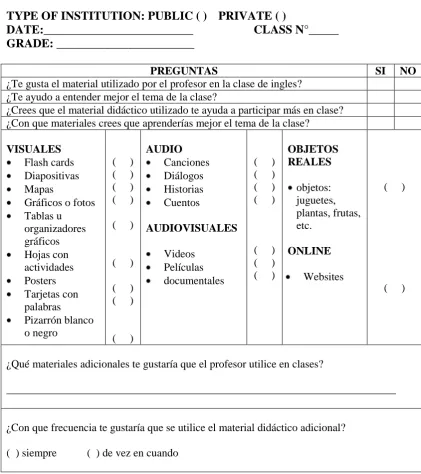
After revising the literature, the researchers carried out the field research observing ten classes in each of the grades at the school selected for this purpose. The instruments to gather the information from each class were observation sheets on which the researcher wrote down the topic of the class, the objectives of the class, and the type of material used by the teacher; detailed information about each type of material was described on a separate sheet titled “Description of the used material”. After, the researchers had completed the ten observations in all grades, they classified the information into charts according to the pertinence of the material in relation to the objectives and topic of the class; the appropriateness of the material in
relation to the students’ age and level was also tabulated into the same charts. The
7 materials, audiovisual materials, realia, and online materials; indicators related to this variables were flashcards, power point presentations, maps, charts, pictures, handouts, posters, word cards, white board, songs, dialogues, stories, tales, movies, documentaries, and websites.
8 DISCUSSION
This section presents the review of the literature related to the use of supplementary materials because the main goal of this research it to analyze the type of supplementary materials used to teach children in the elementary schools in Ecuador. In order to achieve the objectives of this research, this section also includes the analysis of results obtained from observations that took place on each of the grades that participated in this research. The analysis of those results provided important conclusions and recommendations that are presented on the last part of this section.
Literature Review
The use of supplementary materials in EFL classes is an innovative way to teach children because it provides not only motivation, but also such materials are important teaching resources which facilitate the language acquisition through the use of different kinds of learning aids such as: visual, audio, audiovisual, realia, and websites. For this reason, the aim of this paper is to determine and analyze the type of supporting materials used for teaching children in EFL classes.
9
Teaching a Foreign Language
In the majority of primary schools of industrial countries in the world, English has been adopted as a foreign language, and it is the one which parents see as an important tool to their children, in order to give them social and cultural capital. There is another reason, mentioned by Byram (2008), by which English is significant in education: English is the model of teaching all foreign languages. Regarding to how English is taught, this author claims that it is determined by different contexts such as social, political, economic, and by disciplinary context that focuses on the learning process in the classroom. In the same way, this author mentions other aspects more related to the way English is taught as its methods, which are based on theories of language, how people acquire a foreign language according to their age, and how people interact within the context of a foreign language.
More specifically, interaction within the context of a foreign language refers to the communicative purpose of a language. About this, Rodriguez & Valera (2004) cite an investigation made by Kraus (1979), who claims that language should be taught from a communicative perspective; children must be motivated to apply the language as much as possible by using situation games, animated toys, arts, or any activity that provides real situations. Furthermore, Rodriguez & Valera (2004) mention in their journal a work researched by Mur (1998), who states that children have full skills which help them to increase the knowledge of their own language as well as EFL such as: the ability for indirect learning, lively imagination, and creativity.
Teaching a foreign language as a means of communication is associated to the
10 Flavell, Hill, & Pincas (2003), say that teaching English as a foreign language provides a choice of language variety because it plays different roles within a nation´s daily life which can be influenced by geographical, historical, cultural, and political factors; for this reason, it is important to take into account the way in which English is taught due to the impact that it causes on learners. In the case of young learners between 7 and 9 years old, teachers of primary school argues that this kind of students, learn better through enjoyable activities than with intellectual ones.
Learner´s age
Age is an important characteristic of learners and it determines groups of
learners as younger and older learners. About younger learners, Troike (2006) mentions some of their advantages to learn a foreign language such as their brain plasticity, they acquire the target language through informal and naturalistic L2 learning context, and they are less reserved and receive input language from others which facilitate their learning. With regard to older learners, this author explains that they acquire the target language in formal instructional settings, they have better memory for vocabulary, and analytic ability which permits them to understand and use grammatical rules, they may transfer in a positive way some pragmatic skills from L1 to L2, and also their knowledge about real world allows them to perform more complex tasks.
11 able to analyze multiple aspects of a problem, to maintain a topic, and make requests. At this stage, they acquire better metalinguistic consciousness, which is reflected in their language use. Instead, their oral and written literacy will increase as they go through schooling. Also, he claims that adolescence is different to middle childhood, because of cognitive, linguistic and social factors. At this age, learners get abstract thought such as language analysis and the possibility to make logical inferences, and are able to deal with other language aspects such as phonology, morphosyntax, lexicon and pragmatics.
Learner´s differences
12 To conclude, Dantas & Rilling (2009) also make a comparison between children, adolescents, and adults, they explain that adults learn a foreign language by stating clear purposes and goals according to their needs. On the other hand, as these authors explicate, children concentrate on meaning and not in correctness, they have short concentration spans; for this reason, they need active environments and interactive activities in which teacher must employ movement, senses, objects, and pictures. Regarding to adolescents, these authors comment that they tend to use language in abstract ways; they need material focused on their interests, and talents.
Learner´s motivation
Learners not only need active environments, interactive activities, or attractive
material to be engaged on the learning process; they learn because they have a purpose or motive to learn. According to Troike (2006), motivation is an important element in foreign language acquisition because it states the effort that learner employ to acquire L2; furthermore, it contains learner´s goals, desires, and rewards. In addition, there are two kinds of motivation: integrative and instrumental; the first one is related to the interest and desire in L2 learning while the second one is based on the application of L2 in different areas such as business, prestige and power or just for approve an English course.
13 explains that adolescents are more difficult to motivate than children; however, they have a great learning potential that must be well conducted and controlled. Regarding to adults, they are easier to manage, because they are self motivated, willing to learn a foreign language and have special purposes and goals.
In addition, motivation not only depends on learners’ age, according to Daosheng (2004), motivation emerges from internal and external factors. The internal factors are related to cognitive, affective and neurobiological elements. Besides, external factors include social elements such as political, educational, and influences produced by school, teacher, peer and classroom effects.
Learning Styles
Learners have different motives to learn a language, and their style to learn also is different. About this, n a journal published by Ali (2011), she mentions the description made by Reid (1995) who said that learning styles are the internal characteristics which are the base to understand new information, in which students can choose the best strategy or style in order to obtain and understand the foreign language.
14 approach or way of teaching children; also, she statutes that, “Opportunities should be provided for children to initiate their own learning and to use and apply the
literacy skills they have been taught”.
With regard to types of learning styles, Woolfolk, (2006), in her study refer to the investigation of Snow, Corno, and Jackson (1996), who claim there are two kinds of approaches related to learning styles; the first one is a deep-processing approach which is related to learning activities focused on concepts or meaning, in which motivation plays an important role. Besides, the second one is a surface-processing approach focused on remember the learning materials not recognize them. In this case, students need to be motivated by rewards, grades, and positive evaluation from others. In general, learning styles improve when students learn and study in their preferred site and mode.
Teaching Techniques
The way in which learners organize their preferences about learning a language is complemented with a good teaching technique applied by teachers in the classroom. According to Dhand (2008), to teach successfully techniques means knowing how to facilitate a positive learning experience for all students, the teacher must use the best and professional judgment to decide which technique will work best for a particular situation. Also, the author states, that the passive teacher only relies on the same old teaching techniques day after day; whereas, the active teacher varies the day planning different teaching strategies and techniques have a tendency to reach more success in teaching.
15 on the success of an activity. The teacher will have to take into consideration the size of the classroom, accessibility of open space, illumination, physical arrangement of furniture, and materials.
About the importance of teaching techniques, Kochhar (2008) explains that new teaching techniques have been introduced in education to make it more productive, and more individual. One of the most significant techniques in today’s schools is the encouragement of creativity, to promote original thought and invention is the great role of creative education. He also states that working with children implies that they need support to set their own goals, to plan their own activities, work in groups in which opinions can be shared, besides that children have the opportunity to find new ways of handling material and freedom to express their own personalities.
Teaching techniques not only promote learners’ creativity, they have specific
16
Different Contexts for Teaching
Effects of teaching techniques depend a lot on the context where teaching takes place; for this reason, Candlin, & Mercer (2003) state that English is applied in a variety of institutional, geographic, and social contexts.
Concerning to social context, Candlin, & Mercer (2003) suggest that teaching in its social context deals with the number of interpretations and perspective in mind; the social context is also related to the classroom context in which interactions between teachers and learners has an effect in the nature and quality of language learning. Besides, according to these authors, for some learners the contexts outside the classroom are not only where they make use of English, but they can also comprise a powerful motivation for additional learning. In addition, these authors explain that not only the contexts of learning are important, but also we need to understand the professional context of teachers´ practices in this interactive process of classroom teaching-and learning, and also we need to take into account the socio-cultural context by which communicating partners in this process evoke shared knowledge in a sense of building the best context for successful language learning. Also about the social context, Candlin, & Mercer (2003) claim that in that sense the wider social context of life that is external to the classroom has an important effect on what takes place in these relationships between learners and teachers, and among learners themselves.
There are other aspects related to the teaching context, Barron, Grimm, &
Gruber (2006, p. ) say, “touch subjects and routine practices, evoke this embodied
identity, including the inescapable material quality of it as well as the touchiness of any reference to race; it will also include the resulting problematic biases and tacit
17 teaching contexts mean that we encourage students, teachers, scholars, educational administrators, and educational policymakers as a starting point for discussions and decisions about these participants.
In addition to the aspects mentioned above, Edwards, Biesta, & Thorpe (2009) argue that between the different teaching contexts we found the contexts of strata, the level of cultural and the economic status which are very significant because the teaching and learning could differ from person to person, or group to group. They suggest that the strata context, and the economic context emphasizes on the status of the group for education and training, such as schools, colleges and universities.
Supplementary Material
Supplementary materials make classes more interest and motivate students to learn. In relation to this, Kumari (2006) argues that supplementary material is the assistant of the teacher, and it helps to have in mind the mental capacity of the students; he also mentions that supplementary materials should be within the easy reach of the pocket of the students if it is not available in the library school. Additionally, this author states that supplementary material is a part of a work, physically separate from the basic bibliographic unit and frequently in a different medium.
Another definition is provided by Richards, & Rodgers (2007), they suggest that the role of supplementary material is to assist the teacher to develop language mastery in the learner; a student textbook is often not used in the elementary phases of a course where students are primarily listening, repeating, and responding.
18 and didactic any class; that is why, using supplementary materials in the classroom have a great importance. This author also explains that use of good supplementary materials can support the teacher work on developing learning skills and awareness by underscoring what is already an in-class priority and by making students responsible for their own development. In addition, the same author suggested that for new teachers, the use of supplementary material is considered as an instrument that helps students and teachers to ensure the extent to which students are using the deep or surfaced approaches; according to him, supplementary materials can help to stimulate individual thinking and to connect content and learning in the class, and also they can help student to enhance their cognitive skills.
Specifically about the type of supplementary materials available for teachers, Gower, Phillips, & Walters (2005) suggested that visuals can be used to arouse interest and concentrate attention at the beginning of a class, to elicit already known language, to illustrate a new language item, or a vocabulary item, to create a need for new language; also they argued that audio is one of the teacher´s most useful tools, in addition many teachers have access to authentic audio material that that can be brought into the classroom.
19 After revising main points related to this research it is also relevant to talk about the evidence provided by five studies which are going to be described in the next paragraphs.
The first study to be presented was done by Tsou, Tzeng, and Wang in 2004; they performed a study based on the use of storytelling in order to demonstrate that it is a powerful teaching tool. The study consisted of the implementation of a website in one elementary school in southern Taiwan during ten weeks. First, all 5th graders in the school were tested for their general language proficiency in order to measure their story comprehension and language complexity. In addition, teachers received 18 hours of instruction within an EFL storytelling workshop; including techniques, activities, classroom management and teaching aids in English storytelling. Then, five stories were chosen according to students´ cognitive and language levels. Students were divided into two groups, in the first group, instructor presented the storytelling by using visual aids, flash cards and books; while, in the experimental group the stories were recreated with the Storytelling Website to accompany the
teacher’s storytelling. Finally, a questionnaire was applied in order to measure story
comprehension, story sentence complexity, and general language proficiency and to provide feedback. Main conclusions of this study indicate that use of the Internet and the implementation of multimedia Storytelling Website help teachers to integrate the culture and improve the knowledge of the English language though the acquisition of reliable materials to teach English such as songs, pictures and activities related to storytelling.
20 students at Universidad Autónoma in Baja California; the instruments applied on this research were a questionnaire and an interview. The 20 students answered a questionnaire to know the use of computer for language learning, the type of program used for language learning, the use of internet, the type of exercises that students choose, and the students’ point of view about the level of improvement of their language skills. The interview was designed to know perceptions about the
students’ preferences in the computer lab.
Main findings of this study revealed that students preferred educational software and they usually search the internet for educational websites and programs that allow
them to increase their language skills. The students’ answers also showed that their
language skills have increased with the use of computers and they preferred the use
of software rather than the Internet; these results were affected by students’ lack of
ability to use computers. About these results, the researchers conclude that students had improved their language skills and they preferred to work with educational software specifically designed for this purpose. Finally, these researchers recommended that coordinators should pay attention to the use of the Internet because it provides a lot of resources that students usually do not take into consideration.
21 motivation, the questionnaire evaluate levels of motivation about the material in use. In addition, two students were interviewed after each class to know on their own words their views on materials used that day.
As a result of the instruments applied in this research, it was possible to find that students were slightly motivated by the use of authentic materials but not because the materials were interesting; researchers also found that it was quite difficult for the students accept authentic materials after a long period of receiving instruction with artificial materials. Main limitations were related to the instruments designed for this research, they did not bring information about the effects authentic
materials on students’ motivation; in addition, interview was written in English and
this restricted the participants’ responses. Finally, the researcher suggested that for
this type of research is important to separate factors affecting motivation from effects of materials on learners; in this way, it would be possible to know which aspects would help to construct motivation and which effects would have supplementary materials on learners.
22
procedure showed that students’ attitude towards English songs were positive. In
addition, questions about students’ manners of listening songs showed that half of
them tried to catch the words of the song and they enjoyed the activity. Finally, the activities that students enjoyed the most, were arrange jumbled lines, and students considered that songs make lessons more relaxing. With regard to these results, the researcher concluded that songs can help to motivate students in listening skills and they also allowed maximum participation by every student in listening lessons. Moreover, the researcher recommended that teachers should select carefully the
songs in relation to students’ level and in accordance to the teaching method; in
addition, when teachers work with lyrics they should be separated according to
sentences and phrases. To end with this study, limitations concerned with students’
difficult to follow the song because of their lower levels of English; in addition, this research could not prove the effectiveness of songs on improving word recognition, awareness of word linking, enhancing their attention, or comprehension skills. Finally, the last study was made by Rong in 2004 in Taiwan; the purpose of the study was to investigate if an integrated-reading writing instruction through picture books benefits elementary schools students in the English as a foreign language setting in Taiwan; to achieve its objective the researcher used some instruments as worksheets, oral instruments, questionnaires, the investigator’ notes and reflective notes. These instruments were applied to collect data about students’ attitude towards storytelling, picture books and to the English learning process itself. Data was gathered with a qualitative approach, a preliminary pilot study was done to
know students’ level and preferences; after that, students received instruction during
23 Main findings revealed that 73% of the students (35 out of 48) though they were attentive in the story time and 27% (13 out of 48) though that they were not. The investigator also found that children were actually quite strict when they were assessing themselves; in addition, the results of the interview showed positive effects
of the story time on children’s perception toward picture books, except for one
student, most participants felt well about picture books at the end of the study. Finally, it was observed some changes in students’ attitudes toward reading, writing, and pictures book, they acquire more experience on the use of picture books. As a consequence of the effects of storytelling on children in this research, the investigator concluded that activities based on the stories of the pictures books helped them to learn new vocabulary and to overcome affective filter toward learning English; The researcher also recommended that teachers must consider aspects
related to students’ language proficiency, their interests, vivid illustrations, the
author, the writing style before they select books.
About limitations, there were three important constraints about this study. First, the study was conducted in the form of a case study showing only the teaching aspects of a particular EFL setting with limited scope. Second, due to time constraints, the story time of picture books lasted for one semester (18 weeks, 360 minutes) only. The final limitation was that the investigator decided to play the role of instructor increased the difficulty of data collection.
24 Results
Qualitative tabulation
Chart one: Type of supplementary material used to teach children
Variable Indicators Yes No
Visual
Flash cards √
Power point presentations x
Maps x
Pictures √
Charts x
Handouts √
Posters √
Word cards √
White boards √
Audio
Songs √
Dialogues √
Stories x
Tales √
Audiovisual
Videos x
Movies x
Documentaries x
Realia Objects (toys, plants, fruits) √
Online Websites x
25 Chart two: Pertinence and appropriateness of the supplementary material used to teach children
Va
ria
ble Indicators 1
st cla ss 2 nd cla ss 3 rd cla ss 4 th c la ss 5 th c la ss 6 th c la ss 7 th c la ss 8 th c la ss 9 th c la ss 1 0 th c la ss P re t. Appro p. P re t. Appro p. P re t. Appro p. P re t. Appro p. P re t. Appro p. P re t. Appro p. P re t. Appro p. P re t. Appro p. P re t. Appro p. P re t. Appro p. Vis ua l
Flash cards √ √ √ √
Power point presentations Maps Pictures Charts Handouts
Posters √ x √ x √ √
Word cards √ √
White board √ √ x x √ √ √ x x x √ √ √ √
Audi
o
Songs √ √
Dialogues √ x √ √
Stories Tales Audi o v is ua
l Videos
Movies
Documentaries
Rea
lia
Objects (toys,
plants, fruits) √ √ √ √ √ √ √ √
O
nli
ne
Websites
26 Chart three: Pertinence and appropriateness of the supplementary material used to teach children.
Va
ria
ble Indicators 1
st cla ss 2 nd cla ss 3 rd cla ss 4 th c la ss 5 th c la ss 6 th c la ss 7 th c la ss 8 th c la ss 9 th c la ss 1 0 th c la ss P re t. Appro p. P re t. Appro p. P re t. Appro p. P re t. Appro p. P re t. Appro p. P re t. Appro p. P re t. Appro p. P re t. Appro p. P re t. Appro p. P re t. Appro p. Vis ua l
Flash cards √ √ √ √
Power point
presentations
Maps
Pictures √ √ √ √
Charts
Handouts √ √
Posters √ √ √ √
Word cards √ √ √ √
White board √ √ √ √ √ x x x √ √
Audi
o
Songs √ √
Dialogues Stories Tales Audi o v is ua
l Videos
Movies Documentaries Rea lia Objects (toys, plants, fruits) O nli ne Websites
27 Chart four: Pertinence and appropriateness of the supplementary material used in to teach children.
Va
ria
ble Indicators 1
st cla ss 2 nd cla ss 3 rd cla ss 4 th c la ss 5 th c la ss 6 th c la ss 7 th c la ss 8 th c la ss 9 th c la ss 1 0 th c la ss P re t. Appro p. P re t. Appro p. P re t. Appro p. P re t. Appro p. P re t. Appro p. P re t. Appro p. P re t. Appro p. P re t. Appro p. P re t. Appro p. P re t. Appro p. Vis ua l Flash cards Power point presentations Maps
Pictures √ √ √ √
Charts
Handouts
Posters √ √ √ √ √ √ √ √
Word cards √ √
White board √ √ √ √ x x √ √ √ √ √ √
Audi
o
Songs
Dialogues x x
Stories
Tales √ √
Audi
o
v
is
ua
l Videos
Movies Documentaries Rea lia Objects (toys, plants, fruits) O nli ne Websites
28
Quantitative tabulation
Chart five: Frequency of use of supplementary material.
Variable Indicators
4th grade
5th grade
6th
grade Total
f f f f %
Visual
Flash cards 2 2 4 8%
Power point presentations Maps
Pictures 2 2 4 8%
Charts
Handouts 1 1 2%
Posters 3 2 4 9 18%
Word cards 1 2 1 4 8%
White boards 7 5 6 18 36%
Audio
Songs 1 1 2 4%
Dialogues 2 1 3 6%
Stories
Tales 1 1 2%
Audiovisual
Videos Movies
Documentaries Realia Objects (toys,
plants, fruits)
4 4 8%
Online Websites
TOTAL 50 100%
Authors: Sofía Baldeón & Karen Erazo
29 Description, analysis, and Interpretation of results
This section presents the qualitative and quantitative analysis of results. With regard to qualitative analysis, it describes the information that the researcher classified considering the pertinence and appropriateness of the materials in use in each observed class; this analysis also explains whether teachers applied the materials with creativity and originality, students’ motivation towards the material, and quality of the materials. In addition to the quantitative analysis, this section also includes a qualitative analysis; the purpose of this analysis aims to provide a general view about those materials that are frequently used in the classroom. After all this analysis this section presents conclusions and recommendations.
Qualitative analysis
The supplementary materials used in the ten observed classes were: flashcards, posters, word cards, white board, songs, dialogues, realia, pictures, handouts, and tales.
4th grade /8 years old
In the first observed class the topic was Subject pronouns and the objective was to teach students the use of this grammar structure. The teacher used flashcards and the white board; these materials were used as follows:
Flashcards
30 was written a subject pronoun; it had a good quality and all the students felt motivated by this material. This material was used with creativity and originality because the teacher selected cartoons that were known to the students; for this
reason, students were engaged in the activity all the time. Students’ attitudes in the
classroom were consistent with their answers on the survey; in addition, they expressed preferences about the use of other materials as for example songs, videos, movies, and realia.
White board
The teacher used the white board to write sentences about this grammar structures and then students wrote their own sentences. The material was pertinent to the topic and to the objectives of the lesson and the students participated actively;
therefore, the white board was appropriate to students’ age and level. About this, it
was observed that the teacher used the white board as Weimer (2002) suggests, to
make work on learners’ skills and awareness of language development. Students
explained that they liked the activity and they would like other types of materials such as pictures, songs, videos, movies, and objects.
In the second class the students were taught about the use of possessive adjectives. The materials used in this class were posters and the white board; the teacher used them as follows:
Posters
31 appropriate for overall students; maybe because they needed to learn in different way. Ali (2011) explains that some children learn according to their own initiative and this should be combined with the appropriate teaching method. About the survey, students explained that they did not like the material but it helped them to understand the topic; clearly, this result is opposite to what they demonstrated in the classroom. In addition, the students chose some materials that their teacher could use in the classroom such as maps, picture, word cards, songs, stories, tales, videos, movies, objects, and paints. These answers indicated that the students gave, apparently, general answers about all the material that they would like their teachers use in the classroom.
White board
In the second class, the teacher used this material to write the topic of the class and to paste posters that he additionally used. Students wrote sentences on their notebooks using the examples on the posters. Therefore, this material was not pertinent to the topic because the teacher did not used it as a means of instruction; in
the same way, the material was not appropriate to students’ age and level because it
was not used to provide practice in the mastery of language as Richards & Rodgers (2007) mention. Students’ survey showed that they did not like the used material and they would prefer other materials as maps, pictures, word cards, songs, stories, tales, videos, movies, objects, and paints.
The third class was titled Verb to be – affirmative sentences and learners
32
Word cards
First, the teacher explained the students how to make affirmative sentences using the white board; then, he used word cards to form unscrambled sentences that students had to put in the correct order. Not all students participated actively because of their lower English level but in general terms they comprehend the mechanisms of the grammar structure. Consequently, the material was pertinent to the topic and
objectives of the lesson; in addition, it was appropriate to students’ age and level.
This confirms what Weimer (2002) mentions about supplementary materials; they make more interesting and didactic any class. According to students’ survey they liked the material and they would prefer other types of materials as dialogues, videos, objects.
In the fourth class the topic was Verb to be (negative sentences) and the objective was to teach the students about the use negative sentences using verb to be. The materials used in this class were posters and dialogues; these materials were used as follows:
Posters
The teacher explained how to make negative sentences with verb to be using the white board, he presented unscrambled sentences with the aid of a poster and students should arrange them in the correct order. The whole activity was bored because the poster was simple and it was not used creatively; however, the material was pertinent to the topic and the objectives of the lesson. It also was appropriate to
students’ age and students’ level. With reference to this, Ur (2006) claims that
33 Students answered that they liked the material; they argued that they were
afraid of teachers’ reaction if they criticized the material. In addition, they expressed
they would prefer pictures, charts, word cards, songs, dialogues, stories, tales, videos, movies, documentaries, objects, and websites.
Dialogues
The teacher played dialogues and students repeated the sentences. Even though the material was related to the topic and objectives of the lesson, the whole class was bored. But students answered that they liked the material; clearly they did not want to criticize the used material. About their preferences on supplementary materials, they mentioned some materials such as picture, charts, word cards, songs, dialogues, stories, tales, videos, movies, documentaries, objects, and websites. It would be more effective that the teacher used the dialogue to complete sentences; in this way the activity would have been more related to the objectives of the lesson. With regard to this result, Richard & Rodgers (2007) suggest that the role of supplementary materials is to assist the teacher to develop language mastery in the learner.
In the fifth observed class, the topic of the lesson was adjectives and the purpose was centered on teaching students the use of this grammar structure. The materials used in this class were the white board and dialogues; these materials were used as follows:
White board
34 pertinent to the topic and objectives of the lesson; similarly, it was not appropriate to
students’ age because it did not motivate them to participate in class. Weimer (2002)
claims that the correct use of supplementary materials can support the teacher work
on developing students’ learning skills; the teachers should have used material that
called the attention of their students as for example objects; in this way students could have described their characteristics using adjectives.
Dialogues
The teacher played a dialogue and students listened to identify adjectives that people described. Each time the students identified an adjective they had to write down it on their notebooks and make a draw about it; this part of the class was fun and students were motivated and participated actively. Therefore, the use of this material was pertinent to the topic and objectives of the lesson and it also was appropriate to students’ age and level; this material was used as Ur (2006) states, to arouse their interest in learning. According to the students’ answers they liked this material and they would prefer similar materials such as word cards, songs, stories, tales, videos, movies, objects, and websites.
The topic of the sixth class was numbers; the purpose of this lesson was focused on teaching students to pronounce and to write numbers. The materials used to teach the grammar structure were posters and songs; they were used as follows:
Posters
The teacher used a laminated poster with colorful numbers; it called students’
35
students’ age and level; it was used with creativity and it developed students’
awareness of language development, as Weimer (2002) explains. Students’ survey showed that they liked the material. Other types of materials that the students would prefer were: power point presentations, pictures, stories, tales, movies, objects, and websites.
Songs
The teacher used a song along with a laminated poster about numbers; students listened to the song and after that, they spelled each number and wrote sentences using numbers. The whole activity was fun and students seemed motivated and participated actively; in consequence, this material was used according to the topic and to the objectives of the lesson because it helped learners to improve their language development as Weimer (2002) mentions. In the same way, this material was appropriate to students’ age and level and they expressed on the survey that they enjoyed the class; they also would prefer other type of material such as power point presentations, pictures, stories, tales, movies, objects, and websites.
The topic of the seventh class was Prepositions of place and the objective was to teach the students to recognize and to use prepositions of place. The teacher used flashcards and realia; they were used as follows:
Flashcards
36 learn, and enjoyed the activity; for this reason, the material was appropriate to
learners’ age and level. Gower, Phillips & Walters (2005) suggest that visual
materials help learner to concentrate and create on them need for new language.
Realia
First, the teacher explained the meaning of prepositions using flashcards; then, he used the classroom objects such as: pencils, pens, whiteboard, map, etc, by asking questions as, where is the whiteboard?, then children had to answer the question and describe the location of each object in the classroom using prepositions of place. The activity was good for the level of the students and their age, and they were able to complete the activity satisfactorily. In this observed class, the material was pertinent to the topic and to the objectives of the lesson and it also was
appropriate to students’ age and level because the teacher used common objects to
arouse students’ interest on learning as Ur (2006) suggest. About the survey, students
demonstrated positive attitude towards the use of classroom objects in the class; they also would like that the teacher uses power point presentations, stories, tales, movies, and websites.
The topic of the eight class was countable nouns and it aimed that students could recognize countable nouns and could learn to use the structure how many. In this class the materials used were the white board and realia (objects); they were used as follows:
White board
37 objective of the lesson and it was also appropriate to the students’ age and level. Although students liked the material, they also would like other materials as for example: power point presentations, stories, tales, movies, objects, and websites.
Realia
The teacher used realia in the lesson countable nouns and the objective was:
recognizing countable nouns and use how many?. In this lesson, he used classroom
elements to ask the students “can I count all your erasers?” and students showed their
eraser and counted them. The activity was fun and students comprehend the concept of countable nouns; they participated actively and they were motivated. In conclusion, this material was correctly used according to the topic and objective of
the lesson; this material was also adequate to students’ age and level. In this class
the teacher used the material to enhance students’ cognitive skills as Weimer (2002) mentions. The students claimed, according to the survey, that they liked the activity and they also would like other types of materials such as power point presentations, stories, tales, movies, objects, and websites.
In the ninth observed class the topic was uncountable nouns; the students would recognize uncountable nouns and would learn to make sentences using the structure. The teacher used the white board and realia (objects).
White board
The teacher explained to the students what uncountable nouns are and then they wrote sentences on the board. This time the teacher encouraged students to write creative sentences about uncountable nouns; therefore, the activity was fun because the students wrote original sentences. In this way, the material was used
according to the topic and objectives of the lesson as well according to students’ age
38 Weimer (2002) explains. Students expressed through the survey that they liked the way their teacher designed the activity and they also would like other types of materials as power point presentations, pictures, handouts, word cards, stories, tales, movies, and websites.
Realia
The teacher brought to the class some examples of uncountable nouns as sugar, salt, rice, milk, water; he made a review on countable nouns and then asked students whether they could count those elements. Students felt motivated and participated actively in the class; for this reason, the material was pertinent to the
topic and objectives and it also was appropriate to students’ age and level. It was
observed in this class that supplementary materials make classes more interesting and didactic as Weimer (2002) mentions. Students enjoyed the activity and they gave positive opinions about the material used in the classroom; they also expressed their preferences for other types of materials such as power point presentations, pictures, handouts, word cards, stories, tales, movies, and websites.
In the tenth observed class the topic was There is /There are; the objective was to teach students the use of this grammar structure in affirmative sentences. The teacher used only realia in this class.
Realia
The teacher explained the use of there is and there are; she pointed out the white board and said: “There is a white board in this classroom”, after that she
pointed out the students’ desks and said: “there are many desks in this classroom”.
39 meaning of there is/there are as Gower, Phillips & Walters (2005) mention; however, the teacher could use other type of materials as flashcards or posters in
order to increase students’ interest on the topic. At last, the material was appropriate
to the topic and objectives of the lesson; similarly, it was appropriate to students’ age and level. The results of the survey revealed that students agreed with the use of the material but they believed that other type of material could be more interesting; they referred to power point presentations, posters, word cards, stories, tales, videos, movies, and websites.
Learning styles
In relation to the analysis made to the observed class in the fourth grade, there was a balanced use of teaching techniques and materials to meet students’ needs. The teachers used a variety of materials according to students’ learning styles because he considers that supplementary materials are important to motivate students and to improve their rate of learning; he preferred to use pictures because they are attractive and students enjoyed them very much. In our opinion, supplementary materials are a useful tool, which help to improve and motivate students to participate actively in all activities; for this reason, the teachers in this grade tried to meet students’ learning styles and this helped students to apply what they have learned as Scott (2009) claims.
5th grade/ 9 years old
40
White board
The white board was used by the teacher in the first class to write the theme of the class which was titled Simple present and also to write examples of sentences or vocabulary words about the topic of the lesson. This material was adequately used because students practiced writing sentences using the grammar structures; therefore, the material helped the teacher to achieve the objective of the class.
Word cards
First, the teacher introduced the topic using the white board; after the teacher introduced the topic, she pasted unscrambled word cards on the board that students put in the correct order to form a complete sentence. The use of this type of material gave the students a clear idea about the use of present simple; the sentences were
clear and they were adequate to the students’ level. This material also activated
students’ participation and their attention was focused on the activity because the
material was elaborated with pieces of colored cardboard according to students’ age.
The topic of the second class observed in the fifth grade was Vocabulary and the objective was to teach new vocabulary words and to use simple present tense. The materials used in this class were posters and the white board.
Posters
The teacher elaborated a poster using pictures from magazines; it showed images of people doing different activities such as cooking, washing, dancing, jumping. The teacher wrote the action verbs on the white board and wrote some
sentences such as: “He cooks the meal, she dances in her room”. The poster was big
41 and use the simple present; they demonstrated that they understood the topic writing sentences on the board and on their notebooks.
White board
This material was used in the second class together with posters that showed images related to the new vocabulary words. Once the teacher explained the vocabulary words, she wrote sentences on the board and students had to identify simple present tense. The material was pertinent to the content and it was also
appropriate to students’ level because the teacher used black and red markers to write
the sentences; she used red markers to highlight the actions verbs. Students were divided into two groups to compete writing sentences on the white board; students came out to the white board to write their own sentences using the model provided by their teacher; the first group that finished first won the competition and got points from the teacher. This motivates students to participate because the teacher varied the teaching technique when she used the white board as Dhand (2008) recommends.
The topic of the third class was frequency adverbs and the objective was to help students to use frequency adverbs to describe how often people do something. The teacher used these materials in this class: flashcards and the white board.
Flashcards
42 the students because the material contained drawings with a variety of colors that called their attention. Even though some students were able to write sentences using adverbs of frequency, a considerable amount of students demonstrated some kind of difficulty while trying to write the sentences; this was related to lower level in
students’ language proficiency.
White board
The teacher used this material to write sentences along with flashcards. After the teacher explained the class, she encouraged students to write their own sentences. It was observed that this time, students had difficulty to produce adequate sentences; therefore, this material was not appropriate to students’ level. It would be more appropriate for this class that the teacher used a poster to visually show the use of frequency adverbs.
Concerning the fourth class, the topic was Information questions and the topic was to teach the use of wh-questions. The teacher used only one type of supplementary material in this class: handouts.
Handouts
This material was used in the fourth class as a means of practice to evaluate the use of wh-questions; the handouts were elaborated by the teacher and they contained a text that students read and then they answered using wh- questions. The material had clear instructions that all students could follow; the content of the handouts were well related to the topic and they helped the teacher to evaluate students’ knowledge. The quality of the material was good, it was white and black and it was well printed.
43
White board
This material was not appropriately used in relation to the objective of the fifth class because the teacher wrote questions and the answers and then students just wrote similar sentences. In consequence, students only copied the models that the teacher wrote using different words and this resulted on a boring activity. The teacher could use for this class other type of material as for example a story and then students could asked each other questions about its plot; as Kochlar (2008) recommends, it is important that teachers encourage creativity and promote original thought and invention.
The topic of the sixth class was Places and the objective of the class was to learn new vocabulary words such as: park, airport, bank, restaurant, etc. The materials used in this class were pictures and songs.
Songs
Students sang a song about different places in the city; this material was used as a warmer to introduce the topic of the class. The lyrics consisted of questions as for example: where is Lucy? Lucy is in the park…; this song was used along with pictures that represented each place and that were used to teach the students the vocabulary words about different places. The use of this song motivated the students to focus their attention on the topic and to respond to each task that their teacher assigned during the class.
Pictures
44 meaning of each word. After this practice, the teacher asked the students some
questions about the pictures as for example: This is Lucy, where is Lucy? Lucy is…
and students proceed to complete sentences on the board. This material was pertinent
to the class and appropriate to students’ age and level because it helped students to
comprehend the meaning of each word; in addition, the pictures clearly show each location and they had colorful images. Each picture had a good size (42x35cm) and they were cut from magazines and pasted on pieces of cards.
Regarding to the materials preferred by students, it was seen that they would like that teacher uses: power point presentations, posters, word cards, stories, tales, movies and websites.
The topic of the seventh class was irregular verbs and the objective was to learn the conjugation of irregular verbs. The material used was word cards.
Word cards
The teacher elaborated this material using pieces of white cardboard to write
the infinitive, yellow pieces of cardboard to write the past form of the verb, and red pieces of cardboard to write the past participle of the verb. Furthermore, teacher uses this material creatively because she made children plays with the word cards by choosing a word card of any color and looking for the correct pair that contains the past and past participle form of the verb. This color differentiation helped students to distinguish how the verb changes to express past actions; as a result, the material was pertinent to the class because it made the class more didactic as Weimer (2002) explains. The material was also appropriate to students’ age and to their level