1 Effect of different extrusion treatments and particle size distribution on the physico-1
chemical properties of rice flour 2
3
Mario M. Martínez1, Cristina M. Rosell2, Manuel Gómez1* 4
1
Food Technology Area, E.T.S. Ingenierías Agrarias. Valladolid University, Ed. La Yutera, 5
Avd. Madrid 44, 34004 Palencia, Spain. 6
2
Institute of Agrochemistry and Food Technology (IATA-CSIC). Avda Agustin Escardino, 7. 7
Paterna-46980, Spain. 8
9 10
*
Corresponding author e-mail: [email protected] 11
2
Abstract
18
Rice flour is an interesting alternative for developing gluten free products, but its features do not 19
meet the process requirements. The objective of this study was to modify the functional 20
properties of rice flour by combining extrusion and size fractionation. Different extrusion 21
conditions were applied to vary the severity of the treatment on the flour constituents. Extrusion 22
and mechanical fractionation of the rice flours modified their behavior affecting hydration, 23
thermal and pasting features, besides their susceptibility to enzymatic hydrolysis. Thermal 24
properties (temperature and enthalpy) increased with the intensity of the extrusion and that effect 25
was intensified with the greatest particle size of the flours. Fine flours with stronger extrusion 26
showed the highest susceptibility to enzymatic hydrolysis and extrusion process increased that 27
effect. Overall the combination of both physical treatment maybe an attractive alternative for 28
obtaining clean label rice flours with modified features. 29
30 31
Keywords: extrusion, rice flour, particle size, thermal properties, hydration, enzymatic 32
hydrolysis. 33
3
1. Introduction
36
Lately, there is an increasing interest for gluten free products that has prompted extensive 37
research focused on improving the quality of gluten free products. The vast majority of studies 38
have been centered in the substitution of wheat flour for different blends of gluten free flours, 39
starches, protein isolates, hydrocolloids (Houben, Hochstotter, & Becker, 2012) and the 40
enzymatic improvement of those formulations (Rosell, 2009). Nevertheless, the potential of the 41
flours from gluten free cereals has been scarcely exploited. Physical treatments have the benefit 42
over the chemical ones of changing starch functionalities keeping the Green label (Jacobs & 43
Delcour, 1998). 44
Rice flour functional properties are fully dependent on genotype and environmental conditions 45
(Yeh, 2004) and besides that, postharvest treatments could be an alternative for modulating flour 46
functional features. It is well known that rice grinding significantly affects rice flour properties, 47
like water binding capacity and swelling power (Perdon, Siebenmorgen, Mauromoustakos, 48
Griffin, & Johnson, 2001). Recently (de la Hera, Gómez & Rosell, 2013a) showed that particle 49
size fractionation of rice flour might be advisable for selecting specific physico-chemical 50
properties like different hydration properties and enzymatic starch hydrolysis. Moreover, those 51
fractionated flours showed different processing behaviour more suitable for bread or cake 52
making depending on the particle size (de la Hera, Martínez & Gómez, 2013b; de la Hera, 53
Martínez, Oliete & Gómez, In press). 54
Thermal treatments are highly attractive to modify the functional properties of the cereal flours. 55
Extrusion cooking is considered high-temperature-short-time (HTST) during which flours are 56
submitted to high temperatures and mechanical shearing at relatively low levels of moisture 57
4 denaturation of protein, enzyme (in)activation, and Maillard reactions, the extent of which are 59
dependent on the severity of the extrusion. Those changes at the constituents’ level modify the 60
rheological behavior of flour (Hagenimana, Ding, & Fang, 2006). During extrusion, the starch 61
properties are dependent on the temperature, initial moisture content and the screw speed (Wen, 62
Rodis, & Wasserman, 1990). Raising the intensity of the treatment is possible to break down the 63
amylopectin chains (Mercier & Feillet, 1975). In fact, (Colonna, Doublier, Melcion, 64
Demonredon, & Mercier, 1984) described that extruded wheat starches have amylose and 65
amylopectin chains of lower molecular weight than the ones obtained by drum drying due to the 66
shear effect, and that gave low thickening ability at low temperature (Doublier, Colonna, & 67
Mercier, 1986). 68
The extrusion also promotes important nutritional changes in the flours, like increase in the 69
soluble fiber content and reduction in the lipid oxidation tendency, the content of antinutritional 70
factors and the microbial population (Camire et al, 1990). Besides, it could be obtained an 71
increase in the content of resistant starch in rice flours (Hagenimana et al, 2006), which is 72
dependent on the treatment intensity, and it is always higher than the one obtained by other 73
thermal treatments (Alsaffar, 2011). Extrusion cooking is responsible for gelatinization and 74
degradation of starch and also for changing the extent of molecular associations between 75
components, e.g. the amylose– lipid complex that can affect the in vitro starch digestibility of 76
the flours (Hagenimana et al, 2006). 77
Despite the impact of the extrusion on the molecular level, little attention has been paid to the 78
variation of the functional properties of the flours by hydrothermal treatments (Clerici, Arioldi, 79
& El-Dash, 2009), even though physically modified flours are considered to be natural materials 80
5 modified rice flours for making gluten free breads. When using rice flours extruded in the 82
presence of different amount of lactic acid, gluten free breads presented crust and crumb colour 83
and texture values similar to those of wheat bread, although specific volume was rather low. 84
Considering the influence of the flour fractionation on the functional properties of the rice flours 85
(de la Hera et al, 2013b), and the molecular changes induced by extrusion cooking, the 86
combination of both physical treatments could modify rice flour functional properties keeping 87
the green label. The aim of this study was to modify the functional properties of rice flour by 88
combining extrusion and size fractionation. With that purpose, different extrusion conditions 89
were applied to vary the severity of the treatment on the flour constituents. The impact of 90
processing on the flours was also followed by assessing the susceptibility of the flours to 91
enzymatic hydrolysis. 92
93
2. Materials and methods
94
2.1 Materials
95
Rice flours were provided by Harinera Los Pisones (Zamora, Spain) that carried out the 96
extrusion treatment in a single screw extruder Bühler Basf (Bühler S.A., Uzwil, Switzerland). 97
The length to diameter (L/D) ratio for the extruder was 20:1. Rice flour was subjected to 98
different extrusion intensities (barrel temperature and moisture content of the mass feed) 99
yielding three types of extruded flours (1-3). Rice flour 1 and 2 were extruded at a maximum 100
barrel temperature of 110ºC with a feed rate of 700kg/h. For flours 1 and 2 feed moisture 101
content and screw speed was 17% and 30%, and 453rpm and 397rpm, respectively. The 102
diameter of the die hole used in those flours was 8mm. Rice flour 3 was extruded at a maximum 103
6 screw speed was 340rpm and the diameter of the die hole was 6 mm. The same rice flour (rice 105
flour 0) without any treatment was used as a control. 106
Extruded product was dried by convection air and then ground with a compression roller till 107
particle size was lower than 200 microns. Ground extrudates were sifted in a Bühler MLI 300B 108
(Bühler AG, Uzwil, Switzerland) with screens of 132 and 200 microns to obtain fine (f) – lower 109
than 132µm- and coarse (c) – 132µm-200 µm- extruded flours. 110
Flours were stored in air-tight plastic containers and held at 4°C until analysis. 111
112
2.2 Methods
113
2.2.1. Flours characterization
114
Flours were analyzed following AACC method (AACC, 2012) for protein (AACC, 46-30.01) 115
with a Leco TruSpec device (Leco, St. Joseph, MI, USA). The particle size distribution was 116
measured using a particle size analyzer with laser diffraction Helos & Rodos (Sympatec, 117
Clausthal-Zellerfeld, Germany) following AACC method (AACC, 55-40.01). Determinations 118
were carried out in duplicate. 119
Free sugars
120
The glucose content was measured using a glucose oxidase-peroxidase (GOPOD) kit. The 121
absorbance was measured using an Epoch microplate reader (BIOTEK EPOCH, Izasa, 122
Barcelona, Spain) at 510 nm. In all cases four replicates were assayed for each experimental 123
point. 124
Damage starch
125
The content of damaged starch was determined according to AACC 76-30A method (AACC, 126
7 USA) was used in that analysis. Three determinations were made for each sample. Damaged 128
starch was expressed as percentage of flour weight on dry basis. 129
Hydration properties
130
Hydration properties included swelling and water binding capacity (WBC) (Nelson, 2001). 131
Swelling volume or the volume occupied by a known weight of flour was evaluated by mixing 132
5g (±0.1mg) of flour with 100ml distilled water and allowing it to hydrate during 16h. 133
Water binding capacity defined as the amount of water retained by the flour after it has been 134
subjected to centrifugation was measured as described the method 56.30 (AACC, 2012). 135
Determinations were carried out in duplicate. 136
Emulsifying properties
137
Flour suspension (360 mL) of 0.5% (w/v) starch concentration was mixed with commercial 138
sunflower oil (Langosta, F. Faiges S.L, Daimiel, Ciudad Real, Spain) (36 mL). The content was 139
stirred for one min with a beater (Taurus Bapi 350 CP/CM, Taurus, Oliana, Lérida, Spain) to 140
disperse the sample in the oil. The suspensions were then centrifuged at 800xg for 10 min. The 141
emulsifying capacity (EC) was calculated as: 142
EC=(ev/tv)*100 (Eq. 2) 143
where ev is the emulsion volume and tv is total volume. 144
Emulsion stability (ES) against high temperatures, were determined in the emulsions that were 145
heated in a water bath at 80ºC for 30 min, and centrifuged at 800xg for 10 min. ES was 146
calculated as: 147
ES=(fev/iev)*100 (Eq. 3) 148
8 where fev is the final emulsion volume and iev is initial emulsion volume. Determinations were 150
carried out in duplicate. 151
Foaming properties
152
Aliquots (150mL) of 4% w/v suspension were whipped at moderate speed for one min using a 153
beater (Taurus Bapi 350 CP/CM, Taurus, Oliana, Lérida, Spain). Foam volumes were recorded 154
after 30 s. The foam capacity (FC) was calculated as follows: 155
FC=(ifv/tsv)*100 (Eq. 4) 156
where ifv is the initial foam volume and tsv is the total suspension volume. 157
The foam stability (FS) was calculated as the foam volume after 20 min. 158
FS=(ffv/tsv)*100 (Eq. 5) 159
where ffv is the foam volume after 20 min and tsv is total suspension volume. Results were the 160
average of two determinations. 161
Pasting characteristics
162
Pasting properties of flours were analyzed using the standard method (AACC, 2012), (AACC, 163
61-02.01) with a Rapid Visco Analyser (RVA-4) (Newport Scientific Pty Ltd., Warriewood, 164
Australia) controlled by Thermocline software (Newport Scientific Pty. Limited, Warriewood, 165
Australia) for Windows. 166
Thermal properties
167
Analyses were performed in a differential scanning calorimeter DSC-7 (Perkin–Elmer, 168
Waltham, MA, USA), using aluminum pans (PE 0219-0062). The equipment was calibrated 169
with Indium and an empty pan was used as a reference. Flour (3 mg) was loaded into the 170
aluminum pan and distilled water (10µL) was added with the help of a Hamilton micro syringe. 171
9 heating in the DSC. The calorimeter scan conditions were set as follows: samples were kept at 173
30°C for 2 min, heated from 30 to 110ºC at 5ºC/min. Onset temperature (To), peak temperature 174
(Tp), gelatinization temperature range (Tp- To), peak height index (∆Hg/ Tp- To) as well as the 175
enthalpy of starch gelatinization (∆Hg) (expressed as mJ/mg of sample) were determined. All 176
samples were run in quadruplicate. 177
Colour of flours
178
Colour was measured using a Minolta CN-508i spectrophotometer (Minolta, Co.LTD, Tokyo, 179
Japan) with the D65 standard illuminant and the 2° standard observer. Results were expressed in 180
the CIELab colour space. Colour determinations were made 5×2 times on each sample of flour. 181
Enzymatic hydrolysis of starch
182
Starch hydrolysis was measured following the method described by Gularte and Rosell (2011) 183
with minor modifications. Briefly, for free sugars removal, flour sample (100 mg) suspended in 184
two milliliters of 80% ethanol was kept in a shaking water bath at 85ºC for five minutes, and 185
then centrifuged for 10 min at 1000×g. The pellet was incubated with porcine pancreatic α-186
amylase (10 mg/ml) (Type VI-B, ≥10 units/mg solid, Sigma Chemical, St. Louis, MO, USA) 187
and amyloglucosidase (3300 U/ml) (Sigma Chemical, St. Louis, MO, USA) in 10 ml of 0.1M 188
sodium maleate buffer (pH 6.0) in a shaking water bath at 37 ºC (0.25–16 h). Aliquots of 200 μl 189
were withdrawn during the incubation period. Aliquots were mixed with 200 μl of ethanol 190
(96%) to stop the enzymatic reaction and the sample was centrifuged for 5 min at 10000×g and 191
4 ºC. The precipitate was washed twice with 50% ethanol (100 μl) and the supernatants were 192
pooled together and kept at 4 ºC for further glucose determination. 193
The remnant starch after 16 h hydrolysis was solubilized with 2ml of 2M KOH using a Polytron 194
10 The homogenate was diluted with 8ml 1.2M sodium acetate pH 3.8 and incubated with 100μl 196
amyloglucosidase (3300 U) at 50 ºC for 30 min in a shaking water bath. After centrifuging at 197
2000×g for 10 min, supernatant was kept for glucose determination. 198
The glucose content was measured using a glucose oxidase-peroxidase (GOPOD) kit. The 199
absorbance was measured using an Epoch microplate reader (Biotek Instruments, Winooski, VT, 200
USA) at 510 nm. Starch was calculated as glucose (mg)×0.9. Replicates (n=2-4) were carried 201
out for each determination. 202
Experimental data were fitted to a first-order equation (Goñi et al., 1997): 203
Ct = C∞ (1-e –kt
) Eq. 5 204
Where Ct is the concentration of product at time t, C∞ is the concentration at the end point, and k 205
is the pseudo-first order rate constant. Although this equation requires the estimation of an 206
accurate C∞, it was useful because long reaction times were applied to determine resistant starch 207
after complete enzymatic hydrolysis. The plot of ln [(C∞ - Ct)/ C∞ ] = –kt against t was used to 208
estimate the slope that corresponded to –k. 209
However, as recently suggested Butterworth, Warren, Grassby, Patel and Ellis (2012), the linear 210
plot of ln (dC/dt) against t was also represented to calculate the slope (-k), and the intercept on 211
the y axis was used for calculating the ln(k C∞). This plot was used to demonstrate if the data 212
were of logarithmic form and the rate constant remained unchanged along the whole hydrolysis 213
reaction, as recommended Poulsen, Ruiter, Wisser, Jorgen and Iversen (2003). 214
2.2.2. Statistical analysis
215
Multiple analyses of variance were used to determine the individual effects of thermal treatment 216
and particle size of flours. Fisher’s least significant differences test was used to calculate the 217
11 analysis was performed with the Statgraphics Plus Centurion XVI software (Statpoint 219
Technologies, Inc., Warrenton, VA, USA). 220
221
3. Results and Discussion
222
Rice flour was subjected to different extrusion treatments that differed on the maximum barrel 223
temperature and feed moisture content in order to obtain different extrusion intensities. In 224
addition, resulting extruded flours after grinding were separated in two fractions depending on 225
their particle size obtaining coarse extruded flour (132µm-200µm) and fine extruded flour 226
(<132µm). Overall eight samples were obtained from each batch, which differed on the level of 227
extrusion (identified as 1-3) and the particle size (coarse, fine). 228
229
3.1 Damage starch and free sugars
230
To get a complete picture of the effect of extrusion and particle size a multiple analysis of 231
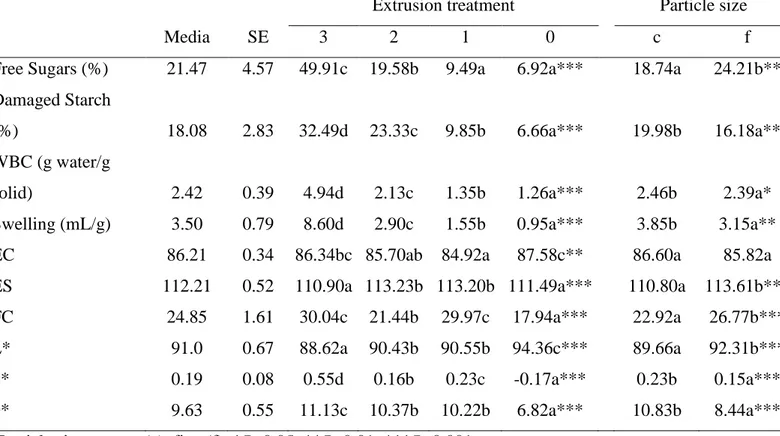
variance was applied to the experimental results (Table 1). The extrusion intensity and particle 232
size had a significant effect on the content of free sugars, which increased with the extrusion 233
intensity and with the reduction of the particle size. Nevertheless, no significant differences were 234
observed between the free sugars content of the control and the mild extrusion treatment (flour 235
1). Thus the hydrolysis responsible of the sugar release required a minimum barrel temperature 236
and also sufficient feed moisture content, since flours 1 and 2 were extruded at the same 237
temperature and with different moisture feeding. Extrusion induced a progressive increase of the 238
damage starch content with the intensity raise, likely due to damage produced by the shears 239
force and the heat during extrusion (Camire et al, 1990). Conversely, damage starch decreased 240
12 agrees with the trend observed by de la Hera et al. (2013a), when studying the features of 242
different particle size fractions of rice flours. 243
244
3.2 Hydration, emulsifying and foaming properties
245
Hydration, emulsifying and foaming properties were significantly affected by the extrusion 246
process and the particle size of the flours (Table 1). Hydrations properties (WBC and swelling) 247
increased with the extrusion intensity and also with the particle size of the flour. Those effects 248
were partially attributed to the increase in the amount of damage starch since it was found a 249
positive correlation between the amount of damage starch and WBC (r=0.88) and with the 250
swelling (r=0.88). Moreover, the cooking produced during extrusion led to gelatinized starch 251
that would have higher WBC and swelling, as occurred with the water absorption index 252
(Hagenimana et al, 2006). Camire et al. (1990) proposed that the breakage of the starch granule 253
integrity led to a poorly ordered molecular phase with hydroxyl groups prone to bind water 254
molecules. 255
The extrusion significantly reduced the emulsifying capacity of the flours, with the exception of 256
flour 3, compared to the control flour, and an increase of the EC was observed with the severity 257
of the extrusion (flour 3). That effect must result from the protein and starch changes during 258
extrusion process. Considering the proteins, extrusion forces the unfolding and aggregation due 259
to protein crosslinking involving SH/SS interchange, oxidation and hydrophobic interactions 260
(Rosell & Foegeding, 2007), which might result in a decrease of the EC of the flour. As the 261
extrusion intensity increase, starch modification might partially mask the consequence of protein 262
denaturation and EC increase due to gelatinized starch has greater number of hydroxyl groups 263
13 Emulsion stabilities were higher in the flours obtained from lower extrusion intensities (flour 1 265
and 2), likely the denaturation of the rice proteins during extrusion increased the stability. The 266
particle size of the rice flours did not affect significantly the EC, but the ES significantly 267
increased with the particle size. A reduction in the particle size of the flour improves the 268
emulsifying properties of the flours (Aluko, Mofolasayo, & Watts, 2009), but it seems that some 269
time is needed for displaying that effect since only ES was affected by the particle size. In the 270
present study, it was observed a significant positive relationship between the ES and the free 271
sugars content (r=0.93, P<0.001), which could reduce the total charge of the proteins leading the 272
formation of interfacial protein membranes that stabilize the emulsion (Aluko et al, 2009). 273
Extrusion improved the foaming capacity of the rice flours, but there was no trend with the 274
extrusion severity. The foam stability could be only measured in flour 3 (50.00 for fine flour and 275
45.18 for coarse flour), because very unstable foams were obtained with the other flours. The FC 276
has been attributed to its microstructure, size and distribution of the gas cells and the interfacial 277
properties (Zhang, Bai, & Zhang, 2011). Hydrothermal treatments can improve the foaming 278
properties, like it has been reported with corn kernels (Boladea, Usman, Rasheed, Benson, & 279
Salifou, 2002). Nevertheless, the minor effect observed in the extruded rice flours could be 280
attributed to the low protein content of the rice flour, since usually protein isolates show great 281
foaming capacity that improves with the hydrothermal treatments (Wang & Johnson, 2001). The 282
effect of extrusion on foam formation followed an opposite trend to the one observed on the 283
emulsion formation, which suggests that different mechanisms are involved during interfacial 284
membrane formation at the air-water and oil-water interfaces. Concerning the particle size, the 285
major FC was observed in fine flours, which was explained by the greater availability of 286
14 288
3.3. Colour
289
Luminosity (L*) of the flours significantly decreased with the extrusion intensity (Table 1), and 290
increased the a* and b*. Nevertheless, whereas the effect was steady with the extrusion severity 291
in the case of the luminosity and b*, no trend was observed in the case of a*. The extrusion 292
process could lead to Maillard reactions and a reduction of the lipids oxidation due to enzymes 293
inactivation that induces the formation of melanoidins and the pigments protection, which in 294
turn produces the modification of the flours color (Camire et al, 1990). Moreover, higher L* and 295
lower a* y b* were obtained in the fine flours. It has been proposed that fine flours had higher 296
surface area that favors the contact of the constituents with the oxygen promoting the pigments 297
oxidation (Atwell, 2001). 298
299
3.4. Pasting characteristics
300
Pasting plots of the extruded flours are displayed in Figure 1. When rice flours were suspended 301
in water, the major viscosity (initial viscosity at 50ºC) was observed in the flour 3 at both 302
particle sizes, due to the high amount of damage starch content and pregelatinized starch (Chao-303
Chi Chuang & Yeh, 2004). Concerning the extrusion treatment, the viscosity during heating and 304
cooling decreased with the extrusion intensity, obtaining minimum viscosity in flour 3 (with the 305
highest intensity). Nevertheless, when particle size was taken into account, a progressive 306
decrease of viscosity was observed in the coarse flours, but fine flours from treatment 1 and 2 307
did not show any difference in the pasting profile (Figure 1 b). Since flour 1 and 2 were treated 308
15 content, it seems that the effect on pasting profiles was independent on the feed moisture content 310
during extrusion when small particle size were subjected to this treatment. 311
Peak viscosity was significantly dependent on the damage starch content (r=-0.79), which agree 312
with previous studies connecting peak viscosity with gelatinized and damage starch that was 313
related to the polymerization degree of the starch granules (Barres, Verges, Tayeb, & Della 314
Valle, 1990). The reduction observed in the final viscosity and setback was displaying the 315
extension of the effect on the amylose chains, which might lose the ability to retrograde during 316
cooling due to their fragmentation during extrusion. This effect agrees with previous results of 317
Doublier et al. (1986). 318
319
3.5. Differential Scanning Calorimetry (DSC)
320
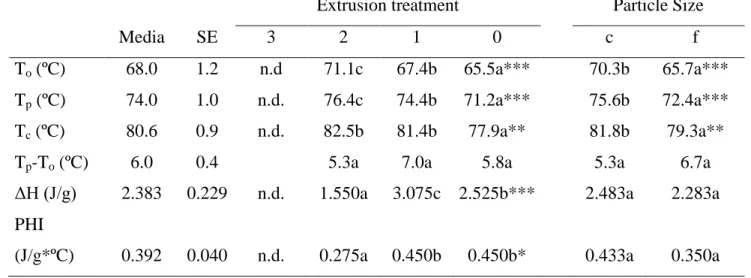
The effect of extrusion treatment and particle size on the thermal properties of the starch is 321
shown in Table 2. In the range of temperature tested, flours exhibited one endothermic peak 322
corresponding to amylopectin gelatinization, with the exception of flour 3. The absence of an 323
endothermic peak for flours 3 indicated total gelatinization of amylopectin. Indeed, these results 324
agree with those previously discussed regarding the very small pasting curve observed in the 325
extruded flours 3. The extrusion treatment significantly modified the gelatinization temperatures 326
of the flours, and those temperatures were also dependent on the particle size of the flours. 327
Gelatinization temperatures were sifted to higher values when flours were treated at increasing 328
extrusion intensity, but the temperature range was not affected. Higher gelatinization 329
temperature indicated that more energy is required to initiate gelatinization of the starch 330
16 progressing to the core of the granule till no crystalline structure is left for gelatinization (flour 332
3). 333
When comparing extruded flours, the gelatinization enthalpy was significantly reduced due to 334
the intensity of the extrusion, which was expected since extrusion induces starch gelatinization 335
and an increase of the damage starch content (Chiu & Solarek, 2009), leading to a reduction of 336
the native starch granules able to gelatinize (Biliaderis, Page, Maurice, & Juliano, 1986). 337
Nevertheless, the mild extrusion treatment (flour 1) gave significantly higher gelatinization 338
enthalpy compared to the untreated flour. Taking into account that treatment 1 was applied using 339
lower feed moisture content (insufficient to complete gelatinization), the higher enthalpy of this 340
sample could be attributed to a reorientation of the structure of the amorphous region to 341
resemble that of the crystalline region (Camire et al, 1990). The extrusion process modifies the 342
crystalline structure of the starch granule affecting the temperature at which swelling starts 343
(Camire et al, 1990). Fine flours showed lower gelatinization temperatures than the 344
corresponding coarse flours, but without affecting the peak high index and the gelatinization 345
enthalpy (Table 2). 346
347
3.6. Starch hydrolysis
348
The susceptibility of the extruded flours to the enzymatic hydrolysis was analyzed. Figure 2 349
shows the kinetic plots of the extruded flours and the effect of the particle size. The enzymatic 350
hydrolysis profiles were dependent on the particle size, and fine flours showed faster hydrolysis 351
and reached higher asymptotic values than course flours. de la Hera et al. (2013) observed lower 352
hydrolysis rate in the coarse flours when studied the effect of particle size distribution on the 353
17 that increase the water diffusion and enzyme accessibility. The hydrolysis curves were fitted to a 355
first order kinetics according to Goñi, García-Alonso and Saura-Calixto (1997) and also to 356
Butterworth, Warren, Grassby, Patel & Ellis (2012) to obtain the kinetic parameters (Table 3). 357
As it was observed in the plots, there was an increase in the equilibrium concentration (C∞) 358
parallel to the extrusion intensity (except flour 2f). Regarding the rate of the hydrolysis, k, there 359
was no general trend with the extrusion intensity. There was great agreement with the 360
equilibrium concentration estimated from both fitted methods, indicating that the kinetic 361
parameters can be fitted to a logarithmic function and that the rate constant did not vary along 362
the hydrolysis reaction (Poulsen, Ruiter, Visser, & Iversen, 2003). 363
Resistant starch was also quantified to determine the potential impact of the extrusion on the 364
structural level of starch. Although there was no clear tendency about the resistant starch 365
content, the highest extrusion intensity gave the flours with the lower level of RS (flour 3). This 366
finding disagrees with previous observations of Hagenimana et al. (2006), who found an 367
increase in RS content with the treatment severity. Those authors attributed the increase in RS to 368
the formation of amylose-lipid complexes during the extrusion, which retarded the enzymatic 369
digestion. Therefore, results divergence might be explained because of the lower content of 370
amylose of the flours in the present study compared with the reported ones. In addition 371
Chinnaswamy & Hannah (1990) reported a change in the percentage of amylose/amylopectin 372
ratio in extruded corn flours that was ascribed to both chains fragmentation, being more intense 373
in the former. That fact could affect the starch hydrolysis rate. Moreover, Hagenimana et al. 374
(2006) stated that the susceptibility of the extruded starches to be enzymatically hydrolyzed was 375
18 The particle size did not significantly affect the hydrolysis rate, but fine flours showed higher 377
values of C∞ and lower amount in RS. Al-Rabadi, Torley, Williamsa, Brydena, & Gidley (2011) 378
stated that fine extruded flours of barley and sorghum had major digestibility than the coarser 379
ones. The most compact structure, besides the smaller surface area of coarser flours, could 380
hinder the accessibility of the enzymes within the starch structure, since diffusion of the enzyme 381
is the first stage in the enzymatic hydrolysis (Al-Rabadi et al. 2011; Ghaid, Al-Rabadi, Gilbert, 382
& Gidley, 2009). 383
384
4. Conclusion
385
Extrusion and mechanical fractionation of the rice flours modified their behavior affecting 386
hydration, thermal and pasting features, besides their susceptibility to enzymatic hydrolysis. The 387
severity of the extrusion treatment was accompanied by an increase in the amount of damage 388
starch and free sugars content, the former contributing to the Maillard reaction, which affected 389
the luminosity of the flours. In parallel, hydration ability increased with the extrusion intensity, 390
leading higher viscosity in cold solution, which might be very interesting for some food 391
applications. Thermal properties (temperature and enthalpy) increased with the intensity of the 392
extrusion and that effect was intensified with the greatest particle size of the flours. Fine flours 393
with stronger extrusion showed the highest susceptibility to enzymatic hydrolysis and extrusion 394
process increased that effect. 395
396
Acknowledgements
397
Authors acknowledge the financial support of Junta de Castilla y León (VA054A12-2), the 398
19 Regional Development Fund (FEDER). Authors are also grateful to Harinera Los Pisones, 400
(Zamora, Spain) for supplying the rice flours. 401
402
References
403
AACC. (2012). Approved methods of the American Association of Cereal Chemists, methods 404
46-30.01 (protein), 55-40.01 (particle size), 76-30a (damaged starch), 56-30 (WBC), 61-02.01 405
(RVA) (11th ed.). St. Paul, Minnesota: American Association of Cereal Chemists. 406
Al-Rabadi, G., Torley, P., Williamsa, B., Brydena, W., & Gidley, M. (2011). Effect of extrusion 407
temperature and pre-extrusion particle size on starch digestion kinetics in barley and sorghum 408
grain extrudates. Animal Feed Science and Technology, 168, 267-279. 409
Alsaffar, A. (2011). Effect of food processing on the resistant starch content of cereals and 410
cereal products - A review. International Journal of Food Science and Technology, 46, 455-462. 411
Aluko, R., Mofolasayo, O., & Watts, B. (2009). Emulsifying and foaming properties of 412
commercial yellow pea (Pisum sativum L.) seed flours. Journal of Agriculture and Food 413
Chemistry, 57, 9793-9800. 414
Atwell, W. (2001). Composition of commercial flour. In W. Atwell (Ed.), Wheat Flour (pp. 27-415
42). St. Paul, Minnesota, USA: American Association of Cereal Chemists. 416
Barres, C., Verges, B., Tayeb, J., & Della Valle, G. (1990). Transformation of wheat flour by 417
extrusion cooking. Influence of screw configuration and operating conditions. Cereal Chemistry, 418
67, 427-433. 419
Biliaderis, C., Page, C., Maurice, T., & Juliano, B. (1986). Thermal characterization of rice 420
starches: a polymeric approach to phase transitions of granular starch. Journal Agricultural of 421
20 Boladea, M., Usman, M., Rasheed, A., Benson, E., & Salifou, I. (2002). Influence of 423
hydrothermal treatment of maize grains on the quality and acceptability of tuwon masara 424
(traditional maize gel). Food Chemistry, 79, 479–483. 425
Butterworth, P.J., Warren, F.J., Grassby, T., Patel, H., & Ellis, P.R. (2012). Analysis of starch 426
amylolysis using plots for first-order kinetics. Carbohydrate Polymers, 87, 2189-2197. 427
Camire, M., Camire, A., & Krumhar, K. (1990). Chemical and nutritional changes in foods 428
during the extrusion. Food Science Nutrition 29, 35-57. 429
Chao-Chi Chuang, G., & Yeh, A. (2004). Effect of screw profile on residence time distribution 430
and starch gelatinization of rice flour during single screw extrusion cooking. Journal of Food 431
Engineering, 63, 21-31. 432
Chinnaswamy, R., & Hannah, M. (1990). Macromolecular and functional properties of native 433
and extruded corn starch. Cereal Chemistry, 67, 490-499. 434
Chiu, C., & Solarek, D. (2009). Modification of starch. In J. BeMiller, & R. Whistler (Eds.), 435
Starch. Chemistry and Technology (pp. 629-656). New York. USA: Academic Press. 436
Clerici, M., Arioldi, C., & El-Dash, A. (2009). Production of acidic extruder rice flour and its 437
influence on the qualities of gluten free bread. Food Science and Technology, 42, 618-623. 438
Colonna, P., Doublier, J., Melcion, J., Demonredon, F., & Mercier, C. (1984). Extrusion cooking 439
and drum drying of wheat-starch.1. Physical and macromolecular modifications. Cereal 440
Chemistry, 61, 538-543. 441
de la Hera, E., Gómez, M., & Rosell, C. (2013a). Particle size distribution affecting the starch 442
enzymatic digestion and hydration of rice flour carbohydrates. Carbohydrates Polymers. 443
de la Hera, E., Martínez, M., & Gómez, M. (2013b). Influence of flour particle size on quality of 444
21 de la Hera, E., Martínez, M., Oliete, B., & Gómez, M. (In press). Influence of flour particle size 446
on quality of gluten-free rice cakes. Food Bioprocess Technology. 447
Doublier, J., Colonna, P., & Mercier, C. (1986). Extrusion cooking and drum drying of wheat-448
starch. 2. Rheological characterization of starch pastes. Cereal Chemistry, 63, 240-246. 449
Ghaid, J., Al-Rabadi, G., Gilbert, R., & Gidley, M. (2009). Effect of particle size on kinetics of 450
starch digestion in milled barley and sorghum grains by porcine alpha-amylase. Journal of 451
Cereal Science, 50, 198-204. 452
Goñi, I., Garcia-Alonso, A. & Saura-Calixto, F. (1997). A starch hydrolysis procedure to 453
estimate glycemic index. Nutrition Research, 17, 427–437. 454
Gularte, M.A., & Rosell, C.M. (2011). Physicochemical properties and enzymatic hydrolysis of 455
different starches in the presence of hydrocolloids. Carbohydrate Polymers, 85, 237–244. 456
Hagenimana, A., Ding, X., & Fang, T. (2006). Evaluation of rice flour modified by extrusion 457
cooking. Journal of Cereal Science, 43, 38-46. 458
Hasjim, J., Li, E., & Dhital, S. (2012). Milling of rice grains: The roles of starch structures in the 459
solubility and swelling properties of rice flour. Starch/Starke, 64, 631–645. 460
Houben, A., Hochstotter, A., & Becker, T. (2012). Possibilities to increase the quality in gluten-461
free bread production: an overview. European Food Research and Technology, 235, 195-208. 462
Jacobs, H., & Delcour, J. (1998). Hydrothermal modifications of granular starch, with retention 463
of the granular structure: a review. Journal of Agricultural and Food Chemistry, 46, 2895-2905. 464
Mercier, C., & Feillet, P. (1975). Modification of carbohydrate components by extrusion-465
cooking of cereal products. Cereal Chemistry, 63, 283-297. 466
22 Perdon, A., Siebenmorgen, T., Mauromoustakos, A., Griffin, V., & Johnson, E. (2001). Degree 468
of milling effects on rice pasting properties. Cereal Chemistry, 78, 205-209. 469
Poulsen, B., Ruiter, G., Visser, J., & Iversen, J. (2003). Determination of first order rate 470
constants by natural logarithm of the slope plot exemplified by analysis of Aspergillus niger in 471
batch culture. Biotechnology Letters, 25, 565-571. 472
Rosell, C. (2009). Enzymatic Manipulation of Gluten-Free Breads. In E. Gallagher (Ed.), 473
Gluten-Free Food Science and Technology (pp. 83-98). Dublin, Ireland: Wiley-Blackwell. 474
Rosell, C.M., & Foegeding, A. (2007). Interaction of hydroxypropylmethylcellulose with gluten 475
proteins: small deformation properties during thermal treatment. Food Hydrocolloids, 21, 1092-476
1100. 477
Wang, C., & Johnson, L. (2001). Functional properties of hydrothermally cooked soy protein 478
products. Journal of the American Oil Chemists Society, 78, 189-195. 479
Wen, L., Rodis, P., & Wasserman, B. (1990). Starch fragmentation and protein insolubilization 480
during twin-screw extrusion of corn meal. Cereal Chemistry, 67, 268-275. 481
Yeh, A. (2004). Preparation and applications of rice flour. In E. Champagne (Ed.), Rice: 482
Chemistry and Tehnology (pp. 495-540). St. Paul, Minesota. U.S.A: American Association of 483
Cereal Chemist. 484
Zhang, M., Bai, X., & Zhang, Z. (2011). Extrusion process improves the functionality of soluble 485
dietary fiber in oat bran. Journal of Cereal Science, 54, 98-113. 486
23
Table 1: Significant individual effects of extrusion treatment (1-3) and particle size (coarse, 489
fine) on free sugars, damaged starch, emulsifying, foaming and colorimetric properties of rice 490
flours. 491
Extrusion treatment Particle size
Media SE 3 2 1 0 c f
Free Sugars (%) 21.47 4.57 49.91c 19.58b 9.49a 6.92a*** 18.74a 24.21b** Damaged Starch
(%) 18.08 2.83 32.49d 23.33c 9.85b 6.66a*** 19.98b 16.18a**
WBC (g water/g
solid) 2.42 0.39 4.94d 2.13c 1.35b 1.26a*** 2.46b 2.39a*
Swelling (mL/g) 3.50 0.79 8.60d 2.90c 1.55b 0.95a*** 3.85b 3.15a**
EC 86.21 0.34 86.34bc 85.70ab 84.92a 87.58c** 86.60a 85.82a
ES 112.21 0.52 110.90a 113.23b 113.20b 111.49a*** 110.80a 113.61b***
FC 24.85 1.61 30.04c 21.44b 29.97c 17.94a*** 22.92a 26.77b***
L* 91.0 0.67 88.62a 90.43b 90.55b 94.36c*** 89.66a 92.31b***
a* 0.19 0.08 0.55d 0.16b 0.23c -0.17a*** 0.23b 0.15a***
b* 9.63 0.55 11.13c 10.37b 10.22b 6.82a*** 10.83b 8.44a***
Particle size: coarse (c), fine (f). *P<0.05; **P<0.01; ***P<0.001. 492
WBC, water binding capacity; EC, emulsifying capacity; ES, emulsion stability; FC, foaming 493
capacity. 494
24
Table 2. Significant individual effects (extrusion treatment and particle size) on thermal 496
properties. 497
Extrusion treatment Particle Size
Media SE 3 2 1 0 c f
To (ºC) 68.0 1.2 n.d 71.1c 67.4b 65.5a*** 70.3b 65.7a***
Tp (ºC) 74.0 1.0 n.d. 76.4c 74.4b 71.2a*** 75.6b 72.4a***
Tc (ºC) 80.6 0.9 n.d. 82.5b 81.4b 77.9a** 81.8b 79.3a**
Tp-To (ºC) 6.0 0.4 5.3a 7.0a 5.8a 5.3a 6.7a
ΔH (J/g) 2.383 0.229 n.d. 1.550a 3.075c 2.525b*** 2.483a 2.283a PHI
(J/g*ºC) 0.392 0.040 n.d. 0.275a 0.450b 0.450b* 0.433a 0.350a 498
Particle size: coarse (c), fine (f). *P<0.05; **P<0.01; ***P<0.001. 499
n.d.: Not detected. 500
To, gelatinization onset; Tp, peak temperature; Tc, conclusion temperature, Tp-To, gelatinization 501
range, ΔH, enthalpy and PHI, peak high index. 502
25
Table 3. Kinetic parameters extracted from first-order and LOS plots of different flours. 504
505
k (min-1) by first
order eq. k (min -1
) by LOS C∞ (%) C∞ (%) by LOS
Resistant starch (%)
0f 0.043 0.044 137.48 150.63 5.52
0c 0.053 0.051 124.39 130.72 5.91
1f 0.074 0.071 358.42 388.85 3.29
2f 0.061 0.059 338.79 364.30 4.01
3f 0.145 0.143 387.35 727.46 2.23
1c 0.054 0.053 134.98 143.25 6.10
2c 0.076 0.073 143.38 156.65 5.75
3c 0.061 0.059 230.75 243.55 2.11
506
k, kinetic constant; C∞, equilibrium concentration 507
Numbers in sample codes are referred to extrusion intensity and letters are associated to coarse 508
(c) or fine (f) flour. 509
26
FIGURE CAPTIONS
511
Figure 1. Effect of extrusion treatment on the pasting properties of rice flours with different 512
particle size. Flour 0 (black line), flour 1 (clear grey line), flour 2 (intermediate tone grey line), 513
flour 3 (dark grey line). Temperature profile (discontinuous line). Coarse flours (a), fine flours 514
(b). 515
Figure 2. Effect of extrusion treatment on the enzymatic hydrolysis of rice flours with different 516
particle size. Flour 0 (black line), flour 1 (clear grey line), flour 2 (intermediate tone grey line), 517
flour 3 (dark grey line). Coarse flours (a), fine flours (b). 518
27 Figure 1
520
521
28 Figure 2
524
525