15 1·56676·963·9/021$0.00+$1.50
e2002by CRCPressLLC
Abstract 16
2.1 Constraints, Context, and Reasons for Innovation , 16
2.1.1 How Innovative is the Food Industry? 16
2.1.2 What Are the Reasons for Innovation? , 18
2.2 Technological Trends ,' 18
2.2.1 Emerging Processing and Preservation Methods 18
2.2.2 Biotechnology ,' 19
2.3 Food Manufacturing Operations 22
2.3.1 What are Food Manufacturing Operations? 22
2.3.2 Can We Define Food Manufacturing Unit Operations? 23 2.3.3 Characteristic Features of Food Manufacturing Operations 23
2.4 Autornatic Control. 25
2.5 Advances in Tools and Concepts in Food Engineering ..':' 26
2.5.1 Tools and Concepts in Product Design 26
2.5.2 Tools and Concepts in Process Design 28
2.5.3 Tools and Concepts in Plant Operation 30
2.6 What Challenges Exist for Food EngineeringL 31
2.6.1 Integrating Rapid Progress in Biology into Food Engineering 31 2.6.2 Integrating Progress in Physico-Chemistry into Food
Engineering 31
2.6.3 Integrate More Mechanization in Food Engineering 32 2.6.4 Use a More Functional Approach in the Design of New
Products and Processes 32
2.6.5 Use More Mathematics to Integrate More Complexity 32 2.6.6 Better Integration of the Human Factor in Plant Design and
Operation 33
2.6.7 Can We Integrate AH Scales? 33
References 33
CONTEN1S
G.
Trystram
j.
l.
Bimbenet
Trends
In
Food
Engi neeri ng
2
3. FAO/WHO. 1992. International Conference on Nutrition. Nutrition and Develop-ment-A Global Assessrnent, Food and Agriculture OrganizationIWorld Health Orga-nization, Rome, Italy.
4. Wotkei, C.E.1998. Impacts of diet on health inNorthAmeríca, inCreating Healthful FoodSystems: Linking Agrieulturelo HumanNeeds. G. F.Cornbs, Jr. and R. M. Welch, eds. Ithaca, NY: Cornell University,
5. James, C. 1998. Global review of commercialized transgenic CfOpS: 1998, Interna-tional Service for the Acquisition of Agri-Biotech.Applications.Brief No. 8. Ithaca, NY.
6. Leistner, L.and L.G.M. Gorris. 1995. "Food preservation by hurdle technology, Trends Food Sei. Teehnol.,6: 41-46.
7. Vega-Mercado, H. et al. 1997. Non-thermal food preservation: P111sedelectric fields, Trends Food Sei. Technol.,8: 151-157.
8. Dunn, J.et al. 1995. P111sedlight treatment of food and paekaging, Food Technol.,
49(9): 95.
9. Barbosa-Cánovas, G.v. et al. 1997.Non-thermal Preservation of Foods.New York, NY: Marcel Dekker, Ine.
10. Ahvenianen, R. and E. Hurrne. 1997. Active and smart packaging fOI meeting con-sumer demands for quality and safety, FoodAddit. Contam.,14: 753-763.
11. Morris, C.E. 1998. 1998 survey of food manufacturing trends: A clear direction, Food Eng.,70(3): 77-86.
Reprinted from Reference 11, Copyright 1998,Food Engineering,Cahners Business Information, a División of Reed Elsevier, lne. AH rights reserved.
-,
High Moderate Low
-~
potential potential potential
Ohmic heating 10 36 54
Elcctron beam radiation 27 38 35
Gamma irradiation 33 35 32
High pressure 19 38 43
Radio frequency cooking 17 50 33
Microwave pasteurization/sterilization 37 36 27
Pulsed light 7 44 49
Pulsed electrica! field 4 36 60
COzdrying 18 40 42
Microwave drying 20 43 37
Low-acid aseptic particulars 23 50 27
Magnetic resonance imaging 22 35 43
Predictive process control 44 44 12
"
TABLE 1.8Cornmercial Potential of New/Unique Process Technologies (Percent of Respondents Familiar with Each Technologv)
Engineering and Food for the 21st Century
• There have been few new unit operations, except extrusion cooking, membrane separations, irradiation, high-pressure treatrnents, and, in a
sense, manufacturingoperations.
• Sorne new processes have been required to make new products (i.e.,
preparedsalads,newcompositedesserts,osmo-dehydrated products,etc.) andnewoperations(membranes, extrusioncooking).
G Many new techniques are used in unit operations: aseptictechniques, super criticalextraction and osmoticdehydration(bothbeing newforms ofsolvent extraction),ohmicheating,RF heating, water-jetcutting,asso -ciative packaging,image analysis, etc.
introductionof newtechnologiesinthefoodindustriesduringthepast fewdecades, thenumberofrealinnovationsturns outtoberatherlow:
Like other hnman activities indeveloped countries, the foodindustry is asked by society tobe "environmentally correct" concerning air, solid wastes, packages, landscape, andwater.The pressure on water supplies isIikely tobecome amajor
problem in many countries inthe coming years.
Tofulfill all ofthepreviously describéd constraints atthe same time, the food
industry has atendency to split itself into twoentities:
• Firsttransformation industry(e.g., production ofsugar, starch, oils,malr,
e!c.)--close to agriculture and international raw materials markets, making
basic products for consumers and more and more'ingredicnts for thefood industry.
• Second transformation industry-close lOdistribution and consumers, which mixes, assembles, andshapes ingredients tojnake complex products ofvarious origins (ascereals +rneals, dairy+fruits, etc.) This evolution tends to break
thetraditionaJ organization of commodities from fiE;l"dtoconsumers (cereals,
meat, dairy, etc.).The fast-growing activity in food ingredients isevidence of this trend.
On theinternational level, shares arebought and soldat the speed ofelectrons,
often onthe basis ofshort-term profits.Whole cornpanies maysimilarly change
owners inavery short time.
The competition in pricing and quality isincreasing, mainly due to the increasing weight ofdistributíon chains. The increasing pres~re ofretailers pushes industry to modify itsway of distribution. Internet market may become anImportanr
trend.
New challenges arecorning: the food'industry has toestablish anddemonstrate
itsability tocontrol its production in terms ofqnality, ofcourse, butalso, nowadays, moreand more interms of safety, nutritive value, and natural image
of the productoPeople alsorequire more convenience andinformation aboutthe food they buy,
Evolution in the structure ofthe
food industry
Respect for
water, air,and
environment
Shareholders'
power
Disrribution power Consumer
power TABLE2.1
Constraints and Context of Evolution in the Food Industries
17 TrendsinFoodEngineering
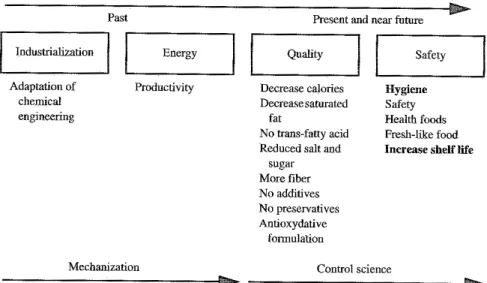
Figure 2.1 Sorneimportantsteps fortheevolutionofobjectivesandrequirementsinthefood industries.
---
Mechaniza--
rion~
--
---
~~
---
Control sc--
ienc--
e--
---
~
HygieneSafety Health foods
Fresh-like food Increase shelflife Decrease calories
Decrease saturated fat
No trans- fattyacid Reduced sal!and
sugar Morefiber No additives
No preservatives
Antioxydative formulation Productivity
Adaptation of chemical engineering Industrialization
~~~E~n_~_gy_.__
~I~1
Q_n_~_'t___y~
1
I~
s_a_fu_ty ~ Present and nearfuturePast
Evolution oiindustrial stepsin the foodindústry
Table 2.1 presents our views of constraints to whichthe food industry is being subjected: Due to the context described here, the food industry has to manage innovatioñto modify andadaptits technologies.Theobjectivesof this adaptation havevariedwith time,as showninFigure 2.1.PresentIy,the accentis placed on safety and on an increase in quality homogeneity. But, when we consider the
2.1.1 How INNOVATlVE 15 THE fOOD INDUSTRV?
l •
2.1 CONSTRAINTS,CONTEXT, AND REASONS FOR INNOVATlON
Technologicalinnovation is presentedasoneof theanswersto the constraintsin the food industry.Examplesof innovationsor research,maínlyinthe fields of preser -vation(thermalandnonthermaltechniques),manufacturing operations (operations onindividual pieces),automaticcontrol,etc.,are presented.New tools andconcepts usedinproduct andprocessdevelopment are described,suchasproduct,material, and reaction engineering. Emphasis is placed on beterogeneous and composite products. Finally,theauthorspresent theirideas aboutchallengestothe food industry incomingyears.
Thefood industryis atthesame time theinstigatorandthe subjectof cbange insociety.Whenthe food industryis subjectedtoseveralkindsofconstraints,ithas tomodifyits structures,andtheseevolutionshave animpactonitstechnology.
Abstract
The use of biotechnology and of biologic steps during processing has increasing importance. Acomprehensive discussion would benecessary to describe this aspect. Sorne of this inforrnation is reported in Reference 2. Table 2.4 summarizes a few
2.2.2 BIOTECHNOLOGY
Also, in theheat processing of food, major improvements canbeprovided using a combination of classical heating methods (convection in-airor Iiquid) and new
technologies as presented in brief in Table 2.3. The way tocombine these technol- .
ogies is not well established at present. Nevertheless, numerous applications ate available,
An interesting point to discuss is the aseptic processing principle. Itmust be
indicated here that itis not realIy a new unit operation orprincipIe of processing, but it is a new set of technologies that permit work to take place in a safe and hygienic climate. Thenextquestiort for such processes that researchers and engineers havetofaceconcems process optimization. Buttheintroduction of thehygiene point of viewprobably will be very important to the future of food industries (see Figure
2.1).
Figure 2.2 Factors inñuencingthesuccessofnew technologies at the industrial level. Legislation
Consumer Scientific
community Tradeunions Acceptance Investmentcost Operation cost Flexibility Reliability Safety
Equipment
Microbiblogy Toxicology Allergy Particulates
1
9
Concurrenttechnologies Trends inFood Engineering
An exhaustive presentation of emerging methods forthe processing offoodproducts
is quite difficult. Inthe case of preservation, sorne points are summarized inTable 2.2. Insorne cases, technologies have already beentransferred toindustry,The main idea for such research is to process food without heat. In fact, in many of these technologies, some heating occurs during processing. Except in sorne specific appl i-cations that are highlighted inTable 2.2, itbecomes obvious that acombination of technologies is preferred.
2.2.1 EMERGINGPROCESSINGAND PRESERVATIONMETHODS
2.2 TECHNOlOGICAlTRENOS
Another important point is the acceptance of the new technology bythe user. It
is obvious that this mechanism of acceptance is not easy to implement, Figure 2.2 represents different points thathave tobe considered during the evaluation of anew technology for industrial purposes.'
• Allhough heat is fue most common method for transformation, sanitatíon, and preservation, itis well known today that the eonsequences of heating arenotneeessarily good for the productoTherefore, nonthermal processing isanimportant objective. On theother hand, the ability toperform aecurate separations of biomolecules becomes more and more important. The con
-sequences ofsuch progress are the lengthening of preservation timeandan increase in theconsumer's perception of the food as being "natural."
• Another driving force for innovation is probably fue attainment of new properties (texture oraroma, for exarnple), which may require new tech -nologies. The design of new products is a matter of competitiveness for industry. In such new products, safety considerations become very im por-tant (Figure 2.1).
• The competition .between companies and the relative ease in fue design of "me-too" products imply firms' increasing focus on technologies involved in the process.
• Innovation is evidently the direct result oí research and development within thefirmoButitisalso theconsequence of research made elsewhere. Transfer from one industrial domain to another is a frequent path of innovation. Screw extrusion was used in the plastics industry before being transferred to thefood industry to beutilized inextrusion cooking. Today, one of fue most promising directions of research and inuovation is ce r-tainly derived from rapid progress made in the field of biology,
A set, probably not exhaustive, of reasons for innovation eonsists of the following:
-,
2.1.2 WHAT ARE THE REASONS FORINNOVATION?
This shows that most of fue existing teclmologies have been inuse for along time; there is more progressive evolution than striking innovation.
,t'.) :.~ ::;1 (1) :::J o, <J>
s
:
"TIg
e, m :J~
.
:J ~. :::J (JQPieces ofproduct areinnnersed in oil _¿.Drying,baking, frying and alahighternperature(180~C). extractionofoil
Precooked prepared meals Tor cold
storage
Themostused method.Thecombinatlonof techniques isiuade to ímproveheattrunsfer.Thetnainwaysloimproveheatuansfer areteincrease CollveX:UÜI1(betterh
.
eat trans... fercoefficicnt), introduce controlled radiation. . und.combine steani injectionwíihunexchanger.Mear,cereal products, fruits,
vegetablcs, andfatproducts
Everyproduct
~
Fruits,meat, fishproducts,and
vegetables
Thinproductpieces Pumpableproducts
Liquidorpiecesofproducís: applicationavailable for in-package products
Puinpable products, even if
particles arepresent Niunerousapplicatlons
Vacuumpermits thereductionof Every kind ofheat Lower temperature temperature, treauneut
Heatingoftightly packagedproducts, Cookingamipastcurizution Quality, safetyandlesslosses Increaseoftransfercoefficient;
controlof impregnationor drying 1Spossiblethroughoperating
conditions
Increaseof transfercoefficient;fast dryíng
Dehydration,soaking,
salting, andpickling
wallsternperature
Baking,dryingandroasting High-intensitydrying;highheating rate
Excellentcontrol ofexchunger Directinsituheating
Heating,pasteurization Electric currentsent inexchanger
walls.
-Superheatedsteam heats theproduct likeahotgas.
Pieces of"product areimmersed ina
concentruted solution; heatedor'001
heated.
Electriccurrentisdirectlyinjected in Heating,pasteurization thepipe;Joule effect, alsoin pieces
of products, if present,
Insituheatgeneration Heatingandíhawing Directin situheating-often
combined with air
Infraredradiationheatsthesurfaces- Heating,s urface treatment, Funetíonof opticalproperties of smallpenetrationdepth. andpasteurization food
°Reat processing improvement cooking
"Sous-vide" Under vacuum
Immersionfrying Immersíon Indirect ohmic
heating
Superheatedsteam Direct ohmic
heating Microwave/high
frequency
Infrared
Products Principie Applications Advantages
lAStE 2.3
New Principies of Heat lreatments
Sterilízatíon,bu! the
principle isnot exactIy known m :::l ~. :::J (1) (1) :::!. :::J (JQ
'"
:::J o, "TI O O o,Q'
....
::¡-(1) N ~ ~ () (1) ;a e-<
N QDisinfection, sterilization Verystrong and fast light pulsations;
effect ofhigh peak powerand broad spectrum of flash;real principIe unknown
High-density pulsed magneticfield provokes adramaticdecreaseof
microorganisms.
A high-electric field is applied.Ifthe
valueishigher than acritica!value,
pores appear inthe cell ruernbranes. Thedeterioration of
membranesisirreversible.
Purnpable foods; packages;inpackagepossible; water processiug
Nontherrnal processing; different effects on parameters suchaspH, ternperature,etc.; Inactivational lower
ternperature, alternauve
forpasteurization
Surfaceinactivation-all typesofmícroorganisms
areinactivated(spores andviruses'included)
Number ofstudies is still toolow
Effectonsporesisunknown-only pumpable products
Low-temperature process Packaged product(inbatch)-may be
continuous forlíquids Inactivation of
mícroorganísms,thawing; Ircezing; diffusionof
solutions (impregnation);
and protein denaturation
Saniuuicn, extraction Increase ofpressure (until 8000
bars)-lhe stressapplied modífies
the behaviorofmicroorganisms, proíeins, etc. Pulsed magnetíc field Pu!sed light Pulsed
electric
field
Products
High pressure
\
Advantages Applicatlons (functions)
Principie lABLE 2.2
New Nonthermal Principies of Preservation lreatmenfs
These manufacturing operations have other fearures that justify special interest,
Many of themtreatproducts on openconveyorsorin openvesse1sor equipment,
and theyincludehumanhandling or the close proximity ofhumans. Thismeans that
hygienic questions are often critica1for such operations andjustify the use of microbiological control of the atmosphere. Clean rooms or aerobic protectionof equipment mustbe employed.
Inmanyinstances, heterogeneity is part of product quality,especiallywhen a composite objectconsists,forexample,of the combination ofsoftandcrispylayers. The problem is thento control thetransferof wateriand/orother molecules)between theselayers.
Inmatters ofquality,each piece must fulfillcertainrequirements (weight,
co
m-position,contamination, etc.), whereasbulkproducts are sold bytotal weight and average characteristicswithcertain variationallowable among samples.Many of these operations areresultsof theindustrializationofmanualoperations developedin kitchens. Mechanization maybedifficultduetothe complexnatureof
2.3.3 CHARACTERISTICFEATURESOF FOOD MAI'\IUFACTURtNG OPERATlONS
Thismeans that themost interestingand originaloftheseunitoperations consists
of shaping,separation, andassembly,includingpackaging.
.. Manyheatand masstransfer operations (cansterilization and drying)are based 00 principIesthat do not differ from the principIesof opera:tions
performed onbulkproducts,andtheyareclassicallystudied,
• Tbe same situation exists for reaetions in food objects;their rates are determined by heat andJormasstransfer and/or by reactions kinetics-e-all
classicalconcepts, .
• Transportationof objectsisnotspecifictothefood industryifthese objects are packages or packaged products; however,a specíficity exists if it concems barefoodobjects,beeause problems ofstickiness, hygiene,and deformation maybe encounterediftheproducís are semisolids.
We can tentativelymake alistofsuchunit operations (Table 2.5)asfollows:
2.3.2 CAN WE DEFINE FOOD MANUFACTURING
UNIT
'"
OPERATlONS?considering objects individually or starting from a bulk product to inake such individual objects. These objects are generally"large,"but their size.is AQ~me relevant eriterion.Iffruits are peeledbyaknife,theyreceivean individualtreatmeüt, and the position ofeachof themis determined;this.maybe considereda manufac -turing operation. When potatoes are peeled by abrasion, the positionof eachof them isnotcontrolled;there is random treatment00 a bulkproduct, Similarly,the color sorting of coffee granulesbyhigh-velocityoptical machines considerseach grain individually,andthis operationcanbe considered food manufacturing.
23
TrendsinFood Engineering
Wehave proposed" todefine a newcategoryofunitoperationsoffood engineering thatwecould callfood manufacturing operations.Itcould bedefinedas operations 2.3.1 WHAT AREFOOD MANUFACTURING OPERATIONS?
Infact, most products sold toconsumers (excludingmostingredients sentto secondary transformation)in industrialcountries formany yearshavenolongerbeen cornmer
-cializedinbulk, Products arepackaged,and oftenshaped, eithertraditionally (e.g., bread, sausages,cheeses,and biscuits) orinnew shapes (e.g., fish fingersandfrozen hamburgers). Furthermore, people consumemoreandmore composite objects such as two-layerdessertcreams,multilayer cakes, ice crearos in eones,pizzas,industrial sandwiches, and prepared dishes.All of thismeansthat growingparts offood plants aredevoted to fomúng, assembling,conveying,and otherwiseprocessing such objects.
1. Treatmentofproduct in bulk, mainlyliquids orsolid particles,correspon d-ing to the classical unit operations of chemical and food engineering (centrifugation,heatinglcoolinginexchangers, distillation, milling,etc.) 2. Treatmentson"objects," i.e.,products likepizzas, cakes,piecesof meat
or fish, and packaged products (cans, bottles, etc.); examples of such operations include the deposition of fruits on a pie, cutting, molding, assemblingofsevera1parts,packaging, etc.
A visit to almost any food plant willshow two typesof operations:
2.3 FOOD MANUFACTURING OPERATlONS
directions of progressinbioteehnology that,in our opinion, offer importantcontrí -butionstothe evolution offood industries. When more generallyspeaking ofbiology, nutrition must alsobequoted as becomingamajorincentive for the creation ofnew products.
Othertechnologicalevolutions havebeen describedaboye. Wenow present as separate topics twospecífic trends: food manufacturing operationsandautomatic controL
for measuring pathogens, unwanted xenobiotic, etc. Specific kits and atIine sensors become available.
tools
New analytical
Tbe cell factory ,'"The useof microorganisms is a way to"do thingsthat can morerapidly lead to new producís." Bioreaction engíneeríng (including enzymatic engineering) is an
important area of progress.
Probably, this is the major arca of interest, with the design of new specífic probes
Genetic and agronomical engineering for agricultural products permits the design
ofnew raw rnaterials.The incidence on processingisnotestablished.
Processingon the field lABLE ~.4
Examples of Perspectives of Biotechnology Application for Innovation in Food Industries
Engineering and Foodfor the 21st Century
Figure 2.3 PrincipIeof sensordevelopment forfoodprocess controlapplicatíons. principies
1tís well recognized today that control science is one of the important avenues for
progress in fuefood industries," Areview of applications and thepotentíal of control
science inthe food industries has been presented.' The main points and ideas are asfollows. Inparallel with heat and massfluxes, which ate classic forfoodengineers,
the complexity of flow sheets implies that fluxes of informati:on are essential aiJ;d
must be taken into account. As it may appear from Figure 2.1, the new objectives
of production imply anecessary evolution frOID mechanization (important for 'P(Ó~
ductivity criteria) to control (important for quality and safety criteria). Withotjt
control, many processes cannot work.
The consequence is that numerous studies have proposed fue'introduotion of
new sensors. Figure 2.3 proposes a set of available methods for sensor designo It is
important toremark that most of the progress today is being made using classical
(simple-ro-use) sensors incombination with computer-based applications.
The direction of algorithm design for control purposes is still under active
development. Nevertheless, animportant gap remains between thelevel oflaboratory 'J
2.4 AUTOMATIC CONTROL
require robotization (in the sense ofprogrammable mechanization), This may
1imit
our interest ininvestments in mechanization, robotization, and automation.
Toall of these specifics may be added the fact that fuese operations so far
ha
v
e
not been the objects of education and academic research commensurate withfheir
importance in industrial investments and with the concerns of food plants operators,
One important exception is packaging, which has received SOrne attention in recent
decades. This deficiency of research, however, has been aIleviated by the transfer
of technology from mechanical industries (products, robotization), These consider
-ations raise our awareness of the need to give mote importance to the topic of
mechanics in the food industry.
TrendsinFood Engineering
many products (thick liquids, pastes, or semisolids=-fragíle, deformable, often
sticky) ro fue composite structure of many of them and to their complicated shapes or dispositions. For example, think of how we could mechanize the deposition of four anchovies onapizza, Insuch operations,themechanical design of themachine
must be related to a knowledge of the mechanical behavior of the product.
Even then, repetitive mechanization, which requires constant human supervision,
is real automation and is difficult to realize, because it supposes SOrne real-time
measurements, The weight of pieces isfairly easy tomeasure (as is.color),but the
determination of shape may require image analysis techniques. Furthermore, auto -mating the control of plants that inelude such operations is very different from the
caseofbulk products; itsupposes the control ofwaiting lines, of flow rates measured in objects per minute, etc., which are all techniques that have been more highly
developed in mechanical industries than infood processing.
Inmany cases, the same plant has toproduce a succession of several batches of products in the same day, which means that flexibility is necessary, and this may
Cheese, yogurt, drysausage
Reactions Biologicaland enzymatic
Everything
Bread, biscuits, meat
Preserves
Meat, bread
Meat
Ham,cheese
Ham, cheese, sausages
'Iransportaiion Conveying
Heat andmass Cooking
transfer Canning Roasting Cooling, freezing Salting Drying
Dosing, depositíon, powdering,
coating
Arrangement
Closing,sealing
Labeling
Wrapping, cartoning
• ofliquids
• ofpasty products • ofpowders and partic1es
Onpizzas, cakes, prepared meals, all cornposite products
Candies, cookies inboxes
Bcttles, cans
Onbottles, cans, etc.
Bottles, cans, etc.
Assembling Filling
Mear carcasses
Mear,fish
Fruits
Fruits, vegetables, coffee grains
Separation Disassemblíng
Cutting Peeling Sorting
Bread, biscuirs, sugar
Biscuits, ham, sugar
Pasta
Formífig Molding ""'.Extrusion
Lamination
Example of products
Principie Unit operation
TABLI~
z.s
Examples of Food Manufaduring Unit Operations
networks
(linquistc)
during processing
Trends
biochemical reactions and theevolution of important factorssuchas temperature, efficient
IN
the form 01'
used to determine water content
engineering will have to be assimilated in theprocesses
the
used to control?
Will
transfer of vn,"''''¡t'',in?' and technology from other sectors. In addition to the fields
described 01' progress
this field will come
Most of the advances
used more
ommendations related to hygiene, traceability, consumers, has
'~"f',rll,,~j- batches.
31
the lineo
frequent. At upper level, flux management and
operation makes this management more critical. The connection between sales, sales
forecasts, materials and other L"-<./...,A."~U, pn)QUICnOn,
has become factor
2.5.3
the
account as as in is
of a "clean process," by which we mean that the process is designed to minirnize
flows of and thus ...."'rinr-H-.n
designs. The
Engineering and Foodfor the 21st Century
7.
5.
3. Bimbenet1. 1.and G. Trystram.1993."Evolution du Génie Industriel Alirnentaire,"
alim. 1-12):
Preservation Technique," Colloque "La conservation de demain," Pessac, France,
User
1.
with machine ratherthan replacing him?
It that
2.6.5 USE MORE MAIHEMATICS 10 INTEGRATE MORE COMPLEXITV
IN Of
USE MORE FUNCTIONAl
NEW PROOUCTS ANO PROCESSES MECHANIZAIION IN
pbysico-chemical
very small scales.
profiles in products during and after processing, Will this method be