Unveiling EFL and Self-Contained Teachers’ Discourses on Bilingualism within the context of Professional Development
Jennyfer Paola Camargo Cely
Universidad Distrital Francisco José de Caldas Facultad de Ciencias y Educación
Unveiling EFL and Self-Contained Teachers’ Discourses on Bilingualism within the context of Professional Development
Jennyfer Paola Camargo Cely
This research work is presented as a requirement to obtain the degree of Magister in Applied Linguistics for English as a Foreign Language
Tutor
Pilar Méndez Rivera
Universidad Distrital Francisco José de Caldas Facultad de Ciencias y Educación
Note of Acceptance
_________________________________ Pilar Méndez Rivera Tutor
________________________________ Harold Andrés Castañeda Peña Juror
I acknowledge the Universidad Distrital Francisco José de Caldas; specifically to the Master in Applied Linguistics for English as a Foreign Language. Special thanks to my family for the support they provided us through our entire lives. I would also like to express my gratitude to
Table of Contents
INTRODUCTION 10
Justification 12
THE STUDY Statement of the Problem 14
Research Question 27
Research Objectives 27
LITERATURE REVIEW 28
Background to the Study 29
Theoretical Framework 34
INSTRUCTIONAL DESIGN Visions of Language and the Educational Process 48
A Social Theory of Language, Learning and Teaching 49
A Social Theory of Learning within a Professional Development Context 53
Schedule and Materials 58
RESEARCH DESIGN Type of Study and Research Paradigm 59
Context 61
Participants 64
Data Collection Instruments and Procedures 65
DATA ANALYSIS Data Analysis Methodology 69
Second Category: The Art of Questioning, Reflecting, and Visioning 93
CONCLUSIONS, PEDAGOGICAL IMPLICATIONS
AND FURTHER RESEARCH 105
REFERENCES 108
List of Figures
FIGURE 1: Graphic 1 “Survey#1Q:6” 21
FIGURE 2: Graphic 2 “Survey#1Q:7” 21
FIGURE 3: Graphic 3 “Survey#2Q:2” 22
FIGURE 4: Graphic 4 “Survey#1Q:6” 22
FIGURE 5: Graphic 5“Survey#3Q:4” 23
FIGURE 6: Graphic 6 “Purposes and Reasons (Seedhouse’s scheme, 1995)” 24
FIGURE 7: Graphic 7 “Ways of Learning (Seedhouse’s scheme, 1995)” 26
FIGURE 8: Graphic 8 “Topics and Contents (Seedhouse’s scheme, 1995)” 26
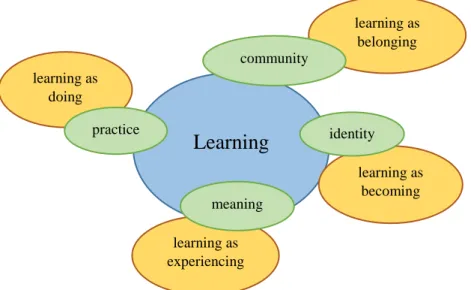
FIGURE 9: Graphic 9 “Components of a Social Theory (Wenger, 1999)” 51
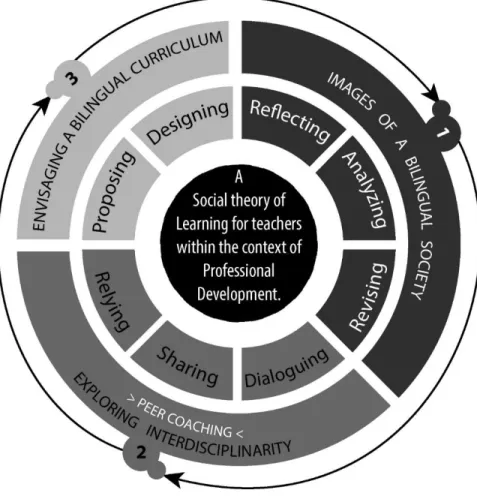
FIGURE 10: Graphic 10 “Instructional Design Stages” 55
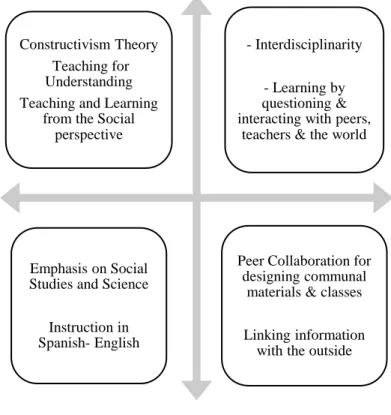
FIGURE 11: Graphic 11 “Participants’ Proposal” 57
FIGURE 12: Chart 1 “Schedules and Materials” 58
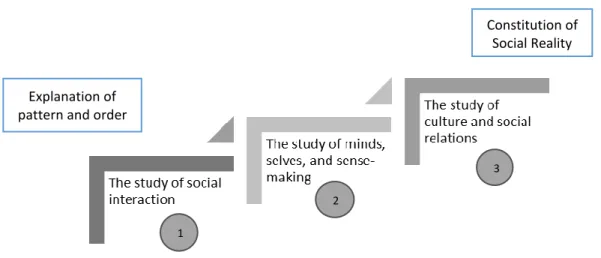
FIGURE 13: Graphic 12 “Discourse Domains” 60
FIGURE 14: Chart 2 “School’s exposition to English as a foreign language” 62
FIGURE 15: Chart 3 “Qualitative Content Analysis Approach” 72
FIGURE 16: Graphic 13 “QCA Data Analysis Stages (Zhang & Wildemuth, 2009)” 72
FIGURE 17: Graphic 14 “Data Management- Labelling Data Atlas.ti” 74
List of Annexes
Annex A: Survey # 1 122
Annex B: Survey # 2 123
Annex C: Survey # 3 124
Annex D: Survey # 4 (Seedhouse’s 1995) 125
Annex D: Participants’ Consent Form 126
Annex E: Protocols 1 and 2 127
Annex F: Teacher Reflective Journal Sample 129
Annex G: Axial Coding 130
Introduction
The following document reports a research experience aiming to answer the question-
what discourses do EFL and self-contained teachers draw on when participating in the
construction of a bilingual curriculum-. The aspects that motivated this research study are based on my concerns regarding teachers’ discourses towards bilingualism and bilingual education in
the school I work at, which according to empirical observation seem to have not only an
incidence in the L2 teaching-learning process, but in both EFL and self-contained educators’
professional development. After backing up this hypothesis through a needs analysis process and
literature review, three main constructs constituting the basis of this proposal arose: Teachers’
Discourses, Bilingualism, and Teacher Professional Development.
In order to evidence and give account on the research process I followed, this document
is organized by chapters. The first chapter entitled Statement of the Problem describes the
pertinence of this research after analyzing institutional documents such as the PEI and the EFL
syllabus. Likewise, I display there the results obtained through three different surveys applied to
EFL, self-contained, and sixth graders in order to back up the initial analysis, which were crucial
to design the leading research question and objectives. Then, the chapter labelled Literature
Review echoes some post-structuralist theories and researches regarding how discourses around
bilingualism and bilingual education have framed and limited the L2 teaching-learning process in
terms of curriculum and methodology design; pedagogical practices; and professional growth.
In the Instructional Design chapter, I draw on Wenger’s (1999) ideas in regards of
communities of practice and I illustrated how by reflecting, sharing, working together, and
colonial discourses and can have an active participation in themes such as bilingualism and
bilingual education. By doing so, participants were able to vision a bilingual curriculum that aimed not only at addressing learners’ proficiency in the foreign language but also at endorsing
their professional growth.
Afterwards, I describe the process followed to analyze the data collected throughout the
pedagogical intervention via protocols, teachers’ journals, and transcripts from the discussion
group sessions bearing in mind the Qualitative Content Analysis approach in the light of Zhang
& Wildemuth (2009), and Mayring (2014). In this sense, I was allowed to reduce the data to two
final categories in order to accomplish this research’s objectives. Finally, the conclusions,
implications, and the pedagogical practices resulting from this study are displayed along with the
Justification
Considering Wenger’s (1999) ideas, throughout history, teaching and learning have been
assumed as single processes with a beginning and an end. Under this assumption, an asocial and
linear view of approaches and methodologies has been embraced, leaving aside individuals’
realities and experiences at the time of denying collectivity. This view has been reflected in
policies, metrics, training programs, and curriculum designs aiming at outlining and controlling
the society (Popkewitz, 2000).
In view of the above, language has been a determinant factor in the construction of that “pre-conceived” society as it dynamic nature, has allowed some nations to take control over
others and assure a privileged position in regards to economy, politics, and sociocultural issues
(Fairclough, 2003). As a result, English as a foreign language was quickly spread, serving as a
means by which certain practices and ideologies have been perpetuated and reproduced
worldwide at the time of nulling or overshadowing other languages (Tollefson, 2007; Ryan,
2010).
Subsequently, the conception and definition of bilingualism held not only in Colombia
but also in most of the countries, was reduced to the fact of speaking English (Guerrero, 2008,
2009; Usma, 2009; De Mejía, 2011; Ordoñez, 2011; Escobar, 2013). Hence, language policies
adopted by governments from monolingual contexts as ours, meant to spread English under
foreign standards under the premise of allowing learners to access to better and qualified
educational and professional lives (Usma, 2009; Valencia, 2013), an imprecise statement as
In the same line of thought, bilingual education practices as evidenced throughout this research, aim at increasing the learners’ exposition to the foreign language. To do so, the
language of instruction used for contained subjects is English. This has led to negative
implications, not only for the learners, but also for both EFL and self-contained teachers, whose
professional development is limited to study and apply what others have designed and
established.
Therefore, this research aims at unveiling EFL and self-contained teachers’ discourses
when envisaging a bilingual curriculum by means of dialoguing and sharing pedagogical
practices and experiences as a way to endorse their professional development. In this sense, their
roles as designers, decision-makers and collaborative coaches were evidenced as they were
invited to propose, reflect and take a stance towards educational policies and practices in defense
The Study Statement of the Problem
The influence of Great Britain and the United States on international relations, political,
and economic systems for the last decades, has ensured acceptance and spread of English as the
main language spoken worldwide (Guerrero and Quintero, 2009). In this sense, English has been
mostly promoted as the language that allows people to build society and to fetch better economic
and academic prospects (Barkhuizen, 2002), and having a certification in this language, is
considered essential for personal and professional development worldwide. (Song, 2006).
Considering this premise, the Colombian Ministry of Education launched the program “la Revolución Educativa” (Education Revolution) and within it the subproject Colombia Bilingüe
(Bilingual Colombia), under the vision of offering Colombian students the possibility of
becoming bilingual so they could increase their productivity in a globalized world (González,
2007; Guerrero, 2009). However, its implementation does not recognize the complexity of students and teachers’ realities, leaving aside internal and external factors that play an important
role within the teaching-learning practices, a fact that seems to have been disregarded (Fandiño,
2014).
Consequently, English is considered as an imposition in the Colombian context, where
the teaching and learning process became standardized and assessed through rubrics, limiting both students and educators’ discourses and practices as foreign bilingual educational
programmes which do not rely upon local policies nor teachers’ experience, have been adopted
(De Mejía, 2004). Hence, there is a need of reflecting and assuming a critical stance about the
adoption of policies and foreign models as well as on relying upon teachers’ experiences and
“sensitive to the context and constructed collaboratively” (p. 315), allowing teachers’
development and enacting social transformations.
In view of the above, one of the main problems teachers in Colombia face in relation to
bilingual education, is the gap between policies and curriculum and their influence within the
educational process (Pineda, 2001; Ordoñez, 2011). Although curricula must integrate diverse
viewpoints and histories as well as to promote meaningful and engaging learning for all students,
it must also be constructed by both English language and Self-Contained teachers and be
developed within a bilingual environment (Anne Marie Truscott De Mejía, personal
communication, May 15, 2015).
By working collaboratively and relying upon various teachers’ experiences and beliefs is
that inquiries and new proposals arise, influencing decisions about the teaching practices
(Gabillon, 2012). Subsequently, it seems essential to me to unveil teachers’ discourses,
attributable to the fact that this social practice as stated by Norton (2010), shows how we build
images of ourselves and our beliefs through language. Based on that premise, researching about
both EFL and self-contained teachers’ discourses towards bilingualism is an opportunity to
understand the way participants’ educational practices have been shaped in relation to the
bilingual policies adopted by the Colombian government.
Moreover, this study is an opportunity to acknowledge local expertise as indicated by
González (2007) when asserting that “once we can get our voices heard, our concepts taken into
account and debated, we will be ready to truly engage in the construction of a professional development model more suitable for our local needs” (p. 324). Hence, this research establishes
an opportunity to conceive professional development beyond formal training but as an ongoing
by means of sharing and relying upon colleagues. Hence, self-contained teachers’ voices
regarding bilingualism and bilingual education in Colombia will be visible since it is a topic that
has not been widely explored as revealed in Chapter II.
So as to support the hypothesis previously mentioned, a needs analysis process was
carried out. In this way, it was important to first revise school documents such as the PEI
(Proyecto Educativo Institucional) and the syllabus of the English class to understand the way in
which the language and the teaching-learning process were conceived. As stated in the PEI, the school’s curriculum is said to be constructed under the light of a Critical Methodological Model
that allowed educators and administrators to understand and to get closer to the school and community’s reality and needs (PEI, 2002, p. 27). In this sense, weaknesses and strengths were
identified and balanced so as to decide the educational model the school will adopt.
Concerning the academic and co-existence dimensions, three problems were identified:
first, that many concepts which were meaningless for the students were taught; second, that it
was necessary to join methodological criteria, and third, that there was a gap between the
school’s philosophy and the academic areas development (PEI, 2002, p.36). All these problems seemed to have a relation to the teachers’ lack of sense of belonging and students’ lack of respect
and acceptance for differences, so working under the principles of Teaching for Understanding
Approach was decided.
The principles, referenced in the document as “the human dimensions of feeling, thinking
and acting that allow a harmonic and balanced development within the theory-analytic;
critical-research; and poetic-creative thoughts” (PEI, 2002, p. 91), constitute the school’s purpose
reached through the concepts and thematic proposed in each area syllabus. This last one is built
coordinator at the end of the year. It must contain detailed information of the justification,
learner profile, general and specific objectives, methodology, assessment process, materials and
references.
Regarding the EFL syllabus, the school states that the process of teaching-learning
English as a foreign language seeks for generating and developing working skills that enable
students to compete within a globalized world (English Area Syllabus, 2015, p. 1). Therefore, its general objective aims “to strengthen English in order to obtain high scores in the standardized
tests which are acknowledged worldwide, offering students the possibility to be part of the industrial world” (English Area Syllabus, 2015, p. 2).
Hence, it could be affirmed that, the school conceives language from an instrumental
perspective, meaning explicit grammar is necessary to be taught, and language learning is
achieved by separating and assessing skills, as the way standardized tests are designed, which in Cook’s (2003) view, it is not necessary, since we do not need to know about language to use it
effectively. As referenced by Tudor, (2011), educators teaching under this premise believe that “language is a system, and mastering this system is a prerequisite for any meaningful form of
communication” (p.50).
Likewise, the EFL learning process is said to be understood as an analytical process, which in Tudor’s (2011) words, “emphasizes the explicit study of the target language as a
linguistic and communicative system” (p. 86) meaning, linguistic elements are combined with
communicative messages as announced in the first specific objective: “to work on language
skills: listening, speaking, reading, and writing; which will allow learners to communicate in English and that are [the skills] requested in different situations in the daily life”( English Area
funds language itself as a set of goals that can be easily achieved if rules and instructions
(previously determined by the CEFR) are followed.
In the same line of though, González (2007) affirms that by approaching and
understanding the EFL teaching-learning process according to what was set by foreign entities
and measured through standardized tests, is that conditions of inequality in the knowledge are
prolonged, as they do not measure what we really know and perpetuate the idea of encapsulating
the knowledge. Therefore, learners are conceived as having the same characteristics, abilities and
aptitudes and they are not able of conveying meaning unless the teachers, who have been
previously trained in approaches, methods and processes that reinforce this vision, present it to
them (González, 2009).
Also, the classroom is seen as a controlled learning environment, “where students work
on the language according to a carefully designed learning program under the supervision and
guidance of a trained teacher” (Tudor, 2011, p. 105). This classroom conception, I believe, lefts aside and limits both learners and teachers, since it doesn’t allow them to naturally interact and
construct meaning by relying on their experiences, which in regards to Goodman (1998), allows
students to develop themselves as whole persons by stimulating reflection about life and social
issues.
Hence, it could be surmise that there is a meaningful relation given by bringing the past
experiences to the present time. Similarly, Mendez & Piñeros (2005) affirmed that, when
learners find a good atmosphere to share their dreams, fears, hopes, and expectations, a
connection to the social environment development arises.
Another fact calling my attention, is that both materials and methodology are linked to
skill with the thematic and exercises provided by the books “meaningful knowledge is reached”
(English Area Syllabus, 2015, p. 3). In this sense, the EFL syllabus does not merely reflect the
way knowledge and concepts are organized in a scholar year, but how the teacher’s role is
relegated to implement what has already been designed by external entities.
In this sense, it could be implied that the term bilingualism is reduced to first, learning
English (even though subjects as Science, Math and Social Studies in the foreign language from
2nd up to 7th grade are taught), and secondly, as a process that can be measured under foreign
standards. As a result, neither teachers nor learners have voices in the design and implementation
of the EFL syllabus, which has to be assumed as an opportunity of transforming their practices,
starting first by examining, designing and creating a syllabus that emphasizes as suggested by
Pineda (2001) on “the communicative nature of language and acknowledges that it has meaning when it is embedded in a context” (p. 14).
In order to gather information about the way these subjects are being approached, a survey based on Graves’ (2000) ideas (see annex A) was applied to EFL teachers. Their
responses did not only corroborate the fact that bilingual education is understood as teaching
other areas subjects in English and that it is measured under foreign standards (as previously
described), but that there is not an established bilingual curriculum other than the books’ scope
and sequence.
Extracts 1 and 2 are samples of some of their answers. Although they were originally
written in the foreign language, English equivalent is provided in the first sample for an accurate
Extract 1
Q1: How are the bilingual policies stated by the government implemented in the school?
A1: according to the new policy, we have been implementing into have more numbers of hours in the teaching language and now we started from last year the bilingual school in preschool, first, etc.
A2: the school takes in account the European Frame to evaluate the level of English of the students
English Equivalent:
Q1: How are the bilingual policies stated by the government implemented in the school?
A1: The amount of hours of the English classes have increased, and since last year we have implemented the bilingual education in preschool, first grade, etc.
A2: Students’ English proficiency is measured taking into account the Common
European Framework
Extract 2
Q2: Are you familiar with the “bilingual programme” implemented in elementary school? (If your answer is affirmative please briefly describe it)
A1: students learn science, math and geography in English
A2: no. I don’t know. I just follow the book that is established by the school
What is more, they revealed they rely most of the time on the textbooks as they are not
familiar with the concepts and that there is barely discussion or sharing experiences with
self-contained teachers. Hence, neither educators nor students’ experiences are being part of the
Q6: Do you constantly rely upon teachers in charge of teaching Science or Math in the mother tongue in order to plan these classes in English?
Q7: the resources you use in the science or math class are (be free to select more than one answer
Graphic 1: Survey #1Q:6 Graphic 2: Survey #1Q7
Subsequently, results were confronted with the literature in order to structure a second
survey (see annex B) that could provide deeper answers. It is important to mention that this
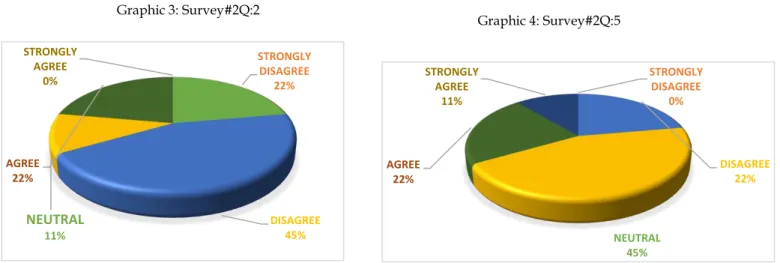
survey was conducted with the same nine EFL teachers. From here, it was corroborated the fact that teachers’ do not participate in the curriculum design as this one is assumed as the scope and
sequence provided by the textbook (as revealed in Survey#1). Thus, this might not have only
limited their practices but their professional growth in the sense that they do not have a visible
voice in terms of making decisions and designing. Graphics 3 and 4 are presented to evidence
this analysis. 0
2 4 6
EFL teachers
0 2 4 6 8 10
Textbook Material designed by you
Q2: Teachers’ experiences and practices are taken into account to develop the bilingual program or curricula
Q5: In our school, teachers examine and rethink their practice
Graphic 3: Survey#2Q:2
Graphic 4: Survey#2Q:5
At this point, it was important to consider students’ perception due to the fact that they
are integral parts of the teaching-learning process, and from them new ideas could emerge
(Barkhuizen, 2002). Hence, a third survey grounded on Graves’ (2000) ideas was conducted with
28 students from 6th grade (see annex C). Their responses reaffirmed the fact that the textbook is
mostly the material used in science or math classes and that it has a direct incidence in their
engagement with the classes, since it makes them boring.
In this sense, it seems evident the need to revise and reflect upon the bilingual practices
and conceptions carried out until this moment in terms of materials and curriculum design in order to understand them as “one relevant element within the larger concept of teachers taking
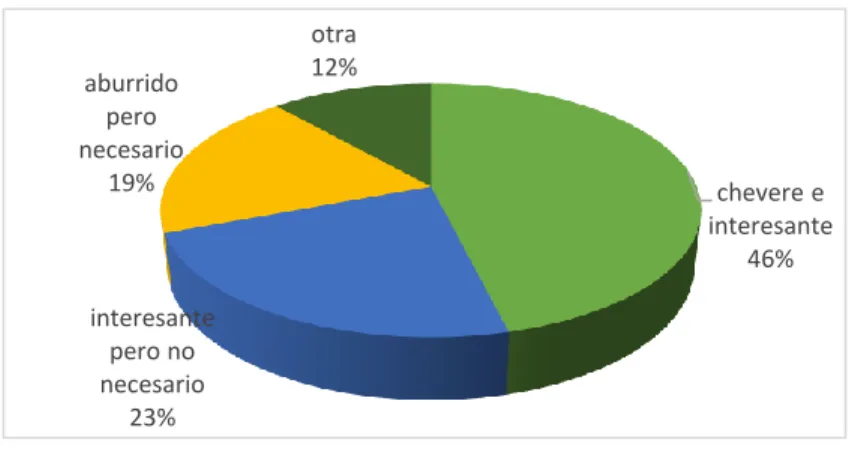
responsibility for what happens in their classes” (Block, 1991, p. 216). Graphic 5 shows sixth
Q4: Consideras que aprender inglés a través de diferentes asignaturas es:
English Equivalent:
Q4: Do you think learning English through different subjects is:
Figure 5: Survey#3Q:4
Similarly, learners’ answers suggested to inquiry about the “why”, the “how” and the
“what” they learn English, so as to recognized elements that need to be included when designing
a bilingual curriculum that addresses educational actors’ needs. Hence, a survey based on
Seedhouse’s scheme (1995) was applied not only to the same 28 learners but to 9 EFL and 5
self-contained teachers who were asked to answer, as a way to understand their personal perspective
regarding the learning process. This instrument (see annex D) was requested and submitted digitally by teachers and carried out in a printed version with the students. Seedhouse’s scheme
(1995) consisted on three items: 1). Purposes and reasons (why are you learning English?);
2).Ways of learning (how do you like to learn?); and 3). Topics and Content (what do you like to
learn through English?).
As shown in Graphic 6, the most common answers among the participants were C (so I
can travel to other countries), D (so I can speak a foreign language) and E (so I can get a better
job when I leave school), evidencing the beliefs about getting better educational and professional chevere e
interesante 46%
interesante pero no necesario
23% aburrido
pero necesario
19%
opportunities if English is spoken. What is more, answers G (because English is an important
world language) and B (so I can pass an international tests) corroborated not only that language
is seen from an instrumental perspective but also reflect ideas of exclusion, manipulation and
stratification, aiming to spread the idea of English as a neutral language while narrowing the
teaching-learning process under the Transmission model. (González, 2007; Guerrero and
Quintero, 2009; Escobar, 2013).
Graphic 6: Purposes and Reasons (Seedhouse’s scheme 1995)
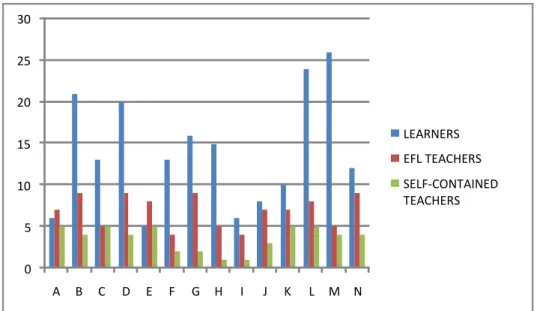
In relation to the second item, ways of learning, diverse responses arose because each
person makes use of different strategies to learn a foreign language. As expected, responses
concerning specific skills B (conversation), E (listening), F (writing), and G (reading) by being
chosen differently, evidenced participants assumptions on giving more importance to one of
them instead of understanding them as a whole. Explicit grammar activities (option A), was
selected as relevant by all self-contained teachers and half of EFL teachers but not by students,
which demonstrates an instrumental view on the teachers’ side. Another fact within this item was 0
5 10 15 20 25 30
A B C D E F G H I J K L M
LEARNERS
EFL TEACHERS
the option L (group work), selected by most of the participants as a preferred way of working
even to solve grammar-based tasks. This choice contradict the previous analysis, as it reflects
language as a social practice instead of as an isolated one. Besides, this could reveal teachers’
willingness of working together and learning from others as well as an indicator of the need of
acknowledging teachers as knowledge constructors (Cárdenas, González, & Álvarez, 2010).
Graphic 7: Ways of Learning (Seedhouse’s scheme 1995)
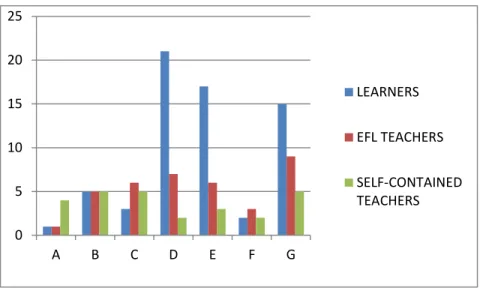
As shown below in Graphic 8 regarding the item Topics and Content, option G (real-life
related) was selected by most participants corroborating the importance of involving
contextualized and genuine aspects to the EFL teaching-learning process. Option A (the ones
proposed by the book) by having a low percentage could also be an indicator that the textbooks
used in the school present contexts and situations different from the ones lived by the
participants which make them meaningless as they do not allow participants to make connections
or reflections to sociocultural practices within their immediate context. Option D
(interdisciplinary topics) had also a significant number of responses, indicating that there is a 0
5 10 15 20 25 30
A B C D E F G H I J K L M N
need of integrating real and contextualized knowledge instead of only using the interdisciplinary
concepts provided by the books.
Graphic 8: Topics and Contents (Seedhouse’s scheme 1995)
In view of the above evidences, it could be surmise that there is a need of examining both
EFL and self-contained teachers’ discourses towards bilingual education so as to understand the
way certain ideas and notions in relation to this phenomenon have shaped or transform participants’ educational practices. Likewise, it displays teachers’ opportunity of growing
professionally by first, relying upon colleagues and secondly, by assuming an active role in terms
of curriculum design. 0 5 10 15 20 25
A B C D E F G
LEARNERS
EFL TEACHERS
Research Question
The main question that emerged considering the fact that language development is
inevitably tied to the learners, and the situations learners are involved in as pointed out by
Norton (2010), is:
What discourses do EFL and self-contained teachers draw on when envisaging a bilingual
curriculum within the context of professional development?
Research Objectives
1. To unveil EFL and self-contained teachers’ discourses on bilingualism when envisaging a
bilingual curriculum within the context of professional development
2. To describe the EFL and self-contained teachers professional development process when
Literature Review
In view of De Mejía (2004), the influence of English as a Foreign Language in
socio-economic systems has led to changes in the Colombian Educational field regarding teaching and
learning this language. These changes, introduced first in the Constitutional Reform of 1991,
have been the basis for the adoption of bilingual policies that intent to measure proficiency and
that have concentrated in the classroom (Herazo et al.; 2012). The latest effort under the name of
Programa Nacional de Bilingüismo (PNB) promotes being bilingual as means of communicating
and getting the appropriate knowledge to be more competent and competitive so as to improve
all Colombian’s citizens quality of life (Ministerio de Educación Nacional, 2006).
As a result, the EFL teaching-learning process in Colombia has been framed under
foreign standards disregarding local contexts and realities (Guerrero, 2009). Likewise, the
concept of bilingualism, as denounced by some researchers (González, 2007; Guerrero, 2008;
Sánchez and Obando 2008; Usma, 2009), has been narrowed to English-Spanish, denying and
oppressing the indigenous and Afro-American languages that there exist in Colombia. Also, EFL teachers’ role under this policy has been relegated as of trainers or/and facilitators of knowledge
as avowed by Pineda (2001). Thus, teachers’ decisions on methodology, curriculum and syllabus
design aiming to fulfill learners’ particular needs while promoting professional development
become limited.
Therefore, it is critical to take a stance on the way bilingual policies are being conceived
and implemented in our country by means of reflecting, and designing methodologies, curricula
as intended in this research. In these order of ideas, three main constructs supporting this chapter
will be approached: discourses, bilingualism, and teacher professional development.
Background to the Study
As assured by Lindblat and Popkewitz (2000, p.14) “new ways to govern education and
the modernization of the school as an institution, demand changes in curricula and new constructions of students and teachers”, meaning taking part in the design of a bilingual
curriculum must be seen as opportunity to reflect and assume a critical stance about bilingual
policies within a monolingual context, and the way these have shaped and limited not only
educational practices but educators’ professional growth.
Concerning this last item, Cárdenas, González, & Álvarez (2010) affirmed that this field
has received emergent attention by researchers in Colombia due to the bilingual program carried
out by the government in the latest decade. Nevertheless, this process has not fulfilled teachers’
needs as it has been focused on achieving proficiency and evaluating scholars under echoed
colonial and traditional discourses as showed in González’ (2007) research, such as taking
standardized tests, following a pre-established methodology, or organizing the syllabus in accordance to their book’s scope and sequence. Consequently, educational foreign models have
been adopted without considering local circumstances and contexts, making even wider the gap
between policies and practices (Ayala Zárate, & Álvarez, 2005; De Mejía, 2011).
Similarly, De Mejía (2004) stated that this division has also disregarded local research
into bilingualism and bilingual education programs, implying that teachers’ concerns and
children and adults learning the foreign language, but also the careers of English language educators in schools and universities” (Guerrero and Quintero, 2009; p. 137).
This last aspect, supports González and Sierra’s (2005) findings about the way EFL teachers’ expertise and knowledge, by being exposed to foreign models of training and
education, have been overshadowed by the common believe that native speakers are the ones
who can be tagged as the source of understanding and capability in terms of EFL educational
practices worldwide.One evidence of it, is the Immersion Classroom Program, where a foreigner
(not necessarily a native speaker of English nor a teacher); and a Colombian EFL teacher,
stimulate the development of the four skills: speaking, listening, writing and reading within a
dynamic and participatory environment (Mora, 2015). It is important to state that the colombian
teacher (tagged as supportive teacher), despite its expertise and knowledge, is in charge of
controlling the discipline and, of course, maintaining the dynamic environment, while the
foreigner, despite its non-expertise, leads the class by following the Linguaventuras curriculum
designed by the British Council.
These practices and discourses, as assured by Guerrero and Quintero (2009, p. 148), limit
the English language to “a vehicle to broaden the ideological and cultural practices of the Anglo North American countries” while voiding teachers’ role as designers, managers and evaluators of
curricula and materials that address the particularities of the learners and its contexts. Parallel
results have been found by researchers in countries with bilingual policies similar to the ones
imposed in Colombia. For example, Muthanna and Karaman (2011) investigation of prospective teachers’ beliefs concerning EFL Education stated the lack of clear standards and philosophy
What is more, it was reported that education policy-makers paid little attention to teachers’ ideas and strategies for improving the EFL program in Yemen. In the same line of
though, Jóhanneson et. al (2000) affirmed in their report entitled Curriculum, management, and
self-evaluation in Icelandic primary and secondary schools that, when teachers teach towards the
goals and objectives that have already been defined, the notion of expertise gets narrowed as “teachers themselves are not the chief players in the self-evaluation process, rather the principal
and external evaluators are to inspect the model” (p.103).
Alike, Barkhuizen’s (2002) study about the Language Education Policy in Africa and the
way students perceive Xhosa (one of their native languages) and English, revealed that not only teachers but students’ voices are “often ignored in decision-making about educational matters”
(p. 511). What is more, students in this study indicated that they have a preference for studying
English over the native language since it has been said, would give them better life opportunities.
This last aspect I think, must lead scholars to wonder about the status and the importance given
to the mother tongue in places where foreign language policies are adopted without considering
the incidences in the community.
In view of the above, the professional development required in Colombia regarding
bilingual practices and guidelines must not be focused only on methodology and curricula design
aiming language proficiency, but on awareness in the way the educational field is molded and
permeable by economic factors (González and Sierra, 2005). Likewise, by raising attentiveness
about the way the EFL education is conceived under a context of knowledge economy as pointed
out by Usma (2009; p. 137), it is hope changes can be generated by the way external discourses
and realities are adopted and carried out, as well as local teacher-researchers’ voices are to be
Another important aspect to look at-which constitutes the novelty of this study - is that
self-contained teachers are invited to be part and take a stance on bilingual policies as they are
required by some institutions, to teach specific concepts in the foreign language and to take up
proficiency tests in order to give continuity to their jobs otherwise,they are being relegated by
EFL teachers, who do not have the necessary expertise to do so as would be referenced in this
study.As revised, self-contained teachers’ role and perspectives regarding bilingual policies in
Colombia have not been widely explored. Research related to different knowledge areas has been
mainly instrumental since their focus is on the way specific concepts are used as mediators to
present the foreign language. These methodologies, known as Content Based Approach (CBI)
and Content and Language Integrated Learning (CLIL), have been advocated as an initiative for
developing bilingual programs.
Referring to CBI, Leung (2005, p.248) has said that this methodology “relates the general
idea of language learning to more specific demands and opportunities”. Likewise, Corrales and
Maloof (2011) concluded from their research with Colombian university students that the CBI
increases motivation since the topics, materials, and activities are relevant, meaningful, interesting, and useful to them, as the content information serves to activate students’ prior
knowledge. In reference to CLIL, Arnó-Macià and Mancho-Barés’ (2015) study showed that participants perceived this methodology as “a real communicative context for discipline-oriented
language use” (p.72). Equally, McDougald (2009) claims that by teaching content in English,
input in the foreign language becomes more comprehensible at the time of being an approach that “can be easily adapted to current educational and bilingual programs in Colombia” (p.47).
Opposite of this, self-contained teachers more than the contents per se, are essential in the
reflecting, dialoguing, and sharing practices and experiences, teachers conceive language of as a
whole and comprehend the way learners establish truly interdisciplinary relationships (Ordoñez,
2011). In this sense, it could be affirmed bilingual education must not only intent to reach L2
proficiency or to fulfill government’s guidelines, but to raise awareness in both teachers and
learners in relation to their personal and educational growth .
With this in mind, research in Colombia regarding professional development and
bilingual policies needs to be conducted bearing in mind: a). stances on the implementation of
bilingual policies; b). development of curricula and educational programs sensitive to the contexts and the educational actors’ needs; and c). relying upon self-contained teachers’
knowledge and expertise.One reviewed attempt concerning this idea is Ordoñez’ (2011) work
which focused on Spanish-English teachers’ collaboration on bilingual curricula design. The
author concluded that by working together, teachers helped students to see and use the
similarities and differences between the two languages in order to learn them both.
What is more, teachers’ professional development in terms of curriculum and practice
changes were possible by relying on their colleagues, a beneficial fact that encourages reflective
dialogue, the de-privatization of practice, and the collective focus on student learning(Meyer,
2002; p.39).Nevertheless, little research about bilingualism in regards of foreignlanguage and
self-contained teachers’ views has been conducted. This study presumes to be an opportunity for
endorsing professional development by means of envisaging a curriculum design at the time of creating an environment for participants’ voices to be heard in relation to bilingual policies and
practices. Similarly, it aims at unveiling teachers’ discourses so as to understand the way this
Theoretical Framework
As previously explained, the theories behind teachers’ discourses; bilingualism/bilingual
education and professional development were the pillars sustaining this study. Each one of them
will be addressed with the intention of providing the necessary support to frame the study within
a critical view.
Teachers’ Discourses
Understanding the world and the relationships given on it, implies understanding
language per se. As assumed by Fairclough (2003, p. 2), “language is an irreducible part of
social life, dialectically interconnected with other elements from that social life”. In that sense,
language seems to be corroborated as a social practice where discourses, both written and oral,
are created, understood, shaped, and validated within a community in a specific context by
means of interaction. This statement is supported by Gee (1999), who defines them as:
“different ways in which we humans integrate language with non-language “stuff” such as different ways of thinking, acting, interacting, valuing, feeling, believing and using symbols, tools, and objects in the right places and at the right times so as to enact and recognize different identities and activities, give the material world certain meanings, distribute social goods in a certain way, make certain sorts of meaningful connections in our experience and privilege certain symbol systems and ways of knowing over others” (p.13).
In this sense, discourses are not static, rather they are always transformed by people
through the use of language that is simultaneously generated by contexts and are those contexts
the ones that validated discourses. Thus, discourses can be defined as doing, reflecting, and
interacting not only with the others, but also with ourselves and the world to enact change. In the
knowledge is produced and reproduced-that is- they reflect a fragment of the world that is only
understood by addressing the context where it is producedin relation to the participants and their
intentions.
Considering the context this study took place, it seemed urgent to unveil EFL and self-contained teachers’ discourses so as to first, research on how the meaning-making of texts
regarding bilingualism was given and the way these have shaped and limited pedagogical
practices and professional growth, and secondly, to make visible their voices in terms of
making decisions about bilingual education processes in Colombia since from a social
perspective, teachers not only possess knowledge but are creators of it (Jhonson & Golombek,
2002).
In keeping with this idea, it is relevant to state that the bilingualism discourse as stated
by different authors (Fairclough, 2003; Guerrero, 2008; Usma, 2009) draws upon the new
capitalism notion, an economic system based on the production of goods and services
characterized by competition and unlimited consumerism. As a result, environmental, political,
labor, medical and social transformations (for naming a few) have arisen. In the word of
Fairclough (2003), these systems of knowledge [discourses] exercise social control, therefore, it
is impossible to ignore the changes this socio-economic model has produced in the education
field and the pervasive effect on our lives as the emphasis has been framed on the global
economy expansion (Humes, 2000).
Consequently, the EFL teaching and learning process has been portrayed worldwide as an
instrumental one, as the only solution through which citizens can access to a “qualified”
life. Despite this marvelous description, inequality, as denounced in Guerrero’s (2010) article,
has gotten deeper since the division between poor and rich, power and powerless, native and
non-native, is getting broader as foreigner practices are receiving more attention than the local
ones.
In this manner, education by being controlled and limited, becomes into the main tool to
practice power, which is exercised less through brute force and more through the systems of
knowledge described by Foucault (2005). Hence, the principles of what should be known
(didactics and learning theories) and the way it should be learned (curriculum) are consequences
of power that enclose not only the possibilities of the present as stated by Popkewitz (2000) but of the future, as they serve as foundations for shaping teachers and learners’ view of the world.
In view of the above, I consider relevant to bring about González (2007); Guerrero and Quintero (2009); and Escobar’s (2013) work in terms of participants and intentions behind
bilingual discourses in Colombia in order to provide enough information to an accurate
interpretation. Referring to these elements, researchers agreed on the fact that the MEN (Ministry
of Education) have enforced discourses of exclusion, manipulation and stratification through the
adoption of bilingual policies and models, as socio-cultural considerations have been
disregarded, colonial ideas privileged, and particular interests protected.
What is more, society has been trained to assume those standards as the ruling factor that
defines EFL education reproducing de idea of language as a linguistic system of signs and
symbols, which establishes a barrier between language and learners. These discourses in view of
Foucault (2005), circle under pre-stablished circumstances and are camouflaged under varied
Discourses concerning bilingualism in Colombia indeed, have been reconstructed and
deconstructed along the years. Nevertheless, Colombian teachers have always been blamed,
questioned, and even replaced (Adriana González, personal communication, June 6, 2015).
Sánchez and Obando (2008) reported two main beliefs around these discourses: a) local
educators are not well prepared to teach a foreign language thus, it is not necessary to invest in
them but to replace them; b) English native speakers [regardless of their professional
background] will ensure the learning process, as the native accent is a determinant factor to learn
the language.
In this sense, the government is privileging foreign entities over local practices and
research as the only materials and tests used and approved to certify the foreign language
proficiency, are the ones designed and sold by these entities. Similarly, the idea of English as a
neutral language is perpetuated under the transmission model, where teachers adopt and follow
models and approaches and learners are forced to memorize and reproduce someone else’s
knowledge in order to fit into the system and be able to get a better job.
Opposite to this, it is my intention to fight against naturalized discourses (Fairclough,
2003) since as discussed along this research study, we learn through language instead of learning
a language. What is more, it is important to make people aware of the discourses given in terms
of education and construction of society so as not to perpetuate unequal ideas. Therefore, it is
important to spread the word and redefine understandings related to bilingualism so as to value
the teaching profession.
In addition, it is essential to involve all teachers notwithstanding of the knowledge they
creation of a more tolerant society instead of providing an ideal way to obtain better jobs, as
everything related to community in terms of language aims at understanding and transforming
hierarchy, power and social injustice (Gee, 1999). In that sense, teachers’ discourses need to be focused on “why” questions instead of “how” ones, as our job goes beyond operational matters
within a pre-established curriculum.
To sum up, by having clarified the concept of discourses in terms of development and
intentions, it was evident the implications within the educational field, and that the discourses in
terms of bilingualism expressed by the government, companies, textbooks, school boards, and so
on, have not only affected Colombian teachers’ professional growth, but their identities and
subjectivities. Subsequently, the understandings of bilingualism and bilingual education within
monolingual contexts will be addressed with the intention of backing up this last statement.
Bilingualism and Bilingual Education
In the word of Guerrero (2010), the field of Bilingualism is a very complex practice
because it is related to language, which constitutes a wide range of points of view from where it
can be perceived and analyzed. Hence, its definition is allied to the emphasis placed by
disciplines such as Sociolinguistics (bilingualism concept regarding contexts); Psycholinguistics
(how languages are learned); Education (how languages are learnedregarding educational
settings), among others.
In order to broaden the scope of bilingualism, it is essential first, to understand some
factors that have contributed towards a bilingual\multilingual society. As reported by Hoffman
(1991), some of those include military conquests, political marriages, succession arrangements,
grounded on societal changes. Nevertheless, research in bilingualism as supported by Baker
(2001) has been mainly focused on determining parameters and establishing tests to measure
language proficiency.
In this sense, the study and importance given to the understanding and conceptualization
of this phenomenon have resulted in multiple categorizations based on different factors. As
reported by Butler and Hakuta (2004), individuals can be classified as bilinguals based on the
proficiency in L1 and L2 (balanced or dominant); the mental process of organizing linguistic
codes (compound, coordinate or subordinated); age (early [simultaneous or sequential] or late
[incipient, receptive or productive]); the effect of L2 in L1 (additive or subtractive); the language
status(elite or folk); context conditions (circumstantial or elective);and cultural identity
(bicultural, monocultural or accultural).
These distinctions as affirmed by these authors, do not constitute definite premises but a
continuous and interrelated hypothesis which not only corroborate bilingualism as a multifaceted
phenomenon, but as a “socio-cultural behavior that has multi-dimensional aspects” (Butler and
Hakuta, 2004, p. 114). Still, conceiving bilingualism as an interdisciplinary field implies
deliberating about how well languages need to be mastered in order tobe considered as bilingual.
Considering the above, the conception of language this proposal dealt with, lays upon the
Constructivist Theory. For this reason, language is understood as a social practice given in terms
of interaction among individuals, contexts and experiences. Consequently, the purposes for
learning a foreign language should go beyond academic and linguistic reasons, and closely tied to the learner’s desire of learning through meaningful and “communicative objectives and
In this sense, bilingualism should be understood as using more than one language for
communicating and interacting with others. This definition implies indeed, that cannot be
measured given that depends on social conditions, and simple categorization is subjective
(Baker, 2001). Nevertheless, and pertaining to the criteria selected to classify bilinguals along
time, it can be inferred that language has been conceived merely as a linguistic system composed
of receptive (listening and reading); and productive (speaking and writing) skills (Baker, Ibid; p.
4). Based on this distinction, bilingual individuals have been measured regardless of factors such
as settings, L2 exposition, and background to name a few.
This fractional view, as affirmed by Grosjean (1984), aims to compare bilingual with
monolingual individuals, seeking to describe the acquired level of linguistic systems, taking for
granted that foreign languages are learned in isolation. In relation to this, Hoffman (1991, in
Baker, 2001; p. 22) affirmed that “if we accept that there are degrees of bilingual competence, this implies that bilingualism is measurable”; meaning language is not developed by means of
interaction but by means of following grammar rules, and that there is any connection between
the mother tongue and the foreign language. Drawing from the concepts presented, I will limit
this discussion to the Educational view so as to understand the way bilingualism is assumed in
Colombia and how bilingual programs arose.
Bilingualism and Bilingual Education in Colombia
To be bilingual in Colombia, as in many other countries, has been understood as to the
fact of speaking English (Guerrero, 2008, 2009; Usma, 2009; De Mejía, 2011; Ordoñez, 2011;
Escobar, 2013). Consequently, the language policies adopted by the government meant to spread
advantages (Ayala Zárate & Álvarez, 2005). In relation to this, De Mejía (2011) affirmed that the
adoption of the Common European Framework for References (CEFR) as a guiding model has
generated criticisms from some Colombian scholars. I consider relevant to point out some of
them so as to frame the bilingual practices in the educational settings and the effects of it within
society.
The first constrain refers to the fact that this foreign model has been perceived as an
imposition rather than as an adoption. Guerrero (2008, 2009) and Guerrero and Quintero’s
(2009) work, has revealed that the documents supporting the bilingual policies carried out by the
government, favored and recognized English as the language of modernization and progress, taking no notice of Colombia’s diversity in terms of languages (e.g. Creole and Indigenous).
Indeed, a similar situation is being evidenced with Spanish, which as claimed by De Mejía and Fonseca (2008), and Ordoñez’ (2011), has been relegated by educational institutions as the focus
of bilingualism is on achieving a high level of proficiency in English.
The second one- refers to the implementation of foreign models unrelated to Colombia’s geographical conditions, learners’ characteristics, and the particularities of the educational
system. As reported by Ayala Zárate & Álvarez (2005), this has led to negative implications for
the EFL teaching and learning processes since the foreign language is conceived as a
standardized linguistic system, reinforcing the idea that bilingualism can be measured and
validated through rubrics.
In keeping with this idea, Romaine (1989, p. 18) declared, “tests which rely heavily on
performance measures, where limitations of memory and time can affect the results should not
updated as educational programs and work settings rely upon these examinations regardless of people’s study choices or job positions. Subsequently, materials as training textbooks, CDs,
DVDs, virtual platforms, etc., are being developed at great speed to fulfill users’ need to be
recognized as bilingual so they can access to high quality education and better life style as
promoted by governments (Ryan, 2010).
I consider relevant then, to draw attention to the fact that by selling the language learning
process as a set of recipes to be followed; creativity, previous knowledge and experiences are not
only rejected, but language learning goals have been limited to scoring tests as reported by De
Mejía and Fonseca (2008); where the main aim is to get a job and continue with the capitalist
discourses, instead of assuming a critical stance towards social-related issues.
Thirdly, the EFL teaching process, as denounced by Escobar (2013); has been outshone
given that teachers were not part of the making-decision process or the design of language
policies, and that the foreign entities in which the government trusts, bring under control the professional growth as they determine “who is competent to teach the language and how these
individuals should teach” (Escobar, 2013; p. 47). In this sense, EFL teachers are also obliged to
certify their language knowledge.
Alike, González (2009) criticizes the fact that even though EFL professional growth has
been limited to high cost programs (e.g. Master programs, Ph.D. programs, etc.); local practices
and research carried out by these professionals have been relegated widening the gap between
pronunciation is what will guarantee the foreign language learning, perpetuating the idea of
English as a neutral language (Guerrero and Quintero, 2009).
The fourth concern deals with the breach bilingual policies broaden between private and
public education. In view of De Mejía (2002, p. 37), “education has been seen as a powerful
means of providing access to valued symbolic resources, such as bilingualism or multilingualism in prestigious world languages”. Public education is left behind as the infrastructure, materials,
and L2 exposure demanded in order to reach bilingual standards is not provided by the
government, and the economic resources of these students are not enough to access to them
(Miranda and Echeverry, 2010). Hence, it can be affirmed that the adoption of bilingual policies
in Colombia does not just make the gap wider in terms of education, but regarding social strata
and economical conditions; where less favored students will continue having restrictions and
fewer opportunities to access to quality education programs.
Hitherto, by having discussed the conceptualization of the term Bilingualism and backing up Colombian researchers’ concerns about the adoption of foreign bilingual policies, it was
demonstrated that professional growth got affected and limited, and that there is an urgent need
to take a critical stance concerning bilingualism so as to co-construct bilingual curricula that met
students, EFL and self-contained teachers’ realities. Subsequently, theories regarding
professional growth will be discussed.
Teachers’ Professional Development
To have a clear conception of what the term Professional Development within the
Educational field entails, I consider relevant initially, to attempt to define it. As studied by
with the conceptions of teacher-training programs aiming to increase teachers’ proficiency in the
foreign language. This understanding, grounded in the Transmission Model, implied that the
knowledge an educator had regarding the teaching of a foreign language, was passed or delivered
to someone wanting to teach, following naturally, a pre-established structure. Henceforth, this
idea was reinforced in the classroom where the “updated knowledge” was transmitted to the
learners.
Similarly, Gabillon (2012) reviewed that this term was associated with programs aiming
grammar teaching and literacy instruction since both skills have been awarded some attention.
According to Díaz-Maggioli (2012), these perspectives correspond to the look-and-learn and
read-and-learn traditions in teacher education, in which the emphasis was on reviewing and
memorizing approaches, methodologies or theories that others had developed. In doing so, educators’ understanding of the teaching process per se was limited at the time of restraining
their professional growth as this validates the idea that there is one way of teaching
notwithstanding of contexts, realities and learners.
However, as time went by, other views regarding Teachers’ Development Processes
arose. On the word of Murray (2010, p. 10) for example, is meant to be an ongoing process of
assessing and reexamining beliefs and practices, which denotes self-reflection on educational
theories and perspectives and the way these are carried out. Besides, it comprises an invitation
for not taking for granted what has been defined as the teaching-learning process regardless of
time and society evolution.
Alternatively, Díaz Maggioli (2004, p. 5) understands it as a “job-embedded
addressing their own particular needs”; meaning this is not only implemented for professional
but personal reasons, and that even though this is decided and carried out by the teacher itself, it
has incidence in the students and the community, since educators reflect on the effects that
teaching has on learning by rethinking their practices so as to introduce changes.
This tradition, think-and-learn (as referenced by Díaz-Maggioli, 2012), balances the
theory-practice dichotomy and encourages educators to continue growing professional and
individually. Nonetheless, teachers were not able to provide or receive critiques and support
from others as being limited to individual growth, missing venues for Professional Development.
Thus, sharing and relying on colleagues became essential. As understood by Johnson &
Golombek (2002), making teachers’ ways of knowing public and able to be reviewed by others is
essential-, since not being able to write, show and share with others what has been reflected and
transformed inside-and-outside the classroom, has denied teachers’ role as theorizers.
Moreover, by sharing experiences, teachers become active participants in the
teaching-learning process, exploring and teaching-learning new ideas and concepts, and making decisions based on their own and others’ experiences and understandings as demonstrated in Ordoñez (2011) and
González’ (2007) studies with Colombian teachers. Considering Wheatley’s (2002) work about
teachers’ efficacy doubts- a term that fosters teacher learning by reflecting and promoting
collaboration- exchanging ideas with colleagues also help teachers to confirm, reject or suspend
judgments of new interpretations and encourages teachers to become aware not only of their
practices but of the effect of those. Therefore, teaching is not just a practice developed within a
In keeping with this idea, Wenger (1999; p. 4) declares that learning by means of sharing and participating with others, “shapes not only what we do, but also who we are and how we
interpret what we do”; implying that both learning and teaching are social practices embedded
and developed within a group. From a constructivist perspective, the construction of meaning is
the process of either relating new and old information when exchanging ideas orally or written
(Goodman, 1998). In this sense, knowledge emerged, is built and co-constructed within a
community. Thus, both teachers and learners’ outcomes of this process may take a variety of
forms, ranging from new semantic or lexical knowledge of the L2, to changes in attitudes, values and beliefs, as supported by Wenger (1999; p. 53) who claims that “the negotiation of meaning
may involve language, but it is not limited to it”.
When talking about Communities of Practice, Wenger (Ibid; p.48) defined them as “the
places where we develop, negotiate and share ideas”, and assured they are an essential part of our
lives as we are social by nature. Certainly, personal and professional commitment is required as
thinking, shaping, and acting as regards of participants’ experiences is embraced. In this sense,
belonging to a community of practice does not entitle the merely fact of “doing”, but the process
of understanding the purpose and the importance of getting involved within it.
Based on this distinction, the EFL Professional Development process should not be
understood only as to formal education programs but as an opportunity of getting involved in
new networks of professional growth, where initiatives concerning bilingual policies, standards,
curricula and materials, are developed to promote not only meaningful and contextualized L2
learning but a space for both EFL and self-contained teachers to “appreciate the diversity and
So far, it has been highlighted the importance of going beyond the idea of conceiving
EFL teaching-and-learning as a transmission process but as a continuous one, where contexts and
experiences are considered, and teachers are actively involved in it .As well, reasoning upon the
way this process is carried out, the purpose of it, and the relevance of sharing with others and
creating communities of practices, allows teachers to redefine their practices, to get engage in the
construction of knowledge and to improve their and their learners realities at the time of
endorsing Professional Development .
In summary, I have discussed the importance of conceiving language as a social practice
by announcing how knowledge is given by means of interaction. Indeed, the examination of
diverse definitions and theories about bilingualism and bilingual education led me conclude that
both EFL and self-contained teachers must be involved in the development of curricula and
making-decision process in order to help learners to construct meaningful knowledge by relying
upon their experiences. What is more, by sharing knowledge and practices, teachers also
self-empower to grow both personal and professionally. Finally, it was demonstrated the need of making teachers’ voices visible about bilingual policies and practices as well as the importance
Instructional Design
As previously discussed, there is a need of relying upon teachers’ experiences and
knowledge as to develop curricula and programs that are “sensitive to the context and
constructed collaboratively” (González, 2007, p. 315). Therefore, it seems relevant for the EFL
community to reflect and assume a critical perspective about the adoption of policies and foreign
models as well as the way they are reflected within the teaching-learning process. The
curriculum, understood as a means to organize experiences and educational practices that take place in a specific context, “entails the process of making programmatic decisions and revising
the results of such decisions” (Pineda, 2001, p. 7), which entails an opportunity to endorse teachers’ professional growth.
Subsequently, both educators and learners’ principles, views and experiences, have to be
taken into consideration and adjusted to the setting in which the foreign language takes place. In
this sense, the pedagogical intervention proposed for this study and carried out with both EFL
and Self-Contained teachers aiming to stimulate professional development while envisaging a
bilingual curriculum is described in detail.
Visions of Language and the Educational Process
When talking about teaching and learning it is commonly defined as individual processes
with active and passive participants: teachers, the active ones, as they possess knowledge from a
specific subject or domain, and learners, the ones who receive it. It also comprises the fact that
the knowledge decided to be worthwhile of being taught (neither by teachers nor learners) is