
Video games as complementary tools for english learners’ motivation, engagement and reinforcement
57
0
0
Texto completo
(2) VIDEO GAMES AS COMPLEMENTARY TOOLS FOR ENGLISH LEARNERS. 2. Table of Content 1. Executive Summary. 5. 5. Theoretical Framework. 9. 5.1 Motivation. 14. 5.2 Common European Framework. 16. 6. Working plan. 20. 6.3 Students’ and Teacher’s roles. 20. 6.4 Chronogram. 24. 7. Data Analysis. 34. 6.2 Data Collection Instruments. 20. 7.1 Categorization of information.. 34. 7.1.1 Categorization of surveys.. 34. 7.1.2 Categorization of the journals. 36. 7.1.3 Categorization of the interviews.. 37. 7.2 Interpretation.. 37. 7.2.1 Interpretation of the survey.. 38. 7.2.2 Interpretation of the journals.. 46. 7.2.3 Interpretation of interviews.. 50. 8. Conclusions. 52. References. 54.
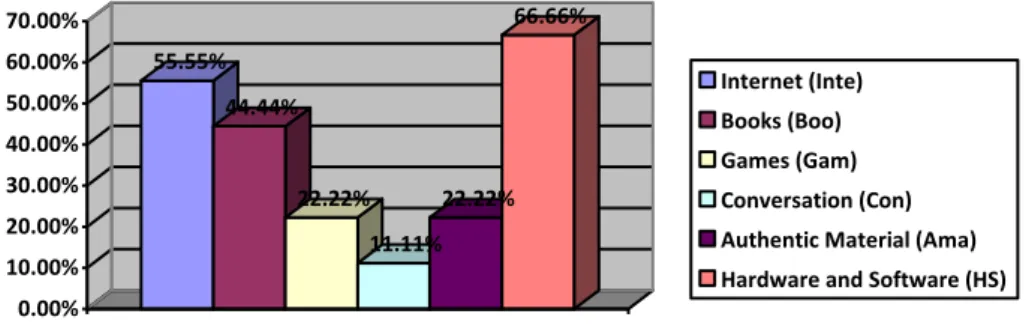
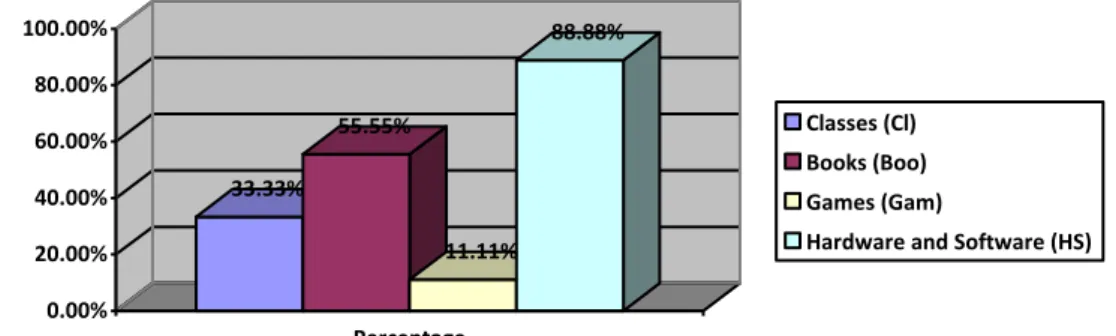
(3) VIDEO GAMES AS COMPLEMENTARY TOOLS FOR ENGLISH LEARNERS. 3. List of Tables and Figures Tables Table 1. Households with a computer, Households with Internet access at home, Individuals using the Internet in the Americas. .............................................................................. 11 Table 2. Common Reference Levels. ........................................................................................ 17 Table 3. Chronogram used in the internship describing the teacher role with the hours’ range ...................................................................................................................................... 25 Table 4. Institutional Syllabus. .................................................................................................. 26 Table 5. Chronogram used in the internship describing the video games. ................................ 30 Table 6. Classification of the video games according to the control and the development. ..... 33 Table 7. Data collection instruments used in the internship...................................................... 21 Table 8. Survey’s Questions two to six and their correspondent categories. ............................ 35 Table 9. Journals from one to four and their correspondent categories. ................................... 36 Table 10. Interview categories. ................................................................................................. 37 Table 11. From 1 to 5 how much do you like English? (Being 1 not much and 5 a lot) .......... 38 Table 12. Why do you think is important to learn English? ...................................................... 39 Table 13. What kind of tools for studying English do you have in your house? ...................... 40 Table 14. What kind of tools for studying English do you have at Smart institution? ............. 42 Table 15. What tools do you prefer to learn English? ............................................................... 43 Table 16. What tools do you use for learning English outside the classroom? ......................... 44 Table 17. ¿From 1 to 5 how motivated do you feel to learn English? (Being 1 Not much and 5 a lot). ............................................................................................................................ 45 Figures Figure 1. Percentage of 15 years students that use the computers almost every day according to its use. ...................................................................................................................... 12 Figure 2. From 1 to 5 how much do you like English? (Being 1 not much and 5 a lot) ........... 38 Figure 3. Why do you think is important to learn English? ...................................................... 40 Figure 4. What kind of tools for studying English do you have in your house? ....................... 41.
(4) VIDEO GAMES AS COMPLEMENTARY TOOLS FOR ENGLISH LEARNERS. 4. Figure 5. What kind of tools for studying English do you have at Smart institution? .............. 42 Figure 6. What tools do you prefer to learn English?................................................................ 43 Figure 7. What tools do you use for learning English outside the classroom? ........................ 44 Figure 8. ¿From 1 to 5 how motivated do you feel to learn English? (Being 1 Not much and 5 a lot). ............................................................................................................................ 45.
(5) VIDEO GAMES AS COMPLEMENTARY TOOLS FOR ENGLISH LEARNERS. 5. 1. Executive Summary This document of the theoretical background of an internship intended to describe the usage of video games as well as their effects in the students' motivation and engagement and how these video games can be used as extra technological tools in an informal educative scenario. It is well known that nowadays we are facing with a new population who has been involved in the new technology since they were born, and some other people aware about this new technology. When they were born the technology was not as complicated as now, they have to use it in their real lives, though. These people are Digital Natives and Digital Immigrants (Prensky, 2001). The institution where I developed the internship seems to be aware of this situation, therefore there are technological resources in order to engage their students according to the “Proyecto educativo institucional” Academia de Idiomas Smart (SMART, 2016). This internship was also planned to describe the video games as technological didactic tools in relation to their effects on the recycling practice of the topics. The idea of this internship was not to separate the institutional method (P.P.P) Presentation Practice and Production; on the contrary, the aim was to show its relation in a blended learning methodology. The blended methodology is intended to combine e-learning with a method in this case (P.P.P), in order to take advantage of both (Friesen, 2012). For the development of this internship the research methodology was a qualitative action research, which is described as a way of improving our teaching skills, and experience meanwhile we are collecting data of our class (Alison & Gass, 2015). According to the data collection techniques, I worked with surveys, journals and interviews, in order to reinforce my teacher’s labor (Mills, 2017)..
(6) VIDEO GAMES AS COMPLEMENTARY TOOLS FOR ENGLISH LEARNERS. 6. 2. Research Questions How do video games as didactic tools influence EFL learners’ engagement in an informal educational setting? 3. Objectives The principal objective of this study is to describe the effects of video games as didactic tools on EFL students’ motivation and engagement in an informal educational setting. To recycle the topics in an informal class with video game-based structured activities. To describe the use of video games as technological tools in the classroom. 4. Justification In this internship developed through an action-research study. I described the effects of applying video games; to reinforce topics studied in class for the adult professional and business people, at a private institution of education for working and human development in Bogotá. The students are A1 level according to the Common European Frame Work of reference (Cambridge ESOL, 2011). At this stage in the research, video games are known as a suitable tool for working with the students that foster the motivation (Prensky, 2002). The other purpose of this research is to describe the use of the blended learning in the classroom. In this way, I did not contrast the institutional class method used in classes, instead, video games and the presentation, practice and production method were used as complementary tools; along these lines, the students would take advantage of both worlds (Freitas, 2007)..
(7) VIDEO GAMES AS COMPLEMENTARY TOOLS FOR ENGLISH LEARNERS. 7. According to the institutional PEI (Proyecto Educativo Institucional) of the institute, I worked. I was required to use technology and the available resources in the classroom (television, tablet and computer) in order to make the classes more didactic. To sum up, the institution fostered the teacher to use technology aids for the development of the class and recycling the topics seen in class. I found that there is not a specific multimedia resource that must be treated in the class, so I wanted to use the video games in order to stimulate the motivation in class (Prensky, 2002) as well as reinforce the topics (Freitas, 2006). The main institutional method of teaching, required by the institution is the (P.P.P) (presentation, practice and production). In this method for the presentation, the teacher contextualizes the language with situations. For the practice stage, the teacher shows the situation and use reproduction techniques like choral repetition, individual repetition or cueresponse drills. In the production stage, the teacher fosters the students to use the input that they receive in order to create something like a writing exercise or a speech using the grammar taught (Harmer, 2015). In the multiple faces of the (P.P.P) method, there is one related to the engagement. It is called the ESA, where E is related to engagement and it suggests that if a student is not engaged, the learning will be less effective. Moreover, the S is related to study; in this step of the process the students will review and advance in the grammar structures of the topic like intonation, use of language, collocation of words and the construction of paragraphs. Finally, the step A is related to activate, this is the trail the students interact with the others using the language in order to activate that knowledge (Harmer, 2015). The video games used as tools for supporting learning are useful for the students, they find them fun and favorable, and also the teachers find the teaching and learning more fun and enjoyable, it also helps the students with different learning styles, especially visual.
(8) VIDEO GAMES AS COMPLEMENTARY TOOLS FOR ENGLISH LEARNERS. 8. learners. Nevertheless, there are students who do not learn visually; hence the instructional, cognitive and situated learning must not be taken away from the students’ process (Freitas, 2006). Related to the motivation Prensky (2002) suggests: “People play games because the process of game playing is engaging” (p.2). It seems that fun improves learners’ motivation and relaxation, so on the relaxation helps students to take the topics more easily and the motivation fosters the work without resentment. Consequently, when the students finish their learning it is important to complement it with other activities, so that is why I want to use video games in order to engage the students learning also I want to describe its effects on the motivation towards the learning. Another key point of the use of video games for teaching English is mainly: the video games are part of the current real world the students are facing, consequently, when students learn through video games their learning occurs in meaningful and relevant contexts, that means the students learn in relation to their environment this is called a situated cognition and develops a meaningful learning from real inputs (Van Eck, 2006). According to Vam Eck (2006): “Interacting with requires a constant cycle of hypothesis formulation, testing and revision.” (p.5). Therefore, students are reconstructing the knowledge that they receive from outside and then they develop a learning process in which they check options and find an answer..
(9) VIDEO GAMES AS COMPLEMENTARY TOOLS FOR ENGLISH LEARNERS. 9. 5. Theoretical Framework The information and communication technologies seem to generate in the learner of English as a second language, motivation and engagement towards learning. I have noticed these in relation to my own experience in the classroom, the description of a new kind of students by Jones (Jones, 2010) and the ideas of Prensky (Prensky, 2002) about motivation, engagement and video games. According to my own experience in the classroom there are multiple technological aids that can be used in the class in order to reinforce the topics seen in the class, but sometimes these media resources are a little bit distant from the students, mainly because they do not interact with the audio, or they do not have a real relationship with the video that is shown in the classroom, Since I realized this I have started using video games in the classroom. The first game I used in the classroom was a phonics game, in order to teach the difference between the sound /ch/ and the sound /sh/, the students participated and they were interested and engaged playing the game. Therefore, I realized that video games could be a suitable technology tool that I can use in my job in order to increase students’ engagement and take the opportunity to use the resources available in the institution. The institution had a computer with internet and a television per classroom and the institution fostered the use of the technology in the classes in order to get better classes for the students and offer more variety to the class. In the case of the population they also seem aware about the use of the technology. There is a new group of people interested in the usage of media and technology, these people are interested in using the technological tools for improving their English skills (Jones, 2010). I found out, meanwhile, I talked to my students, the population was aware of the use of the technology and they had the ability to work with it, using dictionaries in their.
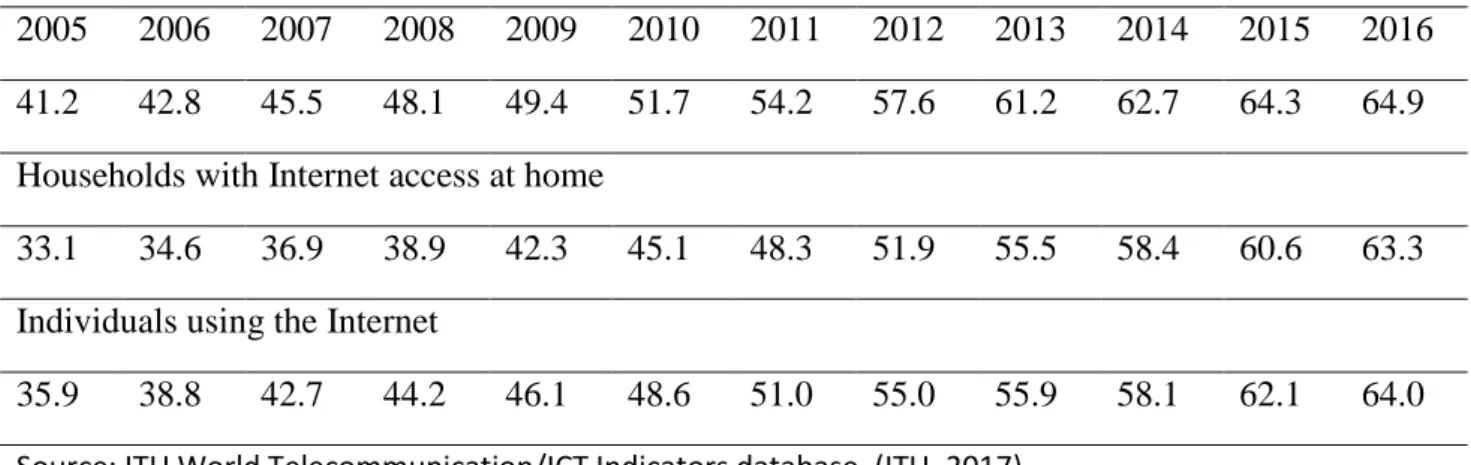
(10) VIDEO GAMES AS COMPLEMENTARY TOOLS FOR ENGLISH LEARNERS. 10. mobiles, downloading apps to learn phrasal verbs and watching videos on YouTube. Jones (2010) described the digital natives: These young people have grown up with the internet and web, in an environment that is infused with digital technologies. The claim is made that this material context has led to young people developing a natural aptitude and high skill levels in relation to the new technologies. (p.365). In the classroom it is possible to see the students using their mobile phones all the time, even for activities which are not related to the education. The students sometimes do not take notes of the written things on the board because they can take pictures of them on their phones. In the normal conversations, they speak about online services to watch videos or even ask for good websites to learn a specific topic of the class. Consequently, in Colombia the population it is aware of the use of the technology in their daily life. Therefore, the population is also using this technology to learn English. There is a raise while the last decades about the internet, and web-based services, there is also a growth of mobile technologies and portable internet. It is possible to see that there is a population immersed in the world in which the technology, the facilities to connect with the internet and the easy access to the information, the games, the videos and the music. (Castells et al. 2007). In Table 1 shows information the Americas about the increase of the households with a computer from a 41% of the households to a 65%. There is also shown the rise of households with internet access at home from 33% to 65%. Finally, there is possible to see the growth of individuals using the internet from 35% to 65%..
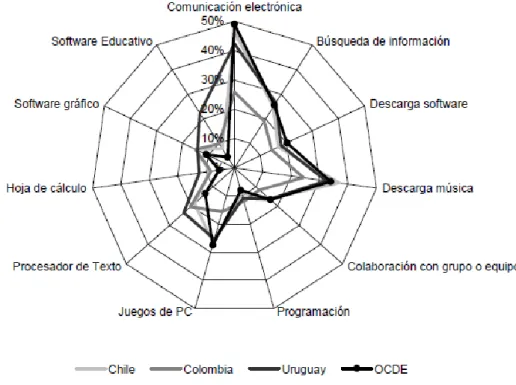
(11) VIDEO GAMES AS COMPLEMENTARY TOOLS FOR ENGLISH LEARNERS. 11. Table 1. Households with a computer, Households with Internet access at home, Individuals using the Internet in the Americas. Percentage Households with a computer 2005. 2006. 2007. 2008. 2009. 2010. 2011. 2012. 2013. 2014. 2015. 2016. 41.2. 42.8. 45.5. 48.1. 49.4. 51.7. 54.2. 57.6. 61.2. 62.7. 64.3. 64.9. 42.3. 45.1. 48.3. 51.9. 55.5. 58.4. 60.6. 63.3. 46.1. 48.6. 51.0. 55.0. 55.9. 58.1. 62.1. 64.0. Households with Internet access at home 33.1. 34.6. 36.9. 38.9. Individuals using the Internet 35.9. 38.8. 42.7. 44.2. Source: ITU World Telecommunication/ICT Indicators database. (ITU, 2017). This data can shows the feasibility of working with technology in the Americas, nowadays more people have computers in their houses, and this means that there is not just an interest towards the technology but it is easier to get access to the new technologies. The people have now much more access to the internet than years before, now they can browse the internet to watch videos, play games, visit governmental websites, etc. This is possible to see in the raise of the individuals using the internet. In the information of the Program for International Student Assessment (PISA) tests (PISA, 2006) it is possible to evidence that the new population of students in Latin America are aware of the use of technology. They used the technology mostly to the communication online (Sunkel, G & Trucco, D. 2010) However, they also use the technology and the internet to download music and play games. The population during that time now has grown and is part of the population I work with. The following figure shows the use of the population that uses the PC the most..
(12) VIDEO GAMES AS COMPLEMENTARY TOOLS FOR ENGLISH LEARNERS. 12. Figure 1. Percentage of 15 years students that use the computers almost every day according to its use.. Elaborated from the database of PISA 2006. (Sunkel, G & Trucco, D. 2010). According to figure 1 it is possible to see that the games have a great impact in the users only surpassed by electronic communication and music downloading, it means that using video games in the classroom have an influence among the students, it is not their favorite way to use the computers and the technologies but it has a great impact in the population. Besides the population in this figure is narrowed, and the population I work with can be different the figure shows a tendency of the population ten years ago a population that nowadays are grownups who are part of the ones I worked with. Video games are mainly games that operate on video consoles, personal computers or mobile devices. Video games are divided into two categories, the first one is mainstream video games, the main focus of these games is not to educate but to amuse, these games can be found in a store and its main purpose is to generate profit, they are usually sophisticated because they usually have big investment, their main market is the game users and they are.
(13) VIDEO GAMES AS COMPLEMENTARY TOOLS FOR ENGLISH LEARNERS. 13. promoted on different media. The other big category, and the one was used during this internship is Edutainment, these kind of video games are video games specially designed for education. This games usually are programmed by software like java, flash, and visual basic, these game are frequently just produced for the personal computer, are designed to work on developing specific skills, their market is the teachers or parents and they are promoted by educational organizations or the educational field (Kirriemuir & McFarlane, 2004). For the development of these internship, the video games used were Edutainment since the classroom has a computer with internet connection to work with and a television set. However, as I have to teach in different classrooms it is better to use games that can be downloaded easily run fast, and can be used online. I also consider that mainstream games can be used as tools to learn English, but not to reinforce a topic about the class because they spend more time playing and the class would be only focused on the game. The key point of the use of video games for teaching English is mainly: the video games are part of the current real world the students are facing. Consequently, when students learn through video games their learning occurs in meaningful and relevant contexts which means the students learn in relation to their environment. This is called a situated cognition and develops a meaningful learning from real inputs (Van Eck, 2006). According to Vam Eck (2006): "Interacting with requires a constant cycle of hypothesis formulation, testing, and revision." (p.5). Therefore, students are reconstructing the knowledge that they receive from outside and then they develop a learning process in which they check options and find an answer. The videogames can offer the students a hypothesis formulation when they need to know how to solve the game itself, they test the game and when they make mistakes the game shows them that there is something wrong. After that, they start to revise what was wrong in order to complete the task in the best way. Besides this interaction it is not with another.
(14) VIDEO GAMES AS COMPLEMENTARY TOOLS FOR ENGLISH LEARNERS. 14. human being, it is possible to see that the video games answer the inputs they receive and give a feedback so they can help students to get the cycle of hypothesis. According to the aforementioned, I selected video games as an ICT and not videos since the videos are more passive in terms of the interaction. Nevertheless, they can be an excellent tool which can help students. According to the Corporation of Public Broadcasting (2004) the videos: "reinforce reading and lecture material, aid in the development of a common base of knowledge among students, enhance student comprehension and discussion, provide greater accommodation of diverse learning styles, increase student motivation and enthusiasm, promotes teacher effectiveness.” In these order of ideas and recognizing that the population and the institutions are aware of the use of the technology, and there are multiple choices to work with, I described the use of video games as a useful tool related to the engagement and motivation in the classroom. More motivated and engaged students get a more enjoyable class and they find it fun and useful for them (Prensky, 2002). 5.1 Motivation The motivation is related to the attitudinal factors, these factors are the ones that encourage the students to communicate in a formal language. An encouraged student will be opened to the process of learning and acquiring a language. There is a socio-affective filter which is the affective factors that work as filters and generate a lower intake of the input they receive. One of the factors that filters the input is motivation, which is mainly the desire to do a task and the enjoyment of the activity (Krashen, 2002). According to Krashen (Krashen, 2002), there are two different kinds of motivation one is the integrative motivation, and the second is the instrumental motivation. The.
(15) VIDEO GAMES AS COMPLEMENTARY TOOLS FOR ENGLISH LEARNERS. 15. integrative motivation is the willing of the student to be an important part of the society of the target language and a remarkable member. The instrumental motivation is the desire of achieving the proficiency in the target language, this motivation is more related to particular purposes, or desires a person with a high instrumental motivation tends to interact with the language in order to get a practical purpose. The students who enter to an institution in order to learn English are already instrumental motivated, because they need to learn the language for a specific purpose, but the idea is that most of them get an integrative motivation, so they learn because they want to use the language in the real context but not because they only want to achieve a goal. Also, the motivation can be seen as a temporal state in which the students can vary their intentions toward the language. Based on the aforementioned, there are two different stages, in which the students are, according to their learning process. The first stage is the pre-decisional phase, which is the stage when the students set their goals to start creating their initial wishes and select a plan in order to achieve their goals. After that, the students get into the post-decisional phase, in this stage, the students face the obstacles during the process of learning and generate strategies to overcome them, the perseverance is a crucial factor for keeping up with the process (Shoaib, A & Dörnyei, Z, 2005). There is a relation between time and motivation and as students are part of the environment, also the environment change them constantly. It happens the same in the case of the English learning, the students learn how to pass through different stages in the learning process, and they learn how to be more perseverant and interested toward the topic or they give up. Usually the motivation and its relation with the video games is related to the fun, but in terms of the education the focus is not the fun but the flow (Malone, 1980) this flow is a state in which the ability to solve the problems and the challenges shown are equal, then the user feels the joy of finishing a challenge that he could not finish before. In order to achieve.
(16) VIDEO GAMES AS COMPLEMENTARY TOOLS FOR ENGLISH LEARNERS. 16. this flow, the following patterns must be followed: the activity must be well structured and the challenges must be adjusted to the user, the activity has to be isolated for any interference, the player must know how well he is doing, the activity ought to provide a feedback and the activity should offer different challenges. The motivation in the class is related to a meaningful task, this mainly means that the tasks should be designed according to the students' context, and it also needs to be challenging. On the other hand, the activity is not something that is beyond their understanding, but something related to their capabilities but with the possibility of failure (Frey & Fisher, 2010). The video games are part of the students’ reality, of course they are not the favorite activity of everyone, but they are among the most common activities, also the students have the devices and the knowledge to work with technology so it represents something that is in their real context. Cognitive constructivism defines two main tenets: Knowledge is a result of active processes of cognition generated by the student; Cognition is a continuous process adapted to function in a specific environment; accordingly, the external knowledge is part of the reality and the students know about it, so on the students internalize the reality and reconstruct it (Doolittle & Camp, 1999). For that reason, there is a relation between the use of the video games in relation to the education and the cognitive constructivism which is the result of the internalization and reconstruction of the input the student receives from the world that surrounds them that process is learning. 5.2 Common European Framework The students in the institution are separated by levels according to the Common European Framework (CEF) which provides a common ground to teachers, the elaboration of syllabuses, curriculums, examinations and some more. According to the Council of Europe:.
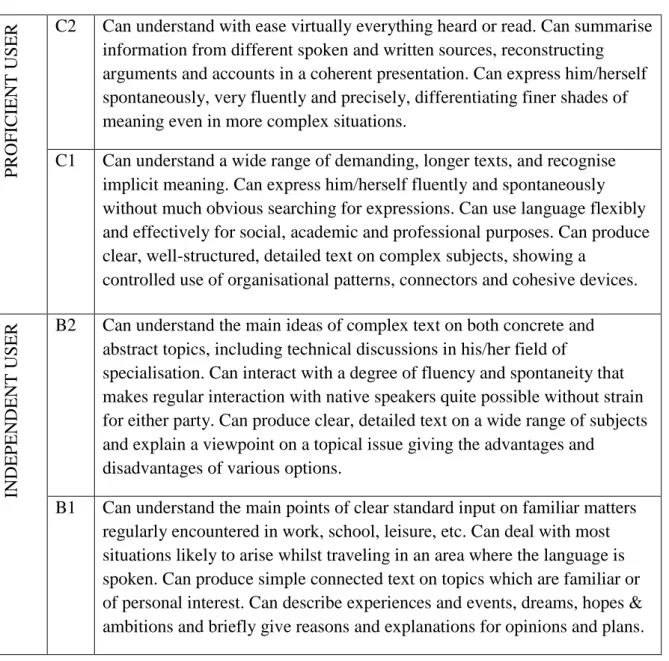
(17) VIDEO GAMES AS COMPLEMENTARY TOOLS FOR ENGLISH LEARNERS. 17. “By providing a common basis for the explicit description of objectives, content, and methods, the Framework will enhance the transparency of courses, syllabuses and qualifications, thus promoting international cooperation in the field of modern languages.”(Council of Europe, 2001, p.1). These levels have a different set of communicative abilities of the students that help teachers to recognize the characteristics of the students and develop better activities according to their use of the language. In Table 2, it is possible to see the differences among the levels and the characteristics of the students according to each level.. PROFICIENT USER. C2. Can understand with ease virtually everything heard or read. Can summarise information from different spoken and written sources, reconstructing arguments and accounts in a coherent presentation. Can express him/herself spontaneously, very fluently and precisely, differentiating finer shades of meaning even in more complex situations.. C1. Can understand a wide range of demanding, longer texts, and recognise implicit meaning. Can express him/herself fluently and spontaneously without much obvious searching for expressions. Can use language flexibly and effectively for social, academic and professional purposes. Can produce clear, well-structured, detailed text on complex subjects, showing a controlled use of organisational patterns, connectors and cohesive devices.. INDEPENDENT USER. Table 2. Common Reference Levels.. B2. Can understand the main ideas of complex text on both concrete and abstract topics, including technical discussions in his/her field of specialisation. Can interact with a degree of fluency and spontaneity that makes regular interaction with native speakers quite possible without strain for either party. Can produce clear, detailed text on a wide range of subjects and explain a viewpoint on a topical issue giving the advantages and disadvantages of various options.. B1. Can understand the main points of clear standard input on familiar matters regularly encountered in work, school, leisure, etc. Can deal with most situations likely to arise whilst traveling in an area where the language is spoken. Can produce simple connected text on topics which are familiar or of personal interest. Can describe experiences and events, dreams, hopes & ambitions and briefly give reasons and explanations for opinions and plans..
(18) BASIC USER. VIDEO GAMES AS COMPLEMENTARY TOOLS FOR ENGLISH LEARNERS A2. Can understand sentences and frequently used expressions related to areas of most immediate relevance (e.g. very basic personal and family information, shopping, local geography, employment). Can communicate in simple and routine tasks requiring a simple and direct exchange of information on familiar and routine matters. Can describe in simple terms aspects of his/her background, immediate environment, and matters in areas of immediate need.. A1. Can understand and use familiar everyday expressions and very basic phrases aimed at the satisfaction of needs of a concrete type. Can introduce him/herself and others and can ask and answer questions about personal details such as where he/she lives, people he/she knows and things he/she has. Can interact in a simple way provided the other person talks slowly and clearly and is prepared to help.. 18. Common Reference Levels: global scale from Chapter 3 of the CEF (Council of Europe, 2001a:24). The (CEF) offers to the professionals a way to organize their goals and objectives, this tool is used to compare the levels of ability of learners of a second language, and get a possible path during the process. However, the (CEF) is not a language context so the teachers can use the (CEF) as a guide but they have to adapt their syllabus according to the conditions of the environment (Cambridge ESOL, 2011). It is also important to recognize that the (CEF) is not something new, but a well-developed scale that has been questioned and restructured since the 1970s and it is still used in many institutions around the world. Due to the need for an international framework which supports the cooperation among educational institutions in different countries (Cambridge ESOL, 2011). The Council of Europe also has as its main objectives the development of chains among different institutions governmental or non-governmental. In order to reach an international standard which is developed not only by the Council. Teachers and learners have to be part of these process around the world in order to enrich this framework with the multicultural aspects of their regions. Consequently, the idea of the (CEF) is not to say that the ideal native speaker is the goal to achieve but to get a linguistic repertory in which the.
(19) VIDEO GAMES AS COMPLEMENTARY TOOLS FOR ENGLISH LEARNERS. 19. communicator dominates the skills, and enrich them with its own culture (Council of Europe, 2001). As the institution divides the students according to the (CEF). This internship was adapted to the level A1 which is the basic level, in which the students are just entering into contact with the language. The idea is that at the end of the course the students will be able to understand familiar expressions, basic phrases, introduce themselves, answer and ask questions about details. When we know the level of the students we get to how to aim the class according to the teaching context. Not everything in the (CEF) is relevant to our context but it is a guideline that can help teachers to focus on the aspects that are relevant to our context, and also adapt features that are not necessarily inside the (CEF) (Cambridge ESOL, 2011). To summarize, the main idea of this internship was to describe the effects of the video games in the classroom related to the engagement, motivation and their use as additional tools in the classroom, as the main methodology I used the (P.P.P) in order to give the students the main abilities to reach the flow and fulfill the activities easily, in that way the abilities of the students were matched with challenge offered by the video game. In order to select the correct game the (CEF) is suitable because it scales what the students can do. So the idea is to focus the task, which in this case is video games, in order to get a reasonable success on the activity, despite the mistakes that the students can make during the process (Cambridge ESOL, 2011)..
(20) VIDEO GAMES AS COMPLEMENTARY TOOLS FOR ENGLISH LEARNERS. 20. 6. Working plan In this internship, the use of video games as extra tools is described in terms of motivation and reinforcement of the topics seen in the classroom. According to the aforementioned, this working plan shows the way I developed the internship based on the pedagogical perspective and the research perspective. In relation to the pedagogical perspective, this working plan describes a pedagogical intervention based on the use of the video games as additional material in order to reinforce something that was taught in the class and also to motivate and engage students. In terms of data collection and the analysis of the process seen during the internship, the methodology of this internship was an action research. 6.2 Data Collection Instruments As the area of the study for this internship is languages and education, the nature of the data that is collected is qualitative since qualitative data studies the human behavior and how they interact in the society (Alison & Gass, 2015). For a collection of data to be successful it is necessary to recognize the type of data that needs to be gathered, the time when this data is recollected, and the sources that are used to collect the data. Consequently, it is useful to collect data from three different sources, to check different information, and to make your data more trustworthy. To the development of this internship, the first source I used was the survey, followed by the journals and finally the interview. The survey is a data collection technique well-structured prepared in a form of document in order to collect data or information. The idea of this data collection technique is to gather information related to the topic of study. The answers given by the population are the data for the report (Mills, 2017). In this internship, the survey is used as a first approach to the students' preferences and relations with the technology and the learning..
(21) VIDEO GAMES AS COMPLEMENTARY TOOLS FOR ENGLISH LEARNERS. 21. The journal is an examining process in which the researcher use and make written records, the idea of this process is to examine the field where the observer is getting firsthand information and using a method that is not intrusive to the process of the students (Mills, 2017). This technique was used in the middle of the process during the classes as I observed the students and their development towards the activities are done. The last data collection technique I used was the interviews. Interviews are inquiring data collection instruments used to get a direct contact with the students and they are a good way to recognize students’ likes and dislikes (Mills, 2017). I selected this to be the last because I could see how the students felt after the experience of having classes. For that reason in Table 7. It is explained the sources of data collection, the type of data, and the time to apply the source. Table 3. Data collection instruments used in the internship. DATA COLLECTION INSTRUMENTS TYPE OF DATA Survey (Mills, 2017). Qualitative. It is used to find students resources at home and at school in order to know if the study is available.. WHEN TO APPLY At the beginning.. Journals (Mills, 2017). Qualitative. It is used to assess the students’ processes and the development of the class.. While the process.. Interview (Mills, 2017). Qualitative. It is useful to check the research process, the likes and the dislikes of the students.. At the end.. Source: Own Creation. In this research data collected was qualitative data. In order to have a clear data analysis I worked based on five steps: The first step is: Get to know the data, the second step is: Focus the analysis, the third step is: Categorize the information, the fourth step is: Identify patterns and connections within categories and the fifth step is: Interpretation (Taylor-Powell & Renner, 2003)..
(22) VIDEO GAMES AS COMPLEMENTARY TOOLS FOR ENGLISH LEARNERS. 22. In the first step, I analyzed the data in order to know whether is valuable or not, if this data is based in biases or if it is objective and also I checked the information validity to the research. In the second step, I focused on the data analysis by the question or topic; it means that I looked at how the participants respond to each question; however, the analysis was also focused by a group, in this case, A1 students. The third step and one of the most important are used to identify patterns. Identifying coherent categories is really helpful in order to organize the data and also it is really helpful to find subcategories. In the fourth step, it is important to recognize the large categories and their subcategories, it is also important to recognize the relevance of the categories for the research and the relationships within a category with other categories. In the interpretation step, it is important to recognize the most important results of the data, what I learned from them, what the possible applications are and what the readers would be interested in. 6.3 Students’ and Teacher’s roles Related to the process of the class, the students initially have a class related to the syllabus. In this class, the students first receive the presentation of the topic, which is usually a reading and listening exercise. The content of the presentation part is the grammar and communicative objective, it is shown as a conversation. After that, the students work on their grammar exercises after a brief explanation of it. Then, the students have a productive part when they speak and communicate with their pairs in another language. Finally, the students face the video game that is intended to the level and syllabus. In a pedagogical intervention, the learner is aware of its knowledge. Consequently, the student is a mediator among his own process, its classmates, the classroom procedures and the activities in the classroom. In this internship that awareness was evidenced, the students were willing to participate and they were conscious of themselves. Furthermore, the student.
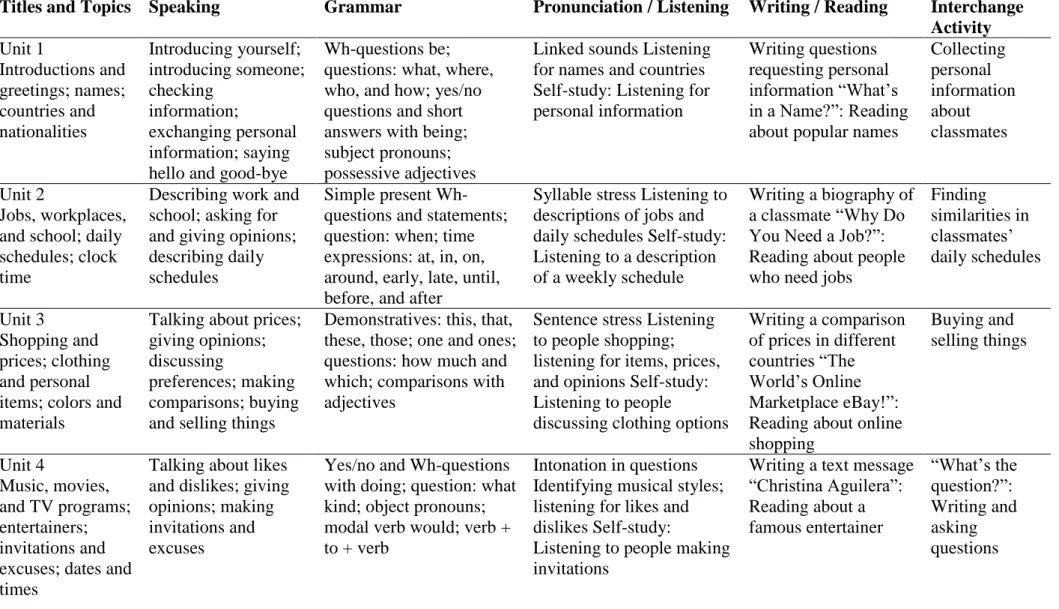
(23) VIDEO GAMES AS COMPLEMENTARY TOOLS FOR ENGLISH LEARNERS. 23. is not isolated from his learning; instead, the student reconstructs its learning. The learner is part of a community. The members of this community, classmates and teacher, learn through the interaction with the other members. Therefore, the learning process is not individual but is a collaborative process. Students are attentive to the teacher input and also support other members of the community with their own knowledge. (Richards & Rodgers, 2001). During this internship, the students were A1 level, for that reason the students were at the first stage, where they were dependent on my commands as guidelines, but this was not a pitfall in order to establish communication with other students. Some students could be in the second stage at the end of the level because they have received different classes so they have already received a big input and also the idea was that the input was shown again towards the video games selected to the class. As the students are in the first stage of their learning, the teacher is a guide that helps them to interact among them, and also the teacher guides the interaction towards the video games, in this stage of their learning process, they are a bit reluctant to criticism and feedback, the video games can give them a brief feedback but not personal. Consequently, they do not feel it so strong or judgmental. The teacher's role at the beginning is a guide and it facilitates the students' communication, between the book and the other activities used in the classroom, so he is mainly a guide that facilitates the understanding of the target language. Then the idea is that the students start to interact among them and the teacher monitors that interaction guiding them and correcting them briefly, so on the students get used to the criticism so the teacher can correct deeper the grammar. At the end, the learners have acquired a grade of independence so they are willing to ask and refine their own language so the teacher role now is not just a person who corrects the students but the teacher becomes part of their learning process based on their requests (Richards & Rodgers, 2001). As a guide during this internship, my work was to be a guide to help them interact with their classmates with.
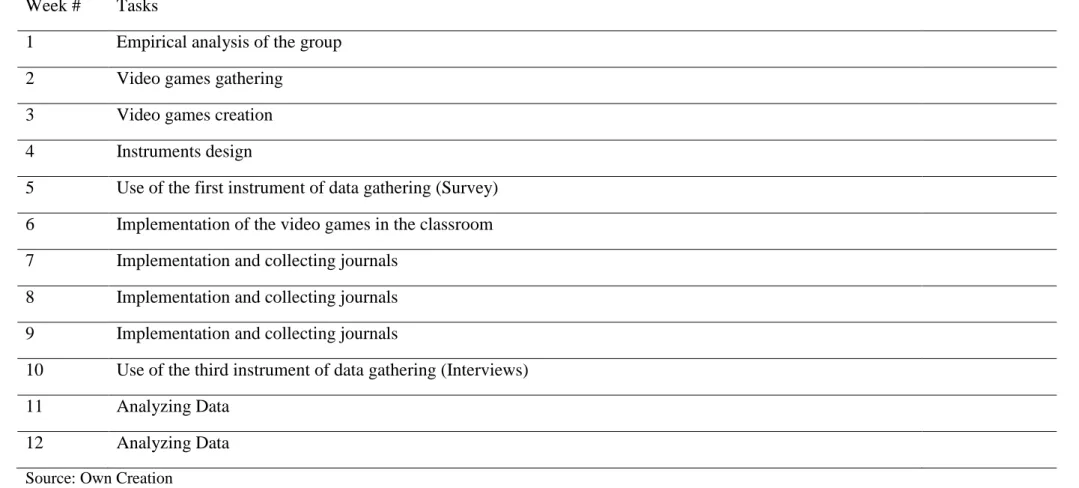
(24) VIDEO GAMES AS COMPLEMENTARY TOOLS FOR ENGLISH LEARNERS. 24. myself, and with the materials used during the class as were the video games and the main book. In terms of the teacher as a researcher describes the uses of the video games in the classroom as a complementary tool. This will be done by a systematic collection of data and analyze it in order to recognize the implications of the material in class and its future usage (Alison & Gass, 2015). 6.4 Chronogram The type of syllabus used in this research was a multi-syllabus syllabus, in this syllabus you can find the lexis that was used in classes and the functions of the lexis (Harmer, 2015). The syllabus showed the games that were used in the classroom as complementary tools for the lexis and the functions in order to reinforce this knowledge; this process also described the hours used during the internship in terms of class work and preparation of classes. In Table 3. It is described a draft of how the hours during the internship were spent, in Table 4. It is described the institutional syllabus according to the (CEF). Finally in Table 5. The video games are described, and how they are related to the syllabus because the activities must be linked according to the (CEF) in order to be accurate, meaningful and related to the needs and capabilities of the students (Cambridge ESOL, 2011)..
(25) VIDEO GAMES AS COMPLEMENTARY TOOLS FOR ENGLISH LEARNERS. 25. Table 4. Chronogram used in the internship describing the teacher role with the hours' range. Week #. Tasks. 1. Empirical analysis of the group. 2. Video games gathering. 3. Video games creation. 4. Instruments design. 5. Use of the first instrument of data gathering (Survey). 6. Implementation of the video games in the classroom. 7. Implementation and collecting journals. 8. Implementation and collecting journals. 9. Implementation and collecting journals. 10. Use of the third instrument of data gathering (Interviews). 11. Analyzing Data. 12. Analyzing Data. Source: Own Creation.
(26) VIDEO GAMES AS COMPLEMENTARY TOOLS FOR ENGLISH LEARNERS. 26. Table 5. Institutional Syllabus. Titles and Topics Speaking. Grammar. Pronunciation / Listening. Writing / Reading. Unit 1 Introductions and greetings; names; countries and nationalities. Wh-questions be; questions: what, where, who, and how; yes/no questions and short answers with being; subject pronouns; possessive adjectives Simple present Whquestions and statements; question: when; time expressions: at, in, on, around, early, late, until, before, and after Demonstratives: this, that, these, those; one and ones; questions: how much and which; comparisons with adjectives. Linked sounds Listening for names and countries Self-study: Listening for personal information. Writing questions requesting personal information “What’s in a Name?”: Reading about popular names. Syllable stress Listening to descriptions of jobs and daily schedules Self-study: Listening to a description of a weekly schedule. Writing a biography of a classmate “Why Do You Need a Job?”: Reading about people who need jobs. Finding similarities in classmates’ daily schedules. Sentence stress Listening to people shopping; listening for items, prices, and opinions Self-study: Listening to people discussing clothing options. Buying and selling things. Yes/no and Wh-questions with doing; question: what kind; object pronouns; modal verb would; verb + to + verb. Intonation in questions Identifying musical styles; listening for likes and dislikes Self-study: Listening to people making invitations. Writing a comparison of prices in different countries “The World’s Online Marketplace eBay!”: Reading about online shopping Writing a text message “Christina Aguilera”: Reading about a famous entertainer. Unit 2 Jobs, workplaces, and school; daily schedules; clock time. Introducing yourself; introducing someone; checking information; exchanging personal information; saying hello and good-bye Describing work and school; asking for and giving opinions; describing daily schedules. Unit 3 Shopping and prices; clothing and personal items; colors and materials. Talking about prices; giving opinions; discussing preferences; making comparisons; buying and selling things. Unit 4 Music, movies, and TV programs; entertainers; invitations and excuses; dates and times. Talking about likes and dislikes; giving opinions; making invitations and excuses. Interchange Activity Collecting personal information about classmates. “What’s the question?”: Writing and asking questions.
(27) VIDEO GAMES AS COMPLEMENTARY TOOLS FOR ENGLISH LEARNERS Unit 5 Families; typical families. Unit 6 Sports, fitness activities, and exercise; routines. Unit 7 Free-time and weekend activities; chores; vacations. Unit 8 Stores and places in a city; neighborhoods; houses and apartments. Talking about families and family members; exchanging information about the present; describing family life. Present continuous yes/no and Wh-questions, statements, and short answers; quantifiers: all, nearly all, most, many, a lot of, some, not many, a few, and few; pronoun: no one Asking about and Adverbs of frequency: describing routines always, almost always, and exercise; talking usually, often, sometimes, about frequency; hardly ever, almost never, discussing sports and and never; questions: how athletes; talking about often, how long, how abilities well, and how good; short answers Talking about past Simple past yes/no and events; giving Wh-questions, statements, opinions about past and short answers with experiences; talking regular and irregular about vacations verbs; past of be. Asking about and describing locations of places; asking about and describing neighborhoods; asking about quantities. There is/there are; one, any, and some; prepositions of place; quantifiers; questions: how many and how much; count and noncount nouns. 27. Intonation in statements Listening for family relationships Self-study: Listening to an interview with a new student. Writing an e-mail about family “The Changing Family”: Reading about an American family. Finding out information about classmates’ families. Intonation with direct address Listening to people talking about free-time activities; listening to descriptions of sports participation Self-study: Listening to a quiz about health and fitness Reduction of did you Listening to descriptions and opinions of past events and vacations Self-study: Listening to a police officer interviewing a possible thief Reduction of there is/there are Listening for locations and descriptions of places Self-study: Listening for locations in a neighborhood. Writing about favorite activities “Health and Fitness Quiz”: Reading about and taking a quiz. Finding out about classmates’ abilities. Writing a postcard “Vacation Postcards”: Reading about different kinds of vacations. “Vacation disasters”: Describing a terrible vacation. Writing a roommate Making a wanted ad “The World neighborhood in One a better place Neighborhood”: Reading about a New York City neighborhood.
(28) VIDEO GAMES AS COMPLEMENTARY TOOLS FOR ENGLISH LEARNERS Unit 9 Appearance and dress; clothing and clothing styles; people. Asking about and describing people’s appearance; identifying people. Questions for describing people: What . . . look like, how old, how tall, how long, and what color; modifiers with participles and prepositions Present perfect yes/no and Wh-questions, statements, and short answers with regular and irregular past participles; already and yet; present perfect vs. simple past; for and since Adverbs before adjectives; conjunctions: and, but, though, and however; modal verbs can and should. Unit 10: Past experiences; unusual activities. Describing past experiences; exchanging information about past experiences and events. Unit 11 Cities; hometowns; countries. Asking about and describing cities; asking for and giving suggestions; talking about travel and tourism. Unit 12 Health problems; medication and remedies; products in a pharmacy. Talking about health problems; asking for and giving advice; making requests; asking for and giving suggestions. Infinitive complements; modal verb should for suggestions; modal verbs can, could, and may for requests. Unit 13 Food and restaurants. Expressing likes and dislikes; agreeing and disagreeing; ordering a meal. So, too, neither, and either; modal verbs would and will for requests. 28. Contrastive stress Listening to descriptions of people; identifying people Self-study: Listening to descriptions of people; identifying styles Linked sounds Listening to descriptions of events Selfstudy: Listening to a job interview; listening to descriptions of experiences. Writing an e-mail describing people “Hip-Hop Style”: Reading about clothing styles. Comparing two pictures of a party. Writing a letter to an old friend “Taking the Risk”: Reading about unusual or dangerous sports. Can’t and shouldn’t Listening to descriptions of cities and hometowns; listening for incorrect information Self-study: Listening to descriptions of vacation destinations Reduction of Listening to health problems and advice Self-study: Listening to advice for a camping trip. Writing a magazine article “Greetings from . . . ”: Reading about famous cities. “Lifestyle survey”: Finding out about a classmate’s lifestyle “ Creating a guide to fun places in a city. Stress in responses Listening to restaurant orders Self-study: Listening to people talking about restaurant orders. Writing a restaurant Creating a review “To Tip or Not menu of dishes to Tip”: Reading about tipping customs. Writing a letter to an advice columnist “Rain Forest Remedies?”: Reading about natural products as medicine. Playing a board game.
(29) VIDEO GAMES AS COMPLEMENTARY TOOLS FOR ENGLISH LEARNERS. 29. Unit 14 World geography and facts; countries. Describing countries; making comparisons; expressing opinions; talking about distances and measurements. Comparative and superlative forms of adjectives; questions: how far, how big, how high, how deep, how long, how hot, and how cold. Questions of choice Listening to a TV game show Self-study: Listening to people discussing Chiang Mai. Unit 15 Invitations and excuses; leisuretime activities; telephone messages Unit 16 A change for the better! Life changes; plans and hopes for the future. Talking about plans; making invitations; accepting and refusing invitations; giving reasons; taking and leaving messages Exchanging personal information; describing changes; talking about plans for the future. Future with present continuous and be going to; messages with tell and ask. Reduction of could you and would you Listening to telephone messages Selfstudy: Listening to telephone messages; identifying errors Vowel sounds /ou/ and /8/ Listening to descriptions of changes Self-study: Listening to people at a class reunion. Describing changes with the present tense, the past tense, the present perfect, and the comparative; verb + infinitive. Plan of book adapted from Interchange Level 1 Teacher's Book 1 (Richards, Hull & Proctor, 2012). Writing an article about a country “Things You Can Do to Help the Environment”: Reading about the environment Writing unusual favors “Cell Phone Etiquette”: Reading about cell phone manner. “How much do you know?”: Taking a general knowledge quiz. Writing a proposal for a class party “Setting Personal Goals”: Reading about goals and priorities. Planning a possible future. Finding out about classmates’ weekend plans.
(30) VIDEO GAMES AS COMPLEMENTARY TOOLS FOR ENGLISH LEARNERS. 30. Table 6. Chronogram used in the internship describing the video games. Teacher Researcher’s Role The teacher will develop and gather the material used in the classroom, it will gather the information and describe the process. Week Video Games Used # 1 http://www.sesamestreet.org/games?id=205 Read that Face In this video game "Big Bird", who is sesame street character, will ask the student to select among three faces which one is feeling happy, angry, sad or surprised in the middle of every correct answer appears a video of the sesame street character representing those emotions. 2. 3. 4. 5. http://www.eslgamesplus.com/learn-words-and-expressions-of-time-eslgrammar-activity/ Learn Words and expressions of time, ESL Grammar activity: In this activity, the students do mathematics with units of time as years, moths minutes and seconds. http://learnenglishkids.britishcouncil.org/en/games/teddy-dresser Teddy dresser: In this video game the students dress a teddy bear with the instructions given in a blue box for example: "I'm wearing a helmet, a black jacket and trousers" https://play.kahoot.it/#/k/349fce13-8950-43d6-8ff0-d04c7eafc269 Entertainment Trivia: In this video game the students compete in a quiz about T.V shows, Soccer, Movies and music the student who finishes first and correct wins. https://www.proprofs.com/games/word-games/hangman/familymembers-33/ Family Members: In hangman, you have to say the letters and you have a limited number of opportunities if you do not guess well you lose. The words used are family members: (Father, mother, aunt, uncle, nephew, niece, son, daughter, grandfather, grandmother, husband and wife).. Video games relation with the syllabus This game is useful to show the grammar Wh-questions be; questions: what, where, who, and how; yes/no questions and short answers with be; part using questions like Are you happy? Are you sad? Or other questions like: How are you? Besides it’s a bit hard it can also help in the listening for personal information but just in terms of emotions. This video game is used to work on the topic; clock time, besides it is a mathematics video game the game shows the vocabulary we use with the clock.. This game is totally addressed to the topic of the class; clothing and personal items, the idea of this game is to show the vocabulary that is used in the class. Another video game that works on the topic of the unit Music, movies, and TV programs; entertainers. This is a game that shows the questions in a Colombian context but also about the American culture. This is a multimedia version of the game hangman, based on the family members' vocabulary, The teacher can give different hints to the students to help them guess the words, or simply let them take more shots..
(31) VIDEO GAMES AS COMPLEMENTARY TOOLS FOR ENGLISH LEARNERS 6. 7. 8. 9. 10. 11. https://www.purposegames.com/game/do-play-go Do, Play, Go: In this activity, the students match verbs with the right activity, for example: go bowling, shopping and swimming; do exercise, sit ups and push-ups; play tennis, soccer and sports. https://www.purposegames.com/game/irregular-verbs-in-past Irregular Verbs in Past: This is matching game in which the students match the verb in infinitive with its correspondent form in simple past. Verbs used: (Buy, choose, come, fall, feel, find, get, go, lose, make, put, read, run, say, speak, take, wear and write) http://www.eslgamesplus.com/countable-uncountable-nouns-game/ Space Rider: In this board video game the students are rolling the dice to advance and answer some questions about the count and non-count nouns if the answer is wrong they go back. https://play.kahoot.it/#/k/b61a0dbb-01e9-441e-a570-b349154ceb1a What does he/she look like? : In this trivia, the students answer 4 different question about personal appearance the questions are based on different pictures: What is she wearing?, How old is he?, How tall is he? And Which one is Robert? https://es.lyricstraining.com/play/adele/hello/HaJ3ymUsra#a7w Lyrics training is a game based on songs and their lyrics meanwhile the student is listening to the song he has to fill the blank spaces with words of the song, there are two options: write mode; in this one the students write the song with the keyboard and choice mode; in this mode they select the word from 4 options. The song selected for this class is Hello from Adele because it has plenty of sentences using present perfect. http://www.english-online.org.uk/games/flash/wordgame.html Weather Words: In this video game, the students will read or listen some clues in order to recognize 4 weather words: (Thunder, lightning, clouds and blizzard).. 31. This game is used to work on the vocabulary Sports, fitness activities, and exercise, it gives the students new vocabulary about fitness activities, and shows again some vocabulary used for sports and exercise. This game is related to the grammar especially simple past irregular verbs vocabulary, this teacher can use this game to help them remember some common irregular verbs and as they have to say the verb you can also help them with the pronunciation. This is a grammar-based video game which has a relation to questions: how many and how much; count and noncount nouns. This game can be used as extra material to show the grammar with different vocabulary because the class topic is "places", and the video game is about "food". This video game works on the grammar questions: What... look like, how old, how tall, how long, and what color. It also related to the topic, Appearance and dress; clothing and clothing styles; people. Based on the grammar present perfect and focused on listening. This game can be used to show examples in a real speech of the present perfect tense. It also has to forms of playing, so you can use it as a multiple option answer or you can help them work on their words spelling.. This game can be used to give students some extra vocabulary about cities’ weather. It also matches some vocabulary seen in the class and words related to the adjectives for example cloud and cloudy..
(32) VIDEO GAMES AS COMPLEMENTARY TOOLS FOR ENGLISH LEARNERS 12. 13. 14. 15. 16. http://learnenglishkids.britishcouncil.org/en/word-games/health-andillness Health and illness: In this video game, the students match a different picture with the correspondent illness also they can listen to the pronunciation. The words listed are: (A cut, Sneeze, tummy-ache, dizzy, toothache, sore throat and cold). http://www.english-online.org.uk/games/cardgame.htm Containers: In this game, you have to match the food with the right container. (A jar of jam, a packet of frozen peas, a bottle of wine, a tub of butter and a tin of sardines.) http://www.arcademics.com/games/toad/toad.html Country Toad: In this game, the students play with a frog and select the correct country of the capital city given there is a timer so when the time is over the game is over, too.. 32. This game is used to show the topic part: Health problems, reinforce the vocabulary and add some new vocabulary with the images, it also shows the pronunciation of those words.. This video game is used to talk about the topic Food and its possible containers, it is a matching game so you can use it to play in groups or individually.. In this video game the idea is to practice the world geography and facts; countries topic. The game is used to show different countries and their capitals, the teachers can show the pronunciation of the countries and cities during the process. https://www.gamestolearnenglish.com/fast-phrases/ Fast Phrases: This is This grammar based video game offers a wide selection of a video game with different categories but I just use the "going to" other mini-games inside. However, I only chose the "going category. In this game the students create the sentence according to the to" category so it is a very big game to use. Related to what image for example: "He is going to jump into the water". we are concerned the game can be used as a trivia to practice more about this tense. https://play.kahoot.it/#/k/d3d1820e-bf85-4708-8b08-4bc60d47704f Besides this is part of the speaking part talking about plans Plans for the future: In this video game the students compete for the future I used this game to work on the grammar of unscrambling the words in some sentences the student who finishes first this questions, so they have to organize these structures and correct wins. well in the video game.. Source: Own Creation.
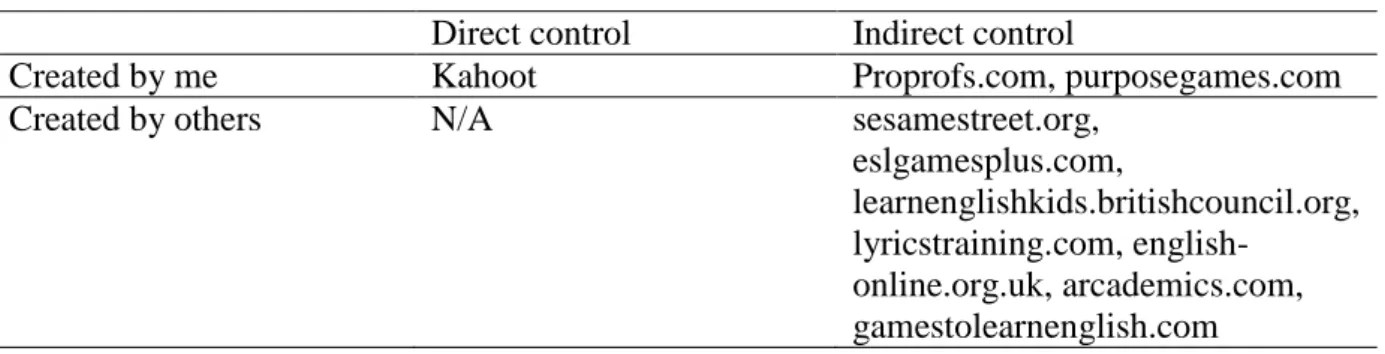
(33) VIDEO GAMES AS COMPLEMENTARY TOOLS FOR ENGLISH LEARNERS. 33. It is very important to recognize that all the games have a direct control, but due to the lack of computers in the classroom the interaction was not direct with all the video games. It is also very relevant to say the video games developed by me, were held regarded to the websites which have the tools to create them. There are some games that I created and some others that were created by other people in Table 6. It is possible to see which games have a direct control and which ones were controlled by me (indirect control), and also the games that were created by me on websites that have useful tools to make them. Table 7. Classification of the video games according to the control and the development. Created by me Created by others. Direct control Kahoot N/A. Indirect control Proprofs.com, purposegames.com sesamestreet.org, eslgamesplus.com, learnenglishkids.britishcouncil.org, lyricstraining.com, englishonline.org.uk, arcademics.com, gamestolearnenglish.com. Source: Own Creation. In the case of the use of the videogames itself the teachers must be acquainted with the needs in the classroom, organize a curriculum or a guideline of games that can help them in order to fulfill the needs of the students, also the resources available in the classroom, so in this case would be easier to select the useful video games, therefore the activity was accurate to their needs and facilities in order to get the flow (Malone, 1980) and a meaningful task (Frey & Fisher, 2010). For instance, in the case that the students are not allowed to use their cellphones during the class, a kahoot game will not be useful, but maybe an online game will be. Also there are plenty of websites on the internet that can help the teacher to develop their own games like purposegames.com or proprofs.com, in this case the video games can be developed for the topics that the teacher really want to explain, besides there is a lack of variety in contrast to the video games created by professional designers like the games British Council games, arcademics or gamestolearnenglish..
(34) VIDEO GAMES AS COMPLEMENTARY TOOLS FOR ENGLISH LEARNERS. 34. 7. Data Analysis The methodology of this internship was developed through a qualitative action research, it is mainly a research designed for teachers and its methodology is simple the teacher takes notes of its classes and is aware of class’ process in order to understand what is better for the next one. This method also helps to describe how the languages are learned and taught, and it also allows the teacher-researcher to understand its own process and future decisions. (Alison & Gass, 2015). 7.1 Categorization of information. In the categorization part, I organized the data collected during the internship into common categories, there were three different data collection techniques. The first one was a survey, the second one the teacher journals and the last one the interviews. The categorization is used in order to organize the data in a better way, it also helps to understand and analyze the data in a more organized way, this is very important in the qualitative data due to the wide range of the answers that appear. This process is a form to organize different data in big groups in order to get a clearer idea of the data. 7.1.1 Categorization of surveys. The first data technique that I used was a survey related to the interest of the students according to the tools they use in class and the motivation toward the language, the questions used in this survey were in Spanish the students mother tongue because I did not want any question to be misunderstood during the process, and due to the fact that the students are A1 level they might not have had the proficiency to understand the question in English. Here I show the questions that I used and their translation into English: 1. From 1 to 5 how much do you like English? (Being 1 Not much and 5 a lot), 2. Why do you think is.
(35) VIDEO GAMES AS COMPLEMENTARY TOOLS FOR ENGLISH LEARNERS. 35. important to learn English 3. What kind of tools for studying English do you have in your house? 4. What kind of tools for studying English do you have at Smart institution? 5. What tools do you prefer to learn English? 6. What tools do you use for learning English outside the classroom? 7. ¿From 1 to 5 how motivated do you feel to learn English? (Being 1 Not much and 5 a lot). The first and the seventh questions have numerical answers for that reason I did not categorize them, however, I categorized the rest of the questions. In Table 8. The questions and their correspondent categories are shown. Table 8. Survey’s Questions two to six and their correspondent categories. Questions Why do you think is important to learn English? What kind of tools for studying English do you have in your house? What kind of tools for studying English do you have at Smart institution? What tools do you prefer to learn English?. Categories Culture (Cul), Quality of life (Qol), Interaction (Int), Work (wor) Internet (Inte), Books (Boo), Games (Gam), Conversation (Con), Authentic material (Ama); Videos (Ama-V), Hardware and software (HS); Software (HS-S) Hardware (HS-H) Classes (Cl), Books (Boo), Games (Gam), Hardware and software (HS); Software (HS-S), Hardware (HS-H). Classes (Cl), Books (Boo), Games (Gam), Conversation (Con), Authentic material (Ama); Videos (Ama-V) Music (Ama-M)Reading (Ama-R), Hardware and software (HS); Software (HS-S), Hardware (HS-H) What tools do you use for Internet (Inte), Books (Boo), Games (Gam), Conversation learning English outside (Con), Authentic material (Ama), Videos (Ama-V), Music the classroom? (Ama-M), Reading (Ama-R), Hardware and software (HS); Software (HS-S), Hardware (HS-H) Note. The categories in italics are subcategories of the categories that appear just before.. The vast majority of the categories do not have sub categories mainly because the answer was literally the category. In the case of the authentic material their answer were very varied so I had to combine the videos, music and reading into this category. I mixed the categories hardware and software because they are complementary and they cannot work without the other, there were students who answer the particular piece of hardware they were using like the computer, but not the programs they were using. The internet is also related to.
(36) VIDEO GAMES AS COMPLEMENTARY TOOLS FOR ENGLISH LEARNERS. 36. the hardware and the software but it has a different category because this category needs hardware and software to work but the software and the hardware do not need the internet to work. This mainly means that a person with a computer, laptop or tablet can enter to the internet but not without one of these pieces of hardware. 7.1.2 Categorization of the journals. The second data instrument I used was the journals. Based on my own experience as an observer of the process and also a participant, during this process, I categorized the Journals according to the patterns I found. The patterns I found were pretty similar among them, with exception of the journal number nine where I described a different category called Student's Preferences. The division of the categories appears in Table 9. Table 9. Journals from one to four and their correspondent categories. Journal Number 1. Categories. Issues (Is), Students’ engagement (SE), Students’ motivation (SM), Students’ learning process (SL), Grammar (SL-G), Listening (SL-L). 2 Issues (Is), Students’ engagement (SE), Students’ motivation (SM), Students’ learning process (SL), Pronunciation (SL-P). 3 Issues (Is), Students’ engagement (SE), Students’ motivation (SM), Students’ preferences (SP), Students’ learning process (SL), Environment (SL-E). 4 Issues (Is), Students’ engagement (SE), Students’ motivation (SM), Students’ learning process (SL), Vocabulary (SL-V), Pronunciation (SL-P). Note. The categories in italics are subcategories of the categories that appear just before.. In terms of the subcategories, there were just subcategories related to the Students' learning process (SL), the subcategories founded were Grammar (SL-G), Listening (SL-L), Pronunciation (SL-P), Environment (SL-E), Vocabulary (SL-V) and Pronunciation (SL-P). These subcategories are useful guidelines in order to recognize the relevant points in the skill or relation of the video game with the topic of the class..
(37) VIDEO GAMES AS COMPLEMENTARY TOOLS FOR ENGLISH LEARNERS. 37. 7.1.3 Categorization of the interviews. The last data technique used was interviews. I selected this kind of source because I can ask about things I consider relevant, but it let me reformulate or create other questions according to the students' responses. I also asked the questions in Spanish because I wanted them to understand as clearly as possible the questions. There are the questions: 1. What tools did you use during the class to learn English? 2. What did you use them for? 3. Did you play during the class? 4. What game did you play? 5. Does this game have a relation with the topics seen in class? And finally, 6.What do you think of the use of this interactive games in class? There were two people interviewed during the process of the internship. In table 10 there are the interviews’ categories. They were almost exactly in terms of categories, but there is a subcategory that appears in the second interview related to the students’ learning process and the grammar. The students described the tools they used in the classroom, their level of motivation during the class, and how the students’ learning process was affected by the environmental effects and the grammar. Table 10. Interview categories. Interview 1 2. Categories Tools (T), Students’ motivation (SM), Students’ learning process (SL), Environment (SL-E). Tools (T), Students’ motivation (SM), Students’ learning process (SL), Environment (SL-E), Grammar (SL-G).. Note. The categories in italics are subcategories of the categories that appear just before.. 7.2 Interpretation. In the interpretation part, I analyzed the data collected during the internship, there were three different data collection techniques the first one was a survey, the second one the teacher journals and the last one the interviews. In order to interpret this data it is important to take into account that it was taken at different moments of the academic process, the surveys were used to identify the preferences of the students, the journals were used to observe the.
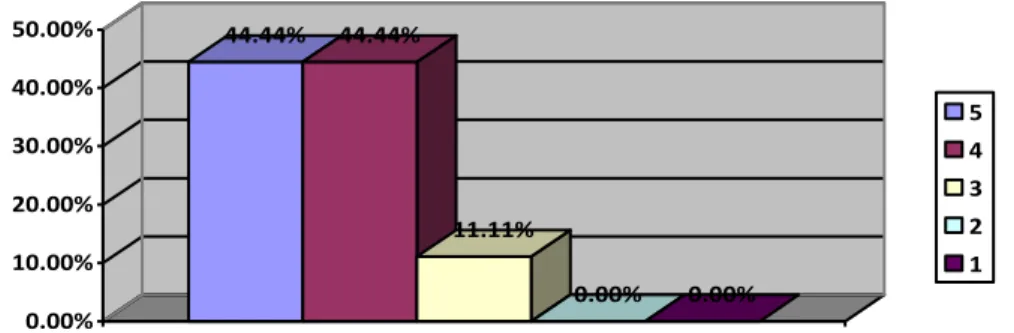
(38) VIDEO GAMES AS COMPLEMENTARY TOOLS FOR ENGLISH LEARNERS. 38. students’ process during the internship, and the interviews were used at last in order to evaluate the process of the internship. I divided this process in two steps, in the first part of the analysis, based on the categories I found I described the process of the internship. At the second stage, I evaluated the common findings that were seen during the process. 7.2.1 Interpretation of the survey. In this first survey, nine students answered the questions, now that the questions are categorized; there are the findings of each question and the analysis. In order to read the interpretations this one is organized in two different ways, first it is possible to see the table and the figure with shows the data, then there is the interpretation based on the data found and its relation to the internship. Table 11. From 1 to 5 how much do you like English? (Being 1 not much and 5 a lot) Score. Percentage. 5 4 3 2 1 Total. 44.44% 44.44% 11.11% 0.00% 0.00% 100%. Source: Own creation. Figure 2. From 1 to 5 how much do you like English? (Being 1 not much and 5 a lot) 50.00%. 44.44%. 44.44%. 40.00% 5 30.00%. 4 3. 20.00%. 2. 11.11% 10.00%. 1 0.00%. 0.00% Percentage. Source: Own creation. 0.00%.
(39) VIDEO GAMES AS COMPLEMENTARY TOOLS FOR ENGLISH LEARNERS. 39. Based on table 6.1 and figure 2.1 the mode this information has 2 modes one is 4 and the other one is 5, the median is 4 and the mean is 4,33. Therefore, it is possible to see that most of the students like the English language. Then there is not a problem with this population regarded to the language itself. Hence, there are not barriers related to the language and how the people react toward the foreign language in this internship. Therefore students are attentive to the teacher input and also support other members of the community with their own knowledge (Richards & Rodgers, 2001). They do not have lack of interest toward learning, besides the students at this stage are dependent on the teacher’s guide during the process, they try to interact with other students and they are willing to participate. Therefore, the students are at least motivated (Krashen, 2002). These are good news because the students are in a good mood to take the class, and there is not struggle to make them participate. However, as it is possible to see in Table 12 they were mostly interested in achieve goals but their principal interest is not the interaction with other in the foreign language. Table 12. Why do you think is important to learn English? Categories Culture(Cul) Quality of life (Qol) Interaction (Int) Work (wor) Source: Own creation. Percentage 33.33% 33.33% 44.44% 66.66%.
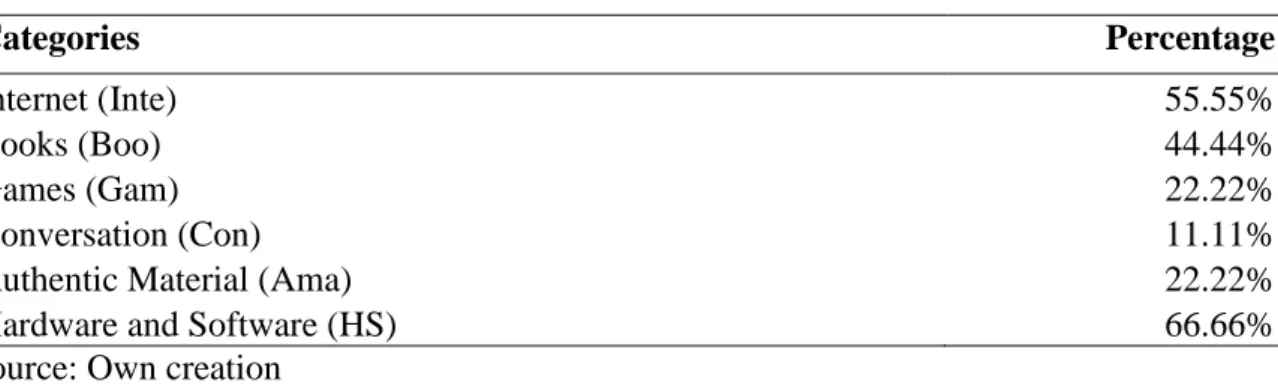
(40) VIDEO GAMES AS COMPLEMENTARY TOOLS FOR ENGLISH LEARNERS. 40. Figure 3. Why do you think is important to learn English? 66.66%. 70.00% 60.00% 44.44%. 50.00% 40.00%. 33.33%. 33.33%. Culture(Cul) Quality of life (Qol). 30.00%. Interaction (Int). 20.00%. Work (wor). 10.00% 0.00% Percentage. Source: Own creation. According to the table 6.2 and the figure 2.2 and knowing that the people like the language. I wanted to know the importance of the language in their real lives. There it is possible to see that the mode of this is: Work; thus, most of the students are interested to learn English in order to improve their jobs, the interaction was the second most important category selected by the students, followed by the quality of live and the culture, related to the population that was interviewed the answer was not a surprise, mainly because the kind of population that goes to the institute is adult professional and business people at a private institution of education for working and human development. As it was said before the students want to learn the language in order to achieve a particular goal which is not bad, but it would be better if they want to learn the language in order to become part of the English community. Table 13. What kind of tools for studying English do you have in your house? Categories Internet (Inte) Books (Boo) Games (Gam) Conversation (Con) Authentic Material (Ama) Hardware and Software (HS) Source: Own creation. Percentage 55.55% 44.44% 22.22% 11.11% 22.22% 66.66%.
Figure
+7
Documento similar