https://doi.org/10.33044/revuma.v60n1a17
FINITE-DIMENSIONAL HOPF ALGEBRAS OVER THE KAC–PALJUTKIN ALGEBRA H8
YUXING SHI
Abstract. LetH8be the Kac–Paljutkin algebra [Trudy Moskov. Mat. Obˇsˇc. 15 (1966), 224–261], which is the neither commutative nor cocommutative semisimple eight dimensional Hopf algebra. All simple Yetter–Drinfel’d mod-ules over H8 are given, and finite-dimensional Nichols algebras overH8 are determined completely. It turns out that they are all of diagonal type. In fact, they are of Cartan typesA1,A2,A2×A2,A1×· · ·×A1, andA1×· · ·×A1×A2, respectively. By the way, we calculate Gelfand–Kirillov dimensions for some Nichols algebras. As an application, we complete the classification of the finite-dimensional Hopf algebras overH8according to the lifting method.
1. Introduction
Let K be an algebraically closed field of characteristic zero. The question of
classification of all Hopf algebras over Kof a given dimension up to isomorphism
was posed by Kaplansky in 1975 [40]. Some progress has been made but, in general, it is a difficult question for lack of standard methods. One breakthrough is the so-called lifting method introduced by Andruskiewitsch and Schneider in 1998 [3], under the assumption that the coradical is a Hopf subalgebra.
We describe the procedure for the lifting method briefly. LetHbe a Hopf algebra whose coradicalH0 is a Hopf subalgebra. The associated graded Hopf algebra of
H is isomorphic to R#H0, where R = ⊕n∈N0R(n) is a braided Hopf algebra in the categoryH0
H0YDof Yetter–Drinfel’d modules overH0, # stands for the Radford
biproduct or bosonization of R with H0. As explained in [14], to classify finite-dimensional Hopf algebrasH whose coradical is isomorphic toH0we have to deal with the following questions:
(a) Determine all Yetter–Drinfel’d modules V over H0 such that the Nichols
algebraB(V) has finite dimension; find an efficient set of relations forB(V).
2010Mathematics Subject Classification. Primary 17B37, 81R50; Secondary 17B35.
Key words and phrases. Nichols algebra; Hopf algebra; Gelfand–Kirillov dimension; Kac– Paljutkin algebra.
(b) IfR=⊕n∈N0R(n) is a finite-dimensional Hopf algebra in
H0
H0YDwithV =
R(1), decide ifR'B(V). HereV =R(1) is a braided vector space called theinfinitesimal braiding.
(c) GivenV as in (a), classify allH such that grH 'B(V)#H0 (lifting). AliftingofV ∈H
HYDis a Hopf algebraLsuch that grL=B(V)#H, where grL
is the graded Hopf algebra associated to the coradical filtration. In other words [16, Proposition 2.4],Lis a lifting ofV iff there is an epimorphism of Hopf algebras
φ:T(V)BT(V)#H →Lsuch thatφ|H = idH and
φ|H⊕V#H:H⊕V#H →L1is an isomorphism of Hopf bimodules. (1.1)
Suchφis called alifting map. If emphasis onH is needed, then we say thatLis a lifting ofV overH.
The lifting method was extensively used in the classification of finite-dimensional pointed Hopf algebras such as [15], [12], [25], [23], [2], [1], [9], [8] and so on. It is also effective to study finite-dimensional copointed Hopf algebras ([16], [27], [22]). We note that there are very few classification results on finite-dimensional Hopf algebras whose coradical is neither a group algebra nor the dual of a group algebra, some exceptions being [19], [26], [11]. It should be mentioned that [11] constructed Hopf algebras with the Chevalley property over a semisimple Hopf algebraH that is Morita-equivalent to a group algebra KG (in the sense of HHYD ' KG
KGYD as
braided tensor categories). It doesn’t cover our case sinceH8can be obtained from a group algebra by a 2-pseudo-cocycle twist but not by a 2-cocycle twist [45].
Here we would like to initiate a project for the study of Hopf algebras whose coradicals are low-dimensional neither commutative nor cocommutative semisim-ple Hopf algebras by running procedures of the lifting method. One important step is to study the Nichols algebras over those low-dimensional semisimple Hopf algebras. Nichols algebras were studied first by Nichols [44]. These are connected graded braided Hopf algebras [4] generated by primitive elements, and all primi-tive elements are of degree one. In the past decades, the study of Nichols algebras was mainly focused on categories of Yetter–Drinfel’d modules over group algebras. Under the assumption that the base field has characteristic 0, the classification of finite-dimensional Nichols algebras over abelian groups was completely solved in [30, 31] by using Lie theoretic structures, and the result of the classification played an important role later in the significant work [15]. The problem of classifying finite-dimensional Nichols algebras over non-abelian groups is difficult in general for lack of systematic method; for related works please refer to [12], [24], [29], [32], [33], [36], [35], etc.
In this paper, we mainly focus on the Kac–Paljutkin algebraH8. The structure of our paper is as follows. In Section 2, we recall the fundamental notions related to Yetter–Drinfel’d modules, Nichols algebras and Gelfand–Kirillov dimension. In section 3, we construct all the simple left Yetter–Drinfel’d modules overH8
accord-ing to Radford’s method. In section 4, we get all the possible finite-dimensional Nichols algebras from Yetter–Drinfel’d modules over H8. It turns out that they
are of Cartan typesA1,A2,A2×A2,A1× · · · ×A1, andA1× · · · ×A1×A2. Here
Theorem A.LetM ∈H8
H8YD. Then the Nichols algebraB(M)is finite-dimensional
iffM is isomorphic to one of the following Yetter–Drinfel’d modules:
(1) Ω1(n1, n2, n3, n4)BL4j=1Mhbj, gji
⊕nj withP4
j=1nj ≥1,(b1, g1) = (i, x),
(b2, g2) = (−i, x), (b3, g3) = (i, y) and (b4, g4) = (−i, y), the infinitesimal braiding is of typeA1× · · · ×A1
| {z }
n1+n2+n3+n4
.
(2) Ω2(n1, n2) B Mhi, xi⊕n1 ⊕Mh−i, xi⊕n2 ⊕Mh(xy, x)i, n
1+n2 ≥ 0, the infinitesimal braiding is of typeA1× · · · ×A1
| {z }
n1+n2
×A2.
(3) Ω3(n1, n2) B Mhi, yi⊕n1 ⊕Mh−i, yi⊕n2 ⊕Mh(y, xy)i, n1+n2 ≥ 0, the
infinitesimal braiding is of typeA1× · · · ×A1
| {z }
n1+n2
×A2.
(4) Ω4(n1, n2)BMhi, xi⊕n1⊕Mhi, yi⊕n2⊕W1,−1,n
1+n2≥0, the infinites-imal braiding is of typeA1× · · · ×A1
| {z }
n1+n2
×A2.
(5) Ω5(n1, n2) B Mh−i, xi⊕n1 ⊕Mh−i, yi⊕n2 ⊕W−1,−1, n1 +n2 ≥ 0, the
infinitesimal braiding is of typeA1× · · · ×A1
| {z }
n1+n2
×A2.
(6) Ω6BMh(xy, x)i⊕Mh(y, xy)i, the infinitesimal braiding is of typeA2×A2.
(7) Ω7BW1,−1⊕W−1,−1, the infinitesimal braiding is of typeA2×A2. Remark 1.1. We point out which of the Yetter–Drinfel’d modules have a prin-cipal realization and which not, since the liftings are known when there is a principal realization and not otherwise [5, Subsection 2.2]. Let (h) and (δh) be
dual bases of H8 and H8∗, and b ∈ {±1,±i}. Define χb B δ1+δxy +b2(δx+ δy) + b(δz +δzxy) + b3(δzx +δzy) ∈ Alg(H8,
K), then (g, χb) is a YD-pair [7]
iff Kχb
g ' Mhb, gi is a one-dimensional Yetter–Drinfel’d module. Mh(g1, g2)i for
(g1, g2)∈ {(xy, x),(y, xy)} andWb1,−1 forb1=±1 don’t have a principal realiza-tion. So only Ω1(n1, n2, n3, n4) has a principal realization.
In section 5, according to the lifting method, we give a classification for finite-dimensional Hopf algebras overH8. Here is the second main result.
Theorem B. Let H be a finite-dimensional Hopf algebra over H8 such that its infinitesimal braiding is inH8
H8YD. ThenH is isomorphic to either of: (1) A1(n1, n2, n3, n4;I1), see Definition 5.4;
(2) B[Ω2(n1, n2)]#H8, see Proposition 5.10;
(3) A4(n1, n2;I4), see Definition 5.18;
(4) A6(λ), see Definition 5.11;
(5) A7(I7), see Definition 5.15.
A1(n1, n2, n3, n4;I1) comprises two 16-dimensional nonisomorphic nonpointed
self-dual Hopf algebras with coradicalH8described in [19] as special cases. Except
2. Preliminaries
2.1. Conventions. LetH be a Hopf algebra overK, with antipodeS. We will use Sweedler’s notation ∆(h) = h(1)⊗h(2) for the comultiplication ([43]). LetHHYD
be the category of left Yetter–Drinfel’d modules over H. A left Yetter–Drinfel’d moduleMoverH is a leftH-module (M,·) and a leftH-comodule (M, ρ) satisfying
ρ(h·m) =h(1)m(−1)S(h(3))⊗h(2)·m(0), ∀m∈M, h∈H, (2.1)
where ρ(m) =m(−1)⊗m(0). The categoryHHYDis a braided monoidal category.
The braidingc∈EndK(M⊗M) ofM is defined byc(v⊗w) =v(−1)·w⊗v(0), and
the inverse braiding is defined byc−1(v⊗w) =w
(0)⊗ S−1(w(−1))·v
.
Definition 2.1 ([14, Definition 2.1]). Let H be a Hopf algebra and V ∈ H HYD.
A braided N-graded Hopf algebra R =Ln≥0R(n) ∈ H
HYD is called the Nichols algebra ofV if
(i) K'R(0),V 'R(1)∈H HYD.
(ii) R(1) =P(R) ={r∈R|∆R(r) =r⊗1 + 1⊗r}.
(iii) Ris generated as an algebra by R(1). In this case,Ris denoted byB(V) =L
n≥0B n(V).
Remark 2.2. The Nichols algebraB(V) is completely determined by the braiding. More precisely, as proved in [49] and noted in [14],
B(V) = K⊕V ⊕
∞
M
n=2
V⊗n/kerSn =T(V)/kerS,
whereSn,1∈EndK V
⊗(n+1)
,Sn ∈EndK(V
⊗n),
Sn,1Bid +cn+cncn−1+· · ·+cncn−1· · ·c1= id +cnSn−1,1,
S1Bid, S2Bid +c, SnB(Sn−1⊗id)Sn−1,1.
Lemma 2.3 ([28, Theorem 2.2], [6, Remark 1.4]). Let M1, M2 ∈ H
HYD be both finite-dimensional and assume cM1,M2cM2,M1 = idM2⊗M1. Then B(M1⊕M2) ' B(M1)⊗B(M2)as graded vector spaces andGKdimB(M1⊕M2) = GKdimB(M1)+
GKdimB(M2).
Proposition 2.4([46, Radford biproduct]).LetHbe a Hopf algebra andA∈H HYD be a braided Hopf algebra. Then A#H is a Hopf algebra with
∆(a#h) =X a(1)#(a(2))(−1)h(1)
⊗
(a(2))(0)#h(2)
, (2.2)
S(a#h) =X 1#SH(h)SH(a(−1))
SA(a(0))#1
, (2.3)
(a#h)(a0#h0) =Xa(h(1)·a0)#h(2)h0, a, a0∈A, h, h0∈H. (2.4)
The mapι:H →A#H given byι(h) = 1#hfor allh∈H is an injective Hopf algebra map, and the mapπ:A#H →H given byπ(a#h) =εA(a)hfor alla∈A, h∈H is a surjective Hopf algebra map such thatπ◦ι= idH. Moreover, it holds
Conversely, let B be a Hopf algebra with bijective antipode and π:B → H a Hopf algebra epimorphism admitting a Hopf algebra sectionι:H →B such that
π◦ι= idH. ThenA=Bcoπ is a braided Hopf algebra inHHYD andB'A#H as
Hopf algebras.
2.2. GK-dimension. Let A be a finitely generated algebra over a field K, and
assume a1, . . . , am generate A. Set V to be the span of a1, . . . , am, and denote Vn the span of all monomials in the a
i’s of lengthn. Asai’s generate A one has A=S∞
k=0Ak, whereAk =K+V +V2+· · ·+Vk. The function dV(n) = dimAn
is the growth function of A. The Gelfand–Kirillov dimension of a K-algebra A
is GKdimA = lim logndV(n). GKdimA does not depend on the choice of V.
Suppose that GKdimA <∞. We say that a finite-dimensional subspaceV ⊆Ais
GK-deterministicif
GKdimA= lim
n→∞logndim
X
0≤j≤n Vj.
Clearly, if V is a GK-deterministic subspace of A, then any finite-dimensional subspace ofA containing V is GK-deterministic. Let A and B be two algebras. Then
GKdim(A⊗B)≤GKdimA+ GKdimB,
but the equality does not hold in general. However, it does hold when A or B
has a GK-deterministic subspace, see [41, Proposition 3.11]. The Gelfand–Kirillov dimension is a useful tool in ring theory and Hopf algebraic theories. We shall not discuss in detail its importance but we refer the reader to [41] as a basic reference and [51, 50, 18, 6] for additional information related with Hopf algebras.
3. Simple Yetter–Drinfel’d modules ofH8
Recall that the neither commutative nor cocommutative semisimple 8-dimen-sional Hopf algebra H8 in [42] is constructed as an extension of K[C2×C2] by K[C2]. A basis forH8is given by{1, x, y, xy=yx, z, xz, yz, xyz}with the relations
x2=y2= 1, z2=1
2(1 +x+y−xy), xy=yx, zx=yz, zy=xz. The coalgebra structure and the antipode are defined by
∆(x) =x⊗x, ∆(y) =y⊗y, ε(x) =ε(y) = 1, S(x) =x, S(y) =y,
∆(z) = 1
2(1⊗1 + 1⊗x+y⊗1−y⊗x)(z⊗z), ε(z) = 1, S(z) =z. The automorphism group ofH8is the Klein four-group [48]. These automorphisms are given in Table 1; they are going to be used in Corollary 5.3.
Denote a set of central orthogonal idempotents of H8 as
e1=1
8(1 +x)(1 +y)(1 +z), e2= 1
8(1 +x)(1 +y)(1−z),
e3= 1
8(1−x)(1−y)(1 + iz), e4= 1
1 x y z
τ1= id 1 x y z
τ2 1 x y xyz
τ3 1 y x 12(z+xz+yz−xyz)
τ4 1 y x 12(−z+xz+yz+xyz)
Table 1. Hopf algebra automorphisms ofH8.
e5=
1−xy
2 , ejek =δjk, j, k= 1, . . . ,5; i =
√ −1;
and denote idempotentse05=14(1−xy)(1 +z),e005 =14(1−xy)(1−z). Then
H8=H8e1⊕H8e2⊕H8e3⊕H8e4⊕H8e5
=H8e1⊕H8e2⊕H8e3⊕H8e4⊕(H8e50 +H8e005),
whereH8e05'H8e005 as leftH8-modules, via e057→xe005,xe057→e005.
Definition 3.1. Denote V1(b) B K{v | x·v = b2v, y·v = b2v, z·v = bv, b ∈ {±1,±i}}, wherev is a vector. LetV2 'H8e05 as left H8-modules; the actions of
the generators are given by
x7→
0 1
1 0
, y7→
0 −1
−1 0
, z7→
1 0
0 −1
.
Proposition 3.2. All simple left modules of H8 are classified by V1(b), V2, b ∈ {±1,±i}.
Remark 3.3. The result was also obtained in [20] under a different basis (thanks to referee for reminding us about this fact).
In the remaining part of the article,V1(b) and V2 always mean simple leftH8 -modules.
Lemma 3.4([47, Proposition 2]). Let H be a bialgebra over a fieldKand suppose S is the antipode of H.
(1) If L ∈HM, thenL⊗H ∈ HYDH; the module and comodule actions are given by
h·(`⊗a) =h(2)·`⊗h(3)aS−1(h(1)), ρ(`⊗h) = (`⊗h(1))⊗h(2), ∀h, a∈H, `∈L. Let M ∈HYDH.
(2) Suppose thatL∈HMandp:M −→L is a map of leftH-modules. Then the linear map f : M −→ L⊗H defined by f(m) =p(m(0))⊗m(1) for all m∈M is a map of Yetter–Drinfel’d H-modules, where L⊗H has the structure described in part (1). Furthermore kerf is the largest Yetter– Drinfel’dH-submodule, indeed the largest subcomodule, contained inkerp.
Similarly, according to Radford’s method, any simple left Yetter–Drinfel’d mod-ule overH8could be constructed by the submodule of the tensor product of a left
moduleV ofH8andH8itself, where the module and comodule structures are given
by
h·(`g) = (h(2)·`)h(1)gS(h(3)), ρ(`h) =h(1)⊗(`h(2)), ∀h, g∈H8, `∈V.
(3.1)
Here we useinstead of ⊗to avoid confusion by using too many symbols of the tensor product. We are going to construct all simple left Yetter–Drinfel’d modules overH8 in this way. Keeping in mind that H8 is semisimple, it is possible to do so. In fact, it is much easier than making use of the fact thatH8
H8YD 'D(H8cop)M. The following is a list of useful formulae for looking for simple objects ofH8
H8YD.
Lemma 3.5.
(id⊗2⊗S)∆(2)(z) = 1
4[(1 +y)z⊗z⊗z(1 +x) + (1−y)z⊗xz⊗z(1 +x) + (1 +y)z⊗yz⊗z(1−x) + (y−1)z⊗xyz⊗z(1−x)],
z(2)⊗z(1)S(z(3)) =
1
4[z⊗(1 +x)(1 +y) +xz⊗(1 +x)(1−y) +yz⊗(1−x)(1 +y) +xyz⊗(1−x)(1−y)],
(3.2)
z(2)⊗z(1)xS(z(3)) =
1
4[z⊗(1 +x)(1 +y) +xz⊗(1 +x)(y−1) +yz⊗(1−x)(1 +y) +xyz⊗(x−1)(1−y)],
(3.3)
z(2)⊗z(1)yS(z(3)) =
1
4[z⊗(1 +x)(1 +y) +xz⊗(1 +x)(1−y) +yz⊗(x−1)(1 +y) +xyz⊗(x−1)(1−y)],
(3.4)
z(2)⊗z(1)xyS(z(3)) =
1
4[z⊗(1 +x)(1 +y) +xz⊗(1 +x)(y−1) +yz⊗(x−1)(1 +y) +xyz⊗(1−x)(1−y)],
(3.5)
z(2)⊗z(1)zS(z(3)) =
1
2[z⊗(1 +y)z+xyz⊗x(y−1)z], (3.6)
z(2)⊗z(1)xzS(z(3)) =
1
2[z⊗(1 +y)z+xyz⊗x(1−y)z], (3.7)
z(2)⊗z(1)yzS(z(3)) = 1
2[z⊗x(1 +y)z+xyz⊗(y−1)z], (3.8)
z(2)⊗z(1)xyzS(z(3)) =
1
2[z⊗x(1 +y)z+xyz⊗(1−y)z]. (3.9)
Definition 3.6. Define Mhb, giBK{vg |v ∈V1(b)}, where b ∈ {±1,±i} and g∈ {1, x, y, xy}.
Lemma 3.7. There are eight pairwise non-isomorphic one dimensional Yetter– Drinfel’d modules overH8asMhb, giwith(b, g)∈ {(±1,1),(±1, xy),(±i, x),(±i, y)}. The actions and coactions are given by
ρ(vg) =g⊗(vg), vg∈Mhb, gi, v∈V1(b). Proof. Letv∈V1(b). Then
z·(v1)====(3.2)=bv
4 [1 +x+b
2(1−x)][1 +y+b2(1−y)], (3.10) z·(vxy)====(3.5)=bv
4 [1 +x+b
2(x
−1)][1 +y+b2(y−1)], (3.11)
z·(vx)====(3.3)=bv
4 [1 +x+b
2(1−x)][1 +y+b2(y−1)], (3.12) z·(vy)====(3.4)=bv
4 [1 +x+b
2(x−1)][1 +y+b2(1−y)]. (3.13)
so
z·(v1) =bv1, z·(vxy) =bvxy, whenb=±1;
z·(vx) =bvx, z·(vy) =bvy, whenb=±i.
Now it is easy to see that Mhb, gi defined above is a one-dimensional Yetter– Drinfel’d module by Radford’s method and the eight one-dimensional Yetter– Drinfel’d modules are pairwise non-isomorphic by observations on their actions
and coactions.
Definition 3.8. Let (g1, g2)∈ {(1, y),(x,1),(xy, x),(y, xy)}and denote three
vec-tor spaces as
Mh(1, xy)iBK{v1, vxy|v∈V1(i)}, Mh(x, y)iBK{vx, vy|v∈V1(1)},
Mh(g1, g2)iBK{(v1+v2)g1,(v1−v2)g2|v1, v2∈V2}.
Lemma 3.9. There are six pairwise non-isomorphic two-dimensional simple Yetter– Drinfel’d modules over H8 as below, where the action and coaction are given by formulae (3.1).
(1) Mh(1, xy)i, the actions of generators on (v1, vxy)are given by
x7→
−1 0
0 −1
, y7→
−1 0
0 −1
, z7→
0 i
i 0
.
(2) Mh(x, y)i, the actions of generators on (vx, vy)are given by
x7→
1 0
0 1
, y7→
1 0 0 1
, z7→
0 1 1 0
.
(3) Mh(g1, g2)i, where(g1, g2)∈ {(1, y),(x,1),(xy, x),(y, xy)}; the actions of generators on the row vector((v1+v2)g1,(v1−v2)g2)are given by
x7→
1 0
0 −1
, y7→
−1 0
0 1
, z7→
0 1
1 0
Proof. Since the coactions are easy to see, we can focus on their structures as left
H8-modules. Parts (1) and (2) of the lemma can be checked by formulae (3.10) to
(3.13). Letv1, v2∈V2. Then z·(v11)====(3.2)= 1
2[v1(x+y) +v2(x−y)],
z·(v21)====(3.2)= 1
2[v1(−x+y) +v2(−x−y)],
z·(v1xy) (3.5)
===== 1
2[v1(x+y) +v2(y−x)],
z·(v2xy) (3.5)
===== 1
2[v1(x−y) +v2(−x−y)],
z·(v1y)====(3.4)= 1
2[v1(1 +xy) +v2(1−xy)],
z·(v2y)====(3.4)= 1
2[v1(−1 +xy) +v2(−1−xy)],
z·(v1x) (3.3)
===== 1
2[v1(1 +xy) +v2(−1 +xy)],
z·(v2x) (3.3)
===== 1
2[v1(1−xy) +v2(−1−xy)]. So we have
z·[(v1+v2)1] = (v1−v2)y, z·[(v1+v2)x] = (v1−v2)1, z·[(v1+v2)xy] = (v1−v2)x, z·[(v1+v2)y] = (v1−v2)xy,
z·[(v1−v2)y] = (v1+v2)1, z·[(v1−v2)1] = (v1+v2)x, z·[(v1−v2)x] = (v1+v2)xy, z·[(v1−v2)xy] = (v1+v2)y.
Part (3) is immediate to check. The six two-dimensional Yetter–Drinfel’d modules are pairwise non-isomorphic since they are pairwise non-isomorphic as comodules.
Lemma 3.10. Letb1, b2∈ {±1} andv∈V1(b2), and denote wb1,b2
1 Bv(1 + ib1y)z, w b1,b2
2 Bvx(1−ib1y)z. ThenWb1,b2 =
Kw1b1,b2⊕Kw
b1,b2
2 is a family of four pairwise non-isomorphic two-dimensional simple Yetter–Drinfel’d modules overH8with the actions of generators on the row vector(wb1,b2
1 , w b1,b2
2 )and coactions given by x7→
0 −ib1
ib1 0
, y7→
0 −ib1
ib1 0
, z7→
(1−ib1)b2
2
(1−ib1)b2
2
−(1−ib1)b2
2
(1−ib1)b2
2
!
,
ρwb1,b2
1
= (1 +y)z
2 ⊗w
b1,b2
1 +
(1−y)z
2 ⊗w
b1,b2
2 , ρwb1,b2
2
= x(1 +y)z
2 ⊗w
b1,b2
2 +
x(1−y)z
2 ⊗w
b1,b2
Proof. It is straightforward by the definition of Yetter–Drinfel’d module. When
b2 , b02, Wb1,b2 ; Wb1,b
0
2 since we will see that their braidings are different in
Proposition 4.1. As explained in the following remark, Wb1,b2 has another basis
{p1, p2}withp1∈V1(b2) andp2∈V1(−b1b2i). SoWb1,b2 ;Wb
0 1,b2 ifb
1,b01. Remark 3.11. (1) LetM =K{vz, vxz, vyz, vxyz |v∈V1(b)},b∈ {±1}.
z acts on elements ofM as
z·(vz)====(3.6)=bv
2 (1−x+y+xy)z,
z·(vxz)====(3.7)=bv
2 (1 +x+y−xy)z,
z·(vyz)====(3.8)=bv
2 (−1 +x+y+xy)z,
z·(vxyz)====(3.9)=bv
2 (1 +x−y+xy)z.
ThenM 'W1,b⊕W−1,bas Yetter–Drinfel’d modules overH8.
(2) Let fjkB 14[1 + (−1)
jx][1 + (−1)ky],j, k= 0,1. Denote
p1=wb1,b2
1 + ib1w b1,b2
2 , p2=w b1,b2
1 −ib1w b1,b2
2 .
ThenWb1,b2=
Kp1⊕Kp2with the actions of generators on the row vector
(p1, p2) and coactions given by
x7→
1 0
0 −1
, y7→
1 0
0 −1
, z7→
b2 0
0 −ib1b2
,
ρ(p1) = [f00−ib1f11]z⊗p1+ [f10+ ib1f01]z⊗p2, ρ(p2) = [f00+ ib1f11]z⊗p2+ [f10−ib1f01]z⊗p1.
According to [42, Remark 2.14],H8is presented by generatorsx, y, w, where the
expressions containingzare replaced by
w=
f00+√if10+ √1
if01+ if11
z, w2= 1,
wx=yw, S(w) = 1 + i
2 x+ 1−i
2 y
w,
∆(w) =
1
2(1 +xy)⊗1 + 1 + i
4 (1−xy)⊗x+ 1−i
4 (1−xy)⊗y
(w⊗w).
Leta+ 1 =±√2. We define
w1(1)B(v1+ iav2) i 2
h
(x+y) +√i(x−y)iw
+ (av1−iv2)
1 2 h
(x+y)− √i(x−y)iw,
w2(1)B(v1+ iav2) i 2
h
(1 +xy) + √i(1−xy)iw
−(av1−iv2)1 2 h
w(2)1 B(v1−iav2) i 2
h
(x+y) + √i(x−y)iw
+ (av1+ iv2)1 2 h
(x+y)−√i(x−y)iw,
w(2)2 B(v1−iav2)
i 2
h
(1 +xy) +√i(1−xy)iw
−(av1+ iv2)
1 2 h
(1 +xy)− √i(1−xy)iw.
Lemma 3.12. Let a+ 1 =±√2. There are four pairwise non-isomorphic simple Yetter–Drinfel’d modulesWa
1 andW2a overH8 as follows:
(1) Let W1a =Kw1(1)⊕Kw (1)
2 . Then W a
1 is a two-dimensional simple Yetter– Drinfel’d module overH8 with actions given by
x·w1(1)=−w1(1), y·w(1)1 =w(1)1 ,
z·w(1)1 = 12(1−i)(a+ 1)w(1)2 , w·w(1)1 = 1
2√i(1−i)(a+ 1)w (1) 2 ,
x·w(1)2 =w(1)2 , y·w2(1)=−w(1)2 , z·w(1)2 =1
2(1 + i)(a+ 1)w (1) 1 , w·w(1)2 =
√
i
2 (1 + i)(a+ 1)w (1) 1 , and coactions given by
ρw1(1)=1
2(x+y)w⊗w
(1) 1 +
√
i
2 (x−y)w⊗w
(1) 2 , ρw2(1)=1
2(1 +xy)w⊗w
(1) 2 +
√
i
2 (1−xy)w⊗w
(1) 1 .
(2) Let W2a =Kw1(2)⊕Kw2(2). Then W2a is a two-dimensional simple Yetter– Drinfel’d module overH8 with actions given by
x·w1(2)=w(2)1 , y·w(2)1 =−w1(2), z·w(2)1 = 1
2(1−i)(a+ 1)w (2) 2 , w·w(2)1 =
√
i
2 (1−i)(a+ 1)w (2) 2 ,
x·w(2)2 =−w(2)2 , y·w2(2)=w2(2),
z·w2(2)=12(1 + i)(a+ 1)w(2)1 , w·w(2)2 = 1
2√i(1 + i)(a+ 1)w (2) 1 , and coactions given by
ρw1(2)=1
2(x+y)w⊗w
(2) 1 +
√
i
2 (x−y)w⊗w
(2) 2 , ρw2(2)=1
2(1 +xy)w⊗w
(2) 2 +
√
i
2 (1−xy)w⊗w
(2) 1 .
Proof. It is straightforward to check by the definition of Yetter–Drinfel’d module. Actually,M 'L
a+1=±√2(W a
1 ⊕W2a) as Yetter–Drinfel’d modules overH8, where M =K{vjz, vjxz, vjyz, vjxyz|vj∈V2, j= 1,2}.
Since √i = cosπ4 + i sinπ4, 12√2√i(1−i) = 1. Denote a+ 1 = b√2,b =±1,
p(1)1 = √iw(1)1 +w(1)2 ,p(1)2 =−√iw(1)1 +w(1)2 ; thenWa 1 =Kp
(1) 1 ⊕Kp
(1)
on the row vectorp(1)1 , p(1)2 given by
x7→
0 1 1 0
, y7→
0 −1
−1 0
, z7→
b 0
0 −b
. (3.14)
Let p(2)1 =w(2)1 + √1
iw (2) 2 , p
(2) 2 = w
(2) 1 −
1
√
iw (2)
2 ; then W a 2 = Kp
(2) 1 ⊕Kp
(2) 2 with
actions on the row vectorp(2)1 , p(2)2 also given by (3.14). Now we can observe that
W−1+
√
2
1 is isomorphic to W
−1−√2
1 as modules (or comodules) under a suitably
chosen base, but they are not isomorphic as modules and comodules simultaneously. SoW−1+
√
2
1 ;W
−1−√2
1 as Yetter–Drinfel’d modules. For the same reason, we have W−1+
√
2
2 ;W
−1−√2
2 andW1a;W2a.
Obviously, any module in Lemma 3.9 is not isomorphic to any one of modules in Lemmas 3.10 and 3.12 as comodules. AsH8-modules,Wb1,b2 'V1(b2)⊕V1(−b1b2i),
and Wa
1 'W2a 'V2. So Yetter–Drinfel’d modules in Lemmas 3.9, 3.10 and 3.12
are pairwise non-isomorphic. Keeping in mind thatH8 is semisimple, now we are arriving at
Theorem 3.13. All the simple Yetter–Drinfel’d modules overH8are classified by • Eight pairwise non-isomorphic simple Yetter–Drinfel’d modules of
one-dimension:
Mhb, gi, (b, g)∈ {(±1,1),(±1, xy),(±i, x),(±i, y)}.
• Fourteen pairwise non-isomorphic simple Yetter–Drinfel’d modules of two-dimension:
Mh(1, xy)i, Mh(x, y)i, Mh(g1, g2)i, Wb1,b2, Wa
1, W2a,
where(g1, g2)∈ {(1, y),(x,1),(xy, x),(y, xy)},b1, b2∈ {±1},a+1 =± √
2.
Remark 3.14. Jun Hu and Yinhuo Zhang investigatedD(H)-modules in [37] and [38] by using Radford’s construction [47]. In particular, they constructed all simple modules ofD(H8) under a different basis ofH8.
4. Nichols algebras in H8
H8YD
In this section, we try to determine all the finite-dimensional Nichols algebras generated by Yetter–Drinfel’d modules over H8. As a byproduct, we calculate
Gelfand–Kirillov dimensions for some Nichols algebras.
We begin by studying the Nichols algebras of simple Yetter–Drinfel’d modules.
Proposition 4.1. Given a simple Yetter–Drinfel’d moduleM overH8,dimB(M)
(GKdimB(M)for some cases) is presented in Table 2. Moreover,
(1) B(Mhb, gi) = (
K[p], if(b, g)∈ {(±1,1),(±1, xy)},
(2) Both braidings of Mh(g1, g2)i for (g1, g2) ∈ {(xy, x),(y, xy)} and Wb1,−1 forb1=±1are of Cartan typeA2, so their corresponding Nichols algebras are isomorphic to an algebra which is generated byp1,p2satisfying relations p1p2p1p2+p2p1p2p1= 0,p21=p22= 0.
M ∈H8
H8YD condition dimB(M) GKdimB(M)
Mhb, gi (b, g)∈ {(±1,1),(±1, xy)} ∞ 1
(b, g)∈ {(±i, x),(±i, y)} 2 0
Mh(1, xy)i ∞ 2
Mh(x, y)i ∞ 2
Mh(g1, g2)i (g1, g2)∈ {(1, y),(x,1)} ∞ ∞
(g1, g2)∈ {(xy, x),(y, xy)} 8 0
Wb1,b2 b1=±1,b2=−1 8 0
b1=±1,b2= 1 ∞ ∞
Wa
1, W2a a+ 1 =±
√
2 ∞
Table 2. Nichols algebras of simple Yetter–Drinfel’d modules overH8.
Proof. Becausec(p⊗p) =g·p⊗p= (
p⊗p, if (b, g)∈ {(±1,1),(±1, xy)} −p⊗p, if (b, g)∈ {(±i, x),(±i, y)}
under the assumption thatMhb, gi=Kp, part (1) is obvious.
As for part (2), we only give a proof for the caseWb1,−1 forb1=±1. Let
p1 = w b1,b2
1 + ib1w b1,b2
2 and p2 = w b1,b2
1 −ib1w b1,b2
2 ; then the braiding of Wb1,b2 is given by
c(p1⊗p1) =b2p1⊗p1, c(p2⊗p2) =b2p2⊗p2, c(p1⊗p2) =−b2p2⊗p1, c(p2⊗p1) =b2p1⊗p2.
Whenb2= 1, GKdimB Wb1,1
=∞according to [6, Lemma 2.8]. When
b2=−1, the braiding is of typeA2. As discussed in [10], the Nichols algebra
B Wb1,−1is generated byp1,p2with relationsp1p2p1p2+p2p1p2p1= 0,
p2
1=p22= 0. So dim B Wb1,−1
= 8.
Letp1=v1,p2=vxy∈Mh(1, xy)i; thenc(pj⊗pk) =pk⊗pj, where j, k= 1,2. If we view Mh(1, xy)i =Kp1⊕Kp2 as braided vector spaces,
then GKdimB(Mh(1, xy)i) = GKdimB(Kp1) + GKdimB(Kp2) = 2 by
Lemma 2.3. Similarly, GKdimB(Mh(x, y)i) = 2.
Letp1= (v1+v2)1,p2= (v1−v2)y∈Mh(1, y)i. The braiding is given
by
By [6, Lemma 2.8], GKdimB(Mh(1, y)i) =∞. For the same reason, we obtain GKdimB(Mh(x,1)i) =∞.
Letθ= 1
2(i−1)(a+ 1). Then
cw(1)1 ⊗w1(1)=−θw2(1)⊗w(1)2 , cw1(1)⊗w(1)2 =θw(1)1 ⊗w2(1), cw(1)2 ⊗w1(1)=−θw2(1)⊗w(1)1 , cw2(1)⊗w(1)2 =θw(1)1 ⊗w1(1), ciw(1)1 ⊗w1(1)+w(1)2 ⊗w(1)2 =−iθiw(1)1 ⊗w1(1)+w(1)2 ⊗w(1)2 , c−iw1(1)⊗w1(1)+w2(1)⊗w(1)2 = iθ−iw1(1)⊗w(1)1 +w2(1)⊗w(1)2 .
By induction,
S2n−1,1
w1(1)⊗w(1)2
⊗n
=(1 +θ)[1−(−θ
2)n]
1 +θ2
w(1)1 ⊗w(1)2
⊗n
,
S2n,1
w(1)1 ⊗w2(1)
⊗n
⊗w1(1)
= 1−θ+ (−1)
nθ2n+1(1 +θ)
1 +θ2
w(1)1 ⊗w(1)2
⊗n
⊗w(1)1
.
It means thatw(1)1 ⊗w2(1)⊗ n
is an eigenvector of S2n−1and
w(1)1 ⊗w(1)2
⊗n
⊗w(1)1 is an eigenvector ofS2n both with nonzero
eigen-value. So dimB(Wa
1) =∞. And dimB(W2a) =∞is similar to prove. Proposition 4.2. (1) B[Mhb, gi ⊕Mhb0, g0i] ' B(Mhb, gi)⊗B(Mhb0, g0i)
for(b, g),(b0, g0)∈ {(±1,1),(±1, xy),(±i, x),(±i, y)}.
(2) When(b, g)∈ {(±1,1),(±1, xy)}the following holds:
B[Mhb, gi ⊕Mh(1, xy)i]'B(Mhb, gi)⊗B(Mh(1, xy)i),
B[Mhb, gi ⊕Mh(x, y)i]'B(Mhb, gi)⊗B(Mh(x, y)i).
(3) B[Mhb, gi ⊕Mh(g1, g2)i]'B(Mhb, gi)⊗B(Mh(g1, g2)i)for the following cases:
(a) (b, g) = (±i, x),(g1, g2) = (xy, x);
(b) (b, g) = (±i, y),(g1, g2) = (y, xy);
(c) (b, g) = (±1,1),(g1, g2)∈ {(xy, x),(y, xy)}.
(4) BMhb, gi ⊕Wb1,−1'B(Mhb, gi)⊗B Wb1,−1for the following cases: (a) (b, g)∈ {(1,1),(1, xy)},b1=±1;
(b) (b, g)∈ {(i, x),(i, y)},b1= 1;
(c) (b, g)∈ {(−i, x),(−i, y)},b1=−1.
(5) B[Mh(xy, x)i ⊕Mh(y, xy)i]'B(Mh(xy, x)i)⊗B(Mh(y, xy)i).
(6) B W1,−1⊕W−1,−1
'B W1,−1
⊗B W−1,−1
.
(8) GKdimBMhb, gi ⊕Wb1,−1 = ∞ for (b, g) ∈ {(i, x),(i, y)}, b
1 =−1 or
(b, g)∈ {(−i, x),(−i, y)},b1= 1.
(9) dimB(Mh(g1, g2)i)⊕2=∞for(g1, g2)∈ {(xy, x),(y, xy)}.
(10) dimB Wb1,−1⊕Wb1,−1=∞forb1=±1.
Proof. Parts (1)–(6) are direct results of Lemma 2.3. We only prove some cases as a byproduct in the following.
Letp1= (v1+v2)g1,p2= (v1−v2)g2∈Mh(g1, g2)i, where (g1, g2)∈ {(xy, x),(y, xy)}. Letp=vg∈Mhb, gi. Then
c(p⊗p1) =
(
−p1⊗p, ifg∈ {y, xy}
p1⊗p, ifg∈ {1, x}, c(p⊗p2) =
(
−p2⊗p, ifg∈ {x, xy} p2⊗p, ifg∈ {1, y},
c(p1⊗p) =
(
b2p⊗p1, ifg1=y p⊗p1, ifg1=xy,
c(p2⊗p) =
(
b2p⊗p2, ifg2=x p⊗p2, ifg2=xy. ◦ When (g1, g2) = (y, xy) and (b, g) = (±i, x),
c(p⊗p1) =p1⊗p, c(p⊗p2) =−p2⊗p, c(p1⊗p) =−p⊗p1, c(p2⊗p) =p⊗p2.
The generalized Dynkin diagram is given by Figure 1. According to [31], dimB[Mh±i, xi ⊕Mh(y, xy)i] =∞.
−1 −1 −1
−1
−1 −1
Figure 1
◦ When (g1, g2) = (xy, x) and (b, g) = (±i, y), the generalized Dynkin
diagram associated to the braiding is given by Figure 1. According to [31], dimB[Mh±i, yi ⊕Mh(xy, x)i] =∞. We thus finish part (7).
◦ As for cases listed in part (6),B[Mhb, gi ⊕Mh(g1, g2)i]'B(Mhb, gi)⊗
B(Mh(g1, g2)i) by Lemma 2.3.
Letp=vg ∈Mhb, gi, where (b, g)∈ {(±1,1),(±1, xy),(±i, x),(±i, y)}. Then
c(p⊗wb1,−1
1 ) =
wb1,−1
1 ⊗p, if (b, g)∈ {(±1,1),(±1, xy)}
ib1wb1,−1
2 ⊗p, if (b, g)∈ {(±i, x),(±i, y)}, c(p⊗wb1,−1
2 ) =
wb1,−1
2 ⊗p, if (b, g)∈ {(±1,1),(±1, xy)} −ib1wb1,−1
c(wb1,−1
1 ⊗p) =
bp⊗wb1,−1
1 , if (b, g)∈ {(±1,1),(±1, xy)} bp⊗wb1,−1
2 , if (b, g)∈ {(±i, x),(±i, y)}, c(wb1,−1
2 ⊗p) =
bp⊗wb1,−1
2 , if (b, g)∈ {(±1,1),(±1, xy)} −bp⊗wb1,−1
1 , if (b, g)∈ {(±i, x),(±i, y)}.
◦ In case (b, g)∈ {(1,1),(1, xy)}, according to Lemma 2.3 we have B Mhb, gi ⊕Wb1,−1'B(Mhb, gi)⊗B Wb1,−1.
◦ In case (b, g)∈ {(±i, x),(±i, y)}, if ib1b=−1, according to Lemma 2.3 we haveB Mhb, gi ⊕Wb1,−1'B(Mhb, gi)⊗B Wb1,−1. If ib1b= 1, the generalized Dynkin diagram associated to the braiding ofMhb, gi ⊕Wb1,−1 is given by Figure 1. Now we finish parts (4) and (8).
As for (g1, g2)∈ {(xy, x),(y, xy)}, dimB(Mh(g1, g2)i)⊕2=∞ by [31], since the generalized Dynkin diagram associated to the braiding is given by Figure 2.
−1
−1
−1 −1
−1
−1
−1
−1
Figure 2
As forWb1,−1⊕Wb01,−1withb1andb0
1in{±1}. Letp1=w b1,−1
1 +ib01w b1,−1
2 ,
p2=wb1,−1
1 −ib01w b1,−1
2 ,p01=w b01,−1 1 +ib01w
b01,−1
2 andp02=w b01,−1 1 −ib01w
b01,−1
2 .
Then
c(p1⊗p01) =−p01⊗p1, c(p2⊗p02) =−p02⊗p2, c(p1⊗p02) =p02⊗p1, c(p2⊗p01) =−p01⊗p2.
Whenb1=b01, the generalized Dynkin diagram associated to the braiding is given by Figure 2. By [31], dimB Wb1,−1⊕Wb1,−1=∞. This finishes (10).
Whenb1=−b01, we havep2=w b1,−1
1 +ib1w b1,−1
2 ,p1=w b1,−1
1 −ib1w b1,−1
2 ,
p02=w b01,−1 1 + ib1w
b01,−1
2 ,p01=w b01,−1 1 −ib1w
b01,−1
2 , and
c(p02⊗p2) =−p2⊗p02, c(p01⊗p1) =−p1⊗p01, c(p02⊗p1) =p1⊗p02, c(p01⊗p2) =−p2⊗p01.
By Lemma 2.3, we have
B Wb1,−1⊕W−b1,−1'B Wb1,−1⊗B W−b1,−1.
Proposition 4.3. The following equalities hold forb1=±1:
dimB Mh(xy, x)i ⊕Wb1,−1=∞= dimB Mh(y, xy)i ⊕Wb1,−1.
Proof. We only prove dimB Mh(xy, x)i ⊕Wb1,−1=∞because the rest is similar to prove. Letp01=w
b1,−1
1 + ib1w b1,−1
2 andp02=w b1,−1
1 −ib1w b1,−1
2 . Then
c(p1⊗p01) =p01⊗p1, c(p1⊗p02) =p02⊗p1, c(p2⊗p01) =p01⊗p2, c(p2⊗p02) =−p02⊗p2, c(p01⊗p1) =p2⊗p02, c(p01⊗p2) = ib1p1⊗p02, c(p02⊗p1) =p2⊗p01, c(p02⊗p2) =−ib1p1⊗p01.
SupposeB Mh(xy, x)i ⊕Wb1,−1is finite-dimensional; then according to [34, The-orem 7.2(3)], ad(M(xy, x)) Wb1,−1= (id−c2) M(xy, x)⊗Wb1,−1is irreducible. Denote
A= (id−c2)(p1⊗p01) =p1⊗p01−p2⊗p02;
B = (id−c2)(p1⊗p02) =p1⊗p02−p2⊗p01;
C= (id−c2)(p2⊗p01) =p2⊗p01−ib1p1⊗p02;
D= (id−c2)(p2⊗p02) =p2⊗p02+ ib1p1⊗p01.
Ifa1A+a2B+a3C+a4D= 0 for parametersaj ∈K,j= 1, . . . ,4, thena1A+a4D=
0 anda2B+a3C = 0. Hencea1 =a4 = 0, anda2 =a3 = 0. So A, B, C, D are linearly independent. This is a contradiction since (id−c2) M(xy, x)⊗Wb1,−1is irreducible and there aren’t any 4-dimensional irreducible Yetter–Drinfel’d modules
overH8.
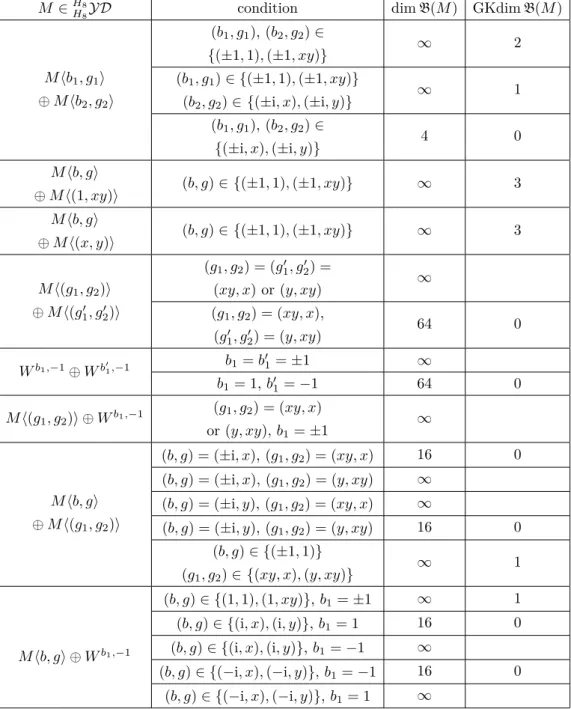
Remark 4.4. According to Propositions 4.1, 4.2, and 4.3, we calculate Nichols algebras over direct sum of two simple objects ofH8
H8YDin Table 3.
Proof of Theorem A. Firstly, we recall the fact that for any submodule M1 ⊂ M2 ∈ H
HYD, B(M1) ⊂ B(M2). Then dimB(M2) = ∞ if dimB(M1) = ∞. The
Nichols algebrasB(M) associated with M listed in Theorem A are finite-dimen-sional according to Lemma 2.3 and [31]. In fact, Ω1(n1, n2, n3, n4) is of Cartan type A1× · · · ×A1
| {z }
n1+n2+n3+n4
; Ωk(n1, n2) for k = 2,3,4,5 is of Cartan type A1× · · · ×A1
| {z }
n1+n2
×A2;
Ωk fork= 6,7 is of Cartan typeA2×A2. So letM ∈HH88YD; then dimB(M)<∞ if and only if M is isomorphic to one of the modules in the list of Theorem A according to Table 2, Table 3, Propositions 4.1 & 4.2.
5. Hopf algebras over H8
In this section, according to the lifting method, we determine the finite-dimen-sional Hopf algebra H with coradical H8 such that its infinitesimal braiding is
isomorphic to a Yetter–Drinfel’d moduleM overH8. We begin by proving thatH
M ∈H8
H8YD condition dimB(M) GKdimB(M)
Mhb1, g1i ⊕Mhb2, g2i
(b1, g1), (b2, g2)∈
{(±1,1),(±1, xy)} ∞ 2
(b1, g1)∈ {(±1,1),(±1, xy)}
(b2, g2)∈ {(±i, x),(±i, y)}
∞ 1
(b1, g1), (b2, g2)∈
{(±i, x),(±i, y)} 4 0 Mhb, gi
⊕Mh(1, xy)i (b, g)∈ {(±1,1),(±1, xy)} ∞ 3 Mhb, gi
⊕Mh(x, y)i (b, g)∈ {(±1,1),(±1, xy)} ∞ 3
Mh(g1, g2)i ⊕Mh(g10, g02)i
(g1, g2) = (g10, g02) =
(xy, x) or (y, xy) ∞ (g1, g2) = (xy, x),
(g10, g20) = (y, xy) 64 0
Wb1,−1⊕Wb01,−1
b1=b01=±1 ∞
b1= 1,b01=−1 64 0
Mh(g1, g2)i ⊕Wb1,−1 (g1, g2) = (xy, x)
or (y, xy),b1=±1 ∞
Mhb, gi ⊕Mh(g1, g2)i
(b, g) = (±i, x), (g1, g2) = (xy, x) 16 0
(b, g) = (±i, x), (g1, g2) = (y, xy) ∞
(b, g) = (±i, y), (g1, g2) = (xy, x) ∞
(b, g) = (±i, y), (g1, g2) = (y, xy) 16 0
(b, g)∈ {(±1,1)}
(g1, g2)∈ {(xy, x),(y, xy)} ∞ 1
Mhb, gi ⊕Wb1,−1
(b, g)∈ {(1,1),(1, xy)}, b1=±1 ∞ 1 (b, g)∈ {(i, x),(i, y)},b1= 1 16 0 (b, g)∈ {(i, x),(i, y)},b1=−1 ∞
(b, g)∈ {(−i, x),(−i, y)},b1=−1 16 0
(b, g)∈ {(−i, x),(−i, y)},b1= 1 ∞
Table 3. Nichols algebras over the direct sum of two simple
ob-jects inH8
Theorem 5.1. Let H be a finite-dimensional Hopf algebra over H8 such that its infinitesimal braiding is isomorphic to a Yetter–Drinfel’d module over H8. Then the diagram of H is a Nichols algebra, and consequently H is generated by the elements of degree one with respect to the coradical filtration.
Proof. Since grH ' R#H8, with R = Ln≥0R(n) the diagram of H, we need
to prove that R is a Nichols algebra. Actually we only need to prove that R '
B(M) for some M in the list of Theorem A since R is finite-dimensional. Let
J =L
n≥0R(n)
∗ be the graded dual of R; then J is a graded Hopf algebra in
H8
H8YDwithJ(0) =K1. According to [13, Lemma 5.5],R(1) =P(R) if and only if
J is generated as an algebra by J(1), that is, ifJ is itself a Nichols algebra. Considering B(M) ∈ H8
H8YD for M in the list of Theorem A, since B(M) =
T(M)/I, in order to show that P(J) = J(1) it is enough to prove that the relations that generate the idealI hold inJ. This can be done by a case-by-case computation. We perform here three cases, and leave the rest to the reader.
SupposeM = Ω1(n1, n2, n3, n4). A direct computation shows that the elements rinJ representing the quadratic relations are primitive and they satisfyc(r⊗r) =
r⊗r. As dimJ <∞, it must ber= 0 in J and hence there exists a projective algebra mapB(M)→ J, which implies thatP(J) =J(1).
Suppose M = Ω6; then M is generated by elementsp1 = (v1+v2)xy, p2 =
(v1−v2)x, p01 = (v1+v2)y, p02 = (v1−v2)xy and the ideal defining the Nichols algebra is generated by the elementsp2
1,p22,p01 2
,p022,p1p2p1p2+p2p1p2p1, p01p02p10p02+p02p10p02p01, p1p01+p01p1, p1p02+p02p1, p2p01−p01p2, p2p02+p02p2. We can
check directly that all those generators of the defining ideal ofB(M) are primitive elements, or by using [21, Theorem 6]. It is enough to show that c(r⊗r) =
r⊗rfor all generators given above for the defining ideal. Since ρ(p1) = xy⊗p1,
ρ(p2) =x⊗p2,ρ(p10) =y⊗p01, we haveρ(p2
1) = 1⊗p21, ρ(p1p2p1p2+p2p1p2p1) =
1⊗(p1p2p1p2+p2p1p2p1),ρ(p1p01+p10p1) =x⊗(p1p01+p01p1). It is easy to see that
c(r⊗r) =r⊗rholds forr=p12,p1p2p1p2+p2p1p2p1, andp1p01+p01p1. We leave the rest to the reader.
SupposeM = Ω4(n1, n2). ThenM is generated by elementsp1=w 1,−1 1 +iw
1,−1 2 , p2 = w1,1−1−iw1,2−1, {Xj}j=1,...,n1, {Yk}k=1,...,n2 with KXj ' Mhi, xi, KYk ' Mhi, yi and the ideal defining the Nichols algebra is generated by the elements
p2
1, p22, p1p2p1p2+p2p1p2p1, Xj2, {Xj1Xj2 +Xj2Xj1}1≤j1<j2≤n1, Y
2
k, {Yk1Yk2 +
Yk2Yk1}1≤k1<k2≤n2,p1Yk−Ykp1,p2Yk+Ykp2,p1Xj−Xjp1,p2Xj+Xjp2. We can check directly that all those generators of the defining ideal ofB(M) are primitive elements, or by using [21, Theorem 6]. It is enough to show thatc(r⊗r) =r⊗rfor all generators given above for the defining ideal. Sinceρ(p1) = (f00−if11)z⊗p1+
(f10+ if01)z⊗p2,ρ(p2) = (f00+ if11)z⊗p2+ (f10−if01)z⊗p1,ρ(Xj) =x⊗Xj, ρ(p1p2p1p2+p2p1p2p1) = [(f00−if11)z(f00+ if11)z]2⊗p1p2p1p2
+ [(f00+ if11)z(f00−if11)z]2⊗p2p1p2p1
+ [(f10+ if01)z(f10−if01)z]2⊗p2p1p2p1
=xy⊗(p1p2p1p2+p2p1p2p1),
ρ(p1Xj−Xjp1) = (f00+ if11)z⊗(p1Xj−Xjp1) + (f10−if01)z⊗(p2Xj+Xjp2).
Because
(f10−if01)z·(p1Xj−Xjp1)
= f10−if01
2 ·[((1 +y)z·p1)(z·Xj)−((1−y)z·Xj)(xz·p1)] = (−i)(f10−if01)·(p1Xj−Xjp1) = 0,
(f00+ if11)z·(p1Xj−Xjp1) = (−i)(f00+ if11)·(p1Xj−Xjp1) =p1Xj−Xjp1, xy·(p1p2p1p2+p2p1p2p1) =p1p2p1p2+p2p1p2p1,
c(r⊗r) =r⊗rholds forr=p1p2p1p2+p2p1p2p1andp1Xj−Xjp1. We leave the
rest to the reader.
Lemma 5.2 ([13, Lemma 6.1]). Let H be a Hopf algebra, ψ :H →H an auto-morphism of Hopf algebras,V,W Yetter–Drinfel’d modules overH.
(1) Let Vψ be the same space underlying V but with action and coaction h·ψv=ψ(h)·v, ρψ(v) = ψ−1⊗idρ(v), h∈H, v∈V.
Then Vψ is also a Yetter–Drinfel’d module over H. If T : V → W is a morphism in HHYD, thenTψ : Vψ →Wψ also is. Moreover, the braiding c:Vψ⊗Wψ→Wψ⊗Vψ coincides with the braidingc:V ⊗W →W⊗V.
(2) If R is an algebra (resp., a coalgebra, a Hopf algebra) in H
HYD, then Rψ also is, with the same structural maps.
(3) LetRbe a Hopf algebra inHHYD. Then the mapΨ :Rψ#H →R#H given byΨ(r#h) =r#ψ(h)is an isomorphism of Hopf algebras.
Corollary 5.3. (1) [Mhbi, xi]τ3 'Mh−bi, yi,b=±1. (2) [Mh(xy, x)i]τ3 'Mh(y, xy)i,
Wb1,−1τ3 'W−b1,−1 with b
1=±1.
(3) B(Ω2(n1, n2)) #H8'B(Ω3(n2, n1)) #H8,
B(Ω4(n1, n2)) #H8'B(Ω5(n2, n1)) #H8.
LetH be a lifting ofB(Ω1(n1, n2, n3, n4)) #H8. Then there exists an
epimor-phism of Hopf algebras φ:T(Ω1(n1, n2, n3, n4)) #H8 →H [16, Proposition 2.4].
Denote
Xj = (vx)#1, vx∈Mhi, xi, j= 1, . . . , n1, Yk = (vx)#1, vx∈Mh−i, xi, k= 1, . . . , n2,
ps= (vy)#1, vy∈Mhi, yi, s= 1, . . . , n3, qt= (vy)#1, vy∈Mh−i, yi, t= 1, . . . , n4.
(5.1)
Definition 5.4. For n1, n2, n3, n4 ∈N≥0 with n1+n2+n3+n4 ≥1, andI1 = {(λj,s)n1×n3,(θk,t)n2×n4} with entries inK, we denote byA1(n1, n2, n3, n4;I1) the algebra [T(Ω1(n1, n2, n3, n4)) #H8]/I(I1), whereI(I1) is the ideal generated by