SOUND-DESIGN DEVELOPMENT WITH SOUND SIMULATION VEHICLE
PACS REFERENCE: 43.50.Ki
Ralf Heinrichs (1), Jörg Becker (1), Winfried Krebber (2)
(1): Ford Werke AG, Acoustic Centre Cologne (ACC); (2) HEAD acoustics (1): Spessartstr.; (2) Ebertstr. 30a
(1): D-50725 Köln; (2) D-52134 Herzogenrath Germany
Tel: +49 221 903 4859 E-mail: [email protected]
ABSTRACT
Within the automotive industry Sound Quality is becoming more and more important. Beside vehicle attributes such as ride, handling, steering and so far the acoustic of a vehicle and in particular its sound quality has been discovered as being an appropriate attribute for setting a certain brand image. All attributes are interacting with each other, thus the acoustics can't be treated independently. In order to overcome that a sound simulation vehicle is going to be presented. Therewith signal theoretical treatments/modifications performed on a computer can be synthesized in a real vehicle in real time.
INTRODUCTION
In these days people of modern societies are used to deal with various types of product communication in their daily live. One way the product communicates to its user is via its sound, thus the sense of hearing is herein involved. Beside telling the user something about the current operating condition of the product its an ideal way of setting an acoustical image according to the brand strategy of the company. Moreover the perceived quality of the product can be enhanced by having a good sound quality.
Since sound-design became more important over the last years also the scientific interest with regard to its perception by humans became eminent. The classic psycho-acoustic approach is not satisfactory capable of describing neither how the sound effects humans nor what it exactly means to them. In the meantime it is well accepted that beside the acoustical input parameters also visual and tactile parameters do influence the acoustical perception. However, beside the sensorial parameters also non-sensorial aspects such as customers expectation and degree of attention as well as brand image, trend and life style aspects can moderate the perception of humans.
COMPLEXITY OF HUMANS SOUND PERCEPTION
[image:2.595.134.440.222.441.2]The base function of humans sense of hearing is to gather information out of their environment and to use it for different purposes. The acoustical stimulus is represented by the collected sound waves. These sound waves, collected by the ears, include all acoustical information of interest. In other words the sound that may be measured with an artificial head for example contains all physical information as far as only the hearing system is concerned. According to Fig. 1 all sensorial information with regard to acoustics, e.g. intensity, frequency spectrum, time structure, stimulus statistics, number and arrangement of sources etc. are considered (acoustical level I and II) in that kind of recordings.
Fig. 1: Influencing aspects for acoustical events
Thus the acoustical part of it is well determined and therefore applicable for simulation purposes. Typically in laboratory listening sessions those recordings are presented to a number of subjects. In this scenario the headphones must be correctly equalized and calibrated. If that is ensured the sensorial side of the acoustic is well comparable to the real sound situation [6].
Up to know the sense of hearing was considered only. Since other senses such as smell, appearance and feel also may have an influence onto the sound sensation one need to take them into account as well. Lots of investigation showed that the various senses interact heavily [2, 3] with each other and that one sense can influence the other.
Going back to the 19th century one can get indications that scientists already explored the inter-modal effects. Modern scientific research in particular in the field of neurobiology show how strong the interactions are. With new methods such as PET (positronenemissionstomography) one can visualize how the different senses interact with each other as well as it can be shown how the degree of attention affects the perception. Those methods do allow interesting insides into the humans brain functionality. Herewith it could be shown that on the one hand those brain regions which are currently in use to cope with a certain situation are provided with the energy needed. On the other hand this implied a significant reduction of energy for those regions which are minor important to deal with that situation. This process is called reciprocal inhibition. However, the brain obviously has only a limited amount of energy available and needs to share it between different tasks to achieve an optimized management of all necessary actions. Hence the deactivation of particular brain regions has an significant impact onto our sound sensation. Driving a vehicle and perceiving its sound is thus different to sitting in a laboratory and listening to the same sound. That needs to be taken into account when setting up a listening session in a laboratory. According to Fig. 1 also cognitive aspects such as expectations, bias, experience etc. do play an important role for the sound sensation. Finally aspects such as hearing culture,
cognitive aspects • • • • image
• • •
• level of attention
• • •
• expectation
• • •
• aesthetics
• • •
• attitude
• • •
• listening culture
• • •
• typology of listener additional senses • • • • appearance
• • •
• feel
• • • • smell
• • • • taste
acoustical level II • • • • sound pattern
• • •
• stimulus statistics
• • •
• number and arrangement of sources
• • •
• motion of sources acoustical level I • • • • frequency spectrum
• • •
• intensity
• • •
• time structure
• • •
image, trend etc. may moderate our sound sensation. That shows how manifold this process appears to be. In particular in the automotive industry it turned out to be insufficient to rely on the laboratory results when sound-design actions where aimed to perform. As soon as sound-design is concerned beside the classical psycho-acoustic with its simplified stimuli a new field of applied psycho-acoustic has to be established which meets the demands towards more realistic sound situations. This includes the involvement of all other sensorial senses as well as the non-sensorial aspects.
Meanwhile first steps were taken to achieve more realistic sound situations. In [4] for example the tactile sense was involved by using a shaker for the seat, steering wheel and shifter excitement in a real vehicle that was operated in standstill. That situation already came somewhat closer to the real sound situation. An other example can be seen in [5] where sound is actively added via loudspeakers in a real vehicle that can be driven. Nevertheless in that case only the power train related sound was treated.
REQUIREMENT FOR A SOUND QUALITY VERIFICATION TOOL
If all influencing factors according to Fig.1 have to be considered for the sound sensation of a vehicle one need to be aware that also the attributes ride, handling, steering etc. need to be involved. It is well known that those attributes and in particular performance feel is strongly interacting with the acoustic of a vehicle.
Various papers deal with the differences of field against laboratory results [1, 7, 8]. Often attentiveness mechanism are responsible for the different results since in a real vehicle the attention onto a certain sound element can be drawn by those mechanism. In order to take all these issues into account without losing the development flexibility the sound simulation vehicle was introduced. With that sound-design verification tool sounds that were developed on a computer as well as sounds that were measured in a test cell can be experienced in a real vehicle. Since the presented sounds in the sound simulation vehicle is to be used for sound-design purposes the auralizations algorithm need to deliver synthesized sounds that are very authentic.
The requirements for such a sound simulation vehicle can be summarized as follows :
• Authentic sound synthesis of computer designed CAE sounds and measured test cell sounds
• Real time sound synthesis of power train, road noise and wind noise separately
• Real time virtual power train, wind and road noise balance adjustment
• Creation of sound stories which are close to reality by means of sound simulation vehicle and on a computer
• Incorporation of visual and tactile senses
• Incorporation of cognitive parameters such as pre-knowledge, degree of attention, experience, expectations etc.
• Incorporation of corporate identity parameters such as brand image, reputation, etc.
IMPLEMENTATION OF THE SOUND SIMULATION VEHICLE
base sound reduction of 10 – 15 dB turned out to be sufficient for these simulation purposes. Reducing the base sound level in this way also has the advantage that the whole sound synthesizing system can easily be moved from one vehicle to another without modifying those vehicles to a great extent. Even an application at prototype vehicles which are only available for a short time without affecting the other prototype usages may be done.
Fig.2 : Base sound reduction due to ANC headphones and earplug/headphone combination
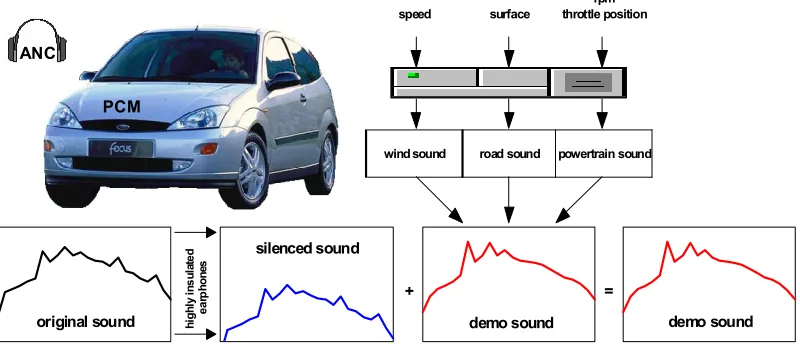
As already stated either pure CAE-sounds or measured sounds may be auralized in real time. When measured sound are to be synthesized one need to follow certain measurement procedures for the power train part as well as for the wind and road noise part. On the power train side for instance various runups need to be performed. The whole engine speed range for several load conditions is to be measured in a test cell. The road and wind noise contribution need to be measured dependent on vehicle speed. All necessary auralization data are stored in a powerful computer which is installed in the boot of the vehicle. Via CAN bus all needed vehicle data such as engine speed, load condition and vehicle speed are transferred to the computer according to Fig.3.
Fig.3 : Principal philosophy and architecture of the sound simulation vehicle
Dependent on the current operating maneuver these data drive the synthesis algorithm to auralize the wanted sound. As stated at the beginning it was the aim to develop a tool that can be used for sound-design purposes. This requires in particular a high quality of the sound auralization. In other words high sophisticated fading and interpolation algorithm have to be developed. This was done on the basis of extensive listening sessions with lots of subjects.
ANC-Headphone
Earplug/Headphone-Kombination
original sound
g rpm speed surface throttle position
wind sound road sound powertrain sound
+ =
silenced sound
demo sound demo sound
veh
ic
le
m
odi
fic
at
io
ns
hi
g
hly
in
s
ula
te
d
ear
p
ho
ne
s
PCM PCM ANC
[image:4.595.97.497.470.647.2]To ensure the high quality of the synthesized sounds they are presented via correctly equalized headphones interactively in the sound simulation vehicle. This now enables the engineer to drive the sound simulation vehicle with whatever sounds he wants.
APPLICATION OF THE SOUND SIMULATION VEHICLE
One requirement for the sound simulation vehicle is to generate customer oriented sound stories. That can easily be done with storing the synthesized sound data on-line on the hard disk of the computer. A typical sound story that was derived from such a real world drive can be seen in Fig.4 with the spectrogram. Here the customer performed the so called traffic light start where he shifts through the first 3 gears revving up to approximately 3000 rpm in each gear.
Fig.4 : Synthesized sound story : Traffic light start
Those synthesized sounds can thus be evaluated in the real vehicle in a real driving situation, i.e. in the sound simulation vehicle and in a laboratory session. However, now evaluation differences between both situation can be investigated. That helps to design appropriate test scenarios for laboratory tests.
A couple of attributes are strongly interacting with each other, e.g. performance feel with sound quality (e.g. acoustical load dependency). In the laboratory situation it isn't possible to check to what extent a certain type of sporty sound enhances the humans performance feel of a vehicle. That can now easily be explored with implementing various sound-designs into the computer and driving the vehicle with those different acoustical load dependencies for instance. Also the cockpit style and seat position interacts with the type of sound timbre that was chosen. All those aspects can be checked by driving the vehicle with different acoustic setups. In this situation the wanted sound-design can thus be evaluated in terms of best sound fit.
Another application of interest allows to perform virtual prototyping. In that scenario several hardware changes such as different engine mount architectures, intake systems, exhaust systems etc. can be measured on a roller dyno and later on stored into the synthesizing computer. With those different sound data sets one can drive the sound simulation vehicle where the different measures can then be experienced under real world driving conditions without affecting the other attributes negatively.
SUMMARY
The perception of humans need to be considered as a highly complex multi-sensorial cognitive process. Therefore it is not sufficient to present only the sound to humans even when one is manly interested in the sound itself. In order to take that into account the sound simulation vehicle was introduced. This tool keeps all vehicle related attributes unchanged while the sound alone can be varied in a wide range. Herewith the interaction between all those attributes with
frequency
tim
[image:5.595.150.424.209.412.2]the acoustic of the vehicle can be explored. Due to the more and more quicker getting development cycles engineering needs to become more efficient too. The sound simulation vehicle allows to optimize laboratory sessions and to bring them closer to reality which saves a lot of costs and time in the end. Finally the first step towards virtual prototyping in terms of acoustic can be taken by driving the vehicle acoustically with different system architectures, just switching between the different sound-designs.
LITERATURE
[1] Bodden, M., Heinrichs, R., Blutner, F. : Bewertung von Geräuschqualität in Feld und Labor. DAGA , Oldenburg, 2000
[2] Gazzaniga, M. S. : Rechtes und linkes Gehirn: Split-Brain und Bewußtsein, Spektrum der Wissenschaft, Dezember 1998
[3] Lehringer, F. J.: Über die Beeinflussung der Hörereignisrichtung durch das Sehereignis bei der Personendarstellung in Telefonkonferenzen. Acustica Vol. 42, 197
[4] Krebber, W., Gierlich, H.W., Hottenbacher, A., Hoffsümmer, H.: 3-D Sound in virtuellen Fahrzeug. DAGA, Zürich, 1998
[5] Schirmacher, R., Lippold, R., Martner, O. : Aktive Klangbeeinflussung in einem PKW. DAGA, Oldenburg, 2000
[6] Takao, H. , Hashimoto, T. : Die subjektive Bewertung der Innengeräusche im fahrenden Auto - Auswahl der Adjektivpaare zur Klangbewertung mit dem Semantischen Differential, Zeitschrift für Lärmbekämpfung 41, Springer Verlag, 1994
[7] Heinrichs, R. : Einflußnahme kognitiver Aspekte bei der Beurteilung des Getrieberassel- Phänomens dargestellt anhand eines speziellen Feld- und Laborexperimente-Designs, Seminarvortrag an der Karl von Ossietzky Universität Oldenburg, 1999
[8] Heinrichs, R. : Perzeptive und signaltheoretische Beschreibungsmöglichkeiten des Getrieberassel-Phänomens von Diesel PKW, Dissertation Universität Ilmenau, 2001