ACOUSTICAL QUALITY OF EDUCATIONAL BUILDINGS
PACS REFERRENCE: 43.55.Hy
Catherine Lavandier 1; Manon Raimbault 1; Danièle Dubois 2; Gérard Ignazi 1
1
Laboratoire MRTE - IUT Dépt. Génie Civil Rue d'Eragny, Neuville sur Oise
95031 Cergy Pontoise - France Tel : 0033 (0)134256839
Fax : 0033 (0)134256841
[email protected] [email protected]
2
FRE 2173 LCPE
44, rue de l’Amiral Mouchez 75014 Paris - France Tel : 0033 (0)143135650 [email protected]
ABSTRACT: The present study is devoted to the analysis of acoustic quality of educational buildings. Three secondary schools have been studied: children, teachers and administrative employees were asked to draw and to write how they perceive and evaluate the acoustic environment of their school. A semiotic analysis of graphic and a linguistic analysis of verbal reports allow identifying sound as cognitive (subjective) representations: they are mainly represented by sources as elements of a “context”, involving activities, time and locations. Therefore, assessment’s notices are to be developed in relation to the ergonomic analysis of those activities generating noise.
1. INTRODUCTION
This paper aims at evaluating the quality of secondary school soundscapes. With the support of the “Conseil Général du Val d’Oise”, we were authorised to experiment three secondary school buildings in Cergy (France). Those three schools has been built less than thirty years, they welcome about one thousand students, sixty teachers, and twenty employees. This study has been financed by a French Equipment Ministry Program (“PUCA”) to give architects and planners new considerations to take into account for improving sound qualities of would-be buildings. This paper presents the results from two domains of investigation: first, the perceptual attitude and opinion of school users through different type of inquiries (interview, questionnaire), second, the acoustical signals (recordings and indicators calculations). Both data would be synthesised in assessment notices structured with an ergonomic approach. Therefore, this program is a multidisciplinary work, which involves psycho-linguistic researchers, ergonomic ones, architects, acoustic specialists and sound designers.
2. METHODS
Our work brings together different approaches, including acoustic, mathematics, perceptual and cognitive items and therefore the corresponding complementary methods:
- Psychological questioning are processed in order to collect information about the appraisals of school soundscapes from both users: students and adults.
- An ergonomic approach helps out to sketch the functional organisation of secondary school and locate the places to analyse.
2.1. Inquiries
2.1.1 Protocols
To inquire the students, we ask the main teachers of several classes to participate in the study. The teachers introduce the researchers to the student during the “free hours” of classes, when it was possible to ask them this request: “Represent the sound ambient environment of your secondary school by one or more sketches. The aim of this study is to help architects to think up educational buildings, which will have good acoustical qualities. Therefore, we need to know how students, teachers, technical and administrative employees feel about the sounds of your school.” Three groups of students have been questioned: 15 from a professional insertion class; 26 younger and 28 older from classical classes and also 29 from a musical class.
In the meantime, teachers and administrative employees have been asked to fill up a questionnaire, built on three open questions:
1. From working in this secondary school, what are, according to your point of view: a. the sound ambient environments common of educational building? b. The one which are specific of secondary schools? c. And possibly, the ones which are specific of this school? 2. Could you describe and precise those several sound ambient environments? a. b. and c. 3. What are the sounds you perceive in your school and how would you characterise them?
A minimum of 20 teachers per school answers the questionnaire. Less administrative persons accepted to participate. In order to pursue this study further, we also interviewed persons (especially the technical employees) during rest time.
2.1.2 Outcome of the inquiries
A semiotic analyse of students sketches distinguishes three kinds of graphics describing soundscapes among the four noticed by [Maffiolo 1999]:
- isolated sound sources represented without any context (sound are identified as object, sometime associated with onomatopoeia, or even with “lines” representing the vibrations);
- representations of soundscapes describing a situation: a location, an activity at a specific time (one or several situations can be sketches which can include duration indications);
- cartographyof the soundscapes, sometimes precise with sound intensity scale.
Among those graphics, students used different manners to express the soundscapes: identification of the vibration and the sound “ripple”, symbols (heart, light, money, knife or skull), onomatopoeia (like “boum”, “dring”, “clac”), written captions, time indications and drawing of themselves. Each of these graphics is exemplified Figure 1. We observe that students mainly draw school soundscapes as situations (60% of the drawing) or/ and as sound sources by drawing sounding objects (27%) identified with written captions and onomatopoeia.
The comments (spoken or written) are transcribed and analysed through psycholinguistic methods previously elaborated for diverse sensory modes (acoustics, but also, olfactory or visual domain). Previous studies notice that, in French, sound phenomena are linguistically represented by nouns (like noise and sound), verbs (like to hear, to listen to) and adjectives (like loud, noisy, quiet) [Dubois 2000]. Facing the complexity and the large quantity of the collected verbalisations, we carry out the construction of a methodical database. The verbalisations are categorised (as nouns, verbs or adjectives…) and counted so that the more frequent expressions stood out in order to allow further cognitive analyses.
The preliminary results present here confirm the diversity of linguistics expressions already observed in earlier works: Students mainly use compound expressions like object + verb or
Figure 1. Three types of graphics designed by students.
a. Objects
b. Situations in the secondary school c. Cartographies
One main concern about the sound ambient environments is the likelihood to hear a conversation. We actually count a large number of expressions describing human voices: including mainly verbs (like to whisper, to speak, to chat, to shout) and some nouns (like whisperings, talks, gossips, screams). Students and teacher are consensual to criticise the sound of the bell ringing at every hours: “eventually, it is becoming tiring” (temporal), “in the corridor, when you are just under the bell, it is horrible!” (spatial) or “we would prefer to hear a more “human noise”.
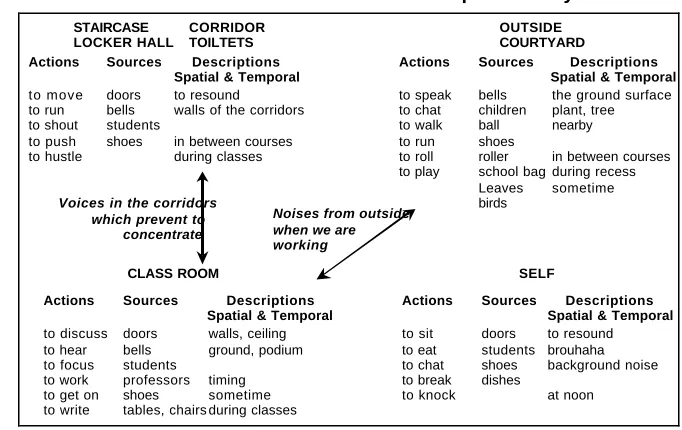
Those descriptions of the sound context underline the negative assessment of the signal. Teachers and administrative employees appear more resigned: they depict students like the main sound sources and therefore without any possible management from a conception point of view. Analyses from other schools would be necessary to make further conclusions. The comments' analyses are synthesised through Figure 2 identifying the linguistic representations of soundscapes with associated locations identified from students' questioning.
[image:3.596.108.466.555.770.2]This article presents the "Touleuses" secondary school results which will by crossed analysed with further studies in two other buildings ("La justice" and "Gerard Philippe" schools).
Figure 2. Classification of school locations from the inquiries analyses.
Descriptions Spatial & Temporal Sources Actions to move to run to shout to push to hustle doors bells students shoes to resound walls of the corridors
in between courses during classes
CLASS ROOM STAIRCASE
LOCKER HALL
Noises from outside when we are working Voices in the corridors
which prevent to concentrate
OUTSIDE COURTYARD
Descriptions Spatial & Temporal Sources Actions to discuss to hear to focus to work to get on to write doors bells students professors shoes tables, chairs walls, ceiling ground, podium timing sometime during classes Descriptions Spatial & Temporal Sources Actions to speak to chat to walk to run to roll to play bells children ball shoes roller school bag Leaves birds
the ground surface plant, tree nearby
[image:3.596.123.464.556.771.2]2.2 Ergonomic Approach
An ergonomic approach considers school as a complex “work tool” in the way of a socio-technical system. From this point of view, each person has to work under “body and mental pressure”. Those works are proceeded in an environment more or less tiring, pleasant or stressful, which can influence the “body and mental pressure” [Ignazi et al 2000].
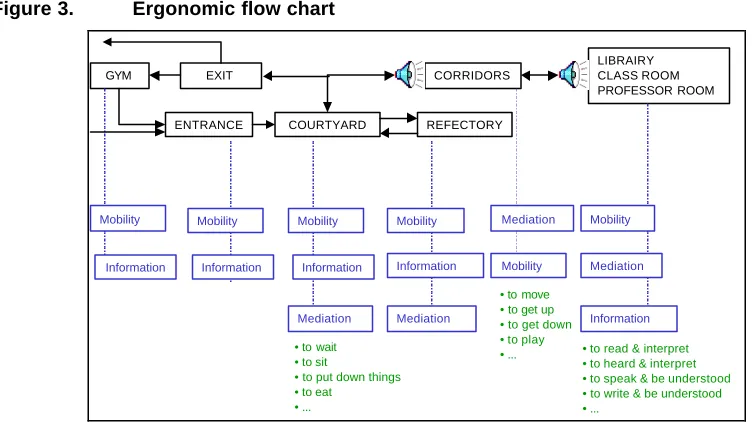
[image:4.596.89.465.281.492.2]For our investigations, this approach consists to separate into activities all the uses of the educational buildings into activities. This study confirms that acoustical identification depends on activities, for a specific moment, in a specific place [Maffiolo 1999]. Therefore, we synthesise educational building activities that we identified in an flow chart. Four types of persons are distinguished: students, teachers, and administrative and technical employees. Following the results of the analyses of the inquiries, we observe that it would be more pertinent to precise the time sequences for those activities in typical locations in order to match with acoustical perception. Analyse of Figure 3 identify several activities, which could be realised by those four types of persons during their daily occupations.
Figure 3. Ergonomic flow chart
GYM EXIT
ENTRANCE COURTYARD REFECTORY
CORRIDORS
LIBRAIRY CLASS ROOM PROFESSOR ROOM
Mobility Mobility
Information
Mobility Mediation Mobility
Mediation Mobility
Mobility
• to wait • to sit
• to put down things • to eat
• ...
• to move • to get up • to get down • to play
• ... • to read & interpret
• to heard & interpret • to speak & be understood • to write & be understood • ...
Information Information
Information
Mediation
Mediation Information
2.3. Acoustical Measurements
2.3.1 Protocols
The external acquisition set consists of one transducer linked to a small acquisition unit (a single channel microphone), which transfers data in real-time to a notebook computer. This instrument allows several functions such as recording the raw audio signal, measuring the noise level time history or showing the changing real-time frequency spectrum. Furthermore, we recorded signals (alarms, slamming doors) and soundscapes in corridors, school yard and lunch-room with a stereo system (ORTF).
2.3.2. Acoustical data analyses
First, we calculate with the measurement system, several building and room acoustic indicators. The tested places were selected taking into account the mentioned areas analysed through the inquiries (Figure 2).
Two types of room indicators were calculated with the MLS sequences, for indoor and outdoor corridors, hall, classes, library and lunchroom:
- the RASTI and Clarity index C80 which are not mentioned in the French regulation but inform about the intelligibility. Distance between source and receiver is about 5 meters. Building indicators such as standardised insulation DnA,T were calculated with a pink noise or with a traffic noise, when the noise coming from outside was mentioned by persons (Figure 2).
Table 1. Room acoustic indicators for the “Touleuses” secondary school building. (for simplicity, only 1000 Hz results are presented)
Locations RT 1000Hz C80 1000Hz RASTI
lunch room 0,54 s 11,8 dB 0,74
indoor corridor 1,75 s - 0,4 dB 0,57 outdoor corridor 1,66 s 2,8 dB 0,55
library 0,86 s 1,9 dB 0,64
teacher room 0,77 s 5,7 dB 0,69
classroom 8 1,69 s - 0,8 dB 0,51
Table 2. Building acoustic indicators for the “Touleuses” secondary school.
Emission Reception DnA,T
indoor corridor classroom 8 25 dB(A)
classroom 7 classroom 8 41 dB(A)
Students and teachers mentioned some classrooms where noise comes from inside and outside. The indices are calculated in classrooms 8 (Table 1), shows that acoustic quality is not good at all for a measurement point of view. The Reverberation Time is too long, the Clarity index is less than 0dB for a point in the middle of the room (about 5 meters from the source). Consequently, the RASTI is only equal to 0,51. The standardised insulation with the neighbouring classroom is 41 dB(A) and with the corridor is only 25 dB(A). As the building was built in 1972, the new acoustic regulation from 1995 is not respected. Teaching and learning in that room is definitely difficult.
The lunch room of the “Touleuses” school is also considered as noisy. The average Reverberation Time is only 0,6 s which is very good concerning the limits of the French regulation. The RASTI is quite good too. But students complain about the sound level. This is the consequence of a great number of students eating in the lunch-room (21x14,5x3,5 m3 for about 300 students). When students are speaking together at the same time, a short reverberance cannot reduce the ambient level.
Teachers mentioned also the staff room, which is uncomfortable at break time. It is impossible to speak with another person without yelling. The Reverberation Time is equal to 0,8 s and the RASTI is 0,69. In that room, the level of the background noise is 43 dB(A), due to the coffee machine. When about 25 teachers are together in that room, the equivalent level during the break, in the middle of the room, is 75 dB(A). The ring lasts 10 seconds and its level is 77 dB(A) with 76 dB at 9650 Hz. Therefore, the sharpness is 3 acum. Even if this level is just above the ambient level, the teachers complain about this ring sound. Except the Reverberation Time, which is correct with regard to the French regulation, the ring sound and the ambient level are not dealt in this text.
3. ASSESSMENT NOTICES
3.1. Conception of Assessment Notices of Educational Buildings Spaces
The assessment notices concern all the activities identified by the cognitive approach. Times and locations have to be referred to in those notices, for sounds are mainly represented by sources as element of a "context". The characterisation of the persons, considered as "users", and the weather conditions are needed. Each notice includes a list of questions, coming from the perceptive approach, which lay the ground for the assessment. But, are those notices relevant for the acoustical quality assessment of educational building? We intent to process new inquiries with those assessment notices: we will ask other teachers, students and administrative employees to answer questions, following different referenced situations. All the data collected in those notices will be integrated into a data base.
3.2. Possible Link or Lack in the Acoustic French Regulations of Educational Buildings
In the assessment notices, each question is associate to a physical measure each time it is pertinent. For example, for the notice concerning the listening activity in the classroom 8 at the end of a lecture, for the question concerning noises coming from outside the room, a link will be create with the insulation indicators DnA,T due to pink or traffic noise. Those indicators, which are mentioned in the French regulation will be compared with limits of this regulation. Here, DnA,T = 41 dB(A) with the next classroom is under the 44 dB(A) demanded by the French regulation. At the question concerning the understanding of the alarms, a link will precise that no rules are mentioned in the French regulation, but this aspect of the sound perception have to be taken into account. Alarms, sound events will be presented as examples of sound design.
3.3. New Data Base for Architects and Planners
All notices will be fulfilled by "users" themselves and/ or by "experts". They will be gathered into a database, where different schools would be evaluated. This base could be used just as a synthesis of soundscapes qualities of a school, but it could be used also by architects as an aid to design new educational buildings. A special care will focus on the simplicity of the data base, in order to ease information research for the design approach of an architect.
4. CONCLUSION
This method could be enlarged to assess comfort in buildings. In France, architects and planners are encouraged to have a High Environmental Quality (HQE) approach. In that approach, visual, thermal, acoustical and olfactory comforts are mentioned but are rarely evaluated after construction and in use. With the assessment notices, w propose a pertinent tool for the sensitive perceptions analyses, in order to help designers to evaluate their High Environmental Quality approach, concerning general comfort.
REFERENCES
[Ignazi et al 2000] Anthropologie et ergonomie de l'espace public; Approche Eco-Ethnologique, Ergonomique et Environnementale du transport public urbain. Recherche ACI Ville; MENRT.
[Maffiolo 1999] De la caractérisation sémantique et acoustique de la qualité sonore de l'environnement urbain, thèse de doctorat, Université du Maine, 1999.
[Tfoin 1996] La qualité acoustique des lycées et des clollèges. Une aide à la programmation et à la décisi on, Ministère de l'Environnement, Mision Bruit.