
Other uses, including reproduction and distribution, or selling or
licensing copies, or posting to personal, institutional or third party
websites are prohibited.
In most cases authors are permitted to post their version of the
article (e.g. in Word or Tex form) to their personal website or
institutional repository. Authors requiring further information
regarding Elsevier’s archiving and manuscript policies are
encouraged to visit:
Author's personal copy
Are
there
population
differences
in
minutiae
frequencies?
A
comparative
study
of
two
Argentinian
population
samples
and
one
Spanish
sample
Esperanza
Gutie´rrez-Redomero
a,d,*
,
Noemı´ Rivalderı´a
a,d,
Concepcio´n
Alonso-Rodrı´guez
b,d,
Luis
M.
Martı´n
c,d,
Jose´ E.
Dipierri
e,
Miguel
A.
Ferna´ndez-Peire
f,d,
Ricardo
Morillo
f,da
DepartamentodeZoologı´ayAntropologı´aFı´sica,FacultaddeBiologı´a,UniversidaddeAlcala´,Alcala´ deHenares,Spain
b
DepartamentodeMatema´ticas,FacultaddeBiologı´a,UniversidaddeAlcala´,Alcala´ deHenares,Spain
cBrigadadePolicı´aCientı´ficadelaComisarı´adeAlcala´ deHenares,Spain
dInstitutoUniversitariodeInvestigacio´nenCienciasPoliciales,UniversidaddeAlcala´,Alcala´ deHenares,Spain e
InstitutodeBiologı´adelaAltura,UniversidadNacionaldeJujuy,Argentina
f
Comisarı´aGeneraldePolicı´aCientı´fica,Madrid,Spain
1. Introduction
Theskinontheinnerhandsandfingersandonthesolesofthe feetandtoesischaracterizedbyalternatingstripsofraisedridges andfurrowsarrangedinavarietyofpatternsandiscalledfriction skin.Thefrictionskinistheouterlayerofskinthatcontainsmany of the elements and characteristics we use to identify and individualizeaprint.Fingerprintsaretheimpressionor reproduc-tionleftonanymaterialbythefrictionskinofthefingers,andthe scientificstudyoffingerprintsforthepurposeofidentificationis knownasDactyloscopy[1–3].
The formation of epidermal ridges occurs very early on in prenataldevelopment[4,5].Dermalpapillaeridgesarepolygenic
characteristicswithenvironmentaleffectslimitedtothefirstfew monthsofembryoniclife[6].Onceformed,andintheabsenceof lesions,theseridgeswillremainessentiallyunchangedthroughout thelifeoftheindividual.Theexceptionisthat,likeotherpartsof theanatomy,thefingerprintsorfrictionskinincreaseinsizeasthe bodygrows[7].Studiesoftheirvariabilityinhumanpopulations have demonstrated the usefulness of the information obtained aboutthesecharacteristicsforunderstandingtheevolution and geneticstructureof humanpopulations [8,9],forcharacterizing syndromesanddiseases[10–12],andforpersonalidentificationin thefieldofForensicScience[13–15].
Oneofthebasicproceduresintheidentificationprocessusing fingerprintimpressionsisacomparisonoftheminutiaefoundin fingermarksobtainedatthesceneofthecrimewiththoseobserved inthefingerprintstakenfromthesuspect.Theproblemisthatthe minutiae, a term coined by Galton [16] to refer to the small distinguishingfeaturesfoundalongeachindividualridge,present aninter-andintra-populationalvariabilitywhichhasbeenpoorly studied, despite constituting the basis for identification from fingerprintimpressionsinthefieldofCriminalistics,see[17,18]. ForensicScienceInternational222(2012)266–276
ARTICLE INFO
Articlehistory:
Received26August2011 Receivedinrevisedform9June2012 Accepted4July2012
Availableonline25July2012
Keywords:
Fingerprints
Minutiae
Frequencies Identification Argentinapopulation Spanishpopulation
ABSTRACT
Inrecentyears,bothscientificandjudicialsourceshavehighlightedtheneedformoreknowledgeabout minutiaevariability,inordertoimprovetheirstatisticalapplicationtofingerprintidentification.Inline withthistrendtowardimprovingourknowledgeofthissubject,theaimofthepresentstudywasto calculatethefrequencywithwhich20typesofminutiaeappearedin2780fingerprintimpressions obtainedfrom278individualsfromtwoArgentinianpopulationsamples(100individualsfromRamal and178fromPuna–Quebrada).Thedifferenttypesofminutiaewerelocated,identified,andquantified visuallyintwoareasonthefingerprint,theinsideandoutsideofacircle,theradiusofwhichcutfifteen ridges perpendicularly, starting from the center cut of the axes defining the sectors. The non-equiprobabilityfoundinbothpopulationsamplesforthedifferentminutiaetypesstudieddemonstrated that the evidential weight provided by these characteristics is not the same when applied in identificationprocesses,whetherusedquantitatively(numericalstandard)orqualitatively(holistic method).Theresultsobtainedforbothpopulationswerecomparedstatisticallywiththosepublished previouslyforaSpanishpopulationsample,whichhadbeencollectedusingthesamemethodology.This comparisonhasenabledustodemonstrate,forthefirsttime,theexistenceofsignificantdifferences betweenpopulationsinminutiaefrequencies,independentlyfromthemainpatterntype.
ß2012ElsevierIrelandLtd.Allrightsreserved.
* Correspondingauthorat: DepartamentodeZoologı´ay Antropologı´aFı´sica, UniversidaddeAlcala´,CampusUniversitario,Crta.Madrid-BarcelonaKm33,6,E 28871,Alcala´ deHenares(Madrid),Spain.Tel.:+34918855074;
fax:+34918855080.
E-mailaddress:[email protected](E.Gutie´rrez-Redomero).
ContentslistsavailableatSciVerseScienceDirect
Forensic
Science
International
j o urn a l hom e pa g e : ww w . e l se v i e r. c om / l oca t e / f ors ci i nt
0379-0738/$–seefrontmatterß 2012ElsevierIrelandLtd.Allrightsreserved.
Recent challenges to fingerprint evidence in court have strengthened the need for statistical research to underpin the fingerprintidentificationprocess.Theproblemoftheuniqueness of fingerprintimpressionswasearlieraddressed[16],andsince then, various models have been proposed for establishing this uniqueidentity,acriticalanalysisofthemodelsproposedhasbeen madebyStoneyandThornton[19],Stoney[20]andSrihariand Srinivasan[21].Thesemodelshavebeenbasedonvery heteroge-neous, and generally very small, samples and very disparate approaches(studyingdifferenttypesofminutiae,different finger-print patterns, different fingers and different finger areas) see [17,18]. Recently, Neumann et al. [22–24] and Egli et al. [25] reportedontheuseoflikelihoodratiosasameansofobjectively assessingtheevidentialweightofcorrespondingminutiaebetween afingermarkandafingerprint.
Thegrowingrigorwithwhichforensicevidenceisexaminedin thelegislativeareahasresultedintheneedtoreconsidersomeof the basic principles that support forensic disciplines in their recognition assciences[26–38].Inthefieldoffingerprints, itis necessary to study and analyze the scientific principles that determinetheprocessofindividualizationinhumanidentification. Any attempt to establish such premises must be based on increasing knowledge about of minutiae variability, given that these are one of the cornerstones of fingerprint identification, whetherusedquantitatively(numericalstandard)orqualitatively (holisticapproach)[2,18,35–39].Linkedtothisissue,theNational Academyof Sciences(NAS)publishedareportofgreat interna-tional impact entitled ‘‘Strengthening Forensic Science in the UnitedStates.Apathforward’’,[35]whichcitedastudycarriedout with a Spanish population as being one of the few statistical studiesofpopulationswhichhavebeenconductedinthisfieldin recentyears[17],andemphasizedtheneedtoimproveknowledge aboutvariabilityinfingerprintcharacteristics.
In the study conducted on a sample of Spanish population [17,38]thedifferenttypesofminutiaewerelocated,identified,and quantifiedvisuallyonthefingerprint,followinganewmethodof standardization,andtheseshowedsignificantdifferencesbetween intrafingers(topological),interfingers,andgender,whichgiveeach of thetypes ofminutiae a differentdiscriminatoryvalue in the processofidentification.Theaimofthisresearchwastoconducta morein-depthstudyonminutiaevariabilityinotherpopulations following the methodology used previously, thus enabling a comparisonoftheresults.
2. Materialsandmethods
UndertheaegisofaprojectfundedbytheSpanishAgencyfor InternationalCooperation(AECI)forthestudyand characteriza-tionoftheArgentinianpopulation,sampleswerecollectedfrom different populations in the northwesternmost region of the country.Presentinggreatgeographicalheterogeneity,thisregion canbedividedintofourclearlydefinedecologicalunits,regarding totheelevationoraltitudeinmetersabovesealevel(m.a.s.l.):Puna (3500m.a.s.l.),Quebrada(2500m.a.s.l.),Valle(1200m.a.s.l.)and Ramal (500 m.a.s.l.), which have been settled by different populationswitha commongeneticandculturalorigin[40,41]. Fingerprintimpressionsfromalltenfingerswerecollectedfroma sampleofadultindividualsofbothsexesinthreeoftheregions mentionedabove:PunaandQuebrada(>2500m.a.s.l.)andRamal (500m.a.s.l.).
The samples were collected at the Police Academy at San Salvador deJujuyandat variouseducationalinstitutionsin the province,withtheinformedconsentof theindividualsstudied. Sampleswerecollectedfromatotalof278adultindividuals.Of these,100(51malesand49females)werefromthecityofSan PedrodeJujuy,locatedintheRamalregion,and178(85malesand
93females)werefromdifferentlocationsintheregionsofPuna andQuebrada.Totalsamplesize,therefore,was2780fingerprint impressions.Subjectoccupationwastakenintoaccount,andthose whowereemployedinmanualworkwereexcludedfromthestudy asthiscouldaffectthemorphologicalanalysisofdermalpapillae ridges.
Thetechniqueusedtocollectfingerprintimpressionswasa variationontheadhesivepaperandgraphitemethoddescribed byAaseandLyons[42].Fingertippapillaeridgeswerestained homogeneouslywithgraphitepowderandthenrolledoverthe sticky side of an appropriatelysized label.Next, these labels were stuck to transparent acetate sheets which had been designed so that each sheet had ten separate areas for depositing each of the ten fingerprint impressions obtained from a single individual. The fingers were assigned the numbers 1–10, starting from the right thumb, or finger 1 (F1),and endingwith theleftlittlefinger,or finger10(F10). Theimageofthefingerprintimpressionthusobtainedprovides amirrorimageofthefingerprint,similartothatachievedusing the classicalink and paper technique.The fingerprints were digitalized,fingerbyfinger,onthepremisesoftheCommissary of Scientific Police at Alcala´ de Henares (Madrid). Each true color(24bit)jpgimagehadasizeof14962002pixels,witha resolutionof 200ppior 79pixels/cm.
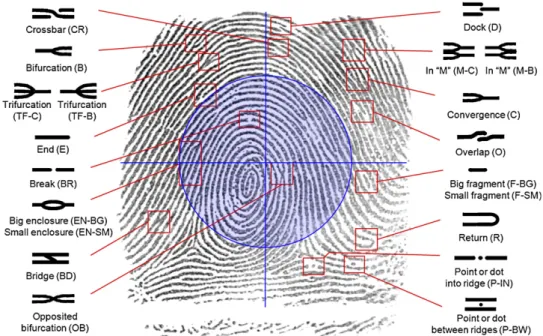
Identification of theminutiae in this study was based on a modifiedversion,see[17,38],oftheclassificationsystemusedby theSpanishScientificPolice[43].Atotalof20typesofminutiae were identified and quantified visually on the inside and the outside of a circle, the radius of which cuts fifteen ridges perpendicularly,inoneofthedistalquadrants,startingfromthe centercutofthetwoperpendicularaxeslocatedatthecenterofthe fingerprint(Fig.1).Thestandardizationchosenforthisstudyhas beendonewiththeaimofcomparingthecentralandperipheral areasofthefingerprintinallpatterntypes(arches,radialloops, ulnarloops,andwhorls).Therefore,thestandardizationhasbeen made,seekingadistributionofareas,similarinsize,sothatthe designedcircleremains locatedinthecentralareaofthefinger (whichispickedupmorefrequentlyinfingermarks).Thisallowsus toassessthecompletetopologicaldistributionoftheminutiaeon thefingerprint’ssurfaceandtocreateresultscomparableacross populations (Spanish and Argentinian). The circle is used to eliminate, asfaraspossible,theeffectof fingersize.Thus, this standardization allows comparison of minutiae frequencies be-tweendifferentfingers,gendersandpopulations.
Thisfacilitatedtheindividualizationof5560ridgecountareas for analysis; i.e., 2 areas (outside and inside circle) on 2780 fingerprints (Fig. 1), on which 233,251 minutiae were found. Codingofthefingerprintsallowedustobuildadatabaseconsisting of 278 individualsand 412variablesby individual (number of minutiaecountedin2areas10fingers20typesofminutiae, sex, placeof birth and general pattern type for each of the10 fingers).
Author's personal copy
Theresultsobtainedfromthisstudyof Argentiniansamples were compared with those of a Spanish population sample, collected andanalyzedin aprevious study[38]usingthesame methodology. To compare the data obtained for the three populations,weusedthetestfordifferencebetweenproportions and the test for independence of characteristics (Chi-square), conductingacorrespondenceanalysiswheneverdependencewas detected. Furthermore, the interpopulation comparison of the minutiae frequencies has been conditioned by general pattern (arch,loop,andwhorl).
3. Results
The minutiae frequencies, for the total sample and by sex, obtained from 1000 fingerprint impressions from the Ramal sampleand1780fromthePuna–Quebradasampleareshownin Tables 1 and 2, respectively. For the total sample (males and
females),andforbothpopulations,weobservedthatthefrequency ofendings(E)wasconsiderablyhigherthantherestoftheminutiae (Ramal: 50.14%; Puna–Quebrada: 51.69%), followed by the frequency of bifurcations (B) (Ramal: 21.17%, Puna–Quebrada: 19.91%) and convergences (C)(Ramal: 19.19%,Puna–Quebrada: 18.28%). The restof theminutiae presentedconsiderably lower frequencies.IntheRamalsample(Table1),fragments(F),whether large (F-BG) or small (F-SM), crossbars (CR) and bridges (BD) presentedfrequencieswhichrangedfrom1%to2%;whilstinthe Puna–Quebradasample(Table2),fragments(F),whetherlarge (F-BG)orsmall(F-SM),breaks(BR)andpointsbetweenridges(P-BW) werethecharacteristicswhichpresentedfrequenciesbetween1% and2%.Theremainingminutiaeanalyzedpresentedfrequenciesof less than 1%. The distribution of minutiae frequencies in both populations highlighted their non-equiprobability (p<0.01). Insidethe circle,both populations presentedlower frequencies forendings(E)thantheypresentedoutsidethecircle.Incontrast, Fig.1.Idealizationof20typesofminutiaeusedinthisstudyandridgecountareas(insideandoutsidethecircle).
Table1
FrequenciesregisteredforminutiaefromtheRamalsample,totals,malesandfemales,insideandoutsidethecircleandtotalarea(ofthetenfingers),n=totalnumberof
minutiae,a
,b
p<0.05.
Total(n=85,269) Males(n=44,923) Females(n=40,346)
Totalarea Insidecircle Outsidecircle Totalarea Insidecircle Outsidecircle Totalarea Insidecircle Outsidecircle
E 50.139 45.495 53.168 49.638 45.045 52.511a
50.696 45.970 53.926a
B 21.166 24.015 19.308 21.848 24.967b 19.898 20.406 23.009b 18.627
C 19.188 20.221 18.513 19.841 20.836 19.218 18.460 19.571 17.701
F-BG 1.093 1.043 1.126 0.966 0.879 1.020 1.234 1.215 1.247
F-SM 1.495 1.420 1.544 1.269 1.221 1.299 1.747 1.630 1.827
BR 0.814 0.838 0.798 0.759 0.821 0.720 0.875 0.855 0.889
EN-BG 0.911 1.245 0.694 0.850 1.192 0.637 0.979 1.301 0.759
EN-SM 0.774 1.153 0.527 0.748 1.145 0.499 0.803 1.160 0.559
P-BW 0.493 0.556 0.452 0.414 0.486 0.369 0.580 0.629 0.547
P-IN 0.063 0.059 0.066 0.049 0.075 0.033 0.079 0.043 0.104
O 0.751 0.654 0.814 0.735 0.619 0.807 0.768 0.690 0.822
CR 1.328 0.891 1.612 1.701 1.041 2.113 0.912 0.733 1.035
BD 1.230 1.673 0.942 0.761 1.093 0.554 1.752 2.284 1.389
OB 0.224 0.258 0.202 0.127 0.150 0.112 0.332 0.372 0.305
D 0.054 0.056 0.052 0.038 0.040 0.036 0.072 0.073 0.071
TF-B 0.056 0.107 0.023 0.047 0.098 0.014 0.067 0.116 0.033
TF-C 0.024 0.045 0.010 0.013 0.035 0.000 0.035 0.055 0.021
M-B 0.101 0.128 0.083 0.093 0.110 0.083 0.109 0.147 0.083
M-C 0.097 0.146 0.066 0.102 0.145 0.076 0.092 0.147 0.054
E.Gutie´rrez-Redomeroetal./ForensicScienceInternational222(2012)266–276
bifurcations(B)andconvergences(C)weremorefrequentinside the circle. These differences were statistically significant in all cases(Tables1and2).
IntheRamalsample,acomparisonbetweenthesexesshowed thatmalespresentedsignificantlymorebifurcations(B)insidethe circle and fewerendings (E) outside it than females (Table 1). Convergences (C) were more frequent in the males than the females,bothinsideandoutsidethecircle.InthePuna–Quebrada sample(Table2),wefoundthatthemalespresentedsignificantly more endings(E) andfewerconvergences(C)thanthefemales, both inside and outside the circle. Significant differences for bifurcations(B)wereonlyfoundoutsidethecircle,andthesewere lessfrequentinthemales.
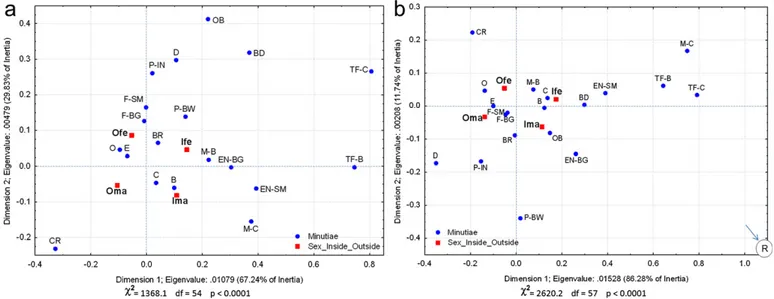
The distribution of the different types of minutiae was significantly dependent on finger area (inside and outside the circle)andsex.Thecorrespondenceanalysisforbothpopulationsis showninFig.2.IntheRamalsample,bothdimensionsexplained 97.07% (Fig. 2a) and in the Puna–Quebrada sample, 98.02%
(Fig.2b).Forbothpopulations,thefirstdimensionseparatedthe distribution of minutiae frequencies in the periphery of the dactylogram (outsidethe circle) fromthose in thecentral area (insidethecircle),anditwasthislatterareawhichpresentedthe greatest diversity of minutiae types. The second dimension separated females from males, with the former presenting a greaterdiversityofminutiaetypes.
We explored the relationship between the distribution of minutiaetypesandthefingers(F1,...,F10),consideringtotalfinger surfaceareaandinsideandoutsidethecircle,forbothpopulations, andfoundsignificantdependenceinallareas.Thecorrespondence analysisdemonstratingthisdependenceinsidethecircleinboth populationsisshowninFig.3.IntheRamalsample(Fig.3a),the twodimensionsexplained91.12%ofinertia.Thefirstdimension separatedtherighthandfingersfromthoseofthelefthand,and thesecond dimensionseparated thethumb fingers (F1and F6) fromtherestofthefingers.Endings(E)werelocatedverycloseto thecoordinatecenterandwere,byfar,themostfrequenttypeof Table2
FrequenciesregisteredforminutiaefromPuna–Quebradasample,totals,malesandfemales,insideandoutsidethecircleandtotalarea(ofthetenfingers),n=totalnumberof
minutiaefoundinarea,a,b,cp<0.05.
Total(n=147,982) Males(n=72,073) Females(n=75,909)
Totalarea Insidecircle Outsidecircle Totalarea Insidecircle Outsidecircle Totalarea Insidecircle Outsidecircle
E 51.690 45.458 55.756 53.469 46.676a
57.626b
50.001 44.387a
53.890b
B 19.906 22.806 18.014 19.161 22.271 17.259c
20.613 23.278 18.766c
C 18.278 21.033 16.480 16.977 20.169a
15.024b
19.513 21.794a
17.932b
F-BG 1.415 1.354 1.455 1.469 1.276 1.588 1.363 1.423 1.322
F-SM 2.284 2.198 2.340 2.356 2.230 2.433 2.216 2.169 2.248
BR 1.122 1.145 1.108 1.224 1.385 1.125 1.026 0.933 1.091
EN-BG 0.758 1.030 0.580 0.795 1.118 0.597 0.722 0.953 0.562
EN-SM 0.988 1.427 0.701 0.814 1.203 0.577 1.153 1.625 0.825
P-BW 1.039 1.195 0.937 1.371 1.521 1.279 0.723 0.908 0.595
P-IN 0.099 0.087 0.107 0.121 0.113 0.125 0.079 0.064 0.089
O 0.793 0.649 0.888 0.795 0.654 0.881 0.792 0.644 0.894
CR 0.809 0.556 0.974 0.688 0.450 0.834 0.923 0.650 1.113
BD 0.576 0.779 0.444 0.513 0.691 0.405 0.636 0.856 0.484
OB 0.080 0.096 0.069 0.082 0.099 0.072 0.078 0.093 0.067
D 0.076 0.050 0.093 0.097 0.058 0.121 0.055 0.042 0.065
TF-B 0.020 0.034 0.010 0.014 0.022 0.009 0.025 0.045 0.011
TF-C 0.014 0.027 0.006 0.010 0.018 0.004 0.018 0.035 0.007
M-B 0.032 0.034 0.030 0.029 0.022 0.034 0.034 0.045 0.027
M-C 0.020 0.036 0.009 0.011 0.018 0.007 0.028 0.051 0.011
R 0.002 0.005 0.000 0.003 0.007 0.000 0.001 0.003 0.000
Author's personal copy
minutiaeinallfingers.Convergences(C)wereassociatedwiththe middle(F3),ring(F4)andlittle(F5)fingersoftherighthand.In contrast,bifurcations(B)weremoreassociatedwiththelefthand, andinparticular,withtheindex(F7),middle(F8),ring(F9)and little(F10)fingers.Theremainingminutiaewerelargelyassociated withthethumbs(F1andF6) andindexfingers(F2 andF7).All convergentminutiae(C,TF-C,M-C),ornegativedirection(sensu Champod,[44]),weremorefrequentontherighthand;incontrast,
itwasthebifurcateminutiae(B,TF-B,M-B),orpositivedirection (sensuChampod,[44]),thatweremostfrequentonthelefthand.In the Puna–Quebrada sample (Fig. 3b), the two dimensions significantlyexplained89.42%ofinertia,andthefirstdimension separatedtherighthandfingersfromthoseofthelefthand,whilst theseconddimensionseparatedthethumbsofbothhands(F1and F6)andthelefthandindexfinger(F7)fromtherestofthefingers. In the Ramal sample, the association between fingers and
Fig.4.Frequenciesforthetypeofpatternsbyfinger(F1,...,F10):(a)Ramalsample;(b)Puna–Quebradasample.Analysisofcorrespondencebetweengeneralpatternsandthe fingers:(c)Ramalsample;and(d)Puna–Quebradasample.
Fig.3.Analysisofcorrespondencebetweenthetypesofminutiaeandthetenfingers(F1,...,F10)inthecentralareaofthefingerprint(insidecircle):(a)Ramalsample;(b) Puna–Quebradasample(theminutiaeR,farawayfromallothers,havebeencutfromthegraphandplacedontheperiphery–lowerleftcorner–forabettervisualizationof therelationshipsamongoftheotherminutiae).
E.Gutie´rrez-Redomeroetal./ForensicScienceInternational222(2012)266–276
bifurcations and convergences presented the same pattern. In addition,itcanbeseenthatthethumbsseparatedfromtheother fingers.Thispatternofassociationalsoappearedoutsidethecircle, in both populations. Similarly, when the total sample (both populations)wasanalyzedbysex,wefoundthatbothmalesand femalespresentedthesametypeofassociationanddependence betweenthedistributionofminutiaetypesandfingers.
Thefrequencyfoundformainpatterntypesbyfinger,forboth Argentinian samples,is shown in Fig. 4.These didnot present significant differences between samples or between sexes. In Fig.4a–b,similarvaluesbetweenhomologuefingerscanbeseenin bothpopulations:whorlsweremorefrequentonthumbsandring fingers(F1,F4,F6andF9),whilstulnarloopsweremorefrequent onthemiddleand littlefingers (F3,F5,F8and F10).Theindex fingersofbothhands(F2andF7)presentedahigherfrequencyof archesandradialloops,withsimilarfrequenciesforwhorlsand ulnarloops.Correspondenceanalysisbetweenmainpatterntype
and fingers revealed a significant association between them (Fig.4c–d):inbothpopulations,thethumbs(F1andF6)andring fingers(F4andF9)wereassociatedwithwhorls,themiddle(F3 andF8)andlittle(F5andF10)fingerswithulnarloops,andthe indexfingers(F2andF7)witharchesandradialloops.IntheRamal sample, thetwo dimensionsexplained97.95%of thevariability found, whilst in the Puna–Quebrada sample, they explained 98.77%.Inbothsamples,thefirstdimensionseparatedthemiddle (F3andF8)andlittle(F5andF10)fingers,whichpresentedmore ulnarloops,fromtherestofthefingers,whichhadmorewhorls. Thedependencebetween theminutiaeandthemainpattern types,byfingers(F1,...,F10),wasstatisticallysignificantinboth populations(Fig.5).Forthesampleinsidethecircle,Fig.5shows theCAbetweenthetypesofminutiaeandthetwomostfrequent typesofpatterns,ulnarloops(UL)andwhorls(W)foreachfinger. Thereturnminutia(R)isanoutlier,i.e.farawayfromallothersand fromthepointoforigin,andthereforethisminutiaindicatesaclear Fig.5.Analysisofcorrespondencebetweenthetypesofminutiaeandthetwomostfrequenttypesofpatterns:ulnarloop(UL)andwhorl(W),foreachfinger(1,...,10):(a) Ramalsample;(b)Puna–Quebradasample.
Author's personal copy
deviationfromwhatwewouldexpectundercomplete indepen-dence.Ithasbeencutfromthegraphandplacedontheperiphery, toprovideabettervisualizationoftherelationshipsbetweenthe other minutiaein the Puna–Quebrada sample(Fig. 5b).For the Ramal sample, correspondence analysis explained 79.23% of inertia (Fig. 5a), and 81.73% for the Puna–Quebrada sample (Fig.5b).Thefirstdimensionseparatedtherighthandfingersfrom thoseofthelefthand,inbothpopulations.Fingerswithulnarloops asthemainpatterntypeweregreaterdeterminantsofdependence betweenminutiaetypesandfingers,andtheirdistributioninthe analysiswasthusfoundtobefurtherfromthecenterofgravity. Meanwhile,theseconddimensionseparatedthethumbsofboth hands,whetherwithwhorlsorulnarloops,fromtherestofthe fingers,whichweremoreassociatedwithconvergences(C)onthe righthand(F2,....,F5)andbifurcations(B)onthelefthand(F7,...., F10). In the analysis, endings (E) were located close to the coordinate axis, or center of gravity, contributing less to dependencesincetheywerethemostfrequenttypeminutiaeof inbothsamples(Fig.5).
AcomparisonisshowninFig.6ofthefrequencyresultsforthe Argentinian populations and the Spanish population sample published previously[38], consideringendings (E), bifurcations (B)andconvergences(C),bothinsideandoutsidethecircle.The differencesobservedinthesethreetypesofminutiae(endings-E, bifurcations-Bandconvergences-C)betweentheSpanishsample and the Ramal and Puna–Quebrada samples were statistically significantbothinsideandoutsidethecircleandforbothsexes: endings (E) were more frequent in the Spanishsample, whilst bifurcations(B)andconvergences(C)weremorefrequentinthe Argentiniansamples.Puna–Quebradamalespresented significant-lymoreendings(E)andfewerbifurcations(B)thanRamalmales, bothinsideandoutsidethecircle.Inaddition,thePuna–Quebrada malespresentedfewerconvergences(C)outsidethecirclethanthe Ramalmales.Incontrast,both insideandoutside thecirclethe Puna–Quebradafemalespresentedsignificantlylowerfrequencies ofendings(E)andmorebifurcations(B)thantheRamalfemales.In addition,thePuna–Quebradafemalespresentedsignificantlymore convergences(C)insidethecirclethantheRamalfemales(Fig.6). The relationship between ending (E), bifurcation (B) and convergence (C) frequencies and the three samples (Two ArgentinianpopulationsamplesfromRamalandPuna–Quebrada and a Spanishpopulation sample) was statistically dependent.
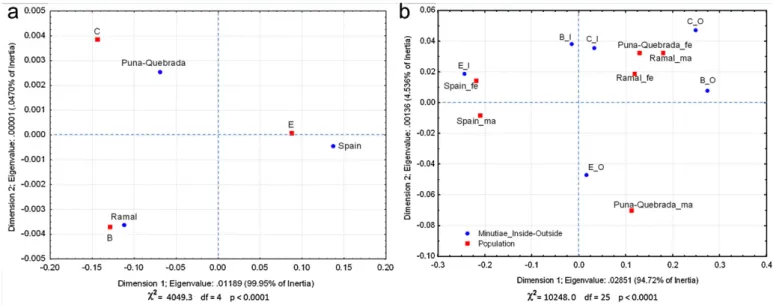
Consequently,weconductedacorrespondenceanalysis,shownin Fig.7.InFig.7a,thetwodimensionsexplained99.99%ofinertia, withthefirstdimensionseparatingtheSpanishpopulation,who presentedahigherfrequencyofendings(E),fromtheArgentinian populations (Ramaland Puna–Quebrada),whopresented lower frequencies of bifurcations (B) in the Ramal sample, and of convergences(C)inthePuna–Quebradasample.Fig.7bshowsthe results of the correspondence analysis considering sex. In this analysis,thetwodimensionsexplained99.26%ofinertia.Thefirst dimensionseparatedbothsexesoftheSpanishpopulationfrom theArgentinianpopulation,whilsttheseconddimension separat-edallfemalesandtheRamalmalesfromthePuna–Quebradaand Spanishmales.
Astheinfluenceofpatterntypeonthenumberofminutiaeis shownbyanincreasefromarches(nodelta)toloops(onedelta)to whorls(two or more deltas and complexity of the center)the impact of general pattern on interpopulation variation was investigated. Fig. 8 shows that pattern frequencies are quite different between the Argentinian and Spanish populations.
Moreover, the dependence on the main pattern types by
populationwasstatisticallysignificantinbothpopulations,with chi-square=95.06andp<0.0001.Therearelowerfrequenciesof ulnarloopsandwhorls,buthigherfrequenciesofarchesandradial loops in the Spanish populations than in the Argentinian populations.
Fig.7.(a)Analysisofcorrespondencebetweenthetypesofminutiae(endings–E,bifurcations–Bandconvergences–C),andArgentinianpopulations(RamalandPuna– Quebrada)andtheSpanishpopulationsamples.(b)Analysisofcorrespondencebetweenthetypesofminutiae(endings–E,bifurcations–Bandconvergences–C),genders (males:maandfemales:fe)andareas(insidecircle:Iandoutsidecircle:O)forArgentinianpopulations(RamalandPuna–Quebrada)andtheSpanishpopulationsamples.
Fig.8.Frequenciesforthepatterntypebypopulation:SpanishandArgentinian (RamalandPuna–Quebradatogether).
E.Gutie´rrez-Redomeroetal./ForensicScienceInternational222(2012)266–276
When conditioning using general pattern, the relationship between ending (E), bifurcation (B), and convergence (C) frequencies and thethree samples(twoArgentinianpopulation
samples from Ramal and Puna–Quebrada and one Spanish
population sample)wasstatisticallydependent,both insideand outside thecircle,as shownin Fig.9. Theresultsrevealhigher
frequenciesofendings(E)andlowerfrequenciesofbifurcations(B) and convergences (C) for all pattern types in the Spanish population than in theArgentinianpopulations. The significant dependency among minutiae(E,B, and C), type ofpattern, and population is shown in Fig. 10. The graph obtained with correspondence analysis highlights the association of endings withtheSpanishpopulation in allpattern types(arches,radial loops,ulnarloops,andwhorls)andtheassociationofbifurcations andconvergenceswiththeArgentinianpopulation.
4. Discussion
Although numerous studies have been carried out on the fingerprints of human populations, some of their inherent characteristicshave received moreattentionthan others.These includeaspectssuchasfrequencyofthemainpatterntypes (arch-A,radialloop-RL,ulnarloop-ULandwhorl-W)andthepartial(RC) ortotal(RCT)ridgecount,aswellastheirvariabilityandheredity in different human populations (see bibliography checklist in [45,46]). However, other features, such as the minutiae, have receivedcomparativelylessattention,despitebeingof consider-ableinterestduetotheirdirectrelevanceinpersonalidentification and despite early recommendations from various specialists [13,47–52].
Thus, it is difficult to compare the results obtained in the presentstudywiththosewhichhavebeenpublishedpreviously due to the different criteria employed, not only as regards classification ofthe minutiae,but alsoin termsof themethods employedfortheirassessment[47–57].Allotherstudies,withthe exception of those conducted by Gutie´rrez-Redomero et al. Fig.9.Frequencyofendings(E),bifurcations(B),andconvergences(C)ofthetenfingersfortheSpanish(S)[38]andArgentinian[Ramal(R)andPuna–Quebrada(PQ)] populationsampleswhenconditioningbygeneralpattern[arch(A),radialloop(RL),ulnarloop(UL),andwhorl(W)],considering(a)insideand(b)outsidethecircle.
Author's personal copy
[17–38],havebeenbasedonfingerprintsamplesfrommales,and vary considerably as regards sample size (from 39 to 1000 fingerprintimpressions),numberof fingersselectedforanalysis (only the thumb, only the index and middle fingers, or other combinations),thefingerareasassessed(distaltips,nucleararea, deltaarea,etc.)andthetypeofmainpatterntypeselected(usually the ulnar loop-UL and Whorl-W). The recent classifications by Ashbaugh[3]and Champod[44],withninemain types,arethe mostsimilartotheclassificationswhichwereusedinthepresent study.Standardizationofminutiaeclassificationcriteriaisahighly desirable objective in order to facilitate comparison between differenthumanpopulationsusingagreaternumberof morpho-logical minutiae characteristics. The advantage of using more minutiaetypesstemsfromthefactthatthelessfrequenttypesare accordinglythemostexceptional,andtherefore,themostuseful foridentificationpurposes[2,13,18,30,57].Forallthesereasons,it wasonly possibletoconducta very generalcomparison ofthe minutiaefrequenciesobtainedinourstudywiththemajorityof those which have already been published. Nevertheless, this general comparison indicated that the most frequent types of minutiaeareendings,followedbyconvergencesandbifurcations, althoughin themajorityofthesamplesfromotherstudies,the lattertwotypesofminutiaewerenotanalyzedseparately.Asinour study, the rest of the minutiae have been found to present considerably lower frequencies. In contrast, it was possible to compare the data we have presented here with the findings reported by Gutie´rrez-Redomero et al., [17,38] for a Spanish population sample,which wascollectedand analyzedusingthe samemethodology.
Theresultsobtainedinthisstudyshow,forthefirsttime,the topological, fingerand sex differences presentingin fingerprint impressionstakenfromtwoArgentinianpopulationsamples.Our resultsforbothsamplesreflecttheheterogeneousdistributionof minutiaeonthefingerarea,withdifferencesinfrequencybetween the different areas assessed. Coinciding with findings for the Spanish population [38], endings were located with more frequencyoutside thecircle(peripheralarea ofthefingerprint), whilstbifurcationsandconvergencesweremorefrequentinside thecircle(centralareaofthefingerprint).Otherauthors,suchas Kingston[48],Lin[53]andSclove[52],havereportedthatminutiae densityvariesaccordingtolocationonthefingerprintimpression, and more recently, Champodand Margot [55]have confirmed theseresults,findingahigherdensityofminutiaeinthenuclear anddelta(triradii)areasthanintheperipheryoftheimpression.In relation tosex, and in contrast tothe Spanishpopulation [38] wherenosexdifferenceswerefoundinminutiaetypefrequencies, bothArgentinianpopulationsdidpresentdifferencesforendings and bifurcations; the females presented a higher frequency of endings,andthemales,ofbifurcations.
Given the mirror image the hands present, the bifurcate minutiaeassessed(B,TFBandMB)wereassociatedwiththeleft hand, whilst the convergent minutiae (C, TFC and MC) were associated withtherighthand,coincidingwithfindingsforthe Spanishpopulation [38].Champodand Margot[55]highlighted theassociationofbifurcationsinapositivedirection(referredtoas bifurcationsinthisstudy)withulnarloopsonthelefthand,and bifurcationsinanegativedirection(referredtoasconvergencesin thisstudy)withulnarloopsontherighthand.AswiththeSpanish population,inthepresentstudywefoundthatthisassociationalso holdstrueforwhorls.
Asregardsmainpatterntype,theSouthAmericanIndianshave greatervariationinfrequencythananyotherAmericanpopulation (Eskimos,NorthAmericanIndiansandCentralAmericanIndians) [58,59]. The finger pattern type frequencies found in the two Argentiniansamplesfellwithinthedistributionrangedescribed for South American populations, and as withall other Andean
populations analyzed, the Puna–Quebrada sample presented a highfrequencyofradialloops[58,60].TheArgentiniansamples werecharacterizedby presentingmorewhorlsand fewerulnar loopsthanotherSpanishpopulation samples.Themain pattern frequencydistributionforeachfingershowsthattheuniversally observedpatternofanassociationbetweenwhorlsandthumbs and ring fingers, ulnar loops and middle and little fingers and archesandradialloopsandindexfingers[10:pp.79]isalsoevident inthesesamples.
Although the topological distribution pattern presented by endings (E), bifurcations (B) and convergences (C) in the ArgentinianandSpanishpopulationscoincided,wefound signifi-cantdifferences,forthefirsttime,inthefrequencyofminutiaein alltheareascompared(totalareaandoutside/insidethecircle). Thus, the Spanish population presented significantly higher frequenciesofendings(E),andlowerfrequenciesofbifurcations (B)and convergences(C)thaneitheroftheArgentinian popula-tions.Giventhedifferencesobservedbetweenthetwopopulations intermsofthefrequenciesofpatterntypesandtheimpactthis mighthaveonthesignificantdifferencesfoundforthethreetypes ofminutiae(E,BandC),acomparisonofconditioningbygeneral pattern was conducted, which confirmed previous results. Therefore, the frequencies of minutiae change in relation to population,butitshouldchangeindependentlyofthepatterntype. Thishighlightstheexistenceofsignificantdifferencesasregards theminutiaefrequenciespresentedbythesepopulations.Further research is nevertheless required in order to determine the magnitudeofthesedifferencesinotherhumanpopulations.
In an identification process based on the comparison of morphologicalcharacteristicssuchastheminutiae,itisimportant tobearinmindthediscriminatorypowerofthesecharacteristics, giventhedifferentfrequencieswithwhichtheyappearindifferent populations[15,18].Forthisreason,inafingerprintidentification, whether or not based on a numerical standard, the evidential weightofminutiaesuchasendings(E), withfrequencies which range from 45% to 66% depending onthe fingerarea, sex and populationanalyzed,cannotbethesameasthatofbifurcationsor convergences,withfrequencieswhichvarybetween12%and25%, ortherestoftheminutiae,suchaspoints(P-BWoP-IN),crossbars (CR),bridges(BD)oroppositedbifurcations(OB),withfrequencies whichrangebetween3%and0.1%.
Theapplicationofmathematical modelsfor theprobabilistic calculationofidentitybasedonfingerprintimpressionswouldbe usefulintheidentificationprocess,andtohavequantitativedata relatedtodifferenttypesofminutiaeandtheirdistributionscould beofgreatinterest.Unfortunately,currentknowledgeaboutthese papillaecharacteristicsisstillinsufficientforthispurpose,asno systematicstudieshavebeenconductedontheirdistributionand variability, and thus important aspects of their biology and geneticsareunknown.Therefore,asscientificandjudicialsources haverecognizedforalongtime[18,35,37,39,61,62],itisnecessary to conduct multidisciplinary studies in order to provide new information andimprove theapplicationof thistechnique, and thusconsolidateitsscientificbasis.
5. Conclusions
We have confirmed the non-equiprobability of different minutiae types in two population samples, and have found significanttopological,fingerandsexdifferences.
We have demonstrated, for the first time, the existence of significantdifferences in minutiaefrequencies between popula-tions,independentlyfrommainthepatterntype.Thesedifferences were present both between the two Argentinian populations studied(RamalandPuna–Quebrada),andbetweeneachofthese andaSpanishsample.
E.Gutie´rrez-Redomeroetal./ForensicScienceInternational222(2012)266–276
Furtherresearchisrequiredinordertoincreaseourknowledge aboutthevariabilityofthesecharacteristicsinhumanpopulations, inordertofacilitatecomparisonandapplicationinprobabilistic calculationofidentity.Tothisend,werecommendthe standardi-zation of nomenclature criteria and the adoption of clear and precisedefinitionstominimizesubjectivitywhenapplied.
Acknowledgements
The authors are grateful to research assistants E. L. Alfaro Go´mez,B.C.Farfa´n,V.Pintado,E.Romero,C.Rodrı´guezPacho,L.E. Herna´ndez-Hurtado, J.L. Rodrı´guez-Villalba, J. L. Nieva, and J. Comendeiro fortheir help inthiswork, and totheanonymous reviewersfortheirvaluablesuggestionswhichhavecontributedto enhancementofthequalityofthepaper.Thisworkwassupported inpartbytheAgenciaEspan˜ oladeCooperacio´nInternacionalpara elDesarrollo(AECID)underprojectA/01575/07,andinpartbythe University Institute of Investigation on Police Sciences under projectIUICP/PI2007/008.
References
[1]H.Cummins,C.Midlo,FingerPrintsPalmsandSoles,DoverPublicationsInc.,New York,1961.
[2]C.Champod,C.Lennard,P.Margot,M.Stoilovic,FingerprintsandOtherRidgeSkin Impressions,33, CRCPress,Washington,2004.
[3]D.Ashbaugh,Quantitative–QualitativeFrictionRidgeAnalysis, CRCPress,Boca Raton,Florida,1999.
[4]W.J.Babler,Prenatalcommunalitiesinepidermalridgedevelopment,in:N.M. Durhan,C.C.Plato(Eds.),TrendsinDermatoglyphicResearch,KluwerAcademic Publishers,Netherlands,1991,pp.54–68.
[5]H.Seidenberg-Kajabova,V.Pospisilova,V.Vranakova,I.Varga,Anoriginal histo-logicalmethodforstudyingthevolarskinofthefetalhandsandfeet,Biomed.Pap. Med.Fac.Univ.PalackyOlomouc.Czech.Repub.154(3)(2010)211–218. [6]D.Z.Loesch,QuantitativeDermatoglyphics:ClassificationGeneticsandPathology,
OxfordUniversityPress,Oxford,1983.
[7]T.J.David,Distribution,ageand sexvariationofthe meanepidermalridge breadth,Hum.Hered.31(1981)279–282.
[8]M.H.Crawford,R. Duggirala,Digital dermatoglyphicpatternsofEskimoand Amerindianpopulations: relationships between geographic,dermatoglyphic, geneticandlinguisticdistances,Hum.Biol.64(1992)683–704.
[9]J.Blangero,Populationstructureanalysisusingpolygenictraits:estimationof migrationmatrices,Hum.Biol.62(1990)27–48.
[10]B.Schaumann,M.Alter,DermatoglyphicsinMedicalDisorders, Springer-Verlag, NewYork,1976.
[11]L.Fan˜ana´s,P.Moral,J.Bertranpetit,Quantitativedermatoglyphicsin schizophre-nia:studyoffamilyhistorysubgroups,Hum.Biol.62(1990)421–427. [12]A.Rosa,M.J.Cuesta,V.Peralta,A.Zarzuela,F.Serrano,A.Martı´nez-Larrea,L.
Fan˜ana´s,Dermatoglyphicanomaliesandneurocognitivedeficitsinsiblingpairs discordantforschizophreniaspectrumdisorders,PsychiatryRes.137(3)(2005) 215–221.
[13]J. Dankmeijer,J.M.Waltman, A.G.Wilde,Biologicalfoundationsforforensic identificationsbasedonfingerprint,ActaMorphol.Neerl.Scand.18(1980)67–83. [14]IEEGFIMethodforFingerprintIdentification,29thEuropeanRegionalConference, InterpolEuropeanExpertGrouponFingerprintIdentificationII:May17–19,2000, Reykjavik,2007. http://www.interpol.int/public/Forensic/fingerprints/Working-Parties/IEEGFI/ieegfi.asp(accessed20.07.2011).
[15]Scientific WorkingGrouponFriction RidgeAnalysis, Studyand Technology (SWGFAST),etal. TheFingerprint Sourcebook, NationalInstitute ofJustice, USA,2011.https://www.ncjrs.gov/pdffiles1/nij/225320.pdf(accessed25.05.12). [16]F.Galton,FingerPrints, MacMillan,London,1892.
[17]E.Gutie´rrez-Redomero,V.Galera,J.M.Martı´nez,C.Alonso,Biologicalvariabilityof theminutiaeinthefingerprintsofasampleoftheSpanishpopulation,Forensic Sci.Int.172(2007)98–105.
[18]ExpertWorkingGrouponHumanFactorsinLatentPrintAnalysis,LatentPrint ExaminationandHumanFactors:ImprovingthePracticeThroughaSystems Approach, U.S.DepartmentofCommerce,NationalInstituteofStandardsand Technology,2012.
[19]D.Stoney,J.Thornton,Acriticalanalysisofquantitativefingerprintindividuality models,J.ForensicSci.31(4)(1986)1187–1216.
[20]D.A.Stoney,Measurementoffingerprintindividuality,in:H.C.Lee,R.E.Gaensslen (Eds.),2nded.,AdvancesinFingerprintTechnology, CRCPress,NewYork,2001, pp.327–387.
[21]S.N.Srihari,H.Srinivasan,IndividualityofFingerprints:ComparisonofModels andMeasurements,CenterofExcellenceforDocumentAnalysisandRecognition, DepartmentofComputerScienceandEngineeringUniversityatBuffalo,TheState UniversityofNewYork,BuffaloNY,USA,2007.
[22]C.Neumann,C.Champod,R.Puch-Solis,N.M.Egli,A.Anthonioz,D.Meuwly,A. Bromage-Griffiths,Computationoflikelihoodratiosinfingerprintidentification forconfigurationsofthreeminutiae,J.ForensicSci.51(6)(2006)1255–1266.
[23]C.Neumann,C.Champod,R.Puch-Solis,N.M.Egli,A.Anthonioz,A. Bromage-Griffiths,Computationoflikelihoodratiosinfingerprintidentificationfor con-figurationsofanynumberofminutiae,J.ForensicSci.52(1)(2007)54–64. [24]C.Neumann,I.W.Evett,J.E.Skerrett,I.Mateos-Garcı´a,Quantitativeassessmentof
evidentialweightforafingerprintcomparisonI.Generalizationtothe compari-sonofamarkwithsetoftenprintsfromasuspect,ForensicSci.Int.207(1)(2011) 101–105.
[25]N.M.Egli,C.Champod,P.Margot,Evidenceevaluationinfingerprintcomparison and automatedfingerprintidentificationsystems–modellingwithinfinger variability,ForensicSci.Int.167(2007)189–195.
[26]P.Margot,E.German,Fingerprintidentificationbreakoutmeeting,in:J.Almog,E. Springer (Eds.),Proceedings ofthe International Symposiumon Fingerprint DetectionandIdentification,Ne’urim,Israel,June26–30,1995:IsraelNational Police,(1996),p.p.21.
[27]I.W.Evett,R.L.Williams,AReviewofthesixteenpointsfingerprintstandardin EnglandandWales,J.ForensicIdent.46(1996)49–73.
[28]D.Grieve,Possessionoftruth,J.ForensicIdent.46(5)(1996)521–528. [29]C. Champod,I.W.Evett,A probabilistic approachtofingerprintevidence, J.
ForensicIdent.51(2001)101–122.
[30]Daubertv.MerrelDowPharmaceuticals,Inc.,509U.S.579;No.92-102,1993. [31]R.B.Stacey,AreportontheerroneousfingerprintindividualizationintheMadrid
Trainbombingcase,J.ForensicIdent.54(6)(2004)706–718.
[32]M.J.Saks,J.J.Koehler,Thecomingparadigmshiftinforensicidentificationscience, Science309(2005)892–895.
[33]B.Schiffer,C.Champod,Thepotential(negative)influenceofobservationalbiases attheanalysisstageoffingermarkindividualization,ForensicSci.Int.167(2007) 116–120.
[34]R.Dror,Rosenthal,Meta-analyticallyquantifyingthereliabilityandbiasabilityof forensicexperts,J.ForensicSci.53(4)(2008)901–903.
[35]NationalResearchCouncil,StrengtheningForensicScienceintheUnitedStates:A PathForward, TheNationalAcademiesPress,Washington,DC,2009. [36]J.R.Vanderkolk,Examinationprocess,in:SWGFAST,etal.(Eds.),TheFingerprint
Sourcebook,NationalInstituteofJustice,USA,2011,pp.1–26(chapter9). [37]G.Langenburg,Scientificresearchsupportingthefoundationsoffrictionridge
examinations,in:SWGFAST,etal.(Eds.),TheFingerprintSourcebook,National InstituteofJustice,USA,2011,pp.1–31(chapter14).
[38]E.Gutie´rrez-Redomero,C.Alonso-Rodrı´guez,L.E.Herna´ndez-Hurtado,J.L. Rodrı´-guez-Villalba,Distributionoftheminutiaeinthefingerprintsofasampleofthe Spanishpopulation,ForensicSci.Int.208(2011)79–90.
[39]D.L.Faigman,J.M.J.Saks,J.Sanders,E.K.Cheng,ModernScientificEvidence: StandardsStatisticsandResearchMethods, ThomsonWest,2008.
[40]J.E.Dipierri,E.Alfaro,V.MartinezMarignac,G.Bailliet,C.M.Bravi,C.Cejas,N.O. Bianchi,PaternaldirectionalmattingintwoAmerindiansubpopulationlocatedat differentaltitudeinNorthwestofArgentina,Hum.Biol.79(6)(1998)1001–1010. [41]J.E.Dipierri,E.Alfaro,J.A.Pen˜a,C.Jacques,J.M.Dugoujon,GM,KMinmunoglobulin allotypesandotherserumgeneticmarkers(HP,GC,PIandTF)amongsouth Americanpopulations livingatdifferentaltitude (Jujuyprovince,Argentina) Admixtureestimates,Hum.Biol.72(2)(2000)305–319.
[42]J.Aase,R.B.Lyons,Techniqueforrecordingdermatoglyphics,Lancet1(1971) 432–433.
[43]F.A.Barbera´,J.V.deLuis-Ture´gano,3rded., Policı´aCientı´ficaTitantLoBlanch, Valencia,Spain,1993.
[44]C.Champod,Reconnaissanceautomatiqueetanalysestatistiquedesminutiessur lesempreintesdigitales,Ph.A.Thesis1,InstitutdePoliceScientifiqueetde Criminologie,Universite´ deLausanne,1996.
[45]Figueras,Dermatoglifos,Bibliografı´a,DepartamentodeAntropologı´adela, Uni-versidaddeCoimbra,Portugal,1993.
[46]H.K.Kumbnani,Dermatoglyphics:areview,in:V.Bhasin, M.K.Bhasin(Eds.), AnthropologyToday,3,ScopeandApplications,Kamla-RajEnterprises,2007,pp. 285–295.
[47]F.Santamarı´aBeltran,Anewmethodforevaluatingridgecharacteristics, Finger-printIdent.Mag.36(3–8)(1955)16–18.
[48]C.R.Kingston,ProbabilisticAnalysisofPartialFingerprintPatterns.Ph.D. Disser-tation,DepartmentofCriminology,UniversityofCalifornia,Berkeley,1964. [49]S.R.Gupta,Statisticalsurveyofridgecharacteristics,Int.Crim.Polic.Rev.218
(1968)130–134.
[50]C.Steffens,VergleichendeUntersuchungenderMinutienderFingerbeerenmuster beiFamilienundeineiigenZwillingspaaren,Anthropol.Anz.29(1965)234–249. [51]J.W.Osterburg,T.Parthasarathy,T.E.S.Raghavan,S.Sclove,Developmentofa mathematicalformulaforthecalculationoffingerprintprobabilitiesbasedon individualcharacteristics,J.Am.Stat.Assoc.72(1977)772–778.
[52]S.L.Sclove,Theoccurrenceoffingerprintcharacteristicsasatwodimensional process,J.Am.Stat.Assoc.74(1979)588–595.
[53]C.H.Lin,Thesimilarityoffingerprintsandthedevelopmentofasinglefingerprint filingandsearchingsystem,Master’sSciencePh.A.Thesis,UniversityofIllinois, Chicago,1981.
[54]D.A.Stoney,J.L.Thornton,Asystematicstudyofepidermalridgeminutiae,J. ForensicSci.32(1987)1182–1203.
[55]C.Champod,P.Margot,Computerassistedanalysisofminutaeoccurrenceson fingerprints,in:J.Almog,E.Springer(Eds.),ProceedingsoftheInternational SymposiumonFingerprintDetectionandIdentification,Ne’urim,Israel,June26– 30,1995:IsraelNationalPolice,(1996),pp.305–318.
[56]N.C. Sarkar, FingerRidgeminutiae: Classification Distributionand Genetics, AnthropologicalSurveyofIndia,Calcutta,2004.
Author's personal copy
[58]R.Garruto,C.Plato,C.Hoff,M.Newman,D.Gajdusek,P.Baker, Characteriza-tionanddistributionofdermatoglyphicfeaturesinEskimoandNorth,Central, and South American Indian populations, Birth Defects Orig. 15 (1979) 277–334.
[59]D.Demarchi,A.Marcellino,DermatoglyphicrelationshipsamongSouth Amerin-dianpopulations,Hum.Biol.70(1998)579–596.
[60]O.R.Baca,L.DelValleMendoza,N.A.Guerrero,Dermatoglyphicsofahighaltitude Peruvianpopulationandinterpopulationcomparisons,HighAlt.Med.Biol.2(1) (2001)31–40.
[61]A.Jamieson,A.Moenssens,WileyEncyclopediaofForensicScience, JohnWiley andSonsLtd.,UnitedKingdom,2009.
[62]L.Spinney,Thefineprint,Nature464(2010)344–346.
E.Gutie´rrez-Redomeroetal./ForensicScienceInternational222(2012)266–276


![Fig. 9. Frequency of endings (E), bifurcations (B), and convergences (C) of the ten fingers for the Spanish (S) [38] and Argentinian [Ramal (R) and Puna–Quebrada (PQ)] population samples when conditioning by general pattern [arch (A), radial loop (RL), ulna](https://thumb-us.123doks.com/thumbv2/123dok_es/7267687.345441/9.892.241.665.109.622/frequency-bifurcations-convergences-spanish-argentinian-quebrada-population-conditioning.webp)
