
DISERTACIÓN PREVIA A LA OBTENCIÓN DEL TÍTULO DE
MASTER EN “ENGLISH TEACHING”
“
HOW CAN READING AUTHENTIC MATERIAL SUCH AS SHORT
STORIES, ARTICLES AND MAGAZINES SUCCESSFULLY HELP TO
TEACH ENGLISH IN YOUNG ADULT EFL CLASSROOMS?
”
MARGARITA LOAIZA ALTAMIRANO
DIRECTOR: MS DONALD STEWART
I dedicate this piece of work to my family, my husband
Edwin, my daughter Yazmeen, my son Edward, my
mother and my best friend Angie because they are the
ones who have inspired me to continue with my studies.
They have always encouraged, supported and helped me
to continue with my studies in these years in order to
obtain my Master’s degree. But this thesis is mainly
dedicated to my daughter Yazmeen because she looked up
to me as a model to follow, and, with this degree, I want to
show her that with effort and persistence, a person can
achieve any goals.
“Just as treasures are uncovered from the earth, so virtue
appears from good deeds, and wisdom appears from a
pure and peaceful mind. To walk safely through the maze
of human life, one needs the light of wisdom and the
guidance of virtue.”
ACKNOWLEDGMENTS
I am grateful for being capable of obtaining this Masters
degree. And I am also grateful to my family, my
university professor Les Embleton, my thesis director
Master Donald Stewart, and also this University because
they have been part of this goal; that is, during my BA,
TABLE OF CONTENTS
INTRODUCTION
……….11_________________________________________________________________________ JUSTIFICATION………….………11
PROBLEM PRESENTATION ….………...14
OBJECTIVES………...16
GENERAL OBJECTIVES………...16
SPECIFIC OBJECTIVES………18
HYPOTHESIS………..21
RESEARCH METHODOLOGY……….22
_________________________________________________________________________
CHAPTER I
THEORETICAL AND CONCEPTUAL FRAMEWORK
……….29_________________________________________________________________________ 1. Definitions and Concepts...29
1.1. Second Language Acquisition………...29
1.2. Input...………30
1.3. Learners’ Cognitive Mechanism...………31 1.4. Errors and Errors Analysis………32 1.5. Errors……….33
1.7. Describing Errors……….34
1.8. Explaining Errors………..34
1.9. Sequence of Acquisition....…..………..35 1.10. Language Aptitude………...36
1.11. Fossilization………..36
1.12. Interlanguage………37 1.13. Reading as a Process...37
1.14. Reading Principles………41
1.15. Different Reading Sources………...45
1.16. What is Authentic Material?...46
1.17. Cultural Enrichment……….49
1.18. Language Enrichment………...50
1.19. Personal Involvement………...50
1.20. What is Motivation?...51
1.21. What is Autonomy?...53
1.22. Interaction……….54
1.23. Automaticity……….55
1.24. Intrinsic Motivation………..55
1.25. Strategic Investment……….56
1.26. Risk Taking………...56
1.27. The language – culture connection………...56
1.28. Communicative Competence………56
CHAPTER II
APPROACHES TO LANGUAGE TEACHING………
...58_________________________________________________________________________ 2. Using different approaches……….………58
2.1.Some Approaches and Aims according to Collie and Slater…..………..……..58
2.2.Approach, Method and Technique………..………...60
2.3.The Grammar Translation Method……….61
2.4.The Direct Method……….62
2.5.The Audio-lingual Method……….62
2.6.Community Language Learning……….63
2.7.Suggestopedia……….63
2.8.The Silent Way………...64
2.9.Total Physical Response……….64
2.10. The Natural Approach………..65
2.11. Communicative Language Teaching………65
2.12. Other Approaches……….66
2.12.1.The Structuralism Approach………66
2.12.2.The Communicative Approach………67
2.12.3.Three phases of Reading………..68
2.13. The Role of the teacher in the classroom using different approaches………..70
CHAPTER III
ACTION RESEARCH
………77________________________________________________________________________ 3. Action Research Cycle………..77 3.1. Research………81
3.2. Research as a Natural Process………...82 3.3. Scientific Research Common Sense………..82
3.4. Construct………...83
3.5.Baseline studies………..83
3.6. Validity………..83
3.7. Reliability………..84
3.8. Frequency Table………85
3.9.Population………...85
3.10. Sample………..85
3.11. Variable………86
3.12. Ways of Categorizing Research………...86
3.12.1.Quantitative and Qualitative Approaches……….86
3.12.2.Introspective and Empirical Data……….87
3.12.3.Individual and Collaborative Approaches………87
3.12.4.Illuminative / Heuristic and Conclusive Approaches………...88
3.12.5.Evaluation and Trailing……….………...88
3.12.6.Interviews and Questionnaires……….89
CHAPTER IV
ANALYSIS OF THE DATA
……….91_________________________________________________________________________ 4. Data collection procedures and duration………91
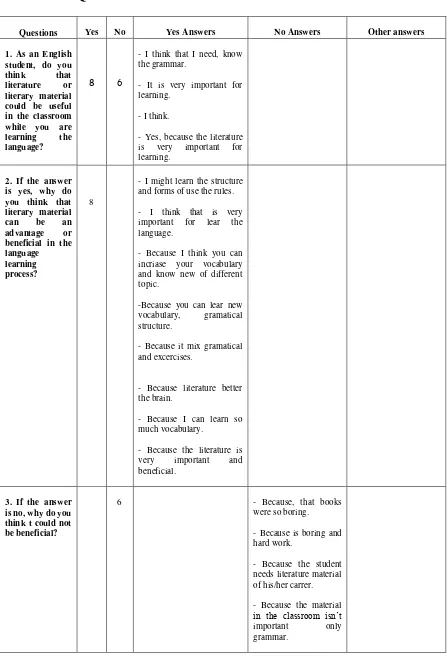
4.1. Analyzing students questionnaire..………93
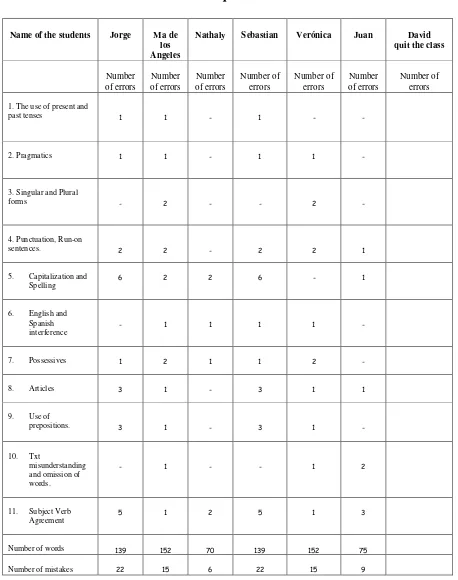
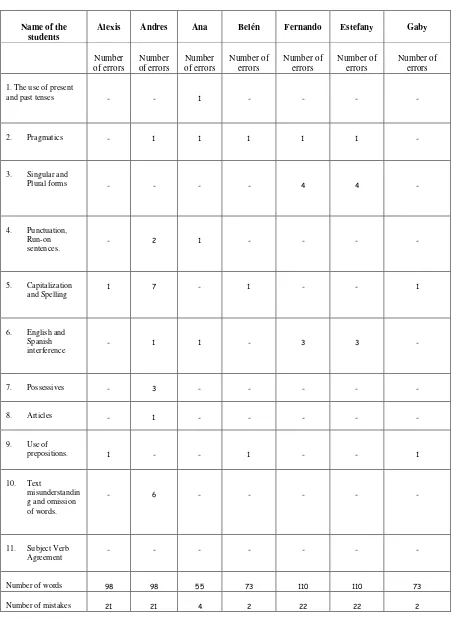
4.2. Sequence Chain………...105
4.3.Analysis of Students’ Sequence Chain First Activity………..108
4.3.1. Andrés and Alexis………..110
4.3.2. Nataly, Belén and Gaby………..111
4.3.3. Fernando and Estefany………...113
4.3.4. Sebastián and Jorge………115
4.3.5. Verónica and Ma de los Ángeles………116
4.3.6. Juan and Ana………..118
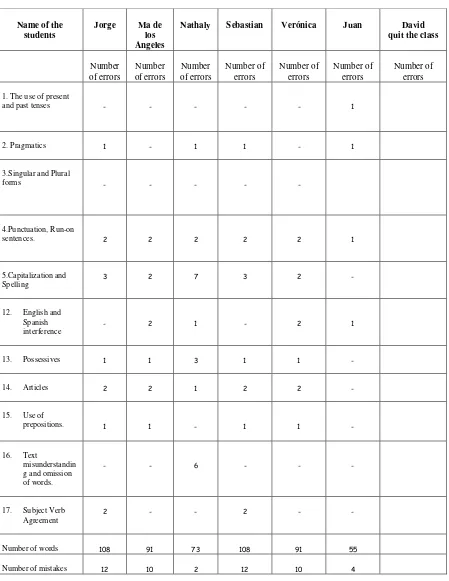
4.4. Analysis of the Last Students’ Sequence Chain ………...120
4.4.1. Andrés and Alexis ……….121
4.4.2. Gaby, Belén and Natahaly………..124
4.4.3. Fernando and Estefany………...125
4.4.4. Sebastián and Jorge………127
4.4.5. Verónica and Ma de los Ángeles………130
4.4.6. Ana and Juan………..132
4.5. Oral Presentations………. ……….135
4.5.1. Oral Presentations Analysis………136
4.5.2. Andrés and Alexis’Analysis………..137
4.5.4. Fernando and Estefany’s Analysis……….140
4.5.5. Sebastian and Jorge’s Analysis………..141
4.5.6. Ma de Los Angeles and Veronica’s Analysis………142
4.5.7. Ana and Juan’s Analysis………143
4.5.8. Oral Presentation Final Result Chart………..145
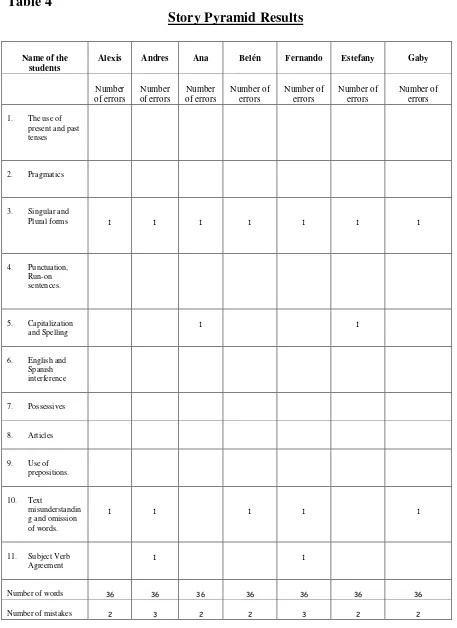
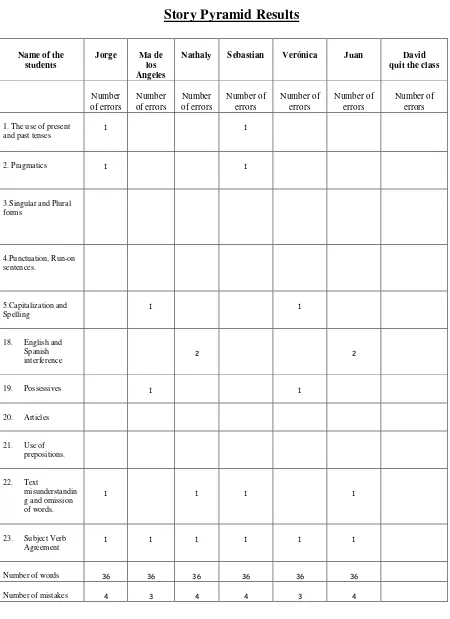
4.6. Story Pyramid ………146
4.6.1. Analysis………..147
4.6.2. Ma de los Ángeles and Verónica………148
4.6.3. Fernando and Andrés………..149
4.6.4. Sebastián and Jorge………151
4.6.5. Estefany and Ana………152
4.6.6. Belén, Gaby and Alexis………..154
4.6.7. Nataly and Juan………..155
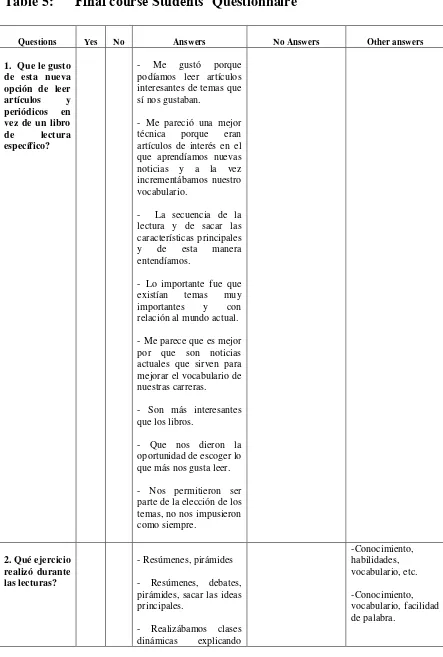
4.7. Final course Students’ Questionnaire……….159
4.7.1. Analysis of the answers………160
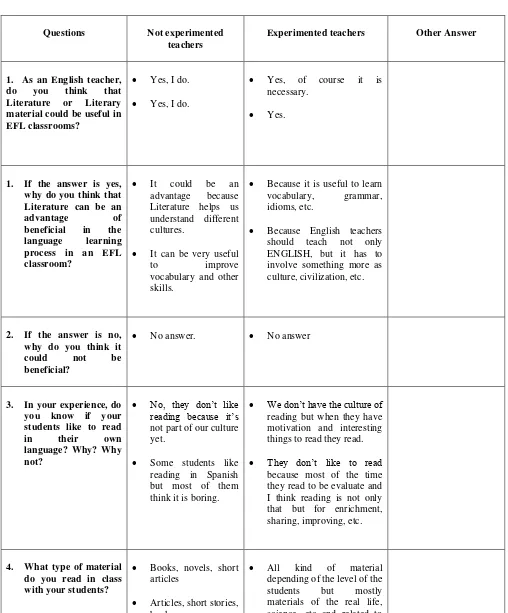
4.8. Teachers’ Questionnaires………...166
4.8.1. Analysis of the answers………..166
_________________________________________________________________________
CHAPTER V
CONCLUSIONS AND RECOMMENDATIONS
………...171______________________________________________________________
5. Conclusions………..171_________________________________________________________________________
BIBLIOGRAPHY
………..179_________________________________________________________________________
APPENDIXES
………..182_________________________________________________________________________ A. Table 1. Questionnaire directed to students………183
B. Table 2. First Sequence Chain Results………189
C. Table 3. Last Sequence Chain Results……….191
D. Oral Presentations Grading Sheets………...193
E. Table 4. Story Pyramid Results………...194
F. Table 5. Final course Students’ Questionnaires………...196
G. Table 6. Teachers’ Questionnaires………..200
H. Copies of the students’ questionnaires……….203
I. Copies of the final course students’ questionnaires………...204
J. Copies of the Teachers questionnaires………...205
K. Copies of the first activity with the Sequence Chain………...206
L. Copies of the Last activity with the Sequence Chain………...207
INTRODUCTION
“Learning language should not be an aim in itself – the ultimate aim is to be able to use language appropriately1”
JUSTIFICATION
It is known and it is sadly true, that in our society, people do not like to read for pleasure as in other cultures. Sometimes, it is really difficult for teachers to make their students read, not only because it is difficult for them reading in another language, but also because they do not even read in their mother tongue.
We can say this because we have talked and interviewed our students from different courses of the university that we have worked at for more than eight years, and most of them say that they do not have time, that they just do not like to read, that they are really busy doing other activities, or they have just said that it is a boring activity.
Besides, if they do not read in their mother tongue because they do not like it, or they do not find the material interesting ,why do we think as teachers that they are going to read any material? Why are they going to read something that sometimes they do not even understand or is tedious for them?
Consequently, it is important for teachers to make their students develop good habits in reading, because teachers know and realize that with reading, students can learn the
language that they are teaching in a better way, and it is going to be easier for students to learn the language and its culture just by reading essential material.
According to Harmer (2007) there are many reasons why getting students to read English texts is an important part of the teacher’s job. First of all, as it is known, reading is useful for language acquisition, and if they read more, they understand more, and they
will be better at it. Besides, if students read, they are not only going to have a positive
effect on learning and increasing their vocabulary but also they will progress in Spelling and Writing.
Teachers have to realize and students have to understand that reading different kinds of texts provide good models of English writing; and, at different situations teachers can encourage students to focus on vocabulary, grammar, punctuation or show them the way we construct sentences, paragraphs and whole texts. Also, good reading texts can lead students to read interesting topics, motivate to group discussions and as a result have interesting classes.
Most of the time, students are given specific material to read (this is what really happens in the institution we work for), but nobody has ever asked them if they are interested in it or not. Reading is just another activity that should be done in class, but without any specific purpose. The teachers just tell the students to read the books that they are assigned to read and then teachers give quizzes about them.
PROBLEM PRESENTATION
Is literary material such as short stories, articles and magazines really helpful in teaching reading in the EFL classroom?
As it was explained, students are just given specific books which they may not be interested in reading in class. These books are given to teachers for the students by the coordinators or directors, and the teachers only follow instructions and tell the students what they have to read. We really think that students should have another option, and if they are not interested in reading a “boring book” as they say, they should be able to read other material in order to take advantage of the moment of reading and learning English in the classroom. Also, if the institution requires the students to read a book, they should give them at least the opportunity of choosing from different books or material, and not just read the ones that they are told to.
When we choose the correct reading material for our students, we have to take into account that it will depend on each particular group of students, and not the same material for all of them; that is, their interests, needs, cultural backgrounds, and language level. We have to choose materials that are significant to their life experiences, emotions or expectations, or we can also choose reading for specific purposes, basing our selection on the topics of the different careers that the students are studying.
OBJECTIVES
GENERAL OBJECTIVES
The principal objective of our research is to demonstrate that the use and implementation of interesting authentic material can be really useful in improving students’ performance in EFL classrooms. That is to say, if we make our students participate or choose on what material they want to read with our supervision, it is going to be easier for the students to work with it, because they are going to be motivated and interested at the moment of reading. They are not just going to read something that they are forced to read in order to take quizzes. They are going to read something that they like and will learn through it. It is material that is going to be useful for students and teachers in the process of learning and teaching.
We as teachers have to be aware that there are various facts that are going to help us understand why reading and reading “authentic material” is important and helpful in our classrooms, and not just think that it is another activity that has to be done in the classroom, or that if we do not have enough time to finish with the program, we should better avoid this activity.
According to Collie and Slater (2004), the use of Valuable “Authentic Material”, Cultural Enrichment, Language Enrichment, and Personal Involvement are essential facts to understand why authentic reading material should be used in class.
“One of the main reasons might be that literature offers a bountiful and extremely varied body
of written material which is “important” in the sense that it says something about fundamental
human issues, and which is enduring rather than ephemeral.”2
Literatures is “authentic material”. By that we simply mean that most works of literature are not fashioned for the specific purpose of teaching a language. Recent course materials have
quite rightly incorporated “authentic” samples of language – for example, travel timetables, city plans, forms, pamphlets, cartoons, advertisements, newspaper or magazine articles. Learners are thus exposed to language that is genuine and undistorted as can be managed in the classroom context.3
Collie and Slater (2004) also say that literature or reading “authentic material” offers plenteous and important material about essential human issues which could be encouraging and interesting for our students. Also, certain authentic materialcan go beyond time and culture because the meaning of the material does not remain static, and it can take the reader directly to another place and time.
2 Joanne Collie and Stephen Slater, Literature in the Language Classroom, Cambridge, Eighteenth printing,
2004, page, 3.
3 Joanne Collie and Stephen Slater, Literature in the Language Classroom, Cambridge, Eighteenth printing,
SPECIFIC OBJECTIVES
With well chosen reading texts, selected by the students themselves from a bank of material provided by the teacher, the investment of effort can be really rewarding so we would expect students to:
Become more motivated.
One of the ways we can make them feel motivated is by letting them be part of the selection of the material. Normally, our students are unwilling to learn the language. Most of our students (in the institution where we work) are studying the language because they have to learn it, because it is part of their pensum, it is a requirement, and not because they like to learn it. For this purpose, when we finish our research we will give students questionnaires in order to know if their attitude towards learning English has changed.
Improve their English
If we take advantage of the material that we want to use in class, that is “authentic material” and not the one (books) that is given to students as a requirement, and work with different activities in the class; we are going to examine if they like what they are doing, and as a result they improve their English.
If they are interested in a specific topic, it is going to be easier for them understand what they are reading, and not just read because they have to, without getting the meaning of it. They will understand the whole meaning, and not the meaning of each word. Students will more successfully infer and deduce the meaning from the context and increase their vocabulary; in that way, they do not have to check the dictionary for every word that they do not understand. This will be practiced with the activities that are prepared for the class, and we will check if this takes place with the questionnaires that we are going to give them at the end of the research.
Participate more in class.
Students will practice speaking with their classmates and teachers in activities as: presentations of the reading with different activities, such as the story pyramid, sequence chain using writing or role plays.
On the other hand, we also want with this thesis to demonstrate the coordinators that we do not have to use just reading books in our classrooms. We want to show them that students also have other options. “Authentic Material” is another option for the reading activity in the classroom. We want to make them realize that with this material, reading does not need to be another activity that can be avoided if there is no time to finish with the program. We will prove that with this material, students will enjoy what they are reading and doing, and as a result they will learn more in the classroom.
Implement any necessary changes in the classroom related to material and teacher’s
Consequently, if well chosen reading texts are implemented, the investment of effort
can be really rewarding and, at a productive level, the students will be more creative and adventurous, because they will appreciate the richness and variety of the language they are learning and trying to master and, with time, they will be able to use all the features that they are experiencing and learning, little by little. Furthermore, if necessary teacher’s
HYPOTHESIS
Authentic reading material such as short stories, articles and magazines will improve students’ performance in the EFL classrooms.
By using the correct material and activities, we are going to demonstrate that we as teachers can take advantage of Reading at the moment of the teaching and learning process in an EFL classroom. Besides, students have to be involved in making the decisions of what they are going to read in order to learn, and not just receive any material that can be boring for them and with no purpose for Reading in the classroom.
By questionnaires, we will also demonstrate that Reading is not an important activity in our EFL classrooms. This is a real fact that we should face in our institution, and it is a
RESEARCH METHODOLOGY
Our research will be an Action Research, which means that we will carry out the research in the classroom, in to order to improve not only our students’ learning, but also our teaching in the classroom. With this research, we expect to see some positive changes in the teaching and learning process. As we learnt in classes, and according to Richards and Lockart (1994), Action Research is defined as teacher-initiated classroom
investigation, which seeks to increase the teacher’s understanding of classroom teaching
and learning, and to bring about change in classroom practices.
According to Wallace (2002), Action Research is a professional self-development method which involves the systematic collection and analysis of data related to practice. This is a process of reflection on professional action also called the “reflective cycle” which provides “tools for reflection” and professional development.
Reflection
Professional Development Professional
As teachers we have to understand and accept that our expertise, knowledge and skills have to be always developing as we continue being teachers. This kind of research is essentially based on the way we, teachers reflect on our teaching and the possible changes that are going to take place in the future in our classrooms after the research. We as teachers have to be critical about ourselves and not unworried because self-development would not take place if we are not able to identify the need of it.
When we decided to use this type of research, is when we realize that we as teachers have a big problem with the activity of reading and the reading material that we use in our English classrooms. We noticed that the students do not like to use the books that they were given in order to read in class. Even though teachers did the activities that each reading book had (when there was time), the students did not feel motivated because they did not like to read this kind of material. They said that the books were boring. In addition, most of the teachers felt frustrated about this particular fact, so it was our interest to make something different in our class in order to improve this activity and get better results with our students.
For the purpose of this thesis, we will not just choose any material that they can decide on; for it, we will find something according to students’ needs, interests and levels, practicality, and not something that we have received from directors or coordinators, or the editorial, that say that their material is the best for the students. Moreover, with this material, that is “authentic material,” we will also check not only our students’
Furthermore, class activities are important in this process. Class activities are special activities that are going to be developed in class according to the material and topics studied in class. For this purpose, we will practice some activities such as the story pyramid, the sequence chain, oral presentations, and other activities in groups.
With these activities, they can practice their speaking, loosing fear of talking in front of other students, or they can share their opinions first in little groups, and then with the whole class, helping each other to understand the text. They can also practice vocabulary
by guessing the meaning from the context and not looking up words in the dictionary, correcting pronunciation among themselves, facing problems with grammar and structures, practicing writing and, after all, presenting the final results.
For example, the story pyramid is an activity where they can practice grammar, writing, by checking spelling and the functions of words, and creating comprehensive short sentences to develop the activity. This activity begins with one word in the first row; then, the students have to write in the second row two words and so on; at the end, they should have 6, 7 or 8 rows (it depends on the material), but with complete sentences, using the given text in order to give a summary of the magazine article, short story or newspaper article.
study and cover the topic of the program that he or she may need to cover, but with a different approach.
For the purpose of this thesis we will work with one of our English classes at the institution we work for. They are fifth level students (pre-intermediate). They are between twenty and twenty-three years old. They study different careers and have different interests. They study careers as: Gastronomy, Hotel Management, Computer Engineering, Food Engineering, etc.
First, we are going to have a short interview with them about their reading habits and their experiences with reading, not only in English, but also in their own language, (Spanish) to collect data, so we can have a baseline. Besides, we will give them a questionnaire about the interview that we had with them before, in order to have a record of their answers.
Third, we will use different material in our class from the one that we have been working with, because the material that we have been using is the book itself with the activities that the same book has. We will choose the material based on our students’
interests and try to show that if we as teachers choose the right material, we can make students read more and learn more, and that reading is a good tool for teaching.
The data collection in our research will be based on the questionnaires, different reading material that we are going to use, as well as the activities that we will develop for each material. We will use activities suchas: the story pyramid, sequence chain activities, and oral presentations. Also, a weekly journal is going to be held to have a record of all the things that may happen in the classroom with the students, the used material and the teacher.
The research is going to be carried out in the place where the students have their classes, and that is in the institution that we work for. This research is also collaborative, because we will have the participation of other teachers that are also interested in the same topic and that will be part of this research. One of the teachers will observe the class and give her opinion about the class.
Besides, it is really important and well worth spending some time trying to obtain
We will also give them different books of short stories, magazines, newspapers and internet articles, so they can choose what they want to read. Another option is to pick or choose some texts, and give the students a summary of each one, letting the students choose the one they find most appealing.
Furthermore, students should also use the target language; they should try to put themselves imaginatively into the target situation. Obviously, there will be some learners that may not yet possess a rich vocabulary, but they could be helped to express their responses either non-verbally or by making a limited linguistic repertoire to finish the activity. If the native language is used, it is not a disaster. It usually indicates that learners are enjoying the task and are engaged in it. So, we are not going to correct our students every time that we hear that they are using their L1. We will encourage them to use the target language as their partners do.
With all the material and activities that we will give them, we attempt to show that they will improve in their language learning by applying these different activities. Besides, we will choose the first and the last activity of the sequence chain, and have an error analysis of this data to see if students have improved in their learning. In addition, two oral presentations will also be chosen to check students’ language improvement. Finally, the last activity of the story pyramid will be taken in order to see how they managed the corrected structures.
According to Richards and Lockart (1994), Action Research usually consists of a
CHAPTER I
THEORETICAL AND CONCEPTUAL FRAMEWORK
1.
Definitions and Concepts
In this dissertation, we will clarify some of the concepts that we are going to be using in our thesis, such as: reading, authentic material, cultural enrichment, language enrichment, student autonomy, motivation, interaction, second language acquisition and others.
1.1.
Second Language Acquisition
According to Rod Ellis (2005) Second Language Acquisition is defined as:
“L2 acquisition, can be defined as the way in which people learn a language other than their mother tongue, inside or outside the classroom, and Second Language Acquisition
(SLA) as the study of this.”4
Ellis (2005) also says in his book and as it is known; nowadays, that people have to learn a second language or different languages not just because they like to learn them, but also, because it is a requirement to obtain a better education or better jobs. Learning a second language can help students and people to be successful in their future life.
It is also important to mention other facts that Ellis (2005) points out about Second Language Acquisition. He says that, Second Language Acquisition is fairly a recent phenomenon and that it began in the second half of the twenty century. He also says that it has occurred because communication between people has expanded outside their local speech communities, so people have had to learn another language besides their mother tongue. Not only because they like it, but also because they need to.
According to Ellis (2005) one way to find out how learners acquire an L2 is to see what learners actually do, as opposed to what they think they do when they try to learn an L2. One way to do this is by collecting samples of the learner language. That is the language that students produce when they are asked to use L2. It could be in speech or writing, and analyze them carefully. He also says, that if samples are collected at different points in time, it may also be possible to find out how students knowledge has gradually developed.
Ellis (2005) states that Second Language Acquisition has not only focused on the communicative aspects of language development, but also on the formal features of the language that linguists have been concerned on. The focus has been on the grammar of L2. Most of the time, researches select specific grammatical structures and explore learner’s ability to produce the selected structure and how it develops over the time.
1.2.
Input
we are using with our students “authentic material”, material that was written for native speakers, such as: magazine, internet and newspaper articles.
1.3.
Learners’ cognitive mechanisms
We also have to keep in mind what Ellis (2005) says about L2 learners. He says that L2 learners carry a massive quantity of knowledge at the moment of learning an L2. That is, first of all, they already know a language (mother tongue) and we teachers expect them to use this knowledge when they learn another language. Second, learners or students know the world in which they live, so this fact will help them understand the input of L2. Besides, some learners can have knowledge of how language in general works, and this fact will also help them learning a new language. Besides, the learners have communication strategies which help them use effectively the L2 knowledge.
Another fact that is important according to Ellis (2005) is what it means when it is said that a learner has acquired a feature of the target language. He states that according to Schmidt and other researchers, they define acquisition in terms of whether the learner has patterns of language use that are similar to native speakers of the target language. Besides, there is also another important fact that has to be mentioned. That is, the use of fixed expressions of formulas. We cannot say that learners have acquired L2 if they use these formulas. They may use them but they do not really know how to use them productively.
and function. In other words, learners must engage with item learning and system learning. They follow particular patterns because their intellectual abilities are structured in such a way that this is the way they learn. Besides, these abilities regulate what learners take from the input and how they store the information in their brains.
On the other hand, according to Ellis (2005) the main way of researching L2 acquisition is by the collection and description of samples of learner language. This description is based on the errors learners make and how these errors change over time. It also may recognize developmental patterns with the description of the phases in the acquisition of particular grammatical features or it will observe the inconsistency found in learner language. For the sake and purpose of this thesis we are going to clarify these definitions:
1.4.
Errors and Error analysis
Ellis (2005) says that it may sound awkward to focus on students errors and not on what they are doing correct; but in contradiction, with errors learners can learn by self-correction to correct the errors they make. Besides, it is useful for teachers to know the errors that learners have. This makes us, teachers think, why do learners make errors?
when they are tired or under pressure. To solve this matter, we need to clarify the difference between Errors and Mistakes.
1.5.
Errors
According to Ellis (2005), Errors reflect gaps in learners’ knowledge. Errors occur because the learner does not know what is correct. They just use a structure without knowing what he or she is doing.
1.6.
Mistakes
On the other hand, mistakes reflect occasional lapses in performance. Mistakes occur because in some way the learner is unable to perform what he or she knows. The learner uses the structure many times and uses it correctly, but then he or she slips on the use of it.
Moreover, Ellis (2005) states that one way to distinguish errors from mistakes will be
to check the consistency of learners’ performance. If the learner constantly uses one structure with other like for example: “study” by “studied” this will show that the learner has a lack of knowledge, so this would be an error. Besides, if sometimes he or she writes
or says “study” and sometimes “studied”, this fact will suggest that the learner possess the
Another way to distinguish errors from mistakes should be by making learners correct their own statements. This is, if they are not able to correct their utterances, these should be errors, but if they do, these will be mistakes.
1.7.
Describing errors
Errors can be identified into different types. First, they could be classified related to
verbs and then identify the different kinds of verb errors like for example, the use of the
simple present, simple past, etc. Second, could be identifying general ways in which
learners’ sentences are different from the target language. These could be: omission,
which is leaving out an item in the sentence that is considered to be grammatical. Another can be misinformation, which is using one grammatical structure instead of another
grammatical structure; and the last one is misordering, that is writing the words in a
sentence in the incorrect order. According to Ellis (2005), this way of classifying errors help us diagnose learners’ learning problems in their developing of SLA and to determine how changes in error patterns occur over time.
1.8.
Explaining errors
Also, there are some learners that overgeneralize forms. For example, they use the
“ed” of the simple past with irregular verbs. With the verb “eat” they use “eated” instead of
“eaten”. Other errors show the way learners make use of their mother tongue when they
are learning L2, and they are known as transfer errors. Besides, no matter what type of errors learners make, they are involved in shaping the grammar that they are learning, and as result of this, they are creating their own rules.
Furthermore, the purpose of error analysis is to help learners learn a second language.
Therefore, we need to evaluate learners’ errors. There are some errors that can be more
serious than others because they can affect the process of communication. These errors are known as global errors, because they break the overall structure of an utterance. Besides,
there are others that are known as local errors and they just affect a single element in the
sentence, like for example the verb. These errors are less likely to produce any processing problems.
1.9.
Sequence of Acquisition
1.10.
Language Aptitude
Ellis (2005) says that there is disagreement in the natural ability that the learner has for learning an L2. He says that it is believed that language aptitude has to do with intelligence, but also as a skill that the learner may have. Furthermore, Ellis (2005) also cites what John Carroll says about the components of language aptitude. They are:
Phonemic coding ability, which refers to the ability to identify sounds of a foreign language that can be remembered later.
Grammatical sensitivity, which refers to the ability that the learner may have to recognize the grammatical function of the words in sentences.
Individual language learning ability, which refers to the ability to identify patterns of correspondence and relations between form and meaning.
Rote learning ability, which refers to the ability to form and remember associations between stimuli. This is, the memory to storage and access the language.
1.11.
Fossilization
grammatical structures. Many learners stop developing and will not reach entirely competence of L2. Learners will succeed in some target language norms, but not in others.
1.12.
Interlanguage:
Another definition that has to be clear and that has to do with SLA is Interlanguage. According to Ellis (2005), some researchers consider that the systematic development of learner language reflects a mental system of L2 knowledge. This system is known as
Interlanguage. This concept is one of the first attempts to explain L2 acquisition. Besides,
this term was coined by the American linguist Larry Selinker, by knowing that L2 learners construct a linguistic system that is based on the learners’ L1 and that is also different from it and also from the target language. Therefore, learners’ Interlanguage is a unique
linguistic system.
Ellis (2005) says that when learners build up a system of abstract linguistic rules which have to do with the comprehension and production of L2, is know as mental grammar, which is referred as Interlanguage. Also, learners’ grammar is permeable and it
can be influenced from outside by input and inside by omission or transfer errors which is
the internal process. Besides, learners’ grammar is also transitional. Learners can modify
1.13.
Reading as a process
According to Williams (1984) reading is a process whereby one looks at and understands what has been written, but this definition of reading does not mean that a foreign learner needs to understand everything in a text. Besides, for some students, this
activity could be really struggling, but is part of the teacher’s job to decrease the student’s
stress level by using different strategies and activities.
He also says in his book that even though reading is defined as a process; the reader does not essentially need to understand everything in a text. He says that the reader is not a passive entity who only reads words or sentences; he points out that the reader is an active object that works on and with the text and that he or she can understand it, without checking every single word. Besides, reading research bears with the view that an efficient reader generally reads in groups of words and not word by word or letter by letter.
Besides, Williams also states that the readers can get many advantages out of the reading activity. For example, he or she can have a good knowledge of the writing system, get familiar with the combinations of letters in spelling of words helping him or her to recognize words; know the language itself, ability to interpret the written text, knowledge of the world as presupposed by the writer, and a reason for reading that determines his or her interests.
“Most of us think of reading as a simple, passive process that involves reading words in a linear fashion and internalizing their meaning one at a time. But reading is actually a very complex process that requires a great deal of active participation on the part of the reader.5”
Reading is a psycholinguistic guessing game. It involves an interaction between thought and language. Efficient reading does not result from precise perception and identification of all elements, but from skill in selecting the fewest, most productive cues necessary to produce guesses which are right the first time. The ability to anticipate that which has not been seen, of course, is vital in reading, just as the ability to anticipate what has not yet been heard is vital in listening. Kenneth Goodman in Journal of the Reading Specialist. (1967)6
Unfortunately, for most teachers reading in the classroom, it is just another activity, and it is a passive process, not an active process, that we can take advantage of. We as teachers sometimes do not realize why reading is so important in class.
The meaning of reading can be different for many people. It may depend on the purpose and the use that is given to reading. That is, for example: if we as teachers want our students to recognize or identify the words of a reading; or if we want our students to practice pronunciation or speaking. But what we have to keep in mind is that we are not only interested in how our students pronounce the words, or if they recognize the word or not. What we also have to be interested in is in the message of the text that we are going to read is understood. We have to realize that our students should read because they may want to get something from the text, from the writing, and then with this piece of reading, we can work with different activities to make learning even more interesting.
5Advanced Study of the Teaching of Secondary School Reading, What is reading? Internet. http://www.indiana.edu/~l517/what_is_reading.html Access: May 26th, 2009
6Advanced Study of the Teaching of Secondary School Reading, What is reading? Internet.
As Nuttall (1989) says, it is presupposed that the readers that read a specific reading can be the intended readers for that text, and that is wrong. There are texts that are written for specific readers, and we, as teachers can not assume or presuppose that any text or reading material can be suitable for our students and learners.
It is equally easy to see that there may be problems for readers who do not share the relevant schema. The writer will not waste time spelling out facts and relationships that she assumes that are already in the reader’s mind. So the reader may be left with too little information to make sense of the text. Either he does not have the schema at all or his schema is significantly
different form the writer’s.7
As we can see, this is one of the reasons why we should let our students choose from different material, under our supervision. Material, which they may know about, and material they may be interested in; and not only the one that is given to us to make them read in our classrooms.
To sum up, as Nuttall says in her book, the main view of reading is concerned with the meaning. With meaning and understanding of the text, we can do many activities in order to make learning more meaningful, like for example: using the sequence chain, story pyramid, oral presentations, or check special structures that are studied in our classrooms. We can really make a difference in our classrooms with meaningful reading and not making it just another activity in class that is part of the program; and if we, teachers do not have time for it; we have to avoid this activity.
7 Christine Nuttall, Teaching Reading Skills in a Foreign Language, Reed Educational and Professional
1.14.
Reading Principles
According to Harmer (2007) there are some Reading principles that we as teachers have to take into account at the moment of reading a text in the classroom, which are:
1.
Encourage students to read as often and as much as possible.
As Harmer (2007) says, the more they read, the better they get at it. As we can see, this principle is really important because practice leads to perfection; and if we choose the
right material, material that they are interested in and that they choose, they are going to read more.
For the purpose of this thesis, we chose the material according to the students’
interests. An interview and a questionnaire took place in order to choose this material. The
decision was not taken just by the teacher’s point of view. The students were the ones who
decided on what topics they were going to read and worked with. The role of the teacher
was to choose the material based on the students’ interests and according to their English level, and also according to the syllabus and the program of the institution. It was not chosen randomly.
2.
Students need to be engaged with what they are reading.
teachers, have to put more emphasis on the material that we are going to choose for the reading activity and for our students. We have to keep in mind that if they enjoy the activity they would get as much pleasure from it as possible, and learn more.
The material was chosen based on the students’ interests, so this fact motivates them to
read a text about a topic that they were interested in. Consequently, if they like what they are going to read, they will be engaged with the reading activity. As we give them also autonomy and we involved them in choosing the type of reading they are going to use they feel more engaged with this activity.
3.
Encourage students to respond to the content of a text (and explore
their feelings about it), not just concentrate on its construction.
Harmer (2007) says that it is important for students to study reading texts in class to see how language is used, but it is also essential to understand the meaning of the text, and give them the chance to reply to that message in some way, because it is important to know how they feel about it. Consequently, with this activity we can know how engaged the student is with the text and the language.
4.
Prediction is a major factor in reading.
they are going to read. Therefore, teachers in their classrooms should give their students
“clues” so they can foretell what they are going to read.
As Harmer (2007) says, and what we have experienced in our classrooms, we as teachers cannot just give them the material and tell them to read. If we impose them any activity, they are not going to respond in a good way. We have to make them think, guess or give ideas about what they are going to read. In this way, we lead them into the reading and to be interested in the topic.
5.
Match the task to the topic when using reading texts.
According to Harmer (2007) when the text that is going to be read has been chosen, teachers should think and choose on the best reading tasks, that is, the right kind of questions, and suitable activities before, during, and after the reading, because the most interesting text could be the most boring, if the activities are not well chosen. So, that is why the activities that we are going to use in our classrooms should be interesting and challenging.
6.
Good teachers exploit reading texts to the full.
also can be used for vocabulary, spelling, grammar or any activity that the teacher would like to implement in class.
In our classrooms and for the purpose of this thesis, we used the reading material to teach not only new vocabulary or speaking, but also we used it for grammar. We tried to take advantage of it and worked with the text in many fields because as we did not have a lot of time just for this activity, and also because we had to finish with the program we tried to make this activity, part of the program.
Unfortunately, we just have two months, that is approximately seven or eight weeks, to finish with all the material and the program, so we have to be careful on how we plan and develop our classes, in order to do all the activities that we want to do.
1.15.
Different reading sources
According to Williams (1984), there are some reading materials that can be used in the English classroom like for example: integrated course books which include reading texts, supplementary reading comprehension and reading skills books containing texts and
exercises, texts from “real life” often called “authentic” texts and “simulated authentic”
texts.
Also, Nutall (1996) mentions in her book that teachers should keep in mind three criteria to choose the texts for the English classroom, and these are suitability of content, exploitability, and readability. But also, there are some other aspects that have to be considered at the time of choosing reading texts, and those are variety, authentic, simplified or specially written texts.
Furthermore, we as teachers would like to work with this kind of material in our classrooms, but unfortunately it is impossible, not because we do not like to work with these kind of books, but it is because of time. These books are big books, and if we sometimes do not have time to use the material that we are given to use in classrooms, imagine ourselves trying to do something with this material. Maybe, if we have some abstracts or summaries, it will be easier, but using the actual book is too much for an intensive course that lasts almost two months.
Nutall (1996) in her book also refers to Exploitability, that is, facilitation of learning. This is one of the most important principles after interest. When a text is
exploited, teachers use it to develop student’s competence as readers. She also says that if a teacher cannot exploit a text, there is no use for teaching, even if the students enjoy reading it. So that is why, it is really important to know what the purpose of the text that teachers are going to use in class is.
Besides, Nutall (1996) also mentions in her book the term Readability, which refers to the combination of structural and lexical difficulty. Teachers have to realize that the same text can be difficult for some students and easy for others. So, it is necessary to assess the right level for the students the teacher teaches; to do this, the teacher must first assess the level of the students themselves.
1.16.
What is Authentic Material?
Literature is “authentic” material. By that we simply mean that most works of literature are not fashioned for the specific purpose of teaching a language. Recent course materials
have quite rightly incorporated many “authentic” samples of language – for example, travel timetables, city plans, forms, pamphlets, cartoons, advertisements, newspaper or magazine articles. Learners are thus exposed to language that is as genuine and undistorted as can be managed in the classroom context.8
We as teachers have to realize that if we use Authentic Material in class, that is
material that was written for native speakers, such as: short stories, articles and magazines; it is going to be easier for us to teach them what they will really see in an English speaking environment. This is the language that they will be exposed to, every time that they may face native speakers or people that speak this language. We, teachers will be working with authentic situations, that is authentic samples of language.
Further more, according to Clare Wardman (2009) in the article of academia.edu, and
Tamo D (2009) in the article “The use of Authentic Material in Classroom,” say that
authentic material could be used in accordance with the students’ level. It will depend on
what the teacher wants to teach or read.
When Collie and Slater refer to valuable material, they are talking about authentic samples of language, like: short stories, newspapers, magazine articles, cartoons,
advertisements and others. In this way, students are exposed to a type of language that is genuine, and they also deal with a language that was written for native speakers, as opposed to that specifically written for non-native speakers,gaining in this way familiarity with genuinelinguistic uses, forms and writing modes like: irony, argument, narration, etc; and that teachers can manage in the classroom.
8Joanne Collie and Stephen Stephen. Literature in the Language Classroom. New York, Cambridge
Nowadays, shared activities can be especially rewarding in helping the learner find a way into what is usually an intensely personal and private experience. That means that if we have students work in groups, a group can reduce the problems or doubts presented in an article, and students will not be afraid to talk or participate.
Besides, this also shifts the attention away from the text into a shared activity by the students, and also prepares them or makes them create a free risk-taking atmosphere in which they can explore their own reactions and interpretations of the text, and reread and consider the text on their own.
According to Collie and Slater (2004), if the material is meaningful and enjoyable,
reading is more likely to have a lasting and beneficial effect upon the learners’ linguistic and cultural knowledge. They say that it is important to choose material which is relevant to life experiences, emotions, or dreams of the learner.
According to Williams (1984), one of the sources of reading is “authentic texts”. This
term is used in the book to refer to any text that was not written specifically for language learning purposes. It is a text written to say something, to transmit a message, and not simply to exemplify language. He says that there is a great variety of this kind of texts, like for example: advertisements, newspaper and magazine articles, poems, short stories, novels, notes, postcards, letters, etc.
achievement and confidence. Another advantage of using authentic texts is the variety and availability of them and that it is possible to build up a teaching program based only on
“authentic texts”.
On the other hand, he also gives teachers a few words of warning. He says that even though authentic texts show language that is used for real communication purposes, they will not magically lead to greater learning of language or language use. Besides, it also depends on the text that the teachers use. For example, if the text is written to give information about weather conditions, the text will be used only to practice vocabulary about weather, so the teacher has to be careful at the moment of selecting the material.
1.17.
Cultural Enrichment
As teachers, we have to realize that going to a country or staying there to know about the people’s culture, is sometimes impossible. Most of our students do not have the chance of traveling to other countries, and sometimes, even teachers do not have the chance to go abroad and, in spite of this fact, they are teaching EFL students. But through authentic material, we can let students know about thoughts, feelings, customs, beliefs, preferences, and show them the real society of the other language.
1.18.
Language Enrichment
When students read a substantial text, they can gain familiarity with features of written language like: the formation and function of sentences, structures, how to connect ideas, etc. The first time, we are not going to introduce a grammar topic with this, but little by little, they will realize what they are reading and what they can do with it. They will also be able to make inferences from linguistic clues or deduce the meaning from the context; in that way, they do not have to check the dictionary for every word that they do not understand.
So, we can say that with well chosen pieces of works, the students will be more
creative and adventurous, because they will appreciate the richness and the variety of the language they are learning and trying to master and, with time, they will be able to use all the features that they are experiencing in classes. While they are reading, they will also be learning.
1.19.
Personal Involvement
the interest or engagement that the reader or student will have with the text or material that he or she is reading.
1.20.
What is Motivation?
According to Williams:
Motivation, that is wanting to read, wanting to learn, is crucial.9
A good way of motivating learners is to know about: their wants, needs and interests, and then, select the texts and activities that are appropriate for the group.
Learner’s interests ---
>
Selection of --->
Exploitationand needs the texts of the text
He also mentions what really happens most of the times in Institutes, Universities, Schools, etc. Teachers are required to use a text book ordered by the authority of the institution, or sometimes the teacher does not have time and facilities to look for the correct material. In this case, the situation changes, and the learner’s needs and interests are in a different position, that is:
Text prescribed ---
>
Exploitation --->
Learner’s interest’sof the text and needs
9 Eddie Williams. Reading in the language Classroom. London, Macmillan Publishers, First published , 1984,
Online Education Support defines motivation as the following:
“Motivation is a desire to achieve a goal, combined with the energy to work towards that goal. Students who are motivated have a desire to undertake their study and complete the requirements of their course.”10
Also, when teachers say that they have motivated students, it does not necessarily mean that they are going to always be thrilled or entirely committed to a task or, in this case, in Reading English material, but it means that by that motivation, the students will complete the given assignments or homework, even if these assignments or works are difficult or look as if they are not interesting.
Also, according to Online Education Support (2002), a distinction between a positive and negative motivation is made. They say that positive motivation is a response which includes enjoyment and optimism about the tasks that the student is involved in. On the other hand, negative motivation involves undertaking tasks because there are not positive outcomes, for example, failing a subject if tasks are not completed.
In addition, we like the idea of students’ participation, which means that they are going
to be involved in decision-making of the material that they are going to read in class, not only because they feel part of the class, but they will think that they are important at the time of making decisions in things that they should practice and learn.
On the other hand, according to Collie and Slater (2004), there are some ways to
stimulate students’ desire to read and encourage their response. For example: teachers
10Sue Lintern, Online Education Support, Motivation, Internet. University of South Australia
http://www.unisanet.unisa.edu.au/motivation/Pages/What%20is%20Motivation.htm. Access: February 9th,
can maintain students’ interest and involvement by using a variety of student-centered
activities. There are some activities, like the story pyramid, sequence chain, inverted triangle, role plays, improvisation, creative writing, discussions, questionnaires and others, that we can normally use in our classrooms, and that can be student-centered, and which
they can really enjoy and feel involved with. Also, with these activities, the teacher can
also improve some students’ weaknesses, in particular, in skill areas like speaking or listening, using written articles in classrooms.
One of the principal aims of all these activities is to let the student develop the benefits of communication and make him or her do other activities for language improvement within the context of suitable reading material. That is, that by sharing this material with the students, they are going to be stimulated, and they will acquire these benefits at the end of the level; and the teacher, by providing valuable material, makes a balance with the selection of activities and in presenting them with confidence.
1.21.
What is Autonomy?
The Longman Dictionary of Contemporary English (1978) defines autonomy as the
right of self-government or management of one’s own affairs. Besides, autonomy in
learning means to have more control over your own learning process. Autonomy in
language learning means to have more control over the purposes of learning languages and the ways in which you learn them.
Learning offers learners the freedom and opportunity to make decisions about the content, organisation and pace of their own learning.
With this concept of Autonomy, Authentic material such as short stories, articles and
magazines will be chosen according to the students’ interests and then we will take them to the class, so students can decide and have autonomy over what they want to read in the
classroom under our supervision.
1.22.
Interaction
With Reading and reading authentic material that should be meaningful to our students, we are interacting with them, we are sending and receiving all kinds of information, and the main purpose of all these activities is that students are learning the language in order to be able to communicate. According to Douglas Brown (2001), interaction is, in fact, the heart of communication; it is what communication is all about. People send and receive messages. People interpret them in context, negotiate with their meanings and also collaborate to accomplish certain purposes.
According to Brown (2001), Interaction is the collaborative exchange of thoughts,
Wilga Rivers says (1987) that through interaction, students can increase their language store as they listen to or read authentic linguistic material, or even the output of their fellow students in discussions, skits, joint problem-solving tasks, or dialogue journals. Even at an elementary stage, they learn in this way to exploit the elasticity of language.
Moreover, Brown (2001), in his book, Teaching by Principles, shows us some Interactive Principles that we, as teachers should take into account in the process of
teaching and learning. They are the following:
1.23.
Automaticity:
True interaction is there, if special attention is given to meanings and messages, and not to grammar and other linguistic forms.
1.24.
Intrinsic motivation:
1.25.
Strategic investment:
Interaction requires the use of strategic language competence to make certain decisions on how to say or write or interpret language, and to make repairs when communication pathways are blocked.
1.26.
Risk Taking
Interaction requires the risk of failing to produce intended meaning, of failing to interpret intended meaning, of being laughed at, of being ignored, or rejected. In this case, the rewards are great, and worth the risks.
1.27.
The language
–
culture connection:
The cultural loading of interactive speech as well as writing requires that interlocutors be completely versed in the cultural nuances of language.
1.28.
Communicative Competence:
CHAPTER II
APPROACHES TO LANGUAGE TEACHING
For the sake of this thesis and the understanding of the readers of our thesis, we will also clarify some other concepts that we will be using along our work, and that are related to Educational Research and Research Methods in language learning:
2.
Using different approaches
When we teach in our EFL classrooms, we can use different approaches, and we are going to mention some of the approaches that appeared some time ago and that are still used by some teachers nowadays. We are not saying that these are the ones that should be used in our classes. We are just clarifying the concepts of the ones that appeared some time ago, and that are important to know, in order to see which we can use or feel more comfortable with, at the time of teaching.
2.1.
Approaches and Aims according to Collie and Slater
Maintaining interest and involvement by using a variety of student-centered activities like: role play, improvisation, creative writing, questionnaire, discussions. With these activities, Collie and Slater say that the teachers will be able to identify
students’ weaknesses in particular skill areas like speaking or listening.
Supplementing the printed page. With this activity, teachers can create a whole
new world in the student’s imagination. This is not just a page full of words; it is a
page that can create a whole new world full of warmth and color.
Tapping the resources of knowledge and experience within the group. According to Collie and Slater, pair group work is known as increasing learners’ confidence in
the foreign language, and also personalizing their contact with it. With this activity, students will be able to supply or give a correct meaning of an important word, or share the activity if they do not know the meaning of it. This activity, most likely leads to the creation of a risk-taking atmosphere, and makes the students think over the text and manage and work with it.
![, ],amongwhich Inadditiontotraditionallearningenvironments,di ff erentstudiesspecifytheinfluenceofinformationandcommunicationtechnologiesontheappearanceofnewPLE[ toothersappear,andtheacquisitionofinformationisnotlimitedtoaspecifictimeandspace[ , ]. oftrainin](data:image/gif;base64,R0lGODlhAQABAIAAAP///wAAACH5BAEAAAAALAAAAAABAAEAAAICRAEAOw==)