Principles and Patterns of Social Knowledge
Applications.
Welcome to the Social Knowledge Applications (or SKAs, for short) Web site.
The aim of this site is to contribute to the understanding of existing social knowledge applications and to the design of novel applications.
If you are unfamiliar with the concept of Social Knowledge Application, you might wish to start from the Overview.
This site is currently the work of a single individual but the intention is to transform it into a Wiki-Book (a “Wook”?) to which everybody will be welcome to contribute.
Legal Babble
Except where otherwise noted, this site is licensed under a Creative Commons Attribution 2.5 License.
Not Your Cup of Tea?
Foreword or How I Learned to Stop Worrying and
Love Wikipedia
In many of the more relaxed civilizations on the Outer Eastern Rim of the Galaxy, the Hitchhiker's Guide has already supplanted the great Encyclopedia Galactica as the standard repository of all knowledge and wisdom, for though it is inaccurate, it scores over the older, more pedestrian work in two important respects. First, it is slightly cheaper; and second, it has the words DON'T PANIC inscribed in large, friendly letters on its cover (Douglas Adams).
When I was fourteen, my family was visited by an eager encyclopaedia salesman who was promoting the Encyclopaedia Britannica. What he proudly presented us was the most amazing work of knowledge I had ever seen. The Britannica had everything to impress an avid young reader. The quality of its contributors was unmatched, Einstein and Freud had written articles for it. The breadth of the work was immense, with tens of thousands of entries. And it was not just its many spiritual qualities that made it stand out, Britannica was also a beautiful object to behold. Just holding one of these beautiful leather-bound volumes gave me a kick. The thing even smelled good! The Encyclopaedia Britannica really oozed quality from the pores of its high-strength paper (the salesman could not resist demonstrating that a single page would happily hold the weight of a whole volume). Unfortunately, at the time, the price of the Britannica in Italy was equivalent to roughly two months of a white-collar salary so, with some regret, I advised my parents not to buy it.
I am now considerably older and slightly wealthier than I used to be and recently, to satisfy that juvenile desire, I bought a copy of the Britannica. Not the expensive and beautiful print version, that would not fit on my little and already overloaded bookshelf anyway, but rather the cheap and handy electronic versions. It has the same contents of its most illustrious relative but it costs only a few tens of dollars and it will follow me everywhere my notebook computer will, that in this days it is most places.
But the most amazing development in my long love affair with Britannica it is not so much the fact that, many years after falling in love with it, I was finally able to fulfil my desire. Oh no, life (and love) is much more complicated than that. The most unexpected twist to the story is that, shortly after becoming a proud owner of the Britannica and while I was looking forward to many years of happy life in common, I started neglecting her. As a matter of fact, nowadays I use my long-desired Britannica quite rarely as, to satisfy my frequent and urgent encyclopaedic needs, I mostly prefer to use Wikipedia.
The Britannica and Wikipedia could hardly be more different. The Britannica is nothing short of an institution. It is in fact the oldest encyclopaedia in the English language, first published in 17681. Its development has being one of the most expensive publishing enterprises ever. Its contributors are leading authorities in their fields and their output it is carefully checked by a little army of keen-eyed editors. Its typesetting, its graphics, its contents are all carefully and professionally choreographed.
Enter now the world of Wikipedia. Do it with caution as it is so much more slippery than the ordered and predictable one you have just left behind. The Wikipedia authors/editors (as there is basically no difference between them) range from university professors to high-school dropouts. It is hard to say really as absolutely anybody, including anonymous users, has the right to edit any Wikipedia article. Wikipedia also totally lacks a respectable pedigree. It was started only in January 2001 and, hear hear, not by an academic institution or a respected publisher but by a small Internet company whose main source of income was the sale of erotic images2.
Despite its recent and plebeian origins, the English Wikipedia is by far the most extensive encyclopaedia ever assembled with more than 900.0003 articles vs. the about 120.000 of the online version and the 50.000 of the printed edition of the Britannica. When it comes to actual usage, according to the independent Internet ranking service Alexa, Wikipedia attracts about fifteen times more users than the Britannica online version4. Wikipedia has already spawned versions in more than one
1Wikipedia:Encyclopædia Britannica. 2Wikipedia:Bomis.
3 As of January 2006, see Wikipedia:Wikipedia,
hundred languages with thirty of them having more than 10.000 articles5. The total number of articles in all languages is close to two millions.
Being a bit of a book worm, the discovery of Wikipedia has been of particular interest to me but naturally the same pattern can be seen in a variety of different fields. Maybe you had your epiphany when you discovered that you liked Linux better than Windows and wondered how a team of volunteers that, in their large majority, have never met face to face could have produced an operating system of such complexity and sophistication. Or maybe when you marvelled at the uncanny ability of Google in returning just the right answer to your queries, picking up the very Web page you were after among billions. What lies behind Wikipedia, Linux, Google and many other cornerstones of the Internet is a new capacity of harnessing the collective intelligence of people from all over the planet to create knowledge products that are unsurpassed in their breath and sophistication.
As it is so often the case, this is both big news and no news.
It is no news in the sense that the ability of harnessing collective intelligence and knowledge has always been a major driving force in the cultural evolution of mankind. The best example probably being the very language that I am using to write these words: English. As all human languages, English is certainly not the product of the genius of a single individual but rather the result of the merging of the contributions of thousands of individuals, and of the judgments on these contributions expressed by millions of people, over centuries. Markets, the best mechanism known to man for the efficient allocation of economic resources, are another example of collective knowledge in action that has been exploited since time immemorial. Representative democracy, with its voting systems and collective deliberation bodies, is also an illustration of the central place that collective intelligence has in our society. Indeed, the fabric of society is woven with systems that extract, merge and apply collective knowledge and intelligence.
But it is also big news, because the breath and depth of our ability of exploiting our ‘global brain’ is been increased a hundred folds by the recent advancements in information and telecommunication technologies. The billion people or so that currently have access to the Internet are often seen just as potential customers: eyeballs for commercials or one more passive audience for the entertainment
5 As of October 2005, see
industry. But the winners of the Internet revolution are those who have realised that the real goldmine, indeed by far the biggest and most valuable natural resource on the planet, is the knowledge and judgment of these people.
Overview
The great advancements in computing and telecommunication technologies that have taken place in the last few decades have hugely reduced the cost of publishing information. Professionally produced content – such as newspapers, music, software and books – created by media companies and independent authors is accessible to a greater audience than ever before.
Even more importantly, they have made possible novel forms of large scale cooperation and knowledge production and sharing. Millions of people from all over the world have engaged themselves in knowledge creation activities that were previously reserved to an elite. Many are the valuable products that have already come out of the collective knowledge cornucopia including encyclopedias, knowledge classification schemes, news and commentary sites, and very sophisticated software.
The possibility of exploiting, in an unprecedented measure, the collective intelligence and knowledge (dare we say wisdom?) of the human race, has profound implications and rises questions of all kinds:
• Political: What new forms of political participations are possible? Could this lead to a transfer of power from governments and big corporations to the general public? How does it alter the concept of citizenship? Is there such a thing as a “network citizenship”?
• Economical: Are we witnessing the emergence of a new model of production? Will the knowledge products of the future be produced by teams of volunteers and made available for free for everybody to enjoy? Will this help bridge the gap between developed and developing world or will the digital divide grow even wider? In what sectors is this new model applicable? Is it efficient and sustainable? How does it compare with market or firm driven production?
• Legal: How should intellectual property and freedom of speech be regulated in order to foster the creation and sharing of knowledge?
• Technical: What technologies are needed to support the publishing, preservation, sharing and aggregation of knowledge on such a massive scale?
The aim of this work is not to tackle directly these questions but, much more modestly, to collect and examine the common principles and patterns that underlie some of the existing success stories in this field. Hopefully, this will lead to a better understanding of the existing social knowledge applications and facilitate the design of even more useful applications.
Rectifying the Names
If names are not rectified … people will not know how to move hand or foot. (Confucius, Analects 13:3)
What’s in a name? That which we call a rose by any other name would smell as sweet. (William Shakespeare, Romeo and Juliet)
Scientists would rather use each other toothbrush than each other nomenclature. (Murray Gill-Mann)
The terminology that has emerged from the research on the collective production and sharing of knowledge in a networked environment is varied, and possibly confusing, reflecting both the unsettled state of this novel field of enquiry and the various research objectives and points of view of different authors.
Yochai Benkler, that looks at the cooperative production of open software and open content as a new mode of production alternative to markets and managerial hierarchies (for a discussion, see Allocation), has introduced the term commons-based peer production 6.
6 Benkler, Yochai. Coase’s Penguin: Linux and the Nature of the Firm, Yale Law Journal,
Authors, like Clay Shirky, that are more interested in the social and technical aspects of these systems use the term social software, intending with this: “software systems that support group interaction”7.
Knowledge refineries is an appropriate term to refer to large-scale knowledge integrators like the Google search engine.
Howard Rheingold, that examines the social, cultural and political consequences of instant and mobile access to information and people, describes the emergence of the smart mobs 8. From a very different theoretical and political standpoint, but with a
similarly keen interest in the political consequences of a networked world, Negri and Hardt use the term multitude 9.
James Surowiecki, that stresses the advantages of group intelligence versus the individual competence of leaders and experts, not just in network environments but in general, talks of wisdom of the crowds10.
Researchers like Francis Heylighen, that look at the Internet from a cybernetic standpoint, as a self-organising system where new forms of global consciousness and intelligence are emerging, prefer the term global brain11.
From a computer science perspective, a group of communicating agents constitutes a network. The term appears also in economics where it indicates a set of compatible elements, that is to say of elements that can be combined to produce composite
7 Shirky, Clay. A Group Is Its Own Worst Enemy, April 2003, http://shirky.com/writings/group_enemy.html
8 Rheingold, Howard. Smart Mobs: The Next Social Revolution. Perseus Books Group (15
October, 2002). ISBN:0738206083
9 Hardt, Michael & Negri, Antonio. Empire. Harvard University Press (July, 2001).
ISBN:0674006712
10 Surowiecki, James. The Wisdom of Crowds: Why the Many Are Smarter Than the Few and
How Collective Wisdom Shapes Business, Economies, Societies and Nations. Doubleday (25 May, 2004). ISBN:0385503865
11 Heylighen, Francis. (2004), Conceptions of a Global Brain: an historical review, to appear in
Technological Forecasting and Social Change,
goods or services12 (this is a particularly fruitful and relevant approach that will be
adopted and discussed at some length in Principles of Network Utility).
I will make use, as appropriate, of many of the previous terms. When referring in general to the systems that are the object of this work, however, I will use the term Social Knowledge Applications (or SKAs for short)defining them simply as systems, typically implemented as software applications on the Internet, that facilitate the social production and integration of knowledge in a networked environment.
The term attempts to capture the three intertwined aspects whose comprehension is necessary for a full understanding of these systems:
• the social aspect, that includes also considerations of economical viability, sustainability and efficiency as well as political issues relative to the system governance and internal power structure.
• the knowledge management aspect, with the classic knowledge workflow phases of knowledge generation, representation, and integration but compounded by the difficulty of operating in a distributed and uncertain environment.
• And finally the technical aspect, that mainly concerns the selection of appropriate software design principles and information and communication technologies.
Why “Knowledge”?
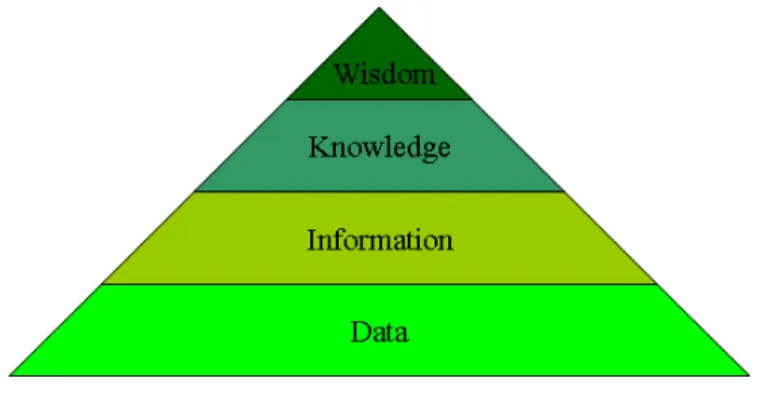
The different aspects of our understanding of the world can be ordered in an “knowledge pyramid” whose different levels are, from the bottom up: data, information, knowledge and wisdom.
Figure 1 - The Knowledge Pyramid
The pyramidal structure indicates two things: that each level is based on the lower one; and that, as we move up the abstraction scale, quantity decreases (wisdom is rarer than knowledge that is rarer than information that is rarer than data).
What is the conceptual difference among these levels? A common answer is that they correspond to “know-nothing”, “know-what”, “know-how” and “know-why”. To make this more concrete, think of a game like chess. With respect to chess, data would be the knowledge of the positions of the pieces on the check-board during a given game; information would be the knowledge of the rules of the game, and therefore of the state space, the set of all admissible game states; knowledge would be knowing how to play, the strategies and tactics; and, finally, wisdom would be knowing why we play, how this act fits into the context of human society and in the players’ life.
Figure 2 – The Meaning of Information, Knowledge and Wisdom13
The “knowledge” in social knowledge applications refers in general to all these levels. Specific applications will usually operate at just one or two of these levels. A project to create an open content map of roads and other geographical features would
operate at the Data level. A general encyclopedia, like Wikipedia, at the Information level. A Wiki dedicated to debating software design patterns, at the Knowledge level. A site dedicated to the collective definition of a new European Constitution at the Wisdom level.
Why are Social Knowledge Applications Important?
SKAs have significant cultural, social, political and economical repercussions because they change:
• The nature of the process by which informational goods, that are increasingly central to our economy, are produced.
• The relationship between consumers and producers of knowledge, progressively removing the barrier between the two.
• The relationship between intellectual capital and intellectual labour, shifting power from capital to labour.
As Karl Marx pointed out over a century ago, the economic structure, or mode of production, is the basic framework into which social, political and intellectual activities take place:
In the social production of their existence, men inevitably enter into definite relations, which are independent of their will, namely relations of production appropriate to a given stage in the development of their material forces of production. The totality of these relations of production constitutes the economic structure of society, the real foundation, on which arises a legal and political superstructure and to which correspond definite forms of social consciousness. The mode of production of material life conditions the general process of social, political and intellectual life. It is not the consciousness of men that determines their existence, but their social existence that determines their consciousness.14
The world economy is still dominated by the mode of production that Marx witnessed and that dates back to the Industrial Revolution, but at its core a major change is taking place, the shift from the production of physical goods to that of informational goods:
… ideas and innovations have become the most important resource, replacing land, energy and raw materials. As much as three-quarters of the value of publicly traded companies in America comes from intangible assets, up from around 40% in the early 1980s. “The economic product of the United States”, says Alan Greenspan, the chairman of America's Federal Reserve, has become “predominantly conceptual”. 15
And in the production of informational goods another major shift is taking place, from commercial to cooperative production. We can see it clearly in the Web where the capacity of extracting and integrating social knowledge already plays a major role. Two out of three of the most popular Web sites are already “powered” by social knowledge. Among the 15 more popular Web sites in English16, five publish professionally produced content (Microsoft, AOL, Go, BBC, CNN), eight are social knowledge integrators or refineries (Google, Ebay, Myspace.com, Alibaba, Blogger, Craigslist, Xanga, The Internet Movie Database) and two (Yahoo and Amazon) have a mixed model where professionally produced and cooperatively produced knowledge complement each other.
We are entering the age of the collective production of information. And just as the mass-trained workers of the Industrial Revolution could produce more, and more sophisticated, goods than the skilled artisans of yore, the unwashed, but Internet savvy, masses of the Knowledge Revolution might reveal themselves more productive, in many domains, than the knowledge artisans of today: academics, journalists and assorted experts.
Power is of those who own, or otherwise control, the essential means of production of their age. Who will control the essential infrastructure of the knowledge age? Currently, the vast majority of intellectual property is in private hands and most cooperatively produced content is also privately appropriated. Increasingly, however, the products of the collective intellectual toil are been released under open content licenses. The pool of communally owned knowledge goods, the “Creative Commons”17, is growing quickly.
15 The Economist, A market for ideas, 20th of October 2005,
http://www.economist.com/surveys/displaystory.cfm?story_id=5014990
16 Data from Alexa.com, after clustering closely related sites such as multiple Google or
Microsoft sites. Verified on the 10th of December, 2005.
This radically alters the relationship between capital and (intellectual) labour. If tomorrow all employees of Microsoft were to walk out and leave, Microsoft would still be a very valuable company as it owns the intellectual property that underlies most of the current computing infrastructure. If all the employees of Red Hat, an open source company, left the company, Red Hat would be worthless. The value of Red Hat is entirely in the skills of its employees. Remembering Marx’s comment that “Capital is dead labour, which, vampire-like, lives only by sucking living labour, and lives the more, the more labour it sucks.”18, we might also say that, in the Knowledge Age,
power shifts from dead to live labour.
To summarize:
• The economic system is increasingly centred around informational goods.
• Knowledge is increasingly cooperatively produced.
• Cooperatively produced knowledge is increasingly collectively owned.
Depending on their position in the economic food chain, different observers look at these developments with feelings that range from fear and disdain19 to exultation20,
but few doubts that such a tectonic shift in the mode of production on which our society is based will not have major consequences.
On Methodology
In approaching the study of social knowledge applications we need to take in account two factors:
• The complex and multidisciplinary nature of the object of analysis that combines social, economical, political, knowledge management and computer
18 Marx, Karl. Capital, Volume I, Chapter 10, Section 1.
19 Kanellos, Michael. Interview with Bill Gates: Restricting IP rights is tantamount to
communism, CNET News.com,January 06, 2005,
http://insight.zdnet.co.uk/software/windows/0,39020478,39183197,00.htm 20 Moglen, Eben. The dotCommunist Manifesto, January 2003,
science issues and therefore the absence, indeed the impossibility, of a single underarching explanatory theory.
• The different requirements of the two professional communities that are interested in these phenomena: on one side, social scientists that are interested in understanding existing social knowledge applications and their wider impact on our society and economy; on the other, software designers and social and commercial entrepreneurs that are interested in designing novel and successful social knowledge applications.
A principled but flexible approach is required to accommodate these varied and somewhat contrasting requirements.
These problems are not unique to SKAs. The study of the urban space is another area where a multidisciplinary approach is required, where no single underarching theory exists and where the needs of scientists and those of practitioners and designers have to be balanced.
The English architect Christopher Alexander21, in a series of popular books 22 23 has
introduced an interesting methodological approach to formulate, organise and share architectural and urban planning knowledge: the pattern language. The idea has been later adopted in computer science, leading to the development of sophisticated software design pattern languages 2425.
Alexander explains the concept of pattern as follows:
Each pattern is a three-part rule, which expresses a relation between a certain context, a problem, and a solution.
21Wikipedia:Christopher_Alexander
22 Alexander, Christopher. The Timeless Way of Building. Oxford University Press (1979).
ISBN:0195024028
23 Alexander, Christopher & Ishikawa, Sara & Silverstein, Murray. A Pattern Language:
Towns, Buildings, Construction (Center for Environmental Structure Series). Oxford University Press (1977). ISBN:0195019199
24 Gamma, Erich & Helm, Richard & Johnson, Ralph & Vlissides, John. Design Patterns.
Addison-Wesley Professional (15 January, 1995). ISBN:0201633612
.. As an element in the world, each pattern is a relationship between a certain context, a certain system of forces which occurs repeatedly in that context, and a certain spatial configuration which allows these forces to resolve themselves.
As an element of language, a pattern is an instruction, which shows how this spatial configuration can be used, over and over again, to resolve the given system of forces, wherever the context makes it relevant.
A pattern language is a set of related patterns that can be combined either to create new architectural and urban configurations or to explain the success or failure of existing configurations.
Principles and Patterns
The basic methodological assumption that will be adopted in this work builds on and extends Alexander’s proposal and can be expressed as follows: social knowledge applications can be understood, and new applications designed, by combining a set of patterns that operate in the context of some basic principles.
Principles and patterns are both necessary to form a complete picture of these phenomena.
A principle is a universal proposition, an assertion that it is true for all the elements of a certain (usually very large) set. Principles come under different labels: laws, theorems, principles, rules, maxims, according to the extension of the set to which they apply and the level of formalization and precision with which they are expressed. Examples range from mathematical principles such as the principle of recursion to folk philosophy maxims such as “money cannot buy happiness”.
Principles explain how the world works but they don’t specify how to make the world work for us. For example, the knowledge of the principles of thermodynamics is a necessary but not sufficient precondition to inform the design of a working internal combustion engine.
Informing us on how to make the world work for our own ends is the job of patterns. Patterns are the conceptual building block that designers use to build new solutions and that researchers use to make sense of existing ones.
Structure of the Work
The structure of the text reflects the methodological approach adopted. It is divided into three parts: applications, patterns and principles.
The first part is an analysis of a significant social knowledge application. The analysis is rather brief, as its main objective is not so much to describe in detail the inner workings of the system but rather to show the utility of patterns and principles as an explanatory device for the application behaviour and performance. The case study examined is Wikipedia, the cooperatively edited and open content online encyclopedia. Wikipedia, because of the ambitiousness of its objective of creating a summary and a gateway to all knowledge, is one of the best examples of large-scale knowledge integration.
The second part is a catalogue of some of the patterns that play an important role in SKAs and that are used in the case study analysis. Patterns are grouped according to the key issues that SKAs have to solve in order to operate successfully and efficiently (see Patterns).
In the third part, we look at SKAs as economic networks and analyze the key principles:
• Of networks utility: examining how the value of networks is affected by their topology (see Principles of Network Utility). This is followed by a discussion of some of the main implications of the same principles (see Some Implications of the Principles of Network Utility).
Wikipedia
Wikipedia is an open-content online encyclopaedia cooperatively authored and edited by a team of international volunteers. Participation is completely open, with anyone, including anonymous users, allowed to edit every article (except for a few pages that are particularly sensitive or frequently subject to vandalism that are modifiable only by a restricted number of administrators). The English version of Wikipedia was launched on January 15 2001 by Jimmy Wales and Larry Sanger of Bomis, a small American Internet company26. The first international editions of Wikipedia, of which currently over 100 are active, appeared in May 200127.
Wikipedia = Wiki + Encyclopedia
Primitive boats come in two basic shapes: the canoe, that can be made out of hollowed-out tree trunks using only the simplest tools, and the raft, that can be built even more easily by binding logs. The advantage of the canoe is that it is fast and manoeuvrable, the disadvantage is that it has a very limited living space and carrying capability. The raft has opposite characteristics: slow and difficult to manoeuvre but with a lot of space and great carrying capacity.
Canoes and rafts have been around for thousand of years but, apparently, it was only in the 5th century28 that some unknown genius realised that by combining these two totally opposite designs – by putting a raft on top of two canoes – a new kind of boat could be created that had all the best characteristics of its two components: fast and easy to sail and still able to carry a great quantity of goods. This new boat, the catamaran, opened completely new possibilities for seafaring and was instrumental to the colonisation of the Pacific.
As its name indicates, Wikipedia is also a blend of two very different, if not all together opposite, technologies: the online encyclopedia and the Wiki.
26Wikipedia:Bomis.
A Wiki is essentially a Web site that can be easily edited by remote users. Wikis are designed to minimise the effort of editing Web pages. Users do not need to install any special software, apart from a standard Web browser, and they write text into a ‘shorthand’ notation that it is designed to be easier to learn and to use than the full HTML language (the language in which Web pages are written). The other striking feature of Wikis is that they usually have a very open access policy, often allowing anyone to edit any page. Online systems usually defend themselves from intrusions and attacks by giving the right of modifying contents only to a few trusted users. Wikis take a different approach: anyone can create a new version of a page and the last created version immediately becomes the ‘official’ version that users see by default. However, all the previous versions of the page are preserved and they can be easily accessed and reinstated as the ‘official’ version making it easy to reverse the effects of vandalism or inconsiderate editing. It might sound like a paradox, but Wikis can afford to be open to unrestricted, unsupervised, editing precisely because, literally speaking, they cannot be ‘edited’ at all: you can add information to a Wiki but you cannot remove or modify existing information29.
After seeing the great success of Wikipedia, the idea of using a Wiki to build a encyclopedia might seems fairly natural. This was definitely not the case, as it is proven by the chronology of the appearance of these technologies. Both online encyclopedias and Wiki systems predate Wikipedia by a number of years. The first
29 From the point of view of an unprivileged user (the situation is different for the Wiki’s
administrators) a Wiki is essentially a set of two functions. The first is a retrieval function that, given the title of a page and a version number, will return the content of the specified version of the page. The other is a publishing function that, given the title of a page and a text, will append a new version with the given text to the existing list of versions of the page with the given title. These functions are referentially transparent, that is to say that, given the same parameters, they always produce the same result. Referential transparency is also a key feature of one of the latest breeds of programming languages: the purely functional
Wiki system was launched in 1995 30 31 and the Encyclopaedia Britannica was already available online as early as 199432 while Wikipedia was launched only in 2001. So, it has taken no less than 6 years, an eternity in Internet time, for someone to realise the explosive potential of the combination of these two technologies.
In effect, the editing process of a Wiki and that of a traditional encyclopedia could hardly be more different. Wikis usually accept contributions from everybody while traditional encyclopedias rely only on distinguished experts. In a Wiki, editing and publishing are a single process with new edited versions being immediately visible to the public while in a traditional encyclopedia the processes of editing and publishing are completely separate activities. Finally, Wikis are often used as a debating ground as much as a way of collecting knowledge with single voices maintaining their independence while one of the distinguishing features of an encyclopedia is that, though by necessity it is always the product of the work of hundreds of authors, it speaks with a single, “objective” voice. Having combined the openness and productivity of the Wiki with the requirements of objectivity and adherence to the facts of an encyclopedia was therefore far from evident and can indeed be considered a bold and inspired design choice.
Is Wikipedia A Real Encyclopedia?
The declared aim of Wikipedia is33:
30 Eillis, C. A. & Gibbs, S. J. & Rein, G. L. (1991), Groupware Some issues and experiences.
Communications of the ACM, 34, 1, 38-58,
http://portal.acm.org/citation.cfm?coll=GUIDE&dl=GUIDE&id=99987
31 Wikipedia:Wiki. One of the main attractions of the Wikis is that they allow users to edit a
page using just a standard Web browser. Non Web-based cooperative editing systems, however, predate the Wiki by a number of years, see for example the GROVE system described in Eillis et al.
32Wikipedia:Encyclopaedia Britannica
33 As the page that contains the “official” aims of Wikipedia is, just as any other page, editable
…to create and distribute a free, reliable encyclopedia in as many languages as possible — indeed, the largest encyclopedia in history, in terms of both breadth and depth. 34
Has Wikipedia achieved its declared goal? To answer this question we need to examine separately a number of different aspects relative to the format as well as the quantity and quality of Wikipedia contents.
First of all, is Wikipedia, an encyclopaedia at all? Encyclopaedias are a specific literary genre with their own structure and rules. In particular we would expect a encyclopaedia to:
• Provide a very wide coverage (encyclopaedic in fact) of its subject. In the case of a general encyclopaedia such as Wikipedia that means coverage of the totality of human knowledge.
• Be structured as a collection of entries relative to specific objects or concepts.
• Be written in a formal, “objective” style.
Even a quick browse of Wikipedia should be sufficient to reassure anybody that it easily matches the first two criteria: its coverage is indeed encyclopaedic and it is broken down in a high number of entries, each meant to illustrate a particular object or concept. The third criteria, though, is harder to assess. While most articles in Wikipedia are clearly written in the formal style typical of a reference work, it is possible to find counter examples of articles containing personal comments as well as colloquial, humorous or possibly even offensive language.
This high variability in style and quality is naturally due to the dynamic nature of Wikipedia. Being subject to continuous editing from thousands of authors, not all of the same quality and experience, as well as to the attacks of vandals and spam spreaders, there is always a certain fraction of Wikipedia content that is of sub-standard quality. A fair assessment of the degree of formality of Wikipedia language therefore would have to take in account the dynamic nature of the media and be measured in statistical rather than absolute terms.
A first study of this kind has been conducted by Emigh and Harring35 that have
measured, using automatic text processing techniques, the degree of formality of the
language of Wikipedia and other online encyclopaedias based on a random sample of articles. Their conclusion is that:
[A]long the formality dimension, … Wikipedia and the Columbia Encyclopedia are not significantly different from one another. Statistically speaking, the language of the Wikipedia entries is as formal as that in the traditional print encyclopedia. 36
We can then reach a first conclusion: at least from a formal, “syntactical”, point of view Wikipedia has succeed in creating a real encyclopaedia.
The second aim of Wikipedia is that of creating the largest encyclopedia ever assembled. This also seems to have been achieved:
As of August 29, 2005, the English Wikipedia alone had over 700,000 articles of any length, and the combined Wikipedias for all other languages greatly exceeded the English Wikipedia in size, giving a combined total of 1.4 million articles in 187 languages. The English Wikipedia alone has over 220 million words, almost 4x the largest English-language encyclopedia, Encyclopædia Britannica, and more than the largest printed encyclopedia on record, the enormous Spanish-language Enciclopedia universal ilustrada europeo-americana, and 90% of that work's volumes haven't been updated since 1933. 37
The objective of supporting a wide range of human languages has also been largely met with active versions of Wikipedia in over 100 languages of which at least 7 seem to have reached a useful size, each having more than 100,000 entries38.
35 Emigh, William & Herring, Susan C. (2004). Collaborative Authoring on the Web: A Genre
Analysis of Online Encyclopedias. Paper presented at the 39th Hawaii International
Conference on System Sciences. « Collaboration Systems and Technology Track », Hawai.
http://ella.slis.indiana.edu/~herring/wiki.pdf
36 This applies only to the specifically encyclopaedic part of Wikipedia, that is to say the
entries. Wikipedia includes also debating facilities, mostly in the form of Talk pages of which there is one per entry, that are used to discuss the contents and development of the corresponding article. Unsurprisingly, the language adopted in these discussion areas is informal, colloquial and very subjective.
37Wikipedia:Size_comparisons
38 It seems unlikely that more than a few of the international versions of Wikipedia will ever
If Wikipedia coverage is extremely wide, its depth, that is to say the amount of information available on each subject, is still relatively limited with an average of 345 words per article. This compares well with other online encyclopedias such as the Columbia Encyclopedia with 130 words per articles or even the Britannica Online at 370 words per article but less well with the printed version of the Britannica (well known for its in-depth coverage of subjects) with around 650 words per article39. The average length of Wikipedia articles is anyway growing steadily and might well, in time, reach a level comparable with that of the best printed general encyclopedias40. Even if this were not to happen, it is likely that, given the extraordinary growth in the total number of articles and the fact that the percentage of longer articles with respect to the total is fairly stable, the absolute number of detailed articles in Wikipedia will eventually be greater than the total number of articles of any other existing encyclopedia.
Width and depth are however of little relevance if the information provided is not reliable. Can we really rely on Wikipedia as a reference work? Certainly an encyclopedia that can be edited by anyone, including many incompetent and malicious users, cannot be really trusted. The elitist point of view, according to which only bona fide experts can produce a reliable encyclopedia, has been majestically expressed by Robert McHenry, former chief editor of the Britannica, in this widely cited extract from his paper on Wikipedia entitled "The Faith-Based Encyclopedia":
providing a focus for the preservation of minority languages and cultures that are currently under-represented on the Web. This is even more evident in the related Wiktionary project, a Wiki-based open content dictionary where, among the top ten dictionaries by size, we find minority languages such as Galician and the artificial language Ido (last checked on the 28th
of November 2005). The minor editions of Wikipedia are one more example of how the Internet can strengthen minority groups and customs. For an even more peculiar case, see The Economist, Made for each other, Modern technology and Indian marriage: a match made in heaven. Oct 20th 2005,
http://www.economist.com/business/displayStory.cfm?story_id=5069006 39Wikipedia:Size_comparisons. Checked on the 25th of September 2005.
40 Some specialised encyclopedias such as the Stanford Encyclopedia of Philosophy (SEP) or
[h]owever closely a Wikipedia article may at some point in its life attain to reliability, it is forever open to the uninformed or semiliterate meddler... The user who visits Wikipedia to learn about some subject, to confirm some matter of fact, is rather in the position of a visitor to a public restroom. It may be obviously dirty, so that he knows to exercise great care, or it may seem fairly clean, so that he may be lulled into a false sense of security. What he certainly does not know is who has used the facilities before him. 41
McHenry’s evident horror in witnessing the entrance of the unwashed masses in the hallowed temple of encyclopedic knowledge, traditionally reserved to the restricted circle of tenured professors, might seem farcical but the point he makes is a reasonable one42 43: given that we have no guarantee that the contributors to
Wikipedia are really knowledgeable of the subjects they are writing about and given that anyone can easily corrupt existing entries, how can a reader trust the Wikipedia contents?
Larry Sanger, the co-founder and previous editor of Wikipedia, has also argued 4445
that Wikipedia tends to marginalise and put off experts and tolerates beyond reason low-quality or biased contributions.
Finally, Wikipedia itself admits the dangers that its radically open authoring model poses to its accuracy and reliability:
41 McHenry, Robert. The Faith-Based Encyclopedia, Tech Central Station, November 15,
2004, http://www.techcentralstation.com/111504A.html
42 McHenry has more to say on this but his arguments are, overall, so inconsistent and biased
that it would be tedious and pointless to try to examine them in detail. For a detailed, point by point, reply to McHenry paper see Krowne.
43 Krowne, Aaron, “The FUD-based Encyclopedia”, Free Software Magazine n. 2, March
2005, http://www.freesoftwaremagazine.com/free_issues/issue_02/fud_based_encyclopedia/ 44 Sanger, Larry, The Early History of Nupedia and Wikipedia: A Memoir Part 1 and Part 2,
Slashdot (April 18-19, 2005),
http://features.slashdot.org/article.pl?sid=05/04/18/164213&tid=95&tid=149&tid=9 and
http://features.slashdot.org/article.pl?sid=05/04/19/1746205&tid=95
Credibility of information is open to question because information on the
provenance of the text in an article is not readily available…
Credibility of sources can be dubious because of the anonymous nature of the
wiki…
Dross can proliferate, rather than become refined, as rhapsodic authors have their articles revised by ignorant or biased editors.
Anyone can add subtle nonsense or accidental misinformation to articles that can take weeks or even months to be detected and removed.
The very nature of Wikipedia makes it possible for someone to change and/or rearrange an article in any way, resulting in lost information or to the point that the article no longer makes sense. 46
So, how reliable, accurate and authoritative is the average Wikipedia article? And, even more importantly, is Wikipedia overall quality decaying or improving with time? After all, as Wikipedia is still in its infancy and it is evolving at an incredibly fast rate, the direction in which it is heading is of much greater consequence that its current state.
One thing that can be excluded is a progressive massive deterioration of the quality of existing articles. Though articles can be occasionally vandalised or mutilated beyond recognition, the fact that all previous versions of Wikipedia articles are preserved by the system and can be very quickly reinstated and the presence of an active group of editors that continuously check the most recent changes makes Wikipedia very resilient to malicious attacks47. Viégas, Wattenberg and Dave have conducted a first study of the patterns of evolution of Wikipedia articles. One of their results is that vandalism is normally repaired very quickly48. in fact, the more
egregiously vandalic the attack and the easier and faster it is to detect and fix it. As
46 Wikipedia:Why_Wikipedia_is_not_so_great, checked on the 28th of October 2005.
47 Wikipedia has also put in place other procedures to defend its contents. The English
mentioned in the previous extract from Wikipedia, much more problematic to spot are subtler modifications, like the change of a date or of other detailed aspects of an article.
Occasionally, however, major slippages can occur and remain undetected for a long time. This has been the case of the Wikipedia entry on John Seigenthaler Sr. 49, a respected American journalist, that contained for a period of over four months a number of libellous allegations 50. The author of the libel was an anonymous user, that has later been identified, whose intention was to play a prank on a colleague that was a personal acquaintance of the Seigenthaler family. The page was not referenced by any other Wikipedia page and probably received close to no traffic and therefore escaped the attention of Wikipedia’s watchdogs. When Seigenthaler has discovered the existence of his doctored biography, he has published a very critical article that has been widely cited and that has significantly damaged the image of Wikipedia. As a result of this incident, anonymous users have been barred by creating new articles, though they can still edit existing entries. It has also rekindled the long running discussion in the Wikipedia community on how to provide an explicit assessment of the quality of an article51.
Seigenthaler’s case is interesting for two reasons. On one side, it provides a vivid illustration of the risks involved in a system like Wikipedia. On the other side, the fact that Mr Seigenthaler has felt the need to write an article on a major newspaper to refuse the allegations of the fake biography and to denounce the unreliability of Wikipedia is, paradoxically, a proof of the growing importance of Wikipedia as a reference work. Certainly, if the allegations had appeared on an unknown Web site, his reaction would have been quite different. His case is a harbinger of a not too distant future when, as the default World Wide Encyclopedia, Wikipedia’s influence will be so great that individuals, corporations, and even nations will want to keep a continuous watch on what it says about them. This might both improve its accuracy,
48 Viégas, F. B. & Wattenberg, M., & Dave, K. Studying cooperation and conflict between
authors with history flow visualizations, CHI 2004, 575-582.
49 Seigenthaler, John Sr. A false Wikipedia 'biography', 29th of November 2005, USA Today, http://www.usatoday.com/news/opinion/editorials/2005-11-29-wikipedia-edit_x.htm
as factual errors will be more likely to be corrected, as well as stultify its contents as an army of PR people descends on Wikipedia to fix its contents to their clients’ advantage. A taste of what might be happening is given by the recent incident where Adam Curry, one of the inventors of podcasting (a system to automatically download audio and video programs to Apple’s iPods and similar portable players), logged in anonymously to Wikipedia and edited the podcasting entry52 to remove references to the role played by another podcasting pioneer53. In this case, Wikipedia’s editorial
process worked admirably well, Curry’s biased alterations were quickly detected and undone and his identity traced obliging him to apologise.
If the self-defence mechanisms present in Wikipedia guarantee that the quality of an article cannot significantly decrease in time, it is reasonable to assume that the only direction left is up. Lih54 has implicitly adopted this point of view, by measuring the
quality of an article as a function of diversity, defined as the number of unique editors, and rigour, defined as the total number of edits. If we accept this approach then clearly, with time, the overall quality of Wikipedia can only increase. This line of reasoning, though, feels uncomfortably like a petition principii, we are assuming as premises our own conclusions. To address properly our questions, we need an external measure of information quality that does not rely on assumptions on the relationship between the nature of the editorial process and the quality of its output.
The most direct way of assessing accuracy and overall quality is to have a team of professional librarians or domain experts to check the facts contained in a statistically significant sample of Wikipedia articles with respect to known reliable sources. One such study has been recently carried out by Nature, in the form of a peer-review of equivalent entries on scientific subjects in Wikipedia and the Encyclopaedia Britannica. The main conclusion is that the accuracy of Wikipedia is only slightly inferior to that of its more illustrious competitor:
52Wikipedia:Podcasting
53 Terdiman, Daniel. Adam Curry gets podbusted, December 2, 2005, News.Com, http://news.com.com/2061-10802_3-5980758.html?tag=nl
54 Lih, Andrew. Wikipedia as Participatory Journalism: Reliable Sources? Paper presented at
The exercise revealed numerous errors in both encyclopaedias, but among 42 entries tested, the difference in accuracy was not particularly great: the average science entry in Wikipedia contained around four inaccuracies; Britannica, about three.
… Nature's investigation suggests that Britannica's advantage may not be great, at least when it comes to science entries.
… Only eight serious errors, such as misinterpretations of important concepts, were detected in the pairs of articles reviewed, four from each encyclopaedia. But reviewers also found many factual errors, omissions or misleading statements: 162 and 123 in Wikipedia and Britannica, respectively. 55
Wikipedia articles, however, were criticised for their poor readability and structure. This suggests that the aspect of encyclopedic writing more impervious to a distributed mode of editing is not the collection and checking of facts but rather the integration of facts in a coherent whole. This is not surprising, while adding new facts to an existing article is a relatively low cost operation reorganising the contents of an article is a much greater task and, critically, a task that can not be easily parallelised (see Modularisation).
Unfortunately, peer reviews are extremely time consuming and no regular series of such studies, that might reveal how the quality of Wikipedia is changing in time, has been conducted yet. Luckily, an automatic and usually reliable indirect measure of the authoritativeness of Web resources, such as Wikipedia entries, is available in the form of search engines ranks. Many search engines, and in particular Google, use ranking algorithms that attribute a higher score to the Web pages that are more widely cited (linked) by other pages. So, the Google rank of a Wikipedia entry can be seen as an assessment, performed by a high number of independent agents, of the value of that entry with respect to all the other Web pages that discuss the same subject 56 57 . Measuring how the Google ranks of a significant subset of Wikipedia articles evolve in time should then give us a good idea of the overall evolution of the
55 Giles, Jim. Internet encyclopaedias go head to head, Jimmy Wales' Wikipedia comes close
to Britannica in terms of the accuracy of its science entries, a Nature investigation finds. Nature, 14 December 2005, http://www.nature.com/news/2005/051212/full/438900a.html.
56 Bellomi, Francesco & Bonato, Roberto, Network Analysis for Wikipedia, Proceedings of
quality of Wikipedia58. The anecdotal evidence is that Wikipedia pages appear ever more frequently near the top of Google’s result lists but proper statistics, a comprehensive Wikipedia “Google-index”, is not yet available. A less refined – as unlike the Google PageRank algorithm, it does not take in account the authoritativeness of the Web sites citing Wikipedia – but still useful statistics is the number of mentions of Wikipedia on other websites. As the following graph shows, they have been increasing extremely fast59.
Figure 3 - Mentions of Wikipedia on Websites outside Wikipedia60
Authoritativeness is a major, but not the only, component of the overall quality of a reference work. Another important aspect of quality, which is not mentioned explicitly among the Wikipedia goals but that certainly has great importance for the user of any encyclopedia, is how up to date the encyclopedia contents are. Even in areas of
57 Bellomi and Bonato have applied Google-like algorithms to Wikipedia to identify the most
authoritative articles.
58 One caveat is in order. Wikipedia is heavily interlinked, with each entry typically referring to
many other entries. In July 2005, Wikipedia had 491M words and 30.5M internal links, that is to say one internal link every 16 words! It is not clear what weight Google gives to links that originate from the same Web site as the linked resource. If they do influence the total ranking then Wikipedia entries might be seen as authoritative simply because other Wikipedia entries suggest so.
knowledge, such as philosophy, that evolve relatively slowly and that are less influenced by recent events and technical advancements the glacial update pace of traditional encyclopedias has been a major problem. Indeed, the necessity of an updated encyclopedia was the main justification for the creation in 1997 of the online Stanford Encyclopedia of Philosophy61, currently the most distinguished open-content
academic encyclopedia. From this point of view, Wikipedia scores much better than any other existing encyclopedia, either printed or online. Wikipedia articles are continuously updated and entries on current events are created and maintained in real time. Lih, that examines Wikipedia as an example of participatory journalism, observes that:
Participatory journalism presents a major change in the media ecology because it uniquely addresses an historic “knowledge gap” – the general lack of content sources for the period between when the news is published and the history books are written. Traditional encyclopedias have typically served in this role, but their yearly publishing cycles and prohibitively high cost make them ill-suited for the task. Even conventional online encyclopedias, such as Britannica.com, work on six month to one year cycles for the creation of their articles.
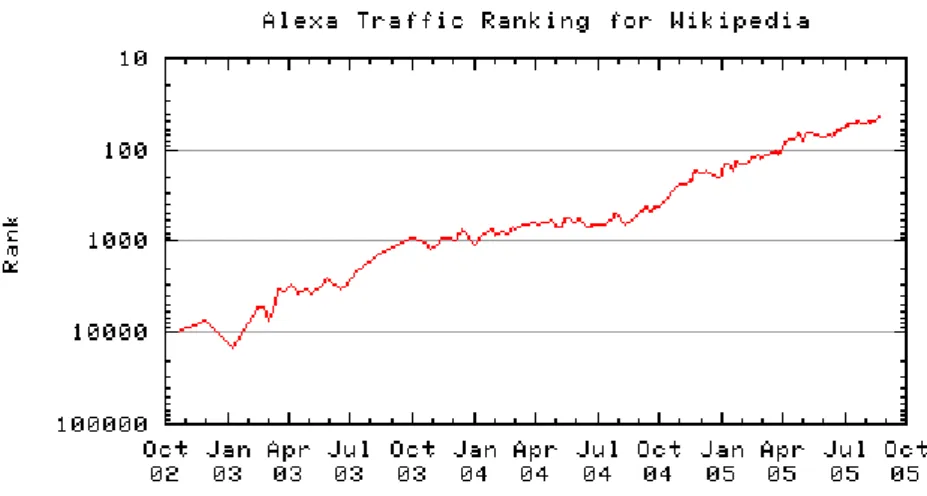
A good measure of the overall value of a Web resource is its traffic rank, its position in the list of the most popular Web sites. As there is no reason to believe that people use Wikipedia as anything but an encyclopedia, an increase in Wikipedia traffic rank, in particular with respect to other reference sites, can reasonably be interpreted as a vote of confidence in its overall usefulness as a reference work. The statistics shown in the following graph, provided by the independent ranking site Alexa, are very clear: the growth in Wikipedia traffic has been exponential and Wikipedia is the most popular online encyclopedia by far 62.
61 Perry, John and Zalta, Edward N, Why Philosophy Needs a Dynamic Encyclopedia,
Figure 4 - Alexa Traffic Ranking for Wikipedia 63
We are now in a position to answer our initial question: has Wikipedia achieved its goal? The conclusion can only be positive: Wikipedia has succeed, in just a few years, in creating an authentic encyclopedia whose breadth is unprecedented, whose depth is reasonable and improving, whose reliability is hard to measure but apparently also improving and whose overall usefulness as a reference work for the general public, if not necessarily for academic or specialised audiences, is unequivocally attested by the exponential growth of its popularity.
We are now ready to start examining some of the principles and patterns that underlie Wikipedia amazing success.
Birth and Growth of Wikipedia
The exponential growth in Wikipedia’s usage and size is the hallmark of systems whose utility grows with usage. At the core of Wikipedia’s growth there is a virtuous cycle: the greatest the quantity of information it contains, the greatest its usefulness and the number of readers-authors that it can attract, leading in turn to further growth in content. Once the virtuous cycle has started, it is virtually unstoppable and it leads to logistic growth, that is to say essentially exponential growth till it approaches the saturation point (see Principles of Network Utility). As Wikipedia is still in its infancy, we can expect its explosive expansion to continue for a long time.
63Wikipedia:Awareness statistics. Note that the graph scale is logarithmic and therefore
The difficulty lies entirely in starting the virtuous cycle. At the time of their launch, systems whose value depend on their usage are at a serious disadvantage as, inevitably, they have no users. This lead to a vicious, rather than virtuous, cycle: no users mean no value and therefore no way of attracting more users. The risk is that, rather than growing, the system will stagnate, unable to “bootstrap” itself (see Networks Have a Bootstrapping Problem).
On this regard, it is instructive to compare Wikipedia’s success with the failure of Nupedia, a previous attempt of the team behind Wikipedia to create an online open-content encyclopedia 64. The key difference between Nupedia and Wikipedia was in
their editorial model. Nupedia tried to emulate the traditional encyclopedic editorial model. Authors were expected to have demonstrable experience in their assigned subjects, mainly by holding a relevant academic position, and the articles went through a lengthy, multi-staged, editorial process of revision and checks. This complex and selective process drastically reduced the number of potential authors (see Out of Mediocrity Excellence) and imposed a significant burden on prospective authors. Unfortunately, as the value of Nupedia in its initial stage was very low as the encyclopedia lacked in both contents and prestige, there was very little incentive for authors to join the project. Costs being greater than rewards, the inevitable result was that Nupedia was able to complete only a negligible number of articles before being superseded by Wikipedia and abandoned.
On the contrary, Wikipedia has successfully managed to solve its bootstrapping problem by a combination of extremely low adoption costs and a modest amount of “start-up capital”. Everything in Wikipedia is geared to attract as many contributors as possible and to reduce to the minimum the cost of participation. In Wikipedia, authorship is literally just one click away. The start-up capital was provided by “seeding” Wikipedia with the contents of existing open-content reference works and by exploiting part of the editorial team that had gathered around Nupedia (see Seeding).
64 Sanger, Larry, The Early History of Nupedia and Wikipedia: A Memoir Part 1 and Part 2,
Slashdot (April 18-19, 2005),
http://features.slashdot.org/article.pl?sid=05/04/18/164213&tid=95&tid=149&tid=9 and
Maximising The Value of Wikipedia
The value of an economic good does not reside uniquely in its intrinsic value, in what it is worth when used on its own, but also on its extrinsic value that is produced by the combination of the good with others to create more complex and valuable goods (see Principles of Network Utility). Wikipedia itself is a very successful combination of two ideas: the online encyclopaedia and the Wiki cooperative authoring system. The combination of these two ideas has a value that goes well beyond that of its separate components. Wikipedia is vastly larger and more valuable than any existing non-Wiki online encyclopaedia or any non-encyclopaedic Wiki.
Wikipedia is particularly good at enhancing the value of its contents by making them available in a way that it is favourable to recombination. It does so by favouring:
• internal recombination through interlinking
• external recombination, thanks to its open content license that permits both the referencing and the replication of its contents
One very evident peculiarity of Wikipedia is the enormous amount of self-reference. Wikipedia articles contain an extraordinary number of references to other Wikipedia articles, on average there is one internal link every 16 words. This is due both to the encyclopedic nature of the work, that provides endless opportunities for cross-reference, and to the low cost of creating internal links. Creating a link to another Wikipedia article is as simple as typing the article name in double brackets, as for example in “[[Italy]]”. It is even possible to create links to entries that do not yet exist. These are displayed in a different colour than links to existing articles and act as reminders of articles that should be written.
Many users discover Wikipedia through search engines like Google, while looking for information on some specific subject. Once they have landed on their first Wikipedia article, however, they are likely to start a much longer journey. In fact, one of the reasons why Wikipedia can become so addictive is the incredible ease by which, thanks to its dense interlinking, one can endlessly flow from one subject to another. The feeling is that of navigating through a huge collective associative memory rather than a loose assembly of articles as in a traditional encyclopedia:
Vannegar Bush's dream in “As you may think” that anything else that I have seen.65
Wikipedia is also very widely cited from external sites. External citations are facilitated by the very simple and predictable naming conventions of Wikipedia (see Addressability). References to Wikipedia are also more valuable, and therefore more likely to be created, than references to commercial encyclopedias. While a link to an article in a commercial online encyclopedia is useful only to those who own a subscription, a reference to a Wikipedia article is useful to everybody.
References, either internal or external, increase the exploitable value of Wikipedia by:
• increasing the extrinsic value of the referencing page or article, that depends on the number of additional resources accessible through it
• reducing the access cost of the referenced article, making it easier to find (see Limits of the Preferential Attachment Model).
Wikipedia’s value is also multiplied by its many clones. Wikipedia is widely replicated, with tens of integral copies available on the Internet 66 plus an unknown but certainly significant number of partial copies and derived works.
Another factor that ensures the long-term growth of Wikipedia’s value is the flexibility of its technical platform. This flexibility has allowed the emergence of the many different mechanisms by which the contents of Wikipedia are structured and made easily accessible. As a result, Wikipedia is probably the encyclopedia that offers the widest variety of classification mechanisms, ranging from a variety of lists and taxonomies to specialised portals (see End-to-End Intelligence).
65 Aigrain, Philippe (2003). The Individual and the Collective in Open Information
Communities,16th BLED Electronic Commerce Conference, 9-11 June 2003.
Coordination
Coordinating the activities of a huge community of volunteer readers-authors, Wikipedia has around half a million registered users67 plus an unspecified number of anonymous contributors, working on hundred of thousands of potentially contentious subjects, is no mean task.
As in all organisations, coordination depends on communication and control. The solutions adopted, however, are quite original and very unlike those typical of formal organisations.
Direct and Indirect Communication
Wikipedians have at their disposal a wide array of one-to-one and one to many communication mechanisms. Each registered user has a personal page where messages can be left. A number of informal online “associations”68 connect likely-minded members of the community. Many “core” Wikipedians know each other identity so they can also communicate directly using e-mail or other communication tools. Finally, a series of national and international face-to-face meetings, including an international conference, have been organised.
Direct communication, however, does not scale well and it would be fanciful to believe that it could provide a suitable foundation for coordination on such a large scale (see Coordination). The hallmark of Wikipedia’s coordination is indirect communication. Coordination mainly takes place by “working on the same page”, editing articles and reacting to edits made by other participants. In a way not dissimilar to ants that coordinate their foraging activities by reacting at chemical markers left on the trails by their comrades, Wikipedians coordinate each other by monitoring the flow of edits on the pages that concern them most (see Stigmergy).
It is only when this mechanism fails, when a conflict arises that cannot be solved indirectly, that direct communication kicks in. The first port of call are the “Talk” pages, of which one exists for every entry. The “Talk” pages are a forum to debate the contents of the corresponding encyclopedic entry. Talk pages absorb and modularise conflict. Though there might be extremely controversial views on certain
67http://meta.wikimedia.org/wiki/Wikipedia