UNIVERSIDAD TÈCNICA PARTICULAR DE LOJA
La Universidad Católica de Loja
ÁREA SOCIO HUMANÍSTICA
TITULO DE LICENCIADA EN CIENCIAS DE LA EDUCACIÓN MENCIÓN
INGLÉS
Teachers’ and students’
perceptions of teaching English in small classes in
Ecuador
TRABAJO DE TITULACIÓN.
AUTORA: Celi Herrera, Ana Belén
DIRECTORA: Pinza Tapia, Eliana Ivanova, Mgs.
CENTRO UNIVERSITARIO MACHALA
Aprobación del Director del Trabajo de Titulación
Magíster.
Eliana Ivanova Pinza Tapia
DOCENTE DE LA TITULACIÓN
De mi consideración:
El presente trabajo de titulación: “Teachers’ and students’ perceptions of teaching English in small classes in Ecuador” realizado por Celi Herrera Ana Belén, ha sido orientado y revisado durante su ejecución, por cuanto se aprueba la presentación del mismo.
Loja, 2016
Declaración de Autoría y Cesión de derechos
“Yo Ana Belén Celi Herrera, declaro ser autora del presente trabajo de titulación:
Teachers’ and students’ perceptions of teaching English in small classes in Ecuador, de la Titulación de Ciencias de la Educación mención Inglés, siendo Eliana Ivannova Pinza Tapia directora del presente trabajo; y eximo expresamente a la Universidad Técnica de Loja y a sus representantes legales de posibles reclamos o acciones legales. Además certifico que las ideas, conceptos, procedimientos y resultados vertidos en el presente trabajo de investigativo, son de mi exclusiva responsabilidad.
Adicionalmente declaro conocer y aceptar la disposición del Art. 88 del Estatuto Orgánico de la Universidad Técnica Particular de Loja que en su parte pertinente textualmente dice: “Formar parte del patrimonio de la Universidad la propiedad intelectual de
investigaciones, trabajos científicos o técnicos y tesis de grado que se realicen a través, o con el apoyo financiero, académico o institucional (operativo) de la Universidad”
f.………
Dedication
Acknowledgement
Contents
Contenido
Cover ... i
Certification ... ii
Declaration de autoria y cesion de derechos………..……….iii
Dedication ... iv
Acknowledgement………v
Contents………...vi
Abstract ... 1
Resumen ... 2
Introduction ... 3
Method ... 5
Discussion ... 7
Literature Review ... 7
Description, Analysis, and Interpretation of Results ... 16
Conclusions ... 33
Recommendations ... 34
Abstract
Teachers’ and students’ perceptions of teaching English in small classes in Ecuador is
the theme of this research; this study was conducted in a public high school in Machala, Ecuador. In this institution, five English teachers and sixty students were surveyed through a questionnaire.
The quantitative method was applied in this research to calculate the percentages of answers given by teachers and students in relation to the variables analyzed. In this analysis, it was necessary to consider main aspects which concern about teachers and students
perceptions about benefits of teaching learning English in small classes, the teaching strategies sources that benefit the teaching process, and limitations of teaching and learning English in small classes. In addition, surveys and note-taking were the techniques and observation formats and questionnaires were the instruments applied in this research.
The results of this study show that the main benefits of teaching and learning English in small classes were that there more opportunities of teacher-student interaction, proper feedback provided. Nevertheless, the main limitation face in small classes is that there are anxiety among learners due to the teachers’ control and discipline.
Resumen
La percepción de profesores y estudiantes en la enseñanza y aprendizaje del idioma Inglés en clases pequeñas en Ecuador es el tema de esta investigación y su propósito es saber si existen beneficios para estos procesos relacionados al tamaño de clase. Este estudio se llevó a cabo en un colegio público de la ciudad de Machala. En esta institución, cinco profesores de inglés y sesenta estudiantes fueron encuestados a través de un cuestionario.
El método cuantitativo se aplicó en esta investigación para calcular los porcentajes de las respuestas dadas por los profesores y los estudiantes en relación con las variables
analizadas. En este análisis, fue necesario tener en cuenta los aspectos principales sobre las percepciones de la muestra acerca de los beneficios de la enseñanza aprendizaje de inglés en clases pequeñas, las estrategias y recursos de enseñanza que aportan al proceso de enseñanza sentimientos de estudiantes al aprender en clases pequeñas y limitaciones de trabajar en clases pequeñas. Además, las encuestas, toma de notas fueron las técnicas y los formatos de
observación y cuestionarios fueron los instrumentos aplicados en esta investigación.
Los resultados de este estudio muestran que los principales beneficios de la enseñanza y el aprendizaje de inglés en clases pequeñas fueron que hay más oportunidades de
interacción entre profesor-alumno, una adecuada retroalimentación y los profesores pueden recordar los nombres de los estudiantes. Sin embargo, la principal limitación que enfrenta las clases pequeñas es que hay ansiedad entre los estudiantes debido al control y la disciplina de los profesores.
Introduction
Nowadays there are many issues hindering the growth of English as a Foreign Language in high schools, especially in the public sector. According to the National Secretariat of Higher Education (SENESCYT), the students who graduated from secondary school have an average of 65% of English; it means they are not able to develop the four main skills and consequently they cannot communicate by using this language. For this reason, the Minister of Education (2012) has implement different policies and strategies such as the improvement of curriculum based on international standards.
Based on what it is mentioned above, the present study was conducted to search on teachers’ and students’ perceptions of teaching English in small classes in Ecuador, whose purpose is to know if small class size is associated with the students’ progress through the following questions: What are the benefits of teaching and learning English in small classes? What teaching strategies and resources benefit the teaching of English in small classes? How do students feel about learning English in small classes? And are there any limitations when teaching English small classes?
Similar studies have been carried in other countries. One of them was carried out by Harfitt (2012) whose purpose was examine whether, and how, class size reduction might help to alleviate language learning anxiety, which has long been seen as an obstacle to second language acquisition.
One of the main limitations of this study was that the information of the students surveyed could not be real since their opinions were influence by their classmates.
Another study was developed by Alghamadi & Gillies (2014) who formulated the following questions: What is the effect of cooperative learning in comparison to traditional small group learning on the achievement of grammatical knowledge of EFL learners?, What
achievement of writing skills of EFL learners?. What is the effect of cooperative learning in
comparison to traditional small group learning on the achievement of writing skills of EFL
learners? No limitation is reported in this study.
A third study was conducted by Din (1999). The researcher proposed the following questions: (a)What kind of factor is class size? (b) What are the benefits for having small classes in schools? (c) What should teachers and students in large classes do to teach and learn effectively? No limitation is reported in this study.
Regarding the benefits of this research, this research will serve as a basis for people who want to know teacher and students’ perceptions of teaching and learning English in small
Method
Settings and participants
This research was carried out in a public high school, located in the urban area of Machala. The sample selected for this study was five secondary classrooms. These small classes were selected at nonrandom sampling since not all of the classrooms fulfilled the class size requirement which was to be comprised by 20 students or less. The participants were 5 teachers and 60 students from 1st, 2do and 3rd year of senior of High School. The age group of sampling ranged from 15 to 23 years old.
Procedures
The study began by finding previous literature directly relevant to this study. The literature came from two different resources: books and articles. The information was found on the Internet and also at Universidad Técnica Particular de Loja through its virtual and physical libraries.
After the questionnaires were applied, the information was tabulated by using and electronic spreadsheet in order to convert them into percentages for an easier analysis of the four different sections. All the information was thoroughly revised for accuracy.
Discussion
Literature Review
This section includes the theoretical information of the most important aspects related to
managing learning (instructions, feedback), teachers and students interaction, teaching
techniques, strategies and activities for teaching English in small classes, the learning environment that in small classes and the effect that class size has on learning that teachers may encounter in a class.
In addition, this section includes a review of five important studies develop by researchers around the world that are related to the present investigation.
Managing learning
Teachers do not use only methods and techniques in the classroom; they give also instructions, feedback and time for each activity or task. Therefore, an important part of managing learning is giving instructions. Dixie (2003) states that it is it not an easy task because it depends on the type of activity and resources that learners will do and use in the classroom. Besides, this author mentions that instruction must be simple, observable, clear, specific and related to learning activities.
Another important aspect of managing learning is feedback. Richard & Lockhart (2006) explain that feedback is an important tool in evaluating students’ process and success in language learning. As a result the more feedback students receive, the more they will be able of self-assess their learning and develop new strategies to acquire knowledge.
Finally, timing is other aspect of managing learning. About it, Richards& Lockhart (2006, p. 171) say “The amount of time that students spend on classroom activities has been identified as one of the most important aspects affecting student learning. Therefore, the authors recommend teachers to consider the time that they are going assign for each activity when you are planning a lesson because by doing this teachers will acquire the sufficient experience to manage time appropriately in class. In addition, Spielberger (2004) mentions that allocating time limits for each activity when you are planning the lesson and avoid the temptation to let activities carry on until the learners are bored.
Teacher-student and student-student interaction
According Zajda (1998) states that teacher- student interaction play an important role in the learning process due to the way participants perceive teachers’ attitude towards them
will determine their attitude in class. Therefore, this author indicate that interactions in small classes are more frequent, and beneficial in relation to those in large classes due to teachers that work with a small group of students respond better to their needs, which give students more confidence and more opportunities for the interaction between teacher- students.
Furthermore, Baker and Westrup (2003) express that language interaction between the instructor and students and peer work among the learners maximize students’ participation
and interaction in class and also this allows teachers to give individual attention to students while many are working in pairs or small groups. As Richards & Rodgers (2001) explain that the main purpose of cooperative language teaching is to help the teacher build positive relationship among students and at the same time teach cooperative skills among learners; here the teacher is a facilitator and take part in the teaching-learning process as an
Class size
Harmer (2003) mentions that class size is an essential factor in the process of teaching English. This author argues that English language classes vary greatly in size, for that reason, teachers have to adapt and use teaching techniques according to the number of students.
According to Blatchford (2007), while teaching a language, class size is of great importance because when a teacher works with small classes, he spends little time controlling activities and the learning is more meaningful.Similarly, Flood, Lapp, & Jensen (2003) clarify that small classes are associated with better achievement and also related to other indicators of quality such as discipline. Also, the authors mention that students in small classes tend to increase their participation and teachers are able of providing effective feedback. Moreover, students in smaller classes had stronger motivation, better self-concept, and lees anxiety.
Nevertheless, Carbone (1998) expresses that students in large classes tend to complain about the impersonal atmosphere; learners argue that they feel demotivated because it is not easy to be noticed among high number of students. In addition, Saraswatti (2004, p. 154) says, “A teacher cannot even get to know the names of all her learners in a large class.
Teaching techniques, strategies or activities for teaching English to small classes
Teachers use different types of methods in English language teaching and each method provides a wide variety of techniques. Brown (2001) describes three types of teaching
Furthermore, there are other techniques that Dhand (2008) mentions, for example: autobiographies, brainstorming, case study, debate, visiting museum. He mentions that autobiographies are good techniques to teach students to describe individual characteristics. About brainstorming, this technique is used to promote on students creativity because they are encouraged to give original ideas about a particular topic. Next, case study is useful to teach students how to elaborate conclusions based on important details. Debate is useful to promote speaking abilities and criticisms about interesting topics. Finally, visiting museum gives students rich experience because they are exposed to real facts of important events in world history.
Finally, more techniques are described by Diaz (1999) who presents participation techniques as important tools to create interaction between students and teachers, some of those techniques are: display, dictation, drama, individual work, and group work. Display is used to encourage students to explain elements or characteristics of certain topic. Dictation is used to practice writing skills. Drama is useful to develop students’ communicative skills.
Individual work develops learners’ independence and self-confidence; it fosters calm and
peace between students. And group work promotes interaction, cooperation, and communication between students.
Learning environment in small classes
In addition, the space for daily routine should be easy and free from congestion to avoid generation disruptive behavior. Then, wall space is another factor to be considered as important and needs special attention given that it is often utilized merely for decorative purposes and should not be like this; more effort could be put into improving this situation. A good idea might be placing shelves or a wide range of items such as worksheets teaching aids supplies of paper of references materials for the class in order to enhance learning in students. Next, general ambience is also important; this aspect has to do with the teacher’s
performance. They should try to create a safe, pleasant and stimulating atmosphere so learning can take place in an enjoyable and effective way Such as floor space, the most common seating arrangements include horizontal rows, vertical rows, circles and long tables, all of which serve different purpose, a good seating arrangement is one which facilitate specific learning task; wall space, it is another area which needs special attention; general ambience, the teachers should try to create a safe, pleasant and stimulating atmosphere as possible so that learning is enjoyable and affective.
Furthermore, there are several seating arrangements that teachers can use in order to make effective use of space and maintain easy access to the whole class. For example, Woolfolk (2007) shows different kinds of seating arrangements such as the clusters of four and the circle arrangements, which are helpful for students’ interaction. Clusters permit
learners to talk, help each other, share materials, and work in group tasks. Circles are especially useful for discussions but still allow independent seatwork.
organize the class in horizontal rows not only to call the students’ attention towards the
teacher at all times, but also to allow students to work more easily in pairs.
So far, the information used in this investigation project has been exposed; the following information that is part of this literature review is from some studies taken from journals.
The first is a study conducted by Harfitt (2012), examine whether, and how, class size reduction might help to alleviate language learning anxiety, which has long been seen as an obstacle to second language acquisition. In the study the researcher use mainly questionnaires, class observations and interviews, this study employed multiple case studies in four Hong Kong secondary schools. Each case constituted one teacher teaching English language to first language Chinese students in a reduced-size class (where class size was between 21 and 25 students) and a large class (where class size was between 38 and 41 students) of the same year grade, and of similar academic ability.
In conclusion this study suggests that the student voice can provide insights into language learning classrooms. Data from the case studies reveal that students’ sense of anxiety can be reduced in smaller classes and that class size reduction may assist in breaking down cultural barriers.
The second is a study conducted by Alghamadi & Gillies (2014) who formulated the following questions: What is the effect of cooperative learning in comparison to traditional small group learning on the achievement of grammatical knowledge of EFL learners?, What
is the effect of cooperative learning in comparison to traditional small group learning on the
achievement of writing skills of EFL learners?. What is the effect of cooperative learning in
comparison to traditional small group learning on the achievement of writing skills of EFL
The study was carried out on four secondary schools in Saudi Arabia where 139 male students, whose ages ranged between 14-15 years old were chosen. The instrument that was used to collect data is a pre-test and post-test English grammar achievement test. The test was
used as both a pre-test and a post-test to investigate the impact of the cooperative learning
method on students’ English language achievements. The test is comprised of twenty
multiple-choice questions. At the beginning of the test, the participants were asked to choose
the correct answer from four options and the time allocated for this part was 40 minutes. After
that, the students were required to write a paragraph to identify their productive grammar and
the time allocated for this part was 20 minutes. The time allocated for the whole test was 60
minutes. There were two marks for each correct answer in the multiple-choice question and
ten marks for the writing task, making the total score obtainable at fifty.
In conclusion, the study showed that there are statistically significant differences
between the mean scores of the students who were taught English in the cooperative learning
environment (the experimental group), and those who were taught the English by using the
traditional small group method (the control group) in the post-test in favor for the
experimental conditions.
The next study was developed by Din(1999). The researcher proposed the following questions: (a) What kind of factor is class size? (b) What are the benefits for having small classes in schools? (c) What should teachers and students in large classes do to teach and learn effectively?
The sample of the study consisted on five schools (three elementary and two
the questions were open-ended and they were designed to collect the perceptions of the Chinese rural teachers on class size related issues.
Based on the results from the data the author concluded that Chinese rural teachers did not see a necessary link between class size and student achievement. However, they believed that small classes facilitate classroom management, more student-teacher interactions, more individualized help from the teachers, and reduce teachers’ workloads. The Chinese rural teachers also believed that competition among students promoted learning for students in large classes.
Another study developed by Harfitt (2013) was also studied, the purpose of which was to explore the relationships between class size and the pedagogical practices adopted by 4 experienced teachers in Hong Kong who are each responsible for one large and one reduced-size English language class of the same grade level.
It may be that the smallness of the class automatically provides opportunities to teachers; in this study some teachers exploited those opportunities more than others but it would be erroneous, perhaps, cutting class size is sufficient on its own as a way of mediating change. Teacher trainers, accordingly, may exemplify this through microteaching, school visits and dissemination of similar case studies to help teachers articulate and then exploit the benefits of class size reduction through the development of a battery of teaching strategies.
Description, Analysis and Interpretation of Results
In this section of the study, the data gathered during the field research will be presented and analyzed by following the qualitative and quantitative approaches.
In order to do this, the responses to each question in the teachers´ questionnaire will be displayed in tables; they will be analyzed, supported and contrasted with the information from the students’ questionnaire, class observation and scientific resources.
[image:22.595.84.558.369.627.2]Qualitative and Quantitative Analysis What are the benefits of teaching and learning English in small classes?
Table 1
Teachers´ perceptions
No In classes with a small number of students:
To ta lly ag re e Ag re e Pa rtia lly ag re e Disa gr ee T OT AL
f % F % f % f % f %
1
It is easier to design activities that help the
students to apply what they have learned. 4 80 1 20 0 0 0 0 5 100 2
The students are attentive and participate in
class activities. 4 80 1 20 0 0 0 0 5 100
3
The class space allows students to properly
do the activities designed. 5 100 0 0 0 0 0 0 5 100
4 Appropriate feedback can be given.
5 100 0 0 0 0 0 0 5 100 5
Activities that allow more interaction among
students are performed. 5 100 0 0 0 0 0 0 5 100
6
There is more interaction between the teacher
and the students. 5 100 0 0 0 0 0 0 5 100
7
It is easier to remember students’ names.
2 40 3 60 0 0 0 0 5 100
Table 2 Students` perceptions
No In classes with a small number of students: T
ot al ly agre e A gre e Part ial ly agre e D isagr ee T O T A L
f % f % f % F % f %
1
The activities done in class help to apply
what students learn. 37 61,7 23 38,3 0 0 0 0 60 100
2
The students are attentive and participate in
class activities. 28 46,7 31 51,7 1 1,67 0 0 60 100
3
The students can better concentrate because
there is less noise in the classroom. 42 70 17 28,3 1 1,67 0 0 60 100
4
The classroom space allows students to
carry out activities assigned by the teacher. 40 66,7 19 31,7 1 1,67 0 0 60 100
5
Students receive proper feedback form the
teacher. 37 61,7 22 36,7 1 1,67 0 0 60 100
6 There is interaction among the students. 32 53,3 20 33,3 8 13,3 0 0 60 100
7
There is interaction between the teacher and
students. 36 60 23 38,3 1 1,67 0 0 60 100
8 The teacher remembers the students’ names. 33 55 20 33,3 7 11,7 0 0 60 100 Author: Celi Herrera Ana Belén
Source: Student`s questionnaire
In accordance to the results displayed in the tables show that 80% of the participant teachers totally agree that in small classes it is easier to design activities that allow students practice and show what they have learned in class; likewise, 61.7 % of the students totally agree that in small classes the activities done in class help to apply what students learn, and 38.3 % students answered agree. It means that most of the teachers and students agree with this statement.
Blatchford (2003) confirms these findings by pointing out that in small classes less time is spent on controlling students and worthwhile activities can be developed in classes due to teachers has the potential to provide more extensive and task-related individualization of instruction.
Regarding to the statement 2, table 1 indicates that 80% of the surveyed teachers totally agree that in small classes the students are attentive and participate during class activities, and 20% students agree with this statement. Table 2 reports that 46.7 of the students totally agree that in small classes the students have the same level of attention and participation in class, 51.7% of them agree. This means that most of the teachers and students affirm that in small classes students are attentive and participate in class activities.
The result shown about this second statement is supported by the data gathered through the observations because in most of the observed classes the students’ attention was maintained by all teachers who fostered learners to remain quiet and pay attention to the class. The short number of students is beneficial when teachers work with small classes because it allowed the whole class participation and students were attentive all the time which is beneficial in the students learning process.
About it, Flood, Lapp, & Jensen (2003) state that participation and involvement tend to increase when classes are small. Besides, these findings are also supported by McCrorie (2006) who explains that small groups provide opportunities for learning that are difficult to establish in large group settings. They are particularly useful to enable learners to take part in discussion, active participation, feedback and reflection, and to consolidate learning, clarify understanding, and explore ideas and concepts.
is less noise in the classroom and 28.3% agree with this statement. It means that all the students think that working in small classes facilitates their concentration.
The results show that there is a tendency majority in favor of the statement, indicated by 98.3% of the students can better concentrate because there is less noise in the classroom. This assumption is supported by the class observations due to that there is low level of disruption during the classes and all observed teachers could easily manage those situations. As a result, it is evident that students can concentrate better on all their activities.
With regard to the statement 3 in table 1 show that all teachers totally agree that in small classes the class space allows students to properly do the activities designed. Table 2 in relation to the statement 4 indicates that 66.7% of the students totally agree that in small classes the classroom space allow students to carry out activities assigned by the teacher, 31.7% agree, and only 1.7% partially agree. This means that both teachers and students think that the classroom space allow the development of activities assigned by teacher.
The results shown about the statement mentioned above is supported by the data gathered through the observations because in most of the observed classes it was palpable that the activities designed by the teacher were developed properly overall in those classes where the number of students was small. It was easy for students to follow the teachers’ directions, especially when they had to move around the class in order to complete activities. It is really important because learning becomes more enjoyable when they have activities that involve movements.
Likewise, Hue & Li (2008) explain that the creative use of physical space has a significant effect on students’ learning. They add that sometimes it is not possible and to change seats it affects students’ level motivation because they are not able to work well.
In statement 4, table 1 indicates that 100% of the surveyed teachers totally agree that in small classes appropriate feedback can be given. Table 2 shows that 61.7% of the students totally agree that in small classes they receive proper feedback from the teacher, 36.7% agree, and 1.67 partially agree. This result shows that teachers and students believe that in small classes feedback is given properly in class by teacher.
Similarly, these results are consistent with the information obtained through the observation sheets reflects that all teachers were able to give students adequate feedback at different moments during the class according to the students’ needs. According to Brookhart
(2008), when teacher gives appropriate feedback in small classes it improves students’ work because develop self-criteria to evaluate their learning process.
With respect to the results in the statement 5, table 1 reports that 100% of the surveyed teachers totally agree the activities that allow more interaction among students are performed in small classes. Table 2 indicates 53. 3% of the students totally agree that there is interaction between students in small classes, 33.3% agree and 13.3% partially agree. It means that small classes allow students to interact among them.
Likewise, the information gathered through the observation sheets demonstrate that in most of the observed classes the interaction among students was notable. They were close to each other and they could develop adequately the activities that involved a kind of interaction among them. The relationship among students seems to be cordial because they know each other very well. Also, they looked comfortable when they talk with their classmates. They do not feel afraid of making any mistake because there was a good environment in the classroom.
strategies for talk and interaction that occurs in language–learning tasks needs to be investigated to understand the full range of interactional opportunities that are afforded to language learners.
Following the interpretation of the results in relation to statement 6, in table 1 indicates that 100% of the teachers totally agree that in small classes there is more interaction between the teacher and the students. Table 2 shows that 60% of the students totally agree that in small classes there is interaction between teacher and students, and 38, 3 % agree. These results reflect that there is interaction between teacher and students in small classes.
The result shown about the statement mentioned above is supported by the data gathered through the observations because most of the observed teachers had a great interaction with the students. They had a good interaction with students. It is an important key for learning because students collaborate with the teacher. Also students seem to feel confident of asking to the teacher about their doubts. On the other hand, in one observed class the interaction between teacher-students was not acceptable. Teacher tried to keep his distance with students in order to control the class. In contrast with this, students did not look comfortable with this situation.
In the same way, Din (1999) believes that small classes facilitate classroom management, provide more student-teacher interactions, individualized help from the teachers and also reduce teachers’ workloads. Besides, the author mentions that is neccesary that the
interactive relationship in the classroom is very helpful to develop good rapport with a teacher and their students during the teaching-learning process
Regarding statement 7 shows that 40% of the teachers totally agree in small classes it is easier to remember students’ names and 60% agree with this statement. Table 2 indicates
From the information gathered in the observational sheets, it can be confirmed that all teachers effectively remembered their students’ names which fostered a better relation
between teacher and students, making the students to feel confident and relaxed. Besides, it means they remember the students’ names easily. It helps students to feel motivated and get
involved in class.
Finally, it is worth indicating that when teachers are capable of remembering the name of every learner, they establish a positive rapport with their students to create a teaching-learning environment full of support and confidence.
What teaching strategies and resources benefit the teaching of English in small classes? Table 3
Teachers` perceptions
No In classes with a small number of students: Tot
al ly agre e A gre e Part ial l y agre e D isagr e e T O T A L
f % f % f % f % f %
8
Design and apply activities that allow student to
practice listening skills. 4 80 1 20 0 0 0 0 5 100
9
Design and apply activities that allow students
to practice speaking skills. 4 80 1 20 0 0 0 0 5 100
10
Design and apply activities that allow students
to practice reading skills. 4 80 1 20 0 0 0 0 5 100
11
Design and apply activities that allow students
to practice writing skills. 4 80 1 20 0 0 0 0 5 100
12 Design and apply group work activities. 5 100 0 0 0 0 0 0 5 100
13 Design and apply individual activities. 5 100 0 0 0 0 0 0 5 100 14 Use technological tools. 2 40 3 60 0 0 0 0 5 100 15 Use didactic materials. 3 60 2 40 0 0 0 0 5 100 Author: Celi Herrera Ana Belén
[image:29.595.84.542.444.687.2]Source: Teacher`s questionnaire
Table 4
Students` perceptions
No In classes with a small number of students: Tot
al l y agre e A gre e Part ia lly agre e D isagr ee T O T A L
f % f % f % f % f %
9 The activities done allow students to practice listening skills. 29 48,3 26 43,3 5 8,33 0 0 60 100
10
The activities done allow students to practice
speaking skills. 34 56,7 22 36,7 4 6,67 0 0 60 100
11
The activities done allow students to practice
reading skills. 35 58,3 24 40 1 1,67 0 0 60 100
12
The activities done allow students to practice
writing skills. 35 58,3 20 33,3 5 8,33 0 0 60 100
13 Group activities are used 37 61,7 16 26,7 7 11,7 0 0 60 100 14 Individual activities are used. 44 73,3 15 25 1 1,67 0 0 60 100 15 Technological tools are used. 34 56,7 18 30 4 6,67 4 6,7 60 100 16 Didactic materials are used. 37 61,7 16 26,7 4 6,67 3 5 60 100 Author: Celi Herrera Ana Belén
Source: Student`s questionnaire
Concerning to statement 8, table 3 shows that 80% of the teachers totally agree that in small classes it is easier to design and apply activities that allow students to practice listening skills and 20% agree with this statement Table 4 reveals that 48.3% of the surveyed students totally agree that in small classes the activities done allow students to practice listening skills, 43.3% agree and 8.33% partially agree.
Regarding to statement 9, table 3 shows that 80% of teachers totally agree that in small classes it is easier to design and apply activities that allow students to practice speaking skills, and 20% are agree. Table 4 indicates that 56.7% of the students totally agree that in small classes the activities done allow students to practice speaking skills, 36.7% agree and only 6.67% partially agree.
Continuing with the analysis of the statement 10, table 3 reports that 80% of the teachers totally agree than in small classes it is easier to design to design and apply activities that allow students to practice reading skill, and 20% are agree. Also, table 4 indicates that 58.3% of the students totally agree that in small classes the activities done allow students to practice reading skills, 40% agree and 1.67% partially agree.
Related to the statement 11, table 3 about designing and implementation of activities that allow students to practice writing skills; 80% of the teachers totally agree and 20% are agree. Furthermore, table 4 in relation to the statement 12, 58.3% of students totally agree, 33.3% agree and 8.33% partially agree.
speaking, reading and writing skills. It was easier for teachers to apply these activities because the class was small and students could listen clearly the audios as there is not too much noise in class. Students could participate and practice actively in speaking and reading activities and they seemed that they liked and enjoyed the same ones. They had the opportunity to write and they understood better even when their vocabulary was not wide. The implementation of all these activities as strategies for improving the English learning in small classes is really beneficial and according to Raimes (1983) students are not comfortable with the normal classroom activity to use all their language skills. On the other hand, when they work in small classes, they have the chance not only to use the new language but also to play with it. They need to experiment with new words and new sentences types.
Table 3 indicates that statement 12, 100% of teachers totally agree that in small classes that it is easier to design and apply group work activities. Related to the same statement, in the table 4, 61.7% of students totally agree, 26.7% agree and 11.7% are partially agree. It means that most of the teachers and students confirm that group work activities are designed and implemented in their classes.
Also, through the observation, it was notable in four of the observed classes that teachers used group activities but in other one teacher did not use this kind of activity. The teachers who implemented these activities made groups easily and students worked in a disciplined way. Students could interact with their classmates and also practice English in real situations.
Regarding to the statement 13, table 3 shows that 100% of the teachers totally agree about the designing and implementation of individual activities in small classes. Table 4 indicates that 73.3% of students totally agree that individual activities are used in small classes and 25% agree. It means that all the teachers and most of the students agree in the fact that individual activities are applied in small classes.
In spite of the results, during the observations, only 2 teachers used individual activities even though this type of work was not carried out in an appropriate way since the teachers asked the whole class to individually complete a task on the book, but they did not check whether all the students worked on their task effectively. However, 3 of the teachers mentioned that they do not use individual classes.
According to the fourteen statement about the use of technology resources in small classes, table 3 indicates that 40% of teachers totally agree and 60% agree. Moreover, 56.7% of students totally agree that technological tools are used in small classes, 30% agree and 6.67% partially agree and 6.7% disagree. This means that most of the teachers and students confirm that technological resources are used in class.
Even though teachers said that they used technological tools in the statement mentioned above. The whiteboard was used by teachers in all observed classes to explain contents and to write of the use grammar structures. In addition, only tape/Cd recorders were used by teachers in some classes to help students listening skills. Unfortunately, this is a common feature between public schools in Ecuador.
Also, in four of the five observed classes teachers used teaching materials but, in one of them teachers did not use any material to teach their students. The teachers that use materials in class get the students’ attention and made the class more enjoyable for students.
In addition, in relation to this matter Cunningsworth (1984) suggests using didactic materials (flashcards, brochures advertisements and tickets, etc.) in small classes help students practice their English. The researcher would like to emphasize that these materials offer a rich source of the target language and are easy to be obtained for working with small classes.
According to all these results, there are some strategies and resources which benefit the teaching of English in small classes. The best strategies involve the designing and implementation of activities to develop the four basic skills. Furthermore, for teachers it is beneficial the implementations of group activities but, according with the theory the individual activities are also beneficial in small classes.
How do students feel about learning English in small classes? Table 5
Teachers` perceptions
No
In classes with a small number of students:
T ot al ly agre e A gre e Part ial l y agre e D isagr ee T O T A L
f % F % f % f % f %
16 They are relaxed when speaking in front of their classmates. 5 100 0 0 0 0 0 0 5 100
17
They are taken into account by the teacher because they have more opportunities to
participate in class. 5 100 0 0 0 0 0 0 5 100
18
They are motivated to participate because of
the small number of students. 5 100 0 0 0 0 0 0 5 100
19
They are at ease because they can healthy
compete with their classmates. 5 100 0 0 0 0 0 0 5 100
Author: Celi Herrera Ana Belén Source: Teacher’s questionnaire
Table 6 Students` perceptions
No In classes with a small number of students: T
ot al ly agre e A gre e Part ial l y agre e D isagr e e T O T A L
f % f % f % f % f %
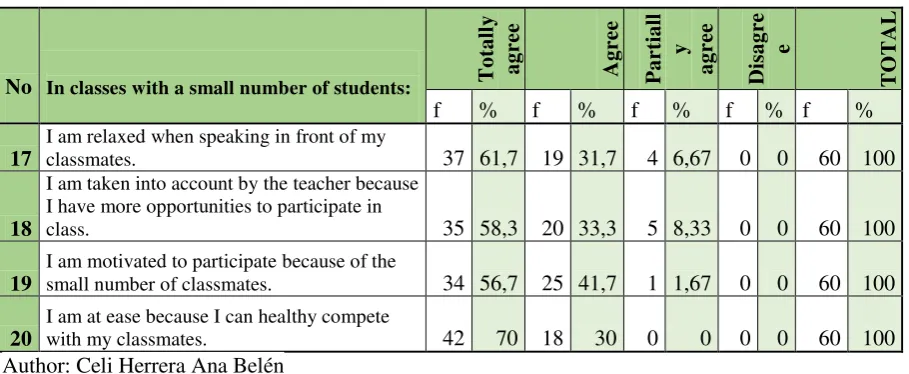
17 I am relaxed when speaking in front of my classmates. 37 61,7 19 31,7 4 6,67 0 0 60 100
18
I am taken into account by the teacher because I have more opportunities to participate in
class. 35 58,3 20 33,3 5 8,33 0 0 60 100
19 I am motivated to participate because of the small number of classmates. 34 56,7 25 41,7 1 1,67 0 0 60 100
20 I am at ease because I can healthy compete with my classmates. 42 70 18 30 0 0 0 0 60 100 Author: Celi Herrera Ana Belén
Source: Student’s questionnaire
[image:34.595.84.539.394.581.2]The results shown about the statement mentioned above is supported by the data gathered through the observation because students feel comfortable and relaxed when they were speaking in front of their classmates. The students’ performance was good. They seemed to feel familiarized with their group and they were not afraid of making mistakes. These results are confirmed by Hale, Janell, & Kristen, (2008). These authors argue that students feel more relaxed with friends than an ordinary mix of classmates and are more secure, and less worried about making mistakes because they know their friends, understand them and try to be helpful in learning together.
Concerning to the statement 17 in table 5 indicates that 100% of the teachers totally agree that in classes with a small number of students, they are taken into account by the teacher because they have more opportunities to participate in class. Table 6 reports that 58.3% of the students totally agree that in small classes, they are taken into account by the teacher because they have more opportunities to participate in class, 33.3 % agree and 8.33% partially agree.
Besides that, through the observation sheets it was notable in all the observed classes that students participated all the time in class. It was easier for the teachers to involve students during the class. Students were included in class and they performed better because teachers expected more from them all the time. In addition to this topic, Harlift (2012) argues that the sense on anxiety is reduced when students are part of a small class because it seems to facilitate participation from the students.
partially agree. It means that both teachers and students agree that in small classes students are motivated to participate in class because of the small number of classmates in their class.
Besides that, in all the observed classes the students felt motivated to participate actively in class. About this, Harfitt (2012) states that students in smaller classes in comparison to a large class are more confident and motivate to speak up and participate in the class. This author further points out that every student in a small class want to contribute perspectives.
In the statement 19, table 5 shows that 100% of the teachers totally agree than in small classes they are at ease because they can healthy compete with their classmates. Table 6 indicates that 70% of the students totally agree than in classes with a small number of students, they are at ease because they can healthy compete with their classmates and 30% agree. This means that all the teachers and all the students totally agree and agree that in small classes can compete healthy with other students in their class.
According to the observation, in four of five observed classes, students seemed comfortable while, in other class students looked a little bit anxious and nervous of competing with other students in the class. Students were comfortable of participating in class because they did not have the pressure of big groups. In the same way Harmer (2007) affirms that another way to influence students’attitude towards learning in a healthy compettition is to
make groups and provide interesting activities so that everybody is attentive and communicative.
feel afraid of competing with their classmates, because they are able to participate in competence with not fear to be wrong.
[image:37.595.88.547.206.336.2]Are there any limitations when teaching English in small classes? Table 7
Teachers` perceptions
No In classes with a small number of students: T
ot al ly agre e A gre e Part ial l y agre e D isagr e e T O T A L
F % f % f % f % f %
20 There is anxiety among students because there is more control form the part of the teacher. 0 0 5 100 0 0 0 0 5 100
21 Listening and speaking skills are more difficult to develop. 0 0 1 20 2 40 2 40 5 100 Author: Celi Herrera Ana Belén
Source: Teacher`s questionnaire
Table 8 Students` perceptions
No In classes with a small number of students: T
ot al ly agre e A gre e Part ial ly agre e D isagr ee T O T A L
F % f % f % f % f %
21 There is anxiety among students because there is more control on the part of the teacher. 29 48,3 12 20 18 30 1 1,67 60 100
22 Listening and speaking skills are more difficult to develop. 27 45 25 41,7 5 8,33 3 5 60 100 Author: Celi Herrera Ana Belén
Source: Student`s questionnaire
With regard to statement 20, table 7 indicates that 100% of the surveyed teachers agree that in small classes, there is anxiety among students because there is more control on the part of the teacher. Table 8, reveals that 48.3% of the students totally agree that in small classes, there is anxiety among students because there is more control on the part of the teacher, 20% are agree, 30% partially agree and 1.67% disagree.
[image:37.595.85.556.411.539.2]control on the part of the teacher. The observation process supports the students’ beliefs. It was noticed that most of the students (68.3%) felt anxiety during classes and teachers seemed not to realize of that situation. However, (31.6%) of the students do not feel anxiety during class, they were relaxed and they worked easily during the class development. In relation to this statement, Harfitt (2012) mentions that if the number of students per class were reduced, learning anxiety would be diminished.
In relation to statement 21, table 7 indicates that 20% of the teachers agree that in small classes listening and speaking skills are more difficult to develop, 40% partially agree, 40% disagree and 0% of them are totally agree. On the other hand, table 8 reveals that 45% of the students totally agree that in small classes listening and speaking skills are more difficult to develop, 41.7% agree, 8.33% partially agree and 3% are disagree.
There is a contradiction in this statement between teachers and students, 80% of the teachers partially agree or disagree that it is more difficult to develop speaking and listening skills in small classes whereas 86.7% of students totally agree or agree with this statement. The classroom observations support both teachers and students. According to the results, four of the five participant teachers included listening and speaking activities during classes.
In summary, there were some limitations of teaching English in small classes. One limitation was that there was anxiety among learners due to the teachers’ control and discipline and they could also monitor more easily and constantly students’ work. And
Conclusions
The benefits of teaching and learning English in small classes were mainly in terms of designing, implementing and developing activities for the students, individualize and appropriate feedback provided by the teacher. Also, the interaction among students and between students and teachers are more effective in small classes.
This research reveals that in small classes, teacher pays equal attention to all students which guarantees students’ participation in interaction for effective learning by getting to know students’ name, by reducing disturbance levels, by maintain clear activities, and by
ensuring that students know what to do.
The main teaching strategies that benefit the teaching of English in small classes are that most of the students integrate listening, speaking, reading and writing skills through tasks that help them to produce the English language by themselves. Besides, the implementation of individual and group work activities that promote interaction with their peers and enable them to practice the target language in dynamic way.
Moreover, the use of technological tools and didactic material are useful resources that benefit the teaching of English in small classes. Also, students who learn English in small classes feel more relaxed, involved, motivated and they are able to healthy compete with their classmates.
Recommendations
Teachers should always take advantage of working with small groups. They should continue working in the design of activities to reinforce what students learn and also apply specific activities for the development of the four basic skills in the students.
Teachers should design an appropriate and daily planning of their classes and activities using a variety of teaching resources and didactic materials, so that English classes in small classes can be funny and interesting for the students.
References
Alghamdi, R., & Gillies, G. (2013). The impact of cooperative learning in comparison to traditional learning (small groups) on EFL learners’ outcomes when learning English
as a foreign language. Asian Social Science, 9(13), 19-27.
Baker, J., & Westrup, H. (2000). English language teacher’s handbook: How to
teach large classes with few resources. London: Continuum.
Blatchford, P. (2007).The class size debate: Is small better?.Maidenhead, UK: McGraw-Hill International.
Blatchford, P., Bassett, P., & Brown, P. (2005) Teaches´ and pupils´ behaviour in large and small classes: A systematic observation study of pupils aged 10/11 years. Journal of Educational Psychology, 97(3), 454-467.
Brandon, D., & Hollingshead, A. (1999). Collaborative learning and computer-supported groups. California: Communication Education.
Carbone, E. (1998). Teaching large classes: tools and strategies. London: SAGE publications Inc.
Christenson, S., & Reschly, A. (2012). Handbook of research on students engagement. New York, United States: Springer.
Cunningsworth, A. (1984). Evaluating and Selecting EFL teaching materials. Oxford:
Heinemann International.
Dhand, H. (2008). Techniques of teaching. New Delhi: S.B Nangia.
Diaz, S. (1999). Técnicas participativas. Su uso en la enseñanza –aprendizaje del idioma
inglés. MEDISAN. 3, 20-25
Din, F. (1999). The functions of class size perceived by Chinese rural school teachers. National forum of Applied Educational Research Journal, 12(3), 1-5.
Finn, J., & Wang, M. (2002). Taking small classes one step further. MaryLand: Laboratory for Students Success.
Flood, J., Lapp, D., Squire. J., & Jensen, J. (2003). Handbook of research on teaching the
English language Arts (2nd Ed.). New Jersey: Lawrence Erlbaum associates. Galton, M. (1994). Teaching in the primary school. London: David Fulton.
Hale, C., Janell, P., & Kristen, C. (2008). Charting new courses : Second language action research in Japanese junior and senior high schools. New York: Accents Asia .
Harfitt, G. (2012). Class size and language learning in Hong Kong: The students’ perspective.
Educational research, 54(3), 331-342.
Harfitt, G. (2013). Why ‘small’ can be better: an exploration of the relationships between class size and pedagogical practices. Research Papers in Education. 28(3), 330-345. Educational research, 54(3), 331-342.
Harmer, J. (2007). The practice of English language teaching. England: Pearson Longman.
Harmer, J. (2003). How to teach English.Edinburgh, England: Pearson
Education Limited.
Hellermann, J. (2008). Social actions for classroom language learning. Great Britain: Cromwell Press Ltd.
Hue, M.-T., & Li, W.-S. (2008). Classroom management. Hong Kong: Hong Kong Teacher Education.
Johnson, D., & Johnson, R. (2003). Social interdependence: The interrelationships among theory, research, and practice. Boston, United States of America: Allyn & Bacon. Lantolf, J. (2000). Sociocultural theory and second language learning. Oxford, England:
Oxford University Press.
McCrorie, P. (2006). Teaching and leading small groups. Edingburgh: ASME Publications.
Raimes, A. (1983). Techniques in teaching writing. London: Oxford University Press.
Richard, J., & Charles, L. (2007). Reflective teaching in second language classrooms. New York: Cambridge Language Education.
Rovegno, I., & Bandhauer, D. (2013). Elementary physical education: Student assessment and lesson plan workbook. Conway: Jones & Bartlett Learning.
Saraswathi, V. (2004). English language teaching-principles & practices. Hyderabad: Orient Longman Private Limited
Siraj-Blatchfod, I. (2007). Effective Leadership in the early year sector. London: British Library.
Snow, S. E. (2002). Teachers' perceptions and use of classroom space. Athens: University of Georgia.
Spielberger. (2004). Encyclopedia of applied pychology. New York: Academic Press.
Tauber, R. (2007). Classroom Management: sound theory and effective practice. Westport: Greengood Publishing Group.
Woodward, T. (2001). Planning lessons and courses: Designing sequences of work for the
language classroom. Cambridge University Press.
Woolfolk, A. (2007). Educational psychology (10th ed.). Boston, MA: Allyn and Bacon.
UNIVERSIDAD TÉCNICA PARTICULAR DE LOJA
La Universidad Católica de Loja
OPEN AND DISTANCE MODALITY
ENGLISH DEGREE
Dear student,
The aim of this brief questionnaire is to obtain information concerning youropinion in relation to the learning of English in small classes. The following information will only be used for academic/research purposes.
Informative data: Please fill in the information below Name of institution :
Type of institution:
Public ( ) Private ( )
School ( ) High school ( ) Language institute ( ) City:
Instructions: place an (X) in the box that best reflects your personal opinion:
Strategy: answer the following questions as honestly as possible based on the following criteria.
Totally agree Agree
Partially agree Disagree
A. Benefits of teaching and learning English in small classes.
In classes with a small number of students:
T otally ag ree Ag ree Par tially ag ree Dis ag ree
1. The activities done in class help to apply what students learn. 2. The students are attentive and participate in class activities.
3. The students can better concentrate because there is less noise in the classroom.
4. The classroom space allows students to carry out the activities assigned by the teacher.
5. Students receive proper feedback form the teacher. 6. There is interaction between the students.
B. Strategies and resources that favor the English teaching in small classes.
N° In classes with a small number of students:
T otally ag ree Ag ree Par tially ag ree Dis ag ree
9. The activities done allow students to practice listening skills. 10. The activities done allow students to practice speaking skills.
11. The activities done allow students to practice reading skills. 12. The activities done allow students to practice writing skills. 13. Group work activities are used.
14. Individual activities are used. 15. Technological tools are used. 16. Didactic materials are used.
C. Students’ feelings when learning English in a small class.
N° In classes with a small number of students,
T otally ag ree Ag ree Par tially ag ree Dis ag ree
17. I am relaxed when speaking in front of my classmates. 18. I am taken into account by the teacher because I have more
opportunities to participate in class.
19. I am motivated to participate because of the small number of classmates.
20. I am at ease because I can healthy compete with my classmates.
D. Limitations of learning English in small classes.
In classes with a small number of students:
T otally ag ree Ag ree Par tially ag ree Dis ag ree
21. There is anxiety among students because there is more control on the part of the teacher.
22. Listening and speaking skills are more difficult to develop.
UNIVERSIDAD TÉCNICA PARTICULAR DE LOJA
La Universidad Católica de Loja
OPEN AND DISTANCE MODALITY
ENGLISH DEGREE
Dear teacher,
The aim of this brief questionnaire is to obtain information concerning youropinion in relation to the teaching of English in small classes. The following information will only be used for academic/research purposes.
Informative data: Please fill in the information below Name of institution :
Type of institution:
Public ( ) Private ( )
School ( ) High school ( ) Language institute ( ) City:
Instructions: place an (X) in the box that best reflects your personal opinion:
Strategy: answer the following questions as honestly as possible based on the following criteria.
Totally agree Agree
Partially agree Disagree
A. Benefits of teaching and learning English in small classes.
In classes with a small number of students:
T
otally
ag
ree
Ag
ree
Par
tially
ag
ree
Dis
ag
ree
1. It is easier to design activities that help the students to apply what they have learned. 2. The students are attentive and participate in class activities. 3. Classroom space allows students to properly do the activities
designed.
4. Appropriate feedback can be given.
B. Strategies and resources that favor the English teaching in small classes.
N° In classes with a small number of students, it is easier to:
T otally ag ree Ag ree Par tially ag ree Dis ag ree
23. Design and apply activities that allow student to practice listening skills.
24. Design and apply activities that allow students to practice speaking skills.
25. Design and apply activities that allow students to practice reading skills.
26. Design and apply activities that allow students to practice writing skills.
27. Design and apply group work activities. 28. Design and apply individual activities. 29. Use technological tools
30. Use didactic materials.
C. Students’ feelings when learning English in a small class.
N° In classes with a small number of students,
T otally ag ree Ag ree Par tially ag ree Dis ag ree
31. They are relaxed when speaking in front of their classmates. 32. They are taken into account by the teacher because they have
more opportunities to participate in class.
33. They are motivated to participate because of the small number students.
34. They are at ease because they can healthy compete with their classmates.
D. Limitations of learning English in small classes.
In classes with a small number of students:
T otally ag ree Ag ree Par tially ag ree Dis ag ree
35. There is anxiety among students because there is more control form the part of the teacher.
36. Listening and speaking skills are more difficult to develop.
UNIVERSIDAD TÉCNICA PARTICULAR DE LOJA La Universidad Católica de Loja
MODALIDA ABIERTA Y A DISTANCIA TITULACIÓN DE INGLÉS
HOJA DE OBSERVACIÓN
INSTITUCIÓN EDUCATIVA: FECHA:
CURSO/NIVEL:
1. Se realizan actividades que permiten poner en práctica lo aprendido.
SI ( ) NO ( ) Notas:
2. Todos los estudiantes están atentos y participan en las actividades desarrolladas en clase.
SI ( ) NO ( ) Notas:
3. El espacio de la clase permite desarrollar adecuadamente las actividades asignadas por el profesor.
SI ( ) NO ( ) Notas:
4. El profesor brinda una retroalimentación adecuada debido al poco número de estudiantes en la clase.
SI ( ) NO ( ) Notas:
5. Existe interacción entre los estudiantes.
SI ( ) NO ( ) Notas:
6. Existe interacción entre el profesor y los estudiantes.
SI ( ) NO ( ) Notas:
7. El profesor recuerda el nombre de los estudiantes.
8. Se realizan actividades que permiten practicar la habilidad de escucha.
SI ( ) NO ( ) Notas:
9. Se realizan actividades que permiten practicar la habilidad de habla.
SI ( ) NO ( ) Notas:
10. Se realizan actividades que permiten practicar la habilidad de lectura.
SI ( ) NO ( ) Notas:
11. Se realizan actividades que permiten practicar la habilidad de escritura.
SI ( ) NO ( ) Notas:
12. Se utilizan actividades grupales.
SI ( ) NO ( ) Notas:
13. Se utilizan actividades individuales.
SI ( ) NO ( ) Notas:
14. Se utilizan recursos tecnológicos.
SI ( ) NO ( ) Notas:
15. Se utilizan materiales didácticos.
SI ( ) NO ( ) Notas:
16. Los estudiantes se muestran relajados al momento de hablar frente a sus compañeros.
17. Los estudiantes tienen mayor oportunidad de expresarse.
SI ( ) NO ( ) Notas:
18. Los estudiantes se muestran interesados en participar en las actividades realizadas en clase.
SI ( ) NO ( ) Notas:
19. Los estudiantes pueden competir sanamente con sus compañeros.
SI ( ) NO ( ) Notas:
20. Los estudiantes se muestran relajados porque no hay mucho ruido en el salón de clase.
SI ( ) NO ( ) Notas:
21. Los estudiantes se muestran tensos debido a que existe mayor control por parte del profesor.
SI ( ) NO ( ) Notas:
22. Se dificulta realizar habilidades de habla y escucha.