7
Contributions to Inclusive
Economic Growth in Argentina
Integrating Design, Marketing and
Entrepreneurship for Local Development in
Buenos Aires Province
FEDERICO DEL GIORGIO SOLFAAND MARÍA SOL SIERRA National University of La Plata; Scientific Research Commission of Buenos Aires Province & National University of Lomas de Zamora Argentina
Abstract
This work aims to study strategies used in Argentine local development experiences, focussing on industrial design, marketing and entrepreneurship. In order to this purpose, backgrounds are analysed with this approach adding the study of three strategic plans for national and provincial-level that are currently in force. With the analysis of the transport system in the last decade, an accelerated cost increase is evident, resulting in a relatively higher price of distributed products. This situation that was initially perceived as a disadvantage finally set up an opportunity to produce locally.
Introduction
The initiative inscribed as the zero step of the Improvement Scholarship project (Call 2014) of Technological Research Commission of the Province of Buenos Aires (CIC-PBA), has been evaluated successfully. The approach comprises the integration of design, marketing and entrepreneurship as an effective methodology for contribution to the local development in small villages.
Overall, the supplies considered are: 1. Strategic Industrial Plan 20 20 (PEI)1; 2. Federal and Participative Agri-food and Agribusiness Strategic Plan 2010-2016 (PEA2)2; and 3. Strategic Productive Plan Buenos Aires 2020 (PEPBA)3. These strategic plans constitute the main political guidelines for national and provincial productive development.
The focus will be on strategies that allow to capitalise locally: territorial potentialities (endogenous) and exogenous favourable conditions, which comes from the national and sub-national context. Leading with this a local growth with development, this last one defined as territorial equity, social inclusion and environmental sustainability (Arocena, 2002).
Context and Industrial Policies
In Argentina, after the conclusion of the last military process, happened between 1976 and 1983, a democratic cycle began. In it, successive institutional and political transformations called ‘first generation’ ones (related to human rights, new rights began and guarantees democracy under the rule of law) were experienced.
In the early 90s the called ‘second generation’ reforms were performed, driving the transformation of the state (affecting the operation of the market economy, opening the domestic market, privatisation, integration into the global world currency stability). It emerged with this a dynamic model that initially resulted in the deepening of the economic policy implemented by the military dictatorship (Azhiazu, 1994).
The change in external conditions, exhibited a strong vulnerability, generating more external and internal (social) debt, unprecedented levels of exclusion and growing social inequality.
In this context, was implemented one of the first programmes aimed at developing the social economy and solidarity, the National Plan for Local Development and Social Economy Manos a la Obra (PMO)4: for the first time lines of work are set at national-level for recovering companies in the hands of their workers and aiming at strengthening local development (Srnec, 2009).
Thus began a tradition in socio-productive policies in Argentina, away from the welfare practice of the previous decade, foregrounding the local development and strengthening local power, the participation of citizens, nurturing ties between actors (Ibíd.). We identify actors as agents capable of producing changes in the territory. These can be individual or collective, of public, private or mixed type. Individual actors are workers, professionals, entrepreneurs, investors, etc.; while with collective actors refers to states, governments, businesses and Non-government Organisations (NGOs).
Cravacuore (2005) agrees with this, but stresses that at this phase the national government was decentralising the role of planner, giving way to local governments. In this process, these sub national governments were strengthened in this new role, although the actors continue awarding loans to the national-level.
The government of Duhalde was succeeded by the government of Néstor Kirchner and Cristina Fernández de Kirchner, prevalent until today. Pedrazzi (2010) argues that this government deepened measures established by Duhalde, progressing over this structure in the economic, political and social-level with a deepening of the model.
In this framework, was presented the PEA2, which promotes the participation of actors from different sectors in four Federal Councils, 23 spaces for interaction and dialogue between the provinces, 53 Faculties, national and international organisations and over 140 business chambers5. In 2012, PEI was introduced with the aim of developing eleven industrial production centres in regional forums, with individual and collective actors, institutionally concatenating the nation, provinces, municipalities, public institutions and NGOs articulate collectively the Project (Ministerio de Industria, 2012).
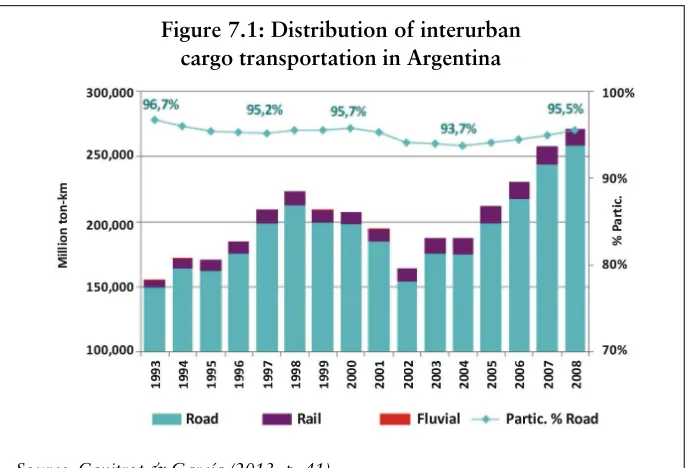
Logistics and Transportation of Goods
95 percent of the country’s cargo requirements, increasing (Canitrot & Garcia, 2013).
Source: Canitrot & García (2013, p. 41)
This situation led to an empowerment of workers and employees of the automotor transport loads sector, who obtained the highest increase in real wages over the last decade: 122 percent6.
These costs significantly influenced the final price of goods for use and consumption, thereby configuring a stage with greater opportunities for local development.
Focussing on the Province of Buenos Aires
Taking as reference the PEI (national plan), in 2013 was agree the PEPBA (provincial plan), which like national plans, promotes among its objectives: increasing productivity and exports, import substitution, reducing unemployment, industrialisation of the primary activities and boost to entrepreneurs and lagging regions by local development7.
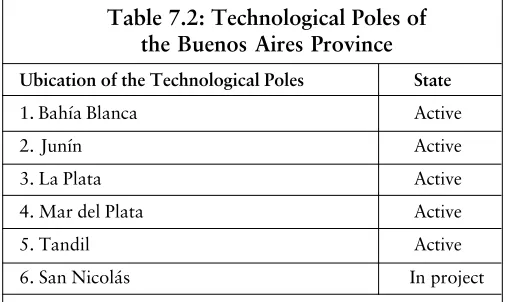
In the area of this province there are currently 87 Local Development Agencies, 15 Project Incubators and six Technological Poles.
[image:4.595.136.480.199.433.2]Local Development Agencies are mixed public-private organisations that promote local production development and articulate the use of
instruments to support the competitiveness of enterprises, to energise the local production and economic activity (Kosacoff, 2008).
[image:5.595.120.464.279.516.2]These organisations have the task of designing and implementing a specific territorial strategy, build an agenda of regional territorial issues and seek solutions in a framework of complementarity and public-private commitment. It is for these reasons, that Local Development Agencies can be conformed in all municipalities, according to the territorial scale required (see Figure 7.2).
Figure 7.2: Geographical Distributions of Local Development Agencies of the Province of Buenos Aires
Source: Ministerio de la Producción, Ciencia y Tecnología.http://www.mp.gba.gov.ar/ spmm/desarrollo_local/mapaprod/mapa_agencias.php
Project Incubators are spaces of assistance to promote projects and ideas for sustainable productive enterprises. It is a tool to support the creation of new enterprises, which aims are to strengthen the productive fabric of the region.
In addition, the Direction of Local Productive Development (provincial government), in conjunction with the Innovative Projects Incubator EMTEC, performs transfers methodologies.
[image:6.595.135.479.272.555.2]From the different local scopes, industrial designers and marketing professional actors can be linked with the nearest incubators to their location, to get advice and support in the early stages of their enterprises. In this manner, incubators increase its outreach to a micro-regional scale.
Table 7.1: Incubators of Buenos Aires Province
Name of the Incubator Municipality State
EMTEC Innovative Projects Incubator La Plata Active
FRAY LUIS BELTRÁN Business Incubator San Martín Active
UNSAM Business Incubator San Martín Active Olavarría Incubates Olavarría Active
Red Gesol Hurlingham Active
DINÁMINA SE Tigre Active
INCUEI Luján Active
Junín Business Incubator Junín Active
Olmos Undertakes La Plata In conformation Coronel Suárez Business Incubator Coronel Suárez In conformation
INCUTEC Berazategui In conformation
Gender Incubator La Plata In project Bahía Blanca Business Incubator Bahía Blanca In project
Azul Business Incubator Azul In project
Center for Development De la Costa In project
Source: Ministerio de la Producción, Ciencia y Tecnología. http://www.mp.gba.gov.ar/ spmm/desarrollo_local/download/incubadoras_activas.xls
Technological Poles (PTs) located in the Province of Buenos Aires, are next to the National Universities, which have careers related to technology. These clusters act as articulators between human resources (scientists and technicians) of universities and the productive system, to develop solutions for the specific needs of each sector.
Thus, companies that are linked to a Pole, receive more benefits and possibilities to innovate, than other firms operating independently.
[image:7.595.161.414.262.413.2]These PT, have the potential to configure productive development models and key business for each area of the Province of Buenos Aires. The holders of the different productive enterprises might eventually attend these centres of research and transfer home their projects, even if they are away from their local areas.
Table 7.2: Technological Poles of the Buenos Aires Province
Ubication of the Technological Poles State
1. Bahía Blanca Active
2. Junín Active
3. La Plata Active
4. Mar del Plata Active
5. Tandil Active
6. San Nicolás In project
Source: Ministerio de la Producción, Ciencia y Tecnología. http://www.mp.gba.gov.ar/spmm/desarrollo_local/download/ polos_tecnologicos_activos.xls
Local growth with development does not belong to any specific discipline, began as an interdisciplinary project of socio-economic research, and this is its main strength. Meanwhile, his weakness is that does not have a recognised theoretical framework, but rather its configured by the user, who can supplement it with his discipline (Sforzi, 2007).
In local development, the key is the involvement of civil society organisations in the taking of decisions, when plans for development of a territory are determined (Quetglas, 2008).
According to Cuervo (1999), who see the local field as an opportunity, agree to support their ideas-project in emerging advantages resulting from the valuation of own resources and synergies of growth and welfare, instead of waiting for extra local assistance.
The local development conceived as integrated, allows the system actors of a territory to jointly develop; also, constitutes a challenge to build a more just, prosperous and caring society9.
territorial equity, social inclusion and environmental sustainability, looking for a local growth with sustainable development (Thomas, 2012).
For Boisier (2001) the local development should be based on social capitalisation of resources and endogenous potentialities of a community or sector, in order to deal with exogenous variables that are unfavourable. Must be taken (social, technical, natural, cultural, institutional and economic) territorial capabilities in order to strengthen common projects, encourage the construction of a territorial identity and achieve social welfare, for the sustained growth of community solidarity.
Regarding emplacement of these policies, local development involves thinking the territory of a particular way: consider a small sector where minimum and indispensable actors manifest, belonging to the same identity portion, sharing a region and common values; achieved this, the territory where it will be project is conformed10.
For a territory interesting from a development perspective, Boisier (2001) defines that it should be organised, that is, having a community with administrative and political regulation, and local identity.
Actors, Institutions and Territory
As mentioned before, local actors can be individual or collective. When we refer to collective actors, in the public scope we find: sub-national authorities (municipal, provincial and regional), universities, schools, training institutions, public financial institutions; and in the private sector: commercial chambers, associations, professional councils, financial institutions, workers’ cooperatives, trade unions, private universities, NGOs, etc. These actors in order to be considered locals or territorials must indispensably share a defined spatial location.
To conform the territory where the local development will be projected, must be take a particular place or micro-region, looking at a bare minimum number of actors who share an identity and values (PEA2, PEI, PEPBA).
In this logic, to improve the interaction between the actors and territory different institutional plans are project and create. Strategic plans analysed, aimed at generating agreements among actors at different levels, to achieve a seamless and synergistic interaction.
The policies11 share the same goal: that the primary links (producers who process the raw material, entrepreneurs and small businesses), achieve long-term profitability.
in dynamic, unique and unrepeatable space-time matrixes. Consequently, it’s necessary to re-signify the role of actors – individual and collective, the features of social organisation and the context in which they operate; as the development decisional matrix can no longer be controlled only by state or market mechanisms.
Therefore, we consider that policies should be diagrammed where the involved society participate in the development process, framing it in the respective institutional and cultural environment.
These issues, are not yet precisely delineated on the most recent programmes. In this proposed scheme, we find on the subject of local development a mediating role.
The Subject of Local Development
The subject of local development, is the figure of the protagonist and beneficiary of the development process. We say that he acts as a mediator because it has a role of territorial entrepreneur, which collects information from the environment and interact with other agents like entrepreneurs, officials, politicians, incorporating proposals and acting; with the capacity to intervene in key aspects of management (Alberqueque 1999).
Aligned to the idea that local development does not belong to any particular discipline, various technical and professional profiles can assume the leading and militant role in local development processes (Arocena, 2002, p. 137).
Martínez (2010) presents the actors in his development scheme as centrals, clarifying -in line with our observations, that there are certain points where development policies implemented by governments, should be careful in order to really benefit involved. He specifically states that: “The system of promotion of productive activity established, must consider as priority actors the local residents” (translated, Martinez, 2010, p11). This seeks to ensure that the external human support introduced into the territory, is make after an exhaustive analysis of the limitations of the community. The intervention must have at exclusive and superior aim to improve opportunities for the inhabitants of the territory, and no facilitate the way for companies to invest in communities using low labour cost and taking profits.
outsiders, because these almost inexorably will be temporary (Sforzi, 2007, p. 36).
The Role of the State
The role of the State as we advance is relevant and determinant in many cases; acts as a harmoniser and catalyst, articulating public and private plans of the actors.
The PEI, which reflects the current government official proposal for the coming years, expound that public investment made in infrastructure, education, technology and science since 2003, has led to significant progress; but the intention is to deepen that dynamic, incorporating local resources (human, natural and financial) in order to increase investment in the own territory, focussing the search for sustainable development (Ministerio de Industria, 2010).
In this plan 11 industrial production centres are rescued. The objective is to develop regional forums where workers, academics, businessmen, representatives of the Ministries of Finance, Industry and Federal Planning, provincial and municipal governments, meet in a space conducive to articulation of various sectors to realise the re-industrialisation.
This process is organised by working on value chains, composed by all necessary activities to produce a good from its initial conception to delivery to the final consumer. This system emphasises the dynamics of the relationships inter and intra sectorial of the economy.
Thus, the objective of PEI is to achieve competitiveness along each chain and in all productive chains. Specifically, it presents science as a crucial resource and with it an ‘industrialisation of rurality’ in terms of generating an industry upcoming to the location where the resources are generated, that reaches international standards of leadership increasing the competitiveness of the entire value chain (Ministerio de Industria, 2012, p. 273).
The Role of Industrial Design
In the context of local development, we conceive the figure of industrial designer in a central position with respect to the articulation between entrepreneurs and users, analysing specific needs, technological and human resources available in the territory, to capitalise efficiently in the design and development of new products (Dean, 2001).
In this case, the industrial designer will focus on executing the steps involved in the process of satisfying the needs of families, the same time as they focus on the replacement of goods produced in other regions of the country.
Along the way, it will connect various disciplines from the local productive system to final recipients of the market (Sierra, 2012).
In this sense, the industrial designer can be configured as an agent of change in productive enterprises, articulating the technical knowledge that will adapt in response to the dynamic needs of the local society (Alburquerque, 1999).
Also, the transfer of product design to entrepreneurs, will seek to promote the autonomy of the different actors, capitalising features of local identity (Garbarini, Delucchi, and Vazquez, 2010).
In these cases, the designer will have the role of identifying which are the regional characteristics that could be manifested in the morphological communication (symbolic), to enhance the products developed12 .
It is further displayed the role of manager and organiser of the production system, where the contribution of the design focusses on facilitating technological processes undertake by small manufactures in their change of scale13.
The Role of Marketing
The marketing dimension represented by different technicians and professionals in the field of management and economics, mainly will comprise two processes: 1. Analysis and diagnosis of: value chains; territorial resources; and cost structure and prices of extra local products. 2. Development of marketing plans for local products and services (Cipolla & Manzini, 2009).
We believe that the processes of buying goods are more inefficient when local prices exceed the actual prices excessively. In this logic, it will be taking into account the rising price involving no local transport of products.
Can also be identified opportunity among land resources, rescuing particularities of rural, urban and architectural landscape, which will be essential to recognise a potential tourist profile (Girotto & Del Giorgio Solfa, 2009).
In the role incumbent on the second process, in response to the projects generated in the framework of local development, it will be design and implement marketing plans to promote new or existing, local products and services (Simonato, 2009; Del Giorgio Solfa, 2012b).
Some of these strategies promotional product will be aimed at promoting the purchase of local products; others will point to the development of products and services channels –of local production-projected to expand the regional market (Cipolla & Manzini, 2009).
The Role of Entrepreneurs
Though the local development approach will allow different actors to become entrepreneurs, can mainly consider two profiles: the social entrepreneur and the business entrepreneur.
The social entrepreneur is a charismatic leader with social acceptance, that committed to the idea of local development, will interact with the other actors adding followers and spreading the benefits and potentialities of the approach (Giordano, 2012).
Instead, the business entrepreneur, attentive to socioeconomic and productive needs, projects action and mobilises resources to generate new business assuming the risks involved14.
In this framework, entrepreneurs in the technology sector are an important perspective for new productive enterprises. Among them we have the technicals and professionals of the areas: agriculture, food, biology, construction, electrical, electro-mechanical, electronic, gastronomy, hospitality, industrial, mechanical, environmental, civil and water works, chemicals, tourism, etc. (Thomas, 2012).
In this context, then we understand that education can develop skills and contribute to the generation of business initiatives based on negotiation skills, leadership, new product development, creative thinking and technological innovation15.
Needs and Potentialities of Productive Chains
In the towns of the province of Buenos Aires, there are needs for goods of use and consumption in reasonable qualities and prices (Quetglas, 2008). Specifically, in small towns that are distant, far from the metropolitan region.
On one hand, we understand that transportation and distribution of certain products manufactured in the Greater Buenos Aires, would produce a deficiency in the processes of acquisition and purchase of the residents of this kind of localities.
This deficiency lies essentially in the high transport costs assumed by the final price of the product, resulting in up to 100 percent more expensive (furnishings large size).
On the other hand, levels of development and innovation in such localities, remains paralysed because of the disarticulation of production systems initiated over two decades ago and whose effects result in lower development opportunities for communities, less employment and emigration to others most dynamic regions (Schorr, 2004).
In this reasoning, we found that the main potentialities are focus on those goods for use and consumption of low complexity that can be produced in the territory. There are a number of furniture goods and consumer products (food, cleaning chemicals), which can be produced or finished there16.
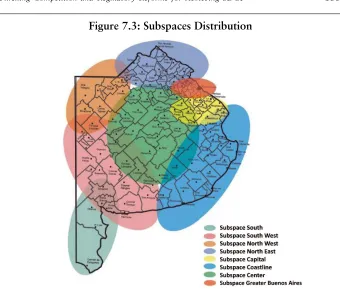
From a provincial perspective, analysing the bonaerenses productive chains, we found that some can be more or less competitive depending on the Sub-space where they are located.
From the provincial policy, the PEPBA highlights the value chains that can enhance local development and value addition at source.
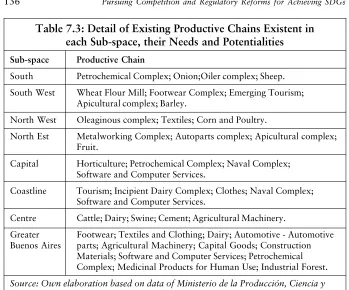
In these subspaces we find among 4 and 11 productive chains, which we will consider overall, although in this paper we focus on the needs and potentialities common to the type of locations that we aim (see Table 7.3).
It can be seen from the analysis of this table that the Buenos Aires production system is varied and displays important coexisting productive chains in its vast territory.
[image:14.595.136.476.137.426.2]For certain productive chains, the chances of capitalising our comprehensive approach that includes design, marketing and entrepreneurship are greater than others, but in most cases, we found that the PEPBA promotes the incorporation of them in the ranging process of their local development objectives.
Figure 7.3: Subspaces Distribution
Local and Human Scale Development
To deepen the local dimension, which we will define what we consider as local and human scale development.
The local scale is the establishment of a limit on the number of people living in the territory will be subject to development interventions, to consider it into our local scale (Arroyo, 2001).
It has been agreed that this population range should be between 5,000 and 30,000 inhabitants, based on criterion, which seeks cover municipalities with potential for territorial development, with important and balanced domestic consumption, whose progress is hampered by the proximity of parties with higher productive scale constituted as regional heads17.
Even though strategic plans evaluated, considered most relevant regions and productive chains, we will focus on local development programs based on the needs and potentialities common to such localities.
[image:15.595.114.463.133.423.2]In this way, we consider key at Max-Neef, Elizalde, & Hopenhayn (1986) who define human scale development as: the sustained in the satisfaction of basic human needs, the generation of growing levels of self-reliance and organic articulation between: humans, nature and
Table 7.3: Detail of Existing Productive Chains Existent in each Sub-space, their Needs and Potentialities
Sub-space Productive Chain
South Petrochemical Complex; Onion;Oiler complex; Sheep.
South West Wheat Flour Mill; Footwear Complex; Emerging Tourism; Apicultural complex; Barley.
North West Oleaginous complex; Textiles; Corn and Poultry.
North Est Metalworking Complex; Autoparts complex; Apicultural complex; Fruit.
Capital Horticulture; Petrochemical Complex; Naval Complex; Software and Computer Services.
Coastline Tourism; Incipient Dairy Complex; Clothes; Naval Complex; Software and Computer Services.
Centre Cattle; Dairy; Swine; Cement; Agricultural Machinery.
Greater Footwear; Textiles and Clothing; Dairy; Automotive - Automotive Buenos Aires parts; Agricultural Machinery; Capital Goods; Construction
Materials; Software and Computer Services; Petrochemical Complex; Medicinal Products for Human Use; Industrial Forest.
technology; global processes with local behaviours; social with personal; planning with autonomy and civil society with the State.
Thus human needs, self-reliance and organic articulations constitute the fundamental pillars of human scale development (Max-Neef, et al, 1986, o.14).
The authors specify that for this type of development work, it must be based on a real prominence of people, to achieve the passage of person-object to person-subject where the main problem is the scale: there is no possibility of prominence in giant systems, hierarchically organised from top to bottom (Max-Neef, et al, 1986, o.14).
Conclusions and Proposals
In the first instance, the review of the literature about local development, entrepreneurship, industrial design and marketing together with institutional inputs (strategic plans and mixed territorial resources) and the statistical information available, we can conclude that its feasible to integrate actions to contribute to local development. Context analysis allowed us to recognise a manufacturing vacuum in small populations, product of the disarticulations -of small and micro industries- in the 90s. The focus in the province of Buenos Aires, took us to contextualise a type of territory starred by municipalities with great potential for local and sustainable development. And also, recognise, which are the natural, human and institutional resources that can support the endogenous development of these local territories.
Furthermore, understanding the roles of each of the disciplinary dimensions we suggest to integrate, we discovered in what degree each actor -individual and synergistically- can cooperate with implementation activities of local development projects.
In addition, the establishment of an appropriate scale of populations to design this type of local development strategies, together with the analysis of the potentialities – common endogenous and differential regional results were obtained, which allowed identifying some common objectives for local manufacturing (Thomas, 2012).
In addition, other distinctive potentials were identified – according to the analysed regions-, resulting in sectors related to tourism, cultural industries, etc.
It is in these sectors and this kind of commodities of use and consumption, where the greatest potential exists, and where the disciplines of marketing, industrial design and entrepreneurship could act on behalf of the local and productive development.
It should be noted that the protagonists and/or recipients of local development not only benefit to getting products to more realistic prices, but will contribute to the creation of a more balanced territory in terms of employment opportunities, development and welfare. Therefore, this integrated design, marketing and entrepreneurship is key to local development in the province of Buenos Aires.
[image:17.595.116.462.134.448.2]For an initial stage, local development agencies allow the organisation of entrepreneurial actions of territory and extra-local supports, coming from technological poles and nearest projects incubators. In this way, although not all municipalities have PT or incubators, they can capitalise somehow the state available resources.
Table 7.4: Examples of Contributions of Industrial Design for each Dimension
Productive System Product Packaging/ Container Marketing Furniture • Materials optimisation • Integration of
carpentry, blacksmith and upholstery.
• Design of wood, melamine and upholstered products. • Self-assembly design.
• Reduced packaging. • Communication and assembly instructions.
• Modular and personalized products. • Strengthening of the
“buy local”.
Food
• Design of Implements for the primary and secondary production in low scale.
• Design of new products based on consumer behaviour.
• Communication of the quality, designation of origin and other qualities.
• Additional benefits for consumption.
• Development of the product portfolio. • Higher quality
perceived by low production scale and proximity.
Chemicals
• Implements design for fractionation at low and medium-level.
• Dispensers design for specific uses.
• Design of new packaging based on consumer behaviour.
• Low prices. • Quality with local
In subsequent stages, should be established:
1. Survey of design and administration professionals 2. Presentation of local needs to the involved actors
3. Establishment of working groups for projects formulation and 4. Monitoring of the validated projects
With the purpose of improve the capabilities of local development for the bonaerenses territories and increase the quality of life of its inhabitants, is proposing to revalue these disciplinary fields and perform this proposal for immediate implementation.
Endnotes
1 The Strategic Industrial Plan 20 20 (Plan Estratégico Industrial 20 20) is a plan developed by the Ministry of Industry of Argentina. On it, eleven industrial productive centers are selected for being developed in regional forums compounds by: employers, workers, academics, ministries of Economy, Industry and Federal Planning, provincial governments and municipal governments. It is an institutional articulation between nation, provincies and municipalities, public institutions and NGOs. It is a collective project with key guidelines for the development of industrial sectors with perspectives until 2020.
2 Federal and Participative Agri-food and Agribusiness Strategic Plan 2010-2016
(Plan Estratégico Agroalimentario y Agroindustrial Participativo y Federal 2010-2016) is a plan developed by the Ministry of Agriculture, Livestock and Fisheries of Argentina, which aims to promote a shared vision for the agri-food and
agribusiness related sectors. It proposes to establish long-term policies that generate predictable, stable rules and a collective national project through the involvement of the different social actors and building institutional capacities.
3 The Buenos Aires Productive Strategic Plan 2020 (Plan Estratégico Productivo Buenos Aires 2020) is a plan elaborated by the Ministry of Production, Science and Technology of the Province of Buenos Aires. It provides the basis for develop human resources and infrastructure, to make possible the objectives of PEI 20 20 at the provincial level; by describing and analysing the existing productive chains in the eight sub-areas strategically defined.
4 The National Plan for Local Development and Social Economy ‘Let’s get to work’ (Plan Nacional de Desarrollo Localy Economía Social Manos a la Obra) is a public policy promoted by the Ministry of Social Development of Argentina, to promote social economy through technical and financial support to productive enterprises for social inclusion that are generated within the framework of local development. 5 Ministerio de Agricultura, Ganadería y Pesca, 2010
6 Ministerio de Trabajo, Empleo y Seguridad Social, 2014
7 García-Tabuenca, Crespo-Espert, & Cuadrado-Roura, 2011; Ministerio de la Producción, Ciencia y Tecnología, 2012
8 Narodowski, 2008; Kotsemir, Abroskin, and Meissner, 2013 9 Arocena, 2002; Rodríguez, 2006; Del Giorgio Solfa, 2012 10 Del Giorgio Solfa, 2012
11 Moalosi, Popovic, & Hickling-Hudson, 2007; Li, Su, & Huang, 2008
12 Chang, Wysk, & Wang, 2006; Aguilar-Zambrano & Hernández-Romero, 2012 13 Spadafora, Barbieri, Cajade, Bonano, & La Rocca, 2010
14 Gunes, 2012; Zappe, Hochstedt, Kisenwether, & Shartrand, 2013 15 Okudan, Ma, Chiu, & Lin, 2013
References
Alburquerque, M (1999). Manual del agente de desarrollo local. Santiago de Chile, Chile: Ediciones Sur.
Aguilar-Zambrano, J. J., & Hernández-Romero, D. (2012). An interpretation of industrial design capacities in SMEs from the manufacturing sector. Strategic Sciences Journal, (20)28. Retrieved 11 Jul, 2014, from http://www.sci.unal.edu.co/
scielo.php?script=sci_arttext&pid=S1794-83472012000200007&lng=en&nrm=iso
Arocena, J (2002). El desarrollo local: un desafío contemporáneo. Montevideo, Uruguay: Taurus-Universidad Católica.
Arroyo, D (2001). Los ejes centrales del desarrollo. In D. Burin & A. Heras (Eds.),
Desarrollo local. Una respuesta a escala humana a la globalización (pp. 89-110). Buenos Aires, Argentina: Ciccus-La Crujía.
Azpiazu, D. (1995). La industria argentina ante la privatización, la desregulación y la apertura asimétricas de la economía: la creciente polarización del poder económico. In D. Azpiazu & H. Nochteff (Eds.), El Desarrollo Ausente (pp. 157-231). Buenos Aires, Argentina: FLACSO-Norma.
Boisier, S. (2001). Desarrollo (Local): ¿De qué Estamos Hablando? In O. Madoery & A. Vázquez Barquero (Eds.), Transformaciones globales, Instituciones y Políticas de desarrollo local (pp.48-74). Rosario, Argentina: Homo Sapiens.
Canitrot, L., & García, N. (2013). La logística como herramienta para la competitividad: el rol estratégico de la infraestructura. Buenos Aires, Argentina: FODECO.
Chang, T C, Wysk, R. A., & Wang, H. P. (2006). Computer-Aided Manufacturing.
University of Michigan: Pearsons Prentice Hall.
Cipolla, C, & Manzini, E. (2009). Relational Services. Knowledge and Policy, 22, 45-50. DOI:10.1007/S12130-009-9066-Z
Cravacuore, D (2005). La articulación de actores para el desarrollo local. Paper presented at the Proceeding Of VII Congreso Nacional de Ciencia Política “Agendas Regionales en Conflicto”, Universidad Católica de Córdoba.
Cuervo, L M (1999). Desarrollo económico local: leyendas y realidades. Territorios, 01,
9-24.
de Azevedo Ferreira de Souza, M C, Bacic, M J, & Ramos Bernardes, J. M. (2009). A gestão estratégica das compras como política para reduzir custos. Gestao &
Regionalidade, 25(74), 35-47.
Del Giorgio Solfa, F. (2012). Cohesión social: clave de los entornos innovadores ciudadanos para el desarrollo local evolucionado. Paper presented at the Proceeding Of XI Seminario de RedMuni: “Repensando la Agenda Local”, Universidad Nacional Arturo Jauretche.
Del Giorgio Solfa, F. (2012b). Plan de Marketing Estratégico en la Industria del Mosaico. Saarbrücken, Germany: Editorial Académica Española.
Del Giorgio Solfa, F, & Girotto, L. M. (2009). Improvement and growth of local productive systems through identity, self-sufficiency and Municipal Development Fora.
Paper presented at the Proceeding of International Conference on Territorial Intelligence, Università degli Studi di Salerno.
Garbarini, R., Delucchi, D., & Vazquez, A. (2010). El rol del diseño como agente de cambio técnico y social en procesos de desarrollo local. Paper presented at the Proceeding Of VII Jornadas Latinoamericanas de Estudios Sociales de la Ciencia y la Tecnología, National Technological University.
García-Tabuenca, A., Crespo-Espert, J. L., & Cuadrado-Roura, J. R. (2011). Entrepreneurship, creative industries and regional dynamics in Spain. The Annals of Regional Science, 47(3), 659-687. DOI:10.1007/S00168-010-0376-6
Giordano, M. (2012). Reflexiones sobre la motivación del emprendedor interno en los determinantes de éxito y/o fracaso en las organizaciones públicas y de sus posibilidades de formación. Revista del Departamento de Desarrollo Productivo y Tecnológico, 1(1),
49-52.
Girotto, L M, & Del Giorgio Solfa, F. (2009). Foros de Desarrollo Turístico Rural como mecanismo para fomentar el Desarrollo Local, a partir de la generación de nuevos servicios turísticos. Paper presented at the Proceeding Of VIII Reunión de Antropología del Mercosur: “Diversidad y poder en América Latina”, National University of General San Martín.
Gunes, S (2012). Design entrepreneurship in product design education. Procedia - Social and Behavioral Sciences, 51, 64-68. DOI:10.1016/J.SBSPRO.2012.08.119
Kosacoff, B. (2008). El desarrollo productivo y los nuevos dilemas económicos. Aulas y Andamios, 1(2), 4-7.
Kotsemir, M. N., Abroskin, A., & Meissner, D. (2013). Innovation Concepts and Typology – An Evolutionary Discussion. Higher School of Economics Research Paper, No. WP BRP 05/STI/2013. Retrieved April 10, 2014, from http://dx.doi.org/10.2139/ ssrn.2221299
Li, L., Su, W, & Huang, Z. (2008). Creativity roots in life — Thinking about the impact of regional culture on product design. Paper presented at the Proceeding Of 9th International Conference on Computer-Aided Industrial Design and Conceptual Design, Kunming, China. DOI:10.1109/CAIDCD.2008.4730678
Max-Neef, M. A., Elizalde A, & Hopenhaym M. (1986). Desarrollo a Escala Humana: una opción para el futuro. Development Dialogue, Special number, 1-96.
Martínez, E. (2010). Debates para honrar el bicentenario: Hacer donde no hay. La construcción de tejido industrial en las regiones pobres del país. Buenos Aires, Argentina: Instituto Nacional de Tecnología Industrial.
Ministerio de Agricultura, Ganadería y Pesca (2010). Plan Estratégico Agroalimentario y Agroindustrial Participativo y Federal 2010-2016 (2ª ed.). Retrieved 19 Apr, 2014, from http://64.76.123.202/site/areas/PEA2/02=Publicaciones/index.php
Ministerio de Industria (2012). Plan Estratégico Industrial 20 20. Retrieved 19 Apr, 2014, from http://www.industria.gob.ar/libro/
Ministerio de la Producción, Ciencia y Tecnología (2012). Plan Estratégico Productivo Buenos Aires 20 20. Retrieved 19 Apr, 2014, from http://www.mp.gba.gov.ar/ jefaturadegabinete/pepba/download/DTP_PEPBA2020.pdf
Ministerio de Trabajo, Empleo y Seguridad Social (2014). Seguimiento de la evolución de precios y salarios.Enero de 2014. Retrieved 19 Apr, 2014, from http://
www.trabajo.gov.ar/downloads/destacados/140123_precios-y-salario.pdf
Moalosi, R, Popovic, V & Hickling-Hudson, A. (2007). Culture-orientated Product Design. Paper presented at the Proceeding of International Association of Societies of Design Research, The Hong Polytechnic University.
Narodowski, P. (2008). Una educación para el trabajo. Aulas y Andamios, 1(2), 12-16.
Okudan, G E, Ma, J., Chiu, M. C., & Lin, T K (2013). Product Modularity and Implications for the Reverse Supply Chain. Supply Chain Forum, 14(2), 54-59.
Pedrazzi, J. F. (2010). Eduardo Duhalde y Néstor Kirchner. La recuperación argentina luego de la crisis de 2001. Revista de Ciencia Política, 11. Retrieved April 15, 2014, from http://www.revcienciapolitica.com.ar/num11art8.php
Quetglas, F (2008). ¿Qué es el desarrollo local? Territorio, políticas y economía. Buenos Aires, Argentina: Capital Intelectual.
Rodríguez, P. G. (2006). Desarrollo local para municipios de escala intermedia en la provincia de Buenos Aires. Escenarios, 6(11), 75-88.
Schorr, M. (2004). Industria y nación. Poder económico, neoliberalismo y alternativas de reindustrialización en la Argentina contemporánea. Buenos Aires, Argentina: Edhasa.
Sforzi, F. (2007). Del distrito industrial al desarrollo local. In R. Rosales Ortega (Eds.),
Desarrollo local: Teoría y prácticas socioterritoriales. México D F.: Miguel Ángel Porrúa.
Sierra, M. S. (2012). El proceso de diseño y desarrollo de nuevos productos y su relación con el marketing. Paper presented at the Proceeding Of 6º Jornadas de Investigación en Disciplinas Artísticas y Proyectuales, National University of La Plata.
Spadafora, C; Barbieri, M; Cajade, A.; Bonano, G.; La Rocca, M. (2010). Manual de Emprendedorismo. Buenos Aires, Argentina: Ministerio de Industria.
Srnec, C C (2009). Crisis económica e impulso estatal a la economía social ¿Sector paliativo o alternativo? La propuesta del Plan Manos a la Obra. Paper presented at the Proceeding Of Seminario Internacional “La construcción del conocimiento y prácticas sobre la economía social y solidaria en América Latina y Canadá”, Universidad de Buenos Aires.
Thomas, H (2012). Tecnologías para la inclusión social en América Latina: de las tecnologías apropiadas a los sistemas tecnológicos sociales. Problemas conceptuales y soluciones estratégicas. In H Thomas, M Fressoli, & G. Santos (Eds.), Tecnología, desarrollo y democracia: nueve estudios sobre dinámicas socio-técnicas de exclusión / inclusión social (pp. 25-76). Buenos Aires, Argentina: Ministerio de Ciencia, Tecnología e Innovación Productiva de la Nación.