
TítuloActions of compounds manipulating the nitric Oxide system in the cat primary visual cortex
13
0
0
Texto completo
(2) production sites suggests a more complex role in cortical visual processing than we have previously demonstrated in the thalamus. For example, recent evidence has shown that NO may be involved in the NMDA-mediated release of noradrenaline and glutamate from rat cortical synaptosomes, suggesting that NO can have both direct actions and actions on modulatory processes (Montague, Guancayco, Winn, Marchase & riedlander, 1994). Of course, since the release of these compounds was specific to NMDA, the effects of NO on other excitatory amino acid receptor-mediated events remain untested. Nevertheless, there is to date little or no published evidence on the effect of NO, or the effect of blockade of NOS, on visual cortical cells. We have therefore examined such effects using microiontophoresis of a competitive inhibitor of NOS, NG-nitro-L-arginine (l-NOArg) and a NO donor, diethylamine-nitric oxide (DEA-NO). Specifically, we have sought to determine what role, if any, NO may have in the elaboration of cortical visual properties, as well as addressing the possibility of more global effects on cell excitability. Furthermore, given our previous findings on the mode of action of NO within the dLGN, where it selectively enhanced NMDA receptor-mediated activity, we have investigated whether such receptor specificity is involved in any cortical locus of action. A preliminary report of these data has been published (Cudeiro, Bivadulla, Rodriguez, Martinez-Conde & Acuña, 1995). Methods Experiments were carried out on nineteen adult cats in the weight range 1.8–2.5kg. Animals were anaesthetized with halothane (0.1–5%) in nitrous oxide (70%) and oxygen (30%), and paralysed with gallamine triethiodide (40 mg initial dose, then 10 mg kg−1 h−1). EEG and ECG, expired CO2 and temperature were monitored and maintained continuously, to ensure that anaesthetic levels were altered as appropriate to maintain an adequate state of light anaesthesia. Changes in parameters indicating a lightening of anaesthetic levels (e.g. changes in intersystolic interval, decreasing spindle frequency, rise in end-tidal CO2) were immediately counteracted by increasing halothane levels accordingly. Once a stable baseline level had been established any variation in the parameters monitored triggered an alarm system. Lignocaine (lidocaine) gel was applied to the ear bars of the stereotaxic frame and all wound margins were treated with subcutaneus injections of lignocaine and adrenaline. Further details of surgical procedures and maintenance can be found in Cudeiro & Sillito (1996). Single units were recorded extracellularly from primary visual cortex (Horsley—Clarke coordinates: anteroposterior, –2 to –8 mm relative to interauricular line; mediolateral, +0.6 to +1.5 mm relative to midline) using seven barrelled glass micropipettes. Pipettes were filled with a combination of the following drugs: NaCl (3 M for extracellular recording); L-arginine (L-Arg; 10 mM, pH 6.0); NG-nitro-L-arginine (lNOArg; 10 mM, pH 6.0); N-methyl-D-aspartate (NMDA; 0.1 M, pH 8.0); α-amino-3-hydroxy-5methylisoxasole-4-propionic acid (AMPA; 15 mM, pH 8); ACh (0.5M, pH 4.0); diethylamine-nitric oxide (DEA-NO; 10 mM, pH 8.0); 8-bromo-cGMP (10 nm, pH 4.5); and Pontamine Sky Blue (PSB; 2% w/v in 0.5 M sodium acetate solution for histological reconstruction applied at 20–40 μA for 15–20 min). All drugs were purchased from Sigma and RBI. Pipette tips were broken back to diameters ranging from 3– 10 μm, and when not in use each drug barrel was subject to a constant retention current of 5–25 nA of appropriate polarity. Pipettes were inserted in a plane nearly perpendicular to the cortical surface and cells were recorded throughout the depth of the visual cortex. All neurons had visual fields centered within 10 deg of the area centralis. Single units were classified into simple and complex types by virtue of their responses to drifting fight and dark edges (Henry 1977). Single-unit data were collected, and visual stimuli produced, under computer control (Visual Stimulation System, Cambridge Electronic Design, Cambridge, UK; for details see Sillito, Cudeiro & Murphy, 1993). Stimuli were viewed monocularly through the dominant eye for each cell under test. The eyes were treated with atropine methonitrate and phenylephrine hydrochloride, and protected with plastic contact lenses. They were brought to focus on a semi-opaque tangent screen at a distance of 0.57 m using supplementary lenses and 2 mm diameter artificial pupils. Our basic protocol was to establish control responses to a drifting bar stimulus, moving backwards and forwards through the receptive field, at the optimal orientation. Subsequently, this procedure was repeated in the presence of the compound or compounds of interest. We also examined the effects of the drugs on spontaneous activity, and in some cases during a complete set of orientations of the moving bar, in which presentation of stimuli of different orientations was randomized. Typically, responses were averaged over ten to twenty stimulus presentations and were assessed from the accumulated count in the binned peristimulus time histograms (PSTHs), using separate epochs for baseline and visual responses. A change in firing was considered significant when P < 0.05 (Wilcoxon signed-rank test). Where error bars are shown these are ±1 s.e.m..
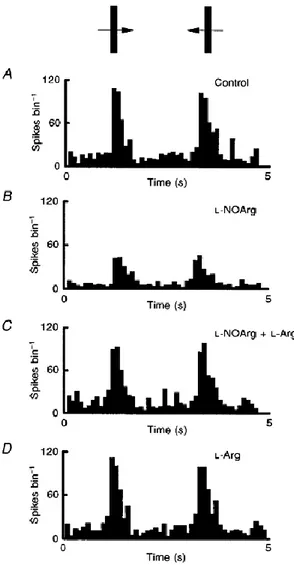
(3) To examine the nature of the action of NOS inhibitors on excitatory responses evoked by exogenously applied NMDA, AMPA or ACh, we used pulsatile iontophoretic application of the excitant before and during continuous application of L-NOArg (alone or in combination with L-Arg). The effect of iontophoretic ejection of 8-bromo-cGMP on visually driven activity was also tested. The magnitude of the drug iontophoretic application current was selected on the basis of initial qualitative observations. Effects were generally seen within the range 60–120 nA and no ejection current above this range was used. At the end of each experiment, the animals were killed by anaesthetic overdose and the locations of the recording sites were determined in Nissl-stained sections from PSB deposits made at the sites of interest. All procedures were carried out in accordance with Spanish National Guidelines, the International Council for Laboratory Animal Science and the European Union (86/809). Results This report is based on data obtained from a sample of seventy-seven cells located throughout the depth of the primary visual cortex. On the basis of their responses to L-NOArg application we have divided this population into two groups, with clear responses to this compound in one group, and no effect in the other. However, no other visual response property clearly belonged to one group or the other. There was therefore no relationship between the actions of the compounds applied that modulated the nitric oxide system and the receptive field type, layer and degree of direction or orientation selectivity. Twenty-nine out of seventy-seven cells were affected by iontophoretic application of L-NOArg. As shown in Fig. 1, the major effect of L-NOArg was suppressive (25/29). Here the responses of a nondirectionally selective complex cell located in layers II–III (Fig. 1A) were markedly reduced (∼60%) by continuous application of L-NOArg (Fig. 1B), along with a suppression of background firing (see below). Effects were manifest within 3–4 min of application and had offset times in the range 6–10 min. Responses to both directions of stimulus motion were equally depressed..
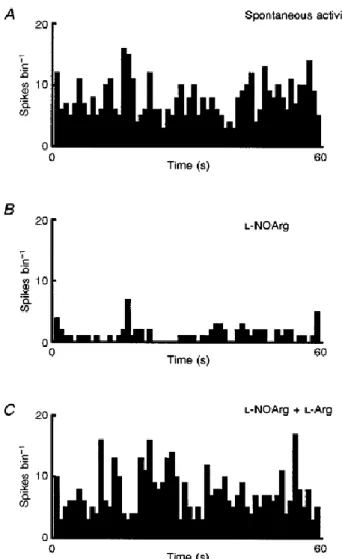
(4) Figure 1 The suppressive effect of NOS inhibition on visual responses Peristimulus time histograms (PSTHs) of the responses of a non-directionally selective complex cell. A shows the control responses to an optimally oriented bar of light moved backwards and forwards across the receptive field (here and in subsequent figures shown as an inset above the PSTHs). In B these responses were repeated during constant application of L-NOArg, and in C with both lNOArg and L-Arg. Finally in D the test was repeated in the presence of L-Arg alone. In all cases where responses to L-Arg alone were compared with its effect on the l-NOArg effect, the same application current was used. Each PSTH is the mean of 15 trials, and bin width is 100 ms.. However, co-application of L-Arg completely reversed this L-NOArg-induced inhibition (Fig. 1C). Application of L-Arg alone (Fig. 1D), even at current levels exceeding those required to block or reverse the L-NOArg effect (data not shown), did not increase response levels above the control levels shown in Fig. 1A. In cells showing measurable spontaneous activity (14/25), this activity was also reduced during drug application, as illustrated in Fig. 2. Here, the spontaneous activity of a simple cell in layer V is shown to be reduced by some 84%. In terms of visual responses, the effect of L-NOArg application was rapid, reaching peak effectiveness within a few minutes (Fig. 2B). Again co-application of the substrate for NOS, L-Arg, reversed the inhibitory effects of L-NOArg, but without measurably increasing spontaneous activity (Fig. 2C)..
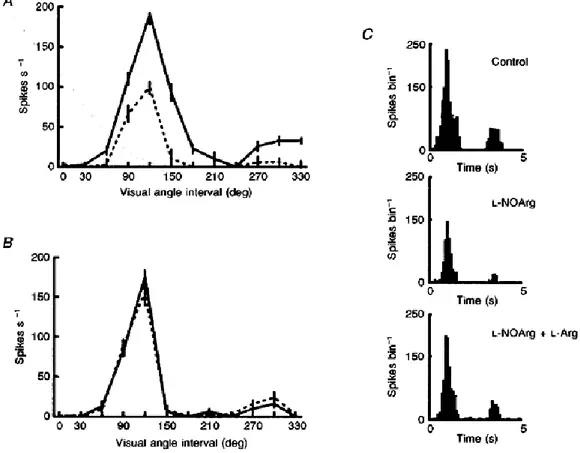
(5) Figure 2 The suppressive effect of NOS inhibition on spontaneous activity A, PSTHs showing the spontaneous activity of one of the visual cortical cells with demonstrable activity (n= 14). In B, the effect of continuous application of L-NOArg is shown, with the suppression of such an effect with concurrent L-NOArg and L-Arg shown in C. Each PSTH is the mean of 10 trials, and bin width is 1s.. A second example of the inhibitory effect of L-NOArg application on visual responses is illustrated in Fig. 3, where a simple cell in layer IV is shown. In this case we have illustrated (Fig. 3A) a full control orientation tuning curve, with data points taken at 30 deg of visual angle intervals around 360 deg. This clearly highly orientation- and direction-selective cell, with little or no spontaneous activity, was heavily suppressed by application of L-NOArg (Fig. 3A, dashed line) with responses at all orientations and directions being affected. The responses to the optimal orientation are shown in detail in the PSTHs on the right (Fig. 3C). Once again co-application of l-Arg prevented the effect of the NOS inhibitor (Fig. 3B). This suppression of visual response and decreased spontaneous activity due to application of LNOArg and the reversal of these effects by L-Arg co-application was common to all twenty-five cells. On average, in this group visual responses were reduced by 62 ± 4 % (means ±s.e.m., P < 0.001), and spontaneous activity by 56 ± 9% (P < 0.001)..
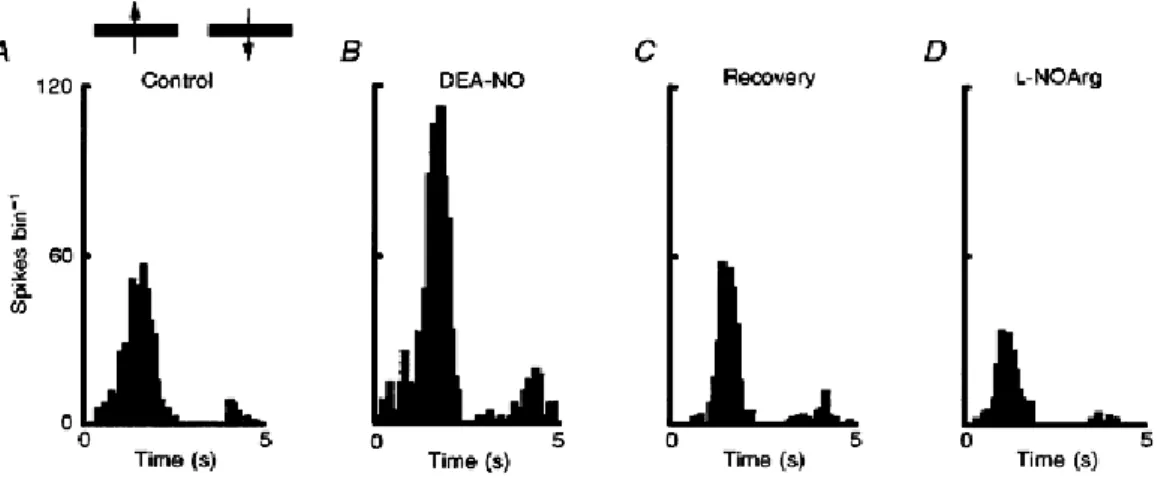
(6) Figure 3 NOS inhibition reduces visual responsiveness but not specificity A, graphic representation of the orientation tuning of a layer IV simple cell (continuous line, control; dashed line, during L-NOArg application with 80 nA). B, effect of co-application of L-NOArg with L-Arg (continuous line, control; dashed line, L-NOArg +L-Arg with 80 nA). Orientation tuning curves as in A. Stimuli were presented randomly interleaved at 30 deg intervals, and were each repeated 20 times. C, representative PSTHs showing the responses at the optimal orientation for this directionally selective cell before, during L-NOArg application alone and during L-NOArg and L-Arg co-application.. In eleven cells the effect of the NO donor DEA-NO was also tested. As typified by the example in Fig. 4, in three cells visual responses (control PSTH, Fig. 4A) were enhanced by application of DEA-NO (Fig. 4B) with, for comparison, the uppression induced by L-NOArg illustrated in Fg. 4D. All three cells showed such enhanced responses (mean, 84 ± 19%) and where present, spontaneous activity was also elevated. Response selectivity, for example, direction specificity, was unaffected when the response magnitude was maintained within subsaturation levels..
(7) Figure 4 NO enhances visual responses PSTHs demonstrating the excitatory effect of DEA-NO on the visual responses of a directionally selective complex cell in layer VI. A, control responses; B, enhanced responses during continuous application of 80 nA of DBA-NO; C, recovery; D, decreased responses during continuous application of L-NOArg with 80 nA. Bin width, 100 ms; 10 trials.. In a subpopulation of ten cells, application of L-NOArg was inhibitory, as above, in three. In these three, application of the soluble analogue of cGMP, 8-bromo-cGMP, induced excitation. This is illustrated in Fig. 5. Once again L-Arg alone was unable to elevate firing rates above control levels, while 8-bromocGMP clearly did so (mean, 106 ± 37%) (Fig. 5D).. Figure 5 The soluble analogue of cGMP acts like NO PSTHs from a simple cell in layer VI. A, control visual responses; B, depression during L-NOArg application; C, recovery; D, effect of 8-bromo-cGMP application; E, recovery; F, L-Arg application alone; and G, L-NOArg and L-Arg together. Each PSTH is the mean of 10 trials, and bin width is 100 ms..
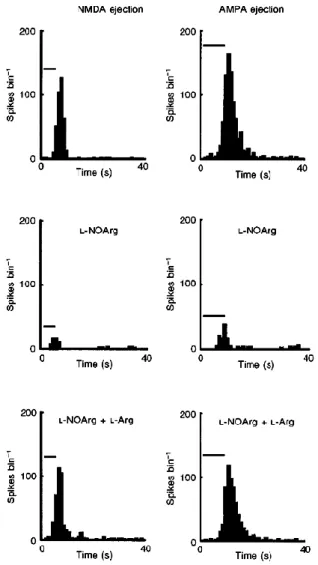
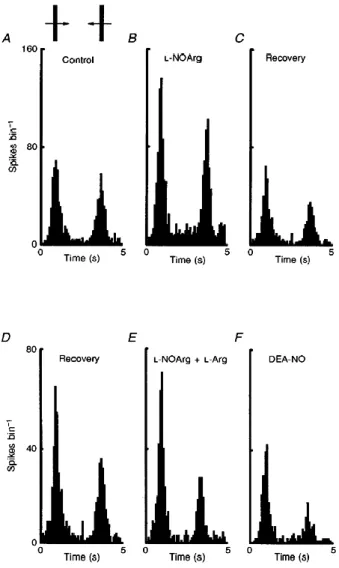
(8) With regard to the pharmacological specificity of these effects, Fig. 6 shows a typical example taken from a sub-population of six (out of 15) cells tested with application of each of the excitatory amino acids NMDA and AMPA. This figure shows clearly that the very potent inhibitory effect of L-NOArg is not selective between these two amino acids, reducing the response to each to near zero, and this effect was seen in all six cells, differing only quantitatively across the population. Again, the inhibitory effect was reversed by co-application of L-Arg (bottom PSTHs in Fig. 6).. Figure 6 Non-specific reduction of excitatory amino acid responses during NOS inhibition PSTHs from a complex cell in layer V. Left columns, activity during application of the excitatory amino acid NMDA, before and during continuous application of L-NOArg, and combined application of L-NOArg and L-Arg (each applied with 80 nA). The right column shows similar data from the same cell treated in this case with the excitant AMPA. Each PSTH is the mean of 5 trials, bin size 1s. The timing and duration of application of the excitant is shown by the bar symbol over each PSTH.. In ten cells we tested the action of L-NOArg on the effectiveness of the non-amino acid excitant, ACh. In five of these cells, responses were heavily suppressed (in each of these five cells, visual responses were also affected, while in the remaining five neither visual nor ACh-mediated effects were altered), and this effect was reversed by concurrent application of l-Arg. This is illustrated by the PSTHs in Fig. 1A, with effects on visual responses shows in Fig. 1B. The histogram in Fig. 1C summarizes the effectiveness of NOS inhibition for the population of five cells. It is again striking that the L-NOArg-induced suppression was effectively blocked by L-Arg, which itself did not elevate activity. As mentioned above, in twenty-five out of twenty-nine cells affected by L-NOArg, visual responses were suppressed. However, in the remaining four (2 complex cells and 2 simple cells), the effect of LNOArg was exactly the opposite–it induced a significant increase in the magnitude of the visual responses in each of these cells (58 ± 13%). In the example in Fig. 8B, the visual responses during L-NOArg.
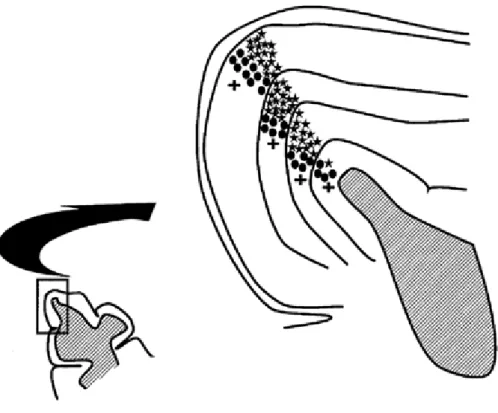
(9) application are greatly enhanced compared with control values (Fig. 8A) yet, as shown in Fig. 8E, responses during the combined application of both L-NOArg and L-Arg are equal to control values. In two of the five cells (out of a total of eleven) affected by DPA-NO application (see above), responses were reduced by some 43%, again showing an effect opposite to that of the larger population of cells affected by L-NOArg. Although few in number, these cells were extremely striking in the difference in their responses to these drugs, a difference that was clearly reproducible and that remained unchanged for as long as the recordings of these cells could be maintained. These cells are also exemplified by the cell illustrated in Fig. 8F, where DEA-NO application resulted in a clear suppression of the visual responses.. Figure 8 Excitatory effect of NOS inhibition on 5% of the cell population Here the visual responses shown in the PSTHs in B are significantly enhanced above control levels, shown in A. D is the recovery PSTH shown in C, but note the redrawn scale. The relative lack of enhancement when L-NOArg and L-Arg are co-applied (E), and the depressive effect of DEA-NO (F) are compared. Each PSTH is the mean of 10 trials, and bin width is 100 ms.. In summary, Fig. 9 illustrates the laminar distribution of the cells affected and unaffected by L-NOArg as outlined above, broken down by cell type (see Fig. 9 legend). We could find no significant correlation between cell type or lamina and the effectiveness of L-NOArg..
(10) Figure 9 Diagrammatic summary of the distribution of cell populations affected or unaffected by l-NOArg throughout the depth of area 17 ★, cells unaffected by L-NOArg (n= 48; 22 simple cells and 26 complex). •, cells with activities reduced by L-NOArg (n= 25; 10 simple and 15 complex). +, cells with activity increased by L-NOArg (n= 4; 2 simple and 2 complex). The cells are shown projected onto a line drawing of a representative section of the histological reconstruction from one experiment The relevant full section is shown in the inset. The mediolateral position of the cells is arbitrary.. Discussion Based both on our previous work and that of other groups (Cudeiro et al. 1994a,b, 1995, 1996; Kara & Friedlander, 1995), we are confident that our iontophoretic application of l-NOArg produces effective local inhibition of the enzyme NOS, thereby preventing release of NO, and we believe that the activity we see does not rely on other transmitter substances or pathways in the cortex, but represents the action of a tightly bound, slowly dissociating competitive antagonist at the l-Arg site of NOS (Furfine, Harmon, Paith & Garvey, 1993; Klatt, Schmidt, Brunner & Mayer, 1994). By far the most potent effect of NOS inhibition we have seen is a depression of activity, both visually elicited and spontaneous. This effect is typical of our previous findings in the dLGN, where all cells encountered, of all cell types, showed just such a suppression during NOS inhibition. However, it is interesting to note that the majority of our population of seventy-seven cortical cells, some forty-eight, were completely unaffected by inhibition of NOS, and, moreover, unresponsive to the application of NO via the donor DEA-NO. It has previously been suggested that locally produced NO (such as that produced by DEA-NO) may affect cells within a volume of tissue in the order of 200μm in diameter (Wood & Garthwaite, 1994). Thus cells without apparent responses to the application of l-NOArg would seem to lack the biochemical machinery necessary to respond to NO manipulating agents, rather than simply being outside of the ‘reach’ of the applied compounds. Indeed, cells both responsive and unresponsive to these compounds were found in the same electrode penetrations and there was no obvious grouping of the two cell types within individual tracks. This suggests a degree of ‘parcellation’ of cortical cells along an as yet undefined axis, but it is interesting in this context to note that cat cortex has recently been shown to contain cytochrome oxidase blobs (Murphy, Jones & Van Sluyters, 1995), the feature which first began the parcellation of primate cortex into regions more complex than orientation and ocular dominance columns (Wong-Riley, 1979; Horton & Hubel, 1981). In primate layer VI, the distribution of NADPH, a marker for neuronal NOS, is closely aligned with that of cytochrome oxidase, showing a similar laminar and spatial distribution (Sandell, 1988), and it is therefore possible that a larger and more detailed sampling of cells in a study such as ours may reveal an anatomical correlation of responsiveness to NO-modulating compounds and a cortical biochemical marker..
(11) While it is known that the input from the basal forebrain to the cerebral cortex utilizes ACh as a primary neurotransmitter (Bickford et al. 1994), less is known about the nature of the cortical postsynaptic recipient structures. It has been suggested that the forebrain selectively influences target inhibitory interneurones in the cortex (Beaulieu & Somogyi, 1991) and such intracortical inhibitory influences have been proposed to ‘sharpen’ visual receptive field properties (Sillito, 1975, 1977; Eysel, Worgotter & Pape, 1987; Ramoa, Paradise & Freeman, 1988). Indeed, the cholinerigic influence itself, mediated mainly by cholinergic muscarinic receptors, is known to enhance visual responsivity and modulate receptive field properties (Sillito & Kemp, 1983; Murphy & Sillito, 1991). We therefore propose that an added NO-mediated influence may extend this direct influence to the neighbouring cells within a selected cortical region by diffusion and activation of NO-mediated excitation, as we have demonstrated at the single–unit level above. In the cortex the mode of action of NO is clearly different to our findings in the thalamus in a number of ways. Firstly, in the visual thalamus (LGN and perigeniculate nucleus), all cells encountered were affected by NOS blockade (Cudeiro et al. 1994a, b, 1996; Rivadulla, Rodriguez, Martinez-Conde, Acuña & Cudeiro, 1996), while in the cortex only some 38% were affected. Furthermore, our NOS blockade in the cortex depressed equally the NMDA receptor-mediated excitation and that induced by the nonNMDA-mediated AMPA receptors and ACh receptors in those cells affected by l-NOArg, while in the thalamus, cells were affected by NOS blockade by a mechanism selectively acting via NMDA receptor activation (Cudeiro et al. 1994a, b, 1996). The reduction in efficacy of these excitants during NOS blockade was lifted when l-Arg was co-applied both in the cortex and in the thalamus, and this was also the case for visual responses and spontaneous activity. This is in contrast to the findings of Montague et al. (1994) who suggested, from observations on rat cortical synaptosomes, that one action of NO was to augment glutamate or noradrenaline release, presumably from neighbouring synapses, as a result of NMDA receptor activation. Such a specific presynaptic mode of action seems unlikely to account for the straightforward reduction in NMDA-, AMPA- and ACh-mediated visual and spontaneous activity we have seen here in vivo. Indeed our findings with 8-bromo-cGMP suggest a simple modulation of the cGMP secondary messenger system, again in contrast to our findings in the thalamus. Such an action on cGMP has been widely reported in the literature (for reviews see Garthwaite, 1991; Moncada et al. 1991; Snyder & Bredt, 1991; Schuman & Madison, 1994; Zhang & Snyder, 1995). We therefore suggest that for this population of cortical cells, during normal functioning, NO acts to enhance excitability in a global way, perhaps dealing with state-dependent changes in excitability, a role already ascribed to the ascending cholinergic fibres arising from the basal forebrain (Buzsáki, Bickford, Ponomareff, Thai, Mandel & Gage, 1988; Bickford et al. 1994). This seems to follow logically from the presence of NOS in these fibres, co-localized with ACh (Bickford et al. 1994). The ability of co-applied l-Arg to reverse the effects of NOS blockade, while alone producing no excitation, mimics the effects we have reported in the dLGN (Cudeiro et al. 1994a,b, 1996). From these observations we suggest that in this situation, available NOS is a rate-limiting step such that increased levels of l-Arg above those which can be immediately processed by the enzyme are without effect. We further speculate that the Ca2+-dependent nature of this enzyme and its location in synaptic terminals suggests that available enzyme levels may fluctuate with the spiking activity of such terminals, ‘following’ the activation of the forebrain input to the cortex. The proportion of cells which were not responsive to manipulation of the NO system may of course be an underestimate in that, although it has been postulated that NO may diffuse over large distances to act on remote sites (Garthwaite, 1991; Wood & Garthwaite, 1994), many cells in the visual cortex have dendritic arbours many times greater than the NO diffusion range (Martin & Whitteridge, 1984; Wood & Garthwaite, 1994). As a consequence, an effect of NO on remote dendrites remains possible, and cannot at this stage be discounted. Whether or not such an effect exists does not, however, detract from the hypothesis that, under the conditions with which we have investigated the NO system, many cells seem to be unaffected. It should be remembered that there are multiple sources of NOS in cat cortex, including some spinefree cells, presumably GABAergic and inhibitory (Bredt et al. 1990; Dawson et al. 1991). This may account for the smaller proportion of cells reported above in which the effects of l-NOArg and DEA-NO were the reverse of the majority of cells affected by l-NOArg – essentially suggesting a physiological inhibitory role for NO in these cells. However, it is true that many other hypotheses may account for this effect, and the extracellular recording technique does not allow identification of the morphological/neurotransmitter cell type under study. Indeed, the variety of effects we have seen during iontophoretic drug application could result from trans-synaptic activation and/or changes in the activity of local circuits. This is particularly relevant to applications of compounds that release NO, which is known to be highly diffusable (Wood & Garthwaite, 1994) and will be the subject of future studies. While changes in local perfusion might also account for some of the effects reported here, we believe this to be unlikely in the anaesthetized and paralysed preparation used here..
(12) In summary, we have demonstrated not only that a significant proportion, some 38%, of our sample of cortical cells is affected by the application of drugs capable of altering NO levels (showing reductions in visual responses when NO production is decreased), but also that there exists a small but significant proportion of affected cells (5%) whose visual responses are inhibited by NO, suggesting the existence of both an up- and down-regulation of cellular firing in separate subpopulations of cortical cells. Finally, our results suggest that, unlike in the visual thalamus, this regulation is carried out via the cGMP second messenger system. Acknowledgements This research was supported by XUGA13401B96, DGICYT (PB93-0347) and FISS 97/0402, Spain. We are indebted to Professor Kamil Ugurbil for helpful comments. K.L.G. gratefully acknowledges the support of the Sloan Foundation.. References Beaulieu, C. & Somogyi, P. (1991). Enrichment of cholinergic synaptic terminals on GABAergic neurons and coexistence of immunoreactive GABA and choline acetyltransferase in the same synaptic terminals in the striate cortex of the cat. Journal of Comparative Neurology 304, 666–680. Bickford, M. E., Günlük, A. E., Guido, W. & Sherman, S. M. (1993). Evidence that cholinergic axons from the parabrachial region of the brainstem are the exclusive source of nitric oxide in the lateral geniculate nucleus of the cat. Journal of Comparative Neurology 334, 410–430. Bickford, M. E., Günlük, A. E., Van Horn, S. C. & Sherman, S. M. (1994). GABAergic projection from the basal forebrain to the visual sector of the thalamic reticular nucleus of the cat. Journal of Comparative Neurology 348, 481–510. Bredt, D. S., Hwang, P. M. & Snyder, S. H. (1990). Localization of nitric oxide synthase indicating a neural role for nitric oxide. Nature 347, 768–770. Bredt, D. S. & Snyder, S. H. (1990). Isolation of nitric oxide synthetase, a calmodulin-requiring enzyme. Proceedings of the National Academy of Sciences of the USA 86, 9030–9033. Buzsáki, G., Bickford, R. G., Ponomareff, G., Thal, L. J., Mandel, R. & Gage, F. H. (1988). Nucleus basalis and thalamic control of neocortical activity in the freely moving rat. Journal of Neuroscience 8, 4007–4026. Cudeiro, J., Grieve, K. L., Rivadulla, C., Rodriguez, R., Martinez-Conde, S. & Acuña, C. (1994a). The role of nitric oxide in the transformation of visual information within the dorsal lateral geniculate nucleus of the cat. Neuropharmacology 33, 1413–1418. Cudeiro, J., Rivadulla, C., Rodriguez, R., Martinez-Conde, S., Acuña, C. & Alonso, J. M. (1994b). Modulatory influence of putative inhibitors of nitric oxide synthesis on visual processing in the cat lateral geniculate nucleus. Journal of Neurophysiology 71, 146–149. Cudeiro, J., Rivadulla, C., Rodriguez, R., Martinez-Conde, S. & Acuña, C. (1995). Application of l-Arg and l-NOArg modify cellular responses in the primary visual cortex of the cat. Society for Neuroscience Abstracts 21, 650.2. Cudeiro, J., Rivadulla, C., Rodriguez, R., Martinez-Conde, S., Martinez, L., Grieve, K. L. & Acuña, C. (1996). Further observations on the role of nitric oxide in the feline lateral geniculate nucleus. European Journal of Neuroscience 8, 144–152. Cudeiro, J. & Sillito, A. M. (1996). Spatial frequency tuning of orientation-discontinuity-sensitive corticofugal feedback to the cat lateral geniculate nucleus. Journal of Physiology 490, 481–492. Dawson, T. M., Bredt, D. S., Fotuhi, M., Hwang, P. M. & Snyder, S. H. (1991). Nitric oxide synthase and neuronal NADPH diaphorase are identical in brain and peripheral tissues. Proceedings of the National Academy of Sciences of the USA 88, 7797–7801. Eysel, U. T., Worgotter, F. & Pape, H. C. (1987). Local cortical lesions abolish lateral inhibition at direction selective cells in cat visual cortex. Experimental Brain Research 681, 606–612. Furfine, E. S., Harmon, M. F., Paith, J. E. & Garvey, E. P. (1993). Selective inhibition of constitutive nitric oxide synthase by l-NG-nitroarginine. Biochemistry 32, 8512–8517. Garthwaite, J. (1991). Glutamate, nitric oxide and cell-cell signalling in the nervous system. Trends in Neurosciences 14, 60–67.DOI: 10.1016/0166-2236(91)90022-M Henry, G. H. (1977). Receptive field classes of cells in the striate cortex of the cat. Brain Research 133, 1–28.DOI: 10.1016/0006-8993(77)90045-2 Horton, J. & Hubel, D. (1981). Regular patchy distribution of cytochrome oxidase staining in the primary visual cortex of macaque monkey. Nature 292, 762–764..
(13) Iadecola, C. (1993). Regulation of the cerebral microcirculation during neural activity: is nitric oxide the missing link? Trends in Neurosciences 16, 206–214.DOI: 10.1016/0166-2236(93)90156-G Ignarro, L. J., Buga, G. M., Woods, K. S., Byrns, R. E. & Chaudhuri, G. (1987). Endothelium-derived relaxing factor produced and released from artery and vein is nitric oxide. Proceedings of the National Academy of Sciences of the USA 84, 9265–9269. Kara, P. & Friedlander, M. J. (1995). The role of nitric oxide in modulating the visual response of neurons in the cat striate cortex. Society for Neuroscience Abstracts 21, 689.13. Klatt, P., Schmidt, K, Brunner, P. & Mayre, B. (1994). Inhibitors of brain nitric oxide synthase. Journal of Biological Chemistry 269, 1674–1680. Knowles, R. G., Palacios, M., Palmer, R. M. G. & Moncada, S. (1989). Formation of nitric oxide from Larginine in the central nervous system: a transduction mechanism for stimulation of soluble guanylate cyclase. Proceedings of the National Academy of Sciences of the USA 86, 5159–5162. Kuchiiwa, S., Kuchiiwa, T., Mori, S. & Nakagawa, S. (1994). NADPH diaphorase neurones are evenly distributed throughout cat neocortex irrespective of functional specialization of each region. NeuroReport 5, 1662–1664. Martin, K. A. C. & Whittbridge, D. (1984). The relationship of receptive field properties to the dendritic shape on neurones in the cat striate cortex. Journal of Physiology 356, 291–302. Moncada, S., Palmer, R. M. J. & Higgs, E. A. (1991). Nitric oxide: physiology, pathophysiology and pharmacology. Pharmacological Reviews 43, 109–142. Montague, P. R., Gancayco, C. D., Winn, M. J., Marchase, R. B. & Friedlander, M. J. (1994). Role of NO production in NMDA-receptor mediated neurotransmitter release in cerebral cortex. Science 263, 973–977. Murphy, K. M., Jones, D. G. &Van Sluyters, R. C. (1995). Cytochrome oxidase blobs in cat primary visual cortex. Journal of Neuroscience 15, 4196–4208. Murphy, P. C. & Sillito, A. M. (1991). Cholinergic enhancement of direction selectivity in the visual cortex of the cat. Neuroscience 40, 13–20.DOI: 10.1016/0306-4522(91)90170-S Palmer, R. M. J., Ferrige, A. G. & Moncada, S. (1987). Nitric oxide release accounts for the biological activity of endothelium-derived relaxing factor. Nature 327, 524–526.DOI: 10.1038/327524a0 Ramoa, A. S., Paradiso, M. A. & Freeman, R. D. (1988). Blockade of intracortical inhibition in kitten striate cortex: effects on receptive field properties and associated loss of ocular dominance plasticity. Experimental Brain Research 73, 285–296. Rivadulla, C., Rodriguez, R., Martinez-Conde, S., Acuña, C. & Cudeiro, J. (1996). The influence of nitric oxide on perigeniculate GABAergic cell activity in the anaesthetized cat. European Journal of Neuroscience 8, 2459–2466. Sandell, J. H. (1988). NADPH diaphorase histochemistry in the macaque striate cortex. Journal of Comparative Neurology 251, 388–397. Schuman, E. M. & Madison, D. V. (1994). Nitric oxide and synaptic function. Annual Review of Neuroscience 17, 153–183.DOI: 10.1146/annurev.ne.17.030194.001101 Sillito, A. M. (1975). The contribution of inhibitory mechanisms to the receptive field properties of neurones in the striate cortex of the cat. Journal of Physiology 250, 305–329. Sillito, A. M. (1977). Inhibitory processes underlying the directional specificity of simple, complex and hypercomplex cells in the cat visual cortex. Journal of Physiology 271, 699–720. Sillito, A. M., Cudeiro, J. & Murphy, P. C. (1993). Orientation sensitive elements in the corticofugal influence on centre-surround interactions in the dorsal lateral geniculate nucleus of the cat. Experimental Brain Research 93, 6–16. Sillito, A. M. & Kemp, J. A. (1983). Cholinergic modulation of the functional-organisation of the cat visual-cortex. Brain Research 289, 143–155.DOI: 10.1016/0006-8993(83)90015-X Snyder, S. H. & Bredt, D. S. (1991). Nitric oxide as a neuronal messenger. Trends in Pharmacological Sciences 12, 125–128.DOI: 10.1016/0165-6147(91)90526-X Wong-Riley, M. (1979). Changes in the visual system of monocularly sutured or enucleated cat demonstrable with cytochrome oxidase histochemistry. Brain Research 171, 11–28.DOI: 10.1016/0006-8993(79)90728-5 Wood, J. & Garthwaite, J. (1994). Models of the diffusional spread of nitric oxide: implications for neural nitric oxide signalling and its pharmacological properties. Neuropharmacology 33, 1235–1244.DOI: 10.1016/0028-3908(94)90022-1 Zhang, J. & Snyder, S. H. (1995). Nitric oxide in the nervous system. Annual Review of Pharmacology and Toxicology 35, 213–233.DOI: 10.1146/annurev.pa.35.040195.001241.
(14)
Figure
+4
Documento similar