UNIVERSIDAD TÉCNICA PARTICULAR DE
LOJA
La Universidad Católica de Loja
ÁREA SOCIO HUMANÍSTICA
TÍTULO DE LICENCIADO EN CIENCIAS DE LA EDUCACIÓN
MENCIÓN INGLÉS
The influence of large classes in the English language
teaching-learning process in Ecuadorian high schools
TRABAJO DE TITULACIÓN.
AUTOR: Godoy Rodríguez, Nelly Gisella
DIRECTOR: Zúñiga Ojeda, Alexandra, Mgs.
Esta versión digital, ha sido acreditada bajo la licencia Creative Commons 4.0, CC BY-NY-SA: Reconocimiento-No comercial-Compartir igual; la cual permite copiar, distribuir y comunicar públicamente la obra, mientras se reconozca la autoría original, no se utilice con fines comerciales y se permiten obras derivadas, siempre que mantenga la misma licencia al
ser divulgada. http://creativecommons.org/licenses/by-nc-sa/4.0/deed.es
APROBACIÓN DEL DIRECTOR DEL TRABAJO DE TITULACIÓN
Magister.
Alexandra Zúñiga Ojeda
DOCENTE DE LA TITULACIÓN
De mis consideraciones:
El presente trabajo de titulación “The influence of large classes in the English
language teaching-learning process in Ecuadorian high schools” realizado por
Godoy Rodríguez Nelly Gisella, ha sido orientado y revisado durante su ejecución,
por cuanto se aprueba la presentación del mismo.
Loja, febrero de 2016
f)………..
DECLARACIÓN DE AUTORÍA Y CESIÓN DE DERECHOS
“Yo, Godoy Rodríguez Nelly Gisella, declaro ser autora del presente trabajo de
titulación “The influence of large classes in the English language teaching-learning
process in Ecuadorian high schools”, de la Titulación de Ciencias de la Educación
mención Inglés, siendo la Mgs. Alexandra Zúniga Ojeda director (a) del presente
trabajo; y eximo expresamente a la Universidad Técnica Particular de Loja y a sus
representantes legales de posibles reclamos o acciones legales. Además certifico que
las ideas, conceptos, procedimientos y resultados vertidos en el presente trabajo
investigativo, son de mi exclusiva responsabilidad.
Adicionalmente, declaro conocer y aceptar la disposición del Art. 88 del
Estatuto Orgánico de la Universidad Técnica Particular de Loja que en su parte
pertinente textualmente dice: “Formar parte del patrimonio de la Universidad la
propiedad intelectual de investigaciones, trabajos científicos o técnicos y tesis de
grado que se realicen a través, o con el apoyo financiero, académico o institucional
(operativo) de la Universidad”.
f...……….
Godoy Rodríguez Nelly Gisella
DEDICATION
I want to dedicate this thesis to special people, my husband David, and my children
Alexis and Vianca. To my husband thanks a million, he taught me that all in life is
possible. He told me “many things are difficult but they are not impossible when we
really want to reach our goals, it is only a matter of time and patience”.
ACKNOWLEDGMENT
The results of this research are dedicated to those people who are part of my life. To
my family, who believed in me all the time, the teachers of the Universidad Técnica
Particular de Loja, who supported me during the execution of this project; and
specially God for all his blessings.
CONTENTS
COVER
APROBACIÓN DEL DIRECTOR DEL TRABAJO DE FIN DE TITULACIÓN…..i
DECLARACIÓN DE AUTORÍA Y CESIÓN DE DERECHOS………ii
DEDICATION………iii
ACKNOWLEDGMENT……….iv
CONTENTS……….v
ABSTRACT……….1
RESUMEN………..2
INTRODUCTION………...3
METHOD………6
DISCUSSION ……….7
Literature Review………...7
Description, Analysis and Interpretation of Results……….23
Conclusions………39
Recommendations………..40
REFERENCES………...41
ABSTRACT
The purpose of this research is to corroborate if large classes influence in the
English language teaching-learning process in Ecuadorian high schools. For this
reason, five secondary schools were selected. They are located in different parts of
Quito. The sample consisted of students from several courses; from 8th level to 3rd senior level.
One instrument was used in order to conduct this research. A questionnaire,
which focused on three aspects, academic, social and psychological, was applied to
183 students. The questions were aimed at gathering the interviewees´ perceptions
when they are learning English in large groups.
The data collected show as a result that class size does not affect the teaching
learning process; however, it was found that there are shortcomings in academic and
psychological aspects because some students report that even though they do not go
unnoticed by the teacher; there is not an appropriate environment where they feel
relaxed and receive individual attention to know about their improvement or
mistakes when they learn a new language.
RESUMEN
El propósito de esta investigación es determinar si las clases grandes influyen
en el proceso de enseñanza-aprendizaje del idioma Inglés en colegios ecuatorianos.
Para ello, cinco colegios fueron seleccionados. Ellos están ubicados en diferentes
partes de la ciudad de Quito. La muestra consistió en estudiantes de varios cursos; de
8vo a 3er año de bachillerato.
Un instrumento fue utilizado para llevar a cabo la investigación. Un
cuestionario, el cual se enfocó en tres aspectos; académico, social y sicológico, fue
aplicado en 183 estudiantes. Las preguntas estuvieron destinadas a recopilar los
sentimientos de los encuestados cuando ellos están aprendiendo Inglés en grandes
grupos.
Los datos recogidos muestran como resultado que el tamaño de la clase no
afecta el proceso de enseñanza-aprendizaje; sin embargo, se encontró que aún existen
falencias en los aspectos académico y sicológicos debido a que algunos estudiantes
manifiestan que, a pesar de no pasar desapercibidos por el profesor, no se puede
propiciar un ambiente adecuado donde ellos se sientan relajados y reciban atención
en forma individual para conocer sobre su progreso o errores cuando aprenden una
nueva lengua.
INTRODUCTION
For many decades the English language has been considered a difficult
language to learn inside the Ecuadorian classrooms. It became in the villain of many
students, because of its difficulty in pronunciation, grammar and the great fear of
speaking in front of others. This is evident from primary levels to secondary and
university levels.
The Ecuadorian government has realized of this big problem, thus it has felt the
necessity to improve the quality in the teaching and learning English language,
especially in high schools, where there are even many shortcomings. For this reason
the Ministry of Education (2012) has disposed various actions and procedures in
order to achieve this objective such as enhance the curriculum based on international
standards, prepare the teachers, and catch up with modern techniques and innovative
technologies, in order to improve students´ knowledge and their skills in reading,
writing, listening and speaking.
However, these actions tackle just some of the aspects of the teaching-learning
process. Teachers in our country also deal with a great number of students to teach
the language which worsen the problem. According to Scrivener (2005) teachers
consider that one of the principal difficulties in teaching English language is the class
size. In large classes it is very complicated to preserve the discipline, to make eye
contact teacher-students, and students-students, learners cannot move readily, the
majority of the teachers cannot give the same attention to all the students, and only
Contrary to Scrivener´s point of view, Shaeffer (2006) points out that in large
classes, teachers have the opportunity to make progress in their teaching and
presentation skills, because large classes contain different kinds of students who have
different learning styles. The students share different points of view and attractive
life experiences.
These positions about the number of students in an English class bring to the
light the need to identify the students´ feelings about this problem.
Similar studies have been conducted around the world such is the case of the
study performed by Jimarkorn and Singhasiri (2006) which says that many teachers
see large classes as less effective, extra working and with a great deal of difficulties
in the teaching-learning process. Some teachers do not see advisable to maintain
large classes only for the institution´s benefit. They consider that duties and ongoing
assessments are not appropriate, because they generate harder work for them. The
authors conclude that all of the aspects cited have a degree of difficulty, above all in
large classes. However, they mention that, it is possible to improve them with a well-
planned and organized teaching management.
In the same way, Harfitt (2012) thinks that teachers do not teach in the same
way when they are in large classes than in small ones. Large classes demonstrate a
distant relationship between teacher and students; the environment is less pleasant,
there are more disciplinary problems, much noise, and more. So, teachers and the
students lose interest in the process of learning and teaching.
On the other hand, in the research made by Galton and Pell (2011), they
size is, however; they say that there are some teaching strategies easier to handle
when the classes are diminished. In fact, class size reductions do not make a
difference to classroom practice. It is only a matter to identify some changes in the
teaching methods in both large and small classes.
Finally, this research revealed some limitations. One of them is the same
questionnaire, because this was only applied to the students. The questionnaire only
reflects the students´ points of view, but not the teachers´ criteria. Another limitation
was that the researcher could not observe the classes, which had served to sustain the
answers collected from the interviewees.
Despite the above limitations mentioned, this study benefited the students
because the teachers can implement enhancements in the academic, social and
psychological aspects with the guidance of the new standards given by the Ministry
of Education.
In addition, the authorities of the scholar campus, the English teachers, the
researcher and all the educational institutions would be many of the beneficiaries in
METHOD
Setting and participants
The study was conducted in five different secondary schools at the South of
Quito city. One hundred eighty three students from public, municipal and private
secondary schools were selected. They were from 8th to 10th levels; and from 1st to 3rd senior levels. The ages of the participants were from 12 to 18 years old.
Procedures
In order to perform this research, the first step consisted in a wide and deep
reading of bibliographic information, from several sources such as books, journals,
and the internet, in order to obtain the most relevant information to write the
Literature Review.
The researcher collected the data by using questionnaires directed to all
students in the class. They are composed of twenty one questions and they were
divided in three areas: academic, social and psychological, with them the researcher
wanted to know what are the student`s points of view when they work in large
classes. The academic area had nine questions; second, the social area contained five
questions and finally the psychological area had seven questions.
The data was tabulated qualitatively. Then it was analyzed. The analysis of
these three areas was quantitative and it will serve to determine what implications
have the large classes in the English language teaching-learning process.
DISCUSSION
Literature Review
Large classes are often seen as one of the major barriers in order to guarantee
quality education. In fact, there are many investigations that show the disadvantages
of large classes and defend small classes as a factor to certify quality education.
However, large classes are a reality in many schools and many countries, probably
for mismanagement or political issues which do not permit to have enough number
of teachers and classrooms that would ensure a quality education. It is important to
contribute with instruments in order to deal with the difficulties of large classes to
improve the quality of education to many students in the scholar field (Shaeffer,
2006).
In the next paragraphs we will see different and important aspects about the
influence of large classes in the English language teaching-learning process. We will
begin with the first aspect.
Teaching Approaches and Methods
According to Brown (2001) the Audiolingual method is an ancient method
created by the U.S Military. The main properties are: extensive oral activity
pronunciation, pattern drills and conversation practice. Also, it is based on the
aural/oral skills.
It was known as Army Method until 1950 where it had many years of
acceptance and fame. Today it is even used, however; people realized that English
Similarly, Richards and Rodgers (2001) argue that drills and patterns practices
are distinguishing properties of Audiolingual method, for example: repetition,
inflection, replacement, completion, restoration among many others. The teacher,
tape recorders and audiovisual equipment are fundamental parts in the development
of this method. They provide to the students situations to practice structures, active
verbal interaction and drills.
The next method is not commonly used in these days, however; it served many
generations when it was created. This is called Community Language Learning
method.
Brown (2001) and Richard and Rodgers (2001) mention that Community
Language Learning is a method designed by Charles Curran and his allies. The
teacher and students play an important part; they affiliate together in order to learn as
community. In this context, teacher helps to the students to understand the
information about English linguistic rules. The teacher´s intention is to core his or
her attention on the students and their concerns.
The next method is Total Physical Response (TPR). This is considered one of
the oldest method and it is rarely used in educational institutions today.
Brown (2001) says that TPR is a method in which students do a great deal of
listening and acting, too. The teacher is the producer and students are the
performers. However, it has its drawbacks because it is effective in the beginning
levels, but nor for advanced levels in its capabilities.
Richard and Rodgers (2001) also mention that TPR as a method which dwell
respond with corporal movements to commands disposed by the teacher. The teacher
occupies an active and direct participation, he/she is the person who has the
responsibility to provide the best kind of exhibition to the language.
As old as TPR is Suggestopedia. We will see opinions about Suggestopedia
method from the authors Brown, Richards and Rodgers.
Brown (2001) says that Suggestopedia was other educational newness inside
the methods, this assures to the students the best results in the learning process only
with the use of their brain power. The following items are the main features of this
method: baroque music and adequate seats. While the teacher presents vocabulary,
readings, dialogues, role plays and many other activities; the students listen to music
in a complete calm.
On the other hand, Richards and Rodgers (2001) argue that Suggestopedia is
promoted by Georgi Lozanov. Its peculiarities are: the decoration, movables, the
arrangement of the seats into the classroom, the use of music and the dominant
manner of the teacher. The baroque music and musical rhythm are important, too.
Finally we will see the purpose and characteristics of Silent way. This is other
important method inside the educational field.
Silent Way, is other method mentioned by Brown (2001). He claims that
Gattegno believed that this method encouraged learners to develop
self-determination, autonomy and liability, only doing silence all the time. The materials
used in this method are set of Cuisenaire rods, small colored rods and colorful wall
charts. The teacher generally uses them to introduce vocabulary, verbs, syntax,
Similar to the other methods, Silent way can generate a distant atmosphere
between the teacher and the students, because they are in silence. In addition, Silent
way is based on the hypothesis that teacher must be in silent as much as possible,
instead of; the learners must be animated to create as much as language as possible.
The materials used are: color charts and the colored Cuisenaire rods. The method is
related to the word that Benjamin Franklin said: “Tell me and I forget, teach me and I
remember, involve me and I learn” (Richard and Rodgers, 2001).
In the following content we will analyze the point of view of different authors
about the class size. Some of them mention that large classes are a true problem,
however; other authors have positive opinions about this aspect.
Class Size
Teachers consider that one of the principal difficulties in the English language
teaching-learning process is the class size because; it is very complicated to preserve
the discipline, to make eye contact teacher-students, and students-students, learners
cannot move readily, the majority of the teachers cannot give the same attention to
the students, and only a certain group of them pay more attention than others
(Scrivener, 2005).
In contrast Shaeffer (2006) mentions that in large classes teachers have the
chance to make progress presenting and teaching skills, because; large classes
contain different kind of students and learning styles, vigorous and enjoyment
On the other hand, he mentions that in small classes the teachers can achieve
that the majority of students participate in active exercises, such as: asking and
answering questions, discussing topics and laughing about funny significantstories.
In fact Harmer (2007) says that teaching one-to-one classes have benefits over
classes with more students, for example: teacher´s attention is center entirely in one
person, teaching process is more flexible and the way in which the students respond
to the learning process is different, however; this method presents disadvantages, too,
because; both teacher and the students can often become tired with the activities.
In contrast Jones (2007) explains that in small classes, the students are more
teacher-dependent, because they wait for compliments or stimulus while they are
talking. The only difference between large and small classes is the quantity of the
time that the teacher uses to observe the groups.
Up to this point, we had seen some drawbacks and benefits about class size;
now we will focus in other important aspect in the English language
teaching-learning process which is managing teaching-learning. It focus in the management of students
in the classrooms and how we can obtain a greater participation of them.
Managing Learning
When teachers give instructions to the students, it is very important to maintain
and follow several of the following aspects: to keep visual contact with the students
in order to avoid whatever kind of distractions. Use short comprehensible and
elementary instructions, in this way they will understand what they have to do. The
students learn better with illustrations rather than explanations. For examples: with
the teacher has given the instructions, it is necessary to know if the whole class
comprehend them, then the teacher will solicit to two or four students replay the
instructions back (Scrivener, 2005; Gower, Phillips and Walters, 2005; Harmer,
1998).
In order to obtain a positive feedback in both oral and written, it is advisable
that the students feel flattered and motivated by the teacher. This occurs when the
teacher expresses words of congratulations, when he gives a special prize or simply
when he publishes agreeable works of the students (Gower, Phillips and Walters,
2005).
Shamim, Negash, Chuku, and Demewoz, (2007) mention that there are
procedures to maintain the problems caused by superabundance noise. They are
creating norms from the start of the course and providing clear recommendations to
the students
Relating to feedback the authors say that it permits to check the advance of the
students in the learning process. It serves to identify what actions to take in order to
develop comprehension and confidence in the students.
We will debate other important aspect about class size. The topic is managing
large classes. Inside of it, we will see examples in order to handle large groups of
students, what activities to do and some tips to control the discipline.
Managing Large Classes
It is based on some important and interesting practical assumptions. First, to
maintain eye contact with the students, second, to use different types of systems,
from the start of the lesson, as a consequence; the teachers will obtain the student´s
attention. On the other hand, the students can be grouped in pairs and groups to use
and practice basic chores and natural oral/aural target language (Woodward, 2001).
Harmer (2007) gives other point of view about managing large classes. He says
that the teachers will help the students with their concerns, for example: arranging
the students in groups, establishing daily routines and maximizing individual work,
before, during and after the lessons
The teacher will maximize the students´ participation, working with the
students as individual, in pair-work, group-work and in chorus reaction, in this way;
they can take advantage from the diversity of each student.
Other important aspect in the English language teaching learning process is the
activities that the teachers carry out in the classrooms. In the following paragraphs
we will observe how the activities help to the students in their educational
development.
Activities for working with large classes
Scrivener (2005) mentions that the activities play a meaningful role in the
development of the students, because; they develop their competences in writing,
reading, listening and speaking. For this reason is very important to practice doing
grammar exercise, listening to a recorder conversation, reading a newspaper articles,
repeating sentences, and preparing role plays, dialogues, or many other activities.
Otherwise Hess (2001) points that the activities such as: introducing games to
will help to the students to acquire abilities as self-expression and interaction inside
the classroom.
The activities are very important as classroom space and seating arrangement
are, because; they play an important part in the English language teaching-learning
process. For this reason, we will see different points of view about this aspects as
follows.
Classroom Space
The space available influences in the English language teaching-learning
process, since it becomes in a decisive element between the teacher and the group,
mainly in large classes. For instance, the students are usually distant in massive
spaces and this condition reflects an air of unease, intimacy, loneliness and
emptiness.
Otherwise, in small spaces the students feel overcrowded, repressed and
elusive. In many occasions, they can hurt among themselves, because they want
more space (Dörnyei and Murhey, 2003).
On the other hand, Scrivener (2012) thinks that limited and extensive spaces
have problems because they influence in the students´ development and in their
teaching process, because; it is not possible to work with the students in pairs or
groups.
It is contradictory, but sometimes there are teachers who cannot work in big
spaces and many of them assume that the space is not completely extensive,
of activities, changing places and reorganizing the classroom. Then, the attitude and
the vision of the teacher makes the difference between both small and large classes.
Seating Arrangement
Not only Scrivener (1994) but also Harmer (1998) point that the organization
of the seats in the classroom can modify for different aspects. For example: the type
of activities that the teacher executes, the interaction among the students and the
class size.
One type of arrangement is orderly rows, this allows higher interaction and
visual connection between teacher and the whole class. The horseshoe arrangement
shows an equal opportunity, because the teacher´s location is less powerful and the
students can interact in a natural way.
On the other hand, horseshoe and circle arrangement teacher maintains visual
connection with the learners, at the same time; the students with other students. Other
arrangement is separated tables which is preferable for small groups, one of its
difficulties is the interaction inside the classroom, because the students are so
scattered.
Finally, the authors mention different levels of proficiency. In many occasions
it has been considered a problem inside the learning process however the authors
have different opinions about this aspect.
Different levels of proficiency
Being ignored, uninterested, pessimistic and abandoned are some of the
since the teacher pays more attention to the lower-level students. These types of
symptoms generate in advanced learners lack of interest in the class.
On the other hand, in weaker students cause a feeling of intimidation. In both
cases these attitudes bring many complications when the teachers work with large
groups.
On the contrary, when both weaker and stronger students are grouped, the
process of learning is easier, because advanced learners can help to weaker students
to gain much more confidence (Harmer and Jones, 2007).
So far, we have discussed important and interesting issues for the
development of this research, below we will see the most significant topics of five
studies done by different researchers.
The first study performed by Jimarkorn and Singhasiri (2006) emphasize to
investigate what are the teacher‘s perceptions, opinions and attitudes towards
teaching English in large classes. The study was done in Thailand with 75
tertiary-level lecturers. They were 17 males and 58 females. The majority of these
participants had master´s degree, the others have doctorate and bachelor´s ones. A
questionnaire was applied to all the participants. Questions about participant´s
personal details, participant´s knowledge about university‘s policy on class size,
others about the facts and opinions about large classes, besides questions for different
conditions teaching in large classes, such as: general, physical conditions, teaching
and learning conditions, difficulties and opinions and ideal classes.
As a consequence of the teacher´s answers, the authors found that many of
difficulties in the teaching-learning process, for instance: First, students do not
develop the most correct approach of learning. Second, there is a deficiency of
attention and feedback, and lack of technological resources, too. Some teachers do
not see advisable to maintain large classes only for the institution´s benefit. They
consider that duties and ongoing assessments are not appropriate, because they
generate harder work for them.
The authors conclude that all of the aspects cited have a degree of difficulty,
above all in large classes. However, they mention that it is possible to improve them
with a well-planned and organized teaching management.
In the second study, Harfitt (2012) talks about an examination of teacher´s
perceptions and practice when teaching large and reduced-sized classes. He says, do
teachers really teach them in the same way? In order to develop the study, the author
examines three experience English language teachers. They were female with more
than 6 years of experience, with Master Degree in education, from the Hong Kong
secondary schools. The data was collected in 22 semi-structured interviews, as well
as 48 lesson observations. A baseline interview was done with each teacher before
the observation began. With this information, the researcher obtained teacher´s
personal ways of thinking and experiences of teaching.
In addition, the analysis was done in three segments: teacher-class,
class-teacher and student-student, with this information, the researcher will be able to
check if teachers take other type of attitude when they move from large to
reduced-size classes. The author used observation sheets with field notes and video
To analyze the results, the interviews were divided in some segments such as:
lesson planning, adopting different teaching approaches, improving classroom
management and knowing students. Classroom observations were divided in
organization of learning and classroom discourse analysis. The mixture of classroom
observations and teacher´s interviews show the following findings. Teachers prefer
to work in small classes than in large classes. They argue that in large classes the
time is limited and it is difficult to follow different teaching approaches. Large
classes are more problematic and it is too hard obtain better comprehension about
students` personality and their points of view.
On the other hand, they think that small classes offer them the opportunity to
work in an environment more relaxed with an air of liberty. The students manifest
more interest to work in groups and many of them answer and participate because
there is more time to make questions.
For these reasons the author concludes that, the teachers do not teach in the
same way when they are in large classes, because; they demonstrate a distant
relationship with the students, the environment is less pleasant, there are disciplinary
problems and much noise. Finally, the teachers and the students lose interest in the
learning-teaching process.
On the contrary, the following research made by Galton and Pell (2011)
explain how class size reductions can or cannot alter the practice in the classroom. In
order to develop it, 37 primary schools were monitored in Hong Kong during 2004
Researchers applied two types of instruments to carry out the study. First
systematic observations in both small and normal classes, from primary 1 through
primary 3. One hundred one English teachers were observed in small classes, and
thirty eight in normal classes. One hundred thirty nine English teachers were
observed and around 720 students were checked between Chinese, English and
Mathematics areas. The second instrument was the student´s record. These
observations were categorized into different groups to evaluate the teacher and the
students.
They revealed that in small classes the students do not achieve the teacher`s
attention than in normal classes. This situation happens because teachers emphasize
the work in groups and pair-work. Teachers pay more attention one student inside the
group rather than in individual form. On the other hand, in normal classes the
students are a part of the class. In large classes, the teachers can interact with the
majority of the students, the contrary happens in small classes, because; teachers
work with one student during a long period of time.
As result, the teachers admitted that useful practice was alike for all classes
whatever their size is, however; they said that there are some teaching strategies
easier to handle when the classes are diminished. In fact, class size reductions did not
make any difference. It was only a matter to identify some changes in teaching
methods in both large and small classes.
The following study is made by Kathi (2011). It pretends to detect the very
common expectations of students in large multilevel secondary English classes. The
establish collaboration, range of tasks, give feedback, classroom English and home
assignment.
The researcher selected the sample, sixty students of tenth grade. Thirty
students were form Ramechhap district and thirty form Kathmandu valley of rural
and urban regions of Nepal. The method applied by the author was one structured
questionnaire which contained nineteen closed ended questions.
Four questions are dedicated to classroom management. They demonstrate that
the students have high and good expectations over them. For example: the students
are interested to follow the rules established by the teacher inside the classroom.
They incline to arrange the seats in rows, but; in circles, too. Besides, they wish that
the teacher learns their first names and that he/she moves around the classroom. One
of the manners to construct respectful between both teachers and the students is to
learn names as soon as possible, in this way the students gain confidence and more
involvement in the activities inside the classroom; they construct an environment of
attraction and liability.
Relating to enhancing collaboration, “teacher can multiply the opportunities for
practice and for creative language use by introducing pair and group work”(Cross,
1992). The students manifest their interest for group and pair work, like group and
pair activities. The result shows that the cooperative work and the reduced use of
mother language improve the collaboration between students in the classroom. For
range tasks, the results demonstrate that the teacher must create varied types of
styles and their own concerns. The teacher must remember that not all exercises are
convenient for all.
About English classroom, the students want that their English classes are
submitted day by day, with short expressions instead complicated and long
sentences. Concerning feedback, the students expect to maintain interaction with
their teachers, while they are receiving feedback. The students prefer that the teacher
notify their advances.
Finally, the students consider that home assignments are overwhelming when
they are in large groups, however; they prefer that the teacher review them every
day. They expect more home assignments than only forced ones.
In conclusion, the study makes numerous pronouncements about the
expectations of the students. Although the students show high expectations relating
to the English language learning. It is not possible to promote a collaborative
working environment, because; multilevel large groups contain students with
different ways of learning and needs. The situation requires of a great effort and
determination by the teacher, especially when the resources are limited in Nepal.
The next study shows similarities with other research above mentioned.
Blatchford, Basset and Brown (2011) pretend to examine the effect of class size on
classroom engagement and teacher – student interaction, if the consequences in the
learning process are the same or change between the students from primary and
secondary levels.
The research took place in England and Wales. Forty nine systematic
schools. The observations were organized in 88 classes. There were 335 female and
351 male students observed, in total 686 students. They were distributed into three
attainment groups: low, medium and high based on the teacher`s notes.
The observations show in detail the students´ conduct, when they share with
the teacher and with other learners. They were carried out when the classroom-based
activities began. The observations were made in Mathematics, English and Welsh
lessons.
The result of the observations demonstrate that the students are more engaged
with the teacher when they receive more personal attention and when the classes are
reduced into smaller ones.
The contrary happens in large classes, because the students do not receive the
same attention from the teacher, however; this situation was more evident in students
Description Analysis and Interpretation of Result
Once the data was collected about the influence of large classes in the English
language teaching-learning process in Ecuadorian high-schools; it was analyzed,
described and interpreted. In these circumstances, three aspects will be considered:
academic, social and psychological area.
The first variable that will be analyzed is the academic aspect.
Quantitative analysis
What instructional implications do large classes have on the teaching-learning
process?
Table 1
N°
In classes with a large number of students:
Tot all y Agree Agr ee Parti al ly Agre e Di sa gr ee TO TA L
f % f % f % f % f %
1.
The activities done in class help to apply what
students learn in class. 56 31% 93 51% 26 14% 8 4% 183 100%
2.
The activities done allow practicing listening, speaking, reading and writing skills.
57 31% 89 49% 28 15% 9 5% 183 100%
3.
The students are attentive and participate in class activities, including those sitting at the back of the
classroom.
21 14% 68 37% 68 37% 26 12% 183 100%
4.
Varied class activities are used such as group, individual, pair-work activities, etc.
116 64% 48 26% 15 8% 4 2% 183 100%
5.
Activities such as plays, competitions, debates, games, etc. are used in class.
6.
Students can cheat during the test. 25 14% 32 17% 62 34% 64 35% 183 100%
7.
Students get distracted by doing assignments
from other subjects. 25 14% 31 16% 60 33% 67 37% 183 100%
8.
The seating arrangement facilitates the tasks that
are carried out in class. 75 41% 75 41% 26 14% 7 4% 183 100%
9.
Students cannot receive regular feedback from the teacher due to the large number of students.
31 17% 67 37% 44 24% 41 22% 183 100%
Author: Nelly Gisella Godoy Rodríguez
Source: Student’s questionnaire
It was found that 51% of the students agree and 31% of them totally agree with the statement about the activities done in class help to apply what they learn in the class. The contrary happens with 14% of the students who partially agree and 4% of
them disagree.
The findings show that 82% of the students feel that the activities applied by teachers inside the classroom are of great interest, since they allow them to apply what they learn in the class. However, 18% of the students think that the activities are not appropriate to learn.
To sum up, the activities organized by the teacher in the class help the students
to reflect a positive attitude towards the English language. This is supported by
Scrivener (2005), who points out that activities for working with large classes play a
meaningful function because all of them help the students in the development of their
competences.
activities allow practicing, listening, speaking, reading and writing 31% of them
totally agree, too. In contrast, only 15% of the students partially agree and 5% of
them disagree.
The data of this statement shows similarities with statement No. 1, because
most of the students (80%) are really motivated when they do activities which allow
them to practice the four skills of English language. The students have a great
interest in the activities because they allow them to achieve their goals along their
learning. They feel motivated especially in activities that gives them the opportunity
to communicate in the target language.
However, the total percentage of students who think different is 20%. This
amount of students consider that the teacher should apply other kind of activities to
develop the abilities of speaking, listening, reading and writing.
It was found that 37% of the students agree and 14% of them totally agree with
the following statement: students are attentive and participate in class activities,
including who are seated at the back of the classroom. On the contrary, the students
who partially agree are 37% and the others disagree are 12%.
The total of students who agree and totally agree is 51%. These students think
that they can be attentive and participate in class activities, including the ones who
are seated at the back of the classroom. A similar percentage (49%) think that
students who are seated at the back do not pay attention as the ones seated in front of
the classroom.
In fact, Scrivener (2005) mentions that the teachers see as one of the principal
classes it is very complicated to maintain the discipline, to make eye contact
teacher-students and teacher-students-teacher-students; learners cannot move readily, the teacher cannot give
the same attention to all of the students, and only some of them receive the benefit.
With the next statement: varied class activities are used such as group,
individual, pair-work; we can see that 64% of the students totally agree and 26% of
them agree; On the other hand, the students who partially agree are 8% and only 2%
of them disagree.
Adding the percentages of agreement and total agreement, there is a 90% of
students who affirm that the teacher works in groups, individual and in pairs in class.
The varied class activities are carried out even though there are many students. This
is affirmed by Kathi (2011) who says that the teacher must create varied types of
activities, because the learners have different ways of thinking, diverse styles of
learning and their own concerns. The teacher must remember that not all exercises
are convenient for all. On the contrary, there is only 10% of students who state that
the teacher does not use varied class activities.
Taking into consideration that 37% of the students totally agree and that 18%
agree, this makes a total of 55% who confirm the use of these specific activities to
learn the language. On the contrary, 45% of the students affirm that some of these
activities are used.
The results show that the students are involved and enjoy of activities such as
plays, competitions, debates and games, because they allow them to learn the
About statement No. 6, related to students can cheat during the test, the table
reflects that students who disagree are 35% and partially agree are 34%. In contrast,
the students totally agree are 14% and 17% of them agree.
We can see that 69% of the students think that it is difficult to cheat during the
test, even though there is a great number of students. They state that the teacher´s
supervision contributes to avoid this situation. But, the contrary happens with the
31% of the students who think that the large number of students in the class allows
them to cheat during the test.
It was found that 37% of the students disagree and 34% of them partially agree
with the question about the students get distracted by doing assignments from other
subjects. On the other hand, 16% of the students totally agree and 14% of them
agree.
The findings show that 70% of students do not keep busy doing other
activities, because they state that the large number of students does not allow them
to concentrate in tasks of other subjects. On the contrary, there is only 30% of the
students who are doing assignments of other subjects while they are learning
English.
It can be seen from statement No. 8 that the students who totally agree are 41%
and the students who agree are 41%, too. On the other hand, the students who
partially agree are 14% and 4% of them disagree.
The results show that the majority of students 82% think that the seating
arrangement helps them to develop the tasks in the class, because it allows higher
Harmer (1998) points out that seating arrangement allows higher interaction and
visual contact between the teacher and the whole class. The contrary happens with
18% of the students who think that the tasks are not being carried out in class,
because the teacher is not making changes in the organization of the seats; since they
cannot interact with their classmates and with the teacher for the great amount of
students in the class.
About statement No. 9 related to students cannot receive regular feedback from
the teacher due to the large number of students. The item shows that the students
who agree are 37% and 17% of them totally agree. In contrast, not only 24% of the
students partially agree but also 22% of them disagree.
Adding the percentages of agree and totally agree, there is a 54% of students
who are not receiving regular feedback from the teacher due to the large number of
students. They feel that they are not learning in the same way like others, because
they do not have the opportunity to know about their progress or mistakes.The
contrary happens with 46% of the students who are satisfied, because they have the
chance to receive regular feedback from the teacher. This is supported by Shamim,
Negash, Chuku and Demewoz, (2007) who state that feedback permits to check the
advance of the students in the learning process. It serves to identify what actions to
take in order to develop comprehension and confidence in the students, because they
need regular feedback to achieve their goals.
The first table related to Instructional implications has been described,
analyzed and interpreted question by question. The findings show that teachers have
work in different activities with the students, in this way they feel motivated and
show a great interest to learn English.
Despite the teacher´s efforts for teaching and the enthusiasm of the students for
learning; the class size reflects a problem too, because many of the students are not
receiving regular feedback from the teacher. They are feeling unpleasant because
they do not know about their growth or errors.
After we have described, analyzed and interpreted the first table related to
instructional area, we will continue analyzing, in the same way, the social
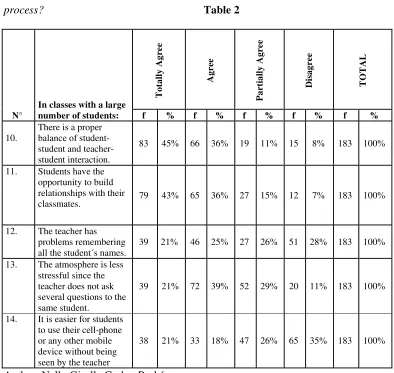
The second table is about Social area, this is composed of five questions as
follows:
What social implications do large classes have on the teaching learning
process? Table 2
N° In classes with a large number of students:
T ota ll y Ag re e Agre e Parti al ly Agre e Di sag ree TO T A L
f % f % f % f % f %
10.
There is a proper balance of student-student and teacher-student interaction.
83 45% 66 36% 19 11% 15 8% 183 100%
11. Students have the opportunity to build relationships with their
classmates. 79 43% 65 36% 27 15% 12 7% 183 100%
12. The teacher has
problems remembering all the student´s names.
39 21% 46 25% 27 26% 51 28% 183 100%
13.
The atmosphere is less stressful since the teacher does not ask several questions to the same student.
39 21% 72 39% 52 29% 20 11% 183 100%
14.
It is easier for students to use their cell-phone or any other mobile device without being seen by the teacher
38 21% 33 18% 47 26% 65 35% 183 100%
Author: Nelly Gisella Godoy Rodríguez
Source: Student´s Questionnaire
It was found that 45% of the students totally agree and 36% of them agree with
the statement which mentions that there is a proper balance of student-student and
[image:37.612.129.523.155.528.2]Totally agree and agree are the higher percentages, they reflect that 81% of the students feel that teachers maintain an appropriate balance of interaction in the classroom. In fact, the students show more interest for learning because they feel motivated by the teacher. The students who think the contrary are 18%. They say that the large amount of students does not allow them to establish a proper balance of
interaction with their classmates and the teacher.
The question reflects that 43% of the students totally agree and 36% of them agree with the statement that mentions: the students have the opportunity to build relationship with their classmates. The opposite happens with the students who partially agree, this percentage is 15%, and disagree is only 7% of the students.
The findings show that 79% of the students feel that large classes give them the opportunity to build relationship with their classmates, because they can be
supported by others since there are more people to exchange different ideas or different points of view. It is beneficial because the collaboration inside the classroom improves not only the social area but academic one as well.
However, the negative answers reflect that 21% of the students do not believe that they can build relationships in the classroom, because there are more people with different criterions.
About statement No.12 which mentions that the teacher has problems
remembering all the student´s names, the item shows that not only 28% of the
students disagree but also 26% of them partially agree. Moreover, the students who
Adding the percentages of disagree and partially agree; there is a 54% of
students who affirm that the teacher remembers all the student´s names.Indeed, they
feel that remembering their names, the teacher shows interest to get involved with
them in the daily activities. This is supported by Kathi (2011) who claims that one of
the manners to construct respect between both teachers and students is learning the
students´ names as soon as possible, in this way the students gain confidence and a
major involvement inside the classroom.
However, 46% of the students say that the teacher presents difficulties
remembering their names because there is a large number of students in the class.
It was found in the questionnaire that totally agree and agree have the higher
percentages related to the statement No. 13 that says: the atmosphere is less stressful
since the teacher does not ask several questions to the same student. The students
who totally agree are 21% and 39% of them agree. In contrast, not only 29% of the
students partially agree but also 11% of them disagree.
To sum up, the results show that 60% of the students agree that the atmosphere
is not stressful since the teacher works with the whole class asking several questions.
The large number of students allows the teachers to focus on several students;
in this way, they create a harmonious environment to learn. On the other hand, 40%
of the interviewees state that the atmosphere becomes more stressful to work since
there are many students in the class.
The next statement that says; it is easier for students to use their cell-phones or
disagree, and 26% of them partially agree; in contrast, the students who agree are
18% and 21% of them totally agree.
The findings show that 61% of the students think that it is difficult to use the
electronic media without being seen by the teacher. They prefer to avoid the use of
technology while they are learning English because, they know the institution´s rules
and they do not want to receive any kind of disciplinary action. The contrary happens
with 39% of the students who think that class size helps them to use their
cell-phones, because; they can hide among their classmates.
The second table about social area has been described, analyzed and
interpreted, too. We can see that this area does not show any problem when the
students learn English in large classes. It happens the contrary, because all the
statements reflect a positive attitude of the students towards teaching-learning
process.
To sum up, it was found that teachers and students maintain a proper balance
of interaction, they establish good relationships student-student, student-teacher and
finally the environment is good for learning.
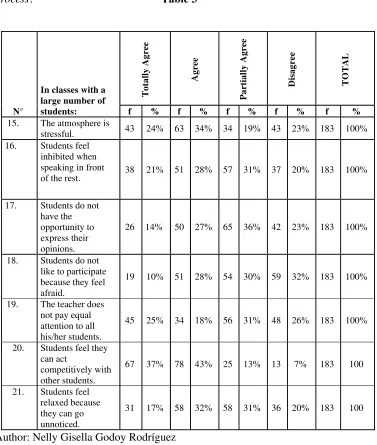
Now we will present the last table. This is about psychological implications.
What psychological implications do large classes have on the teaching learning
process? Table 3
N°
In classes with a large number of students: T otal ly Agre e Agre e Pa rti al ly Ag re e Disa gree TOTA L
f % f % f % f % f %
15.
The atmosphere is stressful. 43 24% 63 34% 34 19% 43 23% 183 100%
16. Students feel
inhibited when speaking in front
of the rest. 38 21% 51 28% 57 31% 37 20% 183 100%
17. Students do not
have the opportunity to express their opinions.
26 14% 50 27% 65 36% 42 23% 183 100%
18.
Students do not like to participate because they feel afraid.
19 10% 51 28% 54 30% 59 32% 183 100%
19.
The teacher does not pay equal attention to all his/her students.
45 25% 34 18% 56 31% 48 26% 183 100%
20. Students feel they can act
competitively with other students.
67 37% 78 43% 25 13% 13 7% 183 100
21. Students feel
relaxed because they can go unnoticed.
31 17% 58 32% 58 31% 36 20% 183 100
Author: Nelly Gisella Godoy Rodríguez Source: Student´s Questionnaire
The table indicates that 34% of the students agree and 24 % of them totally
agree with the statement about the atmosphere is stressful. On the other hand, 23% of
[image:41.612.138.515.140.585.2]shows that 58% of the students think that the atmosphere is stressful due to the great
amount of students; this is affirmed byJimarkorn and Singhasiri (2006) who state
that large classes are less effective, they represent extra work, and; a great number of
them have many difficulties in the teaching-learning process. However 42% of the
students do not think in the same way, because they feel that the atmosphere is good
for learning when there are many students.
The questionnaire shows that 31% of the students partially agree and 20% of
them disagree. On the other hand, it was found that 28% of the students agree and
21% of them totally agree with the statement No. 16 which mentions that the
students feel inhibited when they speak in front of the rest.
The findings show that partially agree and disagree make a total of 51% which
confirms that the students do not feel inhibited when they speak in front of other
students. On the contrary, they feel motivated because they have the opportunity to
communicate in the target language. However, an important number of students 49%
think the opposite because they do not feel comfortable when they speak in front of
many people.
Item No. 17 shows that 36% of the students partially agree, similarly 23% of them totally agree. On the other hand, we can see that only 14% of the students totally agree and 27% of them agree with the statement that says the students do not have the opportunity to express their opinions.
The findings show that the majority of the students 59% can express their
points of view. They think that the great number of students in the classroom is not
students, because they feel that the great amount of students is a barrier in the
English language teaching-learning process, since they cannot express what they
think.
About statement No. 18, related to students do not like to participate because
they feel afraid, the item shows that not only 32% of the students disagree but also
30% of them partially agree. Moreover, the students who agree are 28%; and only
10% of them totally agree.
Adding the percentages of disagreement and partially agreement, there is a
62% of the students who like to participate because they feel comfortable and
pleasant with the activities in the classroom. However, an important number of
students, 38% think the opposite; because they feel intimidated and uncomfortable to
participate when the class is overcrowded.
The question No. 19 shows that 31% of the students partially agree and 26% of the students disagree with the question that confirms: the teacher does not pay equal attention to all his/her students. On the other hand, we can see that 25% of the students totally agree likewise 18% of them agree.
The findings show that the majority of the students 57% affirm that the teacher pay equal attention to all students. Teachers need to attract student´s attention to carry out the activities in the classroom, especially when this group is numerous, although it implies to dedicate more time.However, 43% of the students say the opposite. They think the attention is not equal for everybody mainly when there are many people; this is affirmed by Blatchford, Basset and Brown (2011) who say that
receive more personal attention, in consequence, the students will be more engaged
with the teacher.
The next statement about students feel they can act competitively with other
students, we can see that 43% of the students agree and 37% of them totally agree.
On the other hand, the students who partially agree are 13% and only 7% of them
disagree.
The data of this statement reflect that 80% of the students enjoy when they act
competitively with others. They think is better for their learning development,
especially in classrooms with many students. However the students who affirm the
opposite are 20%; they feel that many people in the classroom is a big problem to
develop their skills competitively.
The last statement is number 21. The data indicates that 32% of the students
agree, and 17% of them totally agree On the contrary, we can see that 31% of the
students partially agree and 20% of them disagree with the statement that mentions
that the students feel relaxed because they can go unnoticed.
Adding the percentages of agree and totally agree, there is a 49% of students
who feel comfortable because the teacher does not notice them. Differently 51% of
the students are stressed because they think that, despite of being an overpopulated
class; the teacher takes notice to them all the time.
This analysis concludes with the third table about psychological implications,
which shows as result that, the large number of students influence in the environment
of the classroom. It becomes stressful and the students do not feel comfortable when
because the students are satisfied when they speak to the rest of the class, they feel
free to express their points of view. Finally, they like to participate competitively
Conclusions
This research demonstrates that in the academic aspect, the teachers have the
ability to handle overcrowded classes because they can plan, organize and develop
different activities with the students.
Despite the teacher´s efforts for teaching and the enthusiasm of the students
for learning; the size of the class also reflects a problem in the instructional area
because many of the students are not receiving individual attention.
The large number of students do not affect the social aspect. The students
show a positive attitude toward English language teaching-learning process.
In the psychological aspect, the great amount of students make the
environment stressful and little comfortable to work.
The teachers cannot give appropriate feedback to all the students, and only
some of them receive this benefit.
Despite the number of students, students cannot do activities of other subjects
because teachers are always monitoring the activities done by the students.
The seating arrangement allows students higher interaction between
Recommendations
Teachers should use more grouping techniques, in this way they can interact
with all students.
Teachers should apply new methodologies which draw the attention of the
students in order to avoid having a stressful and noisy environment.
It is often convenient that teachers express words of congratulations thus
students will feel important and they will gain confidence as well.
The teachers should continuously update their knowledge with modern
techniques, new methodologies of teaching and strategies which generate student`s
REFERENCES
Blatchford, P., Basset, P., & Brown, P. (2011) Examining the effect of class size on classroom engagement and teacher-pupil interaction: Differences in relation to pupil prior attainment and primary vs. secondary schools. Journal
Learning and Instruction, 21,715-730.
Brown, D. (2001). Principles of language learning and teaching (4th ed.). New
York: Longman Publisher.
Brown, D. (2007). Teaching by principles: An interactive approach to language
pedagogy (2nd ed.). New York: Pearson Longman.
Dörnyei, Z., & Murhey, T. (2003). Seating arrangement: Group dynamics in the
language. Cambridge University Press.
Galton, M., & Pell, T. (2012) Do class size reductions make a difference to classroom practice? The case of Hong Kong primary schools. International
Journal of Education Research, 53, 22-31.
Gower, R. Philips, D., & Walters, S. (2005). Teaching practice: A handbook for
teachers in training. Oxford: Macmillan Books for teachers.
Harfitt, G. (2012). An examination of teachers` perceptions and practice when
teaching large and reduced-size classes: Do teachers really teach them in the
same way? Teaching and Teacher Education, 28, 132-140.
Harmer, J. (2007). The practice of English language teaching (4th ed.). New York:
Pearson Longman.
Hess, N. (2001). Teaching large multilevel classes.UK: Cambridge University Press.
English teaching at the university level. KMUTT Journal of Language
Education, 9, 13-23.
Jones, L. (2007). The student-centered classroom. New York: Cambridge University
Press.
Kathi, A.R. (2011) Exploring common expectations from students in large
multilevel secondary level English classes. Journal of Nelta, 15, 98-105.
Leaver, B. L., & Shekhtman, B. (2002). Developing professional – level language
proficiency. Cambridge University Press.
Richards, J. C., & Rodgers, T. (2001). Approaches and methods in language
teaching (4th ed.). New York: Cambridge University Press.
Scrivener, J. (2005). Learning teaching: A guidebook for English language teachers.
(2nd ed.).UK: Macmillan Publishers Limited.
Scrivener, J. (2012). Classroom management techniques.UK: Cambridge University
Press.
Shaeffer, S. (2006). Practical tips for teaching large classes: A teacher´s guide.
Thailand: by UNESCO.
Shamim, F., Negash, N., Chuku, Ch., & Demewoz, N. (2007). Maximizing learning
in large classes: Issues and options. Ethiopia: Master Print Press.
Wooddward, T. (2001). Planning lessons and courses: Designing sequences of work
ANNEXES
INSTRUMENTS
UNIVERSIDAD TÉCNICA PARTICULAR DE LOJA
La Universidad Católica de Loja
OPEN AND DISTANCE MODALITY ENGLISH DEGREE
Dear student,
The aim of this brief questionnaire is to obtain information concerning the: influence of larges classes on teaching and learningEnglish. The following information will only be
used for academic/research purposes. Please answer the following questions as honestly as possible based on the following criteria.
Very satisfactory: Totally agree Satisfactory: Agree
Somewhat
satisfactory: Partially agree Unsatisfactory: Disagree
Informative data: Please fill in the information below
Name of institution _______________________________________
Type of institution: Public ( ) Private ( )
Year of study: 8th year. ( ) 9th year ( ) 10th year. ( )
1st senior high school. ( ) 2
nd senior high school. ( ) 3
rd. senior high school. ( )
A. Academic issues
In classes with a large number of students:
V ery sati sf actory Sat isfactory So m ewh at sat isfactory U nsatisfactory
1. The activities done in class help to apply what students learn in class.
2. The activities done allow practicing, listening, speaking, reading and writing skills.
3. The students are attentive and participate in class activities, including those sitting at the back of the classroom.
4. Varied class activities are used such as group, individual, pair-work activities, etc.
5. Activities such as plays, competitions, debates, games, etc. are used in class.
6. Students can cheat during the test
7. Students get distracted by doing assignments from other subjects.
8. The seating arrangement facilitates the tasks that are carried out in class.
9. Students cannot receive regular feedback from the teacher due to the large number of students.
B. Social issues
N° In classes with a large number of students:
V ery sati sf actory Sat isfactory So m ewh at sat isfactory U nsatisfactory
10. There is a proper balance of student-student and teacher-student interaction.
11. Students have the opportunity to build relationships with their classmates.
12. The teacher has problems remembering all the students’ names.
14. It is easier for students to use their cellphone or any other mobile device without being seen by the teacher.
C. Psychological issues:
In classes with a large number of students:
V
ery
sati
sf
actor
y
S
atisfactory Som
ewh
at
satisfactory Unsati
sf
actory
15. The atmosphere is stressful.
16. Students feel inhibited when speaking in front of the rest.
17. Students do not have the opportunity to express their opinions.
18. Students do not like to participate because they feel afraid.
19. The teacher does not pay equal attention to all his/her students.
20. Students feel they can act competitively with other students.