Review article
ABSTRACT
Background
Salt consumption activates the brain reward system, inducing crav-ings and the search for salted food. Its excessive intake is associated with high blood pressure and obesity. The high quantity of salt in processed food is most likely a major cause of the global pandemic of hypertension (HT).
Objective
To review the current information on the topic of salt addiction and the health consequences this has.
Method
A search in PubMed, ScienceDirect, and EBSCOhost databases was conducted with the keywords “salt”, “salt addiction”, and “food ad-diction”. Articles with information relative to the topic of interest were checked, as were references of those articles and historical and cultur-ally complementary information.
Results
We described the historical relationship between man and salt, the physiology of salty taste perception, its role in the reward system and the health consequences of a high sodium diet.
Discussion and conclusion
There is physiological and behavioural evidence that some people may develop a true addiction to food. Among these people, salt ad-diction seems to be of great importance in the development of obe-sity, HT and other diseases. Sodium is present in high quantities in processed food as salt and monosodium glutamate (MSG), used as flavour enhancers and food preservatives, including in non-salty foods like bread and soft drinks.
Key words: Salt, salt addiction, food addiction.
RESUMEN
Antecedentes
El consumo de sal activa el sistema de recompensa cerebral, inducien-do el deseo y búsqueda de alimentos salainducien-dos. Su ingesta excesiva se asocia a presión arterial elevada y obesidad. La gran cantidad de sal en los alimentos procesados ha permitido que la hipertensión (HT) se instale hoy día como una pandemia.
Objetivo
Revisar la bibliografía existente en el tema de adicción a la sal y sus consecuencias en la salud.
Método
Se realizó una búsqueda en bases de datos PubMed, EBSCOhost y ScienceDirect con las palabras claves “salt”, “salt addiction”, “food addiction”; se revisaron los artículos que contuvieran información re-lativa al tema de interés así como referencias en estos mismos artícu-los e información histórica y cultural complementaria.
Resultados
Describimos la relación histórica entre el hombre y la sal, los mecanis-mos fisiológicos de percepción del sabor salado, su acción sobre el sistema de recompensa y las consecuencias en la salud de una dieta alta en sodio.
Discusión y conclusión
Existe evidencia fisiológica y comportamental de que las personas pueden desarrollar una verdadera adicción a la ingestión de ali-mentos. Entre estas personas la adición a la sal juega un papel muy importante para el desarrollo de obesidad, hipertensión y otras enfer-medades. El sodio está presente en altas cantidades en los alimentos procesados en forma de sal y glutamato monosódico (MSG), usados como conservadores o aditivos alimentarios, incluso en alimentos no salados como harinas y refrescos dulces.
Palabras clave: Sal, adicción a la sal, adicción a los alimentos.
1 Laboratory of Clinical Neurophysiology, Department of Neurology and Psychiatry, National Institute of Medical Sciences and Nutrition Salvador Zubirán
(INCMNZS), Mexico.
2 Academic Division of Health Sciences, Juarez Autonomous University of Tabasco, Mexico.
3 Direction of Nutrition, National Institute of Medical Sciences and Nutrition Salvador Zubirán (INCMNSZ), Mexico.
Correspondence: Dr. Bruno Estañol Vidal, Laboratory of Clinical Neurophysiology, Department of Neurology and Psychiatry, National Institute of Medical Sciences and Nutrition Salvador Zubirán (INCMNZS). Vasco de Quiroga 15, Belisario Domínguez secc. XVI, Tlalpan, 14080, Ciudad de México, México. Tel: 55 5568 - 3450. E-mail: [email protected]
Received first version: September 18, 2015. Second version: May 3, 2016. Accepted: May 6, 2016.
Does salt addiction exist?
José Alberto Soto-Escageda,
1Bruno Estañol-Vidal,
1Carlos Alejandro Vidal-Victoria,
2Anaclara Michel-Chávez,
1BACKGROUND
Salt or sodium chloride is probably the oldest spice used by man. Its extraction, distribution, and possession led to com-mercial trades and wars, to the point that it was known as “white gold”. It is possible that primitive man found the prop-erties of salt when he established contact with thin salt depos-its left on the beach by the sea water. After that, he created his own sea water ponds that would leave small amounts of salt when water was evaporated by the sun; just as happens naturally in places far from the sea where the salt source was probably springs where briny water rose and left some salt when evaporated. In this way he could supply his own needs. These were also excellent places for hunting because different animal species gathered there with the same urge.1
When more advanced instruments were developed, early civilizations extracted “halite”: the solid sediment-ed form of salt, from mines. Man also creatsediment-ed commercial routes to distribute it to a large number of human sites where salt could be well traded for its weight in gold. In An-cient Greece and the Roman Empire, salt could be used to buy slaves, for tax payment, and as a part of the labour pay-ment, which was called salarium and originated the word ‘salary’.1-3
Ancient civilizations took advantage of salt’s ability to dry out and cure food so that it could then be transported over long distances and rehydrated for consumption; this
played a significant role in aiding long-distance travel and
exploration.2
Nowadays salt is used as a meat tenderiser, agglutinat-ing agent, and food additive to give a more attractive taste
to food in general. In baking, it is used to correct flavour and
control dough fermentation. In dairy products, it controls
fermentation and enhances the colour, texture and flavour
of preparations.
In industrial areas salt is used to produce chlorine (Cl-), caustic soda, and in the manufacture of plastic, colorants, pesticides, and drugs. It has been used in leather because of its disinfectant properties and in energy source exploration, such as oil, gas, and water treatment.
In the human body, sodium is important to maintain
fluid balance and blood pressure, muscle contraction, nerve
cell transmission, and most cell functions. Its consumption is so extended that it is added to other nutrients with lesser
dietary distribution such as iodine, to avoid its deficiency in
the general population.1,2
Suggested sodium intake
and actual consumption
According to the World Health Organization (WHO) and other international bodies, the Tolerable Upper Intake Level (UL, the highest daily nutrient level intake that is not likely to pose a health risk) is 5 grams of salt –one
tea-spoon– or less than 2,300 mg of sodium per day (1 gram of salt = 390 mg of pure sodium) for the general population and less than 1,500 mg of sodium for those who have hy-pertension (HT), diabetes, chronic kidney disease, and for black ethnic groups.4-7
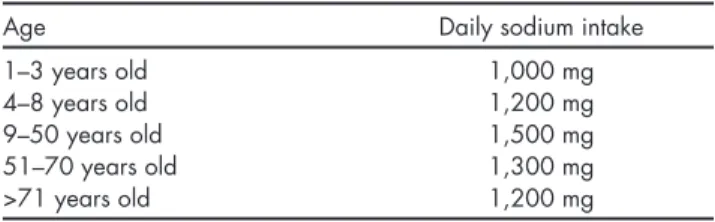
On the other hand, the Adequate Intake of sodium is smaller and depends upon age (Table 1), being higher in people between 9-50 years old (1,500mg of sodium) and de-clining as age increases.8 (Adequate Intake, or AI, is the rec-ommended daily intake of a nutrient based on the amount needed to meet the sodium needs of healthy and moder-ately active individuals, including sodium sweat losses in those exposed to high temperatures).
Studies like Health Canada and INTERSALT were con-ducted to calculate the amount of dietary sodium in differ-ent communities, and even though the salt intake percdiffer-ent- percent-ages varied between groups, every one of them exceeded the limit for daily ingestion. On the basis of the INTERSALT study, which measured urinary excretion of sodium in 24 hours in men and women between 20-59 years old around the world, it was found that almost 50% of women had 5.9-8.8 grams of salt per day and more than 50% of men con-sumed 8.8-11.7 grams per day.4,9 The Centers for Disease Control and Prevention (CDC) report an average daily sodi-um intake of 3,400 mg in the North American diet.5
Main salt sources
The proportion of salt in the diet is as follows: 12% comes naturally in food and only 11% is added by seasoning during cooking or at the table.5,10 Therefore, more than 75% of salt comes from processed food.
In a modern diet, the major proportion of sodium comes from industrialised and processed food (instant soups, junk food, canned and frozen food, sausages, crackers, cereals, sweet beverages, salted meat, pickled foods),10 so adding salt while cooking elevates its already high levels.
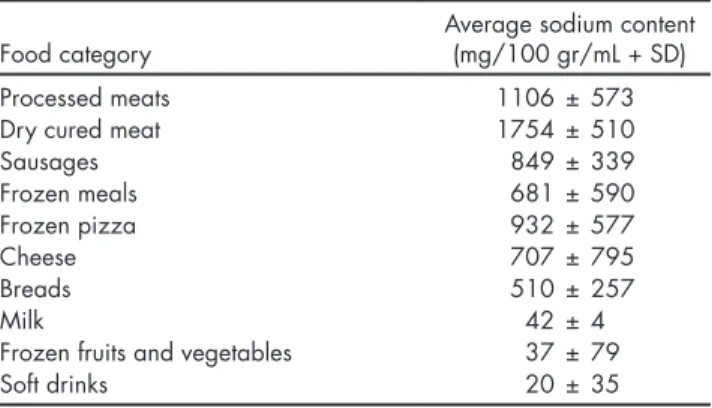
The food category with the highest sodium content (Ta-ble 2) is processed meat (with an average content of 1,100mg of sodium per 100 grams of meat)11 but the largest amount of sodium in diet comes from food that might not even taste salty: grain-based foods (soups, pastas, breads, cakes, cook-ies, and crackers) from which the most daily calories are consumed, followed by meats.12
Table 1. Daily sodium recommended intake according to age
Age Daily sodium intake
1–3 years old 1,000 mg
4–8 years old 1,200 mg
9–50 years old 1,500 mg
51–70 years old 1,300 mg
>71 years old 1,200 mg
A part of dietary sodium is also found as monosodium glutamate (MSG), which has the property of enhancing food
flavour.12,13 It is found naturally in animal products and in a lesser proportion in some vegetables. It is widely used by the food industry in soups and broths, sauces and gravies, and canned or frozen meats, poultry, vegetables, and com-bination dishes. MSG contains 12.3% of sodium, and as the usual MSG use is around one tenth of that of salt, MSG con-tributes to 7-8% of dietary sodium.14 Its chronic
consump-tion has been associated to β-amyloid accumulaconsump-tion in the
brain, neuropsychiatric disorders, and neuronal loss, while acute ingestion has been related to vomiting, headache, nausea, and chest pain among other symptoms sometimes known as “Chinese restaurant syndrome”, but evidence is not totally clear.14-17
Salt perception in the gustatory system
Through chemoreceptors located in taste buds, the tongue is
responsible for perceiving flavours along with the olfactory
system. The receptor for salty taste is activated by food with ionized salts, especially sodium. The umami (“delicious fla -vour” in Japanese) taste is perceived by receptors for amino acids like glutamate (in MSG) and aspartate and by
nucleo-tides; it induces a pleasant sensation in other flavours.18 The chorda tympani branch of the facial nerve (cranial nerve VII, CNVII) innervates the anterior two thirds of the tongue, which is the zone with highest sensitivity to sodium because of its large amount of receptors. The glossopharyn-geal nerve (cranial nerve IX, CNIX) innervates the posterior third, which is less sensitive to salt. The vagus nerve (crani-al nerve X, CNX) innervates taste receptors in the epiglottis epithelium, responsible for regulating diuresis and plasma tonicity. Even though the anterior two thirds are more sen-sitive to salt, when NCVII is sectioned, the posterior third gets a higher sensitivity to salt perception through neuronal plasticity mechanisms, so salt consumption is always regu-lated.14,19,20
Gustatory signals pass through a totally ipsilateral pathway through the geniculate (NCVII) and inferior senso-ry ganglion (CNIX and CNX) to stimulate the second order neurons in the rostral portion of the solitary tract nucleus (the gustatory nucleus of the solitary tract complex) in the lower medulla. These neurons stimulate thalamic nuclei that project to the primary gustatory cortex - the inferior gyrus of the frontal lobe and anterior insula - and second-ary gustatory cortex - the orbitofrontal cortex (OFC). As the
sensation of flavours results from gustatory, olfactory, and
somatosensory inputs, the cerebral cortex mediates the ap-preciation of tastes.19
Physiological aspects of salt addiction
Flavour information from cortical taste areas exerts strong
influence on the lateral hypothalamus (LHT), which has a
role in the generation of autonomic responses associated with ingestion and digestion. The taste cortex also projects directly to the amygdala and ventral striatum (nucleus ac-cumbens, NA).19,20
Therefore, salt intake (as with fat, sugar or caffeine intake) induces activation of LHT that releases dopamine and glutamate in the ventral tegmental area (VTA)21 and in turn it stimulates the NA and other limbic system struc-tures provided with dopamine, endogenous opioids, and cannabinoid receptors. Limbic structures feed back to the medial prefrontal cortex and OFC, a pathway traditionally recognised for its role in reward, pleasure, consolidation of habits, learning, and memory22-25 (Figure 1). These ob-servations correlate with the lack of addictive behaviour for food when naloxone or neuroleptics (antagonists of opioid and dopamine receptors respectively) are admin-istered.26,27
Substance-related obsessive thoughts and compulsion to consume are important characteristics of food and drug addictions. The activity of OFC has been implicated in im-pulsivity and the pathology of obsessive-compulsive disor-der.27-30
Many authors are now using the term “food addic-tion”31-33 because of the similarity of this response and the mechanisms stimulated by drugs of abuse such as amphet-amines and cocaine,34-38 which explain or support the hy-pothesis of an addiction produced by chronic consumption of savoury food. It seems clear that food cravings can occur
in the absence of a nutritional deficit and flavour seems to
be an important factor in the satisfaction of food cravings.39 Also, it has been found that repeated consumption of a cer-tain food when hungry –but not when satiated– produces cravings for that substance after its withdrawal,40 suggest-ing that the gustatory system and learnsuggest-ing processes are di-rectly implicated in food addiction.41
Concurrently, excessive ingestion of these foods and obesity are associated with lower expression of
dopami-Table 2. Average sodium content in packaged foods
Food category Average sodium content(mg/100 gr/mL + SD)
Processed meats 1106 ± 573
Dry cured meat 1754 ± 510
Sausages 849 ± 339
Frozen meals 681 ± 590
Frozen pizza 932 ± 577
Cheese 707 ± 795
Breads 510 ± 257
Milk 42 ± 4
Frozen fruits and vegetables 37 ± 79
Soft drinks 20 ± 35
Behavioural aspects of salt addiction
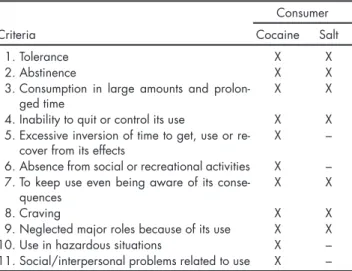
Although sodium intake shares neuronal networks and pathways with drugs of abuse,36,37 it is important to classify salt as a substance of abuse through clinical features in the same way as psychoactive drugs. The Diagnostic and Sta-tistical Manual of Mental Disorders 5 (DSM-5) identifies sub -stance abuse and dependence as “Sub-stance Use Disorders” (SUDs) and points out that it is necessary to accomplish two or more of 11 criteria within a 12-month period to diagnose
it. In most cases, salt consumption fulfils at least seven of
these (Table 3).43,45-47
One of the most important SUD criterion is abstinence that dependent people present when salt is withdrawn
Figure 1. Taste signals from tongue get to the solitary tract nucleus (STN), it stimulates thalamus (Th) that project to primary taste cortex (PTC) and orbitofrontal cortex (OFC). PTC activates lateral nucleus of hypothalamus (Hth) to cause an autonomic response to food intake, it also activates ventral tegmental area (VTA) that releases dopamine in ventral striatum or nucleus accumbens (NAc), which connects to dorsal striatum to produce a motor response to emotions, NAc also stimulate amygdala (Am), that has reciprocal connections with medial prefrontal cortex (MPC), OFC, PFC, hippocampus (Hc), Th, Hth and stimu-late inferior structures like reticular formation (RF) and periaqueductal grey matter (PAGM).
MPC
Emotional
significance Conscientflavour
Memory & learning
Arousal
Endocrine and
autonomous response responseMotor
PTC
OFC
RF
NAc
Hc
VTA
HTh
PAGM
Am
DS
STN
Th
from diet; as anorexia, anxiety, slight nausea during meal time, the need for and seeking out of the substance, etc. It is known that patients under hospital assistance present a low acceptance for food,48 often complaining about finding it tasteless and the lack of salt in their diet.
The massive and life-long use of sodium in food and the lack of success in dietary salt restriction despite the many public health campaigns and recommendations supports its
classification as a clinical addiction.43,45,46
Craving is the strong urge to consume a certain sub-stance; the most frequently craved food is chocolate, fol-lowed by pizza, salty foods, ice cream, and other sweets and desserts.49 The inability to fulfil major social roles (school, work, or home obligations) could happen due to its long-term health consequences (cardiovascular disease, chronic kidney disease, morbid obesity).46
Some criteria refer to significant time invested in
seeking, reaching and consuming the substance; however, absence from social activities and interpersonal problems are not likely to be covered by salt addiction due to the easy access to the substance and the social acceptance of its use.43 Use of the substance in hazardous situations is often referred to in substance intoxications, such as
driv-ing under the influence of alcohol, which is not seen in
this case.46
Health consequences of salt addiction
A high sodium intake increases urinary calcium excretion and bone resorption markers in plasma which is associated with bone loss and a lower bone density, an effect that is more evident in those with a low calcium diet.50,51
Another result of high sodium ingestion is a major con-sumption of liquids and other nutrients such as carbohy-drates and fats, leading to obesity, which is accompanied
with a rise in leptin (a satiety inducer hormone) and insulin concentrations.52,53
Insulin and leptin resistance results in an increased salt sensitivity that predisposes a rise in BP due to high sodium intake, probably due to sympathetic and adrenal dysregu-lation.54-57 Many studies have demonstrated a clear link be-tween high salt intake and increased BP: The INTERSALT study showed a relation between salt and increase in BP, demonstrating that in subjects who ate more than 6 grams of salt per day for more than 30 years, systolic BP was 9 mmHg higher than in people with lower salt intake.9 Another me-ta-analysis proved that a restriction of salt consumption to less than 6 grams decreased systolic BP in 4-7 mmHg in hypertensive patients and 2-4 mmHg in normotensive pa-tients.10
Lowering dietary sodium is an important part of treat-ment in HT and helps to decrease the risk of cardiovascular disease such as left ventricle hypertrophy, peripheral arteri-al damage, cerebrovascular disease and heart failure.5,8
Renal function, responsible for regulating the concen-tration and intravascular volume of sodium, is impaired in response to large loads of sodium by the effects of angio-tensin II, aldosterone, growth factors, reactive oxygen spe-cies (ROS), sympathetic hyperactivity, and direct vascular damage due to HT. This has effects throughout the kidney economy (vessels, tubules, juxtaglomerular apparatus, my-ocytes) impairing its autoregulatory capacity, evidenced
by proteinuria, HT and renal fibrosis, becoming a positive
feedback pathophysiology.58-60 This is why high sodium di-ets increase the risk of developing kidney disease, and inde-pendently increases mortality rates in patients with kidney disease, and low sodium diets decrease proteinuria in pa-tients with HT.61,62
Salt addiction as a public health problem
The modern world involves a faster pace of life and there-fore an increase eating fast food and industrialised food.
These are filled with large amounts of sodium and are di -rectly related to an increase in obesity rates, especially in high-income countries.11,63,64 Taking into account the addic-tive effect, neuronal changes, and other health consequences chronic salt consumption can produce, it can be catalogued as a pandemic.
Excessive salt intake contributes to 10% of cardiovas-cular disease, it is one of the main causes of increased BP and causes more deaths than other food-related factors, compared to high trans-fat consumption, alcohol ingestion, and low intake of fruits and vegetables.65-67 It is also com-mon for young people to prefer salty food, resulting in a major development of HT and other conditions at an early age which, when coupled with the global tendency of great-er life expectancy, translates as an important problem for international economy and health professionals.41,68,69 Table 3. Behavioural criteria for Substance Use Disorder (SUD) that
compares cocaine and salt consumers according to DSM-5 Consumer
Criteria Cocaine Salt
1. Tolerance X X
2. Abstinence X X
3. Consumption in large amounts and
prolon-ged time X X
4. Inability to quit or control its use X X 5. Excessive inversion of time to get, use or
re-cover from its effects X –
6. Absence from social or recreational activities X – 7. To keep use even being aware of its
conse-quences X X
8. Craving X X
Due to its relation to addictive behaviour, obesity, HT and other conditions, governments around the world and global organisations should give the population clear and practical recommendations about sodium consumption and closely regulate the food industry about salt and monosodi-um glutamate use, distribution and labelling.69
DISCUSSION AND CONCLUSION
There is certainly a need to go into depth about the mecha-nisms implied in reward pathways that may turn food into addictive substances and methods to effectively stop or re-vert them.
Currently an important number of researchers con-sider excessive sodium consumption an addiction.31-33 It is important to assume that salt is categorically an addictive substance just as psychotropic drugs, as they share cerebral pathways that perpetuate their excessive consumption. Salt intake implicates more than just a preference for salty taste but further studies must be conducted in the future to
clini-cally define the precise concept of salt addiction.
The large number of patients with obesity, cardiovascu-lar disease, and renal substitutive treatment is an important warning, because if these diseases do not get appropriate treatment and control, they will continue causing incapacity and death all around the world.
Accomplishing dietary sodium recommendations is a challenge: the population at large is exposed to large amounts of salt and people ignore the amount of sodium in their diet, because most of it is previously added during processing and hidden in non-salty foods like breads, des-serts and soft drinks.
Funding
None.
Conflicts of interests
No author of this paper has a conflict of interest, including specific financial interest, relationships and/or affiliations relevant to the subject matter included in this article.
REFERENCES
1. Eskew GL. Salt, the fifth element - the story of a basic American indus-try. Chicago: JG Ferguson and Associates; 1948; pp7-13.
2. Arsenau, N, Rose C, Azullay A, Meyer R. Explorers, traders tracking the cultural and social impacts of the global commodity trade & immi-grants. Hemispheres: University of Texas; 2008; pp133-137.
3. Kass L. The hungry soul: eating and the perfecting of our nature. Chi-cago: University of Chicago Press; 1994; p123.
4. World Health Organization. Reducing salt intake in populations: Re-port of a WHO forum and technical meeting. Geneva, Switzerland. World Health Organization; 2007.
5. U.S. Department of Agriculture and U.S. Department of Health and
Human Services. Dietary Guidelines for Americans, 2010. 7th Edition, Washington, DC: U.S. Government Printing Office; 201; pp21-23. 6. Institute of Medicine. Strategies to reduce sodium intake in the
Unit-ed States. Washington, DC: National Academies Press; 2010. 7. Dasgupta K, Quinn RR, Zarnke KB, Rabi DM et al. The 2014 Canadian
Hypertension Education Program Recommendations for Blood Pres-sure MeaPres-surement, Diagnosis, Assessment of Risk, Prevention, and Treatment of Hypertension. Can J Cardiol 2014;30:485-501.
8. Borghi C, Tartagni E. The older patient with hypertension: care and cure. Ther Adv Chronic Dis 2013;3(5):231-236.
9. INTERSALT Cooperative Research Group. Intersalt: an international study of electrolyte excretion and blood pressure. Results for 24 h uri-nary sodium and potassium excretion. BMJ 1988;297:319–328. 10. He FJ, Marrero NM, MacGregor GA. Salt intake is related to soft drink
consumption in children and adolescents: A link to obesity? Hyper-tension 2008;52:629-634.
11. Korošec Z, Pravst I. Assessing the average sodium content of pre-packed foods with nutrition declarations: The importance of sales data. Nutrients 2014;6:3501-3515.
12. Center for Disease Control and Prevention (CDC). Sodium intake among adults — United States, 2005−2006. MMWR 2010;59(24):742-745. 13. Livingstone VH. Current clinical findings on monosodium glutamate.
Can Fam Physician 1981;27:1150-1152.
14. Yoshi-Hisa S. Flavor enhancers. In: Branen AL, Davidson PM, Salmi-nen S, Thorngate JH (eds.). Food additives. 2da ed. New York: Marcel Dekker, Inc; 2002; pp423-445.
15. Dief AE, Kamha ES, Baraka AM, Elshorbagy AK. Monosodium glu-tamate neurotoxicity increases beta amyloid in the rat hippocam-pus: a potential role for cyclic AMP protein kinase. Neurotoxicology 2014;42:76-82.
16. Quines CB, Rosa SG, Da Rocha JT. Monosodium glutamate, a food additive, induces depressive-like and anxiogenic-like behaviors in young Rats. Life Sci 2014;107(1-2):27-31.
17. Schaumberg HH, Byck R, Gertsl R et al. Monosodium L-glutamate: Its pharmacological role in Chinese Restaurant Syndrome. Science 1969;163:826-828.
18. Chandrashekar J, Hoon MA, Ryba NJ et al. The receptors and cells for mammalian taste. Nature 2006;444:288-294.
19. Noback CR, Strominger NL, Demarest RJ, Ruggiero DA (eds.). The human nervous system, structure and function. Sixth ed., New Jersey: Humana Press Inc; 2005; pp262-265.
20. Purves D, Augustine GJ, Fitzpatrick D et al (eds.). Neuroscience. Fifth edition: Sinauer Associates; 2012.
21. You ZB, Chen YQ, Wise RA. Dopamine and glutamate release in the nucleus accumbens and ventral tegmental area of rat following lateral hypothalamic self stimulation. Neuroscience 2001;107(4):629-639. 22. Wise RA. Roles for nigrostriatal—not just
mesocorticolimbic—dopa-mine in reward and addiction. Trends Neurosci 2009;32(10):517–524. 23. Volkow ND, Fowler JS, Wang GJ. The addicted human brain: insights
from imaging studies. J Clin Invest 2003;111(10):1444-1451.
24. Gearhardt AN, Corbin WR, Brownell KD. Preliminary validation of the Yale Food Addiction Scale. Appetite 2009;52:430-436.
25. Michel-Chávez A, Estañol-Vidal B, Sentíes-Madrid H et al. Reward and aversion systems of the brain as a funcional unit. Basic mecha-nisms and functions. Salud Ment 2015;38(4):299-305.
26. Drewnowski A, Krahn DD, Demitrack MA, Nairn K et al. Naloxone, an opiate blocker, reduces the consumption of sweet high-fat foods in obese and lean female binge eaters. American J Clinical Nutrition 1995;61:1206–1212.
27. Schultz W. Predictive reward signal of dopamine neuron. J Neuro-physiol 1998;80(1):1-27.
28. Shi Z, Yuan B, Wittert GA, Pan X et al. Monosodium glutamate in-take, dietary patterns and asthma in Chinese adults. PLOS ONE 2012;7(12):1-6.
involvement of the orbitofrontal cortex. Cereb Cortex 2000;100:318– 325.
30. Baylis LL, Rolls ET, Baylis GC. Afferent connections of the caudol-ateral orbitofrontal cortex taste area of the primate. Neuroscience 1995;64:801–812.
31. Innamorati M, Imperatori C, Manzoni GM et al. Psychometric proper-ties of the Italian Yale Food Addiction Scale in overweight and obese patients. Eat Weight Disord 2015;20(1):119-127.
32. Schulte EM, Joyner MA, Potenza MN, Grilo CM, Hearhardt AN. Cur-rent considerations regarding food addiction. Curr Psychiatry Rep 2015;17(4):563.
33. Volkow ND, Wang GJ, Fowler JS, Tomasi D et al. Food and drug re-ward: overlapping circuits in human obesity and addiction. Curr Top Behav Neurosci 2012;11:1-24.
34. Parylak SL, Koob GF, Zorrilla EP. The dark side of food addiction. Physiology Behavior 2011;104:149-156.
35. Urban NB, Martínez D. Neurobiology of Addiction. Insight from Neu-rochemical Imaging. Psychiatr Clin N Am 2012;35:521–541.
36. Grace AA. The tonic/phasic model of dopamine system regulation and its implications for understanding alcohol and psychostimulant crav-ing. Addiction 2000;95(2):119–128.
37. Liedtke WB, McKinley MJ, Walker LL, Zang H et al. Relation of addic-tion genes to hypothalamic gene changes subserving genesis and grat-ification of classic instinct, sodium appetite. PNAS 2011;108(30):12509-12514.
38. Corsica JA, Pelchat LM. Food addiction: true or false? Curr Opin Gas-troenterol 2010;26:165-169.
39. Michener W, Rozin P. Pharmacological versus sensory factors in the satiation of chocolate craving. Physiol Behav 1994;56:419–422. 40. Pelchat ML. Of human bondage: Food craving, obsession,
compul-sion, and addiction. Physiology Behavior 2002;76:347–352.
41. Harris G, Booth DA. Infants’ preference for salt in food: its depen-dence upon recent dietary experience. J Reprod Infant Psychol 1987;5:97–104.
42. Colantuoni C, Schwenker J, McCarthy J, Rada P et al. Excessive sug-ar intake alters binding to dopamine and mu-opioid receptors in the brain. Neuroreport 2001;12(16):3549–3552.
43. Tekol Y. Salt addiction: A different kind of drug addiction. Medical Hypotheses 2006;67:1233-1234.
44. Horstmann A, Villringer A. The brain’s role in human obesity. E-Neu-roforum 2013;4:79-84.
45. Ifland JR, Preuss HG, Marcus MT, Rourke KM et al. Refined food addiction: A classic substance use disorder. Medical Hypotheses 2009;72:518-526.
46. Meule A, Gearhardt AN. Food Addiction in the light of DSM-5. Nutri-ents 2014;6(9):3653-3671.
47. Hasin DS, O’Brien CP, Auriacombe M et al. DSM-5 Criteria for sub-stance use disorder: Recommendations and rationale. Am J Psychiatry 2013;170(8):834-851.
48. Sousa AA, Gloria MS, Cardoso TS. Aceitação. Revista Nutrição 2011;24(2):287-294.
49. Weingarten HP, Elston D. Food cravings in a college population. Ap-petite 1991;17(3):167-175.
50. Bedford JL, Barr SI. Higher urinary sodium, a proxy for intake, is associated with increased calcium excretion and lower hip bone den-sity in healthy young women with lower calcium intakes. Nutrients 2011;3(11):951-961.
51. Dawson-Hughes B, Fowler SE, Dalsky G, Gallagher C. Sodium ex-cretion influences calcium homeostasis in elderly men and women. J Nutr 1996;126(9):2107-2112.
52. Grimes CA, Wright JD, Liu K et al. Dietary sodium intake is associat-ed with total fluid and sugar-sweetenassociat-ed beverage consumption in US children and adolescents aged 2–18 y: NHANES 2005–2008. Am J Clin Nutr 2013;98(1):189-196.
53. Fonseca-Alaniz MH, Brito LC, Borges-Silva CN et al. High dietary so-dium intake increases white adipose tissue mass and plasma leptin in rats. Obesity 2007;15(9):2200-2208.
54. Ogawa Y, Masuzaki H, Aizawa M, Yura S et al. Blood pressure eleva-tion in transgenic mice over expressing leptin, the obese gene product. J Hypertens 1998;16:7.
55. Radin MJ, Holycross BJ, Hoepf TM, McCune SA. Increased salt sensi-tivity secondary to leptin resistance in SHHF rats is mediated by endo-thelin. Mol Cell Biochem 2003;242(1-2):57-63.
56. Stocker SD, Madden CJ, Sved AF. Excess dietary salt intake alters the excitability of central sympathetic networks. Physiol Behav 2010;100(5):519-524.
57. Fujita T. Mechanism of salt sensitive hypertension: focus on adrenal and sympathetic nervous systems. J Am Soc Nephrol
2014;25(6):1148-1155.
58. Meneton P, Jeunemaitre X, De Wardener HE, MacGregor GA. Links between dietary salt intake, renal salt handling, blood pressure, and cardiovascular diseases. Physiol Rev 2005;85: 679-715.
59. Castrop H. Blunted renal autoregulation during high salt intake: Ad-vantageous or deleterious? Am J Physiol Renal Physiol 2014;307(3):273-274.
60. Habibi J, Hayden MR, Ferrario CM, Sowers JR et al. Salt loading pro-motes kidney injury via fibrosis in young female Ren2 rats. Cardiore-nal Med 2014;4:43-52.
61. Mc Causland FR, Sushrut SW, Brunelli SM. Increased dietary sodium is independently associated with greater mortality among prevalent hemodialysis patients. Kidney Int 2012;82(2):204-211.
62. Swift PA, Markandu ND, Sagnella GA, He FJ et al. Modest Salt re-duction reduces blood pressure and urine protein excretion in black hypertensives: A randomized control trial. Hypertension 2005;46:308-312.
63. De Vogli R, Kouvonen A, Gimenoc D. The influence of market dereg-ulation on fast food consumption and body mass index: a cross-na-tional time series analysis. Bull World Health Organ 2014;92(2):99–107. 64. Brown IJ, Tzoulaki I, Candeias V, Elliot P. Salt intakes around the
world: implications for public health. Int J Epidemiol 2009;38:791–813. 65. Mendis S, Puska P, Norrving B (eds.). Global atlas on cardiovascular
disease prevention and control. Geneva: World Health Organization; 2014; p32.
66. Dennis B, Stamler J, Buzzard M et al. INTERMAP: the dietary da-ta-process and quality control. J Hum Hypertens 2003;17:609-622. 67. Lawes CM, Vander-Hoorn S, Rodgers A. Global burden of
blood-pres-sure-related disease, 2001. Lancet 2008;371:1513–1518.
68. Desor JA, Greene LS, Maller O. Preference for sweet and salty in 9 to 15 year old and adult humans. Science 1975;190(4215):686-687. 69. Charlton K, Webster J, Kowal P. To legislate or not to legislate? A