Otras secciones de este sitio:
☞ ☞ ☞ ☞
☞ Índice de este número ☞
☞ ☞ ☞
☞ Más revistas ☞
☞ ☞ ☞
☞ Búsqueda
Others sections in this web site:
☞ ☞ ☞ ☞
☞ Contents of this number
☞ ☞ ☞ ☞
☞ More journals
☞ ☞ ☞ ☞ ☞ Search Artículo:
The endocannabinoid system in chronic liver disease
Copyright © 2005: Mexican Association of Hepatology ANNALS OF HEPATOLOGY
Number 4 October-December 2 0 0 5
Volume 4
MG
edigraphic.com
Annals of Hepatology 2005; 4(4): October-December: 248-254Annals of Hepatology
1 Department of Biomedical Research and Liver Unit, Medica Sur Clinic & Foundation, Mexico City, Mexico.
2 Faculty of Medicine, National Autonomous University of Mexico (UNAM). Mexico City, Mexico.
Address for correspondence:
Nahum Méndez-Sánchez, M.D., Ph.D.,
Departments of Biomedical Research, Gastroenterology & Liver Unit, Medica Sur Clinic & Foundation,
Puente de Piedra 150,
Col. Toriello Guerra, Mexico City, Mexico.
Phone: (+525) 55606-6222, ext. 4215. Fax: (+525) 55666-4031 and 55606-1651;
E-mail: [email protected]
Manuscript received: 01 September, 2005 and accepted: 01 November, 2005.
Concise Review
The endocannabinoid system in chronic liver disease
Daniel Zamora-Valdés;
1Guadalupe Ponciano-Rodríguez;
2Norberto C. Chávez-Tapia;
1Nahum Méndez-Sánchez
1Abstract
Despite the public concern about the controversial use
and abuse of marijuana, the scientific community has
fo-cused on the therapeutic potentials of cannabinoid
com-pounds and had highlighted the importance of
endocan-nabinoids and their receptors in physiology and disease.
Endocannabinoids have been shown to be important
mediators in neuroendocrine and psychiatric processes
such as food intake, drug reward and energy
metabo-lism. Cannabinoid receptors are expressed by several
cell lines in the liver, such as hepatocytes,
myofibroblas-tic cells, endothelial cells and probably cholangiocytes.
A perpetuating role in liver damage for the
endocan-nabinoid system has been proposed in several steps of
chronic liver disease progression. Being a major cause
of death worldwide, chronic liver disease is an
impor-tant problem. New therapies are needed in order to stop
or slow damage progression. This review summarizes
the results of experimental studies involving the
en-docannabinoid system in liver disease and their clinical
and therapeutical implications in hepatology.
Key words: Chronic liver disease, endocannabinoids,
fatty liver, fibrogenesis.
Introduction
Chronic liver disease (CLD) is the fourth cause of
death among the productive Mexican population, and
the projections based on mortality trends, seems uneasy.
1The main etiologies of liver cirrhosis in Mexico are
alco-hol consumption and chronic hepatitis C viral infection
(HCV).
2According to population-based studies, 2% of
Mexican adults carries chronic HCV infection.
3Another
major cause of CLD is cryptogenic cirrhosis; however,
af-ter the recognition of non-alcoholic steatohepatitis
4as a
progressive lesion leading to liver fibrosis,
5,6cryptogenic
cirrhosis is now an uncommon diagnosis.
CLD carries a high economical burden for health care
systems,
7due to its high hospitalization needs, lost days
of work, and long-term treatments like antiviral
treat-ments and transplantation.
Understanding the mechanisms associated with
dam-age progression and liver fibrosis is imperative, and
rep-resents a major challenge in modern hepatology. There
are recent reports regarding an endogenous cannabinoid
system involved in fat deposition, apoptosis,
fibrogene-sis and CLD complications. High endocannabinoid
lev-els in situ has been demonstrated in hepatic steatosis,
8acute and chronic hepatitis,
9and cirrhosis.
10The aim of
this review is to summarize current literature on the
ex-perimental and clinical studies involving the
endocan-nabinoid system in CLD and its complications.
Endocannabinoid system, the basics
Endocannabinoids are endogenous lipid compounds
ca-pable of binding and activating
∆
9-tetrahidrocannabinol
re-ceptors.
11,12The first cannabinoid receptor recognized CB
1,
was cloned in 1990 from rat brain
13and in 1993, Munro et
al,
14characterized a peripheral cannabinoid receptor, CB
2,
from promyelocytic leukemia cells. CB
1is distributed
across the central nervous system in areas associated with
motor control, cognition, emotional response and feeding
be-havior.
15CB
1
is also expressed peripherally in endothelium,
16adipose tissue,
17gut
18and the liver;
8while CB
2
is expressed
by several leukocyte lines in peripheral blood,
19spleen,
tonsils, Peyer’s patches, lymphatic ganglia,
20microglia
21and hepatic myofibroblastic cells.
22There is only a 44%
af-finity between CB
1and CB
2, and their signaling pathways
and functions are different,
23sometimes even antagonic.
Devane et al.
24isolated in 1992, the first endogenous
cannabinoid ligand, arachydonoyl-ethanolamide, or
anandamide, and Mechoulam et al.
25identified
D Zamora-Valdés et al. The endocannabinoid system in chronic liver disease 249
edigraphic.com
Anandamide is a weak CB
1and CB
2agonist
23.
Re-cently it has been established as an endogenous ligand
for the ion-channel-type vanilloid receptor 1 (VR1).
262AG is a strong agonist of both CB receptors. In the last
decade, a number of other endocannabinoids has been
isolated, all of them derived from the non-oxidative
me-tabolism of arachydonate, like 2-arachydonoyl glyceryl
ether (noladin),
27a selective CB
1
agonist;
O-arachy-donoyl ethanolamine (virodhamine),
28partial CB
2ago-nist and CB
1antagonist; and N-arachydonoyl dopamine
(NADA),
29selective CB
1
and VR1 agonist. The
physio-logical relevance of noladin, virodhamine and NADA
has not been well established.
Endocannabinnoids are not stored in vesicles or cells,
like neurotransmitters, instead they are released upon
de-mand from lipid precursors in the cytoplasmic membrane
through enzyme activation.
30Anandamide is the product of arachydonate and
phos-phoethanolamide. Arachydonate is released from
cyto-plasmic membrane through enzymatic cleavage of
N-arachydonoyl phosphatidilethanolamide by a Ca
++-de-pendent N-acyl-transferase.
31Fatty acid-amide hydrolase
(FAAH) rapidly inactivates anandamide, producing
arachydonate and phosphoethanolamide. FAAH gene
promoter is activated by leptin and progesterone and
in-hibited by estrogens and glucocorticoids. FAAH
knock-out mice show high serum anandamide levels with
nor-mal 2AG.
322AG is produced by hydrolysis of a diacylglyceride
containing arachydonate in glycerol position 2 released
by a specific diacylglycerol lipase. Although 2AG can be
inactivated by FAAH, the main catabolic pathway seems
to be a specific monoacylglyceride lipase, producing
arachydonate and glycerol.
Endocannabinoids also suffer an oxidative
catabo-lism through lipooxygenases 12 and 15.
3312-OH-anan-damide conserves its agonist capacity and
15-OH-anan-damide is a FAAH inhibitor. 15-OH-2AG is a peroxisome
proliferator activated receptor alpha (PPAR
α
) agonist.
34Hepatic steatosis
Fat deposition is a common finding in several
patho-logical conditions and is currently considered a cofactor
in CLD.
35Hepatic steatosis is present in 90-100% of
alco-holics,
3660-80% of obese subjects
37and 30-70% of
chron-ic HCV cases.
38-40Fatty liver is associated with greater
pro-gression and fibrosis in HCV infection.
41The mechanisms
leading to fat storage in these diverse situations have not
been fully unraveled; however, the recent characterization
of several adipokynes and novel members of the nuclear
receptors family as mediators of lipid metabolism has lead
to new insights into fatty liver development.
Metabolic disturbances are increasingly recognized in
non-alcoholic fatty liver disease (NAFLD), and these
alter-ations are also associated with worse progression of other
CLD related to hepatic steatosis. Among other important
factors, NAFLD results from poor food intake control and
energy homeostasis.
42The endocannabinoid system plays
a central role in both of these processes.
15Hypothalamic
CB
1activation stimulates food intake,
43specially high
en-ergy containing and alcohol.
44,45Interestingly, CB
1knock-out mice are resistant to obesity despite consuming the
same amount of calories than wild-type mice.
46This
sug-gests that endocannabinoids regulation in energy
metabo-lism exceeds that of food intake. Based on these
observa-tions, Cota et al.
17demonstrated CB
1
expression in
adipo-cytes and showed that its stimulation leads to lipolysis
through upregulation of lipoprotein lipase.
Adiponectin is an adipocyte-derived insulin
sensitiz-er
47and a tumoral necrosis factor alpha antagonist,
48,49it
is currently considered a protective factor for the
devel-opment of steatosis and steatohepatitis.
50,51There is
indi-rect data suggesting that CB
1activation downregulates
adiponectin production, as a CB
1antagonist SR141716
(rimonabant), increases its mRNA expression both in
vit-ro (cultured adipocytes) and in vivo (adipose tissue fvit-rom
obese rats).
52CB
1knockout mice are resistant to diet-induced fatty
liver.
8Wild-type mice with diet-induced fatty livers
ex-hibit a 4-fold higher hepatic anandamide concentration
than lean controls, apparently because their hepatic
FAAH, the enzyme responsible for degradation of
anan-damide, is dramatically reduced.
Endocannabinoids activate CB
1receptor in cultured
rat hepatocytes leading to overexpression of sterol
regu-latory element-binding protein 1c (SREBP-1c),
increas-ing de novo fatty acid production rate.
8The increase in
de novo lipogenesis in mice on high-fat diets can be
in-hibited by SR141716. SREBP-1c is
membrane-associat-ed protein that suffers a complex proteolytic cascade and
activates sterol regulatory element sequences in
acetyl-CoA carboxilase, fatty acid synthase, acyl-acetyl-CoA synthase
and steroyl-CoA desaturase genes, upregulating every
major step in fatty acid synthesis and desaturation.
53Experimental overexpression of SREBP-1c in the liver
leads to fatty liver,
54while experimental diabetes-related fatty
liver exhibit SREBP-1c overexpression.
55Even after long
pe-riods, increased fatty acid synthesis can be maintained
through hyperinsulinemia
56or alcohol consumption,
57since
both of these factors directly activate SREBP-1c.
Endocannabinoids induces an elevation of free fatty
acid through 1) lipolysis, 2) adiponectin downregulation
in adipose tissue and 3) de novo fatty acid synthesis in the
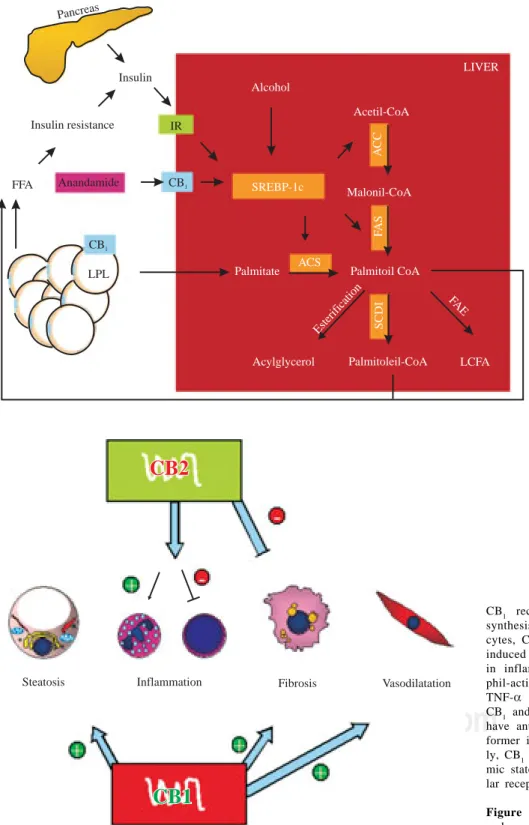
liver (Figure 1). This effect could be involved in the
per-petuation of hepatic insulin resistance and fatty liver.
58Liver fibrogenesis
MG
edigraphic.com
:rop odarobale FDP
VC ed AS, cidemihparG
arap
acidémoiB arutaretiL :cihpargideM
sustraídode-m.e.d.i.g.r.a.p.h.i.c
sustraídode-m.e.d.i.g.r.a.p.h.i.c
cihpargidemedodabor
fibrosis leads to cirrhosis, liver failure, and portal
hyper-tension and often
requires liver transplantation. Once
thought to be a passive and irreversible process, liver
fi-brosis is currently considered as a reversible
wound-heal-ing response to chronic damage. The study of the hepatic
stellate cell (HSC) in the past decades have generated
in-terest in potential interventions in the progression and
re-version of liver fibrosis.
59HSC’s are located in perisinusoidal space and
func-tion as a major vitamin A store. HSC’s morphology and
function are regulated by several stimuli, such as
proin-flammatory cytokines and growth factors, which activate
HSC’s, inducing a phenotypical change into a
collagen-producing, contractile cell.
60The endocannabinoid system might play an important
role in liver fibrogenesis through of HSC’s activity,
mod-ulation (Figure 2). HSC’s express both CB
1and CB
2re-ceptors.
61,62CB
1
-knockout mice exhibit a reduced
fibro-genic score after CCl
4administration with similar
necro-inflammatory response than wild-type mice,
61while
CB
2-knockout mice shows an increased fibrogenic score
and hydroxyproline content
62than wild-type mice after
the same stimulation.
CB
2activation reduces collagen synthesis and DNA
synthesis in HSC’s. Julien et al.
62showed that CB
2
stimu-lation increased caspase 3-like activity and Siegmund et
al.
63demonstrated that anandamide at high
concentra-tions induces apoptosis in HSC’s in a non-CB,
cholester-ol membrane dependent manner. The same effect was
previously shown in HepG2 cells by Biswas et al.,
9how-ever, they did not analyze this in normal hepatocytes.
A recent human case-control study, among 270
consecu-tive untreated patients with chronic HCV infection of
known duration undergoing liver biopsy, Hezode et al.
64studied the relationship between Cannabis smoking and
histological findings. Half of the patients studied were
non-smokers, a third were daily smokers and the rest occasional
smokers. These investigators observed that older age at
in-fection, hepatic steatosis and alcohol consumption were
re-lated with higher METAVIR fibrosis scores, and also that
daily Cannabis smoking was an independent risk factor
for higher fibrosis progression rate in multivariate analysis
(OR = 3.4, 95% CI 1.5-7.4). These results highlight the role
of cannabinoids in liver fibrosis, but raise an interesting
question concerning the relevance of CB
1over CB
2activa-tion under the same ligand availability; and the actual
abili-ty of endocannabinoids to induce fibrosis on activated
HSC’s under concentrations reported in CLD.
End-stage liver disease complications
Portal hypertension
Portal hypertension (PH) is one of the most common
complications of end-stage liver disease (ESLD) due to
mechanical and humoral factors.
65ESLD is also
associat-ed with arteriolar splanchnic vasodilatation and a
hyper-dynamic circulatory state.
66Portal hypertension-related
morbidity and mortality has capital importance in ESLD
patients.
Anandamide worsens and SR141716 prevents
li-popolysaccharide-induced hypotension during septic
shock
67and hypotension in cirrhotic rats.
68,69Macrophag-es and platelets from cirrhotic patients has been shown to
produce endocannabinoids and when administered to
normal rats induce marked hypotension.
67These results
had lead to the recognition of anandamide as a
vasoac-tive component, and the endocannabinoids system has
been postulated as mediators of circulatory
hyperdynam-ic state in cirrhosis.
It should be noted that circulating anandamide
lev-els are almost 2-fold increased during liver cirrhosis
compared to normal controls.
10Being volatile
com-pounds, this fact ensure closer examination.
Endotox-emia is a well characterized feature of liver cirrhosis.
70Portosystemic shunts and decreased Kupffer’s cells
clearance are thought to cause high
lipopolysaccha-ride serum levels.
71Platelets and macrophages had
been shown to release anandamide after stimulation
with lipopolysaccharide through a CD14/MAPK/PI3K
pathway.
72Platelet activating factor (PAF) is elevated
in serum from cirrhotic patients,
73and PAF receptor is
upregulated and overesponsive in their livers.
74PAF
induces 2AG production in platelets and macrophages,
but not of anandamide.
75Unlike anandamide, 2AG
concentration is normal in situ and in serum during
liver cirrhosis.
There is evidence for a role of endocannabinoids
in the vasodilated state in cirrhosis. Although not the
main feature of PH, mesenteric vasodilatation is a
rel-evant issue in ESLD. Anandamide induces mesenteric
vasodilatation in normal and cirrhotic rat isolated
mesenteric arteries
76-78through CB
1
and/or VR1
acti-vation,
79independent of sympathetic and nitric oxide
activity, and probably in an
endothelium-indepen-dent fashion. CB
1is expressed by endothelial and
ad-ventitial cells in second and third degree mesenteric
artery branches and perivascular sensory nerves
in-nervating these arteries which also express VR1. The
expression of CB
1in adventitial cells is upregulated
during liver cirrhosis and the response of isolated
me-senteric arteries from cirrhotic rats to anandamide is
increased.
77Only one clinical study had assessed the direct
rela-tionship between anandamide concentrations and portal
hemodynamics. Fernandez-Rodriguez et al.
10found no
D Zamora-Valdés et al. The endocannabinoid system in chronic liver disease 251
edigraphic.com
SREBP-1c proteolysis is activated by insulin, alcohol and CB1 stimula-tion. SREBP-1c fragments upregu-late the enzymes (remarked) invol-ved in fatty acid synthesis (palmita-te as an example). CB1 also activates LPL in adipose tissue, inducing li-polysis. These mechanisms raise non-esterified fatty acid in the liver and serum, increasing insulin resis-tance, producing hyperinsulinemia and upregulation of SREBP-1c in a vicious circle. IR, insulin receptor; CB1, cannabinoid receptor 1, LPL, lipoprotein lipase; SREBP-1c, sterol regulatory element-binding protein, ACC, acetyl-CoA carboxylase, FAS, fatty acid synthase; ACS, acyl-CoA synthase; SCD-1, steroyl-CoA desa-turase 1; FAE, fatty acid elongase; LCFA, long chain fatty acid.
Figure 1. Hepatic fatty acid
syn-thesis and the role of CB1 activa-tion.
Pancreas
Insulin
IR
CB1
Insulin resistance
Anandamide FFA
CB1
Alcohol
SREBP-1c
LPL
Acetil-CoA
Malonil-CoA
AC
C
FA
S
ACS
Palmitate Palmitoil CoA
FA E
SCDI
LCFA Palmitoleil-CoA
Acylglycerol
Esteri ficat
ion
LIVER
Steatosis Inflammation Fibrosis Vasodilatation
CB1
CB1
CB2
CB2
CB1 receptor stimulation induces fatty acid synthesis in hepatocytes and lipolysis in adipo-cytes, CB1 knockout mice are resistant to diet induced fatty liver. CB2 has a non-cleared role in inflammation, it upregulates IL-8 (neutro-phil-activating cytokine) and downregulates TNF-α and IL-6 (T lymphocytes cytokines). CB1 and CB2 in activated hepatic stellate cells have antagonist roles in liver fibrogenesis, the former inducing and the latter inhibiting. Last-ly, CB1 seems to have a role in the hyperdyna-mic state in portal hypertension through vascu-lar receptors.
Figure 2. Pathophysiological implications of
endocannabinoids in chronic liver disease.
Cirrhotic cardiomyopathy
Cirrhotic cardiomyopathy is a ESLD complication
as-sociated with the pathogenesis of hepatorenal
syn-drome
80and heart failure after orthotopic liver
transplan-tation, which causes 7-15% of postoperative deaths.
81Cirrhotic cardiomyopathy is characterized by high
cardi-ac output with normal ventricular contrcardi-actility at
base-line but abnormal response to inotropic stimuli, like
hem-orrhage, exercise and drugs.
82Several mechanisms have
been involved in the reduced cardiomyocyte response in
liver cirrhosis, ranging from endotoxemia to altered
b-adrenergic receptor signal transduction.
83,84There is only
MG
edigraphic.com
Gaskan et al.
85isolated normal and cirrhotic left
ventricular papillary muscle and assessed its
contrac-tility at baseline and after isoproterenol. Both groups
had similar contractile force induced by electric
stim-ulation, but after isoproterenol administration,
cirrhot-ic heart muscle exhibited an impaired response that
was restored by a CB
1antagonist (AM251).
Preincuba-tion with anandamide blunted the contractile response
to isoproterenol. Interestingly, CB
1density was not
significantly different between the groups and
re-sponse to anandamide was similar. Therefore, the
au-thors argue for a role of high endocannabinoids serum
levels in cirrhotic cardiomyopathy.
Hepatic encephalopathy
Hepatic encephalopathy (HE) is a metabolic
neurop-sychiatric syndrome with a wide clinical spectrum,
rang-ing from altered attention to stupor and coma.
86HE is a
feature of acute liver failure (ALF) and ESLD, although
the pathogenesis seems to be different.
87Currently HE is
considered a prognosis-defining CLD complication.
CB
1receptors are densely expressed in a vast part of
the central nervous system.
22The endocannabinoids
system is thought to mediate synapses in a feedback
manner based on the following observations; first,
anandamide releasing enzyme is Ca
++-dependent;
sec-ond, 2AG synthesizing enzymes are present in the
postsynaptic membrane and degradating enzymes are
located in the presynaptic membrane;
30and third, CB
1
stimulation has been shown to modulate
neurotrans-mitter releasing, such as dopamine, GABA, serotonine
and glutamate.
88CB
2
is not expressed by neurons, but
it is found in microglial brain cells,
21and it is
upregu-lated after microglial cell activation,
89in vivo and in
postmortem examinations of Alzheimer’s disease
brains.
902-AG has been shown to protect rat neurons
from ischemia and traumatic injury and provides
pro-tection against excitotoxicity.
91-93Avraham et al.
94induced ALF in rats by
thioaceta-mide administration. They showed that 2AG brain
levels were 2.5-fold elevated and treatment with
SR141716 improved neurological score, activity and
cognitive function. 2AG administration lead to the
same outcome and the effect on neurological score
was blocked by a CB
2antagonist (SR144528). CB
2specific agonists improved neurological score.
How-ever, CB
1specific agonists had no effect on this
out-come.
CB
2activation leads to cytokine release control,
95this
is an important issue in HE during ALF.
96CB
2
receptors
might alleviate brain structural and functioning damage
through regulation of microglial cells, perhaps reducing
brain edema and neurotoxicity. More studies are needed
to understand the participation of the endocannabinoids
system in HE.
Conclusion
The endocannabinoid system is a new pathway in the
pathophysiology of several steps in CLD natural history
and complications. Endocannabinoids provide an exciting
interventional landscape in modern hepatology. CB
1antag-onism opens a new therapeutic possibility in CLD, which
could be expanded with the use of CB
2synthetic agonists.
However, more studies are needed to understand and clarify
the exact mechanisms by which endocannabinoids
partici-pate in acute and chronic liver disease.
References
1 . Mendez-Sanchez N, Villa AR, Chavez-Tapia NC, Ponciano-Rodriguez G, Almeda-Valdes P, Gonzalez D, Uribe M. Trends in liver disease prevalence in Mexico from 2005 to 2050 through mortality data. Ann Hepatol 2005; 4: 52-5.
2 . Mendez-Sanchez N, Aguilar-Ramirez JR, Reyes A, Dehesa M, Juarez A, Castaneda B, Sanchez-Avila F, et al. Etiology of liver cirrhosis in Mexico. Ann Hepatol 2004; 3: 30-3.
3 . Mendez-Sanchez N, Ponciano-Rodriguez G, Chavez-Tapia NC, Motola-Kuba D, Almeda-Valdes P, Sanchez-Lara K, Ramos MH, et al. Prevalence of hepatitis C infection in a population of as-ymptomatic people in a checkup unit in Mexico City. Dig Dis Sci 2005; 50: 733-7.
4 . Ludwig J, Viggiano TR, McGill DB, Oh BJ. Nonalcoholic steatohepatitis: Mayo Clinic experiences with a hitherto unnamed disease. Mayo Clin Proc 1980; 55: 434-8.
5 . Caldwell SH, Oelsner DH, Iezzoni JC, Hespenheide EE, Battle EH, Driscoll CJ. Cryptogenic cirrhosis: clinical characterization and risk factors for underlying disease. Hepatology 1999; 29: 664-9. 6 . Adams LA, Lymp JF, St Sauver J, Sanderson SO, Lindor KD,
Feldstein A, Angulo P. The natural history of nonalcoholic fatty liver disease: a population-based cohort study. Gastroenterology 2005; 129: 113-21.
7 . Sandler RS, Everhart JE, Donowitz M, Adams E, Cronin K, Goodman C, Gemmen E, et al. The burden of selected digestive diseases in the United States. Gastroenterology 2002; 122: 1500-11.
8 . Osei-Hyiaman D, DePetrillo M, Pacher P, Liu J, Radaeva S, Batkai S, Harvey-White J, et al. Endocannabinoid activation at hepatic CB1 receptors stimulates fatty acid synthesis and contributes to diet-induced obesity. J Clin Invest 2005; 115: 1298-305. 9 . Biswas KK, Sarker KP, Abeyama K, Kawahara K, Iino S, Otsubo
Y, Saigo K, et al. Membrane cholesterol but not putative recep-tors mediates anandamide-induced hepatocyte apoptosis. Hepatology 2003; 38: 1167-77.
10. Fernandez-Rodriguez CM, Romero J, Petros TJ, Bradshaw H, Gasalla JM, Gutierrez ML, Lledo JL, Santander C, Perez-Fernandez T, Tomas E, Cacho G, Walker M. Circulating endogenous can-nabinoid anandamide and portal, systemic and renal hemody-namics in cirrhosis. Liver Int 2004; 24: 477-83.
11. Gaoni Y, Mechoulam R. The isolation and structure of delta-1-tetrahydrocannabinol and other neutral cannabinoids from hash-ish. J Am Chem Soc 1971; 93: 217-24.
12. Di Marzo V, Fontana A. Anandamide, an endogenous cannabinomimetic eicosanoid: killing two birds with one stone. Prostaglandins Leukot Essent Fatty Acids 1995; 53: 1-11. 13. Matsuda LA, Lolait SJ, Brownstein MJ, Young AC, Bonner TI.
Structure of a cannabinoid receptor and functional expression of the cloned cDNA. Nature 1990; 346: 561-4.
14. Munro S, Thomas KL, Abu-Shaar M. Molecular characterization of a peripheral receptor for cannabinoids. Nature 1993; 365: 61-5. 15. Di Marzo V, Matias I. Endocannabinoid control of food intake
and energy balance. Nat Neurosci 2005; 8: 585-9.
D Zamora-Valdés et al. The endocannabinoid system in chronic liver disease 253
edigraphic.com
17. Cota D, Marsicano G, Tschop M, Grubler Y, Flachskamm C,Schubert M, Auer D, et al. The endogenous cannabinoid system affects energy balance via central orexigenic drive and periph-eral lipogenesis. J Clin Invest 2003; 112: 423-31.
18. Croci T, Manara L, Aureggi G, Guagnini F, Rinaldi-Carmona M, Maffrand JP, Le Fur G, et al. In vitro functional evidence of neuronal cannabinoid CB1 receptors in human ileum. Br J Pharmacol 1998; 125: 1393-5.
19. Bouaboula M, Rinaldi M, Carayon P, Carillon C, Delpech B, Shire D, Le Fur G, et al. Cannabinoid-receptor expression in human leukocytes. Eur J Biochem 1993; 214: 173-80. 20. Galiegue S, Mary S, Marchand J, Dussossoy D, Carriere D,
Carayon P, Bouaboula M, et al. Expression of central and periph-eral cannabinoid receptors in human immune tissues and leuko-cyte subpopulations. Eur J Biochem 1995; 232: 54-61. 21. Nunez E, Benito C, Pazos MR, Barbachano A, Fajardo O, Gonzalez
S, Tolon RM, et al. Cannabinoid CB2 receptors are expressed by perivascular microglial cells in the human brain: an immunohis-tochemical study. Synapse 2004; 53: 208-13.
22. Lutz B. Molecular biology of cannabinoid receptors. Prostag-landins Leukot Essent Fatty Acids 2002; 66: 123-42.
23. Bisogno T, Ligresti A, Di Marzo V. The endocannabinoid signal-ling system: biochemical aspects. Pharmacol Biochem Behav 2005; 81: 224-38.
24. Devane WA, Hanus L, Breuer A, Pertwee RG, Stevenson LA, Griffin G, Gibson D, et al. Isolation and structure of a brain constituent that binds to the cannabinoid receptor. Science 1992; 258: 1946-9.
25. Mechoulam R, Ben-Shabat S, Hanus L, Ligumsky M, Kaminski NE, Schatz AR, Gopher A, et al. Identification of an endogenous 2-monoglyceride, present in canine gut, that binds to cannab-inoid receptors. Biochem Pharmacol 1995; 50: 83-90. 26. Smart D, Gunthorpe MJ, Jerman JC, Nasir S, Gray J, Muir AI,
Chambers JK, et al. The endogenous lipid anandamide is a full agonist at the human vanilloid receptor (hVR1). Br J Pharmacol 2000; 129: 227-30.
27. Hanus L, Abu-Lafi S, Fride E, Breuer A, Vogel Z, Shalev DE, Kustanovich I, et al. 2-arachidonyl glyceryl ether, an endog-enous agonist of the cannabinoid CB1 receptor. Proc Natl Acad Sci USA 2001; 98: 3662-5.
28. Porter AC, Sauer JM, Knierman MD, Becker GW, Berna MJ, Bao J, Nomikos GG, et al. Characterization of a novel endocannabinoid, virodhamine, with antagonist activity at the CB1 receptor. J Pharmacol Exp Ther 2002; 301: 1020-4.
29. Huang SM, Bisogno T, Trevisani M, Al-Hayani A, De Petrocellis L, Fezza F, Tognetto M, et al. An endogenous capsaicin-like substance with high potency at recombinant and native vanilloid VR1 receptors. Proc Natl Acad Sci USA 2002; 99: 8400-5. 30. Sugiura T, Kobayashi Y, Oka S and Waku K. Biosynthesis and
degradation of anandamide and 2-arachidonoylglycerol and their possible physiological significance. Prostaglandins Leukot Essent Fatty Acids 2002; 66: 173-92.
31. Schmid PC, Reddy PV, Natarajan V, Schmid HH. Metabolism of N-acylethanolamine phospholipids by a mammalian phosphodiesterase of the phospholipase D type. J Biol Chem 1983; 258: 9302-6. 32. Lichtman AH, Hawkins EG, Griffin G, Cravatt BF.
Pharmaco-logical activity of fatty acid amides is regulated, but not medi-ated, by fatty acid amide hydrolase in vivo. J Pharmacol Exp Ther 2002; 302: 73-9.
33. Kozak KR, Marnett LJ. Oxidative metabolism of endocannabinoids. Prostaglandins Leukot Essent Fatty Acids 2002; 66: 211-20. 34. Kozak KR, Gupta RA, Moody JS, Ji C, Boeglin WE, DuBois RN,
Brash AR, et al. 15-Lipoxygenase metabolism of 2-arachidonylglycerol. Generation of a peroxisome proliferator-ac-tivated receptor alpha agonist. J Biol Chem 2002; 277: 23278-86. 35. Powell EE, Jonsson JR, Clouston AD. Steatosis: co-factor in other
liver diseases. Hepatology 2005; 42: 5-13.
36. Mendez-Sanchez N, Almeda-Valdes P, Uribe M. Alcoholic liver disease. An update. Ann Hepatol 2005; 4: 32-42.
37. Andersen T, Gluud C. Liver morphology in morbid obesity: a literature study. Int J Obes 1984; 8: 97-106.
38. Scheuer PJ, Ashrafzadeh P, Sherlock S, Brown D, Dusheiko GM. The pathology of hepatitis C. Hepatology 1992; 15: 567-71.
39. Bach N, Thung SN, Schaffner F. The histological features of chronic hepatitis C and autoimmune chronic hepatitis: a com-parative analysis. Hepatology 1992; 15: 572-7.
40. Lefkowitch JH, Schiff ER, Davis GL, Perrillo RP, Lindsay K, Bodenheimer HC, Jr, Balart LA, et al. Pathological diagnosis of chronic hepatitis C: a multicenter comparative study with chronic hepatitis B. The Hepatitis Interventional Therapy Group. Gastro-enterology 1993; 104: 595-603.
41. Adinolfi LE, Gambardella M, Andreana A, Tripodi MF, Utili R, Ruggiero G. Steatosis accelerates the progression of liver damage of chronic hepatitis C patients and correlates with specific HCV genotype and visceral obesity. Hepatology 2001; 33: 1358-64. 42. Mendez-Sanchez N, Chavez-Tapia NC, Uribe M. An update on
non-alcoholic fatty liver disease. Rev Invest Clin 2004; 56: 72-82. 43. Williams CM, Kirkham TC. Anandamide induces overeating: mediation by central cannabinoid (CB1) receptors. Psychophar-macology (Berl) 1999; 143: 315-7.
44. Arnone M, Maruani J, Chaperon F, Thiebot MH, Poncelet M, Soubrie P, Le Fur G. Selective inhibition of sucrose and ethanol intake by SR 141716, an antagonist of central cannabinoid (CB1) receptors. Psychopharmacology (Berl) 1997; 132: 104-6. 45. Simiand J, Keane M, Keane PE, Soubrie P. SR 141716, a CB1
cannabinoid receptor antagonist, selectively reduces sweet food intake in marmoset. Behav Pharmacol 1998; 9: 179-81. 46. Ravinet TC, Delgorge C, Menet C, Arnone M, Soubrie P. CB1
cannabinoid receptor knockout in mice leads to leanness, resis-tance to diet-induced obesity and enhanced leptin sensitivity. Int J Obes Relat Metab Disord 2004; 28: 640-8.
47. Yamauchi T, Kamon J, Waki H, Terauchi Y, Kubota N, Hara K, Mori Y, et al. The fat-derived hormone adiponectin reverses in-sulin resistance associated with both lipoatrophy and obesity. Nat Med 2001; 7: 941-6.
48. Kern PA, Di Gregorio GB, Lu T, Rassouli N, Ranganathan G. Adiponectin expression from human adipose tissue: relation to obesity, insulin resistance, and tumor necrosis factor-alpha ex-pression. Diabetes 2003; 52: 1779-85.
49. Maeda N, Takahashi M, Funahashi T, Kihara S, Nishizawa H, Kishida K, Nagaretani H, et al. PPARgamma ligands increase expression and plasma concentrations of adiponectin, an adi-pose-derived protein. Diabetes 2001; 50: 2094-9.
50. Hui JM, Hodge A, Farrell GC, Kench JG, Kriketos A, George J. Beyond insulin resistance in NASH: TNF-alpha or adiponectin? Hepatology 2004; 40: 46-54.
51. Mendez-Sanchez N, Chavez-Tapia NC, Villa AR, Sanchez-Lara K, Zamora-Valdes D, Ramos MH, Uribe M. Adiponectin as a protective factor in hepatic steatosis. World J Gastroenterol 2005; 11: 1737-41.
52. Bensaid M, Gary-Bobo M, Esclangon A, Maffrand JP, Le Fur G, Oury-Donat F and Soubrie P. The cannabinoid CB1 receptor antagonist SR141716 increases Acrp30 mRNA expression in adi-pose tissue of obese fa/fa rats and in cultured adipocyte cells. Mol Pharmacol 2003; 63: 908-14.
53. Shimano H. Sterol regulatory element-binding proteins (SREBPs): transcriptional regulators of lipid synthetic genes. Prog Lipid Res 2001; 40: 439-52.
54. Shimano H, Horton JD, Shimomura I, Hammer RE, Brown MS, Goldstein JL. Isoform 1c of sterol regulatory element binding protein is less active than isoform 1a in livers of transgenic mice and in cultured cells. J Clin Invest 1997; 99: 846-54.
55. Shimomura I, Bashmakov Y, Horton JD. Increased levels of nuclear SREBP-1c associated with fatty livers in two mouse mod-els of diabetes mellitus. J Biol Chem 1999; 274: 30028-32. 56. Fleischmann M, Iynedjian PB. Regulation of sterol
regulatory-element binding protein 1 gene expression in liver: role of insu-lin and protein kinase B/cAkt. Biochem J 2000; 349: 13-7. 57. You M, Fischer M, Deeg MA, Crabb DW. Ethanol induces fatty
acid synthesis pathways by activation of sterol regulatory element-binding protein (SREBP). J Biol Chem 2002; 277: 29342-7. 58. Zamora-Valdes D, Chavez-Tapia NC, Mendez-Sanchez N. Molecular
mechanisms of insulin resistance. Rev Med Sur 2004; 11: 149-59. 59. Bataller R, Brenner DA. Liver fibrosis. J Clin Invest 2005; 115:
MG
edigraphic.com
60. Sato M, Suzuki S, Senoo H. Hepatic stellate cells: uniquecharac-teristics in cell biology and phenotype. Cell Struct Funct 2003; 28: 105-12.
61. Grenard P, Julien B, Tran-Van-nhieu J, Teixera-Clerc F, Li L, Ledent C, Mallat L, Lotersztajn S. Mice deficient for type 1 cannabinoid receptor shows reduced liver fibrosis. Hepatology 2004; 40: 540A (abstract).
62. Julien B, Grenard P, Teixeira-Clerc F, Van Nhieu JT, Li L, Karsak M, Zimmer A, et al. Antifibrogenic role of the cannabinoid re-ceptor CB2 in the liver. Gastroenterology 2005; 128: 742-55. 63. Siegmund SV, Uchinami H, Osawa Y, Brenner DA, Schwabe RF.
Anandamide induces necrosis in primary hepatic stellate cells. Hepatology 2005; 41: 1085-95.
64. Hezode C, Roudot-Thoraval F, Nguyen S, Grenard P, Julien B, Zafrani ES, Pawlotsky JM, et al. Daily cannabis smoking as a risk factor for progression of fibrosis in chronic hepatitis C. Hepatology 2005; 42: 63-71.
65. Roberts LR, Kamath PS. Pathophysiology and treatment of va-riceal hemorrhage. Mayo Clin Proc 1996; 71: 973-83. 66. Trevisani F, Sica G, Mainqua P, Santese G, De Notariis S, Caraceni P,
Domenicali M, et al. Autonomic dysfunction and hyperdynamic circulation in cirrhosis with ascites. Hepatology 1999; 30: 1387-92. 67. Varga K, Wagner JA, Bridgen DT, Kunos G. Platelet- and mac-rophage-derived endogenous cannabinoids are involved in en-dotoxin-induced hypotension. Faseb J 1998; 12: 1035-44. 68. Batkai S, Jarai Z, Wagner JA, Goparaju SK, Varga K, Liu J, Wang
L, et al. Endocannabinoids acting at vascular CB1 receptors me-diate the vasodilated state in advanced liver cirrhosis. Nat Med 2001; 7: 827-32.
69. Ros J, Claria J, To-Figueras J, Planaguma A, Cejudo-Martin P, Fernandez-Varo G, Martin-Ruiz R, et al. Endogenous cannab-inoids: a new system involved in the homeostasis of arterial pres-sure in experimental cirrhosis in the rat. Gastroenterology 2002; 122: 85-93.
70. Lumsden AB, Henderson JM, Kutner MH. Endotoxin levels mea-sured by a chromogenic assay in portal, hepatic and peripheral venous blood in patients with cirrhosis. Hepatology 1988; 8: 232-6. 71. Han DW. Intestinal endotoxemia as a pathogenetic mechanism in
liver failure. World J Gastroenterol 2002; 8: 961-5.
72. Liu J, Batkai S, Pacher P, Harvey-White J, Wagner JA, Cravatt BF, Gao B, et al. Lipopolysaccharide induces anandamide synthesis in macrophages via CD14/MAPK/phosphoinositide 3-kinase/NF-kappaB independently of platelet-activating factor. J Biol Chem 2003; 278: 45034-9.
73. Caramelo C, Fernandez-Gallardo S, Santos JC, Inarrea P, Sanchez-Crespo M, Lopez-Novoa JM, Hernando L. Increased levels of platelet-activating factor in blood from patients with cirrhosis of the liver. Eur J Clin Invest 1987; 17: 7-11.
74. Yang Y, Nemoto EM, Harvey SA, Subbotin VM, Gandhi CR. In-creased hepatic platelet activating factor (PAF) and PAF receptors in carbon tetrachloride induced liver cirrhosis. Gut 2004; 53: 877-83. 75. Berdyshev EV, Schmid PC, Krebsbach RJ, Schmid HH. Activation of PAF receptors results in enhanced synthesis of 2-arachidonoylglycerol (2-AG) in immune cells. Faseb J 2001; 15: 2171-8.
76. Wagner JA, Varga K, Jarai Z, Kunos G. Mesenteric vasodilation mediated by endothelial anandamide receptors. Hypertension 1999; 33: 429-34.
77. Domenicali M, Ros J, Fernandez-Varo G, Cejudo-Martin P, Crespo M, Morales-Ruiz M, Briones AM, et al. Increased anandamide induced relaxation in mesenteric arteries of cirrhotic rats: role of cannabinoid and vanilloid receptors. Gut 2005; 54: 522-7.
78. Jarai Z, Wagner JA, Varga K, Lake KD, Compton DR, Martin BR, Zimmer AM, et al. Cannabinoid-induced mesenteric vasodilation through an endothelial site distinct from CB1 or CB2 receptors. Proc Natl Acad Sci USA 1999; 96: 14136-41.
79. Zygmunt PM, Petersson J, Andersson DA, Chuang H, Sorgard M, Di Marzo V, Julius D, et al. Vanilloid receptors on sensory nerves mediate the vasodilator action of anandamide. Nature 1999; 400: 452-7.
80. Ruiz-del-Arbol L, Monescillo A, Arocena C, Valer P, Gines P, Moreira V, Milicua JM, et al. Circulatory function and hepatorenal syndrome in cirrhosis. Hepatology 2005; 42: 439-47.
81. Myers RP, Lee SS. Cirrhotic cardiomyopathy and liver transplan-tation. Liver Transpl 2000; 6: S44-52.
82. Moller S, Henriksen JH. Cirrhotic cardiomyopathy: a pathophysi-ological review of circulatory dysfunction in liver disease. Heart 2002; 87: 9-15.
83. van Obbergh L, Vallieres Y, Blaise G. Cardiac modifications oc-curring in the ascitic rat with biliary cirrhosis are nitric oxide related. J Hepatol 1996; 24: 747-52.
84. Ma Z, Lee SS, Meddings JB. Effects of altered cardiac membrane fluidity on beta-adrenergic receptor signalling in rats with cir-rhotic cardiomyopathy. J Hepatol 1997; 26: 904-12.
85. Gaskari SA, Liu H, Moezi L, Li Y, Baik SK, Lee SS. Role of endocannabinoids in the pathogenesis of cirrhotic cardiomyopa-thy in bile duct-ligated rats. Br J Pharmacol 2005.
86. Lizardi-Cervera J, Almeda P, Guevara L, Uribe M. Hepatic en-cephalopathy: a review. Ann Hepatol 2003; 2: 122-30. 87. Vaquero J, Chung C, Cahill ME, Blei AT. Pathogenesis of hepatic
en-cephalopathy in acute liver failure. Semin Liver Dis 2003; 23: 259-69. 88. Pertwee RG, Ross RA. Cannabinoid receptors and their ligands.
Prostaglandins Leukot Essent Fatty Acids 2002; 66: 101-21. 89. Carrier EJ, Kearn CS, Barkmeier AJ, Breese NM, Yang W,
Nithipatikom K, Pfister SL, et al. Cultured rat microglial cells synthesize the endocannabinoid 2-arachidonylglycerol, which increases proliferation via a CB2 receptor-dependent mechanism. Mol Pharmacol 2004; 65: 999-1007.
90. Benito C, Nunez E, Tolon RM, Carrier EJ, Rabano A, Hillard CJ, Romero J. Cannabinoid CB2 receptors and fatty acid amide hydro-lase are selectively overexpressed in neuritic plaque-associated glia in Alzheimer’s disease brains. J Neurosci 2003; 23: 11136-41. 91. Sinor AD, Irvin SM, Greenberg DA. Endocannabinoids protect
cerebral cortical neurons from in vitro ischemia in rats. Neurosci Lett 2000; 278: 157-60.
92. van der Stelt M, Veldhuis WB, van Haaften GW, Fezza F, Bisogno T, Bar PR, Veldink GA, et al. Exogenous anandamide protects rat brain against acute neuronal injury in vivo. J Neurosci 2001; 21: 8765-71. 93. Marsicano G, Goodenough S, Monory K, Hermann H, Eder M, Cannich A, Azad SC, et al. CB1 cannabinoid receptors and on-demand defense against excitotoxicity. Science 2003; 302: 84-8. 94. Avraham Y, Israeli E, Gabbay E, Okun A, Zolotarev O, Silberman I, Ganzburg V, et al. Endocannabinoids affect neurological and cognitive function in thioacetamide-induced hepatic encephal-opathy in mice. Neurobiol Dis 2005.
95. Sugiura T, Oka S, Gokoh M, Kishimoto S, Waku K. New per-spectives in the studies on endocannabinoid and cannabis: 2-arachidonoylglycerol as a possible novel mediator of inflamma-tion. J Pharmacol Sci 2004; 96: 367-75.