AE Chávez-Piña et al. Acemetacin pharmacokinetics and liver damage 141
www.medigraphic.com
Annals of Hepatology 2009; 8(2): April-June: 141-147
Annals of Hepatology
Original Article
Pharmacokinetics of acemetacin and its active
metabolite indomethacin in rats during acute
hepatic damage and liver regeneration
Aracely E. Chávez-Piña;1 Liliana Favari;1 Gilberto Castañeda-Hernández1
1Sección Externa de Farmacología, Centro de Investigación y de
Estudios Avanzados del Instituto Politécnico Nacional. México, D.F., Mexico
Address for correspondence: Gilberto Castañeda-Hernández, Ph.D. Sección Externa de Farmacología
Centro de Investigación y de Estudios Avanzados del Instituto Politécnico Nacional
Av. Instituto Politécnico Nacional 2508 Col. San Pedro Zacatenco
07360 México, D.F.
E-mail: [email protected] Tel: 52 55 5747 3305
Fax: 52 55 57 47 38 00 ext. 5415
Manuscript received and accepted: 17 March and 1 May 2009
Abstract
Background and aim: The pharmacokinetics of
acem-etacin, a non-steroidal anti-inflammatory drug which is biotransformed to indomethacin by hepatic first-pass effect, was examined during the necrotic and regenera-tion phases resulting from acute hepatitis induced by carbon tetrachloride (CCl4). Material and methods: Acute hepatitis was induced by oral CCl4 administra-tion to male Wistar rats. On days 0, 1 and 3 after the in-sult, liver histological analysis was performed, bio-chemical markers of liver damage and regeneration were measured, and the pharmacokinetics of oral acemetacin and of its active metabolite, indomethacin, were determined. Results: One day after CCl4 adminis-tration, liver necrosis was apparent and there was an increase in the circulating levels of indicators of liver damage and regeneration with regard to control condi-tions. Acemetacin bioavailability was increased, al-though not in a statistically significant manner. On the other hand, indomethacin bioavailability was signifi-cantly reduced. By day 3, histological analysis re-vealed liver recovery, although not complete, while biochemical indicators of hepatic damage had revert-ed either totally or partially. Markers of liver regener-ation were still increased. Bioavailability acemetacin
and indomethacin was comparable to control values.
In conclusion: Indomethacin bioavailability after oral
administration of its precursor, acemetacin, is signifi-cantly reduced by acute hepatitis produced by CCl4. Pharmacokinetic alterations, as liver damage, are re-versible, but do not require complete liver regenera-tion to return to basal condiregenera-tions.
Key words: Hepatitis, carbon tetrachloride, bioavail-ability, first-pass effect, hepatic metabolism.
Introduction
Acemetacin, a carboxymethyl ester derivative of in-domethacin, is currently used in the treatment of inflam-mation and pain.1-3 It has been shown that equimolar
dos-es of both agents rdos-esult in comparable analgdos-esic and anti-inflammatory effects.1,2 Notwithstanding, clinical studies
have shown that acemetacin produces significantly less gastric damage than indomethacin.3,4 Both, experimental
and clinical studies, have shown that acemetacin is me-tabolized to indomethacin by sterolytic cleavage after oral administration with a relevant participation of he-patic first-pass effect after oral administration.5-9
Notwith-standing, we have provided evidence that acemetacin is not only a prodrug of indomethacin, but an agent en-dowed of gastric-sparing mechanisms, probably involv-ing a reduction in leukocyte adherence.10,11
Liver diseases could change drug disposition, as he-patic damage can produce a reduction in the metabolic activity of several enzymes and therefore decreases in-trinsic drug clearance.12 It has been documented that
nu-merous therapeutic agents exhibit pharmacokinetic changes during hepatic injury. Particularly, our group has reported that experimental liver damage results in al-terations in the bioavailability of several non-steroidal anti-inflammatory drugs (NSAIDs), including naproxen,13
ketorolac14 and diclofenac.15 It should be noted, however,
that liver status after an acute damage is continuously changing, as the necrotic phase is followed by an active regeneration phase.16 Hence, pharmacokinetic alterations
after acute hepatic injury are not permanent, but revert.13
Such alterations are particularly relevant for drugs
sub-Artemisa
www.medigraphic.com
mitted to a substantial hepatic first-pass effect after oraladministration.17
As mentioned above, oral acemetacin is biotrans-formed to indomethacin by liver first pass effect.5-9
How-ever; there are no available reports on acemetacin phar-macokinetics during acute liver injury and subsequent liver regeneration. Thus, the aim of this study was to ex-amine the pharmacokinetics of acemetacin and of its ac-tive metabolite, indomethacin, during the necrotic and regenerative processes occurring after the induction of acute hepatitis by CCl4 in the rat, a widely accepted ex-perimental model of liver damage.15
Material and methods
Chemicals
Indomethacin and mineral oil were purchased from Sigma Chemical Company (Saint Louis, MO, USA). CCl4 and methanol (chromatographic grade) were obtained from J.T. Baker (Xalostoc, Mexico). Acemetacin was a gift from Bayer de México (Mexico City). All other re-agents were of analytical grade. High-quality water, em-ployed to prepare solutions, was obtained using a Milli-Q Reagent Water System (Continental Waters Systems, El Paso, TX, USA).
Animals
Male Wistar rats (250-300 g) from our own breeding facilities were used in this study. All animals received human care and the study complied with the institution’s guidelines and the Mexican official regulation regarding technical specifications for production, care and use of laboratory animals (NOM-062-ZOO-1999).18 Animals
were housed under controlled conditions at 22 ± 2 ºC temperature, 50-60% relative humidity and 12 h light-dark cycles. Food was withdrawn 12 h before initiation of experiments, but animals had free access to drinking water.
Study design
Rats received either CCl4 (4 g/kg) dissolved in mineral oil or vehicle. One or three days after either CCl4 or vehi-cle (control) administration, acemetacin (35 mg/kg) was administered orally by gavage. The drug was suspended in carboxymethyl cellulose (4 mL/kg). 200-µL blood sam-ples were drawn from the caudal artery, as described previ-ously,14 at 0, 0.08, 0.16, 0.25, 0.33, 0.5, 0.75, 1, 2, 4, 8, 10,
24, 27 and 30 h after drug administration. Plasma was ob-tained and acemetacin and indomethacin were determined in plasma samples as described below. Once blood sam-pling was finished, animals were anesthetized with ether and submitted to exsanguinations by cardiac puncture. This blood was used to determine enzyme markers of liver
function. Finally, animals were sacrificed by an excess of anesthesia and the liver was immediately extracted for his-tological analysis.
Liver function and regeneration assays
Liver damage was determined by measuring the activ-ities of g-glutamyltranspeptidase (g-GTP) and alanine amino-transferase (ALT), as described previously.15 ALT
is considered an indicator of liver necrosis, whereas g -GTP is an indicator of cholestasis.19,20 Liver regeneration
was estimated by the determination of a-fetoprotein by enzyme immune analysis (EMIT) using a commercial kit (AxSYM AFP, Abbott, Mexico City), as previously de-scribed.13 Histological analysis of the liver was
per-formed by hematoxiline- eosin staining as described by Mourelle and coworkers.21
Determination of acemetacin and indomethacin in plasma
Acemetacin and indomethacin concentrations in plasma were determined by reverse-phase high-perfor-mance liquid chromatography with ultraviolet detec-tion method developed in our laboratory. Briefly, 100 µL of plasma was spiked with 30 µg/mL of carbam-azepine (internal standard) and 1,100 µL of methanol was added. Extraction was carried out by vortex agita-tion during 1 min at maximum speed; then samples were centrifuged. Aliquots of 60 µL of the supernatant were injected into the chromatographic system. The chro-matographic system consisted of a Novapak C-18 col-umn (150 x 3.9 mm ID, particle size 4 µm, Waters As-soc., Milford, MA, USA) eluted with a mobile phase consisting of a mixture of 0.025 M phosphate buffer (pH 6.0) with methanol, 45:55 v/v at constant flow of 1.0 mL/min at room temperature. The effluent from the column was monitored spectrophotometrically at 260 nm. Retention times were 2.30, 4.25 and 5.10 min for the internal standard, indomethacin and acemetacin re-spectively. Typical chromatograms from a blank rat plasma sample, a blank rat plasma sample spiked with acemetacin, indomethacin and the internal standard car-bamazepine, and a plasma sample from a rat treated with acemetacin spiked with the internal standard are shown in Figure 1. It can be clearly appreciated that there were no peaks due to endogenous compounds which could interfere with the assay. Acemetacin and indomethacin recovery from plasma samples, as established by com-parison with standard solutions, was 85-95%. Calibra-tion curves were constructed for acemetacin and in-domethacin in the 5–100 µg/mL range, being linear (r2
www.medigraphic.com
Data analysis
Individual plasma concentration against time plots were constructed. The peak concentration (Cmax), the time to reach this peak (Tmax) were determined graphically from these plots. The area under the curve (AUC) was es-timated by the trapezoidal rule. The terminal half-life was determined from the slope obtained by linear regres-sion of the terminal phase of semi logarithmic concentra-tion versus time plots. All pharmacokinetic parameters were obtained by non-compartamental analysis using the Win NONLIN software, version 3.0 (Pharsight Corp., Mountain view, CA, USA).
Comparisons of indicators of liver function or phar-macokinetic parameters among different experimental groups were made using a one-way ANOVA followed by the Tukey’s test. Differences were considered to achieve statistical significance when p < 0.05.
Results
Administration of CCl4 induced a reversible liver dam-age (Figure 2, Table I). One day after a single dose of CCl4 histological analysis clearly showed the presence of necrosis while the activity of ALT and g-GTP in plasma was increased compared to control conditions. The levels of a-fetoprotein, an indicator of liver regeneration,13
were also increased. By day 3, histological analysis rev-eled that liver recovery had occur. However, as it can be appreciated in Figure 1, this was not yet complete, as ne-crosis zones, although scarce, could still be detected. ALT decreased, but remained above control values, while g-GTP decreased to levels even lower than in con-trol animals. Levels of a-fetoprotein exhibited a further increase with regard to day 1, suggesting that the regen-eration process was fully active.13
Plasma concentrations against time curves of acemeta-cin one and three days after CCl4 administration and
be-Figure 2. Images (x 125) of liver preparations, stained with hematoxiline-eosine, from rats which received a single dose of CCl4 (4 g/kg).
A) Before administration of CCl4. B) One day after CCl4. The presence of necrosis can be clearly appreciated. C) Three days after CCl4.
Li-ver has regenerated, but not completely. Minor zones of necrosis can still be appreciated.
a b c
Figure 1. Typical chromatograms.
A: blank rat plasma sample. B: rat blank plasma sample spiked with carbamazepine (internal standard), indomethacin and acemetacin. C: plasma sample from a rat treated with acemetacin spiked with the internal standard. Peaks indicated by the numerals 1, 2 and 3 corres-pond to carbamazepine, indometha-cin and acemetaindometha-cin, respectively.
2 min
A B C
1
1 2
2
www.medigraphic.com
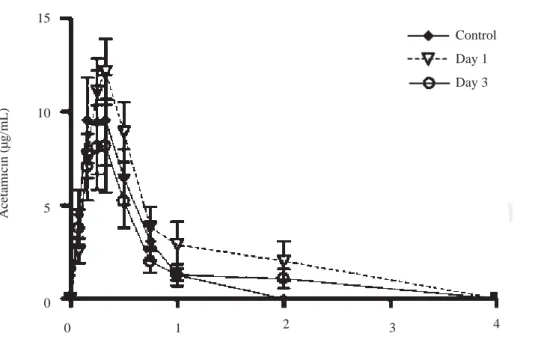
fore the insult are shown in Figure 3. Acemetacincon-centrations were low and remained above detection lev-els for only short time in all the animals studied. Hence, it was not possible to accurately estimate half-life values due to an insufficient number of experimental points for linear regression. Pharmacokinetic parameters which could be estimated with enough precision and accuracy are given in Table II. One day after CCl4 administration, acemetacin plasma levels were augmented. Notwith-standing, there was no significant difference with regard to controls in AUC, Cmax and Tmax. By day 3 both, plasma acemetacin levels and pharmacokinetic parameters were comparable to control values.
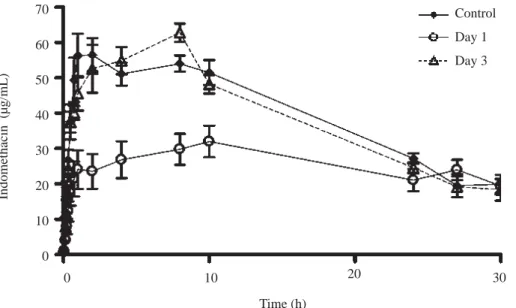
Plasma concentration against time curves for indometha-cin are shown in Figure 4. Pharmacokinetic parameters are shown in Table III. One day after CCl4 intoxication, in-domethacin plasma levels were lower than control values. As a result, AUC and Cmax were reduced in a statistically significant manner, despite a prolongation in half-life. There was no significant difference in Tmax. By day 3, in-domethacin plasma levels and all derived pharmacokinetic parameters were comparable to control values.
Discussion
Acemetacin is a drug which exerts its effects, at least in part, by its biotransformation to indomethacin by he-patic first-pass effect.5-9 It is well known that liver
dam-age can alter the pharmacokinetics of a wide variety of drugs,12-16 being particularly relevant for agents
submit-ted to an extensive first-pass effect.17 On the other hand,
it has been described that a single CCl4 administration is a suitable model of hepatitis15 which mimics clinical
acute liver damage.21-23 Therefore, we decided to examine
the effect of CCl4-induced acute hepatitis on the pharma-cokinetics of acemetacin and of its active metabolite, in-domethacin.
CCl4 intoxication induced a reversible hepatic injury. Histological analysis showed that a considerable hepatic damage with abundant necrosis was present one day after the insult. Notwithstanding, three days after the insult liver recovery was apparent, although scarce zones of ne-crosis were still present, suggesting that liver regenera-tion was not still completed. Consistently with histologi-cal data, biochemihistologi-cal indicators of liver damage, ALT
Table I. Indicators of liver damage and regeneration observed in control rats and in animals studied one and three days after CCl4 administration.
Parameter Control Day after CCl4 administration
1 3
ALT (µmol/L.min) 20.91 ± 2.86 69.02 ± 1.11* 44.42 ± 1.74*† g-GTP (µmol/L.min) 20.76 ± 1.74 46.08 ± 4.93* 12.58 ± 2.72*† a-Fetoprotein (ng/mL) 0.02 ± 0.007 0.40 ± 0.08* 0.115 ± 0.06*†
Data are presented as the mean ± SEM (n = 6-9). *p £ 0.05 vs control. †p £ 0.05 versus day one after administration of CCl 4.
Table II. Acemetacin pharmacokinetic parameters observed after a single oral dose (35 mg/kg) in control rats and in animals studied one and three
days after CCl4 administration.
Parameter Control Day after CCl4 administration
1 3
Cmax (µg/mL) 12.12 ± 3.2 16.62 ± 3.69 10.14 ± 3.13
Tmax (h) 0.39 ± 0.09 0.31 ± 0.02 0.29 ± 0.04 AUC (µg.h/mL) 4.78 ± 1.42 8.46 ± 2.05 4.59 ± 1.54 Data are presented as mean ± SEM (n = 6-9).
Table III. Pharmacokinetic parameters of indomethacin resulting from a single oral dose of acemetacin (35 mg/kg) in control rats and in animals
studied one and three days after CCl4 administration.
Parameter Control Day after CCl4 administration
1 3
Cmax (µg/mL) 68.11 ± 4.45 38.34 ± 3.41* 71.43 ± 2.54†
Tmax (h) 5.56 ± 1.25 7.11 ± 0.02 5.53 ± 0.8
AUC (µg.h/mL) 1,192.68 ± 51.61 845.31 ± 76.65* 1,258.33 ± 77.46†
t½ (h) 14.4 ± 2.31 42.15 ± 16.98* 12.98 ± 0.94†
Data are presented as mean ± SEM (n = 6-9). *p £ 0.05 vs control. †p £ 0.05 versus day one after CCl
www.medigraphic.com
ESTE DOCUMENTO ES ELABORADO PORMEDI-GRAPHIC
and g-GTP, were increased one day after intoxication, but decreased by day 3. On the other hand, a-fetoprotein, an indicator of liver regeneration,13 was increased by day 1,
being further increased by day 3 after CCl4 intoxication. Taken together, these results suggest that, in this experi-mental model, there is a significant liver damage one day after CCl4 administration, while liver regeneration has al-ready started. Three days after CCl4 administration the necrotic phase has almost concluded, whereas the regen-eration process appears to be fully active.
CCl4 administration resulted in an increase of acemet-acin plasma levels. However, we were unable to observe any significant difference in acemetacin bioavailability between the compared experimental groups. This is prob-ably due to the fact that acemetacin is rapidly absorbed, but also very rapidly eliminated by biotransformation to indomethacin.5-9 Hence, plasma concentrations were
mea-surable only during a short period of time and showed a considerable variability. As a result, there is considerable inaccuracy in the determined pharmacokinetic parame-ters, and thus it is not possible to detect statistically sig-nificant differences between diverse experimental condi-tions. This has also been observed for other drugs which are extensively and rapidly biotransformed. We have re-ported that unchanged aspirin bioavailability cannot be estimated with precision in rats after oral administration due to the fact that it aspirin is readily metabolized to salicylic acid by hepatic first-pass effect.24
Conversely, the appearance and disappearance of in-domethacin in plasma could be followed in an adequate manner, due to the high and long lasting plasma concen-trations observed. Indomethacin plasma levels, observed
Figure 3. Effect of CCl4 on
ace-metacin plasma concentrations. Rats received an oral dose of 35 mg/kg acemetacin under control conditions, as well as one and three days after acute administra-tion of CCl4. Data are presented as the mean ± SEM (n = 6-9).
after acemetacin administration, were decreased one day after CCl4 administration; that is, during the necrotic phase of liver damage. AUC and Cmax were reduced. This data suggest that indomethacin formation from acemetacin is decreased due to an impaired first-pass effect resulting from liver damage. Notwithstanding the reduction in AUC, indomethacin half-life was prolonged. It should be noted that indomethacin is also eliminated by metabolic clear-ance, particularly by hepatic CYP2C9.25 Hence,
in-domethacin clearance also appears to be affected by CCl4 liver damage. It should be mentioned; however, that the decrease in indomethacin bioavailability could also be due to impaired acemetacin absorption, as we have previ-ously demonstrated that oral ketorolac absorption is re-duced in hepatic damage by bile duct ligation.14 Further
investigation is required to determine the actual of CCl4 liver damage on oral acemetacin absorption.
By day 3, indomethacin pharmacokinetic parameters were similar to control values. Notwithstanding, histo-logical data as well as results obtained with a-fetoprotein suggest that, at this time, the liver regeneration process was fully active. Thus, it appears that pharmacokinetic al-terations due to impairment of the biotransformation of both, acemetacin and indomethacin, and eventually of acemetacin absorption, revert quite rapidly and do not re-quire complete liver regeneration to return to basal lev-els. Therefore, conventional indicators of liver damage are not directly associated to acemetacin pharmacokinet-ic changes and thus are not useful for eventual dosing ad-justments.
It is concluded that pharmacokinetic alterations after acute hepatitis are not permanent, but reversible due to
15
10
5
0
Acetamicin (µg/mL)
Time (h)
Control
Day 1
Day 3
www.medigraphic.com
Figure 4. Effect of CCl4 on indo-methacin plasma concentrations. Rats received an oral dose of 35 mg/kg acemetacin by the oral route under control conditions, as well as one and three days after acute administration of CCl4.
In-domethacin is a metabolite of ace-metacin. Data are presented as the mean ± SEM (n = 6-9).
liver regeneration. Changes are particularly important for drugs which are being generated from hepatic first-pass metabolism of a parent drug, such as indomethacin de-rived from acemetacin. However, pharmacokinetic alter-ations fully reverted while liver regeneration was not yet complete as determined by histological analysis and bio-chemical markers. Hence, conventional liver damage in-dicators are not adequate predictors of changes in acem-etacin and indomethacin disposition. The present results show that the CCl4 intoxication model is a useful tool for the understanding of the time course of alterations in the pharmacokinetics of acemetacin and its biotransforma-tion to indomethacin. Hence, this model can be used to study the effect of acute liver damage and regeneration on the pharmacokinetics of drugs submitted to an impor-tant first-pass effect.
Acknowledgments
The authors thank to Lourdes González-Flores, Mario Gil Moreno, Ramón Hernández and Benjamín Salinas for highly skilled technical assistance.
References
1. Boltze K, Brendler O, Jacobi H, Optiz W, Raddatz S, Seidel PR, Volbrecht D. Chemical structure and anti-inflammatory activity in the group of substituted indole-3 acetic acids.
Arzneimittelforschung 1980; 30: 1314–25.
2 . Jacobi H, Dell HD. On the pharmacodynamics of acemetacin.
Arzneimittelforschung 1980; 30: 1348–62.
3. Bori-Segura G, Torres A, Herrera LE, Olguín J. Efficacy and tolerability of acemetacin, a non-steroidal anti-inflammatory drug, in Mexican patients: result of the ETAPAM study. Proc West
Pharmacol Soc 2002; 45: 104–7.
4. Chou CT, Tsai YY. A double-blind, randomized, controlled par-allel group study evaluating the efficacy and safety of acemetacin for the management of osteoarthritis. Int J Clin Pharmacol Res 2002; 22: 1–6.
5 . Jones RW, Collins AJ, Notarianni LJ, Sedman E. The compara-tive pharmacokinetic of acemetacin in young subjects and eld-erly patients. Br J Clin Pharmacol 1991; 31: 543–45.
6. Dell HD, Doersing M, Jacobi H, Kamp R. Biochemical studies on Acemetacin experimental test in animals. Arzneimittelforschung 1980; 30(II): 1371-83.
7. Surborg H. Comparative metabolic studies on 14C-labelled
acemetacin and indomethacin in rats. Arzneimittelforschung 1980; 30(II): 1384-91.
8 . Dell HD, Doersing M, Fischer W, Jacobi H, Kamp R, Köhler G, Schöllnhammer G. Metabolism and pharmacokinetics of acemetacin in man. Arzneimittelforschung 1980; 30(II): 1391-98.
9. Li DM, Lu WL, Wang XQ, Wang JC, Zhang H, Zhan RJ, Wang GL, et al. Pharmacokinetics of indomethacin, a metabolite of acemetacin, following a single dose and multiple doses adminis-tered as acemetacin sustained-release tablets in healthy male vol-unteers. Journal of Health Science 2005; 51(3): 308-16. 10. Chávez-Piña AE, McKnight W, Dicay M, Castañeda-Hernández
G, Wallace JL. Mechanism underlying the anti-inflammatory ac-tivity and gastric safety of acemetacin. Br J Pharmacol 2007; 152(6): 930-38.
11. Chávez-Piña AE, Vong L, McKnight W, Dicay M, Zanardo RC, Ortiz MI, Castañeda-Hernández G, Wallace JL. Lack of effects of acemetacin on signalling pathways for leukocyte adherence may explain its gastrointestinal safety. Br J Pharmacol 2008; 155(6):857-64.
12. Boobis AR, Brodie MJ, Kahn GC, Fletcher DR, Saunders JH, Davies DS. Monooxygenase activity of human liver in microso-mal fractions of needle biopsy specimens. Br J Clin Phamacol 1980; 9(1):11-19.
13. Favari L, Castañeda-Hernández G, Hoyo-Vadillo C. Pharmaco-kinetics and pharmacodynamics of naproxen in acute experi-mental hepatitis. Arzneimittelforschung 1993; 43(6): 675-9. 14. Rivera-Espinosa L, Muriel P, Ordaz-Gallo M, Perez-Urizar J,
Palma-Aguirre A, Castaneda-Hernandez G. Ketorolac pharma-cokinetics in experimental cirrhosis by bile duct ligation in the rat. Ann Hepatol 2003; 2: 175–81.
15. Reyes-Gordillo K, Muriel P, Castañeda-Hernández G, Favari L. Pharmacokinetic of diclofenac in rats intoxicated with CCl4
and in the regenerating liver. Biopharm Drug Dispos 2007; 28:415-22.
16. Doshi J, Luisada-Opper A, Leevy CM. Microsomal pentobarbital hydroxylase activity in acute viral hepatitis. Proc Soc Exp Biol
Med 1972; 140(2): 492-95.
70
60
50
40
30
20
10
0
Indomethacin (µg/mL)
Time (h)
0 10 20 30
Control
Day 1
www.medigraphic.com
17. Gibaldi M, Boyes RN, Feldman S. Influence of first-pass effect on availability of drugs on oral administration. J Pharm Sci 1971; 60(9):1338-40.
18. Norma Oficial Mexicana NOM-062-ZOO-1999. http://
www.fmvz.unam.mx/fmvz/principal/archivos/062ZOO.PDF
19. Glossman M, Neville DM. Glutamyl transferase in kidney brush border membranas. FEBS Lett 1972; 19: 340-44.
20. Reitman S, Frankel S. A colorimetric method for determination of serum oxaloacetic and glutamic pyruvic transaminases. Am J
Clin Pathol 1957; 28: 56-63.
21. Mourelle M, Villalón C, Amezcua JL. Protective effect of colchi-cine on acute liver damage induced by carbon tetrachloride. J
Hepatol 1988; 6: 337-342.
22. Muriel P. Nitric oxide protection of rat liver from lipid peroxidation, collagen accumulation, and liver damage induced by carbon tetrachloride. Biochem Pharmacol 1998; 56: 773-79. 23. Weber LW, Boll M, Stampfl A. Hepatotoxicity and mechanism of action of haloalkanes: carbon tetrachloride as a toxicological model. Crit Rev Toxicol 2003; 33: 105-36.
24. Cruz L, Castañeda-Hernández G, Navarrete A. Ingestion of chilli pepper (Capsicum annuum) reduces salicylate bioavailability af-ter oral asprin administration in the rat. Can J Physiol Pharmacol 1999; 77: 441-6.
25. Nakajima M, Inoue T, Kuroiwa Y. Cytochrome P450 2C9 cata-lyzes Indomethacin ï-demethylacion in human liver microsomas.