Annals of Hepatology 6(4) 2007: 222-226
222
medigraphic.com
Annals of Hepatology 2007; 6(4): October-December: 222-226
Annals of Hepatology
Original Article
Metformin is effective in achieving biochemical
response in patients with nonalcoholic fatty liver disease
(NAFLD) not responding to lifestyle interventions*
Ajay Duseja;1 Ashim Das;2 Radha Krishan Dhiman;1 Yogesh Kumar Chawla;1 Kiran K. Thumburu;1 Sanjay Bhadada;3 Anil
Bhansali3
*This work was presented at the Asian Pacific Digestive Week at
Cebu City, Philippines in November 2006 (J Gastroenterol Hepatol 2006; 21 (suppl 6): A457).
1Departments of Hepatology. 2Histopathology.
3Endocrinology.
Postgraduate Institute of Medical Education & Research, Chandigarh, India
Abbreviations
Nonalcoholic fatty liver disease - NAFLD, nonalcoholic steatohepatitis - NASH, , insulin resistance -IR, ursodeoxycholic acid - UDCA, alanine transaminase - ALT, hepatitis B surface antigen -HBsAg, anti hepatitis C virus antbodies - anti HCV, antinuclear antibody ANA, antismooth muscle antibody -ASMA, liver kidney microsomal antibody - LKM, anti-mitochondrial antibody - AMA, body mass index -BMI, world health organization – WHO, fasting plasma glucose - FPG, high density lipoprotein –HDL, low density lipoprotein - LDL, triglycerides - TG, tumor necrosis factor alpha - TNF-α, homeostasis model assessment for insulin resistance - HOMA- IR.
Address for correspondence:
Dr. Ajay Duseja MD, DM, MNAMS, FACG Department of Hepatology
PGIMER Chandigarh, India
Phone-91-172-2756336 Fax-91-172-2744401 E-mail: [email protected]
Manuscript received and accepted: 10 and 17 October 2007
Abstract
Background: Insulin resistance plays an important role in the pathogenesis of NAFLD. Pharmacological treatment of patients with NAFLD is still evolving. In-sulin sensitizing drugs like metformin may be effec-tive in these patients. Twenty five adult patients with NAFLD who did not achieve normalization of alanine transaminases (ALT) after 6 months of lifestyle inter-ventions and UDCA were treated with metformin 500mg tid for 6 months. Insulin resistance was deter-mined by HOMA- IR. Liver function tests were done monthly and patients were defined having no sponse, partial response or complete biochemical re-sponse depending on the change in ALT. Results were compared with 25 patients with NAFLD from the
same cohort treated only with lifestyle interventions (disease controls). Results: Thirteen (52%) patients had class III (n = 5) or class IV (n = 8) disease amount-ing to histological NASH. Of these 13 patients none had severe inflammation and none had stage 4 fibro-sis (cirrhofibro-sis). All 25 patients with NAFLD had insulin resistance in comparison to healthy controls. In com-parison to disease controls (127.5 ± 41.8 vs. 118 ± 21.6 p = NS), all patients treated with metformin had partial biochemical response (mean ALT 122.2 ± 26.8 vs 74.3 ± 4.2 p < 0.01) and 14 (56%) of them achieved complete normalization of ALT. Conclusions: Met-formin is effective to achieve biochemical response in patients with NAFLD who do not respond to lifestyle interventions and UDCA.
Key words: Nonalcoholic steatohepatitis, NASH, insu-lin resistance, diabetes mellitus, metabolic syndrome, UDCA, metformin,
Introduction
Nonalcoholic fatty liver disease (NAFLD) includes patients with simple steatosis and nonalcoholic steato-hepatitis (NASH), which can even progress to cirrhosis and hepatocellular carcinoma.1,2 Pharmacological
treat-ment of patients with NAFLD is still evolving and since insulin resistance (IR) plays a key role in the pathogene-sis of nonalcoholic fatty liver disease (NAFLD),insulin sensitizing drugs like metformin may have role in the treatment of patients with NAFLD.3-9
Objective of this study was to determine the role of met-formin in achieving biochemical response in patients with nonalcoholic fatty liver disease who did not respond to life-style interventions and ursodeoxycholic acid (UDCA).
Patients and methods
Patients
In a prospective analysis (April 2001 – March 2007), 25 patients with NAFLD who did not have complete biochemi-cal response after 6 months of lifestyle interventions and
Artemisa
medigraphic.com
UDCA were included in the study after an informed consent.The project had the approval of institute’s ethical committee. Life style interventions included moderate sustained exercise like brisk walking, jogging, swimming, cycling etc at least for 30-45 minutes per day, low fat and low calorie diet and slow weight reduction (10% of base line in 6 months, not more than 1.6 Kg/week) in those with overweight and obesity. UDCA was given in a dosage of 300 mg twice daily. Inclu-sion criteria were adult (> 16 yrs.) nonalcoholic individuals (total abstinence or intake less than 20 g/day, confirmed by two family members) with raised serum alanine aminotrans-ferase (ALT) (> 1.5 x ULN x at least 6 months), ultrasound showing hyperechoic liver or other features of steatosis, tive viral markers (HBsAg, anti HCV - 3rd generation), nega-tive autoimmune markers [nuclear antibody (ANA), anti-smooth muscle antibody (ASMA), anti-liver kidney microso-mal antibody (LKM), anti-mitochondrial antibody (AMA)], normal serum ceruloplasmin & absent Keyser Fleisher rings on slit lamp examination, normal iron parameters and a liver bi-opsy consistent with NAFLD. Pregnant females and patients with diabetes mellitus were excluded from the study.
Controls
Twenty five patients with NAFLD from the same cohort with comparable age, gender, BMI, waist, baseline ALT, insulin resistance and metabolic syndrome were included as disease controls. These patients were also non respond-er to lifestyle intrespond-erventions and UDCA and wrespond-ere contin-ued on only lifestyle interventions without metformin
Anthropometry
All patients underwent a detailed physical examina-tion including anthropometry. Overweight (BMI ≥ 23 but < 25 kg/m2), obesity (BMI ≥ 25 kg/m2) and abnor-mal waist circumference [> 90 cm (abnor-males), > 80 cm (fe-males)] were defined as per the Asia Pacific criteria.10,11
Biochemistry
Diabetes mellitus was defined as per the WHO criteria with fasting plasma glucose (FPG) ≥ 126 mg/dL or plas-ma glucose ≥ 200 mg/dL in a symptomatic patient or a 2-hour plasma glucose on glucose tolerance test ≥ 200 mg/ dL12 and patients qualifying these criteria were excluded
from the study. Lipid profile was taken as abnormal when serum cholesterol was > 200 mg/dL, serum high-density lipoprotein (HDL) < 40 mg/dL in males & < 50 mg/dL in females, serum low-density lipoprotein (LDL) > 130 mg/ dL and serum triglycerides were > 150 mg/dL.13
In addition to measurement of fasting serum insulin levels (radioimmunoassay), fasting C-peptide (ELISA) and serum TNF- α (ELISA) levels were also determined in these patients.
Metabolic syndrome
Metabolic syndrome was defined by the presence of at least ≥ 3 out of five modified adult treatment panel III criteria including modified abnormal waist as per the Asia Pacific criteria, FPG >110 mg/dL, hypertension (blood pressure ≥ 130/85 mmHg or on anti-hypertensive drugs), serum triglycerides > 150 mg/dL, and serum high density lipoprotein (HDL) < 40 mg/dL (males) & < 50 mg/dL (females).13
Histopathology
Histologically patients were classified into four classes as per Matteoni et al (Class – 1 = Simple ste-atosis, Class – 2 = Steatosis + lobular inflammation, Class – 3 = + Ballooned hepatocytes, Class – 4 = + Mallory hyaline or fibrosis) and those patients with class 3 or 4 were defined as having NASH.14 Further
patients with NASH were graded and staged according to Brunt et al.15
Insulin resistance
Insulin resistance was determined by homeostasis model assessment for insulin resistance ( HOMA- IR) cal-culated as the product of fasting insulin (µU/L) and fast-ing plasma glucose (mmol/L) divided by 22.5. An abso-lute value of HOMA-IR > 1.64 was taken as abnormal.3,16
Treatment and follow up
Patients were treated with tablet metformin 500 mg/tid for 6 months in addition to the life style interventions. Disease controls were continued on only lifestyle inter-ventions without metformin. Liver function tests were done monthly and patients were defined as having no sponse, partial response or complete biochemical re-sponse depending on the change in ALT.
Statistical analysis
All data is expressed in mean ± SD until otherwise specified. Students‘t’ test, chi square test and Mann-Whitney U test were used to determine the differences be-tween different groups. A p value of < 0.05 was taken as significant.
Results
Patients
medigraphic.com
Histopathology
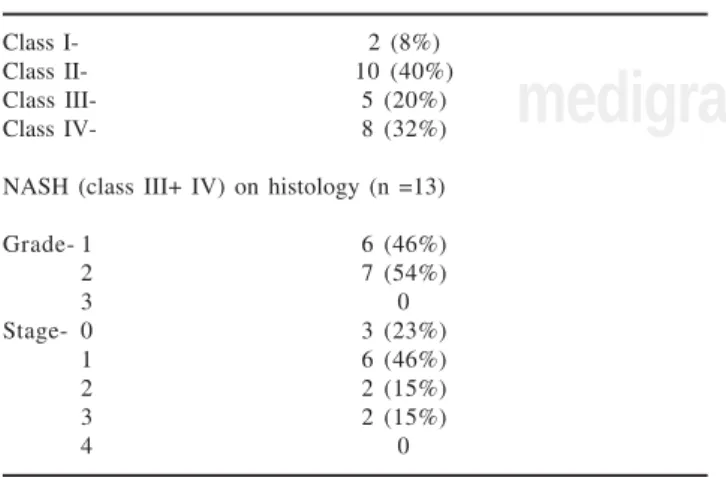
Details of the histopathology are shown in Table II. Thirteen (52%) patients had class III (n = 5) or class IV (n = 8) disease amounting to histological NASH. Of these 13 patients none had severe inflammation and none had stage 4 fibrosis (cirrhosis).
Insulin resistance
Patients with NAFLD had significantly higher HOMA-IR in comparison to the historical healthy controls. (Mean HOMA – IR = 7.6 ± 2.9 vs 1.4 ± 1.2) (p = < 0.01).
Treatment
Though BMI did not change significantly in both the groups, in comparison to disease controls (127.5 ± 41.8
vs 118 ± 21.6 p = NS), all patients treated with metformin
had partial biochemical response (mean ALT 122.2 ± 26.8 vs 74.3 ± 4.2 p < 0.01) and 14 (56%) of them achieved complete normalization of ALT and continue to do so on follow up for 3 months (Figure 1). No patient experienced any side effect and there were no dropouts.
Discussion
Insulin resistance, which is responsible for increased lipolysis from adipose tissue and hepatic steatosis, is very common in patients with NAFLD.3,17 Increased fatty
acid oxidation, oxidative stress and cytokines may lead on to steatohepatitis and its consequences in some of these patients.18 All our patients with NAFLD had IR as
demonstrated by significantly higher HOMA-IR in com-parison to healthy controls. High C-peptide to insulin ra-tio (Table I) in our patients with NAFLD is indicative of primary insulin resistance in these patients rather than the hyperinsulinemia occurring due to decreased hepatic extraction of insulin due to any liver disease.1
First line of treatment in patients with NAFLD is al-ways weight reduction by life style interventions and control of other risk factors. Pharmacological treatment for NAFLD is still evolving and there is no single agent, which is effective in achieving the complete response.19
Earlier studies did show UDCA to be an effective mode of treatment in these patients20 but a recent randomized
placebo controlled trial showed that UDCA is no better than placebo in the treatment of patients with NASH.21
The options in patients like ours who do not respond to above measures are limited. Since insulin resistance is the major pathogenetic mechanism, insulin-sensitizing drugs have a role in the treatment.22-24 Thiazolidinediones
group of drugs including troglitazone, rosiglitazone and
Table II. Liver histology in 25 patients with NAFLD.
Class I- 2 (8%)
Class II- 10 (40%)
Class III- 5 (20%)
Class IV- 8 (32%)
NASH (class III+ IV) on histology (n =13)
Grade- 1 6 (46%)
2 7 (54%)
3 0
Stage- 0 3 (23%)
1 6 (46%)
2 2 (15%)
3 2 (15%)
4 0
Table I. Baseline characteristics of 25 patients with NAFLD.
Parameter
Males: Females 1 7 : 8 Mean age (yrs.) 36.4 ± 9.2 Mean BMI (kg/m2) 26.8 ± 3.6 Mean waist (cm) 96.8 ± 10.0 Mean ALT (IU/L) 122.2 ± 26.8 C- peptide (pmol/L) 422 ± 1255 Mean insulin (pmol/L) 212.1 ± 164.3 Mean TNF-α (pg/mL) 26.7 ± 17.5 Mean Cholesterol (mg/dL) 192 ± 4 6 Mean HDL (mg/dL) 3 7 ± 9.5 mg/dL Mean LDL (mg/dL) 112 ± 38.5 mg/dL Mean TG (mg/dL) 202 ± 98.4 mg/dL
Hypertension 2(8%)
Metabolic syndrome 13 (52%)
BMI – Body mass index ALT – Alanine aminotransferase TNF – Tumor necrosis factor HDL – High-density lipoprotein LDL – Low-density lipoprotein TG – Triglycerides
medigraphic.com
ESTE DOCUMENTO ES ELABORADO POR MEDI-GRAPHIC
pioglitazone have been used in the treatment of NAFLD. Troglitazone has been withdrawn from the market due to its potential hepatotoxicity, which has been described even with rosiglitazone and pioglitazone.22-24
Metformin through its anti- TNF and insulin sensitiz-ing actions is an effective drug for achievsensitiz-ing biochemi-cal response in patients with NAFLD, and data on its use both experimental25 and in patients4-9 with NAFLD is
evolving. Most of the studies on metformin are open la-bel studies.4,8 One randomized trial using metformin
found it to be better than vitamin E and lifestyle inter-ventions in improving the liver biochemistry and histo-logical activity including steatosis, inflammation and fi-brosis and none of the patients had any side effects.9 In
another study 36 patients with NASH were randomized to lipid and calorie-restricted dietary treatment alone and metformin 850 mg b.d. plus dietary treatment for 6 months. The mean serum alanine/aspartate aminotrans-ferase, insulin and C-peptide levels decreased and the in-dex of insulin resistance improved significantly from baseline in the group given metformin, significantly greater than those in the group given dietary treatment alone. Though not significant, more patients in the met-formin group showed improvement in the necro-inflam-matory activity, compared with the group given dietary treatment alone.7
Though we did not evaluate them for histological im-provement, our patients had significant biochemical re-sponse in comparison to patients continued only on life-style interventions with normalization of ALT in 14 (56%) of them. We also found it to be safe with no patient experiencing any side effect and there were no dropouts.
Our study has certain drawbacks. Number of patients is small and results may change with large number of pa-tients. We evaluated patients only for biochemical re-sponse and since ALT may not have good correlation with histology in patients with NAFLD, improvement in ALT in our patients may not signify histological re-sponse.
In conclusion, our study shows that insulin resistance is common in patients with NAFLD.
Metformin is an alternative option to achieve bio-chemical response in patients with NAFLD who do not respond to lifestyle interventions and UDCA. Results need to be reproduced in larger number of patients in a randomized placebo controlled trial with histological data.
References
1. Falck–Ytter Y, Younossi ZM, Marchesini G, Mc Cullough AJ. Clinical features and natural history of nonalcoholic steatosis syndromes. Semin Liver Dis 2001; 21: 17-26.
2. Duseja A, Nanda M, Das A, Das R, Bhansali A, Chawla Y. Preva-lence of obesity, diabetes mellitus and hyperlipidemia in patients with cryptogenic liver cirrhosis. Trop Gastroenterol 2004; 25: 15-17.
3. Chitturi S, Abeygunasekera S, Farrell GC, Holmes-Walker J, Hui JM, Fung C, Karim R, et al. NASH and insulin resistance: Insulin hypersecretion and specific association with the insulin resistance syndrome. Hepatology 2002; 35: 373-9.
4. Chavez-Tapia NC, Barrientos-Gutierrez T, Tellez-Avila FI, Sanchez-Avila F, Montano-Reyes MA, Uribe M. Insulin sensitiz-ers in treatment of nonalcoholic fatty liver disease: Systematic review. World J Gastroenterol 2006 28; 12: 7826-31.
5. Duseja A, Murlidharan R, Bhansali A, Sharma S, Das A, Das R, Chawla Y. Assessment of insulin resistance and effect of metformin in nonalcoholic steatohepatitis – a preliminary report.
Indian J Gastroenterol 2004; 23: 12-5.
6. Marchesini G, Brizi M, Bianchi G, Tomasserti S, Zoli M, Melchionda N. Metformin in nonalcoholic steatohepatitis. Lan-cet 2001; 358: 893-4.
7. Uygun A, Kadayifci A, Isik AT, Ozqurtas T, Deveci S, Tuzun A, Yesilova Z, et al. Metformin in the treatment of patients with non-alcoholic steatohepatitis. Aliment Pharmacol Ther 2004; 19: 537-44. 8. Nair S, Diehl AM, Wiseman M, Farr GH Jr, Perrillo RP. Metformin in the treatment of non-alcoholic steatohepatitis: a pilot open label trial. Aliment Pharmacol Ther 2004; 20: 23-8.
9. Bugianesi E, Gentilcore E, Manini R, Natale S, Vanni E, Villanova N, David E, et al. A randomized controlled trial of metformin versus vitamin E or prescriptive diet in nonalcoholic fatty liver disease. Am J Gastroenterol 2005; 100: 1082-90.
10. Steering Committee of the Western Pacific region of the World Health Organization. The International Association for the study of Obesity and the International Study Task Force. The Asia-Pacific perspective; redefining obesity and its treatment, 8-56. Australia: Health Communications; 2000.
11. Dhiman RK, Duseja A, Chawla Y. Asians need different criteria for defining overweight and obesity. Arch Intern Med 2005; 165: 1069-1070.
12. World Health Organization. Definition, diagnosis and classifica-tion of diabetes mellitus and its complicaclassifica-tions – Part 1: Diagnosis and classification of diabetes mellitus, 31-3. Geneva: World Health Organisation; 1999.
13. Expert panel on detection evaluation and treatment of high cho-lesterol in adults. Executive summary of the third report of the national Cholesterol Education Program (NCEP) expert panel on detection, evaluation and treatment of high blood cholesterol in adults (Adult Treatment panel III). JAMA 2001; 285: 2486-97. 14. Matteoni CA, Younossi ZM, Gramlich T, Boparai N, Liu YC,
McCullough AJ. Non-alcoholic fatty liver disease: a spectrum of clinical and pathological severity. Gastroenterology 1999; 16: 1413-19.
15. Brunt EM, Janney CG, Di Bisceglie AM, Neuschwander – Tetri BA, Bacon BR. Nonalcoholic steatohepatitis: a proposal for grad-ing and staggrad-ing the histological lesions. Am J Gastroenterol 1999; 94: 2467-74.
16. Duseja A, Das A, Das R, Dhiman RK, Chawla Y, Bhansali A, Kalra N. Clinicopathological profile of Indian patients with non-alcoholic fatty liver disease is different from that in the west. Dig Dis Sci 2007; 52: 2368-74.
17. Duseja A, Das A, Dhiman RK, Chawla YK, Das R, Bhadada S, Sialy R, et al. Indian patients with nonalcoholic fatty liver disease presenting with raised transaminases are different at presentation.
World J Gastroenterol 2007; 13: 649-50.
18. Day C, James O: Steatohepatitis: a tale of two «hits»? (Editorial).
Gastroenterology 1998; 114: 842-5.
19. Tilg H, Kaser A. Treatment strategies in nonalcoholic fatty liver disease. Nat Clin Pract Gastroenterol Hepatol 2005; 2: 148-55. 20. Laurin J, Lindor KD, Crippin JS, Gossard A, Gores GJ, Ludwig J,
Rakela J, et al. Ursodeoxycholic acid or clofibrate in the treat-ment of nonalcoholic induced steatohepatitis: A pilot study.
Hepatology 1996; 23: 1464-67.
21. Lindor KD, Kowdley KV, Heathcote EJ, Harrisson ME, Jorgensen R, Angulo P, Lymp JF, et al. Ursodeoxycholic acid for treatment of nonalcoholic steatohepatitis: results of a randomized trial.
medigraphic.com
22. Caldwell SH, Hespenheide EE, Redick JA, Iezzoni JC, Battle EH,Sheppard BL. A pilot study of a thiazolidinedione, Troglitazone in nonalcoholic steatohepatitis. Am J Gastroenterol 2001; 96: 519-25. 23. Neuschwander–Tetri BA, Brunt EM, Wehmeier KR, Oliver D, Bacon BR. Improved nonalcoholic steatohepatitis after 48 weeks of treatment with the PPAR - γ Ligand rosiglitazone. Hepatology
2003; 38: 1008-17.
24. Sanyal AJ, Mofrad PS, Contos MJ, Sargeant C, Luketic VA, Ster-ling RK, Stravitz RT, et al. A pilot study of vitamin E versus vitamin E and pioglitazone for the treatment of nonalcoholic steatohepatitis. Clin Gastroenterol Hepatol 2004; 2: 1107-15. 25. Lin HZ, Yang SQ, Chuckaree C, Kuhajda F, Ronnet G, Diehl