Lifestyle changes associated with a new
antioxidant formulation in non-alcoholic fatty liver disease:
a case series
Ludovico Abenavoli,* Valentina Peta,* Natasa Milic**
* Department of Health Sciences, University Magna Græcia, Catanzaro, Italy. ** Department of Pharmacy, University of Novi Sad, Novi Sad, Serbia.
ABSTRACT
Non-alcoholic fatty liver disease (NAFLD) is a relevant issue in public health owing to its epidemiological burden. It represents the most common chronic liver disease in the general population and is expected to increase in future as a result of an ageing population. The only currently recommended treatment for NAFLD is lifestyle modification. However, literature reports pre-clinical and clinical studies on the use of antioxidant supplementation in NAFLD. A new antioxidant complex, called Bilirel (BIL) (Pharmaluce, Repub-lic of San Marino), have recently introduced in the Italian market. However no data are reported on his effects on liver steatosis. Here we report on a cases series of seven overweight patients with NAFLD, in which the association of an Italian Mediterranean diet, increased physical activity, and daily administration of two pills of BIL for 6 weeks, have induced the rapid improvement of fatty liver accumulation, glucose and lipid metabolism, and weight reduction.
Key words. Non-alcoholic fatty liver disease. Steatosis. Mediterranean diet. Antioxidant. Insulin resistance.
Correspondence and reprint request: Ludovico Abenavoli M.D., Ph.D. Department of Health Sciences, University Magna Græcia
Viale Europa-Germaneto, 88100 Catanzaro, Italy Ph.: +39 0961 3694387. Fax: +39 0961 754220 E-mail: [email protected]
Manuscript received: July 14, 2014. Manuscript accepted: August 04, 2014.
INTRODUCTION
Non-alcoholic fatty liver disease (NAFLD) is a relevant issue in public health owing to its epidemi-ological burden. It represents the most common chronic liver disease in the general population and is expected to increase in future as a result of an ageing population.1 It is estimated that the preva-lence of NAFLD in the general adult population worldwide is approximately between 20 and 30%, with approximately 10% (2-3% overall) meet diag-nostic criteria for non-alcoholic steatohepatitis (NASH).2 The prevalence increase between 70 and 90% in people with obesity or type 2 diabetes.3
NAFLD is currently recognized as a manifesta-tion of metabolic syndrome. Central obesity, hyper-glycemia, type 2 diabetes, arterial hypertension, and hypertriglyceridemia, which are elements of
individualized and one should aim to achieve ener-gy deficit of 500-1,000 kcal/day depending on the body mass index (BMI) of the patient. On the other hand, at least 150 min per week of moderate-inten-sity physical activity and at least 75 min per week of vigorous-intensity physical activity, further to muscle strengthening twice a week are been sug-gested by European guideline.10 However, there is no consensus concerning pharmacological treat-ment.
This report presents the data of seven overweight patients with NAFLD, in which the lifestyle chang-es, associated with the administration of a new anti-oxidant formulation, have induced the rapid improvement of fatty liver accumulation, glucose and lipid metabolism, and weight reduction.
MATERIAL AND METHODS
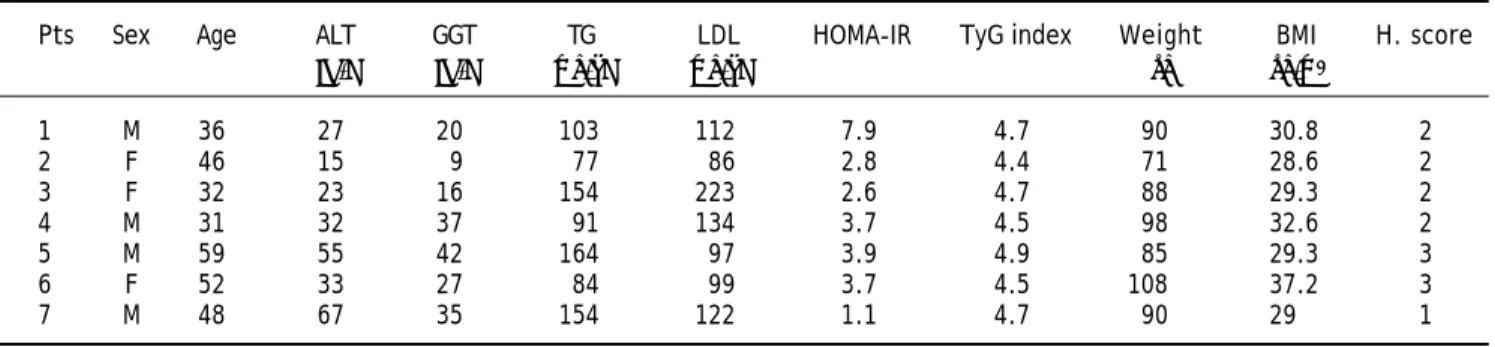
We analyze retrospectively seven consecutively overweight patients with NAFLD, referred to our Department between March and May 2014 (Table 1). Patients included in the study were 4 men and 3 women, with a mean age of 32 (range 31-59) and 43 (range 32-52) years old, respectively. In all cases, other causes of liver disease were excluded, through viral markers (for hepatitis B and C), lack of alcohol intake in the anamnesis more than 20 g/daily, pres-ence of autoimmune or metabolic disease, the use of drugs known to induce liver steatosis. For six weeks, all patients followed an Italian Mediterrane-an diet based on the body weight.14 The recommend-ed composition of the dietary regimen was as follows: carbohydrates, 50 to 60%; proteins, 15 to 20% (of which about 50% was comprised of vegeta-ble proteins); total fat, less than 30% (saturated fat, less than 10%; and cholesterol consumption, less than 300 mg per day), and 30 g of fibers. The com-position of the diet in terms of foods and food combi-nations was planned to obtain an animal to vegetable protein ratio as close to 1:1 as possible. The Italian Recommended Dietary Allowances were incorporated to ensure proper vitamin and mineral intake.14 At the same time the subjects taken 2 pills/daily of a new antioxidant complex recently introduced in the Italian market called Bilirel (BIL) (Pharmaluce, Republic of San Marino). The compo-sition of one pill of BIL was: silymarin 75 mg, chlo-rogenic acid 3.75 mg, protopine 0.02 mg, L-methionine 75 mg, and L-glutathione 75 mg. A daily physical activity was strongly recommended. The pills are taken far from the meals, to not influence its absorption.
The serum levels of total cholesterol, lipopro-teins (i.e., high density HDL and low density LDL), triglycerides (TG) as well as the standard liver tests, including total bilirubin, alanine ami-notransferase (ALT) and gamma glutamyl-transpeptidase (GGT), were performed at the start of the therapy and after 6 weeks. Also fasting glu-cose and insulin levels were measured. To evaluate insulin resistance, we calculated two surrogate in-dex: the homeostasis model assessment technique (HOMA-IR), and the product of plasma triglyceride and glucose concentrations (TyG) index.15,16 BMI was calculated as body weight divided by height squared (kg/m2). Finally, abdominal ultrasound were performed by one of the investigators with previous experience in performing and interpreting echography, to describe the grade of steatosis ac-cording to Hamaguchi score (H. score), a semi-quantitative classification, that ranged from 0 (no steatosis) to 3 (severe steatosis).17 For ethical rea-sons and in according with international recom-mendations, no liver biopsies were performed.
RESULTS
All patients have strictly follow the alimentary regimen prescribed and completed a six weeks treatment with BIL. All patients have reported an increase in physical activity. During the period of observation, none of other treatment for NAFLD was started. Considering the whole group of the patients (n: 7), we describe in all patients the de-crease of the weight and subsequently of BMI (Ta-ble 2). In particular, the median weight reduction registered was 6.1 kg (range 5-8), with a median of 1 kg/week (range 0.8-1.3). On insulin resist-ance, we report that fasting glucose, insulin and consequently HOMA-IR were reduced from week 0 with a median value of 3.7 (range 1.1-7.9), to week 6 with a median value of 2.2 (range 0.7-2.8). In particular, the five patients with identified insulin resistance by HOMA-IR (patients No. 1, 2, 4, 5, and 6) showed normalization in four cases and a reduction in one case. The improvement of insulin resistance in our case series is confirmed by the analysis of TyG index. The four patients with ini-tial high TyG index (patients No. 1, 3, 5, and 7), showed the reduction of the value after 6 weeks, with a normal value in three cases and in one the upper limit.
6-weeks evaluation. In particular, the hyperechogen-ity of the liver parenchyma, an echographic parame-ter directly linked with fat accumulation, was improved.
Considered lipid metabolism, TG value decreased in the three cases with initial hypertriglyceridemia (patients No. 3, 5 and 7), and in the two patients with higher LDL (patients No. 3 and 4). Finally, the two patients with initial hypertransaminasemia, showed the normalization of the ALT value at the end of the treatment (patients No. 5 and 7).
DISCUSSION
Despite the rapidly growing recognition of NAFLD over the past decade, therapy directed at treatment or prevention of this condition remains to be define. Given the high prevalence of NAFLD in overweight patients, prevention of hepatic fat accu-mulation and weight reduction remains the corner-stone of the treatment of liver steatosis, and the management must focus on the treatment of meta-bolic syndrome, and, therefore, NAFLD is often con-sidered as an individual entity in the clinical practice. Essential in the management of NAFLD, is to implies a dietary modification to decrease the body weight and to increase the physical exercise, in
order to reduce insulin resistance and to normalize the transaminases levels.2
The occurrence of liver steatosis and its progres-sion to fibrosis and cirrhosis, is a long process that includes consecutive steps. Liver steatosis is a con-sequence of an altered balance between fat accumu-lation and oxidation, both of which are regulated by insulin. Fatty liver is frequently associated with in-sulin resistance, and type 2 diabetes is associated with a two- to fivefold increased risk to develop NAFLD.16,17 The ideal treatment for NAFLD would reduce the liver damage and its progression. Thefore, drugs for the treatment of NAFLD should re-duce body weight, improve insulin resistance and metabolic alterations, reduce the linkage between adipose tissue and liver function by acting as anti-inflammatory and immune-modulatory agents by blocking oxidative stress. NAFLD patients are gen-erally overweight or obese. A well balanced dietetic regimen and the increase in physical activity, are as-sociated with an improvement in liver enzymes, lipid and glucose metabolism, in about 40% of overweight patients with NAFLD.14,18,19 Our results are in agreement with those studies, and we confirmed a direct correlation between lifestyle changes and BMI, insulin resistance, and hepatic fat accumula-tion.
Table 1. Characteristics of the patients at the baseline.
Pts Sex Age ALT GGT TG LDL HOMA-IR TyG index Weight BMI H. score
(IU/L) (IU/L) (mg/dL) (mg/dL) (kg) (kg/m2)
1 M 36 27 20 103 112 7.9 4.7 90 30.8 2
2 F 46 15 9 77 86 2.8 4.4 71 28.6 2
3 F 32 23 16 154 223 2.6 4.7 88 29.3 2
4 M 31 32 37 91 134 3.7 4.5 98 32.6 2
5 M 59 55 42 164 97 3.9 4.9 85 29.3 3
6 F 52 33 27 84 99 3.7 4.5 108 37.2 3
7 M 48 67 35 154 122 1.1 4.7 90 29 1
Normal value: ALT < 40 IU/L. GGT < 50 IU/L. TG < 150 mg/dL. LDL < 130 mg/dL. HOMA-IR ≤ 2.8. TyG index ≤ 4.5. BMI < 25.
Table 2. Characteristics of the patients after six weeks of lifestyle changes and treatment with BIL.
Pts Sex ALT GGT TG LDL HOMA-IR TyG index Weight BMI H. score
(IU/L) (IU/L) (mg/dL) (mg/dL) (kg) (kg/m2)
1 M 11 13 60 87 2.5 4.3 84 28.9 0
2 F 18 15 70 118 2.4 4.3 66 26.4 0
3 F 21 35 65 89 2.2 4.3 80 26.6 1
4 M 34 31 90 111 2.6 4.5 91 30.3 1
5 M 24 30 89 95 2.8 4.5 80 27.5 1
6 F 32 16 75 75 2.4 4.3 102 34.5 1
Silybum marianum, commonly known as Milk Thistle (MT), is a plant native of the Mediterranean and North African regions and was used in the treatment of liver diseases for millennia.20 The ac-tive complex of MT is a lipophilic extract from plant seeds and it is composed of isomer flavonolignans (i.e. silibinin, isosilibin, silidianin, and silichristine), collectively known as silymarin. Silymarin compris-es at least 70% of the standardized MT. Silibinin is the major isomer and the most active component and represents about 60-70%, followed by silichris-tin (20%), and silidianin (10%). Modern Western medicine has confirmed the hepato-protective prop-erties of silymarin by conducting animal studies
and clinical trials in NAFLD.20,21 Silymarin
presents anti-oxidant, anti-inflammatory, anti-fi-brotic, detoxifying and regenerative properties. In particular, silymarin contrasts lipid peroxidation by scavenging of free radicals and increases the lev-els of reduced glutathione. Silymarin treatment was associated with a reduction of insulin resist-ance and a significant decrease in fasting insulin levels, suggesting an improvement of the activity of endogenous and exogenous insulin.21-23 Is it also been reported that silymarin extract caused an im-provement in ALT levels in human. Recently, Loguercio, et al. showed that a silybin vitamin E complex improves insulin resistance and liver dam-age in patients with NAFLD.24 Considered these properties, in our patients we administered the BIL complex with a daily dose of 120 mg of silymarin, with subsequently improvement of HOMA-IR, TyG index and ALT in the patients with hypertransami-nasemia.
The changes on glucose and lipid metabolism, can also be explained by the action of chlorogenic acid, other component of the BIL complex. In fact, chlorogenic acid, is one of the most abundant polyphenol compounds in the human diet, and an important component of coffee.25 Chlorogenic acid exerts many biological properties and in particu-lar stimulates glucose uptake in both insulin-sen-sitive and insulin-resistant adipocyte, with reduced early fasting glucose and insulin respons-es.25,26 In our cases the metabolic changes report-ed, can be explained by the synergic action of the hypocaloric diet in association with silymarin and chlorogenic acid.
Another component of the BIL complex is the protopine, an isoquinoline alkaloid contained in the Fumaria officinalis, that present choleretic and hepato-protective action.27 In particular, pro-topine selectively inhibits pro-inflammatory
medi-ators (i.e. nitric oxide, cyclooxygenase-2, and prostaglandin E2) and the production of pro-in-flammatory cytokines (i.e. tumor necrotic factor-α, interleukin-1 and -6).28 These data suggests that protopine could be a potential candidate for the treatment of inflammatory diseases, and in particular of NAFLD, in which hepatic lipid accu-mulation could induce an inflammatory status, with progression of the disease. Our data, showed the reduction of the H. score that ranged from 1-3 points at the initial time, to 0-1 at the 6-weeks evaluations.
The increase of the oxidative stress recording in NAFLD, causes not only consumption of the glu-tathione, the major intra-cellular anti-oxidant, with decrease of its levels, but also attenuates activity of s-adenosyl-L-methionine the principal biological me-thyl donor and a precursor of glutathione, essential for the anti-oxidant pathways.29 Is hypothesizable that as a result of oxidant insult, reduction of glu-tathione levels in combination with lower ATP availability due to mitochondrial dysfunction, re-sults in unbalanced reactive oxygen species produc-tion with progression of the hepatic injury.30 The administration of glutathione and methionine, help to restore the oxidative balance.
Finally, the influence of the dietary nutrients in the pathogenesis of NAFLD has been reported. A diet regimen rich in monounsaturated fatty acids and omega-3, fruit, vegetables, fibre and reduced intake of saturated fats, simple carbohydrates, sweetened drinks and moderate alcohol intake should be recommended in the NAFLD patients.31 Considered these basis, we have prescribed to our patients, a personalized Mediterranean diet that has extensively been associated with a favourable health outcome, with beneficial effects both on the prevention and the treatment of the metabolic syn-drome.
CONFLICT OF INTEREST
There are no conflicts of interest associated with this work.
ABBREVIATIONS
• ALT: alanine aminotransferase. • BIL: Bilirel.
• BMI: body mass index.
• GGT: gamma glutamyltranspeptidase. • H. score: Hamaguchi score.
• HDL: high density lipoprotein.
• HOMA-IR: homeostasis model assessment tech-nique.
• LDL: low density lipoprotein. • MT: Milk Thistle.
• NAFLD: non-alcoholic fatty liver disease. • NASH: non-alcoholic steatohepatitis. • TG: triglycerides.
• TyG: triglyceride x glucose.
REFERENCES
1. Bellentani S, Scaglioni F, Marino M, Bedogni G. Epidemiolo-gy of non-alcoholic fatty liver disease. Dig Dis 2010; 28: 155-61.
2. Nascimbeni F, Pais R, Bellentani S, Day CP, Ratziu V, Loria P, Lonardo A. From NAFLD in clinical practice to answers from guidelines. J Hepatol 2013; 59: 859-71.
3. Oni ET, Agatston AS, Blaha MJ, Fialkow J, Cury R, Sposito A, Erbel R, et al. A systematic review: burden and severity of subclinical cardiovascular disease among those with nonalcoholic fatty liver; should we care? Atherosclerosis 2013; 230: 258-67.
4. Tarantino G, Finelli C. What about non-alcoholic fatty liver disease as a new criterion to define metabolic syndrome?
World J Gastroenterol 2013; 19: 3375-84.
5. Day CP, James OF. Steatohepatitis: a tale of two “hits”?
Gastroenterology 1998; 114: 842-5.
6. Rouabhia S, Milic N, Abenavoli L. Metformin in the treat-ment of non-alcoholic fatty liver disease: safety, efficacy and mechanism. Expert Rev Gastroenterol Hepatol 2014; 8: 343-9.
7. Abenavoli L, Scarpellini E, Rouabhia S, Balsano C, Luzza F. Probiotics in non-alcoholic fatty liver disease: which and when. Ann Hepatol 2013; 12: 357-63.
8. Abenavoli L, Luigiano C, Guzzi PH, Milic N, Morace C, Stel-itano L, Consolo P, et al. Serum adipokine levels in over-weight patients and their relationship with non-alcoholic fatty liver disease. Panminerva Med 2014; 56: 189-93. 9. Loria P, Adinolfi LE, Bellentani S, Bugianesi E, Grieco A,
Fargion S, Gasbarrini A, et al. A decalogue from the Italian Association for the Study of the Liver (AISF) Expert Com-mittee. Dig Liver Dis 2010; 42: 272-82.
10. Ratziu V, Bellentani S, Cortez-Pinto H, Day C, Marchesini G. A position statement on NAFLD/NASH based on the EASL 2009 special conference. J Hepatol 2010; 53: 372-84. 11. Farrell GC, Chitturi S, Lau GK, Sollano JD. Asia-Pacific
Working Party on NAFLD. Guidelines for the assessment and management of non-alcoholic fatty liver disease in the
Asia-Pacific region: executive summary. J Gastroenterol
Hepatol 2007; 22: 775-7.
12. Fan JG, Jia JD, Li YM, Wang BY, Lu LG, Shi JP, Chan LY, et al. Guidelines for the diagnosis and management of nonal-coholic fatty liver disease: update 2010. J Dig Dis 2011; 12: 38-44.
13. Chalasani N, Younossi Z, Lavine JE, Diehl AM, Brunt EM, Cusi K, Charlton M, et al. The diagnosis and management of non-alcoholic fatty liver disease: Practice Guideline by the American Association for the Study of Liver Diseases, American College of Gastroenterology, and the American Gastroenterological Association. Hepatology 2012; 55: 2005-23.
14. De Lorenzo A, Noce A, Bigioni M, Calabrese V, Della Rocca DG, Di Daniele N, Tozzo C, et al. The effects of Italian Mediterranean organic diet (IMOD) on health status. Curr
Pharm Des 2010; 16: 814-24.
15. Matthews DR, Hosker JP, Rudenski AS, Naylor BA, Treach-er DF, TurnTreach-er RC. Homeostasis model assessment: insulin resistance and beta-cell function from fasting plasma glu-cose and insulin concentrations in man. Diabetologia 1985; 28: 412-9.
16. Guerrero-Romero F, Simental-Mendía LE, González-Ortiz M, Martínez-Abundis E, Ramos-Zavala MG, Hernández-González SO, Jacques-Camarena O, et al. The product of triglycerides and glucose, a simple measure of insulin sensitivity. Comparison with the euglycemic-hyperin-sulinemic clamp. J Clin Endocrinol Metab 2010; 95: 3347-51.
17. Hamaguchi M, Kojima T, Itoh Y, Harano Y, Fujii K, Nakaji-ma T, Kato T, et al. The severity of ultrasonographic find-ings in nonalcoholic fatty liver disease reflects the metabolic syndrome and visceral fat accumulation. Am J
Gastroenterol 2007; 12: 2708-15.
18. Williams KH, Shackel NA, Gorrell MD, McLennan SV, Twigg SM. Diabetes and nonalcoholic fatty liver disease: a patho-genic duo. Endocr Rev 2013; 34: 84-129.
19. Fruci B, Giuliano S, Mazza A, Malaguarnera R, Belfiore A. Nonalcoholic Fatty liver: a possible new target for type 2 diabetes prevention and treatment. Int J Mol Sci 2013; 14: 22933-66.
20. Milic S, Stimac D. Nonalcoholic fatty liver disease/steato-hepatitis: epidemiology, pathogenesis, clinical presenta-tion and treatment. Dig Dis 2012; 30: 158-62.
21. Abenavoli L, Capasso R, Milic N, Capasso F. Milk thistle in liver diseases: past, present, future. Phytother Res 2010; 24: 1423-32.
22. Milic N, Milosevic N, Suvajdzic L, Zarkov M, Abenavoli L. New therapeutic potentials of milk thistle (Silybum mari-anum). Nat Prod Commun 2013; 8: 1801-10.
23. Cacciapuoti F, Scognamiglio A, Palumbo R, Forte R, Cac-ciapuoti F. Silymarin in non alcoholic fatty liver disease.
World J Hepatol 2013; 5: 109-13.
24. Loguercio C, Andreone P, Brisc C, Brisc MC, Bugianesi E, Chiaramonte M, Cursaro C, et al. Silybin combined with phosphatidylcholine and vitamin E in patients with nonal-coholic fatty liver disease: a randomized controlled trial.
Free Radic Biol Med 2012; 52: 1658-65.
25. Meng S, Cao J, Feng Q, Peng J, Hu Y. Roles of chlorogenic Acid on regulating glucose and lipids metabolism: a review.
Evid Based Complement Alternat Med 2013; 2013:
801457.
26. Olthof MR, van Dijk AE, Deacon CF, Heine RJ, van Dam RM. Acute effects of decaffeinated coffee and the major cof-fee components chlorogenic acid and trigonelline on incre-tin hormones. Nutr Metab (Lond) 2011; 8: 10.
27. Vrba J, Vrublova E, Modriansky M, Ulrichova J. Protopine and allocryptopine increase mRNA levels of cytochromes P450 1A in human hepatocytes and HepG2 cells independ-ently of AhR. Toxicol Lett 2011; 203: 135-41.
28. Bae DS, Kim YH, Pan CH, Nho CW, Samdan J, Yansan J, Lee JK. Protopine reduces the inflammatory activity of lipopol-ysaccharide-stimulated murine macrophages. BMB Rep 2012; 45: 108-13.
29. Kalhan SC, Edmison J, Marczewski S, Dasarathy S, Gruca LL, Bennett C, Duenas C, et al. Methionine and protein
metabolism in non-alcoholic steatohepatitis: evidence for lower rate of transmethylation of methionine. Clin Sci
(Lond) 2011; 121: 179-89.
30. Paz-Filho G, Mastronardi CA, Parker BJ, Khan A, Inserra A, Matthaei KI, Ehrhart-Bornstein M, et al. Molecular path-ways involved in the improvement of non-alcoholic fatty liver disease. J Mol Endocrinol 2013; 51: 167-79.