Good outcomes of liver transplantation for
hepatitis C at a low volume centre
Su Yin Lau,*,** Richard J. Woodman,*** Mauricio F. Silva,**,**** Kate Muller,*,**
John Libby,** John W. Chen,** Robert Padbury,** Alan J. Wigg*,**
* Hepatology and Liver Transplant Medicine Unit, Flinders Medical Centre, Adelaide, South Australia. ** The South Australian Liver Transplant Unit, Flinders Medical Centre, Adelaide, South Australia. *** Flinders Centre for Epidemiology and Biostatistics, School of Medicine, Flinders University of South Australia, Adelaide, South Australia. **** LiverTransplant Unit, Irmandade Santa Casa de Misericordiade Porto Alegre, Brazil.
A B S T R A C T A B S T R A C T A B S T R A C T A B S T R A C T A B S T R A C T
Background and aims. Background and aims.Background and aims. Background and aims.
Background and aims. Concerns exist about outcomes of liver transplantation (LT) from low volume centres, especially for hep-atitis C (HCV) patients. The aim of the study was to assess patient outcomes as well as their predictors post LT for HCV in a small volume Australian unit (< 25 LTs/year), comparing these with the average outcomes obtained from national and international trans-plant registries. Patients transtrans-planted for HCV at the South Australian Liver Transtrans-plant Unit between 1992 and 2012 were studied. Outcomes assessed were patient and graft survival at 1,3, and 5 years. Factors independently associated with the outcomes were assessed using Cox regression model. Results. Results. Results. Results. Results. 1, 3, and 5-year patient survival for HCV patients was 95.2, 82.9, and 78.2%, graft survival were 93.7, 80.1, and 75.5% respectively. The total follow-up time observed was 299.9 years amongst 61 patients in which there were 16 deaths. The expected number of deaths was 40.4 and the standardized mortality ratio 0.40 (95% CI = 0.24, 0.65). These results compared favourably to those obtained from the SRTR registry. Variables independently associated with lower patient survival: donor age (HR = 1.06, 95% CI 1.02 - 1.11; P = 0.003), and post LT cytomegalovirus (CMV) disease requiring treat-ment (HR = 4.03, 95% CI 1.48 - 10.92;P = 0.06). Conclusion. Conclusion. Conclusion. Conclusion. Conclusion. In conclusion, high rates of patient and graft survival for HCV liver transplantation can be obtained in a small volume unit. Young donor age and lack of CMV disease post-transplant were associated with better outcomes. Institutional factors may be influential determinants of outcomes.
Key words. Key words.Key words. Key words.
Key words. Hepatitis C. Low volume center. Outcomes. Survival.
March-April, Vol. 15 No. 2, 2016: 207-214
BACKGROUND
Chronic hepatitis C (HCV) related liver cirrhosis is the most common indication for liver transplantation (LT) in developed countries including Australia, where 21% of LT recipients have HCV as their primary diagnosis according to the Australia and New Zealand Liver Trans-plant Registry (ANZLTR).1
Although HCV is the most common indication for LT, outcomes for HCV patients post LT are inferior relative to other indications for LT.2-4 The poorer outcome of
HCV transplantation has been attributed to HCV recur-rence post LT and accelerated progression of hepatic fi-brosis.5 Another concern with HCV transplantation has
been the absence of improved survival over time, despite
advances in many facets of post LT care and improved out-comes for most other indications for LT. A potential in-fluence on HCV post LT outcomes may be transplantation by low volume centres. Concerns about performing tech-nically complex procedures such as LT, in low volume LT centres have been raised by multiple investigators.6-8
How-ever, few studies have examined the influence of volume on outcomes for the specific diagnosis of LT for HCV.
AIMS
As HCV is the most common indication for LT, con-cerns about inferior outcomes at low volume transplant centres and the relatively low volume nature of most Aus-tralian LT centres, the primary aim of this study was to
ex-The Official Journal of the Mexican Association of Hepatology, the Latin-American Association for Study of the Liver and
the Canadian Association for the Study of the Liver
Manuscript received: Manuscript received: Manuscript received:
amine patient and graft survival post LT in HCV patients in a small volume unit. A further aim was to compare HCV patient LT outcomes from this unit with a non-HCV co-hort within the same unit and to also compare the HCV LT outcomes with average LT outcomes obtained using large database registries including the ANZLTR, the European Liver Transplant Registry (ELTR) and the Scientific Regis-try of Transplant Recipients (SRTR) over comparable time periods. Secondary aims were to identify factors associated with HCV patient and graft survival following LT.
MATERIAL AND METHODS
We performed a retrospective cohort study using elec-tronic and paper medical records of LT patients admitted to the South Australia Liver Transplant Unit (SALTU). The SALTU was established in 1992 and provides liver transplantation services to the state of South Australia and the Northern Territory (1.9 million population). It is one of the smallest volume centres amongst the five transplant centres in Australia. Patients studied were all who re-ceived a LT between 1st January 1992 (commencement of program) and 1st October 2012. A total of 252 transplants on 243 patients were performed during this period for all indications. All patients were followed until death or 1st October 2012. The HCV cohort was defined as patients who remained HCV-PCR positive at LT. Most patients received a standard triple immunosuppression protocol including tacrolimus, azathioprine and short term (3 months) prednisolone.
Donor and recipient selection processes were accord-ing to guidelines of the Transplant Society of Australia and New Zealand (https://www.tsanz.com.au/organallocation-protocols/documents/CSVs1.4_V4_Final.pdf). In summa-ry all organ allocation was from deceased donors and the principal indication for LT was a MELD score > 15. De-ceased donation occurred via an “opt-in” consent system, however, organ donation rates within our region are rela-tively high (mean donations per million population = 19.8 for years 2009-2013) compared with the Australian nation-al average (mean donations per million population = 14.6 for years 2009-2013) and reports from other countries.9
Monitoring of HCV recurrence post LT following the early post LT period was with 3-monthly liver function tests, clinical review and 12-monthly liver biopsy. Clini-cally significant HCV recurrence was defined by evidence of histologically injury in combination with abnormal liv-er biochemical tests and elevated HCV viral load. Histo-logical features supportive of recurrence included, prominent interface injury and necroinflammatory activity in the lobules. Fibrosis was scored using Scheuerstage and inflammatory activity using the hepatitis activity index (HAI). The usual indication for post LT HCV therapy was
a histological Scheuer fibrosis stage of ≥ 2. Differentiation of HCV recurrence from changes of acute cellular rejec-tion was done by an experienced liver histopathologist with rejection changes scored using Banff criteria. A pre-dominance of HAI score over Banff score (ie HAI 7, Banff score 3) was used to favour HCV recurrence over acute cellular rejection, in conjunction with overall morpholog-ical and clinmorpholog-ical features.
Steatosis was assessed both visually and histologically for all grafts. Grossly fatty donor livers were rejected prior to donor hepatectomy. Donor grafts considered mildly steatotic underwent biopsy and frozen section prior to hepatectomy and grafts with ≥ 30% steatosis were not transplanted. All grafts transplanted underwent a time zero biopsy which was used to classify HCV grafts in the study as either non steatotic or steatotic. All grafts classified as steatotic in the study had only mild histologically steatosis (<15% of hepatocytes affected).
Table 1. Factors assessed for potential association with patient survival post LT in hepatitis C.
Factors (variables)
Donor Gender Age
ABO compatibility Graft steatosis
Recipient Gender Age
MELD score at LT Child Pugh score at LT Cofactors (alcohol, HCC)
Comorbidities (diabetes, hypertension, dyslipidaemia, BMI)
Viral
Genotype 1
Prior interferon therapy
Perioperative
Cold ischaemic time Era of LT
Graft type (whole vs. other)
Postoperative Choice of CNI CNI level at 6 months
Prednisolone use for more than 6 months
Steroid bolus for treatment of biopsy proven acute cellular rejection
Azathioprine or Mycophenolate use at 12 months post LT Treated CMV disease
New onset diabetes post LT
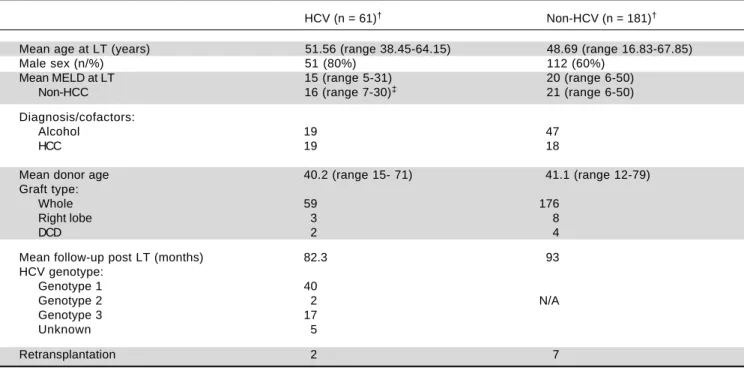
Table 2. Patient clinical characteristics comparing HCV and non-HCV cohort.
HCV (n = 61)† Non-HCV (n = 181)†
Mean age at LT (years) 51.56 (range 38.45-64.15) 48.69 (range 16.83-67.85)
Male sex (n/%) 51 (80%) 112 (60%)
Mean MELD at LT 15 (range 5-31) 20 (range 6-50)
Non-HCC 16 (range 7-30)‡ 21 (range 6-50)
Diagnosis/cofactors:
Alcohol 19 47
HCC 19 18
Mean donor age 40.2 (range 15- 71) 41.1 (range 12-79)
Graft type:
Whole 59 176
Right lobe 3 8
DCD 2 4
Mean follow-up post LT (months) 82.3 93
HCV genotype:
Genotype 1 40
Genotype 2 2 N/A
Genotype 3 17
Unknown 5
Retransplantation 2 7
† 64 transplants in 61 patients in the HCV cohort; 188 transplants in 181 patients in the non-HCV cohort. ‡ 2 patients had MELD of less than 10, they were
transplanted pre-MELD era.
Statistical analysis
All analyses were performed using Stata version 12.0 (StataCorp, Texas, USA). Univariate and multivariate anal-ysis of survival and graft outcomes were assessed using Cox regression. Factors assessed in the univariate analysis for association with patient and graft survival were those listed in table 1. These factors were selected on the basis of prior literature identification and/or biological plausi-bility. All factors except for age, Child-Pugh and MELD scorewere included in the models as categorical variables and a global test of significance were performed for factors with more than 2 categories. Factors considered for inclu-sion in forward stepwise multivariate analysis were those that were significant at p<0.2 in univariate analysis. We also plotted crude survival rates using Kaplan-Meier curves and presented the associated log-rank statistics. Survival rates of HCV patients from our own unit were compared with HCV patients from the SRTR using direct standardization. Each patient’s follow-up time was split by calendar year and the total follow-up time in each year was multiplied by the known calendar year specific survival rates from SRTR or the same calendar period (1995 to 2012) to provide the expected number of deaths. The standardized mortality ratio was calculated as the ob-served/expected number of deaths with 95% confidence intervals obtained using the Breslow and Day approximation.
All hypotheses were performed as two-tailed tests with a type 1 error rate of p < 0.05 considered significant.
RESULTS
Patient characteristics
A total of 61 patients were HCV-PCR positive at LT, representing 24% (61 of 252) of all patients transplanted during the study period. Patient clinical characteristics comparing HCV and non-HCV cohort are shown in table 2. The volume of LTs increased steadily over the period of study (Figure 1) from 6 per year in 1992 - 1996 to 22 per year in 2007 - 2011.
Patient and graft survival for HCV and non-HCV cohorts
Patient survival during the first 5 years post LT for HCV and non-HCV patients is shown in figure 2A. Pa-tient survival at 1, 3, and 5 years in the HCV cohort was 95.2, 82.9, and 78.2% respectively. Patient survival for the non-HCV cohort at 1, 3, and 5 years was 93.0, 88.8, and 85.4% respectively. There was no significant difference be-tween the cohorts (p = 0.23).
81.1% respectively. There was no significant difference be-tween the survival curves (p = 0.35) (Figure 2B).
Overall patient and graft survival for both HCV and non HCV cohorts are shown in figure 3.
There were 16 deaths in the HCV cohort and causes were as follows; recurrence of HCV infection with subse-quent end stage liver failure (13), primary non-graft func-tion (1), recurrence of hepatocellular carcinoma (1), sepsis (1). There were 38 deaths in the non-HCV cohort and causes were as follows; sepsis (9), de novo malignancy (8), HCC recurrence (3), cardiovascular disease (3), intra-operative death (3), multi-organ failure (2), disease recur-rence for primary biliary cirrhosis and alcoholic liver disease (2), miscellaneous (3) and unknown (5).
HCC was an indication for LT in 19 (31%) of HCV patients and in 18 (10%) of the non-HCV cohort.
Figure 2. Figure 2. Figure 2. Figure 2.
Figure 2. Five-year patient (AAAA) and graft (BA BBBB) survival of hcv and non-hcv cohorts at south australian liver transplant unit. A.
A. A. A.
A. Five years overall survival.
Figure 3. Figure 3. Figure 3. Figure 3.
Figure 3. Overall patient (AAAA) and graft (BA BBBB) survival of hcv and non-hcv cohorts at south australian liver transplant unit. Figure 1.
Figure 1. Figure 1. Figure 1.
Figure 1. Number of liver transplants per year performed by the South Australian Liver Transplant Unit.
25
20
15
10
5
0
1992 1994 1996 1998 2000 2002 2004 2006 2008 2010 2012
Transplants (n)
Number at risk
Non-HCV 180 88 43 17 0
HCV 61 26 7 1 0
0 5 10 15 20
Time (years) 1.00
0.75
0.50
0.25
0.00
Log-rank test; p = 0.23 Non-HCV
HCV Number at risk
Non-HCV 180 154 139 122 101 88
HCV 61 52 40 35 32 26
0 1 2 3 4 5
Time (years) 1.00
0.90
0.80
0.70
0.60
0.50
Log-rank test; p = 0.33
Non-HCV
HCV
Number at risk
Non-HCV 180 154 139 122 101 88
HCV 61 52 40 35 32 26
0 1 2 3 4 5
Time (years) 1.00
0.90
0.80
0.70
0.60
0.50
Non-HCV
HCV B.
B. B.
B. B. Five years graft survival.
A. A. A. A.
A. Overall survival. B. B. B. B. B. Graft survival.
Number at risk
Non-HCV 180 82 41 15 0
HCV 61 26 7 0 0
0 5 10 15 20
Time (years) 1.00
0.75
0.50
0.25
0.00
Log-rank test; p = 0.35 Non-HCV
A significant side effect profile was associated with treatment of this cohort. Most (17/25 patients, 68%) pa-tients developed adverse events that included; cytopaenias requiring supportive therapy (absolute neutrophil count 500-750/mm3 or platelet count < 25,000mm3 or
haemo-globin < 10 g/dL), neuropsychiatric symptoms and de-compensated liver failure. Nine patients had treatment ceased prematurely due to significant side effects.
Comparison of post LT HCV outcomes between SALTU and large transplant registries
Although difficult to statistically compare our figures with available large databases, patient survival at both 1 and 5 years for SALTU patients (95.2 and 78.2%) appears non-inferior to survival rates from ANZLTR (89 and 78%), ELTR (81 and 64%) and SRTR (81 and 75%) databases for an equivalent era.
Direct, time-standardized comparison was possible be-tween our HCV cohort and the SRTR HCV cohort. Dur-ing the follow-up period the first HCV patient was operated on in 1995 and the last in 2012. The total follow-up time observed was 299.9 years amongst 61 patients in which there were 16 deaths. The expected number of deaths was 40.4 and the standardized mortality ratio 0.40 (95% CI = 0.24, 0.65). This analysis demonstrated a signif-icantly, lower mortality rate for SALTU HCV patients un-dergoing LT relative to the SRTR HCV cohort.
Factors predicting patient and graft survival in HCV patients post LT
Table 1 shows 22 clinically relevant variables that were assessed for association with patient death and graft loss for the HCV cohort.
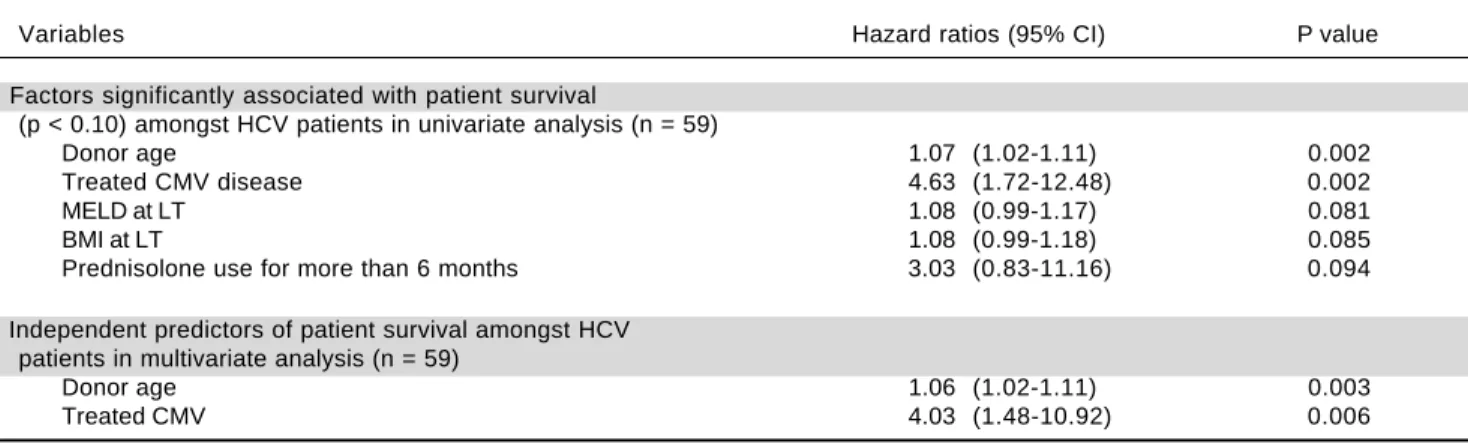
Table 3 shows variables that were significantly associat-ed with patient death in univariate (Table 3A) and multi-variate analysis (Table 3B) respectively. Donor age (HR =
Table 3. Factors significantly associated with patient survival.
Variables Hazard ratios (95% CI) P value
A. Factors significantly associated with patient survival
(p < 0.10) amongst HCV patients in univariate analysis (n = 59)
Donor age 1.07 (1.02-1.11) 0.002
Treated CMV disease 4.63 (1.72-12.48) 0.002
MELD at LT 1.08 (0.99-1.17) 0.081
BMI at LT 1.08 (0.99-1.18) 0.085
Prednisolone use for more than 6 months 3.03 (0.83-11.16) 0.094
B. Independent predictors of patient survival amongst HCV patients in multivariate analysis (n = 59)
Donor age 1.06 (1.02-1.11) 0.003
Treated CMV 4.03 (1.48-10.92) 0.006
HCC recurrence was seen in 2 (11%) of the HCV patients and 5 (28 %) of the non-HCV patients. The overall HCC recurrence rate was 19%.
Three patients experienced primary graft non-function, one HCV patient and two in the non-HCV cohort. Two of these patients underwent re-transplantation (1 HCV, 1 non-HCV) with only the non-HCV patient surviving the peri-operative period.
Causes of graft loss in the 2 patients in the HCV co-hort, not accompanied by patient death due to re-trans-plantation, were recurrence of HCV infection in one patient and hepatic artery thrombosis in the other patient. In addition to the two re-transplants in the HCV cohort, there were 7 re-transplants performed in the non-HCV cohort for the following indications; hepatic artery throm-bosis (2), chronic rejection (2), hepatic artery aneurysm (1), primary graft non-function (1), and graft sepsis in pri-mary sclerosing cholangitis (1).
HCV recurrence and antiviral treatment following LT
Clinically significant HCV recurrence occurred in 25 (41%) of patients. In three (5%) of these patients the recur-rence pattern was consistent with focal cholestatic hepati-tis (FCH), with early (< 12 months), severe biochemical and histological cholestasis associated with high viral load. The remaining patients had a recurrence pattern more consistent with chronic HCV related progressive histological damage (Scheuer fibrosis score ≥ 2, elevated transaminases).
1.06, 95% CI = 1.02-1.11, p = 0.003) was independently as-sociated with patient death, with each 1 year increase in donor age associated with a 6% increased risk of patient death. Post LT CMV disease that required treatment (HR = 4.03, 95% CI 1.48-10.92; P = 0.06) was also inde-pendently associated with patient death, with an approxi-mately four fold increased risk of death for patients treated for CMV disease.
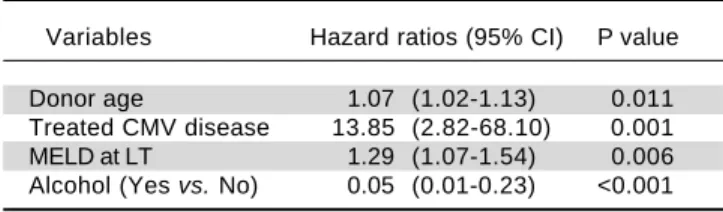
Findings were similar for the analysis of variables asso-ciated with graft loss, shown in table 4, with donor age (HR=1.06, 95% CI = 1.02-1.11, p = 0.009), and treated CMV disease (HR = 4.9, 95% CI = 1.8-13.2, p = 0.002), both independently associated with graft loss. In addition the absence of alcohol as a cofactor for liver injury prior to LT (HR = 0.02, 95% CI = 0.04-0.87, p≤0.03) was a fur-thervariable independently associated with graft loss.
A total of 8 (13%) HCV patients experienced single epi-sodes of biopsy proven acute cellular rejection of suffi-cient histological and biochemical severity to require high dose steroid boluses. Although steroid bolus has been as-sociated with adverse outcomes in multiple prior studies, there was no association with either poor patient or graft survival in this study.
DISCUSSION
The main purpose of this paper was to examine out-comes for HCV transplantation in a low volume unit given the importance of this condition and concerns about poor outcomes associated with LT for this indication and for small volume units.3,7
The important finding from this paper was that out-comes in HCV patients in our low volume unit compared favourably to those from the large SRTR database, using a standardized mortality comparison. Indeed our HCV co-hort had a significant, 60% lower standardized mortality rate relative to the SRTR HCV cohort.
Some caution is required in drawing direct comparisons between outcomes in our centre with the SRTR database. Although this analysis was standardized by year, it was not standardized by other factors such as MELD score and do-nor age and we cannot exclude that these factors, rather than structural and process factors discussed below, accounted
for the better survival of our cohort. Although beyond the scope of our study, further studies adjusting for the effects of MELD score, donor age, and other relevant factors would be highly desirable when comparing outcomes between small and large units.
The better than expected outcomes within this small volume unit are likely to have a number of explanations. Good donor and recipient selection with young donor age (mean of 40.2 years) and low recipient MELD score at the time of LT (mean of 15.1) were likely to be important contributors to good outcomes, and the importance of these factors on severity of HCV recurrence and patient survival has been well described.10 It should be noted that
low MELD scores seen in this population are in part relat-ed to patients with HCV who were transplantrelat-ed prrelat-edomi- predomi-nantly for HCC. The mean MELD score of non-HCC patients transplanted for HCC was above 15, the recog-nized break point favouring transplantation.The deleteri-ous effects of CMV infection on patient and graft survival has also been well described, and it remains unclear if these effects are mediated via CMV induced enhanced im-munosuppression or enhanced HCV replication.11
The low volume of LTs performed at our centre did not appear to adversely influence patient outcomes. Ef-fects of centre volume on patient outcomes following LT and non-transplant procedures are controversial. Although some studies have suggested an association between low volume and poorer patient and graft outcomes,6-8 two
re-cent large scale cohort studies have challenged these find-ings.12,13 Reese, et al.were unable to find a significant
difference in 1-year graft survival following liver retrans-plantation between low (< 50 LT per year), intermediate (50-88 LT per year) and high volume (>88 LT per year) units in a study assessing the recorded outcomes of over 4,000 patients within the Organ Procurement Transplanta-tion Network registry.12 Similarly, Kilic, et al. found that
centre volume was a relatively minor contributor to 1 and 5-year mortality in orthotopic heart transplantation, in a study involving approximately 20,000 patients from the United Network for Organ Sharing registry.13
In view of these studies and our own data, it is plausi-ble that there are important institutional factors beyond patient selection and centre volume that impact on patient outcomes. Indeed, Donabedian principles, which are widely recognized as a valid methodology for assessing quality in health care, require an assessment of institution-al structure and processes, in addition to outcomes.14
Structural factors that authors believe to have contribut-ed to good outcomes include; rapid access to on-site inten-sive care, interventional radiology, liver biopsy and drug assay services. Continuous clinician education is consid-ered another important structural factor for our institution with clinicians from all groups (including hepatology,
Table 4. Factors independently associated with graft survival in multivariate analysis (n = 52).†
Variables Hazard ratios (95% CI) P value
Donor age 1.07 (1.02-1.13) 0.011
Treated CMV disease 13.85 (2.82-68.10) 0.001
MELD at LT 1.29 (1.07-1.54) 0.006
Alcohol (Yes vs. No) 0.05 (0.01-0.23) <0.001
surgery, anaesthetic, intensive care, and transplant co-ordi-nation) receiving periods of external training in large vol-ume centres. A final important structural factor within our institution is a strong commitment to quality and safety principles. Examples of this include; continuous audits, ex-ternal reviews, availability of evidence based transplant pro-tocols to standardize care and weekly multidisciplinary meetings.
A process factor that authors consider to be strength of our institution is the ability to rescue sick patients fol-lowing LT from complications, this being increasingly recognized as an important measure of institutional qual-ity and an explanation for higher mortalqual-ity following complex surgeries in low volume centers.15 The two
main process factors contributing to this ability are high clinician staffing ratios across all areas of patient care and a high number of Intensive Care beds and staff providing rapid 24-h Intensive Care access for deteriorating LT patients. Of relevance are high staffing levels of registered nurses who are at the front line of patient care and can provide high levels of vigilance for deteriorating patients. Indeed, the association of registered nurses staffing levels with lower patient mortality, adverse events and improved care has been noted previously by several investiga-tors.16,17
The second factor that authors consider critical to the ability of our institution to rescue sick patients is the availability of a rapid access-to-care pathway for deteriorat-ing patients in the community. This pathway is available to all LT patients via transplant coordinators, who provide a 24-h 7-day per week telephone contact service for urgent patient problems. The coordinators, who develop strong therapeutic relationships with patients, can help efficient-ly navigate complex medical structures for sick patients by contact with on call clinicians and prompt organization of inpatient beds under the care of specialized clinicians.
A limitation of this study is that it represents a small single centre report and cannot provide definitive conclu-sions about outcomes for HCV transplantation and their relationship to centre volume. In addition while the re-sults compare favourably with those from large transplant registries, a direct comparison that standardizes for all rel-evant factors beyond era was not possible. However, the report confirms that excellent outcomes for complex sur-gical procedures can be achieved in small volume centres and reinforces findings from other larger studies that vol-ume is not always a powerful determinant of outcome.12,13
CONCLUSION
We present outcome data for patients with HCV fol-lowing LT in a small volume unit. We demonstrated that better than expected and above average outcomes are
feasi-ble in this setting. While acknowledging the influence of patient selection in achieving these outcomes (young do-nor age and low recipient MELD score), we also specu-late about other important institution specific contributors to successful outcomes for HCV patients. Such institutional structural and process factors are also likely to help overcome the potential negative effects on outcomes of low volume units. Quantifying these institu-tional factors and studying their effects in larger, multi-center studies would contribute further to our understanding of outcomes following LT and is an impor-tant area for further research given the common situation of low volume units performing complex medical proce-dures in the Australian Healthcare system.
ABBREVIATIONS
• CMV: cytomegalovirus. • HCC: hepatocellular cancer. • HCV: chronic hepatitis C. • LT: liver transplantation.
• MELD: Model of End Stage Liver disease.
• SALTU: South Australia Liver Transplant Unit.
ACKNOWLEDGEMENTS
Authors acknowledge all staff involved with the care of transplant patients at Flinders Medical centre. Authors specifically acknowledge the contributions of Shabnah-Ratnarajah with collection of data and Sonja Jamieson and Monica Beattie for secretarial support required with prep-aration of the manuscript.
REFERENCES
1. Lynch SV, Balderson GA. ANZLT Registry Report 2010. Australia and New Zealand Liver Transplant Registry, Bris-bane, QLD, Australia.
2. Thuluvath PJ, Guidinger MK, Fung JJ, Johnson LB, Rayhill SC, Pelletier SJ.Liver Transplantation in the United States, 1999-2008. Am J Transpl 2010; 10: 1003-19.
3. Forman LM, Lewis JD, Berlin JA, Feldman HI, Lucey MR. The Association between Hepatitis C infection and Survival after Orthotopic Liver Transplantation. Gastroenterology 2002; 122: 889-96.
4. Adam R, Karam V, Delvart V, O’Grady J, Mirza D, Klempnauer J, Castaing D, et al. Evolution of indications and results of liver transplantation in Europe. A report from the European Liver Transplant Registry (ELTR). J Hepatol 2012; 57: 675-88. 5. Firpi RJ, Clark V, Soldevila-Pico C, Morelli G, Cabrera R, Levy
C, Machicao VI, et al. The Natural History of Hepatitis C Cir-rhosis After Liver Transplantation. Liver Transpl 2009; 15: 1063-71.
7. Axelrod DA, Guidinger MK, McCullough KP, Leichtman AB, Punch JD, Merion RM. Association of center volume with outcome after liver and kidney transplantation. Am J Transpl
2004; 4: 920-7.
8. Edwards EB, Roberts JP, McBride MA, Schulak JA, Hunsick-er LG. The effect of the volume of procedures at transplan-tation centers on mortality after liver transplantransplan-tation. N Eng J Med 1999; 341: 2049-53.
9. Shepherd L, O’Carroll RE, Fergusson E. An international comparison of deceased and living organ donation/trans-plant rates in opt-in and opt-out systems:a panel study. BMC Med 2014; 12: 131.
10. Akamatsu N, Sugawara Y. Liver Transplantation and Hepati-tis C. Int J Hepatol 2012: 686135. Published online 2012 Jul 26. doi: 10.1155/2012/686135
11. Burak KW, Kremers WK, Batts KP, Wiesner RH, Rosen CB, Razonable RR, Paya CV, et al. Impact of cytomegalovirus in-fection, year of transplantation, and donor age on outcomes after liver transplantation for hepatitis C. Liver Transplanta-tion 2002;8(4):362-9.
12. Reese PP, Yeh H, Thomasson AM, Shults J, Markmann JF. Transplant center volume and outcomes after liver retrans-plantation. Am J Transplant 2009; 9: 309-17.
13. Kilic A, Weiss ES, Yuh DD, Shah AS, Cameron DE, Baum-gartner WA, Conte JV. Institutional factors beyond
procedur-al volume significantly impact center variability in outcomes after orthotopic heart transplantation. Ann Surg 2012; 256: 616-23.
14. Evaluating the quality of medical care. Milbank Memorial Fund Quarterly 1966; 44: 166-206.
15. Ghaferi AA, Birkmeyer JD, Dimick JB. Hospital volume and failure to rescue with high-risk surgery.Med Care 2011; 49: 1076-81.
16. Kan RL, Shamliyan TA, Mueller C, Duval S, Wilt TJ. The asso-ciation of registered nurse staffing levels and patient out-comes. Med Care 2007; 45: 1195-204.
17. Needleman J, Buerhaus P, Mattke S, Stewart M, Zelevinsky K. Nurse-staffing levels and the quality of care in hospitals.
N Engl J Med 2002; 346: 1715-22.
Correspondence and reprint request:
Alan J.Wigg, MBBS, FRACP, PhD
Flinders Medical Centre, Flinders Drive, Bedford Park. P.C. 5042. Adelaide, South Australia. Australia.