UNIVERSIDAD TÉCNICA PARTICULAR DE LOJA
La Universidad Católica de Loja
ÁREA SOCIOHUMANÍSTICA
TÍTULO DE LICENCIADO EN CIENCIAS DE LA EDUCACIÓN
MENCIÓN INGLES
Teachers and students´ perceptions of teaching English in small classes in
Ecuador
TRABAJO DE FIN DE TITULACIÓN
AUTOR: Grossenbacher, André Cosmos
DIRECTOR: Vargas Saritama, Alba Bitalina, Mgs
CENTRO UNIVERSITARIO LOJA
ii
APROBACIÓN DEL DIRECTOR DEL TRABAJO DE FIN DE TITULACIÓN
Magister.
Alba Bitalina Vargas Saritama
DOCENTE DE LA TITULACIÓN
De mi consideración:
El presente trabajo de fin de titulación: ”Teachers and students´ perceptions of teaching
English in small classes in Ecuador”, realizado por Grossenbacher André Cosmos, ha sido
orientado y revisado durante su ejecución, por lo tanto se aprueba la presentación del mismo.
Loja, Abril de 2015
iii
DECLARACIÓN DE AUTORÍA Y CESIÓN DE DERECHOS
“Yo, Grossenbacher André Cosmos declaro ser autor del presente trabajo de fin de titulación: ”Teachers and students´perceptions of teaching English in small clases in Ecuador” de la titulación de Ciencias de la Educación mención Inglés, siendo Alba Bitalina Vargas
Saritama directora del presente trabajo; y eximo expresamente a la Universidad Técnica
Particular de Loja y a sus representantes legales de posibles reclamos o acciones legales.
Además certifico que las ideas, conceptos, procedimientos y resultados vertidos en el presente
trabajo investigativo, son de mi exclusiva responsabilidad.
Adicionalmente, Adicionalmente, declaro conocer y aceptar la disposición del Art. 88
del Estatuto Orgánico de la Universidad Técnica Particular de Loja que en su parte pertinente
textualmente dice: “(…)forman parte del patrimonio de la Universidad la propiedad
intelectual de investigaciones, trabajos científicos o técnicos y tesis de grado que se realicen a
través, o con el apoyo financiero, académico o institucional (operativo) de la Universidad”
...
Grossenbacher André Cosmos
iv
DEDICATION
This thesis is dedicated to my family, especially to my wife Bachi and our two
beautiful girls, whose love and care supported me throughout this process and gave me the
strength to finish it successfully. I also dedicate this research to my mother and mother-in-law
who did whatever was needed so I was able to fully focus on this paper.
v
ACKNOWLEDGEMENT
I thank the teachers and staff at the institution that allowed me to conduct this
research. In addition, I must send a heart-felt “Thank you” for the patience and unerring guidance of Mgs. Alba Vargas.
vi
CONTENT
COVER……….……….……….i
APROBACIÓN DEL DIRECTOR DEL TRABAJO DE FIN DE TITULACIÓN ... ii
DECLARACION DE AUTORIA Y CESION DE DERECHOS ... iii
DEDICATION ... iv
ACKNOWLEDGMENT ……….………..v
CONTENTS ... vi
ABSTRACT……….……….………...……….……..1
RESUMEN…. ... 2
INTRODUCTION ... 3
METHOD ... 6
DISCUSSION ... 8
Literature Review ... 8
Description, Analysis, and Interpretation of Results ... 23
Conclusions . ... 51
Recommendations . ... 52
REFERENCES ... 53
1
ABSTRACT
This research addressed the topic “Teachers and students´ perceptions of teaching English in
small classes in Ecuador”. This study was initiated to investigate the benefits, strategies, resources,
sentiments and limitations found within small Ecuadorian English classes according to teachers,
students and observations.
The samples taken in this research were from an English language institute located in Loja,
Ecuador. The sample population was comprised of 63 students ranging in age from 13 to 23 and 5
English teachers throughout 5 different classes. The pupils and instructors were surveyed using a
questionnaire containing 22 statements divided into four sections (8 items focusing on benefits of
small classes, 8 items focusing on strategies and resources used in small classes, 4 items of sentiment
and 2 items addressing limitations in small classes).
The obtained results were analyzed using the quantitative and qualitative methods. It was
concluded that students in small classes are able to effectively practice the English language through
the implementation of various activities.
2
RESUMEN
Este proyecto de investigación abordó el tema "Las percepciones que existen entre estudiantes
y maestros en la enseñanza del idioma inglés en clases con pocos estudiantes en Ecuador". El
proyecto fue iniciado para investigar los beneficios, estrategias, recursos, sentimientos y limitaciones
encontradas en clases de inglés con pocos estudiantes en colegios ecuatorianos según los maestros,
estudiantes y observaciones realizadas.
Las muestras tomadas fueron de un Instituto de Inglés ubicado en Loja, Ecuador. La muestra
fue compuesta por 63 estudiantes que van en edades de 13 a 23años, 5 profesores de inglés a lo largo
de 5 clases diferentes. Los alumnos y profesores tomaron un cuestionario que contiene 22
interrogantes divididas en cuatro secciones (8 interrogantes centrándose en los beneficios de las
clases pequeñas, 8 interrogantes centrándose en las estrategias y los recursos utilizados en clases
pequeñas, 4 interrogantes acerca de lo que sienten y 2 abordan las limitaciones de las clases
pequeñas).
Los resultados se analizaron utilizando los métodos cuantitativos y cualitativos. Llegando a la
conclusión que los estudiantes en clases pequeñas son capaces de practicar eficazmente el idioma
inglés a través de la implementación de diversas actividades.
PALABRAS CLAVES: Enseñanza de Inglés, clases pequeñas, percepciones de profesores y
3
INTRODUCTION
Education in Ecuador has experienced a turbulent ascent over the centuries. Originally in the
1800´s the Catholic Church was responsible for the educational system in Ecuador but many changes
have taken place in part to people like Vicente Rocafuerte, Juan Leon Mera and Belasco Ibarra.
There have been constitutional amendments and legislative movements executed with the purpose of
improving the educational system and allowing everyone regardless of race, sex or disability to
receive an education. Knowing that education is a complex entity, the Ecuadorian government has
accepted the technical advice of UNESCO (United Nations Educational, Scientific and Cultural
Organization), OEA(Organizacion de Estados Americanos), USAID (United States Agency for
International Development) and the World Bank to improve the level of education.
Today we find ourselves living in an era of globalization where the unifying language is
English and those not able to communicate with it are being left behind. Once again the Ecuadorian
government is acting proactively to improve the next generation by teaming up with the University of
Mississippi to implement the “Go Teacher” program which is allowing numerous Ecuadorian English
teachers to receive additional training and scholarships to go to the United States to become better
teachers. The public Ecuadorian school system is seeing a helping hand from the Peace Corps
volunteers who are teaching English on two year rotations and the Fulbright Scholarship is being
offered to English teachers. Regardless of how much has been done to improve the educational
system, especially the level of English, students are leaving the secondary national school system
with 65% in English according to SENESCYT (National Secretariat for Higher Education, Science
and Technology).
To fully understand the complexity of this issue many facets must be investigated. This paper
4
research is to better understand if small classes are more beneficial than larger classes
according to students and teachers. The investigation was isolated into four areas: benefits of
small classes in respect to teaching and learning, beneficial strategies and resources used
during the instruction process of small English classes, student sentiments of the learning
process in small classes and limitations of teaching and learning in small English classes. The
relevance of this research will reveal new data of not only how students view the small class
environment but also the teachers viewpoints of teaching in small classes.
There has been previous research into class size before which relates to this study.
Harfitt (2012) set out to explore the differences in learning process between small and large
classes in Hong Kong high schools. The driving idea was that if there was a reduction in the
number of students in a class, there would be a reduction in learning stress. It was concluded
that small classes provided the appropriate learning environment that created high quality
learning more often than large classes. This study was limited by only focusing on four cases
(four teachers and eight classes) and any conclusions made were tentative at best.
Sanogo & Gilman (1994) compared data obtained from the Tennessee´s STAR and
Indiana´s Prime Time Projects in order to further understand if there was a direct correlation
between student achievement and class size. The results of this investigation conclusively
determined that small classes were advantageous over larger classes in respect to resulting
standardized tests.
Blatchford, Bassett, Goldstein & Clare (2003) conducted research in the United
Kingdom to determine if class size had an effect upon students´ academic achievement.
Approximately 10,000 primary aged children took part in the research with the results
5
The above mentioned studies justify the importance of discovering the perceptions of the
teachers and students during the process of teaching English in small classes in Ecuador.
The beneficiaries of this research are mainly the students, however teachers will also benefit
from data obtained. The resulting data will contribute new information about small class limitations
and students sentiments of small classes. This research has opened the way for further investigation
into small class limitations and students emotional status in small classes vs. big classes.
The research was limited by the fact that only 63 students and 5 teachers were surveyed. Even
though the resulting information was consistent, it remains a small sample and in future investigations
6
METHOD
Setting and Participants
This investigation was conducted at a private language institute located in Loja, Ecuador. The
population sample consisted of 63 students ranging in age from 13 to 23 and their level of study was a
B2 according to the Common European Framework of Reference for Language. In addition there
were 5 English teachers surveyed, 4 of whom were native English speakers.
Procedures
The initial step was to research previous literature related to this study. There were two
different sources that the literature was derived from which were books and journal articles. The
information was found on the Internet, Universidad Técnica Particular de Loja (UTPL) physical and
virtual libraries. In particular Google Books and databases were exceptionally helpful, like ERIC and
dspace.
The instrument used to gather field information was a questionnaire see Annex A) that included
22 statements. It was divided into four sections: 8 statements about benefits of small classes, 8
statements about strategies and resources in small classes, 4 statements about feelings in small classes
and 2 statements about limitations of small classes. To apply this questionnaire, first authorization
was granted from the administration of an English language institute located in Loja, Ecuador and
then it was arranged for a convenient day with the teacher of each class. After arriving at the class,
the instructions were given in Spanish so there was no misunderstanding about what was expected
from the students. The investigator read each of the questions and allowed enough time for pupils to
respond to them. The same questionnaire was also given to the teachers (see Annex B) with similar
7
Annex C) and took notes for later review. The methods used for this research were quantitative and
qualitative.
After completing the questionnaires the information was calculated manually and entered into a
spreadsheet. At this point the data was converted into percentages for analysis of the four sections
queried. Results were double checked for accuracy before the analysis began.
Before and during the analysis of the information gathered from the surveys and observations
there were different aspects that were kept in mind. The first aspect to remember was the purpose of
the study while maintaining objectivity. The second aspect was to isolate each of the four sections
being analyzed (benefits, resources, emotions and limitations). Thirdly, the results from the Likert
scale ranging from “totally agree” to “disagree” were interpreted in respect to the question and
analyzed using percentages to identify trends resulting in the researcher arriving at conclusions and
recommendations. Finally, large variations or conflicting data needed to be analyzed with scrutiny to
8
DISSCUSSION
Literature Review
The global language has been set as English resulting in 25% of the worlds´ population having
the ability to communicate with it usefully according to Tsedal Neeley from Harvard Business
School. With the understanding that Ecuador is no longer in a state of economic crisis but in reality
is a flourishing emerging market in South America, it is logical that the administrative bodies are
strongly encouraging the implementation of English upon pupils to make sure that not only this
generation fares well but so does the country. In fact as of early 2014 there were 5 American
universities entered into agreements with the Ecuadorian government to train Ecuadorian teachers in
the field of English reported by Jaclyn Ambrecht who is associated with the Borgen Project.
More than two decades have passed since the Ecuadorian Ministry of Education made English
a mandatory subject in secondary schools, however pupils are still leaving high school with
inadequate English skills. Regardless of the new educational reforms, teacher training and
international programs the students are not producing at the appropriate level.
The factors of the teaching-learning process vary wildly, however one variable that this
research is going to investigate is small classes and the impact perceived by those involved.
Managing Learning
The learning process is often referred to as a natural cycle that we are all exposed to from day
to day activities since early childhood. However, the flipside to this natural occurring phenomenon is
the more structured learning that we find in the classroom environment. In order to teach effectively
many aspects must be considered, but a focus on instructions, feedback and timing are paramount.
9
process and in the following paragraphs some of these issues will be discussed. The skills that
compose learning management are truly the foundation of any teachers´ success.
Both Ridnouer (2006) and Ur (1991) agree that instructions must be made clear from the
beginning of class in order to avoid confusion. Ridnouer (2006) elaborated upon this idea by
claiming that instructions given poorly are a major source of problems in the teaching environment.
By giving a class clear instructions from the beginning the teacher is essentially eliminating an
immediate problem and saving time. In addition Gower, Phillips & Walters (1995) claim that if
teachers do not give students handouts or other material before explaining the task, the instructions
are more likely to be followed accurately.
Students need to understand their errors in order to improve, and this is done through
evaluating the situation and giving constructive feedback. Harmer (2007) speaks about a variety of
techniques on how to give feedback to students where it does not impede the students´ production of
the language. Feedback is categorized as either explicit or implicit according to Harmer (2007).
Depending on the situation, the teacher may stop and correct the student in the moment ensuring they
know that a mistake has been made (explicit feedback). This form of feedback depends on the
judgment of the teacher to determine whether the error is relevant or not. Implicit feedback may take
the form of note taking by the teacher but no immediate response to the student is given. This is often
done during speaking activities because the interruption by the teacher would be counter productive.
Additionally, Brookmart (2008) states that one of the most powerful teaching tools available is
feedback. One of the obstacles for teachers is mastering how to properly assess feedback in a
productive manner. Gower, Philips & Walters (1995) delve deeper into the issue of feedback and
focus their attention on accuracy and fluency. It is important to decide and plan activities with the
10
Another important skill for class management is timing. It is an important skill that teachers
must obtain as classes are planned out and organized on this unit of measurement in the daily, weekly
and yearly lesson plans. Santrock (2010) points out that time management allows the teaching
process to be more productive with positive results by following a timed plan. This approach will
reduce stress upon the teacher and students as well. Gower, Philips & Walters (1995) have identified
that surprisingly much less teaching takes place in the average classroom due to punctuality,
disruptions, topic transition, late starts etc. The resulting objective is to overcome the amount of
unused time and broaden the amount of minutes disposable for learning which is referred to as
allocated time. The next step is to effectively use the time allocated to address the specific tasks to be
learned. Proper time allocation is only one of the many responsibilities that teachers must understand
and master in order to successfully manage academic learning.
Teacher-student, and student-student interaction
Both Harmer (1998) and Carrillo ( 2011) maintain that the teacher-student interaction is
important in the classroom. Establishing a teacher-student rapport is one of the first obstacles in
establishing a class and this will allow for a harmonious atmosphere. Harmer (1998) makes an
emphasis on using the students in a process known as “peer help”. The driving force behind this
theory is that the teacher pairs or groups strong students with weak ones where the students explain
the ideas to the others rather than the teacher repeating the material, thereby reducing stress upon the
teacher-student relationship. This is a method that must be executed with great care as to not alienate
the students who do not understanding the material and to not empower the knowledgeable students
to the point of an oppressive role. There is a fine balance where the teacher is slightly removed yet
ensuring the students are interacting in a productive manner. Harmer (1998) continues the idea of
11
most important aspects a teacher must perform. The true emphasis is placed on students being able to
learn as much as possible from any given activity. This means that teachers must make the objective
of every activity clear because if the students do not understand what they are supposed to do, it is
just a waste of time which may lead to chaos. Even if the instructions are understood, it is still the
responsibility of the instructor to motivate students to engage and participate. The overall view is that
teachers must organize activities so that students understand the objectives, are engaged and are
prepared to use the new information in a rewarding and enjoyable exercise.
Gower, Philips, Walter ( 2005) are also in agreement with Harmer (1998) and Carrillo (2011),
however they have gone on to identify a different issue which is using the communicative approach
in the classroom with authentic language. It is important that pupils avoid using their first language
and focus on the use of the target language. This teacher-student interaction revolves around the use
of authentic language with the teacher as the source. The key is that students should react naturally to
what the teacher says and this is done by the students picking up the expressions and everyday
language that is spoken by the teacher. This creates a bond between teacher and student where they
are communicating in a foreign language. This bond is the base where a good relationship is built
and students desire to continue the learning process because the interaction is rewarding. In these
situations we are acknowledging that teacher talk is required for learning a language inductively.
Useful expressions, calling on students by name and praising students is a wonderful way of injecting
natural useful language that can be learned and repeated by students. This type of interaction
between student and teacher results in a better relationship and a functional use of the language. A
supplementary idea is to have students listen to real listening and have them react to it with the L2
reasonably. Injecting anecdotes or jokes will also bring humor and fun to the classroom while
12
Carrillo (2011) brings a very human aspect to the teacher-student relationship
demanding that teachers must be experts on students and understanding their development in
the basic dimensions: cognitive, physical, emotional and social. It is paramount that active
teachers have a working understanding of what to look for in respect to students that are either
achieving above average or those that are being left behind. In addition, the teacher must
know how to meet the demands of the exceptional learners´ needs as well as those with
learning disabilities such as ADD and other communicative disorders. The teachers must
work with specialists to afford all students the ability to be successful.
Class size
The theme of class size has been the issue of much research which has focused on the
controversial issue of large classes vs. small classes. The size of a class is defined by the number of
students actively attending the course. The historic argument has been that large classes have more
drawbacks than small classes do and as a result students do not receive as good an education in large
classes.
Byram (2004) investigated what is considered to be large classes and consequently came to
the realization that the size of a class does not automatically translate to a poorer quality of teaching
and learning. Instead of focusing immediate negative attention on the number of students, Byram
(2004) gave attention to the components of the class such as teaching methods, organizing
interactions, individual attention and feedback. In essence, the quality of education is not
unconditionally tied to the number of students but is strongly influenced by the teachers themselves.
If the perception of the teacher is that the class is too large, this negative focus will be realized with a
teacher that cannot or will not use correct methodology to control and teach a class. It has been
13
number of students. It is important that the teachers do not become overwhelmed with having to
correct the students´ work, so activities must be organized where the instructor may assess students
quickly and efficiently. He continued to point out that what is considered “large” is open to
interpretation as this varies from country to country. For example in the UK a large class could be
defined as 30-40 students whereas in China a normal class is composed of 50 -60 students. Class size
is relative to what one is accustomed to. Byram (2004) does not overtly state that large classes are a
wonderful idea but that all sizes of classes can be managed successfully and this idea has been
supported by several studies in China.
Ballantine & Spade (2008) have concluded that classes containing less than 20 students are
beneficial in the early grades and extra gains are immediately realized. Small classes have more of an
impact in the primary education but the advantages carry on through high school. Their results
applied equally to boys and girls. The research specifically stated that the classes where well planned
and adequately funded which relates to Byrams (2004) research that implied a large influence of
success depends on the teacher.
Scrivener (2005) shares similar results as Byram (2004) and Ballantine & Spade (2008) in
respect to the objectivity of class size. Scrivener (2005) states that some teachers must work with an
excess of 100 students in one class setting which is not an unusual statement but he offers up why a
numerous class is difficult to manage. He claims that with large classes it is found that neither
students nor teachers have the ability to easily move about the classroom making it nearly impossible
to rearrange the seating of students for different activities. In addition, personal contact is lost and the
primary reason put forth is that eye contact is limited or lost with the inability to equally give
attention to each pupil resulting in a less unified class room environment. This type of large class
14
in the front receive the attention of the instructor. The teacher is left with only one option,
which is to lecture, adding to the monotony of an uneventful class.
Teaching techniques, strategies or activities for teaching English to small classes
It has been established that there are many fundamental differences between small classes and
large classes. Due to the amount of pupils in different classes, teachers have adjusted their teaching
techniques, strategies and activities for smaller classes to become more effective.
Lewis & Hill (1997) suggest to use to-teacher (T-T), to-class (T-C),
teacher-to-student (T-S), student-to-teacher (S-T) and student-teacher-to-student (S-S) activities to learn the new
material. It is implied that in a small class it is easier to change activities quickly and keep the
attention of the class. The majority of all activities put forth by the authors, requires using the
material in context first, teaching the material and then using the new material in an activity. Another
strategy to use with small classes, is to use the seating arrangement to the teachers´ advantage. For
example, when giving a lesson have the students in orderly rows but when doing group activities have
the students physically move the seating arrangement as to effectively facilitate the teaching-learning
process. In small classes re-arranging the class can be done quickly and in a timely manner to afford
efficiency to the learning process.
Herrell & Jordan ( 2012) explain in detail how to maintain small classes. Dealing with
smaller classes presents a variety of positive and negative aspects that teachers must address. In order
for teachers to cope with smaller classes the authors presented a check list of things to have ready.
Often in reduced size classes activities and lessons finish quicker than in larger classes. In case this
happens it is suggested to have ready “fillers” such as games or puzzles. It is helpful to choose activities that do not need materials or complicated instructions, for example: 20 questions, can´t say
15
to reinforce any grammar or vocabulary exercise. For instance if the class was learning new
vocabulary about the body, the teacher could try a game of hangman. All that would be needed is a
marker and a whiteboard. It is a fun way to practice what has been learned, promotes competition
among students and fills in the rest of the class. Another simple yet effective “filler” is to review often. In this instance it is more academic rather than a fun activity. Once again the materials needed
would be the material recently taught and students´ material such as their books and notebooks. By
reviewing often the students will be better prepared for exams and experience less test stress. Other
ways of changing the small class environment is to exchange some students with other classes. By
inviting students from other classrooms in, the class dynamic can be changed which can increase the
motivation for students to learn or review. It was suggested to pair higher level students with lower
level students in order to give students the opportunity to teach. The small class will benefit greatly
from asking for feedback from the students. The idea of a suggestion box creates anonymity and
opportunity for teachers to improve different aspects of the class. In addition to the above mentioned
ways to cope with small classes there were several activities suggested for small classes such as:
using English newspapers in class, playing English music in class, storytelling, chain writing,
role-playing, board games, online lessons, films, class excursions and guest speakers. Using English
newspapers (or printed online articles) about recent events allows for a wide range of new vocabulary
to be learned and known grammar to be read in context. The use of popular English music played in
class is a good way to end a lesson by teaching pronunciation, intonation, introduce expressions and
to enjoy a few minutes with the students. Regardless of what is being taught, it is suggested that
teachers keep a variety of interesting activities on hand to help reinforce students´ knowledge and use
every minute of class time.
16
Harmer (1998) specifies that smaller classes benefit from different seating arrangements such
as circles or horseshoes. The environment is different in this setting because it breaks away from the
standard rows of desks and places the students around the teacher. This form of seating arrangement
is beneficial for games, a variety of activities or any kind of open space that is required in the middle
of the room. In addition it creates a more personal atmosphere where students and teachers are able
to build better relationships while sharing and learning. In both the horseshoe and circle
arrangements the board, overhead projector or whatever other type of presentation can still be made
and seen by all in the room. One of the underlying ideas behind this is that by breaking out of a
normal routine the students will remain engaged and interested in the class.
Ballentine & Spade (2008) mention similar seating situations in their works as did Harmer
(1998), but have gone on to focus specifically on the conduct of the students in both large and small
classrooms instead of the teacher. Poor discipline combined with classroom management problems,
are key areas that hinder instruction. The authors theorize that these problems still exist in smaller
classrooms but are less obvious due to the size of the class. After comparing the large and small
classrooms it was deduced that teachers in reduced size classes experience less stress. This results
with the teachers being able to give pupils more attention during the learning experience. It is noted
that small instructional groups within the class can also create an ambiance where learning is not as
competitive and pupils are emboldened to form supportive relationships with one another. The most
important detail coming from Ballentine & Spade (2008) is that the environment in the small
classroom is structurally different from the large class environment. In the reduced size classes there
is a significantly reduced amount of time dedicated to classroom management and more time focused
on instruction. This resulted in pupils working at higher levels, teachers are able to give more support
17
The perception that small classes are superior to large classes is a long standing controversy.
For decades there have been intellectuals researching the inner workings of classrooms of various
sizes. Both students and teachers have been interviewed and observed in order to better understand
the dynamics of a class but specifically that of the small class. Prior investigations into this debate
have been executed by several different researchers and it is important to review these studies in
order to have a better understanding of the situation.
Harfitt (2012) conducted research on a small scale in Hong Kong to determine if and how it
could be possible to ease or pacify the stress felt by students acquiring foreign language skills by
reducing the number of students in the classroom.
The methodology in this case sample is unique in the sense that it did not just randomly pick
teachers instructing large classes and small classes, however, specifically isolated a teacher in a large
classroom environment and a small one. Data was collected by interviewing the same teacher on a
variety of occasions (total of 4 teachers) and individual interviews with all 231 students. In all, 78
lessons were observed in both environments.
The students reported results in a mature and confident manner about their experiences in
small classes claiming that it produced a sense of security within the community of the classroom. In
addition, pupils´ fears of negative peer-evaluation seemed to diminish as well as that of teacher
criticism. Confidence was boosted in respect to participating in class and these reports were verified
by the observers´ notes.
In conclusion, this study hints at valuable insights into language learning can being provided
by the students own voice. The research data shows that the students´ anxiety can be diminished in a
18
Harfitt (2012) executed a research study of secondary schools in Hong Kong to understand the
perceptions of English teachers when presented with large and small classes conducted at the same
grade level. In addition, it was sought out to determine the differences between practices and
perceptions of the same teacher, in the same grade.
The methodology was conducted using the qualitative method to collect data from 22
semi-structured interviews stemming from three different female teachers located at three different schools.
In addition there were 48 lessons observed. This was a multiple case study approach directed at
expanding upon theories of class size. In this study a “case” was comprised of one teacher instructing
a large and a small class of similar abilities.
The teachers all responded in a positive manner revealing that the benefits included less
classroom management problems, a better understanding of students and genuinely more
opportunities to teach the class. Surprisingly two of the three teachers did not change their pedagogy
from large to small classes. By using the same techniques in similar classes and not changing how
they operated the results were still more positive than in the larger classes.
In summary, further longitudinal studies are needed in order to understand the reality and
details of the classroom. These types of studies would permit investigators to record important
moments from instructors to move them into a better understanding of their teaching practices. These
further studies would also allow researchers to distinguish the fine differences of successful small
classes and larger less successful classes.
Blatchford, Bassett, Goldstein & Clare (2003) undertook a two-step study where they
attempted to verify if the students´ academic achievement was affected by the class size and secondly
to investigate the relationship between processes inside the classroom and class size. The method
19
Random selection of schools where chosen through the local school system and yet all the children
enrolled were included in the study. The schools were comprised of a wide variety of social
backgrounds located in urban, suburban and rural areas.
The resulting data indicated that the size of a class and the size of groups within classes were
connected. With classes in excess of 25 students there was a greater chance of a student ending up in
a group of students of 7-10. Qualitative analysis demonstrated that the educational environment was
less effective in larger groups. The resulting large classes had large groups which left teachers with
the perceptions that larger groups with children of this age had a negative effect on the quality of
teaching the students received. Some teachers reported that it was group size rather than class size
that had a more direct impact on teaching and classroom management. Most commonly the results
are grade oriented where in this study it was made abundantly clear that consideration should be
given to the management of in class groupings.
In conclusion, the first years of schooling are impressively impacted by the class size. These
results have been similar to that seen in the STAR project and confirmed by both experimental and
non-experimental research designs.
Konstantopoulo & Sun (2013) designed a research project with the purpose of determining if
reducing class size is simply enough to result in a positive change in student results. This idea again
amplified to magnify the question, is merely changing the amount of students in a class enough to
improve achievement scores.
Another purpose of the study was to focus on how teachers modify their teaching. The method used
to gather data was to first identify how many classes there were which was done by tabulating the
number of schools with however many classes there were and then sorting by small and regular size
20
(Stanford Achievement Test). Finally the results were separated by large and small classes to
determine differences.
The results indicated that throughout all grades there was a systematic evidence of effective
teaching in smaller classes. Both reading and math skills were noticeably better achieved in smaller
classes
In conclusion, an overwhelming amount of data indicates that teacher effects in early grades
are significant in both reading and mathematical achievement. The teachers´ effects were more
pronounced in smaller classes rather than regular sized classes. There were indicators that some
teachers changed their teaching approach in the classroom when dealing with small classes but this
was not the case with all teachers creating an additional variability in the outcome of student
achievement.
Din (1999) research provocatively approached the subject of class size with four purposes in
mind. The first factor addressed the question of what type of factor is class size? Secondly searching
out the benefits of having small classes in schools. Thirdly, identify the role that teachers and
students play in large classes to make teaching effective. Finally, to understand the perception of
how Chinese school teachers view these issues.
The method that was used in this research was the analytic method using a random survey in a
rural Chinese school district composed of 132 schools and 41,200 students. This research identifies a
class with more than 50 students as large, a class with 30 or fewer students as small.
The resulting data was collected from surveys sent out to rural Chinese teachers.
Unfortunately the return rate was only 55%. The teachers perceived a class with 45 to 50 students as
21
participated in the study indicated that they preferred to teach small classes and the 55th teacher said
“It does not matter to me.”
The research concluded that Chinese teachers in rural areas do not acknowledge a relationship
between student achievement and class size. However, these same teachers did believe that smaller
classes allowed for easier classroom management, better student-teacher interaction, individualized
attention to students and a reduction in the overall workload. There is a strong belief that competition
promotes learning in large classes among the students.
Sanogo & Gilman (1994) conducted comparative research using the Tennessee´s STAR
program and Indiana´s Prime Time projects as the selected data. These two projects were some of the
first major studies to investigate the results of large and small classes. Sanogo & Gilman (1994) set
out to determine if there were any contradictions between the STAR and Prime Time research work
to further the insight into class size issues.
The method employed to compare the above mentioned programs was to read the articles and
reports for background information and gather any other data that was relevant. The design and
methodologies of the programs were discussed, examined and interpreted in order to validate
hypotheses, make conclusions and offer recommendations. No other computation was done.
Sanogo & Gilman (1994) concluded that the methodologies and designs were very similar.
The primary contradiction encountered with the two projects was that the Department of Education in
Indiana did not include the entire state in the project whereas the Tennessee Association of Education
did do a state-wide investigation. In respect to the STAR program it was discovered that the
experimental group knew the objectives of the investigation and it is theorized that the subjects may
22
be implemented because of it. To sum up, neither project was implemented with a scientific attitude
and therefor became useless as the study was biased.
Alghamdi & Gillies ( 2013) conducted research with three objectives in mind. They desired
to understand the outcome of cooperative learning methodology compared to normal small group
learning against the success of reading, grammar and writing skills of EFL learners.
The methodology applied to this research began by having both the experimental and control
groups take a test assess their basic language skills. The same test was presented to the same groups
at the end of the study in order to measure progress. The exams were graded by an independent third
party that had no association with the study.
The concluding data indicated that there was a significant difference with both the
experimental and control groups while using the cooperative learning method rather than
traditional teaching. However, all small groups that were tested did improve at a
23
Description, Analysis, and Interpretation of Results
Due to the high demand for EFL classes in Ecuador, English teachers have many different
obstacles to deal with. One such obstacle is the size of the class they must teach. This makes it
necessary for administrators to look at new ways of improving education and one of those options is
by reducing class size. This research dealt with four components of small classes: benefits, strategies,
sentiment and limitations. The analysis of these variables will tell us more about the teachers´ and
students´ perception in small classes.
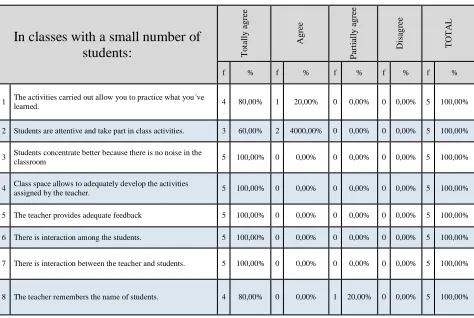
[image:29.612.84.558.384.702.2]Qualitative and Quantitative Analysis What are the benefits of teaching and learning English in small classes?
Table 1
Teachers´ Perceptions
In classes with a small number of
students:
Total ly ag ree A g ree Part ia ll y ag ree D is ag ree T O T A L
f % f % f % f % f %
1 The activities carried out allow you to practice what you´ve
learned. 4 80,00% 1 20,00% 0 0,00% 0 0,00% 5 100,00%
2 Students are attentive and take part in class activities. 3 60,00% 2 4000,00% 0 0,00% 0 0,00% 5 100,00%
3 Students concentrate better because there is no noise in the
classroom 5 100,00% 0 0,00% 0 0,00% 0 0,00% 5 100,00%
4 Class space allows to adequately develop the activities
assigned by the teacher. 5 100,00% 0 0,00% 0 0,00% 0 0,00% 5 100,00%
5 The teacher provides adequate feedback 5 100,00% 0 0,00% 0 0,00% 0 0,00% 5 100,00%
6 There is interaction among the students. 5 100,00% 0 0,00% 0 0,00% 0 0,00% 5 100,00%
7 There is interaction between the teacher and students. 5 100,00% 0 0,00% 0 0,00% 0 0,00% 5 100,00%
8 The teacher remembers the name of students. 4 80,00% 0 0,00% 1 20,00% 0 0,00% 5 100,00%
24
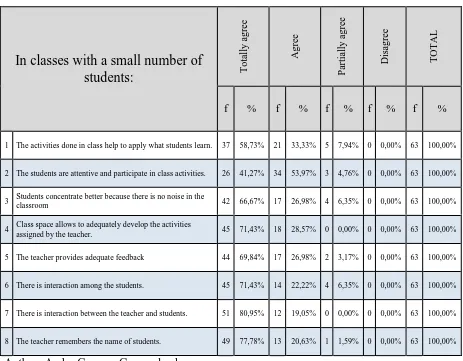
Table 2
Students´ Perceptions
In classes with a small number of
students:
Totally
agr
ee
Agr
ee
P
ar
ti
all
y
agr
ee
Dis
agr
ee
T
OT
AL
f % f % f % f % f %
1 The activities done in class help to apply what students learn. 37 58,73% 21 33,33% 5 7,94% 0 0,00% 63 100,00%
2 The students are attentive and participate in class activities. 26 41,27% 34 53,97% 3 4,76% 0 0,00% 63 100,00%
3 Students concentrate better because there is no noise in the
classroom 42 66,67% 17 26,98% 4 6,35% 0 0,00% 63 100,00%
4 Class space allows to adequately develop the activities
assigned by the teacher. 45 71,43% 18 28,57% 0 0,00% 0 0,00% 63 100,00%
5 The teacher provides adequate feedback 44 69,84% 17 26,98% 2 3,17% 0 0,00% 63 100,00%
6 There is interaction among the students. 45 71,43% 14 22,22% 4 6,35% 0 0,00% 63 100,00%
7 There is interaction between the teacher and students. 51 80,95% 12 19,05% 0 0,00% 0 0,00% 63 100,00%
8 The teacher remembers the name of students. 49 77,78% 13 20,63% 1 1,59% 0 0,00% 63 100,00%
Author: Andre Cosmos Grossenbacher Source: Students´ Questionnaire.
To better comprehend the benefits in small classes, a questionnaire was given to students and
teachers, eight different aspects were evaluated and scored based on students and teachers level of
agreement.
There was a strong positive attitude reflected by the students in respect to the benefits of small
classes which is reflected with the highest percentage of those surveyed marking the “totallyagree”
column. The overwhelming majority does feel that there are noteworthy benefits to the small class
25
Graph 1
Interaction exists between the teacher and students.
Author: Andre Cosmos Grossenbacher
Source: Teachers´ Questionnaire and Students´ Questionnaire
As illustrated in graph 1 this statement received the highest positive ratings found in this
survey.
The premise of teacher and student interaction received 80.95% in total agreement with the rest
of the students being in agreement with this statement. In addition, 100% of the teachers were in
agreement.
This statement is unique as it carries the highest percentage of people in complete agreement
and no negative feedback. Considering that there were 63 students and 5 teachers polled in this
questionnaire that means there were a total of 68 people, 100% of all surveyed, that felt the strongest
benefit experienced in small classes was that there was teacher student interaction.
These sentiments are supported by Harmer (1998) who believes that establishing
teacher-student rapport is one of the greatest obstacles to overcome in creating a harmonious class. It has
been interpreted that the interaction students are referring to is the individualized attention one is
expected to receive in small classes. Since the students polled were actually taking part in small
classes this is not theory but truly the resulting perceptions of high level English students
0% 20% 40% 60% 80% 100%
Totally agree Agree Partially
agree
Disagree
Students
26
experiencing the benefits of being able to interact more profoundly in a one-on-one setting . The
teachers´ responses reflect their attitudes toward having the opportunity to clearly communicate class
objectives with students and resolve any questions that remained.
During the researchers´ time in the 5 classes it was clear that teachers took their time with each
student and students took advantage of the opportunity to ask for clarity when needed. This resulted
in a more peaceful class and the class appeared to cover more material than a larger size class.
Carrillo (2011) emphasizes that by teachers being able to understand students basic dimensions
(cognitive, physical, emotional and social) the teacher-student relationship would improve and so
would student achievement.
Graph 2
The teacher remembers the names of the students.
Author: Andre Cosmos Grossenbacher
Source: Teachers´ Questionnaire and Students´ Questionnaire
Graph 2 shows that there is an overwhelming amount of support for the idea that the teacher is
able to remember the names of students in small classes. There was no negative feedback for this
0% 10% 20% 30% 40% 50% 60% 70% 80% 90% 100%
Totally agree
Agree Partially
agree
Disagree
Students
27
statement. The idea that the teacher was able to remember the students´ names in a smaller class
ranked as the second highest scoring statement in respect to beneficial attributes of small classes.
There was a resulting 77.78% in complete agreement, with only 1.59% (1 person) that partially
agreed and the rest of the students were in agreement with this concept. The analysis of this data
points to fewer students makes it easier for the teacher to remember their names.
The resulting data strongly indicates that both students and teachers see this as one of the
primary benefits of a small class and during the researchers observations it was noted that speaking to
students by name added to the intimacy of the classroom setting. The observer also reflected upon
the fact that 4 out of the 5 teachers were native English speakers who sometimes had to pronounce
and remember names that were foreign to them. This may be the reason for the one student who only
partially agreed with this benefit.
Graph 3
The class space allows you to properly complete the activities assigned.
Author: Andre Cosmos Grossenbacher
Source: Teachers´ Questionnaire and Students´ Questionnaire
0% 10% 20% 30% 40% 50% 60% 70% 80% 90% 100%
Totally agree
Agree Partially
agree
Disagree
Students
28
Again it is demonstrated that both students and teachers surveyed are in strong agreement that
there is enough space within the small class environment to complete given activities as shown in
graph 3. Resulting with no negative opinions, it may be assumed that space in the classroom is
adequate, 71.43% were found to be in total agreement while the remaining 28.57% of those surveyed
agreed with no negative responses. It is easy to understand why this is considered a benefit of any
class, however even more so in the classes that were observed because they were two hour intensive
classes that used a variety of group and individual activities to complete the teaching-learning cycle.
The teachers responded with 100% totally agreeing that the space was adequate for activities. The
researchers´ notes revealed that there were varying sized classrooms that allowed students to work
and allow space for the teacher to move about the room checking on the progression of the work.
Graph 4
Interaction exists between students.
Author: Andre Cosmos Grossenbacher
Source: Teachers´ Questionnaire and Students´ Questionnaire
As graph 4 illustrates, teachers and students strongly agree that there is interaction among
students. The benefit of students interacting with one another was reported back as having 71.43% in
complete agreement, 22.22% in agreement and 6.35% in partial agreement. The students have
0% 20% 40% 60% 80% 100%
Totally agree
Agree Partially
agree
Disagree
Students
29
reported that they interact with each other in a positive fashion and can be assumed that this is
considered academic interaction. Lewis & Hill (1997) claim that student-to-student (S-S) activities
allow the class to learn new material quickly and keep the attention of the class which supports the
premise of the original question. Having 93.65% in some form of positive agreement and only 6.35%
only partially agreeing with the original statement exemplifies the fact that students feel they have
appropriate academic interaction with one another. Teachers responded to this statement with 100%
in complete agreement. It seems that both students and teachers find there is enough student to
student interaction to satisfy an educational requirement. The researcher noted that during the
two-hour class there were a minimum of two activities where students were required to work with each
other using the English language. This left the impression of a well-balanced class as teachers were
able to move from one activity to another with relative ease incorporating student interactive work.
Graph 5
The teacher provides adequate feedback.
Author: Andre Cosmos Grossenbacher
Source: Teachers´ Questionnaire and Students´ Questionnaire
The results returned, shown in graph 5, evidence that both parties totally agree that there is
adequate feedback in the small class environment, indicating that small classes allow the teacher to
0% 20% 40% 60% 80% 100%
Totally agree
Agree Partially
agree
Disagree
Students
30
provide appropriate feedback. Feedback, as a benefit, was tallied as 69.84% in complete agreement,
26.98% in agreement and 3.17% in partial agreement. Feedback is understood to be information
given back to students to improve the use of the English language. Once again it is seen that the
majority of students agree that in small classes there are many benefits. It seems that the small class
environment is a good breeding ground for appropriate feedback according to the students and
teachers. Brookmart (2008) asserts that feedback is one of the most powerful teaching tools
available, the difficulty is mastering how to properly address a student that needs constructive
feedback. The teachers´ response was once again 100% in complete agreement that they are
providing feedback. This is the only area of dispute the researcher has seen in respect to benefits of
teaching and learning English in small classes. During the five observation classes that the
researcher observed there was very little feedback given from the teachers to the students. All too
often teachers were trying to make sure they were on time, on task and keeping control of the class to
give feedback.
Graph 6
Students are able to concentrate better because there is no noise in the class.
Author: Andre Cosmos Grossenbacher
Source: Teachers´ Questionnaire and Students´ Questionnaire
0% 10% 20% 30% 40% 50% 60% 70% 80% 90% 100%
Totally agree
Agree Partially
agree
Disagree
Students
31
A landslide vote by pupils and instructors that there is less noise in smaller classes is evident
in graph 6. The statement pertaining to students having better ability to concentrate because there
was no noise in class was met with 66.67% in complete agreement, 26.98% in agreement and 6.35%
in partial agreement. The analysis of this statement has become difficult to decipher as the idea of no
noise in a classroom seems impossible and the varying degrees to which the students understood the
term “noise”. For all intents and purposes the author has analyzed the information by means of any
noise that would create such a distraction as to lose concentration on said project. The teachers
responded 100% in full agreement that the students concentrate better with no noise. The observer
found these results to be accurate as during the observations there were brief moments of intruding
laughter and off topic discussions which would have created a distraction for others. However, the
small class environment did allow the teacher to regain control and get the students back to the
intended focal point.
Graph 7
The activities done in class help to apply what students have learned.
Author: Andre Cosmos Grossenbacher
Source: Teachers´ Questionnaire and Students´ Questionnaire
0% 20% 40% 60% 80% 100%
Totally agree
Agree Partially
agree
Disagree
Students
32
It can be seen in graph 7 that both the majority of teachers and students totally agree that there
are activities which allow students to put into practice their English knowledge. One of the lowest
scoring statements had to do with how the activities in class allowed students to practice what they
have learned. Students reported that only 58.73% were in complete agreement, 33.33% agreed and
7.94% partially agreed. Surprisingly the teachers reported 80% in full agreement and 20% in
agreement for the same question. The analysis of the data was influenced upon the teachers´ results
more than the students. The teachers were in control of the activities that were created and
implemented yet they only 80% fully agreed. If the teachers cannot be in full agreement with
something of their own design it is to reason that the students rated this as low as they did. In
contrast to the data found from the questionnaire the researcher found that the observation classes
flowed smoothly allowing the students to practice or review what had been taught at the beginning of
the hour. The end result was that students and teachers still showed a positive outlook upon the
activities in class, however, not as strong as some of the other benefits previously mentioned.
Graph 8
The students are attentive and take part in class.
Author: Andre Cosmos Grossenbacher
Source: Teachers´ Questionnaire and Students´ Questionnaire
0% 20% 40% 60% 80% 100%
Totally agree
Agree Partially
agree
Disagree
Students
33
Even though not in complete agreement, both teachers and students agree that students are
attentive and take part in class activities, as illustrated in graph 8. The benefit that received the
smallest amount of complete agreement was the statement that students were attentive and
participated in classroom activities. The students reported 41.27% were in total agreement, 53.97
were in agreement and 4.76% were in partial agreement. The teachers marked this with 60% in total
agreement and 40% in agreement. To analyze these results we need to look no further than the
question itself. The attention span and participation are tied to the students´ energy level after they
have been in school all day and then are obligated to participate in an intensive two hour foreign
language class five days a week. The actual results are not as poor as anticipated by the researcher
and the in class observations showed that students were attentive and participated to varying degrees.
The researcher attributes the higher than expected results to the small classes themselves.
The benefits of teaching and learning English in small classes can be easily summed up as all
the options put forth in the questionnaire are beneficial. There is no doubt that both students and
teachers alike feel that all eight areas are beneficial in small classes. However, when the observers´
notes are incorporated into the question, the answers can be more precisely answered. In the small
class environment the relationship between teacher and students is evident in the interaction reported
by the students and the fact that the teacher is able to more easily remember the students´ names
creating a more personalized environment. In addition, the students were able to interact with each
other further reinforcing the material and all of this is made easier when there is sufficient room in the
class to carry out activities pertaining to the assigned lesson. Hoffman (2006) offers supporting
information in respect to the seating arrangement. Having plenty of room in the class allows the
teacher to effectively facilitate the teaching-learning process. In the students´ opinion, the small class
34
the benefits of a small class include an improved teacher-student relationship with plenty of physical
room and teacher time to carry out activities which produce less noise allowing the teacher adequate
time and opportunity for feedback. Therefore, the results from this section can be generalized as very
positive.
[image:40.612.82.554.279.453.2]What teaching strategies and resources benefit the teaching of English in small classes?
Table 3
Teachers´ Perceptions
In small classes:
Totall y agr ee A gr ee P ar ti all y agr ee D is agr ee T O T A L
f % f % f % f % f %
9 The activities done allow students to practice listening skills. 5 100,00% 0 0,00% 0 0,00% 0 0,00% 5 100,00%
10 The activities done allow students to practice speaking skills. 5 100,00% 0 0,00% 0 0,00% 0 0,00% 5 100,00%
11 The activities done allow students to practice reading skills. 5 100,00% 0 0,00% 0 0,00% 0 0,00% 5 100,00%
12 The activities done allow students to practice writing skills. 5 100,00% 0 0,00% 0 0,00% 0 0,00% 5 100,00%
13 Group activities are used. 5 100,00% 0 0,00% 0 0,00% 0 0,00% 5 100,00%
14 Individual activities are used. 5 100,00% 0 0,00% 0 0,00% 0 0,00% 5 100,00%
15 Technological resources are used. 5 100,00% 0 0,00% 0 0,00% 0 0,00% 5 100,00%
16 Didactic materials are used. 4 80,00% 0 0,00% 0 0,00% 1 20,00% 5 100,00%
[image:40.612.76.558.547.683.2]Author: Andre Cosmos Grossenbacher. Source: Teachers´ Questionnaire.
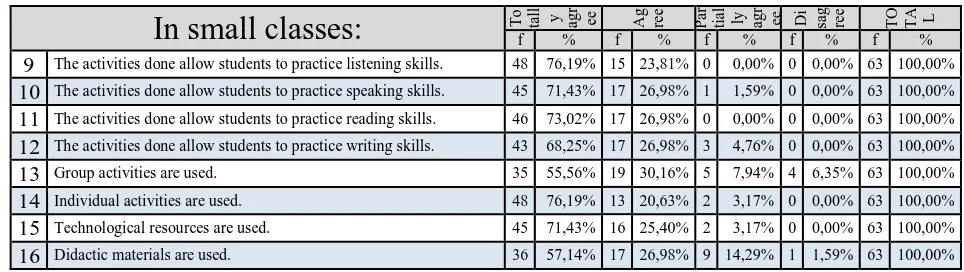
Table 4
Students´ Perceptions
In small classes:
To tall y agr ee Ag ree Par tial ly agr ee Di sag ree TO TA Lf % f % f % f % f %
9 The activities done allow students to practice listening skills. 48 76,19% 15 23,81% 0 0,00% 0 0,00% 63 100,00%
10 The activities done allow students to practice speaking skills. 45 71,43% 17 26,98% 1 1,59% 0 0,00% 63 100,00%
11 The activities done allow students to practice reading skills. 46 73,02% 17 26,98% 0 0,00% 0 0,00% 63 100,00%
12 The activities done allow students to practice writing skills. 43 68,25% 17 26,98% 3 4,76% 0 0,00% 63 100,00%
13 Group activities are used. 35 55,56% 19 30,16% 5 7,94% 4 6,35% 63 100,00%
14 Individual activities are used. 48 76,19% 13 20,63% 2 3,17% 0 0,00% 63 100,00%
15 Technological resources are used. 45 71,43% 16 25,40% 2 3,17% 0 0,00% 63 100,00%
16 Didactic materials are used. 36 57,14% 17 26,98% 9 14,29% 1 1,59% 63 100,00%
35
In section B of the questionnaire the students and teachers rated the teaching strategies and
resources that benefit the teaching of English in small classes. This section was comprised of eight
questions that both teachers and students responded to. Due to the similarity of questions 9-12, the
analysis is presented after graph 12.
Graph 9
The activities done allow students to practice listening skills
Author: Andre Cosmos Grossenbacher
Source: Teachers´ Questionnaire and Students´ Questionnaire
Every sample, from both teachers and students, resulted in a form of agreement in respect to
the idea that listening skills are practiced in class which is illustrated in graph 9.
Graph 10
The activities done allow students to practice speaking skills.
Author: Andre Cosmos Grossenbacher
Source: Teachers´ Questionnaire and Students´ Questionnaire
0% 20% 40% 60% 80% 100%
Totally agree
Agree Partially
agree
Disagree
Students
Teachers
0% 20% 40% 60% 80% 100%
Totally agree
Agree Partially
agree
Disagree
Students
36
Results indicate that both teachers and students agree there are sufficient activities practiced in
class to reinforce speaking skills shown in graph 10.
Graph 11
The activities done allow students to practice reading skills.
Author: Andre Cosmos Grossenbacher
Source: Teachers´ Questionnaire and Students´ Questionnaire
Participants strongly agree that there are activities in class promoting reading skills as can be
seen in graph 11..
Graph 12
The activities done allow students to practice writing skills.
Author: Andre Cosmos Grossenbacher
Source: Teachers´ Questionnaire and Students´ Questionnaire
0% 20% 40% 60% 80% 100%
Totally agree
Agree Partially
agree
Disagree
Students
Teachers
0% 20% 40% 60% 80% 100%
Totally agree
Agree Partially
agree
Disagree
Students
37
The overwhelming majority of the sample population responded in total agreement with the
idea of writing skills being used in activities which is represented in graph 12. The first four
questions in this section, statements 9-12, were about the activities that allowed the students to
practice the four language skills: reading, writing, listening and speaking. The general overview of
these four questions was remarkably positive feedback that was almost the same for each question.
Harfitt (2012) reported that experiences in small classes produced a sense of security within the
classroom community making it easier to excel in activities given and boost student confidence.
Students reported the following for activities for listening, which can be found in graph 9, as
76.19% in total agreement with 23.81 in agreement. Activities for speaking, which can be found in
graph 10, were reported as 71.43% in total agreement and 26.98% in agreement and 1.59% in partial
agreement. Activities for reading (graph 11) were reported as 73.02% in total agreement and 26.98%
in agreement. Activities for writing (graph 12) were reported as 68.25% in total agreement, 26.98%
in agreement and 4.76% in partial agreement.
The students all had positive feelings about the use of activities in class to practice the four
language skills. During the observer´s time in the classes it was noted that there were a variety of
activities drawing on the base information but being produced using the four language skills. It
seemed as though the two hour classes allowed the teachers and students enough time to work on all
the areas with the assigned material. The teachers reported 100% total agreement for all four
language skills activities: reading, writing, listening and speaking. The resulting analysis of these four
questions undoubtedly shows that the teaching strategies to improve the four language skills are
working well and the researcher noted that classes flowed smoothly from one activity to another
38
Graph 13
Group activities are used.
Author: Andre Cosmos Grossenbacher
Source: Teachers´ Questionnaire and Students´ Questionnaire
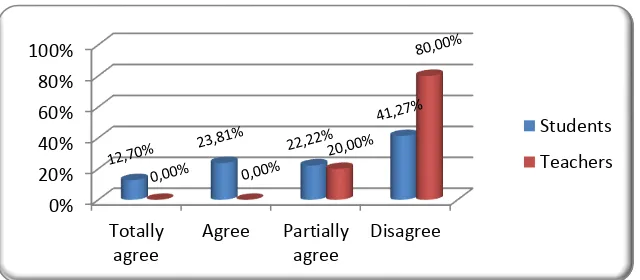
Data collected shows the majority of both pupils and instructors agreed that group activities are
used as seen in graph 13. However, there are 7.94% in partial agreement and 6.35% of students that
are not in complete agreement or disagree completely.
The most poorly scored statement had to do with the use of group activities. Students
reported 55.56% were in complete agreement, 30.16% were in agreement, 7.94% were in partial
agreement and 6.35% disagreed. Teachers stated that they used group activities by reporting 100% in
agreement but there is an obvious conflict between teachers and students. No other strategy or
resource scored as poorly as group activities did.
Harmer (1998) insists that “peer help” delves much deeper into group work by removing the
teacher and allowing students to help other students. This may have helped the group work be more
successful. The researcher observed that there were group activities used in 3 out of 5 classes.
However, the amount of time and interest given by the teachers was lackluster resulting in more of a
0% 10% 20% 30% 40% 50% 60% 70% 80% 90% 100%
Totally agree
Agree Partially
agree
Disagree
Students