Corresponding address: Dr. Ramón Cervantes-Munguía. Hospital de Pediatría, IMSS, Centro Médico Nacional de Occidente, Belisario Domínguez 1000, C.P. 44340. Guadalajara Jalisco, México. E-Mail: [email protected]
Received December 14, 1999; Accepted February 15, 2000.
Original Article
Rev Biomed 2000; 11:251-256.
The Amikacin on premature
newborn: schema of treatment
defined by gestational and
postnatal age.
distributed according to their gestational and postnatal age. All received AMK at the dose of 7,5 mg/kg of weight, only the administration rhythms differed. Our schema proposed of AMK administration: every 24 hours to the premature of less than 33 weeks of gestational age an less or more than 7 days of life, every 18 hours to prematures from 33 to 36 weeks with a postnatal age of 6 days or less and every 12 hours to those aged 7 to 21 days.
Results. AMK serum peak and trough concentrations
were maintained within recommended limits and the posology did not have to be adjusted more than a few times.
Discussion. These results permit us to recommend
this schema in special on those hospitals which don't have the technological support for the serum deter-mination of AMK. (Rev Biomed 2000; 11:251-256) Ramón Cervantes-Munguía1, José de J. Trujillo-López1 , Edgar Vásquez-Garibay2, María de J.
Rivera-Madrigal, Georgina Hernández-Flores3, Simone Orbach-Arbouys4, Alejandro Bravo-Cuellar3.
1Hospital de Pediatría, 2Centro de Investigación Biomédica de Occidente, Centro Médico Nacional de
Occidente. IMSS. Guadalajara Jalisco. 3Instituto de Nutrición Humana, Nuevo Hospital Civil de
Gua-dalajara, México. 4Hôpital Suisse de Paris, Issy-les Moulineaux, France.
SUMMARY.
Introduction. Amikacin (AMK) is an antibiotic of
the aminiglycosides family frequently used against infections caused by gram negative bacteria in the newborn. It is necessary to get defined serum concentrations to obtain the highest efficiency and the lowest toxicity. The classic protocols generally drive to higher plasmatic concentrations than those recommended. That is why, on premature newborn, we used a protocol taking into account weight gestational and the postnatal age, all at the same time, since the physiological constants of the newborn evolve change quickly.
Material and methods. This protocol has been
Key words: Amikacin, premature newborn,
aminiglycosides.
RESUMEN.
La Amikacina en recién nacidos prematuros: esquema de tratamiento definido por edad ges-tacional y postnatal.
Introducción. La Amikacina (AMK) es un
antibiótico de la familia de los aminoglucósidos, utilizado contra bacterias gram negativas en el recién nacido. En su empleo es necesario obtener concentraciones séricas definidas para obtener la mejor eficiencia con la mínima toxicidad. Generalmente los esquemas clásicos llevan a concentraciones plasmáticas más elevadas que las recomendadas. Por esta razón nosotros utilizamos un esquema que considera el peso, la edad gestacional y postnatal al mismo tiempo, dado que las constantes fisiológicas del recién nacido cambian rápidamente.
Material y métodos. Este protocolo se comparó
con el que se emplea de rutina en nuestro Hospital que no considera la edad postnatal. El estudio se realizó en 112 prematuros en el cual se formaron 4 grupos distribuidos de acuerdo a su edad gestacional y postnatal. Todos los RN recibieron AMK a dosis de 7.5 mg/Kg de peso, sólo difirieron los tiempos de administración. En nuestro esquema la administración de AMK fue la siguiente: cada 24 horas para prematuros menores de 33 semanas de gestación mayores o menores de 7 días de vida, cada 18 horas para los prematuros de 33 a 36 semanas de gestación con menos de 7 días de vida y cada 12 horas para aquellos de 7 a 21días.
Resultados. Las concentranciones séricas de
AMK pico y valle se mantuvieron dentro de los límites recomendados.
Discusión. Estos resultados nos permiten
recomendar este esquema de tratamiento en hospitales donde no se cuenta con soporte tecnológico para la determinación de la AMK.
(Rev Biomed 2000; 11:251-256)
Palabras clave: Amikacina, recién nacidos
prematuros, aminoglucósidos.
INTRODUCTION.
The Amikacin (AMK) is one of the aminoglucoside antibiotic family most frequently used in the treatment of newborn infections caused by gram negative bacteria. But since in neonatal period the physiology changes very quickly. The volume of extracellular liquid and the glomerular filtration rate, play an important role on the pharmacokinetics properties of the AMK (1-4) and in its possible toxicity, since AMK is eliminated mainly through urine (5). Consequently it is recommended to supervise serum peak and trough concentrations to avoid the accumulation and side effects that might result (6-7).
Besides as a direct correlation exist between the glomerular filtration rate on one hand and gestational and postnatal age on the other hand, these last parameters associated to body weight allow an excellent definition of the state of the newborn. It will result logical to take into account all these data to determine the AMK posology, instead of excluding some of them, as has been usual (8-10).
The objective of this study was get a schema of AMK administration that, taking into account gestational and postnatal age and weight, would permit for the maintenance of AMK serum concentrations within the advisable therapeutic limits and would require few adjustments. This may be particularly interesting in situations where technological support is lacking.
MATERIAL AND METHODS.
Patients. This clinical assay was carried out on
All serum creatinine values were between normal limits according to Guinar criteria (11).
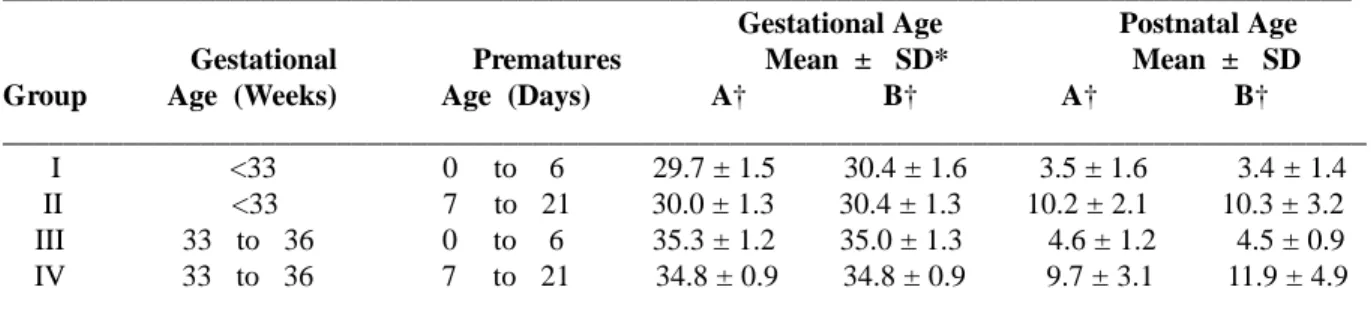
Newborns showing a congenital malformation or if they showed increments above of 0.3 mg/dL of initial creatinine serum values; as well as those whose state had required an exanguino-transfusion or a peritoneal dialysis were excluded of the study. Four groups were formed (Group I to IV) in function of the gestational and postnatal age (12). Inside each group, two subgroups (A and B) with 14 newborn each one were constituted by random distribution. Features of each of the 4 groups with its corresponding subgroups are indicated on table 1.
Treatment. The A schema of AMK administration,
is the schema that we proposed, this schema was established in function of prior observations obtained in a pilot study (not reported) and the B schema, is the one usually employed in our Hospital.
All prematures received the same dose of AMK 7,5 mg/kg of body weight by i.v. injection. According to the A schema, the AMK was given every 24 hours to those of the subgroups I and II; every 18 hours to those of the subgroup III and every 12 hours to prematures of the subgroup. IV. To prematures from the B schema of AMK administration, the antibiotic was given every 12 hours of the other subgroups I and III, and every 8 hours to those of the other subgroups II and IV.
AMK determination. AMK serum concentrations
were determinated using an Amikin kit from laboratories Abbot System assays. Values were expressed in µg/mL. From the third administration, peak values were measured 20 minutes after the antibiotic injection and trough values 20 minutes before the following injection. These two parameters were also determined on the 5th and 7th day of treatment.
AMK serum concentrations were considered adequate when peak values were found between 15 and 25 µg/mL and those of the trough between 2 and 5 µg/mL (13-14). If the aminoglucoside serum concentrations were not in these limits, intervals of administration were decided to be modified.
Creatinine determination. It was carried out, in
the same samples, with the help, of a commercial kit into Hospital routine.
Statistical analysis. In order to guarantee a risk
of mistake of 5% and to have a strength of 90%, 56 patients were included in each therapeutic schema. Variables were compared by the correspondace X2 and/or by Student´s “t” test.
RESULTS AND DISCUSSION.
Table 1 shows that, all newborns, independently of the group or schema of AMK administration (A or B) that they were submitted
TABLE 1
CHARACTERISTICS OF PREMATURES AND GROUPS
_________________________________________________________________________________________ Gestational Age Postnatal Age
Gestational Prematures Mean ± SD* Mean ± SD Group Age (Weeks) Age (Days) A† B† A† B† __________________________________________________________________________________________ I <33 0 to 6 29.7 ± 1.5 30.4 ± 1.6 3.5 ± 1.6 3.4 ± 1.4 II <33 7 to 21 30.0 ± 1.3 30.4 ± 1.3 10.2 ± 2.1 10.3 ± 3.2 III 33 to 36 0 to 6 35.3 ± 1.2 35.0 ± 1.3 4.6 ± 1.2 4.5 ± 0.9 IV 33 to 36 7 to 21 34.8 ± 0.9 34.8 ± 0.9 9.7 ± 3.1 11.9 ± 4.9 ________________________________________________________________________________________
to, were strictly comparable on gestational and postnatal age. To verify the renal function, we measured serum creatinine on newborn from different groups: Groups that received the therapeutic A schema had a creatinine average of 0.69 ± 0.15 mg/dL whereas those that received the therapeutic B schema had a creatinine average of 0.71 ± 0.15, these values remained practically without variations during all treatment, suggesting a good renal function and permitting a valid comparison between the different treatment schema.
AMK dose was the same for all children (7.5 mg/kg of body weight and administration), thus taking into account the child weight.
Premature newborns with less than 33 weeks gestation age groups I (postnatal age from 0 to 6 days) and II (postnatal age from 7 to 21 days), according to the A schema, AMK was given every 24 hours. We found that peak and trough AMK levels were perfectly in the desired limits at the first determination (table 2), as well as those of the determination made at 5th and 7th day of AMK administration (as there were not differences between 5th and 7th day of treatment only are show the corresponding values to the 7th day). With the B schema, the AMK was given every 12 hours to newborn of the group I (postnatal age
from 0 to 6 days) and every 8 hours to newborn with a postnatal age from 7 to 21 days (group II), contrastingly on these groups AMK peak and trough serum concentrations were higher on a rank 1.3-2.2 and 2.9-5.8 times respectively that the superior values recommended as efficients and not toxics (table 2). As to determinations made the 5th and 7th day of treatment, they have not interest because the treatment schema was adjusted to be adapted several times, as it is indicated on table 3. For premature newborns, from 33 to 36 weeks of gestational age, AMK was given every 18 hours, if they were aged from 0 to 6 days ( group III) and every 12 hours if they were aged from 7 to 21 days ( group IV). Values of the peak and the trough of the first AMK determination as well as the values obtained at the end of 7th day of treatment were inside the advisable limits. According to the B schema, the AMK was given every 12 hours to newborn aged from 0 to 6 days (group III) and every 8 hours to those aged from 7 to 21 days (group IV). Peak values came closer to desired values, but those of the trough AMK concentrations were higher than the recommended values, thus for group IIIB and IVB were superior on a rank of 1.94- 4.85 and 1.42-3.5 times respectively (table 2).
It is worthwhile to underline, to get the
TABLE 2
PEAK AND TROUGH SERUM LEVELS OF AMK EXPRIMED IN µg/mL.
__________________________________________________________________________________________ First Determination
Determination At 7th day
Administration (Mean ± S D*) (Mean ± S D) Group Schema Peak Trough Peak Trough
__________________________________________________________________________________________ I A: each 24 hours 22.6 ± 7.4 4.4 ± 1.3 20.3 ± 3.4 4.0 ± 1.0
B: each 12 hours 33.6 ± 5.6 11.8 ± 3.3
II A: each 24 hours 19.3 ± 2.4 4.2 ± 1.8 18.1 ± 1.1 4.4 ± 0.2 B: each 8 hours 32.9 ± 6.6 13.7 ± 5.9
III A: each 18 hours 20.6 ± 5.5 5.3 ± 3.5 20.3 ± 4.4 5.0 ± 1.5 B: each 12 hours 28.2 ± 5.8 9.7 ± 6.4
IV A: each 12 hours 17.8 ± 1.1 5.2 ± 3.1 18.6 ± 4.4 4.4 ± 1.2 B: each 8 hours 24.6 ± 6.9 7.1 ± 4.9
__________________________________________________________________________________________ *= Standard deviation.
desired values, it was sometimes necessary to modify intervals of administration. Table 3 shows that for newborns that were submitted to the A schema, it was done once upon group I, 0 times upon group II, twice upon group III and once upon group IV.
In contraposition with the B schema was done 13 times in the group I, 14 times in group II, 12 times in group III and 13 times in group IV. Let us recall that every group counted 14 newborn. In order to be more clear, we calculated the relative risk ( RR) and its confidence intervals at 95%, that means in this case, how many more times the schema B needs to be modified versus schema A ( see table 3 )
It is important to remark that in some works, the AMK is administered once a day, however these works have been mainly directed to adult and pediatric patients, and no differences were found on AMK serum levels, the authors on those studies have not yet concluded whether this schema is better that the schema based on multiple daily AMK administrations, and could not result adequate for prematures due to its physiologic characteristics (15-17). The schema we propose takes into consideration newborn weight, and it is a function of gestational and postnatal age thus having a more
comprehensive idea of the newborn physiologic state. Thus we got and maintained, desired antibiotic serum concentrations, on the peak as well as on the trough values, with a reduced number of adaptations, in intervals of AMK administration. These observations are important because the assayed therapeutic schema diminish the toxic potential of the AMK, probability of making mistakes and the work load. In addition, it constitutes an important advantage particularly in conditions where it is not possible to follow the pharmacokinetics of the antibiotic by routine measurment of its blodd level.
REFERENCES.
1. Sande M, Mandell G. Antimicrobial agents.The aminiglycosides. In :Goodman A, Rall T Nies A , Taylor P, Eds. The pharmacological basis of therapeutics. 8th ed. New
York: Pergamon Press; 1991. p. 1098-107.
2. Fanos V, Mussap M, Verlato G, Pleban M, Padovani EM. Evaluation of antibiotic-induced nephrotoxicity in preterm neonates in determing urinary alpha 1 microglobulin. Pediatr Nephrol 1996; 10: 645-7.
3. Rose E. Pharmacodynamics: Mechanisms of drug action and the relationship between drug concentration and effect.
In: Goodman A,Rall T, Nies A, Taylor P, Eds. The
pharmacological basis of therapeutics. 8th ed. New York.
Pergamon Press; 1991. p. 33-48. TABLE 3
NUMBER AND RELATIVE RISK OF MODIFICATIONS OF THE AMIKACIN SCHEMA OF TREATMENT. __________________________________________________________________________________________ Number of
Modifications p value Relative Confidence Group Schema to Schema A vs B Risk Intervals at 95 % __________________________________________________________________________________________
I A 1 <0.002 13 1.96 - 86.42 B 13
II A 0 <0.002 B 14
III A 2 <0.002 5.5 1.48 - 20.42 B 12
IV A 1 <0.002 13 1.96 - 86.42 B 13
__________________________________________________________________________________________ 14 prematures in each subgroup A or B.
4. McCracken G, Nelson J. Pharmacologic concepts in the newborn. In: McCracken G. Jr, Nelson J. ed. Antimicrobial therapy for newborns. 2nd ed. New York: Grune & Stratton;
1983. p. 3-7.
5. Andronikou S, Giapros VI, Cholevas VI, Papadopoulou ZL. Effect of aminoglycosides therapy on renal function in full-term infants. Pediatr Nephrol 1996; 10: 766-8.
6. Nanri S, Sunakawa N, Yanashita NA. A pharmacokinetic study in mature and premature neonates treated with amikacin through intravenous drop infusion. Jpn J Antibiot 1987; 40: 1135-45.
7. Phillips JB, Satterwithe C, Dworsky ME, Cassady G. Recommended amikacin doses in newborns often produce excessive serum levels. Pediatr Pharm 1987; 121-125.
8. Kenyon CF, Knoppert DC, Lee SK, Vandenberghe HM, Chance GW. Amikacin pharmacokinetics and suggested dosage modifications for the preterm infant. Antimicrob Agents Chemother 1990; 34: 265-8.
9. Marx C, Cronion J. Medications used in the newborm.
In: Cloherty J, Stark AR, Eds. Manual of Neonatal Care.
3rd ed. Boston: Brown & Co; 1991. p. 619.
10.Gomella TL, Cunninham MD. Commonly used antibiotics. In: Gomella TL, Cunninham MD. Eds. Neonatalogy, basic management, on-call problems, disease, drugs. Norwalk: Appleton and Lange; 1988. p. 384-96.
11. Guinar J. Renal function in the newborn infant. Pediat Clin North Am 1982; 77: 90-4.
12. Ballard JL, Khoury JL, Weding K, Wang L, Ellers-Walsman BL, Lipp R. New Ballard score, expanded to include extremely premature infants. J Pediatr 1991; 119: 417-23.
13. Yow MD. On overview of pediatric experience with Amikacin. Am J Med 1977; 62: 954-68.
14. Trujillo H, Manotas R, Londome R, et al. Clinical and laboratory studies with amikacin in newborns, infants and children. J Inf Dis 1976; 134: 406-11.
15. Freeman CD, Nicoleau DP, Belliveau PP, Nightingale CH. Once daily dosing aminiglycosides: review and recommendations for clinical practice. J Antimicrob Chemother 1997; 39: 677-86.
16. Forsyth NB, Botha JH, Hadley GP. A comparison of
two amikacin dosing regimens in pediatric surgical patients. Ann Trop Pediatr 1997; 17: 253-61.