Fluorosis and dental caries:
an assessment of risk factors in Mexican children
Nelly Molina-Frechero,* Alberto Isaac Pierdant-Rodríguez,**
Anastasio Oropeza-Oropeza,* Ronell Bologna-Molina***
* Departamento de Atención a la Salud, ** Área de Matemáticas Aplicadas a las Ciencias Sociales, Universidad Autónoma Metropolitana, Campus Xochimilco.
*** Departamento de Investigación, Facultad de Odontología, Universidad Juárez del Estado de Durango. ARTÍCULO ORIGINAL
C A B S T R A C T
j i
b e
Objective. To determine the sources of fluoride exposure and the prevalence and severity of fluorosis and dental ca-ries and sources of fluoride exposure in the permanent dentition of 11-year-old children. MMaterial and methods. A cross- et d sectional study of 111 children attending elementary schools in the State of Mexico, where the concentration of fluoride in drinking water is < 0.3 ppm, was performed using a self-admi-nistered questionnaire was directed towards the children’ mo-thers. The level of fluorosis was determined using both the Dean’s Modified Index (ID) and the Community Fluorosis Index (CFI). The decayed, missing, filled teeth (DMFT) was recorded using methods recommended by the World Health Organization (WHO). Statistical analysis was conducted using bivariate analysis with a χ2 test; odds ratios (OR) and 95%
confidence intervals (CI). Logistic regression models were used in the final model. Re uResults. Children had a fluorosisl . prevalence of 52.73% (95% CI: 48.2-55.4) with CFI = 0.75 ± 0.91 (95% CI: 0.58-0.92). The caries prevalence was 53.2% (95% CI: 50.1-56.3) with DMFT = 1.27 ± 1.67 (D = 0.85 and F = 0.42). Children who had no fluorosis showed more caries (p = 0.001). Dental fluorosis was associated with the initial age of brushing (before age four), OR = 0.511 (0.338-0.772); frequency of brushing (three times a day), OR = 0.681 (0.483-0.958), brushing before sleeping (yes), OR = 0.664 (0.473-0.932), and applications of fluoride (yes), OR = 0.756 (0.576-0.994). Den-tal caries was associated with several variables, such as initial age of brushing, OR = 11.28 (4.6-27.7), frequency of brus-hing, OR = 0.245 (0.109-0.553), brushing before sleeping, OR = 8.03 (3.295-19.59), and applications of fluoride, OR = 14.2 (4.54-44.53). In the final regression model, the level of caries and fluorosis was significantly associated (p = 0.000) with the amount of fluoride exposure. The multivariate shows this re-lationship. Conclusions. Fluorosis prevalence was high forn lc low levels and low for more severe levels. According to the CFI in the studied example, dental fluorosis represents a public health problem in the studied sample. Dental caries was low with a predominance of tooth decay. Exposure to different
e
o s a d n l a Fluorosis y caries dental: evaluación
r s d s e s c
de factores de riesgo en niños mexicanosde factores de riesgo en niños mexicanosr s d s e s c
E N E N R E S U M E N R E S U M E N
j i b
Objetivos. Determinar la prevalencia y severidad de fluorosis y caries dental. Evaluar fuentes de exposición a fluoruros en dentición permanente de escolares de 11 años de edad. Material y métodos.Material y métodos. Estudio transversal en 111r l y r l y oo escolares de escuelas primarias públicas del Estado de México donde la concentración de flúor en agua es < 0.3 ppm. Para la recolección de los datos se empleó un cuestionario dirigido a las madres. La fluorosis dental fue determinada con el índice de Dean (ID) y el índice comunitario de fluorosis (ICF). El índice CPOD (cariados, perdidos y obturados por diente) con los métodos recomendados por la OMS. El análisis estadístico fue realizado con análisis bivariado con el test de χ2, odds
ratios (OR) e intervalos de confianza (IC) a 95%. Un modelo de regresión logística fue usado en el modelo final.
.
Resultados. La prevalencia de fluorosis fue de 52.73% (IC95%: 48.2 a 55.4). El ICF fue 0.75 ± 0.91% (IC95%: 0.58 a 0.92). La prevalencia de caries fue de 53.2% (IC95%: 50.1-56.3) con CPOD 1.27 ± 1.67, C = 0.85 y O = 0.42. Los escolares que no presentaron fluorosis presentaron más caries (p = 0.001). La fluorosis dental fue asociada a edad de inicio del cepillado (antes de los cuatro años) OR = 0.511 (IC95% 0.338-0.772), frecuencia del cepillado (tres veces al día) OR = 0.681 (IC95% 0.483-0.959), cepillado antes de dormir (si) OR = 0.664 (IC95% 0.473-0.932) y aplicaciones de flúor (si) OR = 0.756 (IC95% 0.576-0994). La caries dental fue asociada a las variables edad de inicio del cepillado antes de los cuatro años OR = 11.28 (IC95% 4.6-27.7), frecuencia del cepillado tres veces OR = 0.245 (IC95% 0.109-0.553), cepillado antes de dormir OR = 8.03 (IC95% 3.295-19.59) y aplicaciones de flúor OR = 14.2 (IC95% 4.54-44.53). En el modelo de regresión final del comportamiento de la caries en función de fluorosis y exposición a fuentes de fluoruros fue significativo p = 0.000.
c s
INTRODUCTION
In 1988, a pilot program of salt fluoridation was implemented in the State of Mexico, and in 1993, salt fluoridation became a nationwide effort as a part of public health policies aimed to prevent dental
caries.1 In 1995, sanitary standards were
establis-hed to distribute fluoridated iodised salt as a syste-mic control of oral disease.2
In addition to fluoridated salt in the Mexican market, there are many fluoride products that may prevent dental caries. In the 1980s, the marketing of fluoridated toothpastes began, and educational programs in schools introduced 2% sodium fluoride rinses. The combination of these various sour-ces caused the population to consume too much fluoride.
The positive effects that fluoride has on dental ca-ries reduction are well documented.3,4
At the same time, an investigation reported an in-crease in dental fluorosis in certain areas of Mexico with different concentrations of fluoride in the water.5-7
Dental fluorosis can be caused by the prolonged and excessive intake of fluorides, and it is a disorder that occurs during odontogenesis. It is defined as the permanent hypomineralization of enamel and is characterized by surface and subsurface porosity. Fluoridated water is a risk factor for fluorosis, al-though other factors have been noted, including cli-mate and the children’s diet.8,9
Dental fluorosis varies in degree, it may cause se-vere changes in tooth colour and often presents serious aesthetic, organic and functional problems, making it a public health problem with high treat-ment costs.
Based on research that reported a significant in-crease in the prevalence and severity of dental fluo-rosis in Mexico, a group of experts worked in conjunction with representatives of the Ministry of Health in 2002 to update the states of Mexico on where fluoridated iodised salt should and should not be distributed to protect the population from the
problems associated with dental fluorosis.2
Fluoride may come from many different sources, each containing different concentrations of fluoride,
which, especially in combination with the fluoride in drinking water, may exceed the dose recommended for the prevention of tooth decay. Thus, it is impor-tant to further evaluate risk factors associated with the population’s current exposure. Because:
• There are no studies in the State of Mexico on the prevalence and severity of fluorosis and ca-ries and
• Its relation to additional sources of fluoride are important, the central question is whether the known exposure to fluoride in schoolchildren of this region pose a risk for the development of dental fluorosis.
OBJECTIVE
To determine the prevalence and severity of fluo-rosis and dental caries, as well as measure risk fac-tors for exposure to fluorides among 11-year-old children enrolled in public schools in Nezahualcoyotl, Mexico State, an area with people of low socioeco-nomic status, where the concentration of fluoride in the water is less than 0.3 ppm.
MATERIAL AND METHODS
e s dy l i
The study populatione s dy l i The study population
Cases of dental fluorosis have been diagnosed in the schools of Nezahualcoyotl City. Thus, it was im-portant to prepare a study of 11-year-old children because this is the age when permanent teeth are present and students are receiving a basic educa-tion.
Upon approval of this project by the ethics com-mittee of the Division of Biological Sciences and Health at the Metropolitan Autonomous University at Xochimilco, we conducted a prospective, descripti-ve and observational study of children of both gen-ders in the municipality of Nezahualcoyotl, in the State of Mexico.
This is an area with people of low-socioeconomic status, characterised by large families, where cons-truction workers, service employees and tradesmen are found.
sources of fluoride, was a risk factor for the development of fluorosis and a benefit with regard to dental caries.
r e
Key words. Dental fluorosis. Caries. Risk factors. Children.
caries fue baja predominando el factor cariado. La exposición a diferentes fuentes de fluoruro, constituyeron factores de riesgo para el desarrollo de fluorosis y fueron benéficos en relación con caries.
s
We determined the concentration of fluoride in the water in the study area through household sam-pling using a selective ion potentiometer (Orion EA 920 model) with a fluoride-specific electrode (Orion model 940900).
tu mpl e o
Study sample selectionStudy sample selectiontu m l p e o
The sample selection occurred in two stages: first, the schools were chosen and then the children who would participate in the study were chosen.
Based on statistics from the National Institute of Statistical and Geographic (INEGI) 2005 Census, 20,300 students were enrolled in the sixth grade and 19,530 were 11 years of age. Schools were randomly selected from low-income communities with water fluoride concentrations < 0.3 ppm and the highest number of public primary schools. There were 68 schools with these characteristics; they were located in Benito Juárez (21 schools), Las Águilas (21), Re-forma (15) and Metropolitana (11).
The sample included 111 subjects, who were se-lected using a model of population proportion with a confidence level of 95% and an error of 7% based on a standard deviation that was obtained from a
pre-viously conducted study.10 The children were
selec-ted by means of systematic random sampling and included all students who gave their consent to take part in the study. Children from seven schools were selected from these communities using proportional sampling:
• Three from Benito Juárez. • Two from Las Águilas. • One from Reforma, and • One from Metropolitana.
The children were selected from lists supplied by the schools’ principals based on the following crite-ria: they were 11 years old and born and raised in that community. From this population, 111 children were selected by simple random sampling using Epi Info Software. Eight schoolchildren were excluded from the sample because they did not meet the main requirements, and they were replaced by eight other randomly selected students.
The principals of the selected schools provided consent and were asked to inform the parents about the study to give them the opportunity to refuse consent prior to the examination.
We did not seek to distinguish our results by gen-der because previous studies show that this variable does not produce significant differences.
a l o
Data collectiona l o Data collection
In the second stage, mothers and children were given a questionnaire to gather information regar-ding the age of initial brushing, the use of toothpas-te, the type of toothpastoothpas-te, the frequency of brushing, whether teeth were brushed before bed and whether the children had received applications of fluoride at school through a dental health pro-gram or at a private dental practice.
Questionnaire consistency was calculated using a
pilot study with 38 children11,12 using Cronbach’s
statistic12, alpha > 0.7. The reliability of the ques-tions was calculated using intraclass correlaques-tions (obtained values were above 70%).
Finally, each student in the sample underwent an oral clinical evaluation to determine the presence or absence of fluorosis and dental caries. Tests were conducted in daylight by an investigator who was
calibrated according to the OMS13 criteria, with an
intra-measure kappa value > 90 for fluorosis and > 92 for decay.
g o i a f u s s
Diagnosis of dental fluorosisg o i t a f u s s Diagnosis of dental fluorosis
Direct examination and evaluation were conduc-ted with a mirror after the removal of plaque through brushing or, if that was not sufficient, cle-aning with gauze.
For the diagnosis of dental fluorosis, the Dean’s modified index (DI) was applied. A community index of dental fluorosis (CFI) was obtained by using DI data from the two most affected teeth. The statistical weight was multiplied by the degree of their condi-tion and divided by the total number of children exa-mined.14,15
a n s s d n c i
Diagnosis of dental cariesa n s s d n c i Diagnosis of dental caries
For the diagnosis of dental caries, the decayed, missing and filled permanent teeth (DMFT) index was used, based on diagnostic criteria suggested by
the World Health Organization (WHO).13
a y i f a r Analysis of wateray i a f r Analysis of water
Fluoride concentration in triplicate was deter-mined using the fluoride ion selective electrode in 12 water samples from the schools and adjacent houses to confirm that the fluoride concentration was < 0.3 ppm, as reported in the National Insti-tute of Mexico State Catalogue of Fluoride Ion
t a a i Data analysist a a i Data analysis
The analysis involved descriptive statistics, biva-riate and multivabiva-riate analysis. Univabiva-riate descrip-tive analysis used means, standard deviations and confidence intervals of 95%. The bivariate analysis was performed with contingency tables, using chi-square and odds ratios (OR) along with their respec-tive confidence intervals, which allowed us to observe the relationships between the variables to prove the dependence or independence of fluoro-sis and dental caries on fluoride exposure.
For the multivariate analysis, we built a logistic-regression model to explain the characteristics of fluorosis and caries in terms of fluoride exposure. The statistics used included Spearman correlation, the Wald’s test for each coefficient, Hosmer and
Le-meshow and the χ2 to test the significance of the
model, and p values were used to reflect statistical probability.
RESULTS
The water sample analysis was conducted on 12 samples, collected al home and in selected schools, yielding a fluoride concentration level of 0.218 ppm ± 0.018.
One hundred eleven students who were 11 years of age and living in the study area since birth com-posed the study sample. The results indicated that fluorosis was present in 53% of the children (95%CI 48.2-55.4). The distribution, according to Dean’s in-dex (ID), was as follows:
• 52 (46.85%) healthy children.
• 44 (39.64%) children with very mild fluorosis. • 8 (7.21%) children with mild fluorosis.
• 5 (4.51%) with a moderate level, and • 2 (1.8%) children with a severe level.
Subsequently, they were grouped by degree of se-verity into categories 1-2 and 3-4. Bivariate analysis was conducted on fluorosis and caries, and the Spearman correlation was -0.257 (p = 0.006) found
to be significant at 99%. Most of the children pre-sented with very mild to mild levels of dental fluoro-sis; only a small percentage was affected with moderate to severe fluorosis. The CFI was 0.75 ± 0.91 (95%CI 0.58-0.92).
The caries prevalence was 53.2% (59 children) (95%CI 50.1-56.3); thus, 46.8% (52 children) (95%CI 46.7-46.9) were healthy. DMFT average was 1.27 ± 1.67 (decayed = 0.85, missing = 0 and filling = 0.42). Children who had no fluorosis showed more caries (Table 1).
Our results showed that 52.3% of children brus-hed their teeth before the age of four, and the rest started brushing their teeth after that age.
All children reported brushing with fluoride too-thpaste. For the past two decades in Mexico, most toothpaste has contained fluoride. Regarding the fre-quency of brushing, 42.3% brushed once or twice a day and 57.7% three times daily. Sixty-five children reported brushing at night before bed. A total of 67.6% of the studied population had received topical fluoride applications.
The presence of dental fluorosis and exposure to different sources of fluoride are shown in table 2. Of the 58 children who began to brush their teeth befo-re the age of four, 40 childbefo-ren (69%) had fluorosis, whereas only 19 children (35.8%) of the 53 children who did not brush their teeth before the age of four had fluorosis (p < 0.001). With respect to brushing before bedtime, of the 65 children who did brush, 41 children (63.1%) had fluorosis, whereas only 39.1% of the children who did not brush before bedtime had fluorosis (p < 0.013).
Of the 75 children receiving topical fluoride appli-cations, 60% presented with fluorosis, while just 38.9% of the 36 children who received no such appli-cations had fluorosis (p < 0.038).
Table 3 shows the bivariate analysis relating den-tal caries and the independent variables. This analy-sis produced odds ratios and their respective confidence intervals. We found that age at onset of brushing was important. For instance, for children who brushed before the age of four, decay prevalence was 21%, whereas for children who initiated
1
Table 1. Fluorosis and dental caries by DI and DMFT.
DI Percentage CI (95%) DMFT SD CI (95%)
0, healthy 46.8 46.7-46.9 1.79 ± 1.98 0-3.77
hing later in life, decay prevalence was 81% (multi-plied by a factor of 3.8). One can see that the 39 chil-dren without caries who brush three times a day reduce their caries by a factor of 0.56. Of the 58.6% of children who brushed before bed, 66.2% were without caries, whereas 33.8% had dental caries. Of the 41.4% of children who did not brush before bed, 80.4% had caries, which shows that brushing before sleep reduces tooth decay by a factor of 3.62. Of the 67.6% of children who received topical fluoride appli-cations, 64% had no cavities, and 36% had tooth de-cay, whereas of the 32.4% of children who did not receive these applications, only four were free of dental caries. This finding means that applications of fluoride decreased caries by a factor of 7.
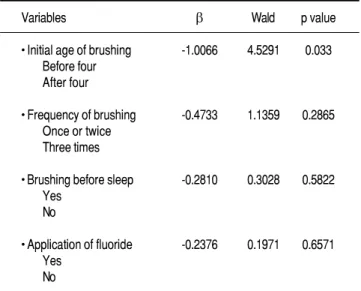
Table 4 shows the multivariate analysis obtained through logistic regression. The model allows us to observe the relationship between fluorosis and inde-pendent variables associated with exposure to fluori-de. The test uses the Wald statistic. The analysis of effect of exposure to diverse fluoride sources showed that only the initial age of brushing was significant.
DISCUSSION
The results revealed dental fluorosis in more than half of school children, with very mild and mild categories as the most prevalent cases. This
.
Table 3. Bivariate analysis between caries and independent variables.
Variables OR C I (95%) p value
• Initial age of brushing:
Before four 2.978 1.920-4.619 After four 0.264 0.148-0.470 0.000
• Frequency of brushing:
Once or Twice 0.434 0.258-0.729 Three times 1.77 1.264-2.478 0.001
• Brushing before sleep:
Yes 2.218 1.557-3.158 No 0.276 0.148- 0.516 0.000
• Application of fluoride:
Yes 2.017 1.511-2.692 No 0.142 0.054-0.374 0.000
OR: Odds ratio. CI: Confidence interval.
l
Table 4. Logistic regression model between fluorosis and independent variables associated with exposure to fluoride.
Variables β Wald p value
• Initial age of brushing -1.0066 4.5291 0.033 Before four
After four
• Frequency of brushing -0.4733 1.1359 0.2865 Once or twice
Three times
• Brushing before sleep -0.2810 0.3028 0.5822 Yes
No
• Application of fluoride -0.2376 0.1971 0.6571 Yes
No
Initial age of brushing is only significant variable. Final equation model is P (fluorosis) = 1/[1+e(2.1789-1.3804 CEPILLAD)].
Table 2. Bivariate analysis between dental fluorosis and independent variables related to exposure to fluoride.
Variables OR CI (95%) p value
• Initial age of brushing
Before four 0.511 0.338 - 0.772
After four 2.030 1.334 - 3.089 0.001
• Frequency of brushing
Once or Twice 1.672 1.069 - 2.616
Three times 0.681 0.483 - 0.959 0.022
• Brushing before sleep
Yes 0.664 0.473 - 0.932
No 1.765 1.114 - 2.796 0.013
• Application of fluoride
Yes 0.756 0.576 - 0.994
No 1.783 1.022 - 3.111 0.038
finding indicates that children are affected in the lowest grades of severity. These data were similar to those found in a study conducted in the state of México17 with regard to the lower levels of severity. However, in the moderate and severe cases of fluo-rosis found in our research, these children were probably exposed to high doses of fluoride and early on. The results that we found were higher than
tho-se reported in the city and eltho-sewhere in México,10
even though the water fluoride concentration is si-milar.18
This finding may be because this population is consuming large amounts of fluoride. In this popu-lation, caries had a prevalence of 53.2%, which is lo-wer than what has been reported in previous years among children in the same area. This finding sug-gests that additional sources of fluoride and table salt are influencing this decrease.17
The results of fluorosis were similar to a study in
the city of Campeche,19 where children who started
brushing with fluoride toothpaste before the age of four and were exposed to different sources of fluori-de had less caries. Children at early ages of the fluori- den-tifrice ingested, as demonstrated by a study in
Mexico City and Veracruz.20 We must also remember
that in Mexico there is little education about children’s use of pulp. Children use adult toothpaste, a product that dominates the market, because it is cheaper, but with the inconvenient of high concen-trations of fluoride. In addition with this fact, the amount of toothpaste on the brush is generally not controlled, noting that it is greater than required.2
Children who brushed before bedtime had a hig-her degree of fluorosis compared with those who did not, and these children also had a lower prevalence of caries. When an analysis was conducted on the presence of dental caries and fluoride exposure, it was found that age of initial brushing is important. For instance, caries was found in 21% of children who brushed before the age of four, whereas it was found in 81% of children who began brushing after the age of four. Brushing before bed was found to re-duce tooth decay by a magnitude of 3.38 times, and fluoride applications available through community programs or at dental practices were also associated with decreased tooth decay. As in other studies, the findings indicate that regular brushing provides 0.77 organs and reduces tooth decay by a magnitude of 1.85 times, which means that this variable in-fluences the magnitude and severity of pathology.
As in other countries21,22, there has also been a
reported increase in dental fluorosis in Mexico.23 In this work, we found a high prevalence of fluorosis at
mild and very mild levels, which is a public health problem, as our calculation of the community index of dental fluorosis was 0.75, and values > 0.6 are considered a health problem.
These results reveal the existence of a relations-hip between fluorosis and caries, which was of bene-fit to children with fluorosis ranging from very mild
and mild.24 Children with fluorosis of moderate to
severe levels had a higher proportion of caries, whi-ch is due to advancing demineralisation and greater inclination for lesions.25
The concentration of fluoride in the water of the study area is low to the extent that no one in this area should have to submit for fluorosis. Thus, the prevalence confirms additional exposure to fluo-ride products, suggesting a community index that may be similar to that found in geographic areas in which the concentration of fluoride in the water is high.
Limitations of the study have to do with its design, as being a cross-sectional study can not esta-blish relationships beyond associations and the study excluding small areas with a higher income level.
With these results, we conclude that it is useful to continue using fluoride products, which have pro-ven beneficial in reducing caries. However, exposure to various fluorides, in addition to the concentration of fluoride in the water and table salt, is a risk fac-tor of dental fluorosis.
ACKNOWLEDGEMENTS
We wish to thank the authorities from the Secre-tary of Education SEP, especially the school princi-pals, teachers, parents and alumni, for their collaboration in the present study. This study was supported by the Universidad Autónoma Metropoli-tana, Xochimilco DCBS. Projects No. 3450418 and 34504407 and the Universidad Juárez del Estado de Durango.
REFERENCES
1. Norma Oficial Mexicana NOM-013-SSA2-1994 Para la Preven-ción y Control de Enfermedades Bucales. Secretaría de Salud. 2. Secretaría de Salud. Manual para el uso de fluoruros dentales
en la República Mexicana. 2006.
3. Ten Cate JM. Fluorides in caries prevention and control: empi-ricism or science. Caries Res 2004; 38: 254-57.
4. Newbrun E. Topical fluorides in caries prevention and mana-gement: a North American perspective. J Dent Educ 2001; 65: 1078-83.
5. Díaz-Barriga F. Endemic fluorosis in México. Fluoride 1997; 34: 233-9.
fluoride concentration in drinking water. Community Dent Oral Epidemiol 1995; 23: 243-5.
7. Molina-Frechero N, Irigoyen-Camacho M, Luengas-Aguirre I. Fluorosi dentale in bambini in etá scolare. Prev Assist Dent 1995; 21: 31-4.
8. Mascarenhas AK. Risk factors for dental fluorosis: a review of the recent literature. Pediatr Dent 2000; 22: 269-77.
9. Manji F, Baelum V, Fejerskov O. Fluoride, altitude and dental fluorosis. CariesRes 1986; 29: 473-80.
10. Molina N, Castañeda R, Hernández JC, Robles G. Prevalencia de fluorosis en escolares de una delegación política de la Ciu-dad de México. Rev Mex Pediatric 2005; 72(1): 13-6. 11. Lerchen ML, Samet JM. An assessment of the validity of
ques-tionnaire responses provided by a surviving spouse. Am J Epi-demiol 1986; 123: 481-9.
12. Arribas M. Diseño y validación de cuestionarios. Matr Prof 2004; 5: 23-9.
13. World Health Organization. Oral health survey-basic methods. 3rd. Ed. Geneva: WHO; 1997.
14. Rozier RG. Epidemiologic Indices for Measuring the Clinical Manifestations of Dental Fluorosis. Overview and Critique. Adv Dent Res 1994; 8: 39-55.
15. Mendoza Roaf PL, Pozos Radillo BE, Balcázar Partida N, Mo-lina Frechero N. La investigación en estomatología. Bases teó-rico-prácticas. Ediciones Cuellar; 2000, p. 57-9.
16. Instituto de Salud Estado de México. Catálogo del agua. Méxi-co 2005.
17. Juárez-López M, Hernández-Guerrero JC, Jiménez-Farfán D, Ledesma-Montes C. Prevalencia de fluorosis dental y caries en escolares de la ciudad de México. Gac Med Mex 2003; 139(3): 221-5.
18. Angelillo I, Torre C, Nobile C, Villari P. Caries and fluorosis prevalence in communities with different concentrations of fluoride in the water. Caries Res 1999; 33: 114-22.
1 9 . Beltrán-Valladares PR, Cocom-Tun H, Casanova-Rosado JF, Vallejos Sánchez AL, Medina Solís CE, Maupomé G. Prevalencia de fluorosis dental y fuentes adicionales de ex-posición a fluoruro como factores de riesgo a fluorosis
dental en escolares de Campeche, México. Rev Invest Clin 2005; 57(4): 532-9.
20. Martínez-Mier EA, Soto-Rojas AE, Ureña-Cirett JL, Stookey GK, Dunipace AJ. Fluoride intake from foods, beverages and dentifrice by children in Mexico. Community Dent Oral Epide-miol 2003; 31: 221-30.
21. Maupomé G, Shulman JD, Clark DC, Levy SM. Socio-demo-graphic features and fluoride technologies contributing to hig-her fluorosis scores in permanent teeth of Canadian children. Caries Res 2003; 37: 327-34.
22. Beltran DE, Griffin SO, Lockwood SA. Prevalence and trends in enamel fluorosis in the United Status from the 1930s to the 1980s. JADA 2002; 13: 157-65.
23. Molina-Frechero, Castañeda-Castaneira RE, Robles Pinto G. Incremento de la fluorosis en México. Acta Pediatr Mex 2007; 28: 149-53.
24. Wondwossen F, Astrom A, Bjorvatn K, Bardsen A. The relatio-nship between denal caries and dental fluorosis in areas with moderate-and high fluride drinking wáter in Ethiopia. Commu-nity Dent Oral Epidemiol 2003; 31: 221-30.
25. Grobleri SR, Louw AJ, van Kotze TJ. Dental fluorosis and caries experience in relation to three different drinking water fluoride levels in South Africa. Int J Paediatr Dent 2001; 11: 372-9.
Correspondence and reprint request:
Nelly Molina Frechero
Departamento de Atención a la Salud Universidad Autónoma Metropolitana, Campus Xochimilco
Paseo de las Galias, Núm. 169 Col. Lomas Estrella,
09890, México, D.F.
Tel.: 5483-7182. Fax: 5594-7115 E-mail: [email protected]