In vitro determination of the short-chain
synthetic peptide RP13 antimicrobial activity
Adrián Sánchez,* Ernesto Calderón,* Sandra L. Castañón-Alonso,*
Araceli Santos,* Beatriz Hernández,* Alfredo Vázquez**
* Laboratorio de Inmunoquímica, Hospital Infantil de México Federico Gómez.
** Departamento de Química Orgánica, Facultad de Química, Universidad Nacional Autónoma de México. ARTÍCULO ORIGINAL
Determinación in vitro de la actividad antimicrobiana del péptido sintético de cadena corta RP13
RESUMEN
Antecedentes. La proliferación de microorganismos resis-tentes a los antibióticos, junto con la falta de nuevos fárma-cos para combatir a estos microorganismos, ha centrado el interés de la comunidad científica en el estudio y desarrollo de productos sintéticos endógenos con actividad bacteriostá-tica o bactericida. En años recientes, algunos péptidos de ca-dena corta y bajo peso molecular aislados de fuentes naturales como plantas y animales han mostrado tener acti-vidad antimicrobiana. A pesar de tener características es-tructurales semejantes a las proteínas microbicidas de plaquetas humanas, el péptido sintético RP11, no posee acti-vidad antimicrobiana. Objetivo. Determinación in vitro de la actividad antimicrobiana del péptido sintético RP13. Ma-terial y métodos. El péptido RP13 se preparó modificando la secuencia original de aminoácidos presente en el péptido RP11, invirtiendo la posición de los aminoácidos lisina y ti-rosina, con la finalidad de modificar la conformación es-tructural del péptido original. Estos aminoácidos están localizados cerca del extremo N-terminal de la cadena peptí-dica. El péptido RP13 se preparó mediante síntesis en solu-ción, usando técnicas convencionales de acoplamiento de aminoácidos. La actividad antimicrobiana de RP13 se eva-luó usando los microorganismos S. aureus, E. faecalis y E. coli por el método de dilución y evaluada por cultivo de pla-cas durante las primeras 2 h después de la inoculación de las bacterias. La actividad antimicrobiana de RP13 se com-paró con la del antibiótico de amplio espectro tetraciclina. Resultados. El nuevo péptido RP13, obtenido de la modifi-cación estructural de la secuencia original de aminoácidos del péptido RP11, mostró actividad antimicrobiana. RP13 inhibe el crecimiento de bacterias gram-positivas más efi-cientemente en comparación con las gram-negativas. Con-clusiones. La modificación estructural del péptido RP11 resultó en un nuevo compuesto con actividad
antimicrobia-ABSTRACT
niques or by chemical synthesis which can provide pure products on a large scale and, at the same time, generate new compounds to study their biological activity.14,15
The isolation, purification and structural character-ization of a short-chain endogenous peptide isolated from factor IV of human platelets called C18G, which displays in vitro antimicrobial activity has been re-ported in the literature.16 In a similar manner,
struc-tural analogs of these peptides have been synthesized with the goal of determining their structure-activity relationship. RP1 and RP11 peptides, consisting of 18 and 13 amino acid residues respectively, have been synthesized, and display characteristics similar to an-timicrobial peptides isolated from platelets. For in-stance, RP1 showed antimicrobial activity against
E. coli.17
The structural modification of a bioactive compound may have a significant impact on its physicochemical properties and changes in its activity, which can go from potentiation to total disappearance of the activity, and in some cases the appearance of different biological properties can occur. With this background in mind, peptide RP13 (H2N-ALKYRLFKKLKKFCO2H) was prepared as a structural analog of RP11 (H2N-ALYKRLFKKLKKFCO2H), which is inactive against
E. coli. The structural modification consisted in re-versing the position of the amino acids Lys and Tyr in the peptidic chain. The purpose of this change was to modify steric hindrance, between the side chains of Lys and Arg. Placing a Tyr residue between two posi-tively charged residues must change the conformation of the peptide and therefore the activity of the peptide against gram-positive and -negative bacteria.18
MATERIAL AND METHODS
Peptide synthesis
RP13 peptide comprised of 13 amino acids (H2 N-ALKYRLFKKLKKF-CO2H) was synthesized in solution following a convergent approach. Two main frag-ments were prepared: the first consisting of 6 and the second of 7 amino acid residues, which were bonded by conventional coupling methods using INTRODUCTION
The increase in the number of infections caused by pathogens and the continuous appearance of an-tibiotic-resistant strains, have focused the attention of the scientific community on the need to discover new products of endogenous origin with different mechanisms of action than those of common use.1,2
During the last decade, some short chain and low molecular weight peptides have shown a great effi-ciency in inhibiting bacterial growth and, at the same time, are effective molecules for the host mech-anism of defense against invading pathogens. These compounds, called antimicrobial peptides, have been isolated from a variety of sources, such as plants and animals.3,4
Antimicrobial peptides have been classified on the basis of their biochemical properties or their struc-tural characteristics such as anionic peptides, aro-matic dipeptides and cationic peptides, which are the most abundant. Notable examples are cecropins, de-fensins, thionins, cathelicidins and thrombocidins,5,6
which have been isolated from different parts of hu-man body.7,8 The main characteristic of these
pep-tides is their electrostatic interaction with the lipidic components of the cell membrane of prokary-ote organisms, deploying their bactericidal action by altering the permeability of the cell membrane caus-ing the cell death.9,10
The antimicrobial activity of platelets has been described as a consequence of the release of a series of cationic peptides into the bloodstream in the presence of pathogens or when they are stimulated with thrombin. These compounds have been re-ferred to as platelet microbicidal proteins (PMPs) or thrombin-stimulated microbicidal proteins (tPMPs). The result of this action is a rapid and highly efficient elimination of a great proportion of opportunistic microorganisms without having to activate the whole immune system and therefore this microbicidal peptides can be considered part of the first barrier of the host against pathogenic agents.11-13
Recent reports have shown that antimicrobial peptides can be prepared using biotechnology
tech-Key words. Antimicrobial peptides. Antimicrobial activity. Gram-negative. Gram-positive. Bacteria. Synthetic peptides.
dicyclohexylcarbodimide (DCC, Aldrich, St. Louis, USA), pentafluorophenol (PFF, Fluka, St. Louis, USA) or (benzotriazol-1-yloxy) tris (dimethylamino) phosphonium hexafluorophosphate (BOP, Aldrich, St. Louis, USA).
The amino acids were used orthogonally protected to avoid side reactions in each of the consecutive stages of coupling and deprotection.19 RP13
pep-tide was finally obtained after removing the protec-tive groups under mild basic conditions with lithium hydroxide (LiOH, Aldrich), followed by cat-alytic hydrogenation with palladium supported on carbon (Pd/C, Aldrich) for the deprotection of the amino groups.20,21 The peptide was purified by
recrystallization by pair of solvents (acetone/hexane) and obtained with an overall yield of 39%. A sample of the peptide was dissolved in 0.1% acetic acid (pH 5.5) and its purity was determined by reverse-phase HPLC analysis using a C18 column with H2O/acetonitrile gradient elution system and 1% trifluoroacetic acid (TFA).22
Structural characterization of the final product and all intermediates was performed by proton (1H NMR, Varian, 700 MHz) and carbon Nuclear Magnetic Resonance (13C NMR, 700 MHz, Varian).
Antimicrobial test
Strains of S. aureus ATCC 29213, Enterococcus faecalis ATCC 29212 and Escherichia coli ATCC 32218 were used in this study to carry out the microbiological tests. As a result of the preliminary assays, it was confirmed that the microorganisms were susceptible to tetracycline, determining the minimum inhibitory concentration (MIC) values for an in vitro test in solution with conventional cul-ture media.
S. aureus, E. faecalis and E. coli bacteria developed in Muller-Hinton broth (Fluka Biochemika, Steinheim Germany) for 18-20 h at 37 °C with con-stant agitation up to the logarithmic growth phase; the microorganisms were collected by centrifugation at 6000 rpm (Zentrifuge, Hettich, Tuttlingen Ger-many) and washed with saline solution (pH 7.2). S. aureus and E. faecalis were adjusted to an optical density of 0.261 and E. coli was adjusted to 0.104 by means of a spectrophotometer (Biomate 5, Thermos-pectrum, Loughborought, Manchester England) at
λ = 540 nm wavelength. The cell density for each microorganism determined spectroscopically was confirmed by colony-forming units (CFU) through quantitative cultures in Muller-Hinton agar plates (Fluka Biochemika, Steinheim Germany).23
Antimicrobial activity of the peptide was evaluat-ed during 3 h in a conventional Mueller-Hinton cul-ture medium (Fluka, Biochemika Steinheim Germany) at pH 7.2, utilizing serial dilutions of the microorganism to be tested to a final cell density of 1 x 10³ CFU/mL.
The RP13 peptide was used at concentrations of 50, 25, 12.5, 4, 2, 1 and 0.5 mg/mL for S. aureus and
E. faecali. In the case of E. coli, the concentrations used were 100, 80, 60, 50, 25 and 12.5 mg/mL. To determine the inhibitory capacity of RP13, samples of 100 μL at 0, 30, 60, 90, 120 and 150 min of expo-sure of the peptide to the microorganism were plated in Mueller-Hinton agar plates and incubated at 37 °C for 18 h. In parallel tests, the MIC value of tetracycline for the microorganisms used in the assay was determined as a broad spectrum antibiotic reference.23
RESULTS
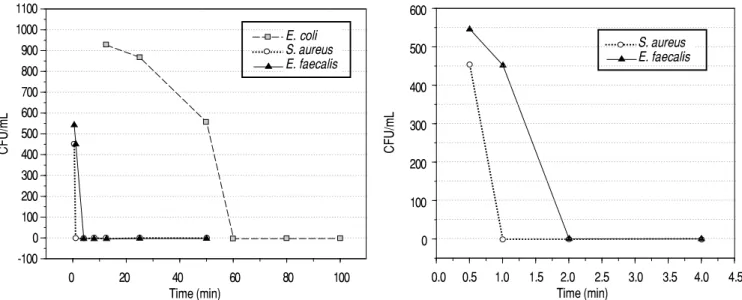
RP13 peptide showed a highly significant effect on the growth inhibition of gram-positive bacteria and was less efficient for gram-negative bacteria. These results show that susceptibility is directly re-lated to the time exposure between the peptide and the microorganisms (Figures 1-3). The growth inhi-bition of the strains tested showed a depending rela-tion on the concentrarela-tion of RP13 peptide. A MIC value of 1 and 2 μg/mL was obtained respectively against S. aureus and E. faecalis, and a MIC value of 60 μg/mL against E. coli (Figure 4). The MIC val-ues obtained for RP13 were higher than the value for tetracycline (Table 1).
DISCUSSION
Antimicrobial peptides have demonstrated a pri-marily inhibitory effect on bacterial growth, and their activity has also been evaluated in fungi, yeasts and viruses, obtaining good results in terms of their inhibitory activity.24,25
In a previous study, RP11 peptide was designed with the structural characteristics similar to the pep-tides derived from PMPs as well as microbicidal pro-teins stimulated by tPMPs. However, this peptide did not show good activity against E. coli, the only bacte-rium used to evaluate its antimicrobial activity.17
required for antimicrobial action on the mem-brane of E. coli. For this reason, we thought that reversing the position of the amino acids Lys-Tyr might reduce the problems and promote antimi-crobial activity against gram-positive and -nega-tive bacteria.
Fortunately, it was confirmed that antimicrobial activity of the peptides is closely related to the three
Table 1. Results of antibacterial activity (MIC) from RP13 peptide, 2 h after incubation with microorganisms at 37 °C.
Microorganism MIC peptide RP13 MIC tetracycline (μg/mL) (μg/mL)
S. aureus 1 0.5
E. faecalis 2 1
E. coli 60 1
dimensional structure that the peptide can adopt in solution, a property that depends on the amino acids sequence on the peptide chain.26 There are
re-ports where the peptides containing basic amino acids such as Lys, His and Arg provide a cationic charac-ter to the molecule, and the presence of hydrocarbon residues such as Leu or Ile, aromatic compounds such as Phe and Tyr favor the specific formation of hydrophobic or hydrophilic regions, which are di-rectly correlated with the amphipathic structure of the peptides, a characteristic that increases its anti-microbial activity against bacteria.27,28 For this
pur-pose, RP13 peptide was prepared with its peptidic chain containing six basic amino acids, four aro-matics, and three hydrocarbons in a sequence that allows clear differentiation of the hydrophilic and hydrophobic regions and a strong cationic charac-ter, in order to increase the electrostatic interac-tions between the amino acids arginine and tyrosine.
. r
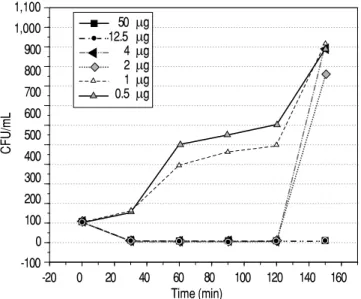
Figure 1. Susceptibility of S. aureus in the presence of peptide RP13. Approximately 103 bacteria per milliliter were cultured at 37 oC in the presence of the peptide RP13. Colony forming units (CFU) were obtained by quantitative cultures taken every 15 min during 2 h.
-20 0 20 40 60 80 100 120 140 160 Time (min)
1,200 1,100 1,000 900 800 700 600 500 400 300 200 100 0 -100
CFU/mL
50 μg 25 μg 12.5 μg 4 μg 2 μg 1 μg 0.5 μg
g
Figure 3. Susceptibility of E. coli in the presence of peptide RP13. Effect of the peptide RP13 on the bacterial growth of E. Coli. The suscep-tibility was evaluated in a trial of 2 h by taking samples every 15 min to obtain the colony-forming units (CFU).
-20 0 20 40 60 80 100 120 140 160 Time (min)
1,800 1,700 1,600 1,500 1,400 1,300 1,200 1,100 1,000 900 800 700 600 500 400 300 200 100 0 -100
CFU/mL
100 μg 80 μg 60 μg 50 μg 25 μg 12.5 μg
r
Figure 2. Susceptibility of E. faecalis in the presence of peptide RP13. Kinetics of antimicrobial activity of the peptide RP13 against E. faecalis in a test of 2 h in culture medium Muller-Hilton to 37 oC by taking samples every 15 min tested for obtaining the colony-forming units (CFU). -20 0 20 40 60 80 100 120 140 160
Time (min) 1,100
1,000 900 800
700 600 500
400 300 200 100
0 -100
CFU/mL
The results obtained showed that there was considerable homogeneity between S. aureus and
E. faecalis, observing a kinetic behavior similar for the inhibitory growth activity. However, there were minimal differences, because S. aureus was more sensitive to the antimicrobial effect the RP13 pep-tide and had a MIC of 1 μg/mL. The antimicrobial activity was maintained for 2 h at low concentra-tions (0.5-4 μg/mL) and this behavior was main-tained only at concentrations > 12 μg/mL (Figure 1).
E. faecalis showed less sensitivity to RP13 peptide with a MIC value of 2 μg/mL. The tendency of the inhibitory effect had a similar behavior to that showed by S. aureus (Figure 2). With respect to
E. coli, the results were different; RP13 peptide had a low antimicrobial activity compared to its activity against gram-positive bacteria. Thus, E. coli showed a MIC value of 60 μg/mL at 2 h of incubation, and the antimicrobial effect remained after 2.5 h only at concentrations > 100 μg/mL (Figure 3). The results of antimicrobial activity are similar to evaluations performed with endogenous antimicrobial peptides as well as with synthetic peptides, where the inhibi-tory growth activity was more prominent in gram-positive rather than gram-negative bacteria.29,30
Evaluation of the antimicrobial activity of the original reported RP11 peptide did not show a sig-nificant effect inhibiting the growth of E. coli, the only microorganism evaluated in this study.17 In
the case of RP13, a MIC value of 60 μg/mL was
obtained, which is between the interval reported for other peptides with antimicrobial properties. Similarly, Azuma, et al.,31 evaluated a series of 20
peptides whose linear main chain was composed of between 20 and 30 amino acids residues and ob-served that ca. 30% of the peptides had a MIC val-ue of ≤ 60 μg/mL for gram-negative bacteria. Similar results with regard to MIC values were described by Jang, et al.,32 in their study of
inhibi-tory activity of halocidine derivatives, a peptide isolated from tunicates. Additionally, it has been reported that the isolated peptides from human platelets are less efficient against E. coli compared with the inhibitory power against gram-positive bacteria.33,34 Linear peptides are not the only
pep-tides that demonstrated this tendency, Janieszews-ka, et al.,35 described a series of short-chain
dendrimeric peptides with highly cationic charac-ter, 60% had MIC values ≤ 80 μg/mL. The most likely reason for this activity may be the different constitution of the cell membranes of gram-nega-tive and gram-posigram-nega-tive bacteria, the site where it has been postulated that these compounds act to exert their antimicrobial activity.5,9,36
Most of the reported evaluations have been car-ried out in conventional culture media, being Mueller-Hinton the most used. When this media was used, the peptide had a greater activity at short times. With incubation periods between 2 and 3 h or larger, the peptide lost its antimicrobial activity.
g
Figure 4. A. Antimicrobial activity of synthetic peptide RP13, 2 h after incubation with the indicated microorganisms. Minimum inhibitory concentra-tion of RP13 peptide against the bacteria tested in vitro assay diluconcentra-tion for a period of 2 h. Minimum inhibitory concentraconcentra-tion values (MIC) of the RP13 pepti-de against the bacteria tested were obtained by tube dilution technique for a period of 2 h. B.B. Defining the zone of inhibition of the synthetic peptide RP13, 2 h after incubation with Gram-positive bacteria.
0 20 40 60 80 100 Time (min)
1100 1000 900 800 700 600 500 400 300 200 100 0 -100
CFU/mL
0.0 0.5 1.0 1.5 2.0 2.5 3.0 3.5 4.0 4.5 Time (min)
600
500
400
300
200
100
0
CFU/mL
S. aureus E. faecalis E. coli
Determinations of the antimicrobial properties of peptides have been performed modifying the conditions of the culture, utilizing serum biometrix plasma and whole blood, simulating the physiologi-cal conditions of the human body by pre-incubating the peptide before the contact with the microorgan-ism. However, the results were not significant because MIC values did not show an increase in the antimicrobial activity.17
The main disadvantage of this class of compounds of peptidic origin is the proteolytic degradation, lead-ing to the loss of the activity activity which is reflect-ed in a short period of inhibition. Moreover, the activity may also decrease due to the culture medium used. It has been reported that compounds of peptidic origin and others, such as dextrin, polysaccharides and sulfates interact strongly with the constituents of the culture medium, a factor to be considered for future evaluations of antimicrobial peptides.37
In conclusion, antimicrobial peptides are promis-ing candidates against resistant pathogens. One of the greatest advantage of it use is the absence or oc-casional resistance that the microorganisms may generate against them. Currently, their clinical utili-ty is limited because of problems of enzymatic degra-dation and availability from natural sources in sufficient quantities for clinical trials and conse-quently chemical synthesis is required for to the prep-aration of this type of compounds. Thus far, once a potentially active peptide is identified as an antimi-crobial agent, the synthesis of derivatives by manipu-lation of its structure may allow the preparation of compounds with an improved biological activity.
The sequence of amino acids that form the pep-tidic chain of compound RP13 plays a pivotal role in its structure and consequently in its antimicro-bial activity. The change in the position of the ami-no acids lysine and tyrosine resulted in the inhibition of cellular growth against gram-positive bacteria (S. aureus and E. feacalis) and even E. coli, a gram-negative bacterium, shows susceptibil-ity to RP13 peptide. The results obtained in the evaluation trial of its inhibitory activity, represent a contribution to growing list of synthetic antimi-crobial peptides and positions it as a strong candi-date in the search for alternatives to combat infectious diseases.
ACKNOWELEDGMENTS
We are grateful to Dr. Jaime Escalante of the Universidad Autónoma del Estado de Morelos for HPLC analysis of RP13 peptide.
REFERENCES
1. Travis J. Reviving the antibiotics miracle? Science 1994; 264: 360-2.
2. Neuhauser MM, Weinstein RA, Rydman R. Antibiotic resist-ance among gram negative bacilli in us intensive care units: implications for fluoroquinoline use. JAMA 2003; 289: 885-8.
3. Hancock RW. Peptide Antibiotics. Lancet 1997; 349: 418-22. 4. Boman HG. Peptides antibiotics and their role in innate
immu-nity. Annu Rev Immunol 1995; 13: 61-92.
5. Hancock RW. Cationic peptides: effectors innate immunity and novel antimicrobials. Lancet 2001; 1: 156-64.
6. Boman HG. Antibacterial peptides: basic facts and emerging concepts. J Intern Med 2003; 254: 197-215.
7. Yeaman MR. The role of platelets in antimicrobial host de-fense. Clin Infect Dis 1997; 25: 951-68.
8. Dürr M, Peschel A. Chemokines meet defensins: the merging concepts of chemoattractants and antimicrobial peptides in host defense. Infect Immun 2002; 70: 6515-7.
9. Yeaman MR, Yount NY. Mechanisms of antimicrobial peptide action and resistance. Pharmacol Rev 2003; 55: 27-55. 10. Brogden KA. Antimicrobial peptides: pore formers or
metabol-ic inhibitors in bacteria? Nat Rev Microbiol 2005; 3: 238-50. 11. Tang YQ, Yeaman MR, Selsted ME. Antimicrobial peptides
from human platelets. Infect Immun 2002; 70: 6224-533. 12. Yount N. Platelet microbicidal protein 1: Structural themes of a
multifunctional antimicrobial peptide. Antimicrob Agents
Chemother 2004; 48: 4395-404.
13. Raj PA, Dentino AR. Current status of defenses and their role in innate and adaptative immunity. FEMS Microbiol Lett 2002; 206: 9-18.
14. Jensen H, Mamill P, Hancock RW. Peptide antimicrobial agents. Clin Microbiol Rev 2006; 19: 491-511.
15. Marshall SH, Arenas G. Antimicrobial peptides: a natural alter-native to chemical antibiotics and a potential for applied bio-technology. Electron J Biotechnol 2003; 6: 271-84.
16. Darveu RP, Blake J, Seachord CL, et al. Peptides related to the carboxyl terminus of human platelet factor IV with antibacteri-al activity. J Clin Invest 1992; 90: 447-55.
17. Yeaman MR, Gank KD, Bayer AS, Brass EP. Synthetic pep-tides that exert antimicrobial activities in whole blood-de-rived matrices. Antimicrob Agents Chemother 2002; 46: 3883-91.
18. Yeaman MR, Puentes SM, Norman DC, et aler ASDC, Bayer AS, Brass. Partial characterization and staphylocidal activity of thrombin-induced platelet microbicidal protein. Infect Immun
2002; 60: 1201-09.
19. Wuts PG, Greene T. Greene’s Protective Groups in Organic Syn-thesis. 4th ed. New York: Wiley Interscience; 2006, p. 1082. 20. Sewald N, Jakubke H. Peptides: Chemistry and Biology. 2nd
Ed. Weinheim, Germany: Wiley-VCH; 2009, p. 578.
21. Bodansky M, Bodansky A. The Practice of Peptide Synthesis. 4th Ed. Berlin: Springer-Verlag; 1994, p. 217.
22. Hancock RW, Lether RI. Cationic peptides: a new source of an-tibiotics. Trends Biotechnol 1998; 16: 82-8.
23. Harwig SL, Ganz T, Lehrer RI. Neutrophil defensins: purifica-tion, characterization and antimicrobial testing. Methods Enzy-mol 1994; 236: 160-72.
24. Koczulla AR, Bals R. Antimicrobial peptides: current status and therapeutic potential. Drugs 2003; 63: 389-406.
25. Yeaman MR, Ibrahim As, Edwards JE, et al. Thrombin-in-duced rabbit platelet microbicidal protein is fungicidal in vitro.
Antimicrobial Agents Chemother 1993; 37: 546-54.
27. Sharma RK, Sundriyal S, Wangoo N, et al. New antimicrobial hexapeptides: synthesis, antimicrobial activities, cytotoxicity and mechanistic studies. Chem Med Chem 2010; 5: 86-95. 28. Oh JE, Hong SY, Lee KH. Structure-activity relationship
study: short antimicrobial peptides. J Pept Res 1999; 53: 41-6. 29. Schriever C, Fernández C, Rodvold KA, et al. Daptomycin: a novel cyclic lipopeptide antimicrobial. Am J Health Syst
Pharm 2005; 62: 1145-54.
30. Maisetta G, Batoni G, Esin S, et al. In vitro bactericidal activity of human β-defensin 3 against multidrug-resistant nosocomial strains. Antimicrob Agents Chemother 2006; 50: 806-09. 31. Azuma M, Kojima T, Tokoyama I, et al. A synthetic peptide of
human apoprotein E with antibacterial activity. Peptides 2000; 21: 327-30.
32. Jang WS, Kim KN, Park SY, et al. Biological activities of synthetic analogs of halocidine, an antimicrobial peptide from the tunicate. Antimicrob Agents Chemother 2003; 47: 2481-6.
33. Krigsveld J, Zaat SA, Meeldijk J, et al. Thrombocidins, micro-bicidal proteins from blood platelets, are C-terminal deletion products of CXC chemokines. J Biol Chem 2000; 275: 20374-85.
34. Xiong YQ, Bayer AS, Yeaman MR. Inhibition of intracellular macromolecular synthesis in Staphylococcus aureus by
thrombin-induced platelet microbicidal proteins. J Infect Dis
2002; 185: 346-56.
35. Janieszewska J, Swieton J, Lipkowski W, et al. Low molecular mass peptide dendrimers that express antimicrobial properties.
Bioorg Med Lett 2003; 13: 3711-3.
36. Zasloff M. Antimicrobial peptides of multicellular organisms.
Nature 2002; 415: 389-95.
37. Ericksen B, Wu Z, Wu Y, et al. Antibacterial activity and spe-cificity of the six human α-defensins. Antimicrob Agents
Chemother 2005; 49: 269-75.
Reimpresos:
Dr. Adrián Sánchez
Laboratorio de Inmunoquímica
Hospital Infantil de México Federico Gómez Dr. Márquez No. 162. Col. Doctores. 06720 México, D.F.
Tel.: (55) 5228-9917, Ext. 2000 Correo electrónico: