P
www.permanyer.com
Rev Inves Clin. 2016;68:221-8 oRIgInal aRtICle
Invasive and Complicated Pneumococcal
Infection in Patients with Cancer
Sugehily Zarco-Márquez
1, Patricia Volkow-Fernández
2, Consuelo Velázquez-acosta
1,
gabriela echániz-avilés
3, María noemí Carnalla-Barajas
3, araceli Soto-noguerón
3and Patricia Cornejo-Juárez
2*1Microbiologylaboratory and 2Department of Infectious Diseases, Instituto nacional de Cancerología (InCan),
Mexico City; 3Infectious Diseases Research Center, Instituto nacional de Salud Pública (InSP), Cuernavaca,
Morelos, Mexico
Corresponding author:
*Patricia Cornejo-Juárez
Department of Infectious Diseases Instituto nacional de Cancerología (InCan) av. San Fernando, no. 22
Col. Sección XVI, Del. tlalpan
C.P. 14080, Ciudad de México, México
e-mail: [email protected] Received for publication: 07-07-2016 accepted for publication: 15-09-2016
AbstrACt
background: In susceptible patients, Streptococcus pneumoniae can cause complicated pneumonia and invasive pneumococcal
disease. the aim of this study was to assess the clinical and antimicrobial features of complicated and invasive pneumococ-cal disease in patients with cancer. Methods: We conducted a retrospective study including all S. pneumoniae isolates between
January 1, 2007 and December 31, 2015 in an oncology center. Capsular serotyping was done in isolates from sterile sites.
results: there were 103 episodes: 69 with invasive pneumococcal disease and 34 with complicated pneumonia. Sixty-two
patients were male (60%); mean age was 50 years. eighty-four isolates were susceptible to penicillin (81.6%), 11 (10%) were intermediate, and eight (8.3%) were resistant. Serotyping was performed in 64 isolates; the main serotypes identified were 3 (n = 13) and 19a (n = 11). no patient had a record of vaccination. Mortality at seven days attributed to pneumococcal infec-tion was different in invasive pneumococcal disease (n = 18, 28.6%) vs. pneumonia (n = 3, 8.9%; p = 0.04). thirty-day mortal-ity related with the infectious process was statistically different between both groups: 21 patients with invasive pneumococcal disease (30.4%) and six with pneumonia (17.6%; p = 0.04). By logistic analysis, the risk factor associated with mortality was not having received appropriate antimicrobial treatment in the first 48 hours. Conclusions: S. pneumoniae is a pathogen related
with high mortality in patients with cancer. Pneumococcal immunization needs to be reinforced in this population. (ReV InVeS ClIn. 2016;68:221-8)
Key words: Cancer. Invasive pneumococcal disease. Pneumonia. Streptococcus pneumoniae.
IntroduCtIon
Streptococcus pneumoniae is an important cause of
community acquired pneumonia, bacteremia, and meningitis. In susceptible patients, pneumococcal pneumonia could lead to hospitalization related to
respiratory distress and in some cases requiring mechanical ventilation. Invasive pneumococcal dis-ease (IPD) is a serious, life-threatening infection that remains an important global cause of major illness despite the introduction of pneumococcal vaccines1,2.
No part of this publication may be reproduced or photocopying without the prior written permission
of the publisher
.
the incidence of IPD and pneumonia is higher in immu-nocompromised individuals, even in the modern antibi-otic era1,2. Patients with cancer are especially
suscep-tible to severe pneumococcal infections, which carry significant morbidity and mortality3-5. appropriate
em-pirical antibiotic treatment initiated as soon as the in-fection is clinically suspected is mandatory to improve outcomes, especially in patients with neutropenia3,4.
Certain cancer patients are more vulnerable, including those with Hodgkin’s lymphoma or multiple myeloma3.
Information on this group of patients is scarce. there-fore, we assessed the clinical features, antimicrobial susceptibility, serotypes, and outcomes of complicat-ed and IPD in patients with cancer at a tertiary level oncology center in Mexico.
Methods
study design and subjects
We retrospectively analyzed all consecutive S.
pneu-moniae infections in patients who were seen at the
national Cancer Institute (InCan) in Mexico City, Mex-ico, between January 1, 2007 and December 31, 2015.
InCan is a 135-bed referral teaching hospital for adult patients with cancer located in Mexico City, with an average of 170,000 medical visits, 35,000 chemo-therapy sessions, and 7,500 hospital discharges per year. the study was undertaken with Institutional Re-view Board approval (InCan/CI/388/15).
Data on demographic characteristics, underlying malig-nancies, concurrent diseases, main clinical symptoms, antimicrobial therapy, intensive care unit admission, type of pneumococcal disease, number of days of an-timicrobial therapy, type of anan-timicrobials used (beta-lactams, third-generation cephalosporins, macrolides, fluoroquinolones, clindamycin, and vancomycin), and infection outcomes were retrieved from patients’ med-ical records and computed institutional databases.
Laboratory procedures
Microbiologic evaluations were performed at the InCan laboratory of Microbiology. S. pneumoniae was isolated by standard microbiological procedures. antimicrobial susceptibility was tested by the oxacillin disk diffusion
method for penicillin susceptibility, following the Clin-ical laboratory Standards Institute (ClSI) methods and criteria6. For non-meningitis isolates, an oxacillin
zone of ≥ 20 mm was considered susceptible to pen-icillin and predicted susceptibility for amppen-icillin and ceftriaxone. Capsular serotyping was conducted in isolates from sterile sites and was performed at the national Public Health Institute (InSP, Cuernavaca, Morelos, Mexico), by the Quellung reaction with type- and factor-specific antisera (Statens Serum Institut, Copenhagen, Denmark). Minimal inhibitory concen-tration was determined for penicillin, erythromycin, and chloramphenicol in these isolates.
definitions
Pneumonia: Radiographic criteria on chest X-ray or computed tomography scan (Ct) plus one or more of the following: fever (≥ 38oC) or hypothermia (< 35oC),
new cough with or without sputum production, pleu-ritic chest pain, dyspnea, and altered breath sounds on auscultation.
Severe or complicated pneumonia: CURB-65 pneumo-nia severity score of ≥ 2 and the presence of pleural effusion, empyema or cavitation.
Invasive pneumococcal disease: Isolation of S.
pneu-moniae from a normally sterile body fluid such as
blood, cerebrospinal fluid, pleural fluid, or ascites.
appropriate antimicrobial treatment: When an an-timicrobial agent had been initiated within the first 48 hours of the first symptoms and if the patient had received it for at least 72 hours, including an antibi-otic to which S. pneumoniae was susceptible.
Clinical cure: Resolution of clinical symptoms and signs, and/or sterilization of blood or respiratory tract cul-tures after antimicrobial treatment, and/or radiograph-ic resolution of pneumonia in patients who had pre-sented with pulmonary infiltrates.
Death related with pneumococcal infection: Persis-tence of a clinical condition of sepsis at the time of death, or when death occurred during the first week after blood cultures were taken.
overall case fatality rate: Death by any cause within 30 days of IPD onset.
No part of this publication may be reproduced or photocopying without the prior written permission
of the publisher
.
statistical analysis
Quantitative variables were calculated as median and interquartile range (IQR). Categorical data were ana-lyzed using the chi-square or the Fisher exact test, as appropriate. For the analysis, the events were divided into two groups: IPD and severe or complicated pneu-monia. a logistic regression model was employed to examine the effects of multiple risk factors on mortal-ity. Variables included in the model were those found to reach a significance level of p ≤ 0.1 in the univariate analysis. overall survival (oS) rates were estimated
by means of the Kaplan-Meier method and the log-rank test. Values for p ≤ 0.05 were considered statis-tically significant. Data was analyzed using Stata v.12 (Stata Corp., College Station, tX, USa) statisti-cal software.
resuLts
there were 103 episodes of pneumococcal infec-tions during the eight-year study period. Sixty-nine (67%) were classified as IPD and 34 (33%) solely as
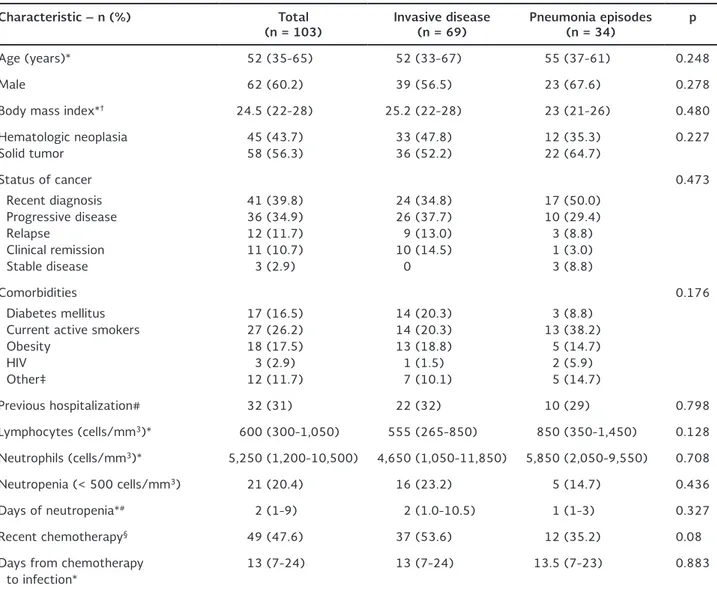
table 1. Clinical characteristics of 103 patients with cancer and Streptococcus pneumoniae infection classified as invasive disease or pneumonia episodes
Characteristic – n (%) total
(n = 103) Invasive disease(n = 69) Pneumonia episodes (n = 34) p
age (years)* 52 (35-65) 52 (33-67) 55 (37-61) 0.248 Male 62 (60.2) 39 (56.5) 23 (67.6) 0.278 Body mass index*† 24.5 (22-28) 25.2 (22-28) 23 (21-26) 0.480
Hematologic neoplasia Solid tumor
45 (43.7) 58 (56.3)
33 (47.8) 36 (52.2)
12 (35.3) 22 (64.7)
0.227
Status of cancer Recent diagnosis Progressive disease Relapse
Clinical remission Stable disease
41 (39.8) 36 (34.9) 12 (11.7) 11 (10.7) 3 (2.9)
24 (34.8) 26 (37.7) 9 (13.0) 10 (14.5)
0 (
17 (50.0) 10 (29.4) 3 (8.8) 1 (3.0) 3 (8.8)
0.473
Comorbidities Diabetes mellitus Current active smokers obesity
HIV other‡
17 (16.5) 27 (26.2) 18 (17.5) 3 (2.9) 12 (11.7)
14 (20.3) 14 (20.3) 13 (18.8) 1 (1.5) 7 (10.1)
3 (8.8) 13 (38.2)
5 (14.7) 2 (5.9) 5 (14.7)
0.176
Previous hospitalization# 32 (31) 22 (32) 10 (29) 0.798 lymphocytes (cells/mm3)* 600 (300-1,050) 555 (265-850) 850 (350-1,450) 0.128
neutrophils (cells/mm3)* 5,250 (1,200-10,500) 4,650 (1,050-11,850) 5,850 (2,050-9,550) 0.708
neutropenia (< 500 cells/mm3) 21 (20.4) 16 (23.2) 5 (14.7) 0.436
Days of neutropenia*# 2 (1-9) 2 (1.0-10.5) 1 (1-3) 0.327
Recent chemotherapy§ 49 (47.6) 37 (53.6) 12 (35.2) 0.080
Days from chemotherapy to infection*
13 (7-24) 13 (7-24) 13.5 (7-23) 0.883
*Interquartile range; †body mass Index = kg/m2; ‡chronic pulmonary disease, coronary heart disease, liver failure, previous breast cancer,
multiple sclerosis, chronic alcoholism; #during the last month; §chemotherapy applied during the previous three months.
No part of this publication may be reproduced or photocopying without the prior written permission
of the publisher
.
pneumonia. Sixty-two patients were male (60.2%); median age was 52 (IQR, 35-65) years. Forty-five patients (43.7%) had a malignant hematological dis-ease. other clinical and demographic characteristics are depicted in table 1.
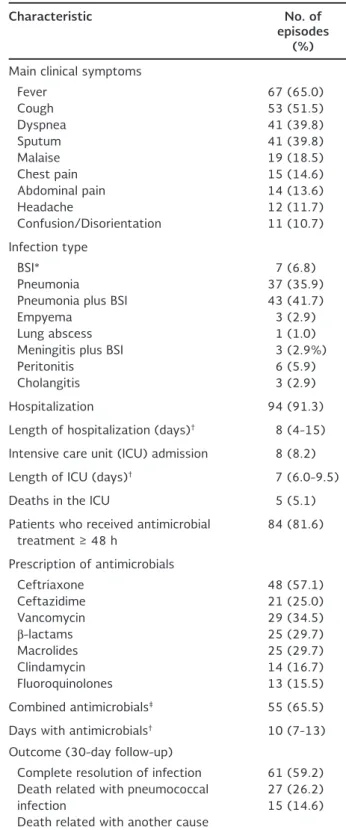
the most frequent pneumococcal manifestation was bacteremic pneumonia (n = 43; 41.7%), followed by pneumonia (n = 37; 36%). ninety-four patients (91.3%) were hospitalized, with a median hospital stay length of eight days (IQR, 4-15 days).
Chest X-ray was performed in 94 patients (91.2%) and 10 patients had Ct; 84 (79%) had findings re-lated with lung infection. More than one lobe of the lung parenchyma was affected in 24 patients (23.3%), cavitation was seen in three (2.9%), and pleural effu-sions of different sizes in 19 (18.5%) patients. other clinical findings are presented in table 2.
twenty infections (19.4%) were classified as hospital acquired, with no differences between IPD and non-invasive disease (p = 0.982).
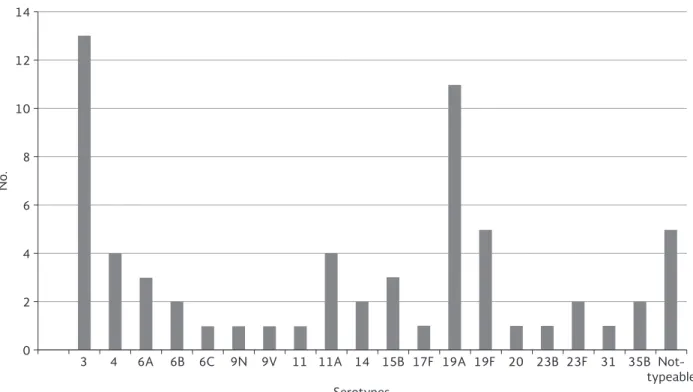
eighty-four isolates were susceptible to penicillin (81.6%), 11 (10%) were intermediate, and eight (8.3%) were resistant. Serotyping was performed in 64 isolates (60.1%). the main serotypes identi-fied were 3 (n = 13), 19a (n = 11), 19F (n = 5), 4 (n = 4), and 11a (n = 4) (Fig. 1). Forty-nine (76.5%) isolates belonged to a serotype contained in the 23-valent pneumococcal polysaccharide vaccine (PPV-23) (Pneumovax 23®; Merck, USa), and 43 (67.1%) to a serotype contained in the 13-valent pneumococcal conjugate vaccine (PCV-13) (Prevnar 13®; Pfizer, USa). no patient had a record of having
received pneumococcal vaccination.
the majority of patients received ceftriaxone (n = 48; 57.1%), followed by vancomycin (n = 29; 34.5%), aminoglycosides (n = 28; 33.3%), β-lactams (n = 25; 29.8%), macrolides (n = 25; 29.8%), and ceftazidime (n = 20; 25%). two or more effective drugs were si-multaneously administered in 55 (65.4%) patients (table 2). Combined antimicrobial treatment was as-sociated as a protector variable in the univariate anal-ysis for seven-day mortality (p = 0.008), but it was not confirmed in logistic regression analysis (p = 0.726). there were no differences in the analysis of 30-day mortality.
table 2. Clinical characteristics related with Streptococcus
pneumoniae infections in patients with cancer (n = 104)
Characteristic no. of
episodes (%)
Main clinical symptoms Fever Cough Dyspnea Sputum Malaise Chest pain abdominal pain Headache Confusion/Disorientation 67 (65.0) 53 (51.5) 41 (39.8) 41 (39.8) 19 (18.5) 15 (14.6) 14 (13.6) 12 (11.7) 11 (10.7) Infection type BSI* Pneumonia Pneumonia plus BSI empyema
lung abscess Meningitis plus BSI Peritonitis Cholangitis 7 (6.8) 37 (35.9) 43 (41.7) 3 (2.9) 1 (1.0) 3 (2.9%) 6 (5.9) 3 (2.9) Hospitalization 94 (91.3) length of hospitalization (days)† 8 (4-15)
Intensive care unit (ICU) admission 8 (8.2) length of ICU (days)† 7 (6.0-9.5)
Deaths in the ICU 5 (5.1) Patients who received antimicrobial
treatment ≥ 48 h
84 (81.6)
Prescription of antimicrobials Ceftriaxone Ceftazidime Vancomycin β-lactams Macrolides Clindamycin Fluoroquinolones 48 (57.1) 21 (25.0) 29 (34.5) 25 (29.7) 25 (29.7) 14 (16.7) 13 (15.5) Combined antimicrobials‡ 55 (65.5)
Days with antimicrobials† 10 (7-13)
outcome (30-day follow-up) Complete resolution of infection Death related with pneumococcal
infection
Death related with another cause
61 (59.2) 27 (26.2) 15 (14.6)
*Blood stream infection (BSI) without another documented source
of infection; †median interquartile range; ‡combination of
antimicrobials: ceftriaxone + clarithromycin (n = 18), ceftazidime + amikacin (n = 9), ceftriaxone + amikacin (n = 7), ceftriaxone + vancomycin (n = 6), ceftazidime + vancomycin (n = 6), piperacillin/tazobactam + clarithromycin (n = 5), and ceftazidime + clindamycin (n = 4).
No part of this publication may be reproduced or photocopying without the prior written permission
of the publisher
.
Fifteen patients (14.6%) died during the first 48 hours, all related with the infectious disease: 11 with IPD and four with pneumonia (p = 0.768). at seven days post-culture, 21 patients (20.4%) had died: 18 with IPD (28.6%) and three with pneumonia (8.9%; p = 0.04). at 30 days, 42 patients had died (40.1%): 32 with IPD (46.4%) and 10 with pneumonia (29.4%; p = 0.09). When deaths were directly attributed to the infec-tious process, there was a significantly higher mortal-ity in patients with IPD (n = 21; 30.4%) than in those with pneumonia (n = 6; 17.6%; p = 0.04) (Fig. 2).
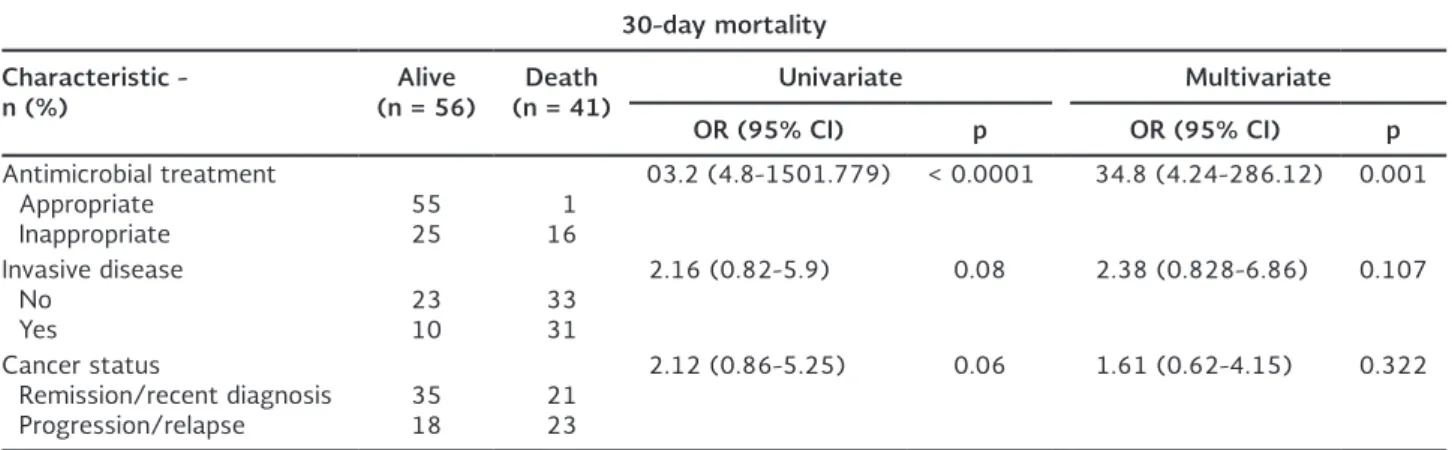
logistic regression analysis showed that a risk factor for 30-day mortality was inappropriate antimicrobial treatment (table 3).
dIsCussIon
this study assessed the disease burden, risk factors, microbiological features, and outcomes of pneumo-coccal infections in patients with cancer.
the mean age of these patients was younger than that reported in other series (52 vs. 64 years of age)2,3. this was probably related with the underlying
neoplastic disease since patients with hematologic ma-lignancies, who are usually younger, comprised 44% in our series.
a previous study reported that multiple myeloma presents a higher risk of pneumococcal infection re-lated with defects in complement activation, neutro-phil function, and functional hypogammaglobulinemia2.
We found lymphoma as the most prevalent hemato-logic disease (17.5%), followed by leukemia (10.3%), and multiple myeloma (8.3%). We explain this finding because lymphoma is the most frequent hematologic disease seen at our hospital, followed by acute leuke-mia, and multiple myeloma as the third most frequent hematologic disorder.
about 20% of these cases were classified as hospital-acquired; other studies have reported that the preva-lence of hospital-acquired pneumococcal pneumonia is 10-20%7,8. this finding is important since
hospital-ization is a risk factor for multidrug-resistant bacte-rial pneumonia; thus, it is important to consider pen-icillin-resistant pneumococcal strains.
Solid tumors comprised 56% of the whole group, with lung cancer being the most prevalent malignancy
14
12
10
8
6
4
2
0
3 4 6A 6B 6C 9N 9V 11 11A 14 15B 17F 19A 19F 20 23B 23F 31 35B
typeable
Serotypes
No.
Figure 1. Serotypes identified in 66 samples from patients with pneumococcal infection.
No part of this publication may be reproduced or photocopying without the prior written permission
of the publisher
.
(n = 10; 9.7%) followed by gastrointestinal cancer (n = 9; 9.3%). other studies in cancer patients have reported lung cancer as the most frequent solid tu-mor present in patients with IPD2.
Bloodstream infection was the most frequent clinical presentation (52%); these were critically ill patients
considering that 20% of them died in the first 48 hours and 47% died in the first month. one study con-ducted in patients with cancer and bloodstream infec-tion by S. pneumoniae reported an early case mortal-ity (< 48 hours) of 4.8% and an overall case fatalmortal-ity rate of 14.3% (< 30 days)3, considerably lower than
our findings. a higher mortality rate of pneumococcal
table 3. Risk factors for 30-day mortality in patients with pneumococcal infection
30-day mortality
Characteristic
-n (%) (n = 56)Alive (n = 41)death univariate Multivariate
or (95% CI) p or (95% CI) p
antimicrobial treatment appropriate
Inappropriate 5525 116
03.2 (4.8-1501.779) < 0.0001 34.8 (4.24-286.12) 0.001
Invasive disease no
Yes 2310 3331
2.16 (0.82-5.9) 0.08 2.38 (0.828-6.86) 0.107
Cancer status
Remission/recent diagnosis
Progression/relapse 3518 2123
2.12 (0.86-5.25) 0.06 1.61 (0.62-4.15) 0.322 1.00
0.75
0.50
0.25
0.00
0 10 20 30
Analysis time (days)
Log rank p = 0.04
Non-invasive disease Invasive disease
Figure 2. Kaplan-Meier curve. Mortality in the first 30 days after Streptococcus pneumoniae isolation, divided into invasive disease (n = 69) and pneumonia episodes (n = 34).
No part of this publication may be reproduced or photocopying without the prior written permission
of the publisher
.
bloodstream infection (16.9%) has been reported in patients aged > 65 years and with underlying diseases or risk factors for immune suppression9. the elevated
mortality reported herein could be explained by the fact that we included patients with invasive and com-plicated infections, such as meningitis, peritonitis, em-pyema, and lung abscess.
one question addressed in other studies is related to the use of single vs. combined anti-pneumococcal treatment, with other authors suggesting a benefit of employing two active antimicrobials10. In this study
there was no benefit in survival by using combined antimicrobial treatment.
the prevalence of different pneumococcal serotypes varies by age group and geographic region, and differs with respect to virulence, invasiveness, and the ability to acquire resistance to different antibiotics11. Studies
performed in patients with malignancy have found a higher prevalence of serotype 6a2, different from
what we found in this study where the main serotypes identified were 3 and 19a (20.3 and 17.1%, respec-tively). Serotype 3 is one of the most susceptible to beta-lactam antibiotics, while 19a is related with resis-tance to beta-lactams and is associated with the selec-tion and disseminaselec-tion of a clonal complex (St 320)11,12.
Since 2010, serotype 19a has shown a trend to in-crease in Mexico, related with PCV-7 used in the pe-diatric population11. Further studies are required to
establish which are the major circulating serotypes in cancer patients.
Pneumococcal vaccines provide effective protection against severe and invasive disease in patients with a high risk of pneumococcal infections, such as can-cer patients13. nevertheless, it is important to
con-sider that patients who have recently received anti-neoplastic treatment could present reduced vaccine immunogenicity14. In Mexico there are two different
pneumococcal vaccines available. the pneumococcal polysaccharide vaccine (PPV-23) is currently recom-mended in patients with cancer; it is safe, inexpen-sive, and effective against invasive disease and im-proves the outcome and recurrences of patients with pneumococcal pneumonia3. the conjugated PCV-13
has a stronger and longer-lasting response because it contains a range of serotypes conjugated to a protein that allows for a t-cell-dependent response, thereby facilitating the formation of memory B-cells3. Both
vaccines are recommended for administration to adults newly diagnosed with hematological or solid malig-nancies14. In data from the Regional System for
Vac-cines (SIReVa) Mexico network, 70% of the strains isolated were included in PPV-23 and PCV-1315,
sim-ilar to what we found in this series (72%). Pneumo-coccal vaccination policies at our hospital clearly have been insufficient and have impacted in complicated disease with high mortality in this group of patients. We need to increase our patients’ coverage and make the rest of the medical team aware of the importance and need of expanding this coverage.
During the study period, 8.3% of S. pneumoniae iso-lates were penicillin-resistant and 10% were report-ed as penicillin-intermreport-ediate, similar to data from SIReVa Mexico network, which reported, in 2013, 12.5% penicillin-resistant and 8.3% intermediate strains. In europe, penicillin resistance is reported in 9.3%, but in the asia-Pacific Rim it is considerably higher (25%)15,16.
this work has some limitations. It is a retrospective study carried out at a single center, although it is a tertiary level referral center, which receives patients from different geographic areas of the country. an important limitation is that we captured patients with positive cultures, so it is possible that some cases may have been missed if cultures were not done or if they were done after the administration of antibiotics.
Invasive pneumococcal disease is a severe life-threat-ening infection, with high morbidity and mortality in patients with cancer. early initiation of antibiotics with activity against pneumococcus in patients with fever, respiratory symptoms and/or severe sepsis is essen-tial to improve survival. It is imperative to reinforce pneumococcal vaccination programs.
referenCes
1. Shigayeva a, Rudnick W, green K, et al; toronto Invasive Bacte-rial Diseases network. Invasive pneumococcal disease among immunocompromised persons: Implications for vaccination pro-grams. Clin Infect Dis. 2016;62:139-47.
2. Wong a, Marrie tJ, garg S, Kellner JD, tyrrell gJ; the SPat group. Increased risk of invasive pneumococcal disease in hae-matological and solid-organ malignancies. epidemiol Infect. 2010; 138:1804-10.
3. garcía-Vidal C, ardanuy C, gudiol C, et al. Clinical and microbiol-ogy epidemiolmicrobiol-ogy of Streptococcus pneumoniae bacteremia in cancer patients. J Infect. 2012;65:521-7.
No part of this publication may be reproduced or photocopying without the prior written permission
of the publisher
.
4. lin SH, liao WH, lai CC, et al. Comparison of clinical features, antimicrobial susceptibility, serotype distribution and outcomes of patients with hospital- and community-associated invasive pneu-mococcal disease. Int J antimicrob agents. 2010; 36:119-23. 5. Youssef S, Rodríguez g, Rolston KV, Champlin Re, Raad II, Safdar
a. Streptococcus pneumoniae infections in 47 hematopoietic stem cell transplantation recipients. Medicine. 2007;86:69-77. 6. Clinical and laboratory Standards Institute (ClSI): Performance
Standards for antimicrobial Susceptibility testing; 26th Infor-mational Supplement, 2015. approved Standard M100-S26. Wayne, Pa, USa: Clinical and laboratory Standards Institute. 7. Ikegame S, Wakamatsu K, Kumazoe H, et al. a retrospective
analysis of 111 cases of pneumococcal pneumonia: clinical fea-tures and prognostic factors. Intern Med. 2012;51:37-43. 8. Christensen JS, Jensen tg, Kolmos HJ, Pedersen C, lassen a.
Bacteremia with Streptococcus pneumoniae: sepsis and other risk factors for 30-day mortality--a hospital-based cohort study. eur J Clin Microbiol Infect Dis. 2012;31:2719-25.
9. Marrie tJ, tyrrell gJ, garg S, Vanderkooi og. Factors predicting mortality in invasive pneumococcal disease in adults in alberta. Medicine. 2011;90:171-9.
10. Bouza e, Pintado V, Rivera S, et al. nosocomial bloodstream infections caused by Streptococcus pneumoniae. Clin Microbiol Infect. 2015;11:919-24.
11. echániz-avilés g, San Román-Álvarez l, Sánchez-alemán M, Car-nalla-Barajas Mn, Soto-noguerón a. Prevalence of Streptococcus
pneumoniae serotype 19a before and after the introduction of the heptavalent conjugate vaccine in Mexico. Salud Publica Mex. 2014;56:266-71.
12. geng Q, Zhang t, Ding Y, et al. Molecular characterization and antimicrobial susceptibility of Streptococcus pneumoniae iso-lated from children hospitalized with respiratory infections in Suzhou, China. PloS one. 2014;9:e93752.
13. ardanuy C, Marimón JM, Calatayud l, et al. epidemiology of invasive pneumococcal disease in older people in Spain (2007-2009): implications for future vaccination strategies. PloS one. 2012;7:e43619.
14. Rubin lg, levin MJ, ljungman P, et al. 2013 IDSa clinical practice guideline for vaccination of the immunocompromised host. Clin Infect Dis. 2014;58:309-18.
15. SIReVa network 2013. [Data for country and age groups about Streptococcus pneumoniae, Haemophilus influenzae and neis-seria meningitides strains characteristics in invasive diseases]. Spanish. Washington, D.C., USa: World Health organization; 2013. ISBn 978-92-75-31918-5. http://iris.paho.org/xmlui/ handle/123456789/31147.
16. tomic V, Dowzicky MJ. Regional and global antimicrobial sus-ceptibility among isolates of Streptococcus pneumoniae and Haemophilus influenzae collected as part of the tigecycline evaluation and Surveillance trial (t.e.S.t) from 2009 to 2012 and comparison with previous years of t.e.S.t. (2004-2008). ann Clin Microbiol antimicrob. 2014;13:52.
No part of this publication may be reproduced or photocopying without the prior written permission
of the publisher
.