Report of the GÉANT Expert Group
••• October 2011
ean C
ommission
tion S
ociet
y and M
edia
Knowledge
without Borders
GÉANT 2020
as the
LEGAL NOTICE
By the Commission of the European Communities, Information Society & Media Directorate-General,
Neither the European Commission nor any person acting on its behalf is responsible for the use which might be made of the information contained in the present publication.
The European Commission is not responsible for the external web sites referred to in the present publication.
The views expressed in this publication are those of the authors and do not necessarily reflect the official European Commission view on the subject.
Luxembourg: Publications Office of the European Union, 2011 ISBN 978-92-79-21036-5
doi:10.2759/52949
© European Union, October 2011
Reproduction is authorised provided the source is acknowledged.
Cover picture credit: map of scientific collaboration between researchers by Olivier H. Beauchesne
ean C
ommission
tion S
ociet
y and M
edia
Report of the GÉANT Expert Group
•••
October 2011
Knowledge
without Borders
GÉANT 2020
as the
Foreword
T
he Digital Agenda for Europe aims to develop a flourishing digital economy by 2020, with everyone able to reap the benefits of the digital revolution. In particular, research and innovation are essential if we are to deliver smart growth and jobs.The quality and effi-ciency of scien-tific research today depends on ICT infra-structure. Researchers are increasingly work-ing in large teams, with research collaborations sometimes spanning the entire world. In that context, access to high speed communication networks is itself a powerful scientific instrument.
Through the joined force of the national research and education networks, GÉANT has made it possi-ble for scientists across Europe and the world to work together, in real time, on ground-breaking research. Bridging digital and geographical divides, it has given 40 million researchers and students in 40 European countries access to the processing power needed to share massive volumes of data: data which is essential whether you are studying the smallest known parti-cles, finding a cure for epilepsy or setting up a typhoon early warning system. With fast evolving technol-ogy, services and capacity, GÉANT remains the most advanced research network in the world.
The European Commission has provided consistent support to GÉANT over the past decade. We are committed to promoting worldwide research collabo-ration to tackle problems from medicine to climate change and beyond. The power and scope of GÉANT ensure Europe remains a central hub for research and education, offering the best infrastructure to the brightest minds in the world.
Rich with these successes, GÉANT must now position itself to face the challenges of the next decade such as the upcoming "data deluge", connectivity at world scale, and providing a seamless service to all EU scien-tists to build an online European Research Area. This is why the Commission has asked a group of high-level experts to advise on future actions.
I am certain that this report will be an invaluable input for formulating research, innovation and e-infrastructure policies not only in the Commission but also in the Member States and GÉANT community. I invite every organisation and every citizen involved in research and education to take note of this report and to use it when discussing and prioritising research and investment.
Neelie Kroes
I
n 1984 I was freelancing as the editor of a micro-computer magazine and travelled to a micro-computer fair in London. At the time citizens of Yugoslavia had to pay a substantial deposit to travel abroad, which really made us angry. On the long journey by train the co-editor and I played with an idea to get some modems, use them to get the data across the border, process data locally and then export the results back to the West, bypassing the monitoring eye of the customs officials and avoiding the business-hostile policies of that Orwellian country.Ten years later, in 1994, I was doing exactly that: I created a search engine for free software, indexing the FTP sites on which it resided and serving the data on the web. What made this possible was that since 1991 the internet had been available in Slovenia, thanks to the European academic networking and Arnes, the Slovenian National Research and Education Network. For a period in the mid-1990s this free service was generating about a third of all Slovenia’s outbound internet traffic; it later evolved into shareware.com.
Another ten years on, in 2004, Slovenia joined the Euro-pean Union. Not only bits and bytes could flow freely across the border, goods, capital and people could too. In the meantime, academic networks allowed me to put Slovenian construction informatics on the global research map, to publish one of the first open access
scientific journals on the Web, and to collaborate on European and global research and education projects.
I, like thousands of academics across Europe, have benefited hugely from GÉANT and its predecessors. Over the last 10 years GÉANT, the pan-European communications infrastructure serving a collection of national research networks, enabled networking and collaboration of the European Research and Education Community. Moreover, in the words of Neelie Kroes, by “bringing together the brightest minds in the world, GÉANT not only benefits Europe’s competitiveness, but is also boosting collaboration between researchers on a global scale”.
After 10 years, the future role of GÉANT needed to be re-evaluated. In 2010, the European Commission set up a GÉANT Expert Group with the mission to “articu-late a 2020 vision for European Research and Education networking and identify an action plan for realizing this vision”.
This document presents this vision and lists a number of recommendations to European and national policy-makers, networks, CIOs of various levels and other stakeholders.
It is based on the understanding that the current economy is a competition of and for talent. Richard Florida correctly argued that talent is attracted by tolerance, technology and other talent. The three T-s attracted talent to great centres of knowledge and learning in the past: for example to the teachers at the Academy of Plato and Lyceum of Aristotle, to the Library of Alexandria, to the University of Bologna, or to the instruments of the Greenwich Observatory.
GÉANT:
Today, the infrastructure that attracts is less and less material - lecture rooms, libraries or instruments - but increasingly digital. Attraction does not imply physical movement. The infrastructure that matters – one that puts you at the centre of the scientific community – is predominantly the e-infrastructure.
GÉANT has been a vital element of this infrastructure up to now. To continue leading in the world and remain at the forefront of the scientific and social developments, to achieve the Europe 2020 goals, Europe must step up its ambition and efforts to provide its talent with the best possible digital infrastructure. GÉANT2020 is our vision for the European networks achieving this. National governments and the European Institutions must see this as a vital policy goal.
This is the message of the Expert Group.
I would like to thank its members: Arndt Bode, Vasilis Maglaris, Dorte Olesen, Roberto Saracco, Peter Tinde-mans and Pedro Veiga for the expertise, effort, and passion with which they contributed to the report. Further, my appreciation goes to our rapporteur Mike Sharpe for shaping the Group’s ideas into a coherent document; to all of our almost 30 invited experts for their contributions; and finally to the officials of the Commission - Mário Campolargo, Kostas Glinos and Jean-Luc Dorel – for their dedicated support.
Foreword
5
GÉANT:
The Journey Continues
6
Table of Contents
8
GÉANT 2020:
Key Findings of the GÉANT Expert Group
10
1 European Research Networks:
Past Successes and Future Potential
16
1.1 GÉANT: a Key Resource for European Research
16
Two decades of achievements
18
1.2 The Current GÉANT Ecosystem
21
Especially important features of the current GÉANT ecosystem
23
Emerging issues
24
1.3 Markets and Users
25
New trends
28
1.4 Time for Renewal
29
2 Welcome to the
Borderless World
30
2.1 Competing in the Global Knowledge-based Economy
30
2.2 New Models in Research, Innovation and Learning
32
Research and the New Science
32
Education
33
2.3 Digital Networks Driving Innovation in Industry,
Business and Public Services
34
2.4 Technology Bringing New Paradigms for Data and Information
35
Key technological drivers
35
3 A Vision for 2020:
The European Communications Commons
for Knowledge, Innovation and Learning
38
3.1 Provide World Class Connectivity
and Services to Knowledge Communities
40
3.2 Support the Growth and Opening up of the Community
42
3.2.1 Help to close digital divides
42
3.2.2 Hub to the world
42
3.2.3 Extend the user base
43
3.3 Push the State of the Art through Innovation
43
4
Reorganize for 2020
46
4.1 Prepare for Change
46
4.2 Ensure Flexibility in Technology and Architecture
47
4.3 Integrate experimentation, engage in standardisation
47
4.4 Improve the Governance
48
4.5 Step up Funding
48
4.6 Update the Regulatory Regime
49
Annex 1:
Terms of Reference and Panel Members
50
Annex 2:
List of Consultees
51
X
T
T
T
T T T
Research and Education is at the
Heart of the Creative Society
Today’s society is a creative society, more than ever a competition of ideas. Ideas are created and communicated using digital technology. In this digital and highly interconnected world, knowledge, innova-tion and learning flow readily, unconstrained by the distances and boundaries of former times. Innovation and creativity are the sources of competitive advan-tage. Europe must embrace growth through knowl-edge by empowering the talent – whether a scientist, academic, student, entrepreneur, artist or citizen – and stimulate the emergence of new paradigms of innova-tion and creativity.
The creative society needs infrastructure. Just as the traditional economy and society have physical and organizational infrastructures, this new society requires common infrastructures for ideas to flow freely and for empowering people with ideas. Having a first rate infrastructure is essential in being able to explore first rate ideas. At the core of the creative society is research and education (R&E).
The European Research Area is the organizational infrastructure for research and innovation. Knowl-edge is the result of people collaborating. Ideally all knowledge and tools should be at researchers’ fingertips allowing independent and cooperative work. In emphasizing the European Research Area (ERA) as a key policy objective, Europe has enshrined the so-called “fifth freedom” – the free circulation of researchers, information and technology – as a building block that supports the free movement of knowledge. In the ERA all players should benefit from attractive
conditions for carrying out research and investing in research-intensive sectors in Europe; as well as healthy Europe-wide scientific competition, together with the appropriate level of cooperation and coordination.
GÉANT is the communication infrastructure backbone to Europe’s research and education community. Funded in part by the EU and developed progressively over the last 20 years, the European R&E networks have performed well and have notable achievements. They are world leaders in many areas; an innovation environment and ideas generator, helping to drive the development of new networking technologies and services. Connecting 40 countries and reaching tens of millions of users in Europe, GÉANT has become not just an infrastructure for e-science but an in-silico realization of European integration.
The Creative Knowledge Society
of 2020 will be very different.
The environment served by GÉANT – the sphere of research, innovation and learning – is experiencing profound change. Globalisation continues a pace, especially in science where the share of scientific outputs from the emerging economies is growing rapidly. Knowledge and openness to new ideas will be essential in tackling major societal challenges such as climate change, resource scarcity, and demographic shifts.
The nature of the scientific process is changing fundamentally, with research becoming more inter-disciplinary and data driven. Big Science projects, which were once confined to a few communities such as high-energy physics, are now found in virtually
GÉANT 2020:
every scientific discipline, including social sciences. Such projects routinely present the most challenging requirements for the research networks. Scientists rely increasingly on trustworthy networks to navigate the complex web of people, data and resources.
Knowledge is increasingly being created outside traditional research organizations. Teaching and learning are happening outside of conventional educational and training settings and span the lifetime of people and enterprises. Today’s knowledge workers are increasingly mobile, meaning that Europe has to compete for the best talents worldwide, in science, business, industry and public administration.
Digital technologies are changing the nature and context of innovation across the economy. Open innovation and open learning are two increasingly interesting paradigms. The research networks tend to be at the most innovative end of the spectrum, and new technologies and services are often discovered in academia where the early adopters are most frequent. The networks provide European industry with a testbed for advanced hardware, software and applications, while also offering an increasingly important market for the supply of advanced technology and services.
Technology is evolving fast and Moore’s law is holding. Unlimited bandwidth is opening the way to new networking applications, while developments such as fibre and advanced mobile will bring the always-on everywhere vision closer to reality. Major resources such as high-performance computing, data repositories, and data visualisation are increasingly being virtual-ised. Everything – people, devices and sensors – are connected, extending the digital landscape.
The situation is critical and Europe risks losing out. Past achievements are no guarantee of future success and Europe faces stiff competition. Other regions, including the United States and China, are investing heavily in research networks as a source of competi-tive advantage, putting Europe’s innovation efforts in a stark light. It is time to reassess the requirements and renew the European networks as a key 21st century infrastructure.
A Vision to maintain Europe’s lead:
“GÉANT 2020” is the European communications commons, where talent anywhere is able to collaborate with their peers around the world and to have instantaneous and unlimited access to any resource for knowledge creation, innovation and learning, unconstrained by the barriers of the pre-digital world.Specifically, the goals that fulfil the GÉANT 2020 vision are:
Support knowledge communities by providing
world-1
class connectivity and services.
Support the growth of these communities, in both
2
breadth and depth within Europe, and opening up to talent beyond Europe’s borders ;
Push the state-of-the-art of the communications
com-3
mons by constant innovation and by translating this innovation into a competitive European ICT sector;
Reorganize to cope with the constantly changing
4
Goal 1: Support Knowledge
Communities
The main mission of GÉANT 2020 is to support knowledge communities. The GÉANT infrastructure will be a genuine commons, with its core business being to serve Europe’s research and higher education. It will enable world-class research and education at all levels and in all disciplines, and facilitate new user communi-ties in emerging areas of science. The networks will address the needs of both advanced high-end users operating at the leading edge, and less information-intensive communities requiring commodity services. In terms of activities, provision of connectivity, identity and trust are the lowest common denominator.
Integrate the work of knowledge communities. Each such community is unified by a common learning, research or some other interest. The digital aspect of this unification would be the ICT services that can be combined or integrated to support this goal. Users take connectivity for granted; GÉANT 2020 needs to provide services beyond what is available from the market to remain relevant.
Embrace the services culture. A focus on users with differentiated needs and demands calls for major cultural change. The networks must embrace the service culture, putting users and their requirements at the centre stage. The current generation networks must evolve into service-enabled infrastructures that provide a platform for innovation by users. This service provision spans, and requires interaction across, three levels: advanced networking R&D, testbeds, and production services. It is the co-existence of these three levels, in unique combination, that constitutes a European communications commons and distin-guishes the research and education networks from commercial service provision.
Develop a clearer business orientation. National Research & Education Networks (NRENs) should be encouraged to make explicit business decisions on which services to offer and how they are to be delivered. Their focus should be on those services not available from commercial providers and on stimulating market innovation; this could be achieved either through centralized provision and/or through
competition. In addition, a service culture requires a more responsive and customer-focused approach by the NRENs, through investing in support services and skills.
Think of the weakest link. The GÉANT infrastructure needs to be looked at as a chain, running from desk to desk and to servers. Governments and institutions therefore must be responsible for adequate invest-ments in each mile and metre. NRENs will have to work much more closely with campus and other local networks to ensure that users benefit from infrastruc-ture of the highest quality and that solutions for true multi-domain networking are found (for example in the area of security).
Goal 2: Expand Knowledge
Communities
As society is increasingly creative, knowledge will be created, needed and communicated at unusual places, both within Europe as well as beyond the borders of Europe.
Open the organizational walls. Research and educa-tion no longer take place only behind the walls of traditional organizations. Scientist, researcher, entre-preneur and citizen should be in a position to access data and resources regardless of location, be it at home, roaming in another country or at another institution, or on the road. A paradigm of openness should prevail: as in open access to scientific data, open publications, open courseware. Software developments using public funds within the evolution of GÉANT 2020 should be put under an open source license.
Bridge Europe’s digital divides. Talent in Europe is distributed equally; opportunities that this talent is offered are not. GÉANT 2020 should strive to elimi-nate inequalities due to state, geographical location, income, etc. Solidarity has to be the principle in bridging the geographic divide.
other continents; active in offering the most advanced networking services; and active in serving all major international research projects. For maximum leverage, Europe must also take an active role in innovation and standardisation efforts with partners in other regions so as to ensure efficient and synergistic platforms for global science efforts.
Extend beyond the traditional uses in research and education into wider public services. Leveraging the scale and capacity for innovation, the networks can be key drivers of public sector change, enabling service delivery and partnerships. By aggregating smart users, the European networks can help drive innovation in public sector service provision, assist in reducing the costs of public services and improving the user satis-faction.
Goal 3: Push the State of the Art
A platform for innovation: A much stronger orien-tation towards innovation is required, building on the networks’ unique, but underutilized, position within the European innovation ecosystem. Innova-tion here means not just (or even primarily) technolog-ical innovation but also in the use of technology and in the provision of services. NRENs should become living labs, providing live testbeds for future technologies and connecting researchers and others to the market. No commercial provider has this capability and it is a further demonstration of GÉANT’s European scale.Organize for innovation. To realise this goal, innova-tion has to be made a central focus of networking activities, and supported/reinforced through appro-priate structures and funding. Greater inclusiveness and transparency must be introduced, opening these activities up to industry, academia and user communi-ties.
Provide a research partner and lead customer for the European ICT industry. NRENs should play a key role in mediating between the higher education sector and its suppliers in the provision of commer-cial networking services, including cloud services. Advanced networking testbeds should be available in all industry sectors and academia. GÉANT 2020 including NRENs, DANTE and funding agencies should
use pre-commercial procurement to foster innovation in technology and services within European industry.
Work more closely with the industry in the area of service provision. The provision of services will see a much closer involvement of telecom providers and industry at large. GÉANT 2020, particularly the NRENs and DANTE should be encouraged to make explicit business decisions on which services to offer and how they are to be delivered. There will increasingly be more commercial services available for meeting demands of researchers. GÉANT 2020 and NRENs should use them when the requirements of functionality, service guarantees, costs and trust allow. In all cases the benchmark should be whether the GÉANT 2020 can add value over what is available commercially, for example through coordination, market aggregation, resource sharing or sharing of best practice.
Goal 4: Reorganize for Change
Systems, procedures and structures designed for the previous era are not necessarily those best suited for 2020. Organizational set-ups, business models, governance structures, funding regimes, regulation: all must be adapted and updated and where neces-sary new ones put in place. The vision requires that we reappraise the role of the European networks and set a course to equip them for addressing three core functions: (1) community building, high level strategy and coordination; (2) connectivity & service provision; and (3) innovation.
Focus operations on technical flexibility and services for users. Guarantee the best international connectivity and continue the hybrid approach including IPv6 services for the majority with trust, secu-rity and privacy centre-stage. Ensure multi-domain performance; embrace mobile solutions; promote virtualisation and support experimental testbeds for Future Internet research and innovation.
Ensure a stable and sustainable funding regime. Overall, a step-change is required in Europe’s public investment in e-infrastructure in general, and the research networks in particular. Core backbone services to sustain the European Communications Commons should be fully funded by the EU with a check on quality and needs, and EU support should be concentrated in the Research and Innovation Frame-work Programme. Member States should continue to invest in their research and education networks and in campus level resources to bring the full benefit to users. Nationally, user institutions should share in the costs of networking, increasingly on a competitive basis for services. High-end users and research infrastructures should budget for networking services. Innovation should be funded by EU, Member States and industry on a project basis. Innovative use of Structural Funds
and the Risk Sharing Financial Facility can further help address digital divide issues and investments in networks.
The European networks should fully participate in supporting global collaborations. This should focus both on developed nations, epitomized by the USA, and emerging and developing nations. The BRIC countries and Africa, in the latter case with support of EU’s development aid, are priorities for Europe on the world stage.
X
T
T
T
T T T
1.1 GÉANT: a Key Resource
for European Research
Dr. Marcin Gawroński is looking for planets, and breaking records in the process. Leading a team of scientists at the Torun Centre for Astronomy, Nicolaus Copernicus University in Poland, Dr. Gawroński is using a technique called electronic Very Long Baseline Inter-ferometry (e-VLBI) to observe red dwarfs, looking for patterns that would indicate the orbits of companion planets. His first e-VLBI observation of these sources was carried out in March 2011 using the European VLBI Network (EVN) and was the longest e-VLBI observation carried out by the EVN.
This observation used Torun’s own 32-metre telescope in conjunction with other radio telescopes spanning 2100 kilometres across the width and breadth of Europe. Each telescope streamed the data to the central processor at the Joint Institute for VLBI in Europe (JIVE) in the Netherlands, generally at 1 Gigabit per second (Gbps), for a steady total throughput of about 7.5 Gbps for most of the 48 hours of observation.
Due to the real-time element of e-VLBI, the data was available considerably sooner than would have been the case with traditional EVN observations. With traditional VLBI, data is recorded onto hard disks at the telescopes and shipped to the data processor for correlation at a later time. More importantly, however, Dr. Gawroński notes, “e-VLBI with the EVN is the best tool for astrometric studies of young, active red dwarfs. The flexibility in scheduling observations is crucial for measuring orbital periods outside of our own solar system, and the EVN’s sensitivity is unsurpassed.”
The work undertaken by Marcin Gawroński and his colleagues is made possible in part by GÉANT, a high-speed network that supports European scientists and researchers. First established around twenty years ago, GÉANT has evolved into a fast and reli-able pan-European communications infrastructure serving Europe’s research and education community. With fast-evolving technology, services and capacity, GÉANT enables the best minds across Europe and the world to work together on ground-breaking research activities that were previously not possible. Dedicated communications networks now form the basis for advances in many areas of science, in both applied and curiosity-driven research.
These vital networks are supported by a community of national research and education network (NREN) part-ners in 40 countries. NRENs are national organisations that support and service the research and education networks in their territories. They aim to provide top quality network services for their national communi-ties, although vary considerably in their scope, activi-ties and funding. Interconnectivity, within Europe and globally, is provided by successive generations of backbone (now known as GÉANT), and increasingly by other types of connections as well.
The NRENs are complemented by a number of other organisations and structures, which together make up the European networking landscape (see Box 1). These include: DANTE, a not-for-profit company owned by a number of NRENs that has built and operates the GÉANT backbone; the NREN Policy Committee (NREN PC), which oversees governance of the networks; and TERENA, a forum for networking and collaboration within the NREN community.
1
European Research Networks:
Box 1: Who’s Who in European Research Networking?
A quick guide to the alphabet soup of European research and education networks:
DANTE (www.dante.net): (standing for ‘Delivery of Advanced Network Technology to Europe’) is a limited liability company and a not-for-profit organisation that plans, builds and operates advanced networks for research and education. It is owned by fifteen European NRENs and works in partnership with them and in cooperation with the European Commission.
eIRG (www.e-irg.eu): The e-Infrastructure Reflection Group is a policy forum set up by the European Commission to define and recommend best practices for the pan-European electronic infrastructure efforts. Its mission is to pave the way towards a general-purpose European e-Infrastructure.
GÉANT (www.geant.net): is the pan-European communications infrastructure serving Europe’s research and education community. The current network and associated programme of activities, known as GN3 is co-funded by the European Commission and the NRENs, with total EC funding of €93 million and €88 million from NRENs over four years from April 2009.
NRENs: National Research and Education Networks are national institutions in the EU member states and associated states responsible for providing research and education networking services within their terri-tories. 32 NRENs representing 36 countries are full members of the NREN PC and 4 are special members. Further information on NRENs’ capabilities and activities can be found in the annual publication TERENA Compendium of National Research and Education Networks In Europe, www.terena.eu/compendium.
NREN PC: The governance body of the GÉANT backbone consisting of senior representatives of partici-pating NRENs, DANTE and TERENA as well as 4 observers.
In this report we use the terms ‘the European network’ or ‘European networking’ as a shorthand for the European research and education networking community as a whole: that is as the sum of the GÉANT high-speed back-bone, other international connections, the NRENs across Europe, and the user communities that are an increas-ingly important feature of the research networking environment. Further, we use the term GÉANT 2020 to refer to the future concept of the networks, i.e. to the vision, structure, organisation and activities within the 2020 timeframe specified under the Group’s mandate.
Two decades of achievements
Since 1991 Europe has built six generations of networking infrastructure, each faster and more reli-able than the previous. Development has followed an evolutionary approach, with attention slowly shifting away from raw connectivity while starting to build links to other world regions. So far Europe has sustained its investments in research networks.
Established a world leading position: In the 1990s Europe lagged behind North America in its research networking capabilities. This period was characterised by extremely high prices due to telecommunications monopolies, limited offer of services especially in peripheral regions of Europe, and rapid technological change related to growth of network capacities. Since liberalization in the telecom sector, major investments at national and European levels as well as extensive European collaboration have allowed Europe to catch up. It is now a world leader not just in terms of connec-tivity but also in other aspects of research networking, such as innovation and services.
An innovation environment and ideas generator: Many new ideas have come from Europe over the last 20 years. A high-speed hybrid dark-fibre infrastructure enabling stable IP services as well as advanced light path services in a complex multi-domain environment has become the basis for networking everywhere. Europe was a key driver in the development of Eduroam, a secure roaming access service developed for the research and education community that is now being adopted worldwide by this community. Eduroam allows students, researchers and staff from participating institu-tions to obtain internet connectivity across campus and
when visiting other participating institutions by simply opening their laptop. European networks were early adopters of IPv6, a networking protocol that provides a solution for the shortage of internet addresses, deploying and testing this new protocol at a large scale since 2003, in cooperation with industry.
European dimension: GÉANT has a strong European dimension. Connecting 40 countries and reaching several tens of millions of users in Europe, it has become not just an infrastructure for e-science but an instrument of European integration. GÉANT is an essential feature of the European research landscape and brings particular benefits for small/peripheral countries, allowing them to leverage European research and participate in major science projects and initiatives such as those at CERN and JIVE.
The European networking community’s impact is felt well beyond research. For instance, it has been a major player in coordinating Computer Emergency Response Teams (CERTs), public sector organisations that act in response to computer security incidents and provide advice to reduce the threat exposure.
Facilitating global infrastructure: GÉANT’s reach extends to countries beyond Europe, through inter-connections with other research and education networks across the world. Today, Europe sits at the heart of global research networking, and indeed the GÉANT community has played a pioneering role in facilitating many of the international networks and links among them (see inside back cover). These inter-national connections are a key feature and a substantial achievement in their own right.
Not all international connectivity is via the GÉANT backbone. In addition to GÉANT connections, NRENs obtain international connectivity through cross-border links (between institutions, or from NRENs to institutions), NREN-to-NREN connections, interregional backbone providers (such as Nordunet), and connections from NRENs to other continents or
to commercial operators (Figure 1). Also a number of NRENs operate or have strong cooperation with major internet exchanges (IXs) in Europe and worldwide. As NRENs take care of more international connectivity themselves, some are questioning whether it is necessary any longer to maintain expensive GÉANT backbone Points of Presence in all countries.
Box 2: The GÉANT Architecture
The GÉANT backbone comprises an innovative, hybrid network architecture delivering a flexible, robust service to NRENs’ users with choice of connectivity options spanning IP (v4 and v6) and point-to-point circuits. This has involved the installation of 50,000 km of network infrastructure, including 12,000 km of optical fibre across Europe. Over 80% of users across the GÉANT service area are able to access to point-to-point circuits at up to 10 Gbps dedicated capacity. Total NREN partner access capacity to the network has increased more than 800% since 2000, from 32 Gbps to 258 Gbps.
All networks send information by splitting the data into packets (datagrams or chunks) and routing or switching these across the paths in the network. As a hybrid network, GÉANT offers unprecedented flex-ibility in how the packets are managed. It is made up of a general purpose research internet carrying multiple users’ traffic, and virtual “private” network paths dedicated to carrying the traffic of individual projects that have particular requirements relating to aspects such as quantity, security or accuracy of the data transfer. The aim is to meet the needs of different types of user with the most appropriate tech-nology. Combining the two transmission methods in one network is innovative and opens up new service possibilities. GÉANT has led the world in deploying this hybrid technology in a production network on an international scale.
Eighteen of the EU/EFTA NRENs currently offer dedicated wavelengths (lambdas) to their customers, and another is planning to do so. In addition, at the pan-European level the GÉANT lambda service provides private, transparent 10 Gbps wavelengths between any two NRENs connected to the GÉANT dark fibre cloud. In most cases, the number of lambdas is increasing, however overall the numbers are still low.
GÉANT direct, 15.9% GÉANT indirect, 2.3%
NORDUnet, 5.8%
Other NREN, 9.2%
Commercial, 21.0% Internet exchange, 27.6%
Other, 3.2% Cross-border fibre, 14.9%
Figure 1: Capacity of NREN External Connections (EU/EFTA countries), 20101
The GÉANT backbone accounts for only a small frac-tion of the European networks’ overall costs. The current GN3 project, which covers the operation and development of the GÉANT backbone, has a budget of around €30 million per year, funded equally by the Euro-pean Commission and the NRENs. This represents just a fraction of the total costs of the European academic networks, however, as the majority of the costs are borne at national and sub-national level, including in the 4000+ campuses connected to the European network. As a ‘rule of thumb’, the inter-national, national, and campus costs are in the ratio of 1:10:100: i.e. for each euro spent at international level, 10 euros are spent at national level, and 100 euros on campus infrastructure. This makes the total European market
for research and education networking worth several billions per year, a not insignificant part of which goes to European industry. A detailed understanding of the national (NREN) and campus/communities (user) levels is therefore essential to the development of a coherent strategy.
Connectivity is no longer a bottleneck. Today, most NRENs are based on dark-fibre networks3 and
tech-nology allows network capacity upgrades at limited additional costs, both within national networks and the GÉANT backbone (e.g. by using DWDM to light the fibres). Consequently, connectivity is no longer a bottleneck and most users effectively have access to
unlimited bandwidth (Figure 3). NRENs use diverse methods of connecting institutions: either directly to a NREN; via a MAN or RAN4 operated by the NREN; via
a MAN or RAN not operated by the NREN; or via a peer with a connected site. In EU/EFTA countries, direct PoP connection is the most common, followed by connec-tions via a MAN or RAN. In the non-EU/EFTA countries,
0% 10% 20% 30% 40% 100% 50% 60% 70% 80% 90% Non-EU/EFTA EU/EFTA sei tis re vi n U noi ta cu de re htr uF set uti ts ni hcr ae se R sl oo hc s y ra dn oc eS sl oo hc s y ra mir P s mu es u M/s eir ar biL sla ti ps oh . in u-no N st ne mtr ap ed . t’v o G
Figure 2: Connection Policies of European NRENs, 20102
2 TERENA Compendium 2010, www.terena.eu
3 ‘Dark fibre’ refers to optic fibre cable that is not connected to transmission equipment by the vendor or owner of the cable and therefore
has to be connected (i.e. ‘lit’) by the NREN or the client institution.
4 A Metropolitan Area Network covers a geographic region such as a city. This term is often used interchangeably with Regional Area Network
(RAN), which generally covers a wider geographic area.
1.2 The Current GÉANT Ecosystem
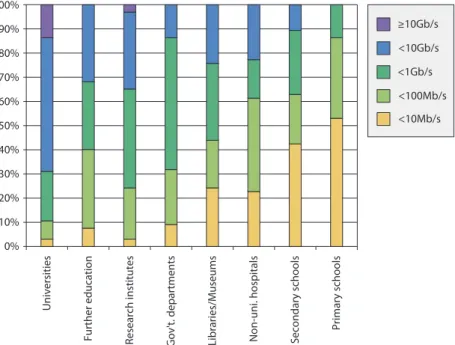
The national research and education networks serve a wide range of users, from high science to schools and libraries. Their core user community has been, and will remain, academic users involved in scientific research and in higher education more generally. In some countries, the networks also serve schools and other education institutions (Figure 2). But we must recognise that the community involved in research and education is expanding rapidly beyond traditional settings. Some networks, moreover, are developing beyond research and education into the
The European networks are founded on collabora-tion. NRENs collaborate closely in both operational and innovation activities, either bilaterally and/or under the TERENA umbrella. These collaborations are mainly on an informal basis, such as through participa-tion in task forces and projects facilitated by TERENA on behalf of all NRENs. An exception is Nordunet, a more formalised structure bringing together Nordic NRENs which predates the establishment of TERENA.
Federation operates at many levels. The current structure is often described as a ‘federated approach’, meaning that the NRENs and DANTE work together as one community or unit. In practice, it is a good deal
more complicated than this: ‘federation’ is actually a multi-level concept that depends partly on organisa-tional frameworks within the member states. At one level, the NRENs in Europe work together to organise certain services, e.g. through DANTE. At another level NRENs in a region may organise part of their connec-tivity and associated services in a regional context. Yet another level is formed by a particular user commu-nity bringing together, in a federated way, the global partners to create the integrated networking services it requires. Intercontinental connectivity is a fourth example of federation by certain partners; which part-ners come together may often be the result of calls for tender6.
0% 10% 20% 30% 40% 100% 50% 60% 70% 80% 90% sei tis re vi n U noi ta cu de re htr uF set uti ts ni hcr ae se R sl oo hc s y ra dn oc eS sl oo hc s y ra mir P s mu es u M/s eir ar biL sla ti ps oh . in u-no N st ne mtr ap ed . t'v o G <10Gb/s ≥10Gb/s <100Mb/s <1Gb/s <10Mb/s
Figure 3: Typical Bandwidth by User Category, EU/EFTA Countries5
5 TERENA Compendium 2010, www.terena.eu
6 For example, the Global Lambda Integrated Facility (GLIF) federates a cross-section of the research & education networking organisations
PoP connections are more prevalent. As shown in the Figure, the bandwidths provided to the various user categories differ considerably and there is also great variation in the range of services provided. In some
NRENs face many challenges in how they operate: organisational, commercial, and regulatory. They have to meet the needs of their users while at the same time being part of a Europe-wide network. They have to engage with commercial partners who see them both as customers but also competitors. And as publicly-funded entities operating on the peripheries of a regulated market (telecoms), they are continually wary of competition law.
Especially important features of the
current GÉANT ecosystem
Diversity of models: NRENs come in all shapes and sizes and no one form can be considered ‘typical’. They range from organisations such as DFN (Germany), JANET (UK) and SURFNet (Netherlands) with 30+ employees, to those in smaller countries with only a handful of full-time staff. The differences are determined in part by the size of the local userbase and partly by national regulations and funding structures and also, in some cases, the political organisation of the country. Each NREN tends to have particular strengths and interests, but it is difficult to identify a single business model that is applicable across Europe. As noted above, they also organise in different configurations in delivering services to users.
Complex cost-sharing: GÉANT operates a cost-sharing model whereby the cost of the European network and services are apportioned across the partners according to an agreed formula. The model aims to ensure that costs are distributed in a way that is fair and equitable, related to underlying costs, encourages the use of new services, and diminishes the geographic divide. Factors that influence the subscription for individual NRENs include: access capacity (and type of access); costs of the circuits/dark fibre used; number of votes an NREN has (based on purchasing power parity and GDP). The model is flexible but quite complex.
Tensions between traditional and emerging roles: In terms of connectivity, NRENs face three types of demand from their users:
Leading-edge activities in the research community.
•
This depends heavily on GÉANT and historically has been the main focus for most NRENs;
Common Internet services, such as a ‘plain vanilla’ IP
•
service required by the standard user in research and education;
New activities in public services delivery. Although
•
important this is being considered separately, with little sign of NRENs wishing to mix traffic.
This diversification of activities can create tensions. Traditionally, NRENs have built capacity far in advance of need, which is a very un-commercial approach, but are increasingly being pushed towards behaving more like a commercial supplier where backhaul is limited7. However this approach of providing ample,
cost-effective bandwidth together with user-defined networking characteristics can also be a source of innovation, since projects do not have to limit them-selves to the parameters of commercial networks. In their response to change, NRENs face increasing conflicts whether to position themselves as ‘intelligent customers’ on behalf of the R&E community or to provide services themselves.
Emerging issues
Increasing competition for international connec-tivity: The fact that many of the NRENs’ international links are provided outside of the GÉANT/GN3 frame-work makes for a very dynamic situation. High-end user communities exploit this dynamism to create their own global networks (e.g. for the data produced by the LHC accelerator at CERN). Effectively, there is no monopoly for international connectivity, nor should there be.
Opaque governance: Good governance is essential for the effective working of the research networks and is an area where the European system has generally performed well. Under the current structures – and despite several attempts at reform – users are not part of the governance, however. Increasingly, user communities need to have connections to multiple NRENs and the number and diversity of these situations
is expected to rise significantly in the coming years. In addition, efforts to move to an association model have been prolonged. This lack of transparency represents a challenge given the increasingly important role of users as stakeholders in the networks.
Heterogeneous regulatory environments: Research networks are a grey area in terms of regulation and are treated inconsistently by Member States. Although they are generally accepted as closed networks under telecoms regulation, moves to serve wider audiences in schools, hospitals and government departments mean they could be classified as public networks, and so draw complaints from commercial providers. As examples, SURFnet has been challenged by the Dutch Telecom Regulator concerning its practices8; and in
Finland the NREN is registered as a provider of public communication services.
Lack of visibility: Research networks have an image problem. Tubes in the ground filled with optical fibres is not a visible or an attractive area for politi-cians, nor indeed for decision-makers in universities and research funding agencies. Consequently, the networks tend to get marginalised in discussions of research investment: a shiny new laboratory, an impressive telescope, or supercomputers can look much more appealing. Yet this situation totally under-plays their significance to a modern knowledge-based economy. The position is particularly acute at campus level, where European universities are significantly underinvesting in networking capabilities to a point that threatens Europe’s future position as a world-class player in scientific research. This funding gap must be addressed.
7 Backhaul refers to the intermediate links between the core network, or backbone, and the small sub-networks at the ‘edge’ of the entire
The scientific and educational constituency served by NRENs is experiencing profound change.
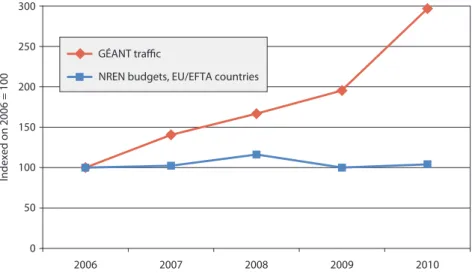
Exponential traffic growth and changing profiles: The volume of traffic carried over the networks is
increasing exponentially, with no signs of a plateau. Between 2006 and 2010, traffic carried by GÉANT increased three-fold (Figure 4), a pattern that is mirrored (and even amplified) at national and campus level.
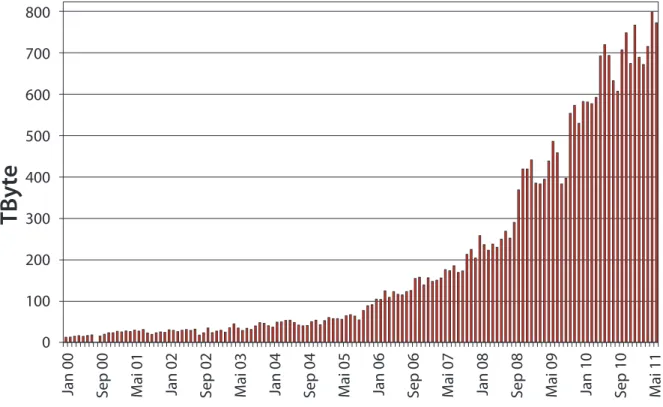
In the Munich Scientific Network (MWN), for example, between Dec 2005 and Dec 2010 traffic increased more than seven times to 800 TB per month (Figure 5).
Furthermore, there have been changes in daily traffic profiles as a result of new users, such as schools and students dormitories, who have different usage patterns to researchers. In MWN, the greatest demand on the network is from student dormitories during the early evening. Much more of the traffic is wireless, with the number of wireless access points growing rapidly. A multiplicity of devices means that the assumption of one user equates to one device no longer holds. Users are looking to access their data from wherever they are: in their lab, on the road, or via commercial networks. And with increasing emphasis on lifelong learning, the contents of university networks are being opened up to local communities. In short, the networks have
evolved from a purely professional to a more service use, and carry much more media-rich content.
Changing user expectations: At the same time, users’ expectations are changing. In the beginning, RENs catered for advanced technology-savvy users. With an ever greater range of scientific assets and data avail-able in digital form, the networks are attracting new communities from beyond traditional research and education and new uses beyond fast connectivity and high performance computing. In addition, new types of users are coming onto the scene, from areas such as healthcare and the public sector, bringing a different ethos and requirements (e.g. with respect to privacy) which need to be carefully assessed before opening up research and education networks. Such communities are not interested in networks per se but want them to support what they do.
1.3 Markets and Users
0 50 100 150 200 300
250
2007 2008
2006 2009 2010
Indexed on 2006 = 100
GÉANT traffic
NREN budgets, EU/EFTA countries
Figure 4: Budgetary and Traffic Growth, 2006-20109
Escalating demand from leading-edge users: This does not mean that the traditional users in Big Science projects have gone away. On the contrary: their requirements become ever more demanding. At CERN, the European Research Centre for Particle Physics, for example the commissioning of the Large Hadron Collider (LHC) has brought the need to capture, store and process terabytes (1012) of data per day (see box 3).
Networking requirements are prompting the establish-ment of 100 Gbps connections. European researchers
look to the networks to guarantee that they remain in a competitive position in relation to their collabora-tors around the world, in particular their US and Asian colleagues. Users must be guaranteed to connect to their research facilities from almost anywhere, in a way that is open, flexible, cost-effective and sustainable. As demands grow, end-users are looking for gigabit inter-faces (so-called ‘gigabit to the desktop’), even if the core networks themselves are not gigabit enabled.
800
700
600
500
400
300
200
100
0
TByt
e
Jan 00 Sep 00 Mai 01 Jan 02 Sep 02 Mai 03 Jan 04 Sep 04 Mai 05 Jan 06 Sep 06 Mai 07 Jan 08 Sep 08 Mai 09 Jan 10 Sep 10 Mai 11
Research in all disciplines becoming data-driven: Such scientific projects are at the leading edge of the data deluge affecting all disciplines and sectors10.
Global storage capacity continues to expand at an exponential rate. In life sciences, especially, the rate of growth far exceeds Moore’s law; the European Bioin-formatics Institute (EBI see box 4) is doubling storage every 12 months. JIVE can generate 1PB of data in an 18 hour session and next generation projects such
as the Square Kilometre Array (SKA) will be even more demanding11. Even in the social sciences and
humanities, an emerging and non-typical community, data requirements are escalating. Such large science projects tend to underestimate their IT requirements and always demand more than planned. In many communities data retention policies are still in their infancy.
Box 3: The Large Hadron Collider - Smashing the Limits of Data
The Large Hadron Collider (LHC) at CERN, the European Centre for Nuclear Research, near Geneva, is one of the most ambitious scientific projects of our age. Although physically located at the Swiss-French border, the LHC enables a community of around 20,000 high-energy physicists worldwide.
While famed for its 27km of particle accelerator, the project’s data and connectivity requirements are equally impressive. During initial operations in 2009-10, the machine’s sensors were generating data at a rate of 2Gbps, amounting to around 15PB (petabytes) of storage per year. Both these parameters are expected to double every 2-3 years as the facility becomes fully operational. In fact, LHC user requirements continue to evolve and as new capabilities become available the physics community is quick to adopt.
The initial ideas in the 1990s of using 622Mbps circuits rapidly changed to a grid computing model as international networking became substantially cheaper. During the implementation, the LHC community considered a number of options for meeting its connectivity requirements. Very high bandwidth has to be available around the clock and able to evolve to match the needs of the experiments and distribute data across the world. To satisfy the needs of the initial data distribution between the 11 principal centres a worldwide network was needed. This was formed through a collaboration of NRENs and GÉANT in Europe as well as other network providers and commercial companies in other countries and is called the LHCOPN.
In order to maintain competitiveness it was important that GÉANT circuits compete on a commercial basis with all other suppliers so that they can be replaced if they become too expensive. It is also common business strategy to ensure that there is never dependence for any service on a single supplier.
http://lhc.web.cern.ch/
10 For analysis see Riding the Wave: How Europe can gain from the rising tide of scientific data. Final report of the High Level Expert Group on
Scientific Data, European Commission, October 2010
11 The Square Kilometre Array (SKA) is a global collaboration to establish a radio telescope with a total collecting area of one square kilometre.
Open Access initiatives in many scientific communities: The Berlin declaration on Open Access to Scientific Knowledge of 22 October 2003 motivated the creation of multiple initiatives of many scientific and academic communities and is becoming a powerful means to give access to knowledge, information, and data. This is essential in higher education and research, and more generally for sustained progress in society. This immediate, online, free availability of research outputs without the restrictions on use commonly imposed by publisher copyright agreements can be a fundamental means to increase innovation. Open access will have an impact on NRENs since it will increase the volume of data in scientific repositories and the pressure on connectivity of these repositories at a global scale.
New trends
These trends are forcing NRENs to move away from simply delivering connectivity to focus on two addi-tional aspects: services and innovation.
Research and Education networks are becoming increasingly a service environment. Users have welcomed the introduction of services such as Eduroam and AAI12 and take-up has been enthusiastic.
These are becoming essential features of the network and demand from academic users and others is certain to increase. Current services (not all of which are provided by the GÉANT community) are often not user-friendly, however. Moreover evidence presented to us suggests there are major gaps and shortcomings in service provision. For example, there are no ready-made solutions, nor even guidelines, for contracts to establish an identity federation and users have been left to work it out for themselves. Virtual organisations and security are other areas where timely advice has been lacking. Users also complain of a confusing landscape: they are looking for a ‘one-stop-shop’ with one clear point of responsibility (similar problems, in fact, are occasionally to be found at a national level). International organisations and global virtual research communities, especially, have experienced
Box 4: EBI - Innovating under the Data Deluge
Biomedicine and genomics is a fast-growing sector with major economic and societal impact. The sector is a major user of Europe’s research and education networks.
Datasets here are growing at a phenomenal rate. Advances in gene sequencing technology and increases in available computing power mean a genome can now be sequenced in hours, rather than months, while new applications and clinical treatments are emerging rapidly. Thus, the sector has to ride the data deluge not just in undertaking research but also innovating for the commercial marketplace. Data are generated in a geographically distributed manner but require integration, while data analysis algorithms are becoming more compute intensive. Since some of the data refer to clinical cases, privacy issues also have to be taken into account. Bandwidth is a major bottleneck and demand to increase bandwidth are not expected to go away.
To address these challenges, the European Bioinformatics Institute (EMBL-EBI) is looking to minimise the movement of data, bringing the compute power as close to the data as possible through ‘virtual machines’. Algorithms are being parallelised, effectively creating a Grid solution, while cloud solutions are also being explored where commoditised data and computing can be utilised. User training is an important issue and is being integrated with service provision, enabling a large and diversifying audience to learn about bio-molecular data resources and tools.
www.ebi.ac.uk
12 Authentication and authorisation Infrastructures (AAI) are identity management systems used to accredit users so that they may gain
difficulties since they fall outside individual NRENs’ national remit.
Innovation is an underrepresented feature of NRENs. In addition to their infrastructural responsi-bilities, in some countries innovation is an element of NREN funding. To some extent this is the case at the European level as well, where activities are led by GN3, a consortium of NRENs coordinated by DANTE. GN3 has identified several key priorities such as: seamless multi-domain networking; flexible bandwidth-on-demand (BoD) and lambda-on-bandwidth-on-demand capabilities; executing testing at 100 Gbps including over long distances; a feasibility study into the expansion of Eduroam; and facilitating a common European AAI mechanism. These will help to establish a European virtual network capability to support generic test-beds of network technologies13. The planned review
of network infrastructure requirements for ERA, in particular ESFRI projects, might lead to other innova-tive solutions.
Campuses are getting left behind. Many universi-ties and colleges have difficuluniversi-ties to afford the new interfaces to the high-capacity networks being developed at European and national levels. Indeed, in some countries national policies towards innovation specify that NRENs stop at the campus gate. This lack of investment in state-of-the-art facilities and human
resources at campus level is at the heart of the funding gap referred to above. It creates problems in providing end-users with high quality networking services. NRENs can play a significant role in helping to deploy best practices inside each territory where, traditionally, they are a source of technical expertise.
1.4 Time for Renewal
Europe has demonstrated considerable successes, but we cannot be complacent. The European networks face unprecedented challenges as a result of changes within both their own ranks and the communities they serve. As we discuss in the following section, these factors are exacerbated by wider trends influencing the creative knowledge economy. Aggressive investment is taking place elsewhere. Science is reorganising itself as a response to powerful new data, communication and computing possibilities. The networking infra-structure must reposition itself too.
The situation is critical and Europe risks losing out. The world is changing fast – both in terms of demand pull and technology push – and we need to adapt. Past achievements are no guarantee of future success and Europe faces stiff competition. It is time to reassess the requirements and renew the European networks as a key 21st century infrastructure.
The environment served by GÉANT – the sphere of research, innovation and learning – is experiencing profound change. In this section we outline the challenges and opportunities arising from this wider context, as a basis for the vision and recommendations which follow.
Our themes are fourfold: changes in the global context and the need to seek innovative solutions to societal challenges; changes in the nature of the scientific process and the movement of research and learning beyond traditional settings; changes in the nature and context of innovation across the economy and society; and the continuing evolution of technology which promises exciting new approaches to data and information.
In the resulting Creative Knowledge Society, success – for individuals, enterprises and countries – depends more than ever on a fruitful competition of ideas. In this digital and highly interconnected world, knowledge, innovation and learning flow readily, unconstrained by the distances and bounda-ries of former times. It is a world without borders, where talents from around the world compete openly and understanding and creativity are the sources of competitive advantage.
2.1 C
ompetingintheg
lobalK
nowledge-
basede
ConomyGlobalisation continues a pace, with the so-called BRIC countries accounting for a rapidly rising share of global GDP. With their young – and fast-growing – populations, excellent education systems and fast-improving standards of living, they are eager and agile; Europe will have to leverage on its specific strengths and values - like the focus on privacy, intel-lectual properties, local diversity, social values, high standards of living - if it is to compete with them. This is
especially true of science, where the share of scientific output from the BRIC economies has been growing rapidly. China now has the third largest output of scientific papers after the EU and the US. The EU share of global scientific output by comparison is declining. However, since the almost instantaneous availability of information makes it irrelevant where that specific information is generated, the crucial aspect becomes how to make use of the information. The “think global, act local” applies.
Knowledge and openness to new ideas will be essential in tackling the challenges ahead. Climate change, energy and resource scarcity are major policy drivers for the 21st century, affecting everything
from the macro to micro levels. Meanwhile, Europe is experiencing major demographic change, with wide-ranging policy implications from health and social care, to lifelong learning and access to public services. We see automation everywhere including in service industries, and the continuing march of digital communications in all its forms. All of these areas demand innovation and creativity and a willingness to seek new solutions.
In ICT, labour costs will be a progressively less important factor in competitiveness. Beyond 2020 we can expect that the same decrease in transaction cost that has characterised the previous two decades, and is still affecting the present one in the ICT area, will be seen in the production chain. The trend of outsourcing manufacturing to Asia may well be reversed as a consequence of lower salary differential and the marginal impact of salary on the final product cost. At the same time products will embed an enor-mous flexibility, allowing them to be mass produced and customised at the point of sale. The ICT infrastruc-ture will be the real differential factor.