DOI: 10.1542/peds.2010-1919
; originally published online September 12, 2011;
2011;128;644
Pediatrics
Angeline S. Lillard and Jennifer Peterson
Executive Function
The Immediate Impact of Different Types of Television on Young Children's
http://pediatrics.aappublications.org/content/128/4/644.full.html
located on the World Wide Web at:
The online version of this article, along with updated information and services, is
of Pediatrics. All rights reserved. Print ISSN: 0031-4005. Online ISSN: 1098-4275.
on Young Children’s Executive Function
WHAT’S KNOWN ON THIS SUBJECT: Previous study results have suggested a longitudinal association between entertainment television and later attention problems.
WHAT THIS STUDY ADDS: Using a controlled experimental design, this study found that preschool-aged children were significantly impaired in executive function immediately after watching just 9 minutes of a popular fast-paced television show relative to after watching educational television or drawing.
abstract
OBJECTIVE:The goal of this research was to study whether a fast-paced television show immediately influences preschool-aged chil-dren’s executive function (eg, self-regulation, working memory).
METHODS:Sixty 4-year-olds were randomly assigned to watch a fast-paced television cartoon or an educational cartoon or draw for 9 min-utes. They were then given 4 tasks tapping executive function, including the classic delay-of-gratification and Tower of Hanoi tasks. Parents completed surveys regarding television viewing and child’s attention.
RESULTS:Children who watched the fast-paced television cartoon per-formed significantly worse on the executive function tasks than chil-dren in the other 2 groups when controlling for child attention, age, and television exposure.
CONCLUSIONS:Just 9 minutes of viewing a fast-paced television car-toon had immediate negative effects on 4-year-olds’ executive function. Parents should be aware that fast-paced television shows could at least temporarily impair young children’s executive function.
Pediatrics2011;128:644–649
AUTHORS:Angeline S. Lillard, PhD, and Jennifer Peterson, BA
Department of Psychology, University of Virginia, Charlottesville, Virginia
KEY WORDS
television, preschool, executive function
ABBREVIATIONS EF—executive function
HTKS—head toes knees shoulders
Dr Lillard conceived of the essential study; Ms Peterson and Dr Lillard developed the methods together; under Dr Lillard’s guidance, Ms Peterson conducted the study and coded and entered data; both authors contributed to data analysis; and Dr Lillard wrote the text, and Ms Peterson reviewed it.
www.pediatrics.org/cgi/doi/10.1542/peds.2010-1919
doi:10.1542/peds.2010-1919
Accepted for publication May 31, 2011
Address correspondence to Angeline S. Lillard, PhD, Department of Psychology, University of Virginia, PO Box 400400,
Charlottesville, VA 22904. E-mail: [email protected]
PEDIATRICS (ISSN Numbers: Print, 0031-4005; Online, 1098-4275).
Copyright © 2011 by the American Academy of Pediatrics
FINANCIAL DISCLOSURE:The authors have indicated they have no financial relationships relevant to this article to disclose.
Preschool-aged children watch ⬎90 minutes of television daily,1and
corre-lational studies link early television viewing with deficits in executive func-tion (EF),2–7a collection of prefrontal8
skills underlying goal-directed
behav-ior, including attention, working mem-ory, inhibitory control, problem solv-ing, self-regulation, and delay of gratification.9–12EF is increasingly
rec-ognized as key to positive social13and
cognitive14functioning and is strongly
associated with success in school.15–17
If television has long-term effects on EF, then one might see small short-term effects; even adults report feeling less alert immediately after watching
television.18 Most research on
televi-sion has focused on attention, one of many EF processes. Entertainment television is particularly associated with long-term attention problems19;
thus, its viewing might be most likely to have negative short-term impacts. Within the realm of entertainment tele-vision, fast-paced shows seem
particu-larly likely to have a negative impact on attention, one reason for this being that rapidly presented events capture attention in a bottom-up fashion, in-volving the sensory rather than
pre-frontal cortices.20 Thus, fast-paced
television would do nothing to train in-ternally controlled (prefrontal) atten-tion over the long-term. In the short-term, the effort to encode rapidly
presented events could tax children’s executive resources. When adults are presented with televised events in more rapid succession, more
re-sources are allocated to encoding those events,21presumably depleting
resources that could otherwise be available for other aspects of atten-tion. Thus, we hypothesized that
watch-ing a fast-paced cartoon would have an immediate negative impact on chil-dren’s EF relative to watching a slower-paced, realistic educational cartoon or
engaging in a self-paced activity such as drawing.
There is a limited amount of literature on the immediate impact of television show pacing on children’s attention or other aspects of EF. One study found that a fast-paced show led to less task persistence than a slow-paced one.22
However, posttesting was conducted in a large group setting in which the behavior of a few individuals might have affected others. Another study suggested fast pacing is not problem-atic: watching fast- versus slow-paced episodes ofSesame Streethad no im-pact on task persistence or impulsivity in later free play.23It should be noted
that Sesame Street is even
faster-paced today than it was 30 years ago24
when that study was conducted; it is possible that even the fast-paced clip created for the 1977 study was not as fast-paced as today’s television shows.
Task persistence is only one outcome of high EF. Young children’s EF has been assessed by many tasks tapping its various aspects. Performance on these tasks is often found to be inter-correlated,14,25and it is also correlated
with parent and teacher assessments of children’s self-regulated behav-ior.26,27EF was assessed here by using
4 well-known tasks: Tower of Hanoi, backward digit span, delay of gratifica-tion, and head toes knees shoulders (HTKS). Although delay of gratification is considered a measure of EF, espe-cially of inhibitory control, it tends to be less well correlated with the other
abilities,28theoretically because it taps
“hot” or emotional decision-making.29
In this study, one-half of the subjects were tested by experimenters blind to the subject’s study group. It is unusual to use blind experimenters in basic cognitive development research, but we did so out of concern that exper-imenters might intuitively expect fast-paced television to influence children’s performance. Studies of the impact of pretend play, generally presumed to be positive,30,31on
chil-dren’s cognitive functioning show ex-perimenter bias influences results in that domain: when experimenters were blinded, positive results went away.32–34As a precaution and to
exam-ine whether blind experimenters are important in this domain, we tested one-half of the children with a blind ex-perimenter and compared results un-der the 2 conditions.
METHODS
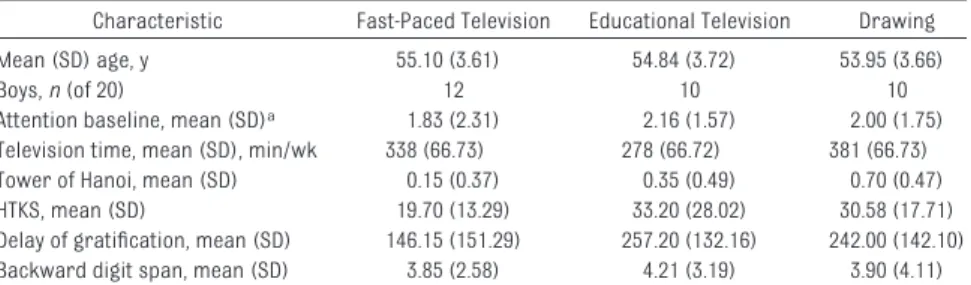
Sixty 4-year-olds (Table 1) were re-cruited from a database of families willing to participate in research. Most of the children were white and from middle- to upper-middle-class fami-lies. Parents were telephoned and told about the study; willing parents made an appointment to come to the labora-tory, where the study was described again, and parents signed a consent form approved by the University of Vir-ginia institutional review board.
Children were randomly assigned (by the experimenter drawing a number
TABLE 1 Study Factors According to Intervention Experience
Characteristic Fast-Paced Television Educational Television Drawing
Mean (SD) age, y 55.10 (3.61) 54.84 (3.72) 53.95 (3.66)
Boys,n(of 20) 12 10 10
Attention baseline, mean (SD)a 1.83 (2.31) 2.16 (1.57) 2.00 (1.75) Television time, mean (SD), min/wk 338 (66.73) 278 (66.72) 381 (66.73) Tower of Hanoi, mean (SD) 0.15 (0.37) 0.35 (0.49) 0.70 (0.47) HTKS, mean (SD) 19.70 (13.29) 33.20 (28.02) 30.58 (17.71) Delay of gratification, mean (SD) 146.15 (151.29) 257.20 (132.16) 242.00 (142.10) Backward digit span, mean (SD) 3.85 (2.58) 4.21 (3.19) 3.90 (4.11) aAssessed by using a scale of 1 to 10 (10 indicates more attention problems).
fast-paced television group watched a truncated episode of a very popular fantastical cartoon about an animated sponge that lives under the sea. The educational television group watched a truncated episode of a realistic Pub-lic Broadcasting Service cartoon about a typical US preschool-aged boy. Free drawing with markers and crayons was the control condition. All children completed the study.
To quantify pacing, the 2 television ep-isodes were viewed for the number of times a complete scene change oc-curred (eg, from swimming pool to bedroom). For the fast-paced show, the scene completely changed on aver-age every 11 seconds; even within the scene, characters were almost con-stantly rapidly moving through space. The educational television show had a complete scene change every 34 sec-onds on average.
The experiment was conducted with each child individually in a small room in a university laboratory. Nine-minute clips of the fast-paced or educational shows were played on an Acer note-book computer (Acer American Corpo-ration, San Jose, CA) to children in the television groups. Children in the drawing condition were given some crayons, markers, and paper and al-lowed to draw for 9 minutes. Next chil-dren were administered the EF tasks in a fixed order using a Latin squares design.
The Tower of Hanoi task35used a base
with 3 long pegs and a larger and a smaller disk that fit on the pegs, as well as a picture depicting a goal state. The disks were described as monkeys playing on a tree (the left peg), but they were tired and needed to move to their sleeping tree (the right peg). The child was asked to help move the monkeys according to 3 rules36: only 1 monkey
ger disk) could never go on top of the Mommy monkey (the smaller disk). The children were given a score of 1 if they moved the disks from the first peg to the third peg following all the rules. Children who broke a rule or failed to complete the task were given a score of 0.
Next children were given the HTKS task,27in which the experimenter told
children, “When I say touch your head, I want you to touch your toes, but when I say touch your toes, I want you to touch your head.” After brief training, 10 test items were presented. Children received 2 points for every correct re-sponse, 1 point for every response that was initially wrong but corrected (eg, they touched their head then touched their toes), and 0 points for an incor-rect response. If children received at least 10 points on the first 10 items, a shoulders-knees rule was added and 10 more items were given. Children who received at least 14 additional points on part 2 went on to part 3, where the rules switched (eg, “Now when I say touch your head I want you to touch your shoulders”).
After the HTKS task, children com-pleted a delay-of-gratification16 task.
First, they were shown a bag of minia-ture marshmallows and a bag of Gold-fish crackers and asked which they would like to have as a snack. The ex-perimenter put 10 pieces of the chosen snack on 1 plate and 2 pieces on an-other, and placed the bell between the 2 plates. Children were told that they could eat the 10 pieces if they waited for the experimenter to return, or they could ring a bell at any time to get the experimenter to come back immedi-ately, in which case they could only have the 2 pieces. The experimenter re-corded the time from when she left the room until the child either rang the
The children then participated in a cre-ativity task (not discussed here) be-fore completing the backward digit span subtest of working memory ca-pacity from the Woodcock-Johnson tests of cognitive abilities.37The
exper-imenter told the child, “I am going to say some numbers and I want you to say them backwards; for example if I say 3,4 then you say 4,3. Now you say the numbers backwards.” The experi-menter then gave practice items with feedback; once children got 1 correct or after 4 practice items maximum, they moved on to 15 test items until they got 3 consecutive items wrong. Children received 1 point for each cor-rect answer and could receive up to 15 points. A Sony Camcorder (Sony Elec-tronics, San Diego, CA) was used to record children throughout the procedure.
While children were being tested, par-ents completed a media survey on which they indicated the number of minutes the child watched television and DVDs each week. They also filled out the Strengths and Difficulties Ques-tionnaire,38,39 a 25-item personality
survey with 5 items related to atten-tion. Items were scored 0, 1, or 2 char-acterizing how true the statement was of the child. The attention-related items were: “restless, overactive; can-not stay still for long,” “easily dis-tracted, concentration wanders,” “constantly fidgeting or squirming,” “sees tasks through to the end; good attention span,” and “thinks things out before acting” (the latter 2 were reverse-scored).
RESULTS
Difficulties Questionnaire (P ⫽ .88). There were also no group differences in the amount of television children watched per week (P⫽.55), with the range being 278 (educational televi-sion) to 381 (drawing) minutes per week.
Cronbach’s ␣ for 3 of the EF tasks (Tower of Hanoi, backward digit span, and HTKS) was 0.69 but dropped to 0.51 when delay of gratification was in-cluded. Therefore,zscores for the first 3 EF tasks were summed for a compos-ite EF score, and delay of gratification was analyzed separately.
A first analysis of covariance assess-ment examining whether experi-menter blindness influenced results in any condition, controlling for chil-dren’s age, revealed that blindness had no influence on condition scores (P⫽.83 for composite EF and .62 for delay of gratification). Thus, we are confident that experimenter bias did not influence results for those sub-jects whose assessments were not run blind.
Combining across these groups and using age as a covariate, there was a significant main effect of intervention on the composite EF score (P ⫽ .01, p2⫽.15). Posthoc analyses revealed
that the fast-paced television group
did significantly worse on the EF composite than the drawing group (P
⫽.004). The difference between the fast-paced and the educational tele-vision groups approached signifi-cance (P⫽.05) (Fig 1), and there was no difference between educational television and drawing. A regression analysis was performed entering the amount of television watched per week, attention problems, and child’s age at the first step, and intervention condition at the second step, setting the drawing and educational television conditions as baseline. The first 3 vari-ables made no significant contribution to the EF composite score but condi-tion did (P⫽.03).
Delay of gratification was analyzed separately and showed similar re-sults, with a significant main effect of intervention condition on the number of seconds waited (P⫽.03, p2⫽.12),
and posthoc analyses revealed that the fast-paced television group waited significantly less long than either the drawing group (P⫽.03) or the educa-tional television group (P⫽.02), which did not differ from each other. Another regression analysis was performed entering the amount of television watched per week, attention prob-lems, and child’s age at the first step
and intervention condition at the sec-ond step, setting the drawing and ed-ucational television conditions as baseline. Again, the first 3 variables made no significant contribution but condition did (P⫽.006).
DISCUSSION
This study provides empirical evidence that watching a 9-minute episode of a fast-paced television cartoon immedi-ately impaired young children’s EF rel-ative to watching an educational televi-sion show or drawing. Children in the fast-paced television group scored sig-nificantly worse than the others de-spite being equal in attention at the outset, as indicated by parent report. This result is consistent with others showing long-term negative associa-tions between entertainment televi-sion and attention.19Given the
popular-ity of some fast-paced television cartoons among young children, it is important that parents are alert to the possibility of lower levels of EF in young children at least immediately after watching such shows.
In addition to the pacing, we speculate that the onslaught of fantastical events that was also present in the fast-paced show might have further exacerbated EF. Whereas familiar events are en-coded by established neural cir-cuitry,40there is no such circuitry for
new and unexpected events, which fan-tastical events often are. Encoding new events is likely to be particularly de-pleting of cognitive resources, as ori-enting responses are repeatedly en-gaged in response to novel events.41
Because cognitive depletion taxes self-regulation,42,43we hypothesize that the
fantastical aspect of the fast-paced show could also be partly responsible for the EF effects seen here. This hy-pothesis will be tested in further research.
This study has several limitations. First, we cannot tell exactly what fea-FIGURE 1
zscores for each task.
fantastical events and fast pacing are responsible, but further re-search systematically varying those features is needed. A recent study has begun this effort by replicating the effect with different fast-paced and fantastical episodes and shows.44
Second, only 4-year-olds were tested; older children might not be negatively influenced by fast-paced television. Third, we do not know how long the negative effects persist or what the long-term effects of habitual viewing include. Finally, we only used 9 minutes
programming slot. Watching a full fast-paced cartoon program could be more detrimental.
Some strengths of the study were the use of a blind posttester for half of the children, with results suggesting blindness is not crucial in this domain; random assignment to conditions; and groups of children who were similar at the outset in terms of weekly tele-vision exposure and parental ratings of attention. The use of a range of EF tests was also an asset, as was the testing of a children’s television
car-2- to 11-year-olds.
CONCLUSIONS
Children watch a great deal of
televi-sion, and it has been associated with
long-term attention problems.
How-ever, there is little research on the im-mediate impact of television on EF. The present study found that 9 minutes of
viewing a popular fast-paced fantasti-cal television show immediately
im-paired 4-year-olds’ EF, a result about
which parents of young children should be aware.
REFERENCES
1. Vandewater EA, Rideout VJ, Wartella EA, Huang X, Lee JH, Shim M. Digital childhood: electronic media and technology use among infants, toddlers, and preschoolers.
Pediatrics. 2007;119(5). Available at: www. pediatrics.org/cgi/content/full/119/5/e1006
2. Christakis DA, Zimmerman FJ, DiGiuseppe DL, McCarty CA. Early television exposure and subsequent attentional problems in children.Pediatrics. 2004;113(4):708 –713
3. Barr R, Lauricella A, Zack E, Calvert SL. In-fant and early childhood exposure to adult-directed and child-adult-directed television programming: relations with cognitive skills at age four.Merrill-Palmer Quarterly. 2010;56(1):21– 48
4. Ozmert E, Toyran M, Yurdakok K. Behavioral correlates of television viewing in primary school children evaluated by the child be-havior checklist.Arch Pediatr Adolesc Med. 2002;156(9):910 –914
5. Levine LE, Waite BM. Television viewing and attentional abilities in fourth and fifth grade children.J Appl Dev Psychol. 2000; 21(6):667– 679
6. Landhuis CE, Poulton R, Welch D, Hancox RJ. Does childhood television viewing lead to attention problems in adolescence? Results from a prospective longitudinal study. Pedi-atrics. 2007;120(3):532–537
7. Schmidt ME, Pempek TA, Kirkorian HL, Lund AF, Anderson DR. The effects of background tele-vision on the toy play behavior of very young children.Child Dev. 2008;9(4):1137–1151
8. Alvarez JE, Emory E. Executive function and the frontal lobes: a meta-analytic review.
Neuropsychol Rev. 2006;16(1):17– 42
9. Davidson MC, Amso D, Anderson LC, Dia-mond A. Development of cognitive control and executive functions from 4 to 13 years: evidence from manipulations of memory, inhibition, and task switching. Neuropsy-chologia. 2006;44(11):2037–2078
10. Miyake A, Friedman NP, Emerson MJ, Witzki AH, Howerter A, Wager TD. The unity and di-versity of executive functions and their con-tributions to complex “frontal lobe” tasks: a latent variable analysis.Cognitive Psychol-ogy. 2000;41(1):49 –100
11. Rueda MR, Posner MI, Rothbart MK. The development of executive attention: con-tributions to the emergence of self-regulation.Dev Neuropsychol. 2005;28(2): 573–594
12. Marcovitch S, Zelazo PD. A hierarchical com-peting systems model of the emergence and early development of executive func-tion.Develop Sci. 2009;12(1):1–18
13. Fabes RA, Martin CL, Hanish LD, Anders MC, M a d d e n - D e r d i c h D A . E a r l y s c h o o l competence: the roles of sex-segregated play and effortful control.Dev Psychol. 2003; 39(5):848 – 858
14. Blair C, Razza RP. Relating effortful control, executive function, and false belief under-standing to emerging math and literacy ability in kindergarten. Child Dev. 2007; 78(2):647– 663
15. Duncan GJ, Dowsett CJ, Claessens A, et al. School readiness and later achievement [published correction inDev Psychol. 2008; 44(1):232]. Dev Psychol. 2007;43(6): 1428 –1446
16. Mischel W, Shoda Y, Rodriguez MI. Delay of
gratification in children. Science. 1989; 244(4907):933–938
17. McClelland MM, Cameron CE, Connor CM, Farris CL, Jewkes AM, Morrison FJ. Links between behavioral regulation and pre-schoolers’ literacy, vocabulary, and math skills.Dev Psychol. 2007;43(4):947–959
18. Kaplan S, Berman M. Directed attention as a common resource for executive functioning and self-regulation.Perspectives Psychol Sci. 2010;5(1):43
19. Zimmerman FJ, Christakis DA. Associations between content types of early media expo-sure and subsequent attentional problems.
Pediatrics. 2007;120(5):986 –992
20. Buschman TJ, Miller EK. Top-down versus bottom-up control of attention in the pre-frontal and posterior parietal cortices. Sci-ence. 2007;315(5820):1860 –1862
21. Lang A, Bolls P, Potter RF, Kawahara K. The effects of production pacing and arousing content on the information processing of television messages.J Broadcasting Elec-tronic Media. 1999;43(4):451– 475
22. Geist EA, Gibson M. The effect of network and public television programs on four and five year olds ability to attend to educational tasks.J Instructional Psychol. 2000;27(4): 250 –261
23. Anderson D, Levin S, Lorch E. The effects of TV program pacing on the behavior of pre-school children. Educ Technol Res Dev. 1977;25(2):159 –166
25. Carlson SM. Developmentally sensitive mea-sures of executive function in preschool children. Dev Neuropsychol. 2005;28(2): 595– 616
26. Smith-Donald R, Raver CC, Hayes T, Richard-son B. Preliminary construct and concurrent validity of the Preschool Self-Regulation As-sessment (PSRA) for field-based research.
Early Childhood Research Quarterly. 2007; 22(2):173–187
27. Ponitz CC, McClelland MM, Matthews JS, Morrison FJ. A structured observation of behavioral self-regulation and its contribu-tion to kindergarten outcomes.Dev Psychol. 2009;45(3):605– 619
28. Huizinga M, Dolan CV, van der Molen MW. Age-related change in executive function: developmental trends and a latent variable analysis. Neuropsychologia. 2006;44(11): 2017–2036
29. Hongwanishikul D, Happeny KR, Lee WS, Zelazo PD. Assessment of hot and cool exec-utive function in young children: age-related changes and individual differences.
Dev Neuropsychol. 2005;28(2):617– 644 30. Golinkoff R, Hirsh-Pasek K, Singer D. Why
play⫽learning: a challenge for parents and educators. In: Singer D, Golinkoff R, Hirsh-Pasek K, eds.Play⫽Learning: How Play Moti-vates and Enhances Children’s Cognitive and Social-Emotional Growth. New York, NY: Ox-ford University Press; 2006:3–12
31. Ginsburg KR; American Academy of
Pediat-rics, Committee on Communications; Amer-ican Academy of Pediatrics, Committee on Psychosocial Aspects of Child and Family Health. The importance of play in promoting healthy child development and maintaining strong parent-child bonds.Pediatrics. 2007; 119(1):182–191
32. Simon T, Smith P. The study of play and problem solving in preschool children: have experimenter effects been responsible for previous results?Br J Dev Psychol. 1983; 1(3):289 –297
33. Simon T, Smith P. Play and problem solving: a paradigm questioned. Merrill-Palmer Quarterly. 1985;31(3):265–277
34. Smith P. Children’s play and its role in early development: a reevaluation of the “play ethos.” In: Pellegrini AD, ed.Psychological Bases for Early Education. New York, NY: Wiley; 1988:207–226
35. Welsh M, Satterlee-Cartmell T, Stine M. Towers of Hanoi and London: contribution of working memory and inhibition to per-f o r m a n c e . B r a i n C o g n. 1 9 9 9 ; 4 1 ( 2 ) : 231–242
36. Welsh M, Pennington B, Groisser D. A normative-developmental study of execu-tive function: A window on prefrontal func-tion in children.Dev Neuropsychol. 1991; 7(2):131–149
37. McGrew KS, Woodcock RW. Woodcock-Johnson III Technical Manual. Itasca, IL: Riv-erside Publishing; 2001
38. Goodman R. Strengths and Difficulties Ques-tionnaire.J Child Psychol Psychiatry. 1997; 38(5):581–586
39. Goodman R. Psychometric properties of the strengths and difficulties questionnaire.J Am Acad Child Adolesc Psychiatry. 2001; 40(11):1337–1345
40. Posner MI, Rothbart MK.Educating the Hu-man Brain. Washington, DC: American Psy-chological Association; 2007
41. Sokolov EN. Higher nervous functions: the orienting reflex.Annu Rev Physiol. 1963;25: 545–580
42. Gailliot M, Baumeister R. The physiology of willpower: linking blood glucose to self-control.Pers Soc Psychol Rev. 2007;11(4): 303
43. Ackerman JM, Goldstein NJ, Shapiro JR, Bargh JA. You wear me out: the vicarious depletion of self-control.Psychol Sci. 2009; 20(3):326 –332
44. Lillard AS, Peterson J, Greenwood R.Effects of Fast-Paced, Fantastical Cartoons on Chil-dren’s Executive Function. Charlottesville, VA: University of Virginia; 2011
45. Gorman B. Nickelodeon closes week as ba-sic cable’s top total day network with kids and total viewers. Available at: http:// t v b y t h e n u m b e r s . c o m / 2 0 1 0 / 0 6 / 2 2 / nickelodeon-closes-week-as-basic-cables- top-total-day-network-with-kids-and-total-viewers/54950. Accessed May 31, 2011
DOI: 10.1542/peds.2010-1919
; originally published online September 12, 2011;
2011;128;644
Pediatrics
Angeline S. Lillard and Jennifer Peterson
Executive Function
Services
Updated Information &
ml
http://pediatrics.aappublications.org/content/128/4/644.full.ht
including high resolution figures, can be found at:
References
ml#ref-list-1
http://pediatrics.aappublications.org/content/128/4/644.full.ht
at:
This article cites 38 articles, 8 of which can be accessed free
Citations
ml#related-urls
http://pediatrics.aappublications.org/content/128/4/644.full.ht
This article has been cited by 4 HighWire-hosted articles:
Rs)
3
Peer Reviews (P Post-Publication
http://pediatrics.aappublications.org/cgi/eletters/128/4/644
R has been posted to this article: 3
One P
Subspecialty Collections
ctice
http://pediatrics.aappublications.org/cgi/collection/office_pra
Office Practice
the following collection(s):
This article, along with others on similar topics, appears in
Permissions & Licensing
ml
http://pediatrics.aappublications.org/site/misc/Permissions.xht
tables) or in its entirety can be found online at:
Information about reproducing this article in parts (figures,
Reprints
http://pediatrics.aappublications.org/site/misc/reprints.xhtml
Information about ordering reprints can be found online:
rights reserved. Print ISSN: 0031-4005. Online ISSN: 1098-4275.