As featured in:
See Haifeng Yu, Atsushi Shishido, jingze Li, Kaori Kamata, Tomokazu Iyoda and Tomiki Ikeda, J. Mater. Chem., 2007, 17, 3485
www.rsc.org/materials
Registered Charity Number 207890
Aberration-corrected imaging is employed under the scanning
transmission electron microscopy (STEM) mode to precisely determine
the chemical ordering of Au/Pd nanoparticles. These colloids exhibit
a core-shell structure with a three-layer arrangement that surprisingly
presents alloying events in the observed layers.
Title: Atomic Structure of Three-Layer Au/Pd Nanoparticles
Revealed by Aberration-Corrected Scanning Transmission
Electron Microscopy
Showcasing work from the Yacaman Group at The
University of Texas at Austin, High Temperature
Materials Laboratory at Oak Ridge National Laboratory
and Molecular Design Laboratory at The Autonomous
University of Nuevo León
Journal of Materials C hemistr y Pages 28 53 –2 952
www.rsc.org/materials Volume 17 | Number 28 | 28 July 2007 | Pages 2853–2952
ISSN 0959-9428
0959-9428(2007)17:28;1-W HIGHLIGHT
Glen E. Fryxellet al.
Design and synthesis of self-assembled monolayers on mesoporous supports (SAMMS): The importance of ligand posture in functional nanomaterials
FEATURE ARTICLE
Siddharth V. Patwardhanet al.
Interactions of biomolecules with inorganic materials: principles, applications and future prospects
Volume
18
| Number
21
| 2008
Journal of Ma
terials C hemistr y Pages 2393–2508
www.rsc.org/materials Volume 18 | Number 21 | 7 June 2008 | Pages 2393–2508
ISSN 0959-9428
0959-9428(2008)18:21;1-Z
PAPER
Jaap C. Schouten et al.
“Hairy Foam”: carbon nanofibers grown on solid carbon foam. A fully accessible, high surface area, graphitic catalyst support
PAPER
Miguel José-Yacamán et al.
Atomic structure of three-layer Au/Pd nanoparticles revealed by aberration-corrected scanning transmission electron microscopy
As featured in:
See Domingo Ferrer, Douglas A. Blom, Lawrence F. Allard, Sergio Mejía, Eduardo Pérez-Tijerina and Miguel José-Yacamán,
J.Mater. Chem., 2008, 18, 2442
www.rsc.org/materials
Registered Charity Number 207890
Aberration-corrected imaging is employed under the scanning
transmission electron microscopy (STEM) mode to precisely determine the
chemical ordering of Au/Pd nanoparticles. These colloids exhibit a
core-shell structure with a three-layer arrangement that surprisingly presents
alloying events in the observed layers.
Title: Atomic Structure of Three-Layer Au/Pd Nanoparticles Revealed by
Aberration-Corrected Scanning Transmission Electron Microscopy.
Showcasing work from Yacaman Group at The University
of Texas at Austin, High Temperature Materials Laboratory
at Oak Ridge National Laboratory, Advanced Materials
Research Center, México (CIMAV) and Center for Innovation,
Research& Development in Engineering & Technology
(CIIDIT) at UANL, México.
Volume
18
|Number
21
|2008
Journal of Ma
terials C
hemistr
y
Pages
2393–2508
www.rsc.org/materials Volume 18 | Number 21 | 7 June 2008 | Pages 2393–2508
ISSN 0959-9428
0959-9428(2008)18:21;1-Z PAPER
Jaap C. Schoutenet al. “Hairy Foam”: carbon nanofibers grown on solid carbon foam. A fully accessible, high surface area, graphitic catalyst support
PAPER
Miguel José-Yacamánet al. Atomic structure of three-layer Au/Pd nanoparticles revealed by aberration-corrected scanning transmission electron microscopy
Published on 19 March 2008. Downloaded by Universidad Autonoma de Nuevo Leon on 28/01/2016 17:29:26.
Atomic structure of three-layer Au/Pd nanoparticles revealed by
aberration-corrected scanning transmission electron microscopy
Domingo Ferrer,
aDouglas A. Blom,
bLawrence F. Allard,
bSergio Mejı´a,
cEduardo Pe´rez-Tijerina
cdand Miguel Jose´-Yacama´n
†
*
aReceived 23rd January 2008, Accepted 21st February 2008 First published as an Advance Article on the web 19th March 2008
DOI: 10.1039/b801320a
The study of nanomaterials can be greatly improved with the use of aberration-corrected transmission electron microscopy (TEM), which provides image resolutions at the level of 1 A˚ and lower. Sub-A˚ ngstro¨m image resolution can yield a new level of understanding of the behavior of matter at the nanoscale. For example, bimetallic nanoparticles are extremely important in catalysis applications; the addition of a second metal in many cases produces much-improved catalysts. In this paper, we study the structure and morphology of Au/Pd bimetallic particles using primarily the high-angle annular dark-field (HAADF) imaging mode in an aberration-corrected STEM/TEM. It is well established that, when recorded under appropriate illumination and collection geometries, incoherent HAADF-STEM images are compositionally sensitive and provide direct information on atomic positions. We matched the experimental intensities of atomic columns with theoretical models of three-layer Au/Pd nanoparticles, in different orientations. Our findings indicate that the surface layer of the nanoparticle contains kinks, terraces and steps at the nanoscale. The effect of adding a second metal induces the formation of such defects, which might very likely promote the well-known improved catalytic activity of this system.
Introduction
Since the development of practical aberration correctors for electron microscopy,1a new possibility for understanding matter at the nanolevel has been opened. In particular, aberration-corrected scanning transmission electron microscopy (STEM) offers the possibility of studying atomic structures at a resolution of <1 A˚ ,2–4 using primarily the high-angle annular dark-field (HAADF) imaging mode of an instrument with an aberration corrector fitted on the incident probe side. The incoherent nature of HAADF images, recorded with carefully controlled illumina-tion and collecillumina-tion geometries, makes them free of dynamical interference effects (particularly for the case of crystalline particles of small dimensions) and therefore more straightfor-ward to interpret than conventional high-resolution transmission electron microscopy (HRTEM) images.5–8
The structure of nanoparticles is of great interest in many applications of nanotechnology such as catalysis, plasmonics, sensing and others. Using two metals, we can achieve a broader range of properties; for instance, a core–shell structure will
scatter light in a different way than will an alloy particle.9We can in principle tune the properties by changing the way the metals combine. The case of Au/Pd is particularly interesting. In the bulk, these two metals are fully soluble at all composi-tions. However, the Au/Pd nanoparticle structure strongly depends on the preparation method. For instance, core–shell structures have been reported by several authors10–12 when chemical synthesis methods are used. On the other hand, Au/Pd particles grown by sputtering show an alloy structure with an icosahedral structure.13 It is also possible to produce a three-layer structure, as shown by Marzan et al.14,15 In this work we describe a novel three-layer structure in Au/Pd nanoparticles, and demonstrate that by combining aberration-corrected imaging with conventional techniques such as theoret-ical simulation and single particle diffraction, we can obtain significant new information about nanoscale colloids.
Experimental
Bimetallic nanoparticle synthesis
The colloidal dispersions of Au/Pd bimetallic clusters, stabilized by a polymer, were fabricated as previously described16by succes-sive alcoholic reduction of their constituent metal ions. Solutions of 0.1 M tetrachloroauric acid (HAuCl4) and 0.05 M palladium
chloride (PdCl2) were prepared by dissolving the corresponding
crystalline material in deionized water. The protective agent poly(N-vinyl-2-pyrrolidone) (PVP, 0.4 g, 3.6 mmol of monomeric units) and PdCl2solution (2 mL, 0.1 mmol) were then mixed in
ethylene glycol. This solution was stirred and heated to reflux at 140C in air. The reduction of the Pd precursor was indicated by a sudden change in the color of the solution from yellow to
aChemical Engineering Departmental, The University of Texas at Austin,
Austin, TX, 78712, USA. E-mail: [email protected]
bMaterials Science and Technology Division, Oak Ridge National
Laboratory, Oak Ridge, TN, 37831, USA
cCenter for Innovation, Research & Development in Engineering &
Technology (CIIDIT), Universidad Auto´noma de Nuevo Leo´n, Monterrey, Nuevo Leo´n, 64440, Me´xico
dAdvanced Materials Research Center, Me´xico (CIMAV), Chihuahua,
31109, Me´xico
† Currently working at: Department of Physics and Astronomy, The University of Texas at San Antonio, San Antonio, Texas, 78249, USA. E-mail: [email protected]
brown. Following reduction of the Pd, the aqueous solution of HAuCl4(1 mL, 0.1 mmol) was added and subsequently reduced.
This mixture was finally refluxed again at 140C for 3 h in air. The total amount of both metals was always kept as 0.2 mmol in 50 mL of the mixed solution. Nanoparticles with different compositions of gold and palladium (namely AuPd, Au0.75Pd0.25, and Au0.25Pd0.75), and monometallic nanoparticles
of Au and Pd, were fabricated by the above method.
Transmission electron microscopy characterization
Nanodiffraction patterns were acquired using a JEOL 2010F (200 kV) transmission electron microscope equipped with a field-emission gun and an ultra-high-resolution pole piece with STEM attachment. Aberration-corrected microscopy was performed with a JEOL 2200FS STEM with a hexapole corrector (CEOS GmbH) for the electron probe. The geometric aberrations of the probe-forming system were controlled to allow a beam convergence of 26.5 mrad half-angle to be selected. The HAADF images were acquired from 100 to 170 mrad scattering semi-angle, easily satisfying the requirement for the detector to eliminate contributions from unscattered or low-angle scattered beams. The theoretical models of the nano-particles’ structure were obtained using the Materials Studio software (Accelrys Inc.). In all cases the structure was relaxed to obtain the minimum energy configuration. The resultant atomic coordinates were fed into image simulation programs. We employed the SimulaTem17software, modified for STEM, and the software WIN-HAADF (HREM Research Inc.).18
Results and discussion
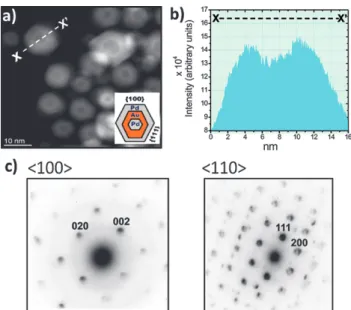
The fabricated particles presented a three-layer structure, as has been previously reported.16 They exhibit a Pd-rich core, with the first shell highly enriched in Au, and a Pd-rich outer shell. A typical HAADF image of the three-layer Au/Pd particles is shown in Fig. 1a. The inset indicates a sketch of element-rich locations in the layers. By tuning the ratio of Au and Pd, the thickness of the layers systematically changed. A higher content of gold increased the diameter of the central Au-rich layer at the expense of the Pd-rich core and external thickness, andvice versa. The three-layer structure observed in these nanoparticles was found to be dependent on the diameter.16It was observed that 25% of the nanoparticles had a diameter of 5.51.3 nm, and only displayed two clear layers. The remaining 75% of the nanoparticles showed a size of 12.70.8 nm, with three layers being evident.
The intensity profile through a typical Au/Pd nanoparticle is displayed in Fig. 1b, and depends on the atomic number and column thickness. The crystallographic structure of these particles was directly determined by means of electron microdif-fraction techniques from isolated nanostructures. A beam of 2–5 nm was precisely positioned on a particle and the diffraction pattern was obtained. Fig. 1c shows the microdiffraction patterns from two particles, consistent with <100> and <110> orientations of an FCC structure. The lattice parameter was measured by using the standard non-linear form of the Bragg Law,19and a value of 3.97 A˚ was obtained.
An ultra-high-resolution HAADF image of Au/Pd nanopar-ticles is shown in Fig. 2a. The atomic columns are clearly
resolved. A detailed image of the outer shell is shown in Fig. 2b. The inset corresponds to the digital diffractogram of this image, which indicates that the nanoparticle is in the <110> orientation. By measuring the distance between the indi-vidual atomic column peaks in the plot of intensity profileversus
distance, an interplanar spacing was obtained, and the lattice parameter determined. The values obtained by the two methods were consistent, with a mean value of 3.97 0.08 A˚ being obtained. This value is consistent with the one expected from Vegard’s law,20 and indicates that despite the observed three--layer structure, which exhibits different composition domains, the lattice parameter is not significantly altered. Moreover, no
Fig. 1 (a) Image of Au/Pd nanoparticles with cuboctahedral shape. The contrast is due to a core–shell structure consisting of three layers as sketched in the inset. Projected facets of the cuboctahedral particles can be observed. (b) The experimental intensity profile of a typical HAADF-STEM image shows a lower magnitude on the central portion on the particle (indicated as x–x0) due to the fact thatZ
Pd<ZAu. (c)
Nanodiffraction patterns of an individual Au/Pd nanoparticle showing a single-crystalline structure. Two orientations, <100> and <110>, can be observed. Note that extra spots due to twins are not observed.
Fig. 2 Aberration-corrected STEM images. (a) Atomic-resolution HAADF-STEM image of a cuboctahedral Au/Pd nanoparticle. The contrast of the three distinct regions can be clearly seen. Bright dots represent atomic columns. The inset corresponds is the fast Fourier transform of the nanoparticle. (b) Enlarged image of a small part of the exterior layer of nanoparticle (indicated as a white square in (a)), exhibiting <110> crystal orientation.
extra diffraction spots, which would have suggested the presence of twinning or defects at the core–inner-shell and inner-shell– outer-shell interfaces, were found. This strongly suggests that coherent interfaces are produced in these layered nanoparticles. Another interesting feature of the particles studied is their single-crystal structure. We can simulate the HAADF contrast observed in the nanoparticles of Figs. 1 and 2 by assuming that the whole shape of the particle corresponds to a cuboctahe-dron. It is well established that projected atomic columns in HAADF-STEM images appear in bright contrast. Since the images are incoherent, no interference effects are produced between the Bloch waves propagating through the crystal. The contrast strongly depends on the atomic number. To a very good approximation, the detailed image is a convolution
between a probe function and the projected atomic structure. We can approximate the image intensity as
I¼Ip5I(Vp) (1)
whereIpis the probe effective intensity distribution andI(Vp) is
the contribution of the projected potential. Now if we assume that two kinds of atoms are present, in any column of atoms, we can write:
I(Vp)¼F(NAui+ NPdj)I(Z) (2) whereF(NAui+ NPdj) corresponds to the atomic distribution of atoms in the particle, andI(Z) is the intensity that originates from thermal diffuse scattering (TDS). In order to determine
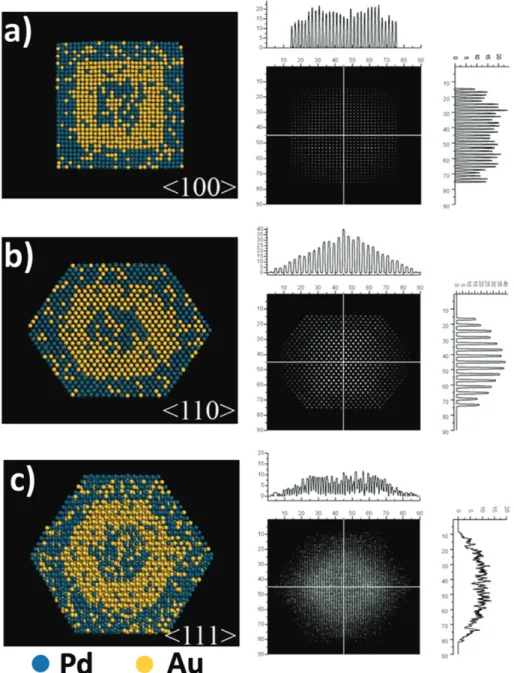
Fig. 3 Simulated HAADF-STEM of a cuboctahedral particle consisting of three layers: a Pd-rich inner-core with a thickness of five layers, an Au-rich intermediate-shell with a thickness of five layers, and a Pd-rich exterior-shell with a thickness of five layers. The cross-sectional view of Au/Pd models, their corresponding STEM images, and intensity profiles are shown for the (a) <100>, (b) <110>, and (c) <111> orientations, respectively.
F(NAui + NPdj), we assume a cuboctahedral-shaped particle formed of three layers: a central core containing 60% palladium, an intermediate shell containing 90% gold and an exterior shell containing 75% palladium. The I(Z) was calculated assuming that the main contribution corresponded to TDS.21The results for three different zone axes are shown in Fig. 3a–c. The displayed orientations, namely <100>, <110> and <111>, exhibit a good agreement between theoretical and experimental images, in all cases.
A measurement of the theoretical inter-atomic column spacing was also consistent with the experimental measurements. However, a systematic study of the aberration-corrected HAADF-STEM images shows deviations from the ideal shape. For instance, in several cases the central core is more rounded than in the simulated case. When we compared an experimental HAADF intensity profile in a picture without atomic resolution
(Fig. 1a,b) we found a profile that agrees quite well with the theo-retical profile for a <110>-oriented cuboctahedral shape. The profile is consistent with a three-layer particle with a Pd-rich central core. No twins or stacking faults are seen on the interface between layers, indicating that the interfaces between layers are fully coherent along the axis. However, more detailed informa-tion can be obtained from aberrainforma-tion-corrected images. Another cuboctahedral particle is shown in Fig. 4a,b in STEM bright-field (BF) mode and HAADF mode, respectively. The fast Fourier transform (FFT) of both images can be readily indexed as corresponding to the <110> zone axis. Since the HAADF-STEM intensity is sensitive to the atomic number and to the mass thickness, we can obtain profiles of different rows of atomic columns. The results are shown in Fig. 4c–e for the first and second atomic rows of the <100> surface and the <111> atomic row. The measurements were taken along the directions indi-cated by the arrows shown in Fig. 4b. As can be seen, the profiles show an increase in intensity and then a decrease, displaying a Gaussian distribution.
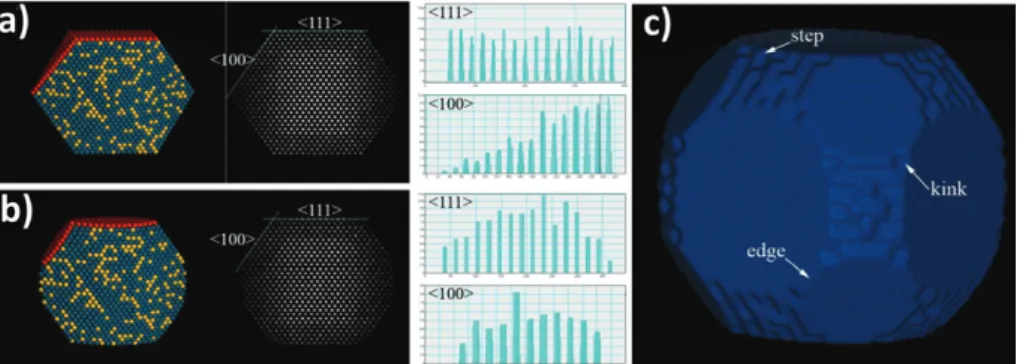
A close examination of the regular cuboctahedral structure shown in Fig. 5 indicates that the intensity in the <100> direction should always be increasing (Fig. 5a), and that the profile in the <111> direction should display constant intensity. The only possibility to reconcile the experimental data with the Au/Pd three-layer model (Fig. 5b) is that two phenomena are occurring. First, the particle is not smooth, and contains edges, steps and kinks (Fig. 5c), and secondly there is atomic mixing of Au and Pd in the columns on or near the surface. From consideration of the theoretical models included in this report, we conclude that the addition of a second metal introduces defects to the surface of the particles. The lack of extra diffraction spots in the electron diffraction patterns of the particles (Fig. 1c) indi-cates that these are single crystals. The absence of defects in the electron diffraction patterns is an intriguing fact that requires additional experimental analysis.
Conclusions
In summary, this paper reports the direct observation of individual atomic columns of nanoparticles with three-layer morphology. This enabled us to investigate their structure– composition relations. A very important principle for bimetallic
Fig. 5 Models corresponding to (a) a regular cuboctahedron and (b) Au/Pd modified cuboctahedron. The thickness of the atomic columns increases for a <100> face, whereas is constant for a <111> face for the regular cuboctahedron. The model of the reconstructed shape of Au/Pd nanoparticles is consistent with the observed intensity profiles. (c) Solid polyhedron representing an Au/Pd nanoparticle, showing steps, edges and kinks on the surface. Locally, these features produce high-index surfaces.
Fig. 4 Image of Au/Pd nanoparticle showing deviation from ideal cu-boctahedral morphology and its corresponding intensity profile along different crystal orientations. By employing aberration-corrected HRTEM under (a) bright field and (b) HAADF-STEM modes, the atomic positions and chemical species can be clearly analyzed. The scale bar corresponds to 2 nm in both cases. The intensity profiles for (c) the first and (d) the second atomic layers of the bimetallic nanoparticle along the <100> surface and (e) the <111> face show a Gaussian distribution.
particles was elucidated, namely that for nanoparticles display-ing alloydisplay-ing and a core–shell structure, differences in atomic radii and atom mobilities causes the formation of high Miller index facets. However, these facets are unstable and decompose into steps formed composed of {100} and {111} facets. It is very likely that the stepped surface of analyzed nanoparticles plays an important role in the catalytic activity of bimetallic systems.
Acknowledgements
The authors thank the Center for Nano and Molecular Science and Technology at the Texas Materials Institute, and the Inter-national Center for Nanotechnology and Advanced Materials at The University of Texas at Austin. We also thank the support from the Welch Foundation Grant F1615, and the NSF Grant DMR-0602587: ‘‘Alloys at the Nanoscale: The case of Nanopar-ticles’’. Electron microscopy at Oak Ridge National Labora-tory’s High Temperature Materials Laboratory was sponsored by the Assistant Secretary for Energy Efficiency and Renewable Energy, Office of FreedomCAR and Vehicle Technologies, as part of HTML’s National User Program, ORNL, managed by UT-Battelle LLC, for the U.S. Department of Energy under contract number DE-AC05-00OR22725.
References
1 N. Dellby, O. L. Krivanek, P. D. Nellist, P. E. Batson and A. R. Lupini,J. Electron Microsc., 2001,50, 177.
2 Y. Peng, P. D. Nellist and S. J. Pennycook,J. Electron Microsc., 2004,
53, 257.
3 J. L. Hutchison, J. M. Titchmarsh, D. J. H. Cockayne, R. C. Doole, C. J. D. Hetherington, A. I. Kirkland and H. Sawada, Ultramicroscopy, 2005,103, 7.
4 E. C. Cosgriff and P. D. Nellist, J. Electron Microsc., 2001, 50, 291.
5 K. Ishizuka,J. Electron Microsc., 2004,53, 129.
6 J. Yamasaki, T. Kawai and N. Tanaka,Microsc. Microanal., 2006,
12, 285.
7 A. M. Sanchez,Microsc. Microanal., 2006,12, 483.
8 D. A. Blom, L. F. Allard, S. Mishina and M. A. O’Keefe,Microsc. Microanal., 2006,12, 483.
9 C. Noguez,J. Phys. Chem. B, 2007,111, 3806.
10 S. J. Mejı´a-Rosales, C. Ferna´ndez-Navarro, E. Pe´rez-Tijerina, D. A. Blom, L. F. Allard and M. Jose´-Yacama´n,J. Phys. Chem. C, 2007,111, 1256.
11 H. Nitani,J. Nanopart. Res., 2006,8, 951.
12 A. Steinbrueck, A. Csaki, G. Festag and W. Fritzsche,Plasmonics, 2006,1, 79.
13 E. Pe´rez-Tijerina, M. Gracia Pinilla, S. Mejı´a-Rosales, U. Ortiz-Me´ndez, A. Torres and M. Jose´-Yacama´n,Faraday Discuss., 2008,
138, 353.
14 G. Kickelbick and L. M. Liz-Marzan, ‘Core-shell nanoparticles’, in: Encyclopedia of Nanoscience and Nanotechnology, American Scientific Publishers, Valencia, California, USA, 2004, vol. 2, p. 199. 15 L. M. Liz-Marzan,Mater. Today, 2004,7, 26.
16 D. Ferrer, A. Torres-Castro, X. Gao, S. Sepu´lveda-Guzma´n, U. Ortiz-Me´ndez and M. Jose´-Yacama´n, Nano Lett., 2007, 7, 1701.
17 The SimulaTem software can be obtained from Dr A. Gomez at the Instituto de Fı´sica, UNAM, Me´xico, D.F.
18 K. Ishizuka,Ultramicroscopy, 2001,90, 71.
19 K. Andrews, D. J. Dyson and S. R. Keown,Interpretation of electron diffraction patterns. Plenum Press, New York, 1971.
20 A. R. Denton and N. W. Ashcroft, Phys. Rev. A, 1991, 43, 3161.
21 M. D. Croitoru, D. Van Dyck, S. V. Aert, S. Bals and J. Verbeeck, Ultramicroscopy, 2006,106, 933.