1
FACULTAD de FILOSOFÍA Y LETRAS
DEPARTAMENTO de FILOLOGÍA INGLESA
Grado en Estudios Ingleses
TRABAJO DE FIN DE GRADO
EMOTIONS FROM LITERATURE TO CINEMA:
REVOLUTIONARY ROAD
Laura A. Gómez Díez
Tutora: Ana Sáez-Hidalgo
2
ABSTRACT
The objective of this dissertation is to see how emotions are reflected in literature and cinema. This work is structured in three parts, the first part of my research studies emotions from a more scientific and analytical point of view; observing the different theories of emotion, the emotional system and seeing how emotions work and manifest themselves in people. In the second part of this work I will analyse how emotions are reflected in literature from different points of view: the use of narrative techniques to convey emotions and how to find emotions in different elements that make up the work as the author, the reader and characters. Once I have seen how emotions are part of the literary field, I will be able to apply these results to the audio-visual and cinematographic area. The last part of my research will analyse the characters in the film Revolutionary Road (2008) from an emotional point of view. Frank and Alice Wheeler will be the subjects studied since it is about the two main characters in the film. I will analyse specific scenes of the film where the characters suffer a great emotional burden.
KEY WORDS: Characters, cinema, literature, narrative, Revolutionary Road, theory of emotions.
RESUMEN
3
punto de vista emocional. Frank y Alice Wheeler serán los sujetos estudiados ya que se trata de los dos personajes principales protagonistas de la película. Analizaré escenas concretas de la película donde los personajes sufren una gran carga emocional.
4
TABLE OF CONTENTS
1. EMOTIONS
1.1.THE CONCEPT AND THEORY OF EMOTIONS……… 5
1.2.EMOTIONS IN LITERARY STUDIES……….. 9
1.3.EMOTIONS IN CINEMA STUDIES……… 20
2. EMOTIONS IN REVOLUTIONARY ROAD……….. 27
3. CONCLUSION………. 33
5
The purpose of this dissertation is to analyse Frank and Alice Wheeler characters who are the protagonists of the film Revolutionary Road. I chose this film because of its emotional content. Frank and Alice Wheeler are characters who represent 1950s American society. The role of men and women was very defined and stereotyped during this period. Frank and Alice are suffering characters with frustrated lives who decide to follow the established common life and live like everyone else. Although they feel different from the rest they end up doing the same things and the same routines as everyone else. This whole situation ends up being a catastrophe for them. The emotions and feelings which move these characters make me think about this film in order to analyse them. This essay is organised as follows; the first part introduces the concept of emotion, classifies the different theories of emotions, then and following Robert Plutchik’s wheel of emotions I explain the primary and secondary emotions. After having studied the concept of emotions I continue my work deepening in the study of how emotions are found in literature and what literary techniques are used to transmit emotions in the narrative scene. The next section studies how emotions are found in cinema considering the different cinematographic techniques. Then, I apply these literary and cinematographic techniques to the film Revolutionary Road. Finally, I state my conclusions of this research.
For there is nothing either good or bad but thinking makes it so.
Hamlet 1. EMOTIONS
1.1.THE CONCEPT OF EMOTIONS AND THE THEORY OF EMOTIONS
6
individual knows the sensations experienced at these emotional reactions, because he has been able to live them frequently throughout his life. Emotions exert a great power on us and influence our thinking and behaviour that is why they have a great weight in the study of psychology.
In recent years, different theories have emerged that try to explain the how and why of human emotions. The most important theories of emotion can be grouped into three categories: physiological, neurological, and cognitive. Physiological theories suggest that intracorporal responses are responsible for emotions. Neurological theories suggest that activity in the brain leads to emotional responses. And, finally, cognitive theories argue that thoughts and other mental activities play an essential role in the formation of emotions. A general theory of emotion must account for at least the following elements and their interrelations:
1. A situation or stimulus, that meets certain characteristics or certain emotional potential, as generator of emotions.
2. A subject capable of perceiving this situation, processes correctly and reacts appropriately to it.
3. The meaning that the subject grants to that situation.
4. The emotional experience that the subject feels in this situation. 5. Body reaction.
6. The observable motor expression.
If an emotional reaction occurs, changes are seen in three different types of channels of emotional expression:
1. At the experiential level, or what the subject experiences (feelings of joy, sadness, anger, etc.).
2. At the body or physiological level (changes in heart or respiratory rate, increased sweating, changes in muscle tension, etc.).
7
These are three different forms of expression of the same phenomenon. The responses of each of these three types are often considered as an indicator that an emotional reaction is occurring. However, changes in the three levels of response are sometimes inconsistent and may vary in intensity. These three systems of response are called: cognitive, physiological and motor (Lang). It is difficult to classify the multiple theories of emotion from general criteria. However, I am going to follow Robert Plutchik’s classification because this categorization includes most of the theories of emotions that have been emerging since the earliest psychological studies conducted about emotions (Plutchik). According to Plutchik’s classification the four great theoretical traditions in the study of emotion are:
1. The Evolutionary theory initiated by Darwin which exposes his observations on the emotional behaviors of different species. He concludes that the emotional expressions are given not only in man, although in him they acquire their maximum development.
2. The Psychophysiological theory initiated by James which says that emotion is the affective experience of a reflex behavior. Bodily changes are a necessary and sufficient condition for it to occur emotion. Body change is experienced at the time it occurs. Every emotion is characterized by a distinctive reaction pattern visceral (psychophysiological specificity). Each person has a personal idiosyncrasy expression (specificity individual).
3. The Neurological theory initiated by Cannon states that the emotions are an activity of the C.N.S., not of the Peripheral S. Autonomic and somatic activity accompanies the emotion and prepares for action. The physiological activation is general and non-specific. The neural structures involved in the emotional reaction are studied.
8
functional analysis of disorders following an empirical contrast and a rigorous methodology. Development of techniques such as behavior modification.
To these four great traditions he incorporates other groups of theories:
5. The behaviorist approaches
6. The theories of activation
7. The cognitive theoriesof emotion postulate a series of cognitive processes (evaluative, attributive, labeling, perceptual representations, etc.) that are situated between the stimulating situation and the emotional response. They also study the subjective contents (cognitive and affective representations) that are manifested in the emotional reaction (subjective experience). 1
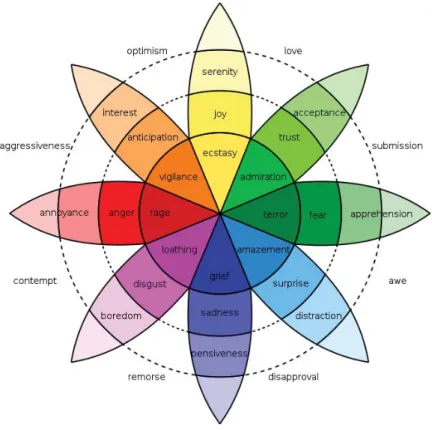
As we have seen there are different theories of emotion, although they differ in concepts and development, all conclude that emotion is a response to a stimulus or situation temporarily close and known. It can have positive or negative connotations, but it is always linked to adaptation to situations that pose an important threat to the balance of the organism. Now we know how these emotions alter and work in our body from the point of view of the different theories of emotion, we just need to know what those emotions are. That question is answered thanks to Robert Plutchik who developed the wheel of emotions. According to his study collected in his work The Psychology and Biology of Emotion:
This (...) approach makes the assumption that a small number of emotions are considered primary or fundamental or basic, and that all other emotions are secondary, derived mixtures, or blends of the primary ones. From this perspective, one needs to identify the basic emotions and then explain which mixed emotions or blends are derived from them. (Plutchik 53-4)
9 Following this line of research, emotions are divided into two major groups: primary emotions and secondary emotions derived from the primary. In the group of primary emotions, we find ourselves: joy, confidence, fear, surprise, sadness, aversion, anger and anticipation. The combination of these emotions gives rise to the secondary emotions that are: love, submission, fright, disappointment, remorse, contempt, treachery and optimism. Each of them composed of two basic emotions. The emotions are combined in primary dyads that will form the advanced emotions, by secondary and tertiary dyads that give rise to even less frequent emotions. According to this theory, emotions vary in their degree of intensity. For example, anger is less intense than rage and rage more intense than anger. The more intense an emotion is, the more it motivates a behavior related to it.
Fig. 1. The wheel of emotions by Robert Plutchik. This image is public domain. Image taken from Wikipedia. https://upload.wikimedia.org/wikipedia/commons/c/ce/Plutchik-wheel.svg
1.2.EMOTIONS IN LITERARY STUDIES
10 pathology not a healthy state. They are both parts of the whole, each a subsystem embedded in an integrated, larger system. There is nothing more human than our reason and our emotions. We are probably the most emotional creature on the earth as a result of the complexity and subtlety of our thought, our mind's and body's role in adaptation, and our dependency on other people, all of which are relevant to survival and how we flourish as individuals and a species. (Lazarus 100)
Lazarus was right, our emotional system combines a whole world of emotions, feelings and affections. The human being expresses his emotions to adapt and relate to the rest of the world. The way in which our body manifests emotions is through the responses that our emotional system resolves before the different stimuli. Our body functions as a machine that reacts and responds differently which depending on the situation will generate a certain type of behaviour in relation to its emotions.
Now that we have an idea of what the primary emotions are and how the combination of these gives rise to other emotions, we can respond to how these emotions work in the narrative frame. Writers have learned how to take advantage of these emotions to apply them to the wide artistic world, from the simplest children's story to the most complex masterpiece, emotions play a very important role in art and in this case, literature. Patrick Colm Hogan and Maass state that fictional narrative is completely connected with emotion:
Literary stories, especially the stories we most admire and appreciate, are structured and animated by emotion. Any coherent sequence of events might constitute a story. But stories that engage us, the stories we celebrate and repeat - “paradigm stories- are precisely stories that move us, most often by portraying emotions or emotional consequential events (Hogan 5).
Emotional impact is not an extra. It’s as fundamental to a novel’s purpose and structure as its plot. The emotional craft of fiction underlies the creation of character arcs, plot turns, beginnings, midpoints, endings, and strong scenes. It is the basis of voice. (Maass 4)
11 the study of emotions: Affective Science and Affect Theory. “Affective Science derives from Cognitive Science, along with some influence from Social Psychology” (Hogan) while the Affect Theory can include studies derived from other fields far from (Cognitive) Psychology such as social oriented discourse or other practices. The Affective Science is a discipline and field of study, so it has a scientific rigor which affect theory lacks, therefore this section will focus on the study of emotion from the perspective of Affective Science.
Different concepts have to be considered in order to talk about emotions. The first one is
affect, the American Psychological Association (APA) defines it as “any experience of
feeling or emotion, ranging from suffering to elation, from the simplest to the most complex sensations of feeling, and from the most normal to the most pathological emotional reactions.” “The affects include emotions, moods, attitudes, interpersonal stances, and affect dispositions” (Hogan). These concepts are necessary to know how the human being faces and lives the emotions. The second concept is mood. According to the APA, “The moods are a disposition to respond emotionally in a particular way that may last for hours, days, or even weeks, perhaps at a low level and without the person knowing what the state prompted.” “When one is in an anger mood, one is likely to respond to one’s environment with anger” (Hogan). In literature, the mood is the tone that the author gives to the work in this way helps the reader to determine the emotions of the work. It is the emphasis and focus that the author transmits through the solemn, the serious, the critical to the ingenious, and the ironic and comical. The tone can be maintained throughout the story, from the beginning to the end. But it can be combined with another or other tones (dramatic / romantic - tragic / comic). One tonality may appear stronger than the other or both tones may have the same intensity in the work. The mood can evolve or remain flat depending on the work. There may be different types of tone (mood), melancholic, realistic, tragic, comical, ironic, etc. For example, in the poem Annabel Lee (1849) by Edgar Allan Poe, the melancholic and romantic tone that is maintained throughout the poem is clearly visible.
12 And the stars never rise, but I feel the bright eyes
Of the beautiful Annabel Lee;
And so, all the night-tide, I lie down by the side Of my darling—my darling—my life and my bride, In her sepulchre there by the sea—
In her tomb by the sounding sea.
“Edgar Allan Poe’s poem Annabel Lee tells a tragic story of love and loss. The mood that this poem provokes in the reader is generally one of sadness and nostalgia. Poe inspires this mood by establishing a bleak psychological setting and showing the art of the relationship up to Annabel Lee’s death”2. The third concept is attitudes. “Attitudes are
relatively enduring and general evaluation of an object, person, group, issue, or concept on a dimension ranging from negative to positive. Attitudes provide summary evaluations of target objects and are often assumed to be derived from specific beliefs, emotions, and past behaviours associated with those objects” (APA). “For example, one might have an attitude of distrust toward politicians” (Hogan). The attitudes are linked to the view that the reader has of the work and how the reader responds to the work. To create a connection between the reader and the work it is important that there is empathy, in this way the reader sympathizes with the characters, the environment and the history of the work. Hogan adds another concept related to the empathy idea, the identity group division, which is “our initial response to in-group members (e.g., people of the same race or religion) is more often parallel, whereas our initial or unreflective response to out-group members is more often complementary” (Hogan). This means that it is easier to feel identified with a group of people who belongs to the same culture, ethnic or belief as you. In literature, there are many examples that deals with the idea of race, religion and identity. In this fragment from Sherman Alexie The Absolute True Diary of a Part-time Indian (2007) novel, we see how it reflects the conflict of the character with respect to his group identity.
I realized that, sure, I was a Spokane Indian. I belonged to that tribe. But I also belonged to the tribe of American immigrants. And to the tribe of basketball players. And to the tribe of
13 bookworms. And the tribe of cartoonists. And the tribe of chronic masturbators. And the tribe of teenage boys. And the tribe of small-town kids. And the tribe of Pacific Northwesterners. And the tribe of tortilla chips-and-salsa lovers. And the tribe of poverty. And the tribe of funeral-goers. And the tribe of beloved sons. And the tribe of boys who really missed their best friends. It was a huge realization. And that's when I knew that I was going to be okay. (Alexie 217)
The fourth concept is the affect dispositions. “The affect dispositions or traits are an enduring personality characteristic that describe or determine an individual's behaviour across a range of situations” (APA). “Regarding the function of the traits in literature trait affectivity has long been a significant part of character analysis, perhaps most obviously in the form of humoral psychology” (Hogan, 2016). The literary characters are usually defined first physically but also defined according to the emotional characteristics that the narrator attributes to them, and even the way they speak and the actions they perform. Even their physical and appearance features tend to give the characters a special characterization related to their emotions. These features will contribute to the characters acting in a certain way as the actions are happening in the narrative. Thus, there will be characters that will be impulsive or calm, angry or reflexive, brave or cowardly, happy or bitter. Let's see an example of how the narrator models the character, in Look Homeward, Angel (1929) a novel by Thomas Wolfe.
My brother Ben’s face, thought Eugene, is like a piece of slightly yellow ivory; his high white head is knotted fiercely by his old man’s scowl; his mouth is like a knife, his smile the flicker of light across a blade. His face is like a blade, and a knife, and a flicker of light: it is delicate and fierce, and scowls beautifully forever, and when he fastens his hard white fingers and his scowling eyes upon a thing he wants to fix, he sniffs with sharp and private concentration through his long, pointed nose. Thus women, looking, feel a well of tenderness for his pointed nose, bumpy, always scowling face: his hair shines like that of a young boy—it is crinkled and crisp as lettuce. (Wolfe 135)
14 After knowing the two main branches of research that are responsible for the study of emotion and the main components of affect, we can now know the mechanisms that make emotions work. Emotions develop thanks to a succession of events that alter our emotional system. Hogan called these events emotion episodes. The emotion episodes are formed by four components that alter our emotions and make them manifest in real life. The emotion episodes are: eliciting conditions, expressive or communicative outcomes, action readiness and the phenomenological tone. The first component of the emotion episodes is the eliciting conditions. “The eliciting conditions are the circumstances that give rise to the emotion episode. Such circumstances most obviously include the events and properties of the external world. But they also include affective dispositions and moods on the part of the person feeling the emotion” (Hogan). The eliciting conditions can also be propitiated by the presence of a memory that made a strong impact on us and makes us remember a particular emotion, this memory continues to affect the present. In literature, the eliciting conditions are found in the use of memoirs, memories or flashbacks that happen in the novel. Writers can use these literary devices to narrate the past (presently) of the characters and prepare and warn the reader about the past of the characters. The eliciting conditions are very well reflected in the English poetry of the First World War, let’s see an example:
You're quiet and peaceful, summering safe at home; You'd never think there was a bloody war on!... O yes, you would. . . why, you can hear the guns.
Hark! Thud, thud, thud, -- quite soft. . . they never cease -- Those whispering guns -- O Christ, I want to go out And screech at them to stop -- I'm going crazy; I'm going stark, staring mad because of the guns.
15 would be the eliciting conditions that make alter the emotions of the narrator although they are moments from the past.
The second component of the emotion episodes are the expressive or communicative outcomes. Hogan describes them as “the results of the emotion that do not serve directly to alter or maintain the situation as such. Rather, they serve to convey the emotion to those present (which may of course lead in its turn to changes in the situation). For example, a cry of fear at the sight of a predator would serve to warn others of the danger” (Hogan). Not only do communicative outcomes inform others, they also generate emotional empathy. In the previous example, thanks to the squealing and warning of a person, another person may be safe and protected from danger. In most cases the communicative outcomes are not planned but arise spontaneously altering our emotional system and generating an emotion in the moment. It is more complicated to find the communicative and expressive outcomes in literature; however, “this occurs in part through simulation and through subvocalization, the silent "voicing" of a speaker's utterance. Tone of voice-including, variation in volume and pitch contour-is a very important expressive or communicative outcome” (Hogan). The expressive outcomes are reflected in literature through the exclamations, questions, onomatopoeia in a way that denote a different and stronger intensity. With this the author seeks to convey a more intense emotion. We can see it clearly reflected in the novels and articles of the North American journalist Tom Wolfe who makes use of exclamations continuously to intensify what he means.
She wanted us to have the party in Robert's father's house on 70th Street in the first place. I'm serious! She doesn't like this apartment! It embarrasses her! Do you know what it is? Do you know who runs the East Side of New York? The nanny mafia. There's a nanny mafia! (Wolfe 271)
16
The third concept is action readiness “which is the entire bodily and mental orientation towards behaviour that will either alter the situation or maintain it, depending on whether the emotion is aversive or pleasurable. It involves the "priming" of motor routines (i.e., the partial activation of such routines, below the threshold of enactment), the preparatory tensing or relaxation of the muscle, and other, relevant physiological orientations. Actional outcomes are, of course, the actions themselves, such as running from a danger” (Hogan). In this case, any example would be valid to see how a character reacts to facts and is able to take action transforming this whole process into an emotion. However, not only facts and actions generate emotions and feelings as there is a series of ambiguous elements that do not necessarily come from the strictly material, or the exchange of interactions between some people. We are talking about the landscape, the environment, the smell, the colour, the sounds, etc. The human being can also react to a landscape and make it transmit a series of emotions. These ambiguous elements generate emotions that also alter our system. In literature we find this resource in the author's description of the scenery and the setting of the novel, through the descriptions of the landscape and the environment that the author does, the maximum splendour of this resource was used by writers of Romanticism, with the description of the evocative landscapes of this era, however not only the landscape can transmit emotions but the environment that accompanies the character too. Victorian writer Charles Dickens was extraordinary describing the English decadent environment of the nineteenth century. If we take a look at this fragment of the novel Hard Times (1854) we find in what the definition of the environment refers to what concerns us:
It was a town of red brick, or of brick that would have been red if the smoke and ashes had allowed it; but as matters stood, it was a town of unnatural red and black … It had a black canal in it, and a river that ran purple with ill-smelling dye, and vast piles of building full of windows where there was a rattling and a trembling all day long, and where the piston of the steam-engine worked monotonously up and down, like the head of an elephant in a state of melancholy madness. (Dickens 223)
17 good and bad. His description gives the reader an idea of the polluting and lugubrious environment that was lived in that period of history.
The fourth concept is the phenomenological tone. “The phenomenological tone is the one component of an emotion episode that is essentially private; it is a subjective experience that cannot be observed by anyone else or even phrased in a third-person language” (Hogan). This emotion is endowed with a very personal character since it is part of a person's private life, so it is very difficult to share that emotion so that others understand it for themselves. For example, a person can be full of joy to have got the job and the opportunity of his life, however, telling this experience to a friend, family member or another person, they won’t live that happiness the same way and intensity as it is an individual experience with a very personal feeling. As we have seen previously, we can observe how the elements that make up the functioning of emotions in our system are represented in literature through the use of different literary devices. Although emotions also take part in other important aspects of literature such as the characters, the author, the reader or the genre of the novel.
Another important feature projecting emotions through the novel are the characters who transmit all the emotional intensity in the story. There are many ways to define and analyse the characters of a novel; however, we will focus on analysing the characters from an emotional point of view, taking into account their emotions, their emotional systems and their behaviour when reacting to different situations.
[…] literary character is said to be “real” insofar as it embodies the emotional dynamics of a work. […] Character is a medium through which central tensions in a work are expressed. […] the basic tensions in a work are portrayed by the characters. […] Characters are people-in-tension, if not always people-in-action. […] Literary characters express the complexity of the basic tensions of the emotional life rhythm. (Ragland 34)
18 the main character, usually have desires and goals that keep the plot emotionally active. Sometimes these purposes confront the character himself and alter his internal emotional world and his inner peace, which can make him act against his own principles and ideas and maintain a struggle with himself in which emotions play a key and fundamental role. This will affect the way the story unfolds, with turns and emotional changes altering the plot. The characters of the novel experience different emotional states and sometimes an evolution through the novel. The stories lead their characters to a personal journey that makes them change and alter their main state. Literature classifies characters according to their personal and emotional evolution: flat or static and dynamic or rounded characters. In the case of flat or static characters are those who do not show any kind of evolution throughout the work.
The essence of a flat character, for instance, is in its limitations: a flat character may be summed up in an epithet. [...] Moreover, a flat character is predictable: transfer this character to a new situation, and it will act as before. [...] flat characters, though lacking in depth, are finished creations, possessing what one might call contextual closure. (Galef 2-3)
These characters present the same physical and mental characteristics from start to finish. Their emotions and their way of behaving throughout the work are always presented the same so they will not have a more developed emotional depth than other characters. If they have an evil, cowardly or even cheerful behaviour, their status will not change. His emotional state does not change so, although it does not evolve, it has a stability throughout the novel that the round characters lack.
...flat characters are characterized by a peculiar kind of freedom - the freedom of changelessness wherein they do not have to learn, grow or evolve, the freedom which lies in their immunity to the knockers and buffets doled out to them. (Ragland 43)
19 The round or dynamic characters have a remarkable evolution throughout the novel. They are by nature more complex than flat characters. They have a personal and emotional evolution. A round character has a greater depth. Being more complex psychically has virtues, defects, strengths, weaknesses, fears, dreams that accompany him throughout the novel. It is a well-characterized character, so much that it seems real and it is usually easier to feel identified with it because it opens body and soul in the work. Many times, his emotions betray him, but he lives with greater intensity. It is not a flat and static character but is dynamic and can evolve. The story and plot of the novel change round characters and they mostly suffer all the hard consequences, but this makes them look even more real and credible. A classic round or dynamic character would be, continuing with Dickens, Ebenezer Scrooge, A Christmas Carol (1843). At the beginning of the work is a surly, evil and selfish character however at the end of the novel his being has changed and has become a good generous and loving person.
Emotions can also be linked to the genre of the novel. This is because there are emotions associated with certain scenes or moments that occur in the novel. Those emotions become resources that writers use to express characters’ feelings, novel’s atmosphere, the environment, etc. A clear example would be the anxiety linked to the genre of suspense.
When the hero must subdue the villain or die trying, this covers not only interest, but also suspense. [...] Literature may give us not only targeted suspense (e.g., about whether the hero will defeat the villain or be killed). They also give us more generalized and undirected feelings of foreboding, due to example of the use of narrative techniques and resources such as foreshadowing, the cliffhangers, the climax, the close calls, the short sentences, etc. (Hogan)
Continuing with the theme of suspense and anxiety, I will give an example of taken from The Shining (1977) by Stephen King:
20 that ever happened? At the far end of the concrete ring, Danny heard the stealthy crackle of dead leaves, as something came for him on its hands and knees. (King 320)
This fragment is foreshadowing the culminating moment of the scene. It is felt in the environment that a dangerous situation is about to occur. King makes use of the close calls to show that the character is in danger. The use of short phrases (as is the case) is a resource used to give greater speed to reading, in this way an atmosphere of anxiety, anguish and danger is created. Emotions will be present in all kinds of genres, such as romantic, comical, tragic. The key is to find the resources and narrative techniques that the author uses to locate emotions in the genre.
1.3.EMOTIONS IN CINEMA STUDIES
In the modern world’s emotional landscape, the movie theatre occupies a central place: it is one of the predominant spaces where many societies gather to express and experience emotion. The cinema offers complex and varied experiences; for most people, however, it is a place to feel something. (Smith 4)
The cinema is a scene of emotions where the viewer enjoys being reflected in the characters, the story and the atmosphere of the film. It is a show that represents the human experience and its drama. Once explained how emotions work in our system, the different theories that support them and their application in literature this part of the study will embrace the audio-visual field specifically cinema.
21 Cinematography techniques work with a film’s mode of organization (narrative, documentary, or avant-garde), with its mise en scène and editing, and with its sound to
produce meaning in an integrated way. The most powerful uses of cinematography do more than simply display technical expertise: they provoke emotional, intellectual, and aesthetic responses. (Pramaggiore and Wallis 99)
There are different branches of research that classify cinematographic techniques according to different criteria. In this case I will focus on the transmission of emotions through the use of cinematographic techniques. The article ‘Environment Expression: Expressing Emotions through Cameras, Lights and Music’ (2005) written by Celso de Melo and Ana Paiva make a classification of the different elements that help the transmission of emotions in a film.
This work proposes an integrated storytelling model – the environment expression model – capable of expressing emotions through three channels: cinematography, illumination and music. Stories are organized into prioritized points of interest which can be characters or dialogues. Characters synthesize cognitive emotions based on the OCC emotion theory. Dialogues have collective emotional states which reflect the participants’ emotional state. During storytelling, at each instant, the highest priority point of interest is focused through the expression channels. The cinematography channel and the illumination channel reflect the point of interest’s strongest emotion type and intensity. The music channel reflects the valence of the point of interest’s mood. (de Melo and Paiva)
22 The Stanislavsky system requires that an actor utilize, among other things, his emotional memory (i.e., his recall of past experiences and emotions). The actor’s entrance onto the stage is considered to be not a beginning of the action or of his life as the character but a continuation of the set of preceding circumstances. The actor has trained his concentration and his senses so that he may respond freely to the total stage environment. Through empathic observation of people in many different situations, he attempts to develop a wide emotional range so that his onstage actions and reactions appear as if they were a part of the real world rather than a make-believe one. (“Stanislavsky system”)
This method established a list of actions that represented certain emotions. For example, when someone is in love acts in a certain way and there are feelings associated with that emotion such as dreams, hatred, doubt, admiration, respect, ecstasy, bewilderment, jealousy, etc. If an actor wants to convey an emotion such as anger, clenches his fists and adds tension to the muscles of his body or breathes quickly, can generate physical intensity, which causes a greater impression. Every detail counts, from the concrete actions of the actors, such as the word, the silences, the character's way of walking projecting insecurity or suspicion, as well as the scenarios in which it moves (dark and threatening alleys).
The second point of interest in de Melo and Paiva’s classification is the dialogue or script. The dialogue is the cinematographic language of the film. It is quite important as it includes part of the technical features which make the film work. The script establishes not only the way characters are going to communicate between each other but the soundtrack, the sounds, the silences, the movements, the description of the characters and the dimensions. These guidelines give life to the movie. It depends on the script that the words of the text have a coherence and connection so that all the elements in the script have a meaning. Like the narrative text, the script needs two basic elements to make sense of the work: a story, with its respective events, characters, scenarios and actions; and the speech, the way in which this story will be transmitted. The speech is essential in the work because it marks the rhythm of it. Giving it a unique personality, which will depend on the director and his scriptwriters how they want to express it.
23 when words prove to be inadequate or insufficient. Words are related to time and images to space, but with the invention of the cinematographic camera the concept of time passing becomes inseparable from visual experience and the way we see human beings changes; perspective stops being the only one available. (Astudillo)
Continuing with the three main channels, first, cinematography plays a very important role when it comes to reflecting emotions in fiction since it encompasses the entire visual field of the film: camerawork, visual effects, lenses and filters, etc. It facilitates the transmission of emotions thanks to the camera work. The shots, angles, movement and distance are factors that have the capacity to alter emotional intensity. According to de Melo and Paiva,
A shot represents a camera configuration of a certain time duration which is not broken up by cuts. A shot can be either static or dynamic. Shots can vary, among others, according to the distance and to the angle with the point of interest. Regarding distance, the closer the camera is, the higher is the audience’s attachment to the point of interest. (de Melo and Paiva)
24 just carefully arranged elements within a frame to create dramatic tension or evoke a sense of place and time, or character” (Mullen). Following with distance technique, De Melo and Paiva states that “distance shots reflect different emotion intensity”. They classify five types of shots:
1. Extreme close up, which focuses a particular detail, like the character’s eyes.
2. Close up, which focuses the character’s face.
3. Medium shot, which focuses the character from the waist up. 4. Full shot, which focuses the whole character.
5. Long shot, which films the whole character and also the surrounding environment (De Melo and Paiva).
25 Regarding the shot angles, de Melo and Paiva states that “angle shots reflect the character’s power”. They mention three different types:
1. Eye level – the camera is placed at the height of the point of interest, representing a neutral view. “Looking at someone at eye level shows them as an equal” (Cassidy).
2. High angle – the camera films the point of interest from above creating the impression of smallness and isolation. “Shooting a subject from a high angle makes them look small and weak” (Cassidy).
3. Low-angle – the camera films the point of interest from below creating the impression of a powerful point of interest (De Melo and Paiva). “Shooting a subject from a low angle makes them look powerful and intimidating” (Cassidy).
There is another cinematographic technique called POV (acronym of “point of view”) or ‘Kuleshoveffect’ which is very useful in order to show and transmit emotions in a deeper way. This technique makes the public see the narration through the eyes of the character. It involves the alternation between the actor’s face shots and shots which are recreating what the character is seeing in that moment (the eyes of the character). That is, the audience perceive the world through the eyes of the protagonist. “The aim of the experiment was to show that editing could engender emotions and associations in the spectator that went far beyond the content of individual shots” (Dimare 993).
Regarding the illumination channel, it is about creating a relation between lights and emotions. The colours and tones with which the film is recorded have a great importance when it comes to reflecting what kind of emotions. De Melo and Paiva talk about the the three-point-lighting technique. They classify three types of lightening in films:
26 2. Fill light – which is a low-intensity light that fills an area that is
otherwise too dark.
3. Back light – which is used to separate the character from the background (De Melo and Paiva).
Regarding colour, colours are generally associated with moods and films project the colours on the screen depending on the mood of the scene. Usually red is associated with passion but at the same time it can reflect anger, aggressiveness and excitement; yellow is naive but it can be madness, or obsessive; green is nature and easing but it can be corruption and darkness; blue is calm, and peace related with, but it can be cold and isolation or melancholy; among others. “Regarding brightness, it is known that well illuminated scenes are happy and cheerful and poorly illuminated scenes are mysterious and sad” (de Melo and Paiva). If we take a look to Tarantino’s films, colour is one of the cinematographic techniques with more importance as in Kill Bill: Vol 1. (2003) The film makes brilliant changes from ‘black & white’ to colour and he even creates new scenes mixing both methods. The fact that Beatrix Kiddo ‘The bride’ is wearing that bright yellow bodysuit during the fight at ‘The house of Blue Leaves’ is brilliant and magnetic at the same time, she is the point of interest and has the power in all the scenes, shinning above all others.
Regarding the music cinematographic technique de Melo and Paiva classify four dimensions:
1. Structural features – which relates the music’s structure with emotions. The tempo of the music can be slow or fast depending on it, fast tempo “may be associated with happy/exciting emotions and slow tempo with sad/calmness emotions”
2. Performance features – which refer to the influence of the interpretation of the music.
27 4. Contextual features – which refer to aspects of the performance and/or
listening situation (De Melo and Paiva).
According to de Melo and Paiva’s study, “Positive songs have fast tempo and, if they have lyrics it should be positively valenced; Neutral songs have medium tempo; Sad songs have slow tempo and, if they have lyrics, it should be negatively valenced.” Music and films have a long and old relationship, there are unforgettable examples of how music transmits emotions in films, remarkable ones, the soundtrack from Jaws (1975) or Psycho (1960) is anguished and scary. These films contemplate scenes impossible to forget, like the shower scene from Psycho with the shouting and anxious music or people running out of the beach trying to escape from the shark in Jaws. To sum up, the three main channels (cinematography, illumination and music) of cinematography techniques help films transmitting emotions and making scenes cinema masterpieces.
2. EMOTIONS IN REVOLUTIONARY ROAD
28 enthusiastic about the idea, leave their suburban life behind and to change Revolutionary Road for a bohemian and different Paris, far from the superficial and frivolous American life. A new promotion in Frank's work and the accommodation of a life already built with a third child on the way again dispel the idea forever. The couple enters an abyss of fights, vices, infidelities and lies. The novel perfectly represents the American dream, but it unravels its black and miserable interior, revealing the shortcomings of a seemingly happy marriage.
In order to get an idea of the situation in Revolutionary Road, I will introduce the 1950s-decade, moment and role of the characters that are reflected both in the book and in the film. We have to go back to the United States of 1950. The end of the Second World War made clear the supremacy of the United States of America in the Western world. The USA economic hegemony made the country the main creditor of the countries ruined by the war. This economic splendour of the ‘50s brought together the development of the ‘American Way of Life’ that was imposed on the philosophy of life, language, fashion, music, arts, etc. This welfare society had its lights and shadows as the role of women in 1950s American society, the struggle for rights and racial inequality.
Once the Second World War ended, there appeared in America a desire for change in society, a new home, a new space on which to establish the ideal family, boosted again and again in the advertising canons. Mad Men (2007) TV show delves deeply into the theme of advertising and marketing of the 50s focused on female consumption in addition to the role of women and men during that time. This situation generates the need to acquire new products, new looks, new furniture, in short, new objects for a new life. Women are required to be the safeguard and support of society in their role as self-sacrificing mothers and perfect wives in what Betty Friedan, very aptly, called The Mystique of Femininity (1963).
29 Without economic independence, the way of life of the housewife in this new technological home produces loneliness, depression and other medical conditions qualified as ‘typically female’. Friedan analyses the economic system in which women are sold an identity consistent with the family unit of consumption in which the family has been transformed (Friedan, 1962). The book A People and a Nation: A History of the United States (2009) highlights, “Suburban domesticity left many women feeling isolated from the larger world their husbands inhabited. The popular belief that one should find complete emotional satisfaction in private life put unrealistic pressure on marriages” (Norton 789).
It did not make sense to go out and compete in the market for a medium or low qualification position when you could be your own boss at home. The American housewife not only took care of the home but established the relationships by which the husband could progress: meetings, associations, dinners, parties, that would blow up the candles of family progress. The role of man in 1950 is based on going to work, bring a good salary home to be able to support the ideal American family: woman, children and dog. Most of the time he is too busy working so his role at home is limited to drinking, watching television and socializing on weekends at neighbourhood parties.
In 1950s families, men and women usually took distinct roles, with male breadwinners and female homemakers. […] In fact, the economic and social structure and the cultural values of the post-war United States determined the choices available to men and women. […] There were strong incentives for women to stay home, especially while children were young. Childcare experts, including Dr. Spock, whose 1946 Baby and Child Care, insisted that a
mother’s full-time attention was necessary for her children’s well-being. Because of hiring discrimination, women who could afford to stay home often did not find the available jobs attractive enough to justify juggling cooking and housework, too. (Norton 788)
30 extraordinary. The film shows how Frank and April's decision to change their lives for the better leads to betrayal and tragedy. The film perfectly reflects the isolation that comes from comfort; the lack of communication caused by the lack of sincere feelings and emotions, and the loss, often unconscious of values that at one time seemed fundamental. The portrait of these two characters becomes a deep inquiry into what people let society do with them. The scenes in the film reproduce perfectly all these social behaviours, the control of feelings and emotions, in short, an empty life, full of lies, frustrations and deceptions.
31 pair. The idea of presenting the beginning of the couple from a remarkable distance means how far they are from each other and how far they are going to be throughout the whole movie. When they start dancing, there is a close-up of both characters showing their faces from a closer distance. A physical attraction and passion are the real emotions which tie these characters to be together. The primary emotion is love however the emotions they are feeling are the ones of passion and attraction which are secondary emotions from love. The illumination of the scene is soft and faint making the atmosphere look calm and serene, the colours are neutral and not striking which makes the scene look peaceful. Regarding the literary techniques, this emotional episode has some clear eliciting conditions; the looks and the smiles. The expressive outcome is the way they are talking between each other, they are flirting, he makes her laugh, they are making it clear that there is a mutual interest and a physical attraction between the two. The action of readiness begins the moment they start dancing, they cannot stop looking at each other, their hands do not separate, they intertwine their fingers.
32 representing a neutral view of the situation so nobody is being overshadowed or magnified, everybody is equal. In this emotional episode, there is a case of phenomenological tone, they are thinking and feeling different emotions. She is sad, embarrassed and disappointed as the play has being a failure while he is worried about having a drink with his neighbourhoods. The result is a situation of discomfort for both, they are distant from each other and denoted a clear lack of communication between the two just the opposite of what happened at the beginning of the film. The dreams of the beginning have given way to terrible frustration. The theatrical performance where April has been in evidence before her husband is also a perfect image of deception, of the wonderful fiction that both have adopted as life, discovering that they are really like the living dead. However, both face the situation differently. While April cannot take it anymore and she is feeling sad and frustrated, Frank is reluctant to open his eyes, accepting things as they are.
The last scene plans a different scenery. The emotion here is anger turned into a fight.
33 quite distanced. The camera shows a medium shot of both arguing heatedly outside the car, exchange of reproaches, insults, a very tense moment takes place when Alice insults Frank and he raises his fist with the intention of hitting her, but finally hits the car, injuring himself, “The look April gives him is probably the worst look he's ever received: a look of pitying boredom.” (Haythe) End of the discussion. Background in black. The titles of the movie appear. The emotion is anger, the mood and attitude of both characters is anger, disgust and distance. The eliciting conditions that give rise to the emotional episode are the crossing of words that Alice and Frank keep in the car, each time he speaks her anger grows and her answers become more edges, dry and distant. The expressive outcome of both characters is very aggressive, they address and talk to each other in a very hurtful way. The action of readiness occurs the moment Frank stops the car, Alice gets out of the car leaving him there, and the discussion gets worse, now they are no longer speaking in a high tone of voice, they are shouting at each other. Reproaches is the only thing that is heard. After the discussion, both get into the car, a close-up of their faces takes place. First Alice's face is focused, her facial expression denotes tiredness, astuteness, exhaustion, her eyes look at nothing and seem empty. Then, Frank’s close-up shows an angrier expression than Alice's, although he is also tired, but above all frustrated.
The film begins the narration with the story of how Frank and Alice met for the first time, the second scene shows the failure of the play that Alice was part of. The love, illusion and the happiness of the beginning is nowhere to be found, the sadness, frustration and disenchantment have taken over the characters.
3. CONCLUSIONS
Throughout this investigation we have seen what an emotion is, the theories that explain
how emotions work in the human being, what are the emotions that are part of our system
and how they work in it. All this previous research has helped me to understand emotions
in a more scientific and analytical way, however, the objective of this research was to see
how emotions behave in the artistic area, specifically in literature and cinema. Writers
34
artistic life. They are a key and fundamental piece to create literary and cinematographic
works. Both film and literature have developed a series of techniques to express emotions
in both areas which has facilitated their development and analysis in literary texts or films.
Following Hogan’s research, we have seen how the emotional episodes have a place in
the narrative frame, they are important in order to get an idea of which elements explain
the process of how an emotion is transmitted in literature. Regarding the cinematography
techniques Celso de Melo and Ana Paiva states the three main channels which define the
way of transmitting emotions through cinema: the cinematography or the camerawork,
the illumination and the music. Considering the narrative and cinematographic techniques
explained before I analysed the film Revolutionary Road, based on the novel of the same
name by Richard Yates. I decided to analyse three scenes which involves three different
primary emotions: love, sadness and anger. Frank and Alice Wheeler are frustrated and
suffering characters who have left their dreams behind, so the film creates an aura of
failure and disillusion.
“You're painfully alive in a drugged and dying culture.”
Richard Yates, Revolutionary Road
4. WORKS CITED
APA Dictionary of Psychology. https://dictionary.apa.org/affect. Accessed 28 Apr 2018.
35 http://revistamedicinacine.usal.es/es/volumenes/80-vol4/num319/1060-the-cinema-as-an-instrument-for-a-better-understanding-of-human-nature-html. Accessed 9 May. 2018.
Anderson, Joseph D., and Barbara Fisher Anderson. Moving Image Theory: Ecological Considerations. SIU Press, 2007.
Birdman or (The Unexpected Virtue of Ignorance). Directed by Alejandro González Iñárritu, Fox Searchlight Pictures, 2014.
Cassidy, Kyle. Emotional Justification of Shot Choices. Videomaker.Com, 2014, https://www.videomaker.com/article/c06/17192-emotional-justification-of-shot-choices. Accessed 7 Jun 2018.
de Melo C., and Paiva A. Environment Expression: Expressing Emotions Through Cameras, Lights and Music, edited by Tao J., Tan T., Picard R.W. Affective Computing and Intelligent Interaction. ACII 2005. Lecture Notes in Computer Science, vol 3784.,
Springer, Berlin, Heidelberg, 2005.
https://celsodemelo.net/static/publications/deMelo05-acii.pdf, Accessed 5 Jun 2018.
David Mullen. Coment on Static Frame - Students and New Filmmakers. Cinematography.Com, http://www.cinematography.com/index.php?showtopic=47557. Accessed 6 Jun 2018.
Dickens, Charles. Hard Times. Collins Clear Type Press, 1858.
Dimare, Philip C. Movies in American History: An Encyclopedia. ABC-CLIO, 2011. Friedan, Betty. The Feminine Mystique. W. W. Norton, 1963.
Galef, David. The Supporting Cast: A Study of Flat and Minor Characters. Penn State Press, 2010.
Hogan, Patrick Colm. ‘Affect Studies and Literary Criticism’. Oxford Research Encyclopedia of Literature, Aug. 2016. literature.oxfordre.com, doi:10.1093/acrefore/9780190201098.013.105. Accessed 21 May 2018.
- - -. The Mind and Its Stories: Narrative Universals and Human Emotion. Cambridge University Press, 2003.
Jaws. Directed by Steven Spielberg, Universal Studies, 1975.
Kill Bill: Vol 1. Directed by Quentin Tarantino, Miramax, 2003.
King, Stephen. The Shining. Simon and Schuster, 2002.
Lazarus, Richard S. Stress and Emotion: A New Synthesis. Springer Publishing Company, 2006.
36 Maass, Donald. The Emotional Craft of Fiction: How to Write with Emotional Power, Develop Achingly Real Characters, Move Your Readers, and Create Riveting Moral Stakes. F+W Media, Inc., 2016.
Norton, Mary Beth, et al. A People and a Nation: A History of the United States, Volume 2: Since 1865, Brief. Cengage Learning, 2009.
Plutchik, R. A general psychoevolutionary theory of emotion. New York: Academic Press. 1980
- - -. The Psychology and Biology of Emotion. 1st edition, Harpercollins College Div, 1994.
Sassoon, Siegfried. Foundation, Poetry. “Repression of War Experience”. Poetry Foundation, https://www.poetryfoundation.org/poems/57267/repression-of-war-experience. Accessed 2 May 2018.
Poe, Edgar Allan. Annabel Lee: Poem. HarperCollins, 2014.
Pramaggiore, Maria, and Tom Wallis. Film: A Critical Introduction. Laurence King Publishing, 2005.
Psycho. Directed by Alfred Hitchcock, Shamley Productions, 1960.
Ragland, Mary E., and Ellie Ragland-Sullivan. Rabelais and Panurge: A Psychological Approach to Literary Character. Rodopi, 1976.
Revolutionary Road. Directed by Sam Mendes, DreamWorks, 2008.
Haythe, Justin. Revolutionary Road Script at IMSDb.
http://www.imsdb.com/scripts/Revolutionary-Road.html. Accessed 18 May. 2018.
Heiderich, Timothy. Cinematography Techniques: The Different Types of Shots in Film. Videomaker, https://www.oma.on.ca/en/contestpages/resources/free-report-cinematography.pdf, Accessed 6 May 2018.
Smith, Greg M. Film Structure and the Emotion System. Cambridge University Press, 2003.
Spock, Benjamin, and Robert Needlman. Dr. Spock’s Baby and Child Care: 9th Edition. Simon and Schuster, 2012.
“Stanislavsky System” Encyclopaedia Britannica,
37 Vindel-Cano, Antonio. “Orientaciones en el estudio de la emoción”, Manual de Motivación y Emoción, Madrid: Centro de Estudios Ramón Areces, E. G. Fernández-Abascal, 1995, 337-383.
Wolfe, Thomas. Look Homeward, Angel. Penguin UK, 2016.
Wolfe, Tom. The Kandy-Kolored Tangerine-Flake Streamlined Baby. Random House, 2005.