Original article
Psychiatric symptoms, substance use,
and other medical conditions in patients
with obesity who seek treatment for weight loss
Rodrigo Marín-Navarrete,
1Javier Quintero,
2Javier Correas-Lauffer,
3Julio Cortés-Ramírez,
4Luis Villalobos-Gallegos
1ABSTRACT
Introduction
Scaling in obesity classes increases its effect on medical comorbidities and psychiatric symptoms. Anxiety and depression have a significant effect on treatment adherence and weight loss.
Objective
This study had three aims: a) to evaluate the prevalence of psychiatric symptoms; b) to evaluate the interactions between obesity classes and demographic variables in relation to psychiatric symptoms; and c) to analyze the interactions between obesity classes, demographic vari-ables, and psychiatric symptoms in association with medical comorbid-ities in a sample of obese individuals seeking treatment for weight loss.
Method
Medical record review of 22 weight loss clinics during January-De-cember 2014. Binomial logistic regression was carried to assess uni-variate associations, second- and third-order interactions.
Results
Total sample was composed of 13,305 patients, mostly women (82.04%), married (53.66%), with elementary education (38.6%), mean body max index was 34.94 (SD = 4.39). The most preva-lent psychiatric symptoms were anxiety (45.21%) and depression (16.36%). When analyzing interactions, it was found that men with class II obesity had higher odds for alcohol use (OR 1.56, IC 95% 1.10-2.22), and participants with obesity class III and married had more probability of diabetes II (OR 1.53, IC 95% 1.06-2.19).
Discussion and conclusion
Results show the complexity of the relation between demographic variables, psychiatric symptoms, medical comorbidities and obesity, underscoring the need to tailor treatments based in such variables, to promote adherence and weight loss.
Key words: Psychiatric symptoms, obesity, substance use, weight reduction programs.
RESUMEN
Introducción
El incremento en el grado de obesidad se asocia con comorbilida-des médicas y los síntomas psiquiátricos. La ansiedad y la depresión afectan la adherencia al tratamiento de la obesidad y la reducción de peso corporal.
Objetivo
El estudio tuvo tres objetivos principales: a) Evaluar la prevalencia de síntomas psiquiátricos; b) evaluar las interacciones entre grados de obesidad, variables demográficas y síntomas psiquiátricos; c) anali-zar las interacciones entre grados de obesidad, síntomas psiquiátri-cos y comorbilidades médicas.
Método
A través de revisión de expedientes médicos de 22 clínicas de reduc-ción de peso entre enero-diciembre de 2014. Se analizó a través de regresión logística univariada y evaluando interacciones de segundo y tercer orden.
Resultados
La muestra total fue de 13305, mayormente mujeres (82.04%) la ma-yoría son casados (53.66%) con escolaridad de secundaria (38.6%) y preparatoria (36.7%), el IMC promedio fue de 34.94 (SD = 4.39). Las comorbilidades más prevalentes fueron síntomas de ansiedad (45.21%) y depresión (16.36%). Al analizar las interacciones los hombres con obesidad tipo II tuvieron mayor probabilidad de consu-mo de alcohol (OR 1.56 IC 95% 1.10-2.22), y los participantes con obesidad tipo III y casados tuvieron mayor probabilidad de diabetes (OR 1.53 IC 95% 1.06-2.19).
Discusión y conclusión
Los resultados muestran la compleja relación entre variables demográ-ficas, obesidad, síntomas psiquiátricos y comorbilidades, implicando la necesidad de desarrollar programas de tratamiento que tomen en cuenta dichas variables para promover la adherencia al tratamiento y la reducción de peso.
Palabras clave: Sintomatología psiquiátrica, obesidad, consumo de sustancias, programas de reducción de peso.
1 Unidad de Ensayos Clínicos en Adicciones y Salud Mental, Instituto Nacional de Psiquiatría Ramón de la Fuente Muñiz, México. 2 Servicio de Psiquiatría, Hospital Universitario Infanta Leonor, Universidad Complutense de Madrid, España.
3 Hospital Universitario del Henares, Servicio de Psiquiatría y Salud Mental, España. 4 Facultad de Psicología, Universidad Nacional Autónoma de México, México.
Correspondence: Rodrigo Marín-Navarrete. Instituto Nacional de Psiquiatría Ramón de la Fuente Muñiz (INPRFM), Clinical Trials Unit on Addiction and Mental Health. Calz. México-Xochimilco 101, San Lorenzo Huipulco, Tlalpan, Zip. 14370, Mexico City. Phone: +52 55 4160 – 5480. E-mail address: [email protected]
INTRODUCTION
International studies show that overweight and obesity are two of the medical conditions with the highest burden of disease1 and their risk of mortality increases when
comor-bidity with diabetes and hypertension is met.2-6 Current
ev-idence shows that overweight and obesity have significant
effects on several areas, diminishing quality of life and over-all health.7-9
Obesity has not only shown high comorbidity with
general medical conditions, but also with specific psychi -atric comorbidities,10-12 such as depressive and anxiety
dis-orders, substance abuse, and suicidality.12-18 This results in
1.18 times more probability of showing depression when compared to non-obese individuals, regardless of cultural background.19 Regarding suicide, studies have found that
women with obesity have greater frequency of suicidal ide-ation and suicide attempts, compared to men with obesity.20
Few studies have associated body mass index (BMI) with substance use. Evidence indicates that overweight and obesity are related with a higher risk of alcohol use disorder in men, but not in women21 and that obesity and tobacco use
significantly increases the risk of mortality.22,23 Furthermore,
substance use in obese individuals increases 34%-89% after bariatric surgery.24
The study of psychiatric disorders in individuals with obesity is particularly relevant because these conditions are associated with low adherence to treatment, higher uti-lization of health services, and negative results in health examinations.25,26 Gender, age, socioeconomic status, and
obesity class act as potential moderators in the relation between obesity and depression16,27,28 whereas gender
dif-ferences are consistent with substance use and suicide.20,21
However, evidence is still controversial because of the possibility of interactions between sociodemographic vari-ables and obesity.
It is relevant to state that Mexico is one of the coun-tries with the highest rates of overweight and obesity.1
According to the Mexican Health and Nutrition Survey
(ENSANUT, 2012), the prevalence of obesity (BMI ≥ 30)
and overweight (BMI between 25 and 29.9) in the Mexican population between the ages of 20-69 is 32.4% and 38.8% re-spectively, with 73% of women and 69.4% of men showing either of these conditions.29 Notwithstanding the impact of
obesity in Mexico, few studies have evaluated the relation between mental disorders and substance use, and those that are available are derived from small samples30 and with
spe-cific populations, e.g. students.31
Considering that in Mexico the relation between
obe-sity and mental disorders has not been sufficiently studied,
the present work has the following objectives: a) to evalu-ate the prevalence of psychiatric symptoms; b) to evaluevalu-ate the interactions between obesity classes and demographic variables in relation to psychiatric symptoms; and c) to
an-alyze the interactions between obesity class, demographic variables, and psychiatric symptoms in association with medical comorbidities in a sample of individuals that seek treatment for obesity.
METHOD
Design
This analysis was developed following the methodology of Medical Record Review (MRR),32 which refers to any study
that uses pre-recorded patient-focused data as the primary source of information to answer a research question.
The medical records were registered in the first contact
with physicians at 22 outpatient community centers special-ized in obesity and weight loss treatment in four states of Mexico (18 in Mexico City, one in Puebla, one in Morelos, and two in the State of Mexico). The centers comply with current Mexican regulations for outpatient primary care (NOM-178-SSA1-1998). Data was collected between January 2014 and December 2014.
Study sample
The medical records included in this analysis belong to pa-tients who seek weight reduction treatment at outpatient community centers and endorsed obesity criteria estab-lished by the international standards from the World Health Organization (Class I: BMI of 30 to 34.9 kg/m2, Class II: BMI
of 35 to 39.9 kg/m2; Class III or severe obesity: BMI
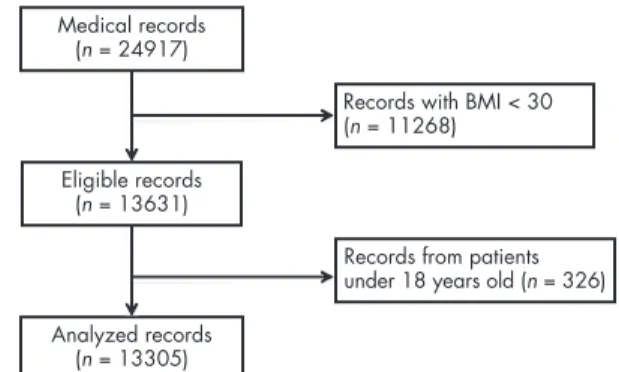
great-er than 40 kg/m2).33 Records from patients younger than 18
years old were excluded from the analysis (figure 1).
Measurements
The medical assessment was integrated by: a) standardised clinical interview, b) point of care glucose testing, c) blood pressure (diastolic and systolic in mm/Hg), and d) anthro-pometric measurements including: waist circumference (in
Figure 1. Medical records flowchart. Analyzed records
(n = 13305) Medical records
(n = 24917)
Eligible records (n = 13631)
centimeters), height (in centimeters), weight (in kilograms) and BMI (in kg/cm2). Diabetes II, hypertension and
dyslip-idemia cases were taken as stated in the patient’s medical record.
To assess psychiatric symptoms and substance use, the standardised clinical interview used the following ques-tions: depression symptoms “In the past 30 days have you
felt significantly sad or depressed?”; anxiety symptoms “In
the past 30 days have you felt significantly anxious or ner
-vous?”; suicide attempt “In the past year have you made
any suicide attempts?”; daily smoking “In the past year
have you been smoking at least one cigarette per day?”; al-cohol use “In the past year have you been drinking at least
once per week?”; drug use “in the past year have you used
any drug at least once?”.
Procedures
The database was conformed from a community preven-tion and treatment program for obesity and weight loss sponsored by public institutions in 22 sites across Mexico City, the State of Mexico, Morelos, and Puebla. This com-munity treatment program aimed to provide free medical care to individuals seeking treatment for weight loss. As a part of the procedures the physicians performed medi-cal assessments and requested consent to use the patients’ data for research. All physicians who participated in the
medical assessment were certified in obesity and weight
loss treatment.
Ethical considerations
Patients signed a written informed consent approving the use of their data for research purposes. A technical and eth-ical academic committee approved all procedures for this
data analysis and to preserve confidentiality, the identifica
-tion and localisa-tion data of the patients wee de-identified
in compliance with Mexican research regulations (NOM-012-SSA3-2012), and international standards of good clinical practices for human research.
Statistical analysis
Demographic, medical and psychiatric variables were sum-marised using mean and standard deviation for numeric, frequencies and percentages for categorical variables. Uni-variate differences between three obesity classes were tested using one way ANOVA for numerical and chi square (χ2) for
categorical variables. A second step to test associations be-tween obesity, demographics, medical and psychiatric vari-ables was to perform univariate binomial logistic, then two-way interactions between obesity classes and demographic variables were tested for psychiatric variables, and two-way interactions between obesity classes, psychiatric and demo-graphic variables were tested for medical variables. When
two or more two-way interactions were significant,
three-way interactions between the variables were tested. Statis-tical analyses were performed using R software v 3.2.3.
Sig-nificance was set to p < .05.
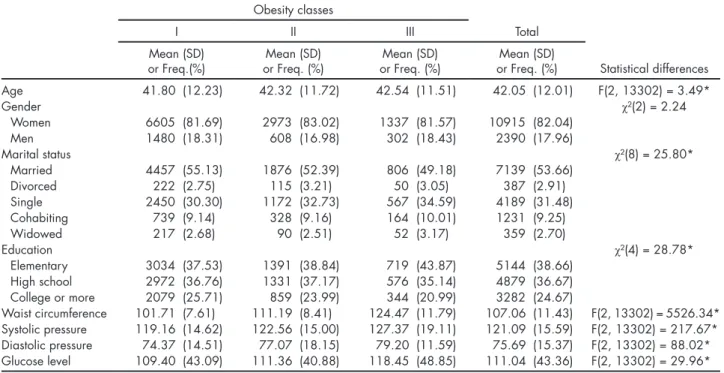
Table 1. Patients characteristics (n = 13305)
Obesity classes
I II III Total
Mean (SD)
or Freq.(%) or Freq. (%)Mean (SD) or Freq. (%)Mean (SD) or Freq. (%)Mean (SD) Statistical differences Age 41.80 (12.23) 42.32 (11.72) 42.54 (11.51) 42.05 (12.01) F(2, 13302) = 3.49*
Gender χ²(2) = 2.24
Women 6605 (81.69) 2973 (83.02) 1337 (81.57) 10915 (82.04)
Men 1480 (18.31) 608 (16.98) 302 (18.43) 2390 (17.96)
Marital status χ²(8) = 25.80*
Married 4457 (55.13) 1876 (52.39) 806 (49.18) 7139 (53.66)
Divorced 222 (2.75) 115 (3.21) 50 (3.05) 387 (2.91)
Single 2450 (30.30) 1172 (32.73) 567 (34.59) 4189 (31.48)
Cohabiting 739 (9.14) 328 (9.16) 164 (10.01) 1231 (9.25)
Widowed 217 (2.68) 90 (2.51) 52 (3.17) 359 (2.70)
Education χ²(4) = 28.78*
Elementary 3034 (37.53) 1391 (38.84) 719 (43.87) 5144 (38.66) High school 2972 (36.76) 1331 (37.17) 576 (35.14) 4879 (36.67) College or more 2079 (25.71) 859 (23.99) 344 (20.99) 3282 (24.67)
RESULTS
A total sample of 13,305 patients (records) met eligibility criteria, with a mean age of 42 (SD = 12) years old, and most of them were women, married, and with elementary or high school education. Mean BMI (SD) for obesity classes I, II and III were: 32.19 (1.41), 37.00 (1.40), and 43.97 (3.83) re-spectively; while in the whole sample mean BMI was 34.94
(SD = 4.39). Between groups (obesity class) significant dif -ferences were found in age, marital status, education, waist circumference, diastolic and systolic blood pressure, and glucose level (table 1).
Regarding the prevalence of psychiatric and other medical conditions, the most prevalent were: anxiety and depressive
symptoms, dyslipidemia, and hypertension. Significant differ -ences were found between groups for anxiety and depressive symptoms, alcohol use, diabetes, and hypertension (table 2).
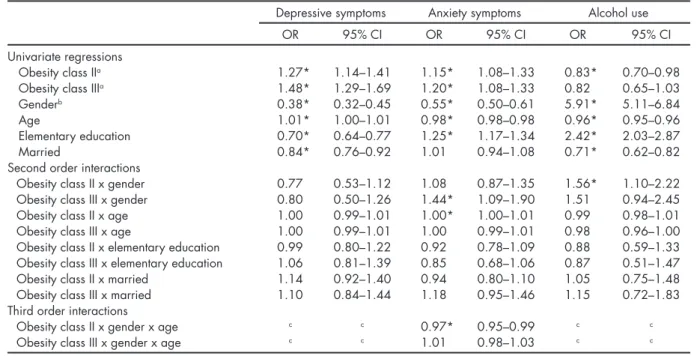
When univariate predictors were added, most of the
demographic and obesity classes were significant, exclud -ing the association between obesity class III and alcohol use.
The only significant second order interactions for anxiety
symptoms were obesity class III by gender and obesity class II by age, while for alcohol use obesity class II by gender
interaction was significant (table 3). Table 2. Psychiatric and other medical comorbidities (n = 13305)
Obesity classes
I II III Total
Freq. (%) Freq. (%) Freq. (%) Freq. (%) Statistical differences Depressive symptoms 1195 (14.78) 647 (18.07) 335 (20.44) 2177 (16.36) χ²(2) = 42.30* Anxiety symptoms 3533 (43.70) 1691 (47.22) 791 (48.26) 6015 (45.21) χ²(2) = 19.46* Suicide attempt 39 (0.48) 20 (0.56) 9 (0.55) 68 (0.51) χ²(2) = 0.33 Tobacco use 1087 (13.44) 501 (13.99) 190 (11.59) 1778 (13.36) χ²(2) = 5.70 Drug use 62 (0.77) 26 (0.73) 16 (0.98) 104 (0.78) χ²(2) = 0.96 Alcohol use 529 (6.54) 198 (5.53) 89 (5.43) 816 (6.13) χ²(2) = 6.03* Diabetes II 574 (7.10) 294 (8.21) 191 (11.65) 1059 (7.96) χ²(2) = 38.99* Dyslipidemia 1802 (22.29) 839 (23.43) 384 (23.43) 3025 (22.74) χ²(2) = 2.35 Hypertension 1012 (12.52) 653 (18.24) 419 (25.56) 2084 (15.66) χ²(2) = 200.14* *p < .05.
Table 3. Regression models for psychiatric symptoms (n = 13305)
Depressive symptoms Anxiety symptoms Alcohol use
OR 95% CI OR 95% CI OR 95% CI
Univariate regressions
Obesity class IIa 1.27* 1.14–1.41 1.15* 1.08–1.33 0.83* 0.70–0.98
Obesity class IIIa 1.48* 1.29–1.69 1.20* 1.08–1.33 0.82 0.65–1.03
Genderb 0.38* 0.32–0.45 0.55* 0.50–0.61 5.91* 5.11–6.84
Age 1.01* 1.00–1.01 0.98* 0.98–0.98 0.96* 0.95–0.96
Elementary education 0.70* 0.64–0.77 1.25* 1.17–1.34 2.42* 2.03–2.87
Married 0.84* 0.76–0.92 1.01 0.94–1.08 0.71* 0.62–0.82
Second order interactions
Obesity class II x gender 0.77 0.53–1.12 1.08 0.87–1.35 1.56* 1.10–2.22 Obesity class III x gender 0.80 0.50–1.26 1.44* 1.09–1.90 1.51 0.94–2.45
Obesity class II x age 1.00 0.99–1.01 1.00* 1.00–1.01 0.99 0.98–1.01
Obesity class III x age 1.00 0.99–1.01 1.00 0.99–1.01 0.98 0.96–1.00
Obesity class II x elementary education 0.99 0.80–1.22 0.92 0.78–1.09 0.88 0.59–1.33 Obesity class III x elementary education 1.06 0.81–1.39 0.85 0.68–1.06 0.87 0.51–1.47 Obesity class II x married 1.14 0.92–1.40 0.94 0.80–1.10 1.05 0.75–1.48 Obesity class III x married 1.10 0.84–1.44 1.18 0.95–1.46 1.15 0.72–1.83 Third order interactions
Obesity class II x gender x age c c 0.97* 0.95–0.99 c c
Obesity class III x gender x age c c 1.01 0.98–1.03 c c
a Obesity class I was the comparison b Comparing men to women c Not estimated
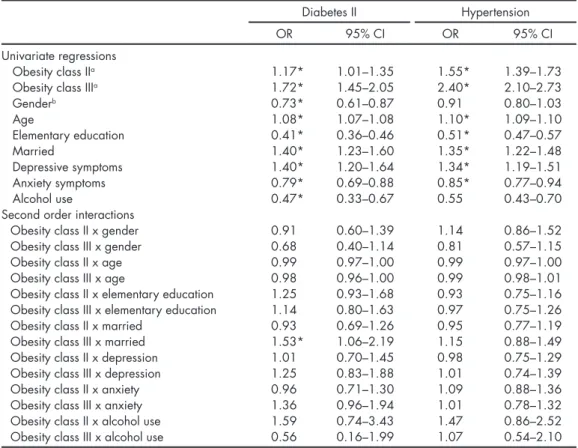
In the logistic regression analysis for medical comor-bidities, obesity class, demographic variables, and
psychiat-ric comorbidities were significant. The only significant sec -ond order interaction was obesity class III by being married for diabetes (table 4).
DISCUSSION AND CONCLUSION
The present study aimed to assess the prevalence of psy-chiatric symptoms and the interactions between obesity and demographic variables, and to determine its association with medical comorbidities in a sample of patients with obe-sity seeking treatment for weight loss.
It was found in univariate analysis that the probability of anxiety and depression symptoms increase as the obesity class increased; however, that relation was found to have an opposite direction with alcohol use. When analyzing second order interactions between demographics and obesity class it was found that men with class III obesity had more prob-ability for anxiety symptoms when compared to men with obesity class I and II; for women with obesity class I, there is a direct relationship between the age and the probability of anxiety symptoms, when compared to women with
obe-sity class II and III. These results are consistent with pre-vious studies,10,13,21,27 suggesting that the increase in BMI is
associated with the probability of depression and anxiety symptoms,13 suggesting that such relationships are
moder-ated by the interaction of gender and age, implying that the effect of obesity in mental health varies across gender and age groups.
Men with obesity class I displayed higher odds for al-cohol use when compared with obesity class II and III. This
finding might support the hypothesis that compulsive eat -ing and substance use compete for the same circuits in the reward system, hence, as one behaviour increases the other is less likely to occur.34,35 The main common factor between
eating and substance use is dopamine release in the me-solimbic pathway, as the eating habits and the rewarding properties of food lead to neuroadaptation of the reward, motivation, and decision-making circuits, resulting in a sub-sequent loss of control and compulsive behaviours. How-ever the opioid, GABAergic, or cannabinoid systems are implicated too.35-38 Previous evidence strongly suggests that
substance use and food compete in the reward system; tak-ing into account that food consumption is much more com-plex, it is plausible that the brain adaptation to overeating is harder compared to substance use.35
Table 4. Regression models for medical comorbidities (n = 13305)
Diabetes II Hypertension
OR 95% CI OR 95% CI
Univariate regressions
Obesity class IIa 1.17* 1.01–1.35 1.55* 1.39–1.73
Obesity class IIIa 1.72* 1.45–2.05 2.40* 2.10–2.73
Genderb 0.73* 0.61–0.87 0.91 0.80–1.03
Age 1.08* 1.07–1.08 1.10* 1.09–1.10
Elementary education 0.41* 0.36–0.46 0.51* 0.47–0.57
Married 1.40* 1.23–1.60 1.35* 1.22–1.48
Depressive symptoms 1.40* 1.20–1.64 1.34* 1.19–1.51
Anxiety symptoms 0.79* 0.69–0.88 0.85* 0.77–0.94
Alcohol use 0.47* 0.33–0.67 0.55 0.43–0.70
Second order interactions
Obesity class II x gender 0.91 0.60–1.39 1.14 0.86–1.52
Obesity class III x gender 0.68 0.40–1.14 0.81 0.57–1.15
Obesity class II x age 0.99 0.97–1.00 0.99 0.97–1.00
Obesity class III x age 0.98 0.96–1.00 0.99 0.98–1.01
Obesity class II x elementary education 1.25 0.93–1.68 0.93 0.75–1.16 Obesity class III x elementary education 1.14 0.80–1.63 0.97 0.75–1.26
Obesity class II x married 0.93 0.69–1.26 0.95 0.77–1.19
Obesity class III x married 1.53* 1.06–2.19 1.15 0.88–1.49 Obesity class II x depression 1.01 0.70–1.45 0.98 0.75–1.29 Obesity class III x depression 1.25 0.83–1.88 1.01 0.74–1.39
Obesity class II x anxiety 0.96 0.71–1.30 1.09 0.88–1.36
Obesity class III x anxiety 1.36 0.96–1.94 1.01 0.78–1.32
Obesity class II x alcohol use 1.59 0.74–3.43 1.47 0.86–2.52 Obesity class III x alcohol use 0.56 0.16–1.99 1.07 0.54–2.10 a Obesity class I was the comparison
b Comparing men to women
The characteristics of the sample are another relevant
finding, as most were women with an age around 42 years
old, with elementary education and married. When we consider global (men 37% and women 38%) and Mexican (men 26.5% and women 37.5%) obesity rates,2 it is clear
that there is an important difference in the rates by gender of individuals seeking treatment for obesity when com-pared to the national and global men to women ratio. This
may point to the existence of gender-specific barriers lim -iting the attendance of men, such as attitudes and beliefs towards health care (underestimating risks, resistance to pain, perception of invulnerability), work hours and socio-economic status;39,40 the age, education, and marital status
of the sample. This implies that there are particular
pro-files of patients using this service, therefore it is necessary
to develop tailored interventions based on these variables; for instance, as the majority of the patients were married and had an elementary education, a weight reduction pro-gram focused on partner and family social support might boost the effects of the intervention.41,42 In terms of
edu-cational level,43-45 is important that the provision of
infor-mation is paired with the patient’s education, otherwise it
might be difficult to initiate behavioural changes. This re
-sult highlights the importance of tailoring specific weight
loss programs, and to develop strategies to increase men’s attendance to treatment.
Future studies should focus on the complex relations between obesity and psychiatric symptoms, particular-ly because weight loss treatment requires dietary and
be-havioural changes, and such lifestyle modifications are significantly affected by psychiatric variables; this becomes clear as we see the findings of previous studies that point
out that anxiety and depression symptoms increase the like-lihood of sedentary lifestyles, eating unhealthy food, and binge eating.15,27
This study had the following limitations: the cross-sec-tional design made it impossible to determine the tempo-ral sequence of the events, and we were unable to identify which psychiatric symptoms preceded obesity. A second limitation is that the measurement of psychiatric symptoms used a single question instead of using a structured inter-view or a validated scale, thereby limiting the internal va-lidity of the results, and implying that future studies will require the use of these measurements. A third limitation is that the method to diagnose hypertension, diabetes II and dyslipidemia is unclear for every patient, resulting in a probable underestimation of their prevalence.
Finally, this is one of the few studies in Mexico using a considerable clinical sample allowing testing of complex interactions between variables. This study also points out important patient characteristics that enable us to under-stand particular requirements needed for tailoring treat-ment. These results highlight that the complexity of the re-lationship between demographics, obesity, and psychiatric
symptoms might be decisive for the outcomes in weight loss treatment;46,47 however, it seems necessary to conduct more
studies using longitudinal designs and assessing other
rele-vant psychiatric disorders, such as attention deficit and hy -peractivity disorder.48 In conclusion, weight loss treatment
programs must take into account the interaction between psychiatric symptoms, gender, and educational level, to boost treatment adherence25,26 and weight reduction, finally
having an impact on the treatment costs and the patient’s quality of life.49
Funding
None.
Conflict of interests
All sites enrolled in this study are part of a community prevention and treatment program for obesity and weight loss funded indi-rectly by the pharmaceutical laboratory PRODUCTOS MEDIX®,
through strategic agreements with public institutions for the imple-mentation of the program.
The authors had no role in the implementation of this treatment program. The authors state that they have signed an agreement with pharmaceutical laboratory PRODUCTOS MEDIX® to
ana-lyze the database. The authors declare that they did not receive any payment or other kind of retribution for writing this academic work. The pharmaceutical laboratory PRODUCTOS MEDIX® had
no role in data analysis, interpretation of results, writing process or the decision to submit this paper for publication. Therefore, the academic opinions presented in this paper are responsibility of the authors.
Acknowledgments
A special acknowledgment to pharmaceutical laboratory PRO-DUCTOS MEDIX® for sharing the clinical database needed to write
this article.
REFERENCES
1. Ng M, Fleming T, Robinson M, Thomson B et al. Global, regional, and national prevalence of overweight and obesity in children and adults during 1980–2013: a systematic analysis for the Global Burden of Disease Study 2013. Lancet 2014;384(9945):766-781. doi:10.1016/S0140-6736(14)60460-8
2. Barquera CS, Nonato CI, Rojas R, Rivera J. Obesidad en México: epi-demiología y políticas de salud para su control y prevención. Gac Méd Mex 2010;146:397-407.
3. De Schutter A, Lavie CJ, Milani RV. The impact of obesity on risk factors and prevalence and prognosis of coronary heart disease—the obesity paradox. Prog Cardiovasc Dis 2014;56(4):401-8. doi:10.1016/j. pcad.2013.08.003
4. Ezzati M, Lopez AD, Rodgers A, Vander Hoorn S et al. Murray CJL. Selected major risk factors and global and regional burden of disease. Lancet. 2002;360(9343):1347-1360. doi:10.1016/S0140-6736(02)11403-6 5. Laditka SB, Laditka JN. Active life expectancy of Americans with
dia-betes: Risks of heart disease, obesity, and inactivity. Diabetes Res Clin Pr 2015;107(1):37-45. doi:10.1016/j.diabres.2014.10.008
an update of the 1997 American Heart Association Scientific State-ment on Obesity and Heart Disease from the Obesity Committee of the Council on Nutrition, Physical Activity Metabolism. Circulation 2006;113(6):898-918. doi: 10.1161/CIRCULATIONAHA.106.171016 7. Freedman DM, Ron E, Ballard-Barbash R, Doody MM et al. Body mass
index and all-cause mortality in a nationwide US cohort. Int J Obesity 2006;30(5):822-829. doi:10.1038/sj.ijo.0803193
8. Olshansky SJ, Passaro DJ, Hershow RC, Layden J et al. A potential de-cline in life expectancy in the United States in the 21st Century. New Engl J Med 2005;352(11):1138-1145. doi: 10.1056/NEJMsr043743 9. Zhang C, Rexrode KM, van Dam RM, Li TY et al. Abdominal obesity
and the risk of all-cause, cardiovascular, and cancer mortality: sixteen years of follow-up in US women. Circulation 2008;117(13):1658-1667. doi: 10.1161/CIRCULATIONAHA.107.739714
10. Jung H, Chang C. Is obesity related to deteriorating mental health of the U.S. working-age population? J Behav Med 2015;38(1):81-90. doi: 10.1007/s10865-014-9580-7
11. Kessler RC, McGonagle KA, Zhao S, Nelson CB et al. Lifetime and 12-month prevalence of DSM-III-R psychiatric disorders in the United States. Results from the National Comorbidity Survey. Arch Gen Psy-chiatry 1994;51(1):8-19. doi:10.1001/archpsyc.1994.03950010008002 12. Stunkard AJ, Faith MS, Allison KC. Depression and obesity. Biol
Psy-chiatry 2003;54(3):330-337. doi:10.1016/S0006-3223(03)00608-5 13. Brumpton B, Langhammer A, Romundstad P, Chen Y et al. The
asso-ciations of anxiety and depression symptoms with weight change and incident obesity: The HUNT Study. Int J Obesity 2013(9):1268-1274. doi:10.1038/ijo.2012.204
14. Gariepy G, Nitka D, Schmitz N. The association between obesity and anxiety disorders in the population: a systematic review and me-ta-analysis. Int J Obesity 2010;34(3):407-419. doi:10.1038/ijo.2009.252 15. Luppino FS, de Wit LM, Bouvy PF, Stijnen T et al. Overweight,
obe-sity, and depression: a systematic review and meta-analysis of longi-tudinal studies. Arch Gen Psychiatry 2010;67(3):220-229. doi:10.1001/ archgenpsychiatry.2010.2.
16. Markowitz S, Friedman MA, Arent SM. Understanding the Rela-tion Between Obesity and Depression: Causal Mechanisms and Implications for Treatment. Clin Psychol-Sci Pr 2008;15(1):1-20.doi: 10.1111/j.1468-2850.2008.00106.x
17. Nigatu YT, Reijneveld SA, de Jonge P, van Rossum E et al. The com-bined effects of obesity, abdominal obesity and major depression/anx-iety on health-related quality of life: the LifeLines Cohort Study. Plos One 2016;11(2):e0148871-e. doi: 10.1371/journal.pone.0148871
18. Scott KM, Bruffaerts R, Simon GE, Alonso J et al. Obesity and mental disorders in the general population: results from the world mental health surveys. Int J Obesity 2008;32(1):192-200. doi:10.1038/ sj.ijo.0803701
19. de Wit LM, Luppino F,van Straten A, Penninx B et al. Depression and obesity: A meta-analysis of community based studies. Psychiatry Res 2010;178(3);230-205. doi:10.1016/j.psychres.2009.04.015
20. Klinitzke G, Steinig J, Blüher M, Kersting A et al. Obesity and suicide risk in adults—A systematic review. J Affect Disorders 2013;145(3):277-284. doi:10.1016/j.jad.2012.07.010
21. Barry D, Petry NM. Associations between body mass index and sub-stance use disorders differ by gender: results from the National Epi-demiologic Survey on Alcohol and Related Conditions. Addict Behav 2009;34(1):51-60. doi:10.1016/j.addbeh.2008.08.008
22. Freedman DM, Sigurdson AJ, Rajaraman P, Doody MM et al. The Mortality Risk of Smoking and Obesity Combined. Am J Prev Med 2006;31(5):355-62. doi:10.1016/j.amepre.2006.07.022
23. Ma J, Jemal A, Flanders WD, Ward EM. Joint association of adi-posity and smoking with mortality among U.S. adults. Prev Med 2013;56(3/4):178-184. doi:10.1016/j.ypmed.2012.12.012
24. Li L, Wu L-T. Substance use after bariatric surgery: A review. J Psychi-atr Res 2016;76:16-29. doi:10.1016/j.jpsychires.2016.01.009
25. Huang H, Russo J, Bauer AM, Chan Y-F et al. Depression care and
treatment in a chronically ill Medicare population. Gen Hosp Psychia-try 2013;35(4):382-386. doi:10.1016/j.genhosppsych.2013.02.006 26. Katon W, Ciechanowski P. Impact of major depression on chronic medical illness. J Psychosom Res 2002;53(4):859-863. doi: 10.1016/
S0022-3999(02)00313-6
27. Faith MS, Matz PE, Jorge MA. Obesity-depression associations in the population. J Psychosom Res 2002;53(4):935-942. doi:10.1016/S0022-3999(02)00308-2
28. Friedman MA, Brownell KD. Psychological correlates of obesity: Moving to the next research generation. Psychol Bull 1995;117(1):3-20. doi: 10.1037/0033-2909.117.1.3
29. Gutiérrez J, Rivera-Dommarco J, Shamah-Levy T, Villalpando-Hernán-dez S et al. Encuesta Nacional de Salud y Nutrición 2012. Resultados Nacionales [National Health and Nutrition Survey 2010]. Cuernavaca, México. 2012.
30. Padilla-Téllez E, Ruiz García J, Rodríguez-Orozco AR. Asociación depresión-obesidad. Salud Publica Mexico 2009;51(4):275-276. doi: 10.1590/S0036-36342009000400001
31. Lazarevich I, Irigoyen-Camacho ME, Velázquez-Alva MC. Obesity, eating behaviour and mental health among university students in Mex-ico city. Nutr Hosp 2013;28(6):1892-1899. doi: 10.3305/nh.2013.28.6.6873 32. Worster A, Haines T. Advanced statistics: understanding medical re-cord review (MRR) studies. Acad Emerg Med 2004;11(2):187-192. doi: 10.1111/j.1553-2712.2004.tb01433.x
33. World Health Organization. Obesity and overweight [Fact sheet N°311]. 2015 [cited 2015 10/03]. Available from: http://www.who.int/ mediacentre/factsheets/fs311/en/.
34. Simansky KJ. NIH symposium series: Ingestive mechanisms in obe-sity, substance abuse and mental disorders. Physiol Behav 2005;86(1– 2):1-4. doi:10.1016/j.physbeh.2005.06.016
35. Volkow ND, Wise RA. How can drug addiction help us understand obesity? Nat Neurosci 2005(5):555-560. doi:10.1038/nn1452
36. Wang G-J, Volkow ND, Logan J, Pappas NR et al. Brain dopamine and obesity. Lancet 2001;357(9253):354-357. doi:10.1016/S0140-6736(00)03643-6 37. Wang G-J, Volkow ND, Telang F, Jayne M et al. Exposure to appe-titive food stimuli markedly activates the human brain. Neuroimage 2004;21(4):1790-1797. doi:10.1016/j.neuroimage.2003.11.026
38. Volkow ND, Fowler JS, Wang G-J. The addicted human brain: insights from imaging studies. J Clin Invest 2003;111(10):1444-1451. doi:10.1172/ JCI18533.
39. Gough B, Conner MT. Barriers to healthy eating amongst men: a qualitative analysis. Soc Sci Med 2006;62(2):387-395. doi:10.1016/j. socscimed.2005.05.032
40. Galdas PM, Cheater F, Marshall P. Men and health help-seeking behaviour: literature review. J Adv Nurs 2005;49(6):616-623. doi: 10.1111/j.1365-2648.2004.03331.x
41. Kiernan M, Moore SD, Schoffman DE, Lee K et al. Social support for healthy behaviors: scale psychometrics and prediction of weight loss among women in a behavioral program. Obesity 2012;20(4):756-764. doi: 10.1038/oby.2011.293
42. The Look AHEAD Research Group. The Look AHEAD Study: A De-scription of the lifestyle intervention and the evidence supporting it. Obesity 2006;14(5):737-752.doi: 10.1038/oby.2006.84
43. Moroshko I, Brennan L, O’Brien P. Predictors of dropout in weight loss interventions: a systematic review of the literature. Obes Rev 2011;12(11):912-934. doi: 10.1111/j.1467-789X.2011.00915.x
44. Bradshaw AJ, Horwath CC, Katzer L, Gray A. Non-dieting group in-terventions for overweight and obese women: what predicts non-com-pletion and does comnon-com-pletion improve outcomes? Public Health Nutr 2010;13(10):1622-1628.doi: 10.1017/S1368980009992977
45. Elfhag K, Rössner S. Initial weight loss is the best predictor for success in obesity treatment and sociodemographic liabilities increase risk for drop-out. Patient Educ Couns 2010;79(3):361-366. doi:10.1016/j.pec.2010.02.006 46. Ogden J. The correlates of long-term weight loss: a group comparison
47. Jerome GJ, Myers VH, Young DR, Matthews-Ewald MR et al. Psy-chosocial predictors of weight loss by race and sex. Clin Obesity 2015(6):342-348. doi: 10.1111/cob.12120
48. Cortese S, Moreira-Maia CR, St. Fleur D, Morcillo-Peñalver C et al. Association between ADHD and obesity: a systematic review and meta-analysis. Am J Psychiat 2016;173(1):34-43. doi: 10.1176/appi. ajp.2015.15020266