Artículo original
Relationship between human
development and drug use.
Human development index and drug use
Fernando Salazar Silva,
1Jorge Ameth Villatoro Velázquez,
2Natania Froylan Oliva Robles,
2Marya Hynes,
3Maria de Marco
3SUMMARY
Human Development Index is currently considered a reference indica-tor to account for the social and economic situation experienced by countries.
Method
This study was conducted using the database from the study “Guiding Elements for Public Policies on Drugs in the Subregion -First Compara-tive Study on Drug Use and Associated Factors in Population of 15 to 64 years”, held in Uruguay, Bolivia, Chile, Perú, Ecuador and Argen-tina. Target was urban population, from both sexes and of 12 to 65 years. Samples were stratified, three-staged and probabilistic. Sample sizes were theoretical with the inclusion of a non-response rate.
Results
Prevalence of drug consumption during last year and last month pri-or to the survey is higher in countries with high HDI compared with medium HDI countries. Lifetime prevalence of alcohol consumption is higher in countries with medium HDI compared with those with high HDI. There is less consumption in lifetime prevalence of legal drugs of countries with higher human development index and an equal rate of cigarette consumption.
Discussion
High development index implies that the inhabitants of a country have a long and healthy life, more access to knowledge and a decent stan-dard of living. Population with a favorable view on these indicators are not only exposed, but they are also active drug users. The higher the index of human development is, the higher the drug consumption rates are, which indicate that although the human development index can reflect material or economic improvements, it is not necessarily traduced in the human value of the people or society and does not assure quality of life or well-being.
Key words: Human development index, drug use, Latin America.
RESUMEN
El Índice de Desarrollo Humano (IDH) es un indicador de referencia para explicar la situación social y económica de un país.
Método
Este estudio se realizó con la base de datos del estudio “Elementos Orientadores para las Políticas Públicas sobre Drogas en la Subregión - Primer Estudio Comparativo sobre Consumo de Drogas y Factores Asociados en Población de 15 a 64 Años”. La población objetivo fue urbana, de ambos sexos y de entre 12 y 65 años. Las muestras fueron estratificadas, trietápicas y probabilísticas. Se estimaron tamaños de muestras teóricos, incluyendo una tasa de no respuesta.
Resultados
La prevalencia de consumo de drogas en el último año y en el mes pre-vio al estudio es mayor en los países con IDH alto en comparación con los países con IDH medio. La prevalencia de consumo de alcohol algu-na vez en la vida es mayor en los países con IDH medio comparados con aquellos que tienen un IDH alto. En cuanto a las drogas legales, los países con un IDH alto presentan menores prevalencias alguna vez en la vida, situación similar cuando se considera el consumo de tabaco.
Discusión
Un IDH alto implica que los habitantes de un país tienen una vida larga y saludable, mayor acceso a la educación y un estándar de vida satisfactorio. La población con una puntuación favorable en es-tos indicadores no sólo está expuesta al consumo de drogas, sino que también es usuaria activa de éstas. Cuanto mayor Índice de Desarro-llo Humano, mayor es la prevalencia de consumo de drogas, lo que indica que si bien el índice de desarrollo humano refleja mejoras en la economía o bienes materiales, no necesariamente se traduce en valores humanos para la persona o la sociedad y no garantizan una buena calidad de vida o el bienestar.
Palabras clave: Índice de Desarrollo Humano, uso de drogas, Latinoamérica.
1 Universidad Peruana Cayetano Heredia.
2 Instituto Nacional de Psiquiatría Ramón de la Fuente Muñiz, Mexico. 3 Inter-American Drug Abuse Control Comission.
Correspondence: Doctor Fernando Salazar Silva. Facultad de Salud Pública y Administración de la Universidad Peruana Cayetano Heredia. Av. Honorio Delgado 430, Lima 31, Perú. E-mail: [email protected]
INTRODUCTION
Human development is a process which seeks to expand opportunities of human beings1 to create an environment
of possibilities in which people can live long, healthy, and creative lives.2 Based on the development model, Mahbub
ul Haq layed out the basis to evaluate human development in all countries.3 The basic idea was raised on the argument
that economic growth alone does not ensure a better quality of life3 and that people are the true wealth of a nation.2 In
this context, the United Nations have spent nearly twenty years carrying out empirical measurements of human de-velopment in different countries in the Latin American re-gion.
The Human Development Index (HDI) is currently con-sidered a reference indicator to account for the social and economic situation of countries. The HDI includes three cri-teria: a long and healthy life assessed by life expectancy at birth, access to knowledge currently measured by calculat-ing the adult literacy rate combined with the total school enrollment ratio in primary, secondary and tertiary educa-tion, and a dignified living standard measured by the gross domestic product (GDP) per capita, expressed through the purchasing power parity (PPP) in dollars.4
Development achievements in countries of the region are annually monitored and they explain a part of the social phenomena that affects the reference population. Thereby, a country with low HDI of less than 0.5 is probably affected by poverty and illiteracy, which generate inadequate health con-ditions or exposure to certain risk factors. In contrast, it is pos-sible that countries with high HDI of 0.8 or more are exposed to certain risk factors related to wealth or economic access.
However, different human development reports state that material wealth is not a synonym of good quality of life. “The development can be understood as a process of expanding the real freedoms people enjoy”,5 but these
free-doms can be misunderstood causing major risk factors, which is typical of large cities in development.
In the twenty-first century, concerns about national se-curity, armed conflicts, terrorism, weapon sales, and drug trafficking6 overwhelm many nations because they are
ac-companied by corruption, violence, and drug consumption. The United Nations Office on Drugs and Crime (UNO-DC) says that commercial transactions revolving around drugs are evident in “urban settings controlled by criminal groups”, and that this problematic will worsen in megacities because the issue of drugs is human and not economic. Usu-ally, addicts are not engendered in marginal areas but rather in mainstream populations that also give rise to mafias.6
Currently, large cities are a reflection of the economic and social growth of a region, where the availability of drugs and violence rates are increasing. One survey found that in eight Latin American countries, excepting Perú, people per-ceived that drug use was increasing; Venezuela and Chile
are highlighted in these findings.7 Coincidentally, Chile and
Venezuela are among the countries of the region that are considered to have high human development indexes ac-cording to the HDI2 ranking. At the same time, Chile is also
the country with the highest rate of cannabis consumption of the region in high school population (12.7%), and has the second highest rate of ecstasy use (1.6%).6
When comparing drug consumption in different coun-tries according to their HDI, apparently there is a correla-tion between drug use prevalence and development. For example, Paraguay and Bolivia, placed in positions 91 and 115 of the HDI ranking, report cocaine, cannabis and ecstasy use rates below the ones from Colombia and Perú, located in positions 70 and 82 in the same report.2,6
The link between HDI and drug use has not been stud-ied thoroughly. The present article aims to examine the re-lationship between HDI and drug use in six Latin American countries. Recognizing this relationship will contribute to a better understanding of the social and economic factors at play in drug use in the Latin American region. We expect this information will help guide political efforts and may provide the basis to develop improved indicators for ad-dressing the drug problem in our region.
MATERIAL AND METHODS
This study was conducted using the database obtained from the study “Guiding Elements for Public Policies on Drugs in the Subregion -First Comparative Study on Drug Use and Associated Factors in Population of 15 to 64 years”,8
carried out in Uruguay, Bolivia, Chile, Perú, Ecuador, and Argentina. In this study, target was male and female urban population, from 12 to 65 years old. Seventy percent of the population consisted of urban settlements and cities. The sample from Uruguay included localities of 10 000 inhabit-ants or more, Bolivia and Chile samples included localities of 30 000 and above inhabitants (excepting, Aysen in Chile), Perú localities were of 20 000 or more inhabitants, Ecuador 50 000 and more inhabitants and the locations of the East Region included localities of 24 000 and more inhabitants, Argentina included localities of 80 000 or more inhabitants, including two provincial capitals of smaller size.
In all countries the sample was stratified, three-staged and probabilistic. Sample sizes were theoretical with the ad-ditional inclusion of a non-response rate (table 1).
The countries were grouped in medium level: Bolivia, Ecuador and Perú, with HDI between 0.5 and 0.8, and high level: Argentina, Chile and Uruguay, with HDI higher than 0.8. Logistic regressions considering the sample design and controlled by age and sex were used to assess the association between lifetime, last year and last month drug prevalence.
phase because it already had a standardized questionnaire. All applications were conducted by people trained for the task, and only Chile included the possibility to answer the drug consumption section in a self-administered way but this modality was chosen by no more than 6% of respon-dents in that country. Each country was able to add modules to the questionnaire according to their specific needs, while maintaining a common and comparable core questionnaire.
RESULTS
Table 2 shows that prevalence of drug consumption during the month prior to the survey is higher in countries with high HDI compared with medium HDI countries. The same situation occurs with the prevalence of drug consumption in the last year shown in table 3.
Table 4 shows that lifetime prevalence of alcohol con-sumption is higher in countries with medium HDI com-pared to those with high HDI, but in all of the other drugs, lifetime prevalence is higher in countries with high HDI compared to the ones with medium HDI.
To evaluate the effect of HDI with drug use, several lo-gistic regressions were performed, taking into account the sample design and controlled by age and sex. Tables 5 and 6 show that consumption in the last month and last year is higher in countries with a high level of human development
compared with the ones that have medium human devel-opment index, excepting cocaine paste in which there is no difference between both groups of countries.
Table 1. Size of sample and population of 12 to 65 years represented by country
Theoric Effective Represented
Country Samplea Sampleb Population
Argentina 19,084 13,493 17,376,574
Bolivia 14,166 9,533 3,254,256
Chile 23,796 17,192 8,876,262
Ecuador 10,610 7,954 4,494,119
Peru 12,884 11,825 11,318,495
Uruguay 22,000 7,000 1,602,844
Total 102,540 66,997 46,992,550
a Theoric Sample = Homes to be visited.
b Effective Sample = Effective number of surveys made.
Source: First Comparative Study on Drug Consumption and Associated Factors Among the General Population of (15-64 Years Old).
Table 2. Drug use last month prevalence according to Human Deve-lopment Index. 2009
Human Development Index
High Medium
CI 95% CI 95%
Drug Average Sup.Lim. Inf.Lim. Average Sup.Lim. Inf.Lim. Alcohol 50.44 49.94 50.95 33.41 32.87 33.95 Cigarettes 35.31 34.83 35.79 18.35 17.91 18.80 Marijuana 3.18 3.00 3.36 0.38 0.31 0.46 Cocaine 0.83 0.74 0.92 0.11 0.07 0.15 Cocaine paste 0.19 0.14 0.23 0.09 0.05 0.12
Table 3. Drug use last month prevalence according to Human Deve-lopment Index. 2009
Human Development Index
High Medium
CI 95% CI 95%
Drug Average Sup.Lim. Inf.Lim. Average Sup.Lim. Inf.Lim. Alcohol 65.56 65.08 66.04 58.06 57.49 58.62 Cigarettes 39.45 38.95 39.94 29.64 29.12 30.16 Marijuana 5.38 5.15 5.61 0.89 0.78 0.99 Cocaine 1.55 1.42 1.67 0.25 0.19 0.30 Cocaine paste 0.44 0.37 0.51 0.17 0.12 0.21
Table 4. Drug use lifetime prevalence according to Human Develop-ment Index. 2009
Human Development Index
High Medium
CI 95% CI 95%
Drug Average Sup.Lim. Inf.Lim. Average Sup.Lim. Inf.Lim. Alcohol 78.19 77.77 78.60 79.82 79.36 80.28 Cigarettes 58.79 58.30 59.29 53.41 52.84 53.98 Marijuana 16.39 16.01 16.76 4.82 4.57 5.06 Cocaine 5.35 5.12 5.58 1.78 1.62 1.93 Cocaine paste 1.65 1.52 1.78 1.04 0.92 1.16
Table 5. Association between drug use, last month prevalence and Human Development Index. 2009
Last month
consumption of:** OR* p CI 95%
Alcohol 1.26 0.000 1.20 1.33
Cigarettes 1.34 0.000 1.26 1.42
Marijuana 11.33 0.000 8.58 14.96
Cocaine 7.31 0.000 4.33 12.36
Cocaine paste 1.86 0.072 0.95 3.67 Any illegal drug 5.04 0.000 3.21 7.91
* Reference group was the one with medium level of human development index. ** A logistic regression controlled by age and sex was made for each one of the drugs.
Table 6. Association between drug use, last year prevalence and Human Development Index. 2009
Last year
prevalence of:** OR* p CI 95%
Alcohol 1.26 0.000 1.20 1.33
Cigarettes 1.34 0.000 1.26 1.42
Marijuana 6.17 0.000 3.43 11.10
Cocaine 7.25 0.000 5.08 10.35
Cocaine paste 1.90 0.008 1.18 3.04
Any illegal drug 5.04 0.000 3.21 7.91
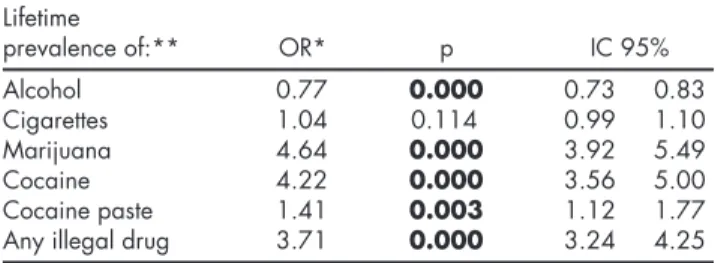
Table 7 shows the same trend with the exception that, in relation to legal drugs, there is less lifetime prevalence consumption in countries with higher human development index and an equal rate of cigarette consumption.
DISCUSSION
As countries develop and social economic power increases, governments face new social and public health challenges. Over the past few decades, many Latin American countries have gone through a continuous period of development and improved their socio-economic conditions.9 Although
ideally all aspects of development should move forward together, reality shows this process is gradual and uneven, resulting in public health issues that the sociopolitical framework may be unprepared to address. Just as a rise in economic means may translate into issues such as obesity due to increased access to food,10 increased wealth may
re-sult in greater access to drugs, posing risk for a potential drug epidemic in countries where drug use was previously low and not considered a priority.
According to World Bank reports,11 Latin America is a
region composed by countries with low, middle, and up-per middle incomes based on their gross domestic product (GDP). In 2006, when the information of this article was gathered, Chile, Argentina, and Uruguay were considered countries with high HDI; while Perú, Bolivia, and Ecuador, were considered countries with medium HDI.2 These
dif-ferences may explain, to some extent, rising public health issues such as drug use. Difference in drug use prevalence is notable between high and middle HDI countries, as shown on the results of this study. The average prevalence of licit or illicit drugs consumption is higher in countries with high HDI, and lower in countries with medium HDI.
A possible issue at play may be increased longevity. As humans mature they may experience demands, challenges, and frustrations that generate stress, peer pressure or other factors that influence drug use choices. An Epidemiological Survey on Alcohol and Related Conditions (NESARC) con-ducted in 2001-2002 found that 70% of young adults in the
United States (approximately 19 million people) consumed alcohol in the year preceding the study.12 In 2008, the
Na-tional Institute on Alcohol Abuse and Alcoholism (NIAAA) warned that people born in recent years tend to drink more than older generations and that adding the fact that they live longer, a continued increased in alcohol consumption rates within populations may be expected.13
The social fabric of a country shaped by the trust be-tween social actors, their behaviors and norms, also plays an important role in drug use.14 If this social fabric is corrupt,
vi-olent, and unsafe, the well-being of the population is endan-gered.15 The social fabric surrounding drug use is frequently
characterized by delinquency, corruption, social and politic violence.7 These factors make it difficult for countries to
ef-fectively intervene on rising drug epidemics. For example, Argentina, with the highest HDI in Latin America, is a coun-try with one of the highest drug use prevalences in the region and a growing market for illegal drugs. This high drug use combined with inadequate political infrastructure and add-ing institutional gaps lead to the difficulty of effectively im-plementing a comprehensive public health policy on drugs.16
A possible explanation for higher drug use prevalence rates in high HDI countries might be related to perceived access to drugs, which has also been shown to play a role as a predictor of drug consumption.17 The three high HDI
countries, Argentina, Chile and Uruguay, are known drug transit areas* in contrast to middle HDI countries, Bolivia, Colombia and Perú, which are known to be drug-producing countries. Remarkably, a perceived access to drugs is higher in Argentina, Chile and Uruguay such as the prevalences of drug use are. It is difficult to argue that drug producing countries have fewer drugs available than transit countries. Nevertheless, countries with lower HDI like Colombia and Perú have both low consumption rates and low perception of access to drugs. The discriminating factor in both groups of countries is the HDI. Our data support the idea that per-ception of access correlates with HDI, which in turn may act as another potential predictor of drug use.
Wealth may play a role in drug consumption through an increased purchasing power of the citizens of countries with high HDI. According to Dreyfus, “criminal activities are structured around the demand of illegal products in the wealthier regions of the world, which is the case of drug traf-ficking”.20 This is reasonable given that once basic needs are
covered surplus money can be spent on non-essential items or activities such as drugs. On the other hand, countries with medium HDI have lower purchasing power that limits their expenses to basic/immediate priorities. In Perú, for exam-ple, nearly 50% of the population is below the poverty line.
Table 7. Association between drug use lifetime prevalence and Hu-man Development Index. 2009
Lifetime
prevalence of:** OR* p IC 95%
Alcohol 0.77 0.000 0.73 0.83
Cigarettes 1.04 0.114 0.99 1.10
Marijuana 4.64 0.000 3.92 5.49
Cocaine 4.22 0.000 3.56 5.00
Cocaine paste 1.41 0.003 1.12 1.77
Any illegal drug 3.71 0.000 3.24 4.25
* Reference group was the one with medium level of human development index. ** A logistic regression controlled by age and sex was made for each one of the drugs.
* The report from March 2008 of the International Narcotics Control Strategy (INCSR) from United States Department18 characterized Chile as a drug transit
The same is for 62.7% of the population in Bolivia, where nearly a quarter of the population lives on a dollar daily and 16% of the population does not reach 40 years of age.2 In this
context, drug demand may be associated with purchasing power, a situation that is evidenced by the 15% prevalence of past month tobacco consumption in lagging countries with high HDI.
Although good for society as a whole, high HDI may have negative consequences, which must always be taken into account when approaching public health policy. Wheth-er such consequences outweigh the ovWheth-erall gains of devel-opment, each society will have to examine on their own. However, we must not ignore the potential social problems that may accompany development as society transitions. Developing countries, with increased access to economic opportunity, are at higher risk of gestating drug epidemics than countries that have experienced less development or less wealth increase. The present paper does not imply that HDI is the cause of drug consumption but rather that the HDI might be an indicator for potential drug use. Given the developmental process that most countries in the region are experiencing, drug consumption has become a public health priority that demands active intervention.21
ACKNOwLEDgEMENTS
The National Drug Commissions of: Argentina - Secretaría de Pro-gramación para la Prevención de la Drogadicción y la Lucha contra el Narcotráfico (SEDRONAR). Bolivia - Consejo Nacional de Lucha Contra el Tráfico Ilícito de Drogas (CONALTID). Chile - Consejo Nacional para el Control de Estupefacientes (CONACE). Ecuador - Consejo Nacional de Control de Sustancias Estupefacientes y Psi-cotrópicos (CONSEP). Perú - Comisión Nacional para el Desarrollo y Vida sin Drogas (DEVIDA). Uruguay - Junta Nacional de Drogas (JND). The United Nations Office on Drugs and Crime (UNODC). The Inter-American Drug Abuse Control Commission (CICAD/ OAS) and the Inter-American Observatory on Drugs (OID). The Red Latinoamericana de Investigadores en Drogas (REDLA).
REFERENCES
1. Programa de las Naciones Unidas para el Desarrollo. Informe sobre desarrollo humano 1990. Primera edición. Bogotá: Tercer Mundo Edi-tores; 1990.
2. Programa de las Naciones Unidas para el Desarrollo [PNUD]. Informe sobre desarrollo humano 2006. Barcelona: Aedos; 2206.
3. ul Haq M. Reflections on human development. New York and Oxford: Oxford University Press; 1995.
4. Programa de las Naciones Unidas para el Desarrollo [PNUD]. Human De-velopment Indices. A statistical update 2008. New York: Green Ink; 2008. 5. Sen A. Development as freedom. Oxford: Oxford University Press; 1999. 6. Oficina de las Naciones Unidas contra las Drogas y el Delito [ONUDD].
Informe Mundial Sobre Drogas 2009; s.f.
7. Hopenhayn M. Droga y violencia: Fantasmas de la nueva metrópoli latinoaméricana. Polis, Revista Académica Universidad Bolivariana 2002;1(3):1-7.
8. ONUDD, la Comisión Interamericana para el Control del Abuso de Drogas (CICAD/OEA), la Secretaría de Programación para la Preven -ción de la Drogadic-ción y la Lucha contra el Narcotráfico (SEDRO -NAR), el Consejo Nacional de Control de Estupefacientes (CONACE), Viceministerio de Defensa Social, Secretaría Técnica (CONALTID), el Consejo Nacional de Control de Sustancias Estupefacientes y Psicotró -picas (CONSEP), la Comisión Nacional para el Desarrollo y Vida Sin Drogas (DEVIDA) y la Junta Nacional de Drogas (JND). Elementos orientadores para las políticas públicas sobre drogas en la subregión -Primer estudio comparativo sobre consumo de drogas y factores aso -ciados en población de 15 a 64 años. Oficina contra la Droga y el Delito. Primera edición. Lima Perú: Tetis Graf; 2008.
9. Bulmer-Thomas V. The economic history of Latin America since inde -pendence. Cambridge: Cambridge University Press; 2003.
10. Miranda JJ, Kinra S, Casas JP, Davey G et al. Non-communicable di -seases in low- and middle-income countries: context, determinants, and health policy. Trop Med Int Health 2008;13(10):1225-1234. 11. The World Bank: Europa technologies recovered on March 2010, from
http://geo.worldbank.org/.
12. National Institutes of Health. Young adult drinking. Alcohol alert 2006. Recovered on April 2006 from http://pubs.niaaa.nih.gov/publica -tions/aa68/aa68.htm.
13. National Institutes of Health. Senior adults and alcohol: A National Health Issue. Alcohol alert. Recovered on January 2008 from http:// pubs.niaaa.nih.gov/publications/AA74/AA74.pdf.
14. Putnam RD. Bowling alone: America’s Declining Social Capital. J De -mocracy, 1995;6(1):65-78.
15. Kliksberg B. Más ética, más desarrollo. Buenos Aires: Temas Grupo Editorial SRL; 2004.
16. Sain MF. El fracaso del control de las drogas ilegales en Argentina. 2009. Recoverd on March 2010, from http://www.nuso.org/upload/arti -culos/3626_1.pdf.
17. Lejckova P, Csemy L. Risk perception and attitudes of young people towards drug use. Adiktologie 2005;5(1):34-48.
18. Bureau of International Narcotics and Law Enforcement Affairs. In -ternational Narcotics Control Strategy Report. Washington: United States Department of State; 2008.
19. Erghougassian KD. El crimen organizado. En: El Cono Sur. Un mapeo de los flujos de las transacciones ilícitas en Argentina, Uruguay, Para -guay y Chile. Buenos Aires: OAS; 2008.
20. Dreyfus P. Vino viejo en odres todavía más viejos: Tendencias regio -nales del Crimen organizado en Latinoamerica en la primera década del siglo XXI y más allá. Anuario 2009 de la Seguridad regional en América Latina y el Caribe. Bogotá: Gente nueva; 2009.
21. United Nations Office on Drugs and Crime [UNODC]. World drug re -port 2009. New York: United Nations; 2009.