Recommendations for the Regionalizing of
Coffee Cultivation in Colombia: A
Methodological Proposal Based on
Agro-Climatic Indices
Juan Carlos Garcı´a L.1,2*, Hu´ver Posada-Sua´rez3, Peter La¨derach4
1.Production and Productivity Program, National Center for Coffee Research (CENICAFE´ ), Manizales, Colombia,2.Agricultural Sciences Faculty, Universidad de Caldas, Manizales, Colombia,3.Technical Division, National Federation of Coffee Growers of Colombia (FNC), Santafe´ de Bogota´, Colombia,4.
Decision and Policy Analysis (DAPA), International Center for Tropical Agriculture (CIAT), Cali, Colombia *[email protected]
Abstract
The Colombian National Federation of Coffee Growers (FNC) conducted an agro-ecological zoning study based on climate, soil, and terrain of the Colombian coffee-growing regions (CCGR) located in the tropics, between 1˚and 11.5˚N, in areas of complex topography. To support this study, a climate baseline was constructed at a spatial resolution of 5 km. Twenty-one bioclimatic indicators were drawn from this baseline data and from yield data for different coffee genotypes evaluated under conditions at eight experimental stations (ESs) belonging to the National Center for Coffee Research (CENICAFE´ ). Three topographic indicators were obtained from a digital elevation model (DEM). Zoning at a national level resulted in the
differentiation of 12 agro-climatic zones. Altitude notably influenced zone differentiation, however other factors such as large air currents, low-pressure atmospheric systems, valleys of the great rivers, and physiography also played an important role. The strategy of zoning according to coffee-growing conditions will enable areas with the greatest potential for the development of coffee cultivation to be identified, criteria for future research to be generated, and the level of technology implementation to be assessed.
Introduction
Coffee is one of the most important commodities in the international agricultural market and a source of income for many countries in Asia, Africa and Latin OPEN ACCESS
Citation:Garcı´a L. JC, Posada-Sua´rez H, La¨derach P (2014) Recommendations for the Regionalizing of Coffee Cultivation in Colombia: A Methodological Proposal Based on Agro-Climatic Indices. PLoS ONE 9(12): e113510. doi:10.1371/ journal.pone.0113510
Editor:Dafeng Hui, Tennessee State University, United States of America
Received:December 19, 2013
Accepted:October 28, 2014
Published:December 1, 2014
Copyright:ß2014 Garcı´a L. et al. This is an open-access article distributed under the terms of theCreative Commons Attribution License, which permits unrestricted use, distribution, and repro-duction in any medium, provided the original author and source are credited.
Funding:The Colombian National Federation of Coffee Growers (FNC, its Spanish acronym) funded Juan Carlos Garcı´a L.’s doctoral program. The FNC provided the information used in the development of the thesis, as research outcome data, the coffee weather information network, and the coffee information system (SICAH, its Spanish acronym), which is related to the characterization of coffee farms. The base information used by Juan Carlos Garcı´a L. as part of his doctoral thesis was restricted to the scope thereof and the results generated from this will be public, with priority use for the Colombian coffee growers. The salary of researchers Hu´ver Posada and Juan Carlos Garcı´a L. is in charge of the FNC. The salary of Peter Laderach and the logistics of the seven months internship conducted by Juan Carlos Garcı´a L. was assumed by CIAT (Centro Internacional de Agricultura Tropical). The donors had no role in study design, data collection and analysis, decision to publish, or preparation of the manuscript.
America. In the period from 1965 to 1995, Colombia contributed to an average of 13.5% of world production, and between 2000 and 2011 to 7.6% [1]. The coffee crop (Coffea arabica) represents 17% of Colombia’s agricultural gross domestic product and constitutes 9% of its agricultural output. About 2.2 million people depend directly on coffee for their livelihoods, this figure is equivalent to 25% of Colombia’s rural population and 31% of its national labour force employed in agriculture [2]. Much of this employment is seasonal, part-time and informal [1], with jobs directly generated by the coffee industry distributed among the
following activities: investment (3.9%); management (65.2%); harvest (29.5%); and postharvest (1.4%) [3].
The Colombian coffee-growing regions, lie between 1
˚
and 11.5˚
N, and 72˚
and 78˚
E, encompassing the Western, Central, and Eastern Andean Ranges, as well as the mountain system of the Sierra Nevada of Santa Marta in northern Colombia [4]. Coffee plantations are found at altitudes between 800 and 2000 masl.CENICAFE has experimental stations (ESs) located in important coffee-growing areas, in the states of Caldas, Antioquia, Tolima, Risaralda, Cauca, Cundinamarca, Cesar and Quindı´o. These highly technological coffee farms include the Central Experimental Station Naranjal, ES Rosario, ES La Trinidad, ES La Catalina, ES El Tambo, ES Santa Ba´rbara, ES Pueblo Bello and ES Paraguaicito. In Colombia, the intertropical convergence zone is responsible for the existence of two dry and two wet seasons per year [4,5,6]. These seasons determine the two coffee harvesting periods, with variations in the northern and southern extremes of the CCGR where a mono-modal rainfall distribution results in a concentrated harvest [4,5,6,7]. The relative intensity of the dry season (1 to 2 months) has repercussions on the production cycle, from flowering to harvesting, with variability observed between 215 to 240 days at 5
˚
N and 11˚
N, respectively [5].Colombia is characterized by climatic complexity, with temporal variability rendering the association of a pattern of reaction to an agronomic variable with given climatic elements, as difficult. The country’s climate was first classified by Hurtado into seven groups using Thornthwaite’s classification criteria [8]. Later, Baldio´n and Hurtado [9] proposed five groups based on agro-climatic indices derived from hydric balances obtained through Palmer’s method [10] which collected climate information over a period of 10 years. More recently, Malago´n et al. introduced the concept of bioclimatic factors related to soil formation, emphasizing the importance of temperature and soil moisture in soil evolution [11].
The FNC studied soils, climates, and terrains in the coffee-growing regions defined by the 1980–1981 Coffee Plantations Census. In total, 86 agro-ecological zones known as ecotopes were identified where coffee trees responded to their environment in similar ways and where geographic area was homogenous and continuous [4].
In several studies in Brazil, the use of indicators for coffee has permitted the following activities:
N
Development of agro-climatic models for estimating productivity [15,16]N
Construction of agro-climatic zones for delimiting homogeneous areas by theirperformance and defining their limitations, advantages, and risks [17,18]
N
Design of frost-alert systems [19]In Colombia, indices have been constructed taking into account the crop’s physiological periods, in particular, flowering [20,21], fruit development [7], and the entire cycle from planting to harvest [22]. These indices help to establish criteria for season planning [23,24,25].
This research aims to identify coffee-growing areas with similar agro-climatic characteristics and determine if the scope of current research is sufficiently regional in terms of its coverage. This will contribute to important future decision-making processes by coffee growers in the diverse regions of the country.
Materials and Methods
The methodology consisted of defining and acquiring the baseline and the bioclimatic indicators, and then incorporating field attributes of the coffee-growing regions. This methodology was adopted following previous analysis which used climatic elements such as annual precipitation and temperature. The results of the agro-climatic groups (ACGs) obtained are presented in a later section of this paper.
2.1. Physiological data
2.1.1. Information on harvesting patterns
Based on Arcila et al. [23], a harvest raster adjusted to the Colombian coffee-growing regions was generated using two criteria: the main harvest predominating in the first semester (between January and June) and the main harvest
predominating in the second semester (between July and December). These criteria were used to construct the coffee tree’s physiological stages (detailed below), with their corresponding peak harvesting months for the zones with first and second semester harvests (May and October, respectively).
2.1.2. Consolidation periods and physiological phases
Three physiological phases were defined as occurring before the main harvest, relating to the bioclimatic indices described above:
a. Four months before maximum flowering (which defines the principal harvest):
hereafter referred to as stage 1. This phase begins with the flowering induction, followed by the appearance of latent floral buds, and finally the occurrence of flowering after a rainfall. [20,26].
b. First four months of berry development (towards the principal harvest):
c. Four months before the principal harvest: hereafter referred to as stage 3. In this phase coffee berries acquire their uniformity and final weight. [7,26].
2.2. Environmental data
2.2.1. Climate information
More than 20 years of historical information on precipitation, temperatures (minimum, mean, and maximum), and solar brightness from 80 meteorological stations of the FNC’s coffee climate network was used for this study. Daily information from the coffee-growing regions was modelled using Hutchinson’s methodology [27] together with the ANUSPLIN interpolator, version 4.3 (which uses geographic coordinates and terrain elevation as independent variables). This procedure has been used in global studies undertaken by Hutchinson [28] and others [29,30,31,32,33,34]. Usually, the strategy of generating daily data requires the adaptation of programming routines in the R Platform [35,36].
2.2.2. Information on the water retention capacity of soil
Soil water retention (SWR), also known as maximum storage in hydric balance, is defined in terms of field capacity (fc), permanent wilting point (pwp), apparent density (ad), and depth of the coffee tree’s root zone (d). The formula is as follows:
SWR~½(fc{pwp)add
10 [37]
Information on the shape of soil units (digitized from findings in FNC’s framework study on coffee ecotopes [4]) was crossed with the results of the physical characterization (fc, pwp, ad, d) carried out by Sua´rez [38] on some of these units. A raster with information on soil water retention was generated. To assure the zone’s continuity, in areas not covered by Sua´rez’s study [38] a theoretical daily retention capacity of 50 mm was assigned, based on test results from hydric balances of CENICAFE´’s Agroclimatology Research Group.
2.2.3. Generating buffer zones adjusted to CCGR
Following the delimitation of coffee-growing plantations or farms, additional bordering areas or buffer zones of 3 km wide were generated to cover the edges of coffee-growing regions and facilitate generation of daily information on
bioclimatic indices. Through this information, 5789 pixels or centroids across CCGR were obtained.
2.2.4. Constructing the bioclimatic indices
Moisture indices: To calculate the daily hydric balance, a routine was generated in R Platform [35], according to the methodology described and adapted by Jaramillo et al. [39,37] At the end of the routine, the soil water index (SWI) was obtained (i.e. the difference between real evapotranspiration [ETr] and potential
evapotranspiration [ETp]). Its values are expressed between 0 and 1, where 0
corresponds to completely dry soil, and 1 to all the porous spaces being filled. Moderate hydric deficit (MHD) falls in the range 0.5# SWI #0.8, while severe hydric deficit (SHD) is established at SWI ,0.5. For each stage, the number of days, and the accumulated daily rainfall (ppt) observed satisfied the criteria for one of the two indices. The following bioclimatic indicators were generated:
ppt1 5 accumulated rainfall, stage 1 ppt2 5 accumulated rainfall, stage 2 ppt3 5 accumulated rainfall, stage 3
md1 5 number of days with MHD, stage 1 md2 5 number of days with MHD, stage 2 md3 5 number of days with MHD, stage 3 sd1 5 number of days with SHD, stage 1 sd2 5 number of days with SHD, stage 2 sd3 5 number of days with SHD, stage 3
Solar brightness indices: An R Platform routine was generated to calculate solar radiation (SR), using Campbell and Donatelli’s methodology as described by Meza and Varas [40] and Rivington et al. [41,42]. Solar brightness (SB) is calculated from SR, based on (a) coefficients a and b obtained by Go´mez and Guzma´n [43], using the A˚ngstro¨m formula, and (b) the methodology presented in Appendix C of the Atlas de Radiacio´n Solar de Colombia [44]. The difference between the duration of the astronomical day in hours and SB gives the solar brightness deficit (SBD). For each of the physiological stages established, the hours of SB were counted, together with days where SBD was ,7.2 [21], to generate the following bioclimatic indicators:
sb1 5 accumulated SB, stage 1 sb2 5 accumulated SB, stage 2 sb3 5 accumulated SB, stage 3
bd1 5 number of days with SBD at ,7.2, stage 1 bd2 5 number of days with SBD at ,7.2, stage 2 bd3 5 number of days with SBD at ,7.2, stage 3
Thermal indices: The indices for Thermal Amplitude (TA) or thermal gradient (Tmax – Tmin,) and Thermal Time (TT) or degree days (Tmean– Tbase) were
generated from information on maximum (Tmax), minimum (Tmin), and mean
(Tmean) temperatures, and with the lowest base temperature (Tbase) of 10
˚
C, asof the three physiological stages proposed, the TT and the number of days with TA at,10 were accumulated [21]. The following bioclimatic indices were generated:
tt1 5 accumulated TT, stage 1 tt2 5 accumulated TT, stage 2 tt3 5 accumulated TT, stage 3
ta1 5 number of days with TA at ,10, stage 1 ta2 5 number of days with TA at ,10, stage 2 ta3 5 number of days with TA at ,10, stage 3
2.2.5. Incorporating the bioclimatic indices to the geo data base
As well as constructing the 21 bioclimatic indices, each of the 5789 centroids was associated with the physiographic components of aspect, shade, and slope, thus incorporating 24 attributes per pixel. This also served to geo-reference the pixels.
2.2.6. Topographic information
Terrain attributes such as elevation, slope, hillside shade, and aspect were generated from the DEM of the Shuttle Radar Topography Mission [45]. A resolution of 5 km was used for national zoning, taking into consideration only pixels where the area covered by coffee was more than 30%.
2.3. Statistical methodology
2.3.1. Multivariate analysis
Results
3.1. Forming agroclimatic groups for the CCGR
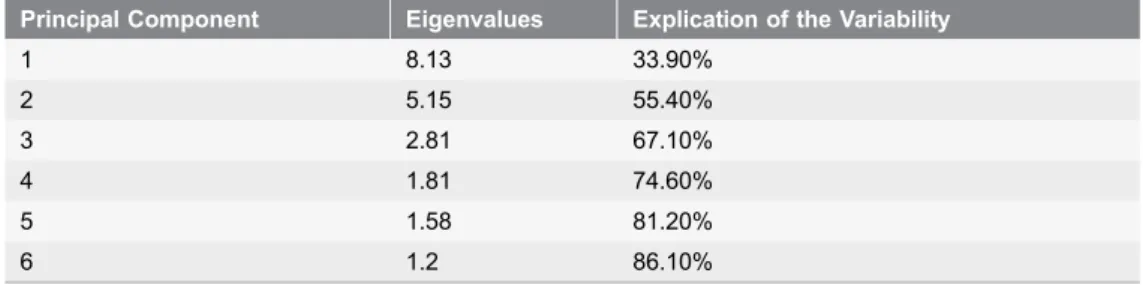
Six principal components represented 86% of the variability attributable to the original 24 variables (21 bioclimatic and 4 topographic indices). The first component explained 34% of total variation, comprising most of the bioclimatic indicators; except sd2, sb2, ppt1, ta3, sb3, bd3, md1, and sd1, which were not significant. The second component explained 21.5% of the variation and was composed of six bioclimatic indicators: sb2, sb3, bd3, ta3, ppt1, and sd1.
Components 3 to 6 explained 11.7, 7.5, 6.6, and 5.0% of the variation respectively. Component 5 was represented by the topographic indicators of aspect and shade.
Slope showed a relationship with component 6 (Table 1).
The six components were taken into account in the cluster analysis. The clustering test considered 40 combinations for 39 possible groups with 100 iterative processes for each one. The cluster for agroclimatic group 12 (ACG 12) showed three situations of interest: (a) a similarity index mean value of 75% and the least fluctuation on the range of all the groups, even though the extreme values were 64 and 90%; (b) a quality index mean value of 2.47 with minimum variation; and, (c) 78.9% of variability explained, with a fluctuation between 77.5 and 79.5% (Figure 1). The above-mentioned results show the need to subject the indices to increased control when deciding on the number of groups to be formed.
The process focused on seeking, within each of the 12 ACGs, the particular conditions that differentiated them. Table 2lists, for each ACG, the mean values of the 21 bioclimatic and 4 topographic indices (including altitude obtained from a DEM with a resolution of 90 m).
3.1.1. Distribution of experimental stations and the coffee climate network in the setting of agro-climatic groups
The red dots inFigure 2show the distribution of CENICAFE´’s ESs throughout the ACGs. Four ESs — El Rosario, Naranjal, La Trinidad, and La Catalina — lie within ACG 9, whereas ESs El Tambo and Santa Ba´rbara lie within ACG 12. The two remaining ESs are situated in different ACGs, namely, ES Pueblo Bello in ACG 6 and ES Paraguaicito in ACG 4. The main stations in the coffee climate network, totaling 74 and forming part of CENICAFE´’s ESs, are represented inFigure 2by yellow dots. Aside from ACG 2, they are distributed throughout all the ACGs, cover different types of areas.
3.1.2. Description of the agro-climatic groups
Discussion
4.1. Agro-climatic groups
The cluster analysis describes relevant characteristics that either contribute to, or limit coffee production. The methodology is based on factors that occur before the crop’s principal harvest, over the three stages of the reproductive period, that is, the physiological events of pre-flowering, flowering, and fruit growth until
Table 1.Principal Component Analysis from the twenty four bioclimatic indices.
Principal Component Eigenvalues Explication of the Variability
1 8.13 33.90%
2 5.15 55.40%
3 2.81 67.10%
4 1.81 74.60%
5 1.58 81.20%
6 1.2 86.10%
doi:10.1371/journal.pone.0113510.t001
Figure 1. Boxplot from three indexes, Quality of Elbow and Similarity and Quality of Liao, built to determine the best decision criteria for groups,
in an analysis of k-means clustering in the ACG.The axis "x" represents the k group level and the axis ‘‘y" the value of each index, the first and last
values are expressed from 0–1, with 1 being the perfect fit. The red box highlights the group with best fit.
harvest. Seasonal analysis is determined through the way in which the baseline is obtained - daily history for an average year - whereby the goal is to analyze the performance of the climatic indices.
Table 4presents advantages and disadvantages of the ACGs according to their agro-ecological suitability for the coffee crop in Colombia. This information is based on agro-climatic indices values drawn from the literature and based on research on the coffee crop in Colombia and Brazil.
In general, planting time dates determines crop development. At high
elevations, the reproductive stage is reached later than at lower altitudes. In some
Figure 2. Agroclimatic groups across Colombian coffee-growing regions.
Table 4.Description of suitability of agroclimatic zones proposed for the Colombian coffee-growing regions.
Agroclimatic zone Limitations Advantages Recommendations
1 and 4 -Slow vegetative and reproductive growth in high areas.
-Zones are suitable for the crop. -Management with mulch.
-Flowering tends to be concentrated in two periods.
-High planting densities and arranged in wide alleys.
-Longer renovation cycles. -Planting at the beginning of the rainy season.
2 and 3 -Zones are affected by the La Nin˜a phenomenon.
-Zones can become suitable for cultivation under conditions of the El Nin˜o phenomenon.
-Management with mulch and semishade.
-Excess humidity does not permit concentration of flowering.
-Medium planting densities and arranged in wide alleys.
-Risk of diseases such as rots caused by Phoma spp., especially at higher altitudes.
-Planting at the beginning of the rainy season.
-Slow vegetative and reproductive growth. 5 and 6 -In both zones, shaded conditions may
limit production.
-Concentrated flowering and harvesting times.
-Planting at the beginning of the rainy season.
-Risk of hydric deficit in the middle phase of fruit development in zone 6.
-Longer renovation cycles. -Regulating shading so that it is no more than 50%.
-Slow vegetative and reproductive growth at higher altitudes, principally in zone 5.
-Conservation practices with mulching in the dry season.
7, 8, and 9 -Risk of hydric deficit in the late phases of fruit development.
-Flowering frequently concentrates into one semester.
-Management with mulch or transitory shading that favor humidity in stage 3. -These zones can lose their suitability for
coffee cultivation under conditions of the El Nin˜o phenomenon.
-Sufficient thermal availability. -Planting at the beginning of the two rainy seasons.
-Shorter renovation cycles. -Optimal distribution in coffee border lands.
10 -Cropping in agroforestal systems because of the temporariness of rainy seasons.
-Flowering frequently concentrates into one semester.
-Management with mulch to favor humidity in stages 2 and 3.
-This zone can lose its suitability for cultivation during conditions of the El Nin˜o phenomenon.
-Regulating shading so that it is no more than 60%
-Shade can diminish thermal availability. -Medium to high planting densities and arranged in wide alleys.
-Shady conditions can limit production. -Planting at the beginning of the rainy season.
11 and 12 -Slow vegetative and reproductive growth. -Flowering frequently concentrates into one semester.
-Medium to high planting densities and arranged in wide alleys.
-Risk of hydric deficit in the late phases of fruit development.
-Longer renovation cycles. -Regulating shading so that it is no more than 45%.
-Zones may lose suitability for cropping under conditions of the El Nin˜o phenomenon.
-Management with mulch to favor humidity in stage 3.
-Thermal availability diminishes under cloudy conditions.
-Risk of diseases such as rots caused by Phoma spp.
ACGs, hydric deficit during the last phases of fruit development could be improved by adopting management practices such as mulching and establishing live barriers on steep hillsides [52,53]. In other ACGs, high humidity prevailing throughout most of the crop’s reproductive development may favour the appearance of diseases such as those caused by Phoma sp. (dieback) and
Erithricium salmonicolor (pink disease). During flowering, star flower or other
abnormalities and attacks from fungi such as Colletotrichum sp. (anthracnose) may also appear [52,54,55,56].
As growing coffee under shade may also limit yield [57], practices through the dry period such as regulating shade, sanitary harvesting, and pruning the crop, reduce the potential effects of pests and diseases [58,59]. Agronomic management of the crop, such as fertilizer application, weed control, mulching, and shade management, reinforces the conditions for a suitable crop [58,59,60,61].
4.2. General considerations on agro-climatic group formation
In Colombian coffee cultivation, the concept of latitudinal zoning has been used in agronomical management. In this context, such differentiation results in at least four zones, which are related to flowering patterns [5,23,62,63]: (a) southern zone, delimited between 1
˚
and 3˚
north; (b) central-southern zone, between 3˚
and 4˚
north [5] and 4˚
in the west, 5˚
in the north, and 6˚
in the east; (c) central-northern zone, between 5˚
and 8˚
north; and (d) northern zone, between 9˚
and 11˚
north.As indicated above in the description of ACG formation, altitude exerts a strong influence on agro-ecological suitability of areas for coffee cultivation. The four latitudinal zones are associated with the ACGs as follows: the northern zone with ACGs 5, 6, and 10; the southern zone with ACGs 4, 11, and 12; the central-southern zone (the piedmont of the plains and south of Huila) with ACG 8; and the central-northern zone with ACGs 1, 7, and 9. For the northern, southern, and central-southern zones, these associations with the ACGs clearly delineate the influence of the great northeastern air currents and the atmospheric systems of the Pacific Ocean and the Amazon Basin, respectively [6,64]. The broad valleys forming the Magdalena River’s central watershed and the Cauca River watershed noticeably influence the formation of ACGs 1, 7, and 9. Only ACGs 2 and 3 are primarily governed by altitude, which averages at 1800 m above sea level.
Cauca, will determine the future for coffee growers and the FNC, safeguarding farmers from variability in terms of both climate and prices, and enabling progress to be made towards guaranteeing a quality product.
Recommendations
Spatial resolution at 5 km used to obtain the indices is limited, especially for climatic elements such as precipitation and for topographical features such as slope and altitude. In steep zones, where slopes are more than 25
˚
, the changes associated with altitude, precipitation, and solar radiation within a cell of 5 km are large. Assuming only one class for each element will consequently distort these extreme conditions. The advantages of using this resolution are (a) an association of large surfaces in a continuous manner incorporating data into each cell; (b) efficient use of hardware and software resources; and (c) improved level of precision of information generated.Although the objective of establishing the potential scope of research results generated by the ESs was achieved, the level of dispersion of the coffee climate network did not allow a higher level of precision. An option to consider is to incorporate more historical series type of information from weather stations, both within and outside the coffee-growing regions, as administered by national agencies such as the Institute of Hydrology, Meteorology, and Environmental Studies (IDEAM) or private companies such as sugar mills. This would result in benefits in terms of consistency of information, the possibility of increasing the level of resolution and therefore the level of detail, and the possibility of exploring other methodologies based on functional geo-statistics, functional regression, and other tools of interpolation to obtain a greater coverage with improved level of confidence.
One factor that limited the process of obtaining bioclimatic indicators was the restricted scope of soil studies. Another factor was the scarcity of associated digital information as attributes in each unit, such as in the case of water retention capacity for which only a small part (40 units out of 800) could be related.
Yield information on coffee genotypes evaluated in the ESs and related to bioclimatic indices, other variables of interest related to vegetative growth, flowering, and quality, and molecular markers should be included in new research. Research should not be limited to the ESs, but should have wider national application, incorporating new research sites that this study identified as having potential strategic importance and therefore as being worthy of inclusion in the FNC’s investigation plan.
Conclusions
information is valuable to the Colombian National Coffee Federation to guide their research and extension and will benefit the farmers of Colombia. The methodology and approach developed here can be used in other coffee-growing countries across the world.
Acknowledgments
The authors acknowledge: the National Federation of Coffee Growers of Colombia, who provided information and sponsored Juan Carlos Garcı´a’s doctoral formation in this fieldwork; the CENICAFE´’s Agroclimatology Research Group, headed by A´lvaro Jaramillo and Andre´s Pen˜a, for consolidating and facilitating historical information on the coffee climate network and for
participating in the review of the baseline generated; the CGIAR research program on Climate Change, Agriculture and Food Security (CCAFS) and specifically the Decision and Policy Analysis (DAPA) at the International Center For Tropical Agriculture (CIAT), for training and supervising Juan Carlos Garcı´a during his internship, allowing him to develop the methodology presented in this article. This manuscript represents a portion of a PhD thesis submitted by the first author to a Doctoral Program of the Universidad de Caldas, Colombia.
Author Contributions
Performed the experiments: JCGL HPS PL. Analyzed the data: JCGL HPS PL. Contributed reagents/materials/analysis tools: JCGL HPS PL. Wrote the paper: JCGL HPS PL. Participated in study design and coordination and revised the manuscript: JCGL HPS PL. Acquired data, participated in data analysis and interpretation, and drafted the manuscript: JCGL HPS PL. Read and approved the final manuscript: JCGL HPS PL.
References
1. Cano C, Vallejo C, Caicedo E, Amador J, Tique E(2012) El mercado mundial del cafe´ y su impacto en
Colombia. Borradores de Economı´a: 1–56.
2. Federacio´ n Nacional de Cafeteros de Colombia (FNC)(2012) Caficultura sostenible. Informe del
Gerente General. LXXVII Congreso Nacional de Cafeteros 2012. Accedida Septiembre, 2013. Available:
http://www.federaciondecafeteros.org/static/files/IGG2012.pdf. Federacio´n Nacional de Cafeteros de Colombia.
3. Leibovich J, Botello S(2008) Ana´lisis de los cambios demogra´ficos en los municipios cafeteros y su
relacio´n con los cambios en la caficultura colombiana (1993–2005). Ensayos sobre economı´a cafetera 21: 67–87.
4. Go´mez L, Caballero A, Baldio´ n J (1991) Ecotopos cafeteros de Colombia. Bogota´: Federacio´n
Nacional de Cafeteros de Colombia. pp.131.
5. Trojer H(1968) The phenological equator for coffee planting in Colombia. In: Unesco editor, Parı´s.
pp. 107–117.
6. Jaramillo A(2005) Clima andino y cafe´ en Colombia. Chinchina´: FNC - Cenicafe´. 195 p.
7. Arcila J, Jaramillo A(2003) Relacio´n entre la humedad del suelo, la floracio´n y el desarrollo del fruto
8. Hurtado G (1988) Caracterizacio´n agroclima´tica de Colombia. Santafe´ de Bogota´, D.C.: Instituto colombiano de hidrologı´a, meteorologı´a y adecuacio´n de tierras. 112 p.
9. Baldio´ n J, Hurtado G(1992) Estudio agroclima´tico del tro´pico hu´medo de Colombia. Santafe´ de
Bogota´, D.C.: Instituto colombiano de hidrologı´a, meteorologı´a y adecuacio´n de tierras. 187 p.
10. Palmer WC(1965) Meteorological Drought. Research Paper No. 45. U.S. Department of Commerce.
Washington, D.C.
11. Malago´ n D, Pulido C, Llina´s R, Chamorro C(1995) Factores bioclima´ticos de formacio´n del suelo.
Suelos de Colombia. Santafe´ de Bogota´, D. C.: Instituto Geogra´fico Agustı´n Codazzi. pp. 221–286.
12. Pezzopane J, Pedro JM, Camargo M, Fazuoli L(2008) Exigencia te´rmica do cafe´ ara´bica CV. Mundo
Novo no subperı´odo florescimento - colheita. Cienc agrotec, Lavras 32: 1781–1786.
13. Nunes F, Camargo M, Fazuoli L, Rolim G, Pezzopane J (2010) Modelos agrometeorolo´gicos de
estimativa da durac¸a˜o do esta´dio florac¸a˜o-maturac¸a˜o para treˆs cultivares de cafe´ ara´bica. Bragantia, Campinas 69: 1011–1018.
14. Carvalho H, Melo B, Rabelo P, Silva C, Camargo R(2011) I´ndices bioclima´ticos para a cultura de cafe´.
Revista Brasileira de Engenharia Agrı´cola e Ambiental 15: 601–606.
15. Santos M, Camargo M (2006) Parametrizac¸a˜o de modelo agrometeorolo´gico de estimativa de
produtividade do cafeeiro. Bragantia, Campinas 65: 173–183.
16. Camargo M, Rolim G, Santos M (2007) Modelagem agroclimatolo´gica do cafe´: estimativa e
mapeamento das produtividades. Informe Agropecua´rio, Belo Horizonte 28: 58–65.
17. Silva F, Santos E, Evangelista B, Assad E, Pinto H, et al.(2000) Delimitacao das a´reas aptas do
ponto de vista agroclima´tico para o plantio da cultura do cafe´ (Coffea arabica) no estado de Goia´s. I Simpo´sio de Pesquisa dos Cafe´s do Brasil: Embrapa. pp. 123–125.
18. Meireles E, Volpato M, Alves H, Vieira T(2007) Zoneamento agroclima´tico: Um estudo de caso para o
cafe´. Informe Agropecua´rio, Belo Horizonte 28: 50–57.
19. Caramori P, Filho A, Morais H, Filho F, Duquia C(2007) Sistema de aleta pars geadas na cafeicultura
do Parana´. Informe Agropecua´rio, Belo Horizonte 28: 66–71.
20. Camayo G, Chaves B, Arcila J, Jaramillo A(2003) Desarrollo floral del cafeto y su relacio´n con las
condiciones clima´ticas de Chinchina´, Caldas. Revista Cenicafe´ 54: 35–49.
21. Ramı´rez V, Arcila J, Jaramillo A, Rendo´ n J, Cuesta G, et al.(2010) Floracio´n del cafe´ en Colombia y
su relacio´n con la disponibilidad hı´drica, te´rmica y de brillo solar. Revista Cenicafe´ 61: 132–158.
22. Jaramillo A, Guzma´n O(1984) Relacio´n entre la temperatura y el crecimiento en Coffea arabica L.,
variedad caturra. Revista Cenicafe´ 35: 57–65.
23. Arcila J, Jaramillo A, Baldio´ n J, Bustillo A(1993) La floracio´n del cafeto y su relacio´n con el control de
la broca. Avances Te´cnicos Cenicafe´ 193: 1–6.
24. Jaramillo A, Arcila J(1996) E´ pocas recomendables para la siembra de los cafetos. Avances Te´cnicos
Cenicafe´ 229: 8p.
25. Jaramillo A, Ramı´rez V, Arcila J(2011) Distribucio´n de la lluvia, clave para planificar las labores en el
cultivo del cafe´ en Colombia. Avances Te´cnicos Cenicafe´ 411: 1–8.
26. Arcila J, Buhr L, Bleiholder H, Hack H, Wicke H(2001) Application of the "Extended BBCH - Scale" for
the description of the growth stages of coffee (Coffea sp.). Cenicafe´. pp. 32.
27. Hutchinson M (2006) Anusplin version 4.36 User Guide. 4.36 ed., Canberra, Australia: Centre for
Resource and Environmental Studies at the Australian National University. pp. 54.
28. Hutchinson M (1998) Interpolation of Rainfall Data with Thin Plate Smoothing Splines - Part I: Two
Dimensional Smoothing of Data with Short Range Correlation. Journal of Geographic Information and Decision Analysis 2: 139–151.
29. Hijmans R, Cameron S, Parra J, Jones P, Jarvis A(2005) Very high resolution interpolated climate
surfaces for global land areas. Int J Climatol 25: 1965–1978.
30. McKenney D, Pedlar J, Papadopol P, Hutchinson M(2006) The development of 1901–2000 historical
31. Hutchinson M, McKenney D, Lawrence K, Pedlar J, Hopkinson R, et al.(2009) Development and Testing of Canada-Wide Interpolated Spatial Models of Daily Minimum–Maximum Temperature and Precipitation for 1961–2003. Journal of Applied Meteorology and Climatology 48: 725–740.
32. Ramı´rez J, Jarvis A(2010) Downscaling Global Circulation Model Outputs: The Delta Method Decision
and Policy Analysis Working Paper No. 1. Cali, Colombia: CIAT. 17p p.
33. Niekerk A, Joubert S(2011) Input variable selection for interpolating high-resolution climate surfaces for
the Western Cape. Water SA 37.
34. La¨derach P, Zelaya C, Ovalle O, Garcı´a S, Eitzinger A, et al.(2012) Escenarios del Impacto del Clima
Futuro en A´ reas de Cultivo de Cafe´ en Nicaragua. Cali, colombia; Managua, Nicaragua: CIAT. 32 p.
35. Team RDC(2008) R: A language and environment for statistical computing. R Foundation Statistical
Computing.
36. Hijmans R(2010) Introduction to the ’raster’ package (Version1.6–19). R package ’raster’.
37. Jaramillo A, Go´ mez O(2002) Desarrollo de una aplicacio´n de co´mputo para el ca´lculo de balance
hı´drico en cafetales. Chinchina´, Caldas: Cenicafe´.
38. Sua´rez S(2000) Caracterı´sticas fı´sicas de los suelos de la zona cafetera de Colombia relacionadas con
el uso, manejo y conservacio´n. Simposio sobre suelos de la zona cafetera Colombiana, Cenicafe´. pp. 17p.
39. Jaramillo A(1982) Balance hı´drico de la zona cafetera colombiana. Revista Cenicafe´ 33: 15–28.
40. Meza F, Varas E(2000) Estimation of mean monthly solar global radiation as a function of temperature.
Agricultural and Forest Meteorology 100: 231–241.
41. Rivington M, Matthews B, Buchan K(2002) A Comparison of Methods for Providing Solar Radiation
Data to Crop Models and Decision Support Systems. Proc Int Environmental Modelling and Software Society 3: 193–198.
42. Rivington M, Bellocchi G, Matthews B, Buchan K(2005) Evaluation of three model estimations of
solar radiation at 24 UK stations. Agricultural and Forest Meteorology 132: 228–243.
43. Go´mez L, Guzma´n O(1995) Relacio´n empı´rica entre la radiacio´n solar global y el brillo solar en el a´rea
de Cenicafe´, Chinchina´, Caldas. Revista Cenicafe´ 46: 205–218.
44. UPME, IDEAM (2005) Atlas de Radiacio´n solar de Colombia. Santafe´ de Bogota´ D.C.: Unidad de
Planeacio´n Minero Energe´tica, Ministerio de Minas y Energı´a; Instituto de Hidrologı´a, Meteorologı´a y Estudios Ambientales, Ministerio de Ambiente, Vivienda y Desarrollo Rural. 176 p.
45. Reuter H, Nelson A, Jarvis A(2007) An evaluation of void-filling interpolation methods for SRTM data.
International Journal of Geographical Information 21: 983–1008.
46. Pen˜ a D(2002) Ana´lisis datos multivariantes: McGraw Hill. 539 p.
47. Dı´az L (2007) Estadı´stica mutivariada: inferencia y me´todos. Santafe´ de Bogota´ D. C.: Universidad
Nacional de Colombia. Facultad de Ciencias. Departamento de Estadı´stica. 487 p.
48. Chessel D, Dufour A (2012) Analysis of Ecological Data: Exploratory and Euclidean methods in
Environmental sciences. Package ade4: dudipca Principal Component Analysis. 1.5–1 ed.
49. Liao T(2005) Clustering of time series data—a survey. Pattern Recognition 38: 1857–1874.
50. Reymondin L (2011) Near-real time pan-tropical monitoring system for natural habitat conversion
detection. Strand, London: King’s College London. 53 p.
51. Dimitriadou E(2012) Convex Clustering Methods and Clustering Indexes. R package version 2.15.2
(2012-10-26). R-project. org/package5cclust.
52. Ramı´rez V, Jaramillo A, Pen˜ a A(2013) Gestio´n del riesgo agroclima´tico. Vulnerabilidad y capacidad de
adaptacio´n del sistema de produccio´n de cafe´. Manual del cafetero colombiano Investigacio´n y tecnologı´a para la sostenibilidad de la caficultura. Chinchina´. Caldas. Colombia: FNC-Cenicafe´. pp. 91– 114.
53. Salazar L, Hincapie´ E (2013) Conservacio´n de suelos y aguas. Manual del cafetero colombiano
54. Jaramillo A, Arcila J(2009) Variabilidad clima´tica en la zona cafetera colombiana asociada al evento de El Nin˜o y su efecto en la caficultura. Avances Te´cnicos Cenicafe´ 390: 1–8.
55. Jaramillo A, Arcila J(2009) Variabilidad clima´tica en la zona cafetera colombiana asociada al evento
de La Nin˜a y su efecto en la caficultura. Avances Te´cnicos Cenicafe´ 389: 1–8.
56. Flo´rez C, Ibarra L, Go´mez L, Carmona C, Castan˜ o A, et al.(2013) Estructura y funcionamiento de la
planta de cafe´. Manual del cafetero colombiano Investigacio´n y tecnologı´a para la sostenibilidad de la caficultura. Chinchina´. Caldas. Colombia: FNC-Cenicafe´. pp. 123–168.
57. Farfa´n F, Jaramillo A(2009) Sombrı´o para el cultivo del cafe´ segu´n la nubosidad de la regio´n. Avances
Te´cnicos Cenicafe´ 379: 1–8.
58. Farfa´n F(2013) Establecimiento de sistemas agroforestales con cafe´. Manual del cafetero colombiano
Investigacio´n y tecnologı´a para la sostenibilidad de la caficultura. Chinchina´. Caldas. Colombia: FNC-Cenicafe´. pp. 44–63.
59. Ramı´rez V(2013) Establecimiento de cafetales al sol. Manual del cafetero colombiano Investigacio´n y
tecnologı´a para la sostenibilidad de la caficultura. Chinchina´. Caldas. Colombia: FNC-Cenicafe´. pp. 28– 43.
60. Sadeghian S(2013) Nutricio´n de cafetales. Manual del cafetero colombiano Investigacio´n y tecnologı´a
para la sostenibilidad de la caficultura. Chinchina´. Caldas. Colombia: FNC-Cenicafe´. pp. 85–116.
61. Salazar L, Hincapie´ E (2013) Manejo integrado de arvenses. Manual del cafetero colombiano
Investigacio´n y tecnologı´a para la sostenibilidad de la caficultura. Chinchina´. Caldas. Colombia: FNC-Cenicafe´. pp. 117–142.
62. Trojer H(1954) El ambiente climatolo´gico y el cultivo del cafe´ en Colombia: problemas, conocimientos
actuales y perspectivas. Revista Cenicafe´ 5: 22–37.
63. Arcila J (2007) Factores que determinan la productividad del cafetal. In: Cenicafe´-FNC, editor.
Sistemas de produccio´n de cafe´ en Colombia. Chinchina´. pp. 61–86.
64. Trojer H (1959) Fundamentos para una zonificacio´n meteorolo´gica y climatolo´gica del tropico y
especialmente de Colombia. Revista Cenicafe´ 10: 287–373.
65. Carbonell J, Quintero R, Torres J, Osorio C, Isaacs C, et al.(2011) Zonificacio´n agroecolo´gica para el
cultivo de la can˜a de azu´car en el valle del rı´o Cauca (cuarta aproximacio´n). Principios metodolo´gicos y aplicaciones. Cenican˜a. pp . 119.
66. Cock J, Oberthur T, Isaacs C, La¨derach P, Palma P, et al.(2011) Crop management based on field
observations: Case studies in sugarcane and coffee. Agricultural Systems 104: 755–769.
67. La¨derach P, Haggar J, Lau C, Eitzinger A, Ovalle O, et al.(2011) Cafe´ Mesoamericano: Desarrollo de
una estrategia de adaptacio´n al cambio clima´tico. CIAT Polı´ticas en Sı´ntesis: 4p.
68. Oberthu¨ r T, La¨derach P, Posada H, Fisher M, Samper L, et al.(2011) Regional relationships between