UNIVERSIDAD TÉCNICA PARTICULAR DE LOJA
La Universidad Católica de Loja
ÁREA SOCIOHUMANÍSTICA
TITULACIÓN DE LICENCIADO EN CIENCIAS DE LA EDUCACIÓN
MENCIÓN INGLÉS
Teachers and students’
perceptions of Teaching English in small classes.
TRABAJO DE TITULACIÓN
AUTOR: Espinoza López, Paulina de los Ángeles
DIRECTOR: Lida Mercedes, Solano Jaramillo, Dra.
Centro Universitario Madrid
Esta versión digital, ha sido acreditada bajo la licencia Creative Commons 4.0, CC BY-NY-SA: Reconocimiento-No comercial-Compartir igual; la cual permite copiar, distribuir y comunicar públicamente la obra, mientras se reconozca la autoría original, no se utilice con fines comerciales y se permiten obras derivadas, siempre que mantenga la misma licencia al ser divulgada. http://creativecommons.org/licenses/by-nc-sa/4.0/deed.es
ii
APROBACIÓN DEL DIRECTOR DEL TRABAJO DE TITULACIÓN
Doctora:
Lida Mercedes Solano Jaramillo
DOCENTE DE LA TITULACIÓN
De mi consideración:
El presente trabajo de titulación, “Teachers and Students‟ perceptions of Teaching English in small classes in Ecuador” realizado por Espinoza López Paulina de los Ángeles, ha
sido orientado y revisado durante su ejecución, por cuanto se aprueba la presentación del mismo.
Loja, noviembre de 2014
f) Lida Mercedes Solano Jaramillo
iii
DECLARACIÓN DE AUTORÍA Y CESIÓN DE DERECHOS
“Yo, Paulina de los Ángeles Espinoza López declaro ser la autor (a) del presente trabajo de
titulación: Licenciado en Ciencias de la Educación mención Inglés, siendo Lida Mercedes Solano Jaramillo director (a) del presente trabajo; y eximo expresamente a la Universidad Técnica Particular de Loja y a sus representantes legales de posibles reclamos o acciones legales. Además certifico que las ideas, conceptos, procedimientos y resultados vertidos en el presente trabajo investigativo, son de exclusiva responsabilidad.
Adicionalmente declaro conocer y aceptar la disposición del Art. 88 del Estatuto Orgánico de la Universidad Técnica Particular de Loja que en su parte pertinente textualmente
dice: “Forman parte del patrimonio de la Universidad la propiedad intelectual de
investigaciones, trabajos científicos o técnicos y tesis de grado o trabajos de titulación que se
realicen con el apoyo financiero, académico o institucional (operativo) de la Universidad”.
f………..
Autora: Paulina de los Ángeles Espinoza López
iv
DEDICATION
v
ACKNOWLEDGEMENT
I want to express my deep gratitude to “Universidad Técnica Particular de Loja”, for its distance modality learning, and for giving me the opportunity to grow intellectually and spiritually.
I also want to thank to all the teachers who have guided me during this career, especially Mgs. Lida Merdeces Solano Jaramillo my thesis director for her cooperation and patience throughout the research process.
vi
CONTENTS
COVER i
APROBACIÓN DEL DIRECTOR DEL TRABAJO DE FIN DE TITULACIÓN ii
DECLARACIÓN DE AUTORÍA Y CESIÓN DE DERECHOS iii
DEDICATION iv
ACKNOWLEDGEMENT v
CONTENTS vi
ABSTRACT 1
RESUMEN 2
INTRODUCTION 3
METHOD 6
DISCUSSION 8
Literature Review
Description, Analysis and interpretation of the Results
8 23
Conclusions 52
Recommendations 53
REFERENCES 54
1
ABSTRACT
This research focus was on analyzing teachers and students‟ perceptions of teaching English in small classes. Its purpose was to find out if the results of working with small classes generate positive or negative results in students English learning.
The general approach used in this research was quantitative and qualitative. Besides, survey, note taking, and observation techniques were considered and the main instruments used were questionnaires and observation sheets.
The field research was conducted in two private schools in Soria and the sample analyzed consisted on twenty-five students and five teachers, who were surveyed in order to know their perceptions of teaching and learning English in small classes.
The most important finding gotten from this research was that students and teachers feel more comfortable when they work in small classes, they can take advantage of all resources, more time for interaction among them and more opportunities to practice.
2
RESUMEN
Esta investigación fue dirigida para analizar las percepciones de profesores y estudiantes de la Enseñanza de Inglés en clases pequeñas. Con el fin de averiguar si los resultados de trabajar con grupos reducidos, genera resultados positivos o negativos en el aprendizaje de Inglés de los estudiantes.
El enfoque general fue cuantitativo y cualitativo. En base al análisis cuantitativo se hizo la tabulación de los estudios completados por cada maestro en cada aula observada y por cinco estudiantes seleccionados al azar en cada clase. Se consideraron las técnicas encuesta, toma de notas y de observación y los principales instrumentos utilizados fueron cuestionarios y hojas de observación. La investigación de campo se llevó a cabo en dos escuelas privadas en Soria, la muestra analizada consistió en veinticinco estudiantes y cinco profesores, que fueron encuestados y entrevistados para conocer sus percepciones sobre la enseñanza y el
aprendizaje de Inglés en clases pequeñas. La investigación se realizó durante el día en dos escuelas subvencionadas en el capital de Soria; en donde las clases se componen de 20 estudiantes o menos. La edad de los estudiantes en este estudio va entre 9 a 13 años de edad, que pertenecen a la sección primaria.
3
INTRODUCTION
English is studied in many countries in South America and Europe as a foreign language, precisely because to know English opens the door for better jobs with a better salary paid and also because there are more possibilities to travel and study abroad.
Besides, Globalization and new technologies require us to know English; for this reason, it is very important to focus on improving the quality of teaching and learning process in schools, colleges and universities. This issue motivated the current research since by
investigating the teachers and students‟ perceptions of teaching English in small classes in
order to know the positive or negative results of class size related to the students‟ progress.
This research is specifically intended to answer the following questions: What are the benefits of teaching and learning English to small classes? What teaching strategies and resources benefit the teaching of English in small classes? How do students feel about learning English in small classes? Are there any limitations when teaching English in small classes?
Previous studies show the teachers and students‟ opinions about teaching English in
small classes. The first one was conducted by Harfitt (2012) with the purpose of exanimating whether and how class size reduction might help to alleviate language learning anxiety which is considered as an obstacle to second language acquisition. In this study this author employed multiple case studies in four Hong Kong secondary schools. With four teachers, multiple interviews were used and individual interviews at the total of 231 students. The interview questions for the students were focused on their perspectives and experiences of studying in large and reduced- size classes. Data was taken from multiple students‟ interviews and
4
evaluation from their peers and teachers. Besides, students felt more confident about
participating in English lessons. The author concluded that in small classes learner‟s anxiety
can be reduced and class size reduction may help in breaking down cultural barriers.
Another study is the one conducted by Blatchford, Bassett, Goldstein & Martin (2003) whose purpose is to know whether class size differences affect pupils‟ academic achievement
and connections between class size and classroom processes, which might explain any differences found. They used in this study an observational approach with the objective to capture the nature of the relation class size and achievement across a full range of observed classes. The schools taken into account for this study were randomly selected and belong to a wide range of social backgrounds and situated in urban, suburban, and rural areas, and were schools with different class size categories i.e. large (30 and over), large medium (26-29), small medium (20-25), and small (under 20). The results showed that the class size is connected with the numbers and size of the groups in the class. Besides the educational environment of large groups was less effective than small groups, due to, an adverse effect on the amount and quality of teaching and the quality of pupils' work and concentration in large groups. Teachers felt that group size and class size affect their teaching and classroom
management. These authors concluded that class size is related to several classroom processes and the effects of class size are possible to be multiple. The limitations encountered in this study may be other outcomes and classroom processes related to class size differences, that neither were nor covered in this study.
Finally, Harfitt (2013) conducted a study whose purpose was to examine why „small classes‟ can be better than large classes. In this study he examined the relationships between
5
results showed that teachers did not change their pedagogy between large to small classes.
About “knowing” students better in small classes, the interviews of the teachers said that
smaller classes had allowed teachers to know their students better and this was reflected in the more frequent use of names of the small class students in the classroom episodes. This author concludes that teachers have good teaching practice in smaller classes; in fact, teachers adopted different approaches in their small classes such as: more group work and pair work, different interaction patterns, greater use of open questions, more individualization, lengthier wait-times, different classroom rules and more humor. A limitation of this study was the lack of time, and the sample size that unable examined the student achievement.
Teachers, students and policy makers of the educational process are the main
beneficiaries of this study. Teachers can be highly benefited from this research work because they can understand how to improve the way in which they teach by incorporating new techniques, strategies, and motivating students with things that they love.
The main limitation encountered in this research was the lack of time for doing the observations and the possibly differences between public and private schools. Also, this study was conducted only with the primary section with learners between 9 to 12 years old;
6
METHOD
Setting and Participants
This research was carried out in Spain in the city of Soria. It was carried out in two private schools, through five class observations. These two schools are located in the urban area of the city of Soria. The sample selected for this research consisted on 25 students, whose ages ranged from 9 to 13 years old, and belong to the 3rd to 6th years of school. Besides, teachers were all female aged between 26 to 51 years old, each of them with at least 5 years in teaching English.
Procedures
The first step of this research was the gathering of the information to build up the literature review. The bibliographical support was search based in the followings topics: managing learning, Teacher-student, and student-student interaction, class size, teaching techniques, strategies or activities for teaching English in small classes, and learning
environment in small classes. The most relevant information of concepts and definitions were taken mainly from books, manuals, and e-books.
This information supports and clarifies the concepts used through this research. Besides, five previous studies were utilized in the same way which permitted to establish the bibliographical background for the present study.
The second step was the field research. It began with the observations of English classes. One class per day was observed, in each class the teacher filled in a teacher questionnaire, during their free time; also, five students randomly selected filled in the
student‟s questionnaire. Both questionnaires were based on four related groups with the
7
the strategies, and resources favoring the teaching of English in classes with few students, opinion about how students feel learning English in a class with few students, and limitations of learning English in classes with few students. Furthermore, both questionnaires were written in Spanish to avoid misunderstandings.
The instruments used for collecting data were observation sheets, teacher
questionnaires, and student questionnaire; and the techniques used were note taking, which was used to collect details and more important extra information about the English classes and class observations, where the researcher post in the information sheet.
8
DISCUSSION
Literature Review
Nowadays learning English is very important in both the academic and workplace. So, it is necessary that the process of learning English as a foreign language in Ecuador may be analyzed in order to keep improving the quality of teaching in schools and high schools, providing teachers with the right preparation and resources.
With objective of improving the quality of the English teaching and learning Ecuadorian government through the Ecuadorian Ministry of Education has created The Project for Strengthening the Teaching of English as a Foreign Language, which main objective is that the Ecuadorian students attain a functional level of use of the English
language. Their specific initiatives are aimed at updating national curricula that subject to the delivery of textbooks aligned to these curricula, professional development for teachers of English in exercise, and improving training in this career. (Ministerio de Educación 2012).
Also, the Ministry of Education with the aim of improving the teaching of English is using certain strategies to measure the degree of knowledge of the English teachers, this is the TOEFL test, and according the managers of the Ministry of Education of Ecuador this
program will help to train to English teachers. Besides, this program will help to enhance their English skills and learn new strategies to use in the classroom, in order to build an attractive environment for learning the language. The objective of the program is to ensure that all teachers of EFL reach a B2 level in English (as defined by the Common European Framework of Reference) and to improve their ability to teach EFL.
9
language around the world; it is used in more than 130 countries, including Australia, UK, Canada, and USA. This assessment measures the ability of a person to understand English and proficiency in the four skills: listening, speaking, reading and writing.
In addition to the preparation of teachers for teaching English there are other factors that affect the process of teaching and learning such as the size of the class, the better small or large classes, it could benefit the teaching of English in small classes.
In this section, it is included the supporting concepts and definitions used through the present research.
The following topics are going to be considering: Managing learning (instructions, feedback and timing); Teacher-student, and student-student interaction (importance of the interaction); Class size (number of students in small and large classes); Teaching techniques, strategies or activities for teaching English in small classes; Learning environment in small classes (use and organization of the physical space; and social and emotional atmosphere).
Managing learning
10
In the same way, Harmer (2007) states that there are two general rules for giving instructions: they must be simple and logical. Teachers must know what they want to teach and what students need to accomplish the task successfully. When instructions are given it is very important to verify that the student has understood what to do, this can be done by asking directly to the student.
Another aspect to consider in managing learning is feedback. Askew (2000) says that effective language learning is a cycle that involves processes and outcomes. Within the processes for effective learning he mentions for example: make connections of learning in different contexts; reflect on one‟s own learning and strategies, explore the contexts that have contributed to learning, set future learning goals and engage with other in learning. Regarding to the outcomes he includes: deep knowledge, higher other skills, strategies and approaches, actions towards greater complexity and more learning, positive emotions, excitement, enthusiasm; enhanced sense of self, more sense of connections with others, further learning strategies; greater affiliation to learning, and change personal significance.
He concludes, that if all of these processes are fulfilled the learning outcomes cited above can be reached.
Finally, giving feedback is very important in order to bring self-awareness and
progress in the development of any activity during the class because students continually need to know how they are doing, so providing feedback is one of the responsibilities of the
teacher. One way of providing feedback can be by praising and encouraging the students, by correcting them or by testing them; discussing and exchanging opinions, taking into account that feedback always can be done in a positive way. (Gower, et al 2005)
11
Lighbown & Spada (2006) highlight the importance of the interaction between the learner and the teacher in the acquisition of the second language. They also state that interaction plays an important role in the learning of any language. Therefore, in teaching English teachers should interact with their students, if they want to obtain good results.
In addition, teacher and student relationship is one of the aspects of classroom management as Marzano (2003) says that if the teacher maintains a good relationship of respect and trust with his pupils, they work and learn more easily and without disciplinary problems. So good teachers provide support and strong academic guidance but, at the same time taking into account the opinion of the learners based on their needs and desires for attempting to work as in a team. This author believes that in the classroom there should be a right combination of moderate dominance and moderate cooperation for proper learning.
Besides the interaction with the teacher and interaction with other students plays an important role in learning English as Lighbown & Spada (2006) say that the interactions with other learners allow them express their thoughts, opinions and learn from each other, when they are working together in a particular task. This type of interaction provides them an opportunity that any other form of interaction does, because students can ask for confirmation or clarification, repetition with a questioning intonation, in this way they can learn languages forms, grammatical structures and specially vocabulary while they work with a partner.
12 Class size
Bray & Kehle (2011) argue that class size is an important element in the success of
students‟ English learning. These authors consider a classroom with 20 or fewer students as a
small, and those with more than 20 students as large. For them, small classes allow students to get favorable results; the main benefits small classes provide are: (a) students‟ learning
behavior; (b) students‟ social behaviors; and (c) students-teachers interactions. These authors also indicates that students in small classes, unlike large classes, are more likely to participate in the activities proposed by the teacher during class; also, the teacher can give individual attention to students by identifying who needs more support in a particular task.
Similarly, Nilson & Miller (2010) point out that small classes have many benefits for both teachers and students. Small classes allow learners to have a positive self-image, more opportunities to participate in activities during the class, and feel motivated toward learning English; besides, for teachers small classes means more job satisfaction, increases their desire to teach; in fact, there are more opportunities to do activities with their students and allows to improve classroom management, control the students‟ discipline. Therefore, these authors conclude that small classes allow teachers to know better at each of their students, know their strengths and weaknesses and be able to provide individualized support, allowing a better relationship between teacher and student and also succeed in English learning.
On the other hand, referring to class size Kaplan & Owings (2002, p.49) state that
“Class- size effects vary grade by grade level, pupil characteristics, subject areas, teaching
methods, and other variables. Thus, reducing class size without simultaneously improving
teacher and teaching quality appears to be both an expensive and often unproductive option”
13
attention to students, because they spend more time to keep students under control, than teaching them. So, small class allows more attention, time, opportunities to give feedback and energy from teacher to students in their tasks. Therefore, teaching learning process becomes easier to be achieved and students can development a higher grade of confidence and stronger effect between class members.
In conclusion, according to Kaplan & Owings (2002) class size is one of the factors that affects to the teaching and learning quality. In addition, for them, the teacher is a very important component that must be highly qualified to address the needs and expectations of students. If the teacher complies this, interacts and provides individualized help to students in both small and large classes. So, the academic success not only depends on the size of the class.
Teaching techniques, strategies or activities for teaching English to small classes
Before appointing techniques favoring teaching in small classes, it is important to know the definition of a technique. Related to Brown, (2007, p.16) a “Technique is any wide variety or exercises, activities or tasks used in the language classroom for creating lesson
objectives”. Therefore, this author indicates that to keep students engaged in the English
learning teachers need to consider sounds, patterns, gestures, maps, jigsaws, summaries, symbols, multimedia, computers programs and visual aids, ask and answer questions, share experience, state concepts, role playing among others.
Furthermore, Herrell & Jordan (2012) mention three strategies for teaching English to small classes such as: skills grouping, partner work and cooperative learning. In skills grouping, students are placed into groups according to their level of instruction in a
14
input. Similarly, partner work strategy results very effective when you work with second language learners because this strategy allows students interact each other. For instance, they work in pairs and they have more time for practicing the verbal interactions, first with their partner and after with the whole class. In relation with cooperative learning, students are placed in groups to accomplish a particular task, where each student has to complete part of the task, so students need to work collaboratively to develop a good job. For cooperative learning activities, it is necessary that the teacher let the students to know each other and have a clear idea of what it is that the teacher expected to achieve in each task.
Besides, Kendall & Khuon (2005) state that although students receive instructions as a whole class to perform certain tasks, sometimes learners need to work in small groups for receiving feedback and feel more comfortable when they ask questions. Because students feel embarrassed in front of the whole class. Sometimes, working with small groups can be
complicated depending on the affinity between students and the type of the task; on the contrary, this strategy allows students to learn in a low anxiety environment with more opportunities for teacher-student interaction and also student-student interaction guided more often by the teacher and thereby, easier for the teacher check for understanding and monitor the classroom.
15
linguistic technique is used for practicing controlled exercises, using context, skimming and summarizing while reading. Besides, the affective technique allows students share opinions, feelings and ideas about the subject with other classmates. Finally, within the creative technique students can evidence their creativity for example when they work in the brainstorming for completing a task.
Learning environment in small classes
Erwin (2004) mentions some strategies that create a safe and orderly classroom environment such as: maintain a daily or weekly agenda, buildings activities in team, journal communication and use of music in the classroom. This author also explains that the use of daily weekly agenda is important to help students know what they have to do in a specific moment in the class and reduce their fear at the unknown. Moreover, team- building activities help them to feel safe and secure while they are working and learning with peers. Besides, the use of journal communication allows students to feel more comfortable communicating their feelings and thoughts in written way instead of telling the teacher directly. In this way, students can express their fears, concerns and needs in discreet manner. Related to the music, he thinks, that it is a good source to create an atmosphere of calm and order, specially the classical and baroque music, due to the softness of rhythm that transmits.
Another aspect that plays an important role in the learning environment is seating arrangement. According to Bray & Kehle (2011) the physical characteristic and arrangement of the classroom is one of the important aspects of learning environment because seating
arrangement influences on students‟ behavior, allows eye contact between teacher and
16
According to these authors, the seating arrangements should be based on students‟
needs and activities to control students‟ behavior. These authors also argued that some types of seating arrangement are: in rows, semicircles, and circles. Teachers should arrange the seats into rows when the goal is based on independent tasks and in semicircles when the learners need more interaction between them in order to complete the tasks.
Another important aspect inside the physical characteristics of the classroom
mentioned by these authors is the noise. Excess noise affects on students‟ concentration and performance of students in the class, so Bray & Kehle (2011) recommend that teachers should control the noise within the classroom placing students away from air conditioners, fans and other devices that impede student‟s concentration. Unfortunately, outside noise is not under the control of any English teacher, but teachers should try to minimize external noise by closing the doors and windows of the class, to avoid noise of cars, planes, whistles, horns and more. Finally, these authors conclude that it is important that the teacher note these important factors in the environment of the class complies with the ideal learning conditions, and the results will be good for both teacher and student.
The following pages contain relevant studies performed on the teachers and students‟
perceptions of teaching English in small classes, which have been considered in order to support the current research.
The first study was conducted by Harfitt (2012) with the purpose of exanimating whether and how class size reduction might help to alleviate language learning anxiety which has long been seen as an obstacle to second language acquisition. In this study this author employed multiple case studies in four Hong Kong secondary schools.
17
perspectives and experiences of studying in large and reduced- size classes. Data was taken
for multiple students‟ interviews and classroom observations. A „case‟ in this study
constitutes one teacher teaching in a small and large class. Each teacher taught one large and one small class.
The results showed that students in small classroom exhibit a strong sense of security within their classroom community and decrease their fears to the negative evaluation from their peers and teachers. Besides, students felt more confident about participating in English lessons as demonstrated during classroom observations.
The author concluded that in small classes learner‟s anxiety can be reduced and that
class size reduction may assist in breaking down cultural barriers. The importance of this study was that pupils‟ voice represents a different perspective to the important issue of how class size can mediate teaching and learning. Conclusions described earlier indicated the need for a deeper examination of students and teachers working in large and small classes through the organization of longitudinal studies that capture the reality and fine details of the
classroom context.
Finally, Harfitt identifies as a limitation of this study the focus on only four cases (eight classes and four teachers) so that any conclusions are best only provisionally.
Din (1999) in his study investigated: (a) what kind of factor is class size? (b)What are the benefits for having small classes in schools? And (c) What should teachers and students in large classes do to teach and learn effectively? The purpose of the study was to obtain data on how Chinese school teachers perceive these issues.
18
town or villages in where the 90% of the population were farmers. In this district, a class with 50 students or more was considered large, a class with 30 students or less was considered a small class. In each class the average of students was 48. Nevertheless, classes in elementary schools were relatively larger than those in secondary schools. A survey package was sent at the principals of five schools, in a separate letter, the principals were requested to distribute the surveys packages to his/her teachers with five or more years of teaching experience. About 50% of the teachers in each school were surveyed.
The findings showed that the majority of teachers considered a class with 45 to 50 students as a small class and a class with 50 or more students as a large class. In conclusion, most part of the teachers 54 of 55, prefer to teach small classes and only one thinks that “It
does not matter to me”.
The author concluded that the Chinese rural teachers did not see a necessary link between class size and student achievement. However, they believed that small classes facilitate classroom management, more student-teacher interactions, more individualized help
from the teachers, and reduce teachers‟ workloads. On the other hand, Chinese rural teachers
believed that in large classes‟ student competition encourage learning.
As limitation this author mentions the number of students per class varies from one to another continent; therefore, this study limited to Asia because, American educators have a different standard. Nevertheless, Chinese rural teachers prefer to teach to small classes for several reasons:small classes are easier to manage, easier for teachers to provide
19
Blatchford, Bassett, Goldstein & Martin (2003) investigated whether class size differences affect pupils‟ academic achievement and connections between class size and classroom processes, which might explain any differences found.
They used in this study an observational approach with the objective to capture the nature of the relation class size and achievement across a full range of observed classes. The schools taken into account for this study were from a wide range of social backgrounds and situated in urban, suburban, and rural areas. Besides, it was randomly selected and schools were from different class size categories i.e.large (30 and over), large medium (26-29), small medium (20-25), and small (under 20)
The results showed that the class size is connected with the numbers and size of the groups in the class. Besides, the educational environment of large groups were less effective than small groups, due to, an adverse effect on the amount and quality of teaching and the quality of pupils' work and concentration in large groups. Teachers felt that group size and class size affect their teaching and classroom management.
They concluded that class size is related to several classroom processes and the effects of class size are possible to be multiple. They said that the limitations may be other outcomes and classroom processes related to class size differences, that neither were nor covered in this study.
20
In this study it was employed a qualitative research methodology in the collection and analysis of data, which includes 22 semi-structured interviews with three experienced
teachers across three case study schools as well as 48 lesson observations. A „case‟ in this
study constitutes a teacher teaching a large class as well as a reduced-size class of comparable level and ability. Each case provides us an opportunity to understand and explain any
differences identified.
The results showed that all three teachers answered related with the planned of the lesson that they prepared both classes in the same way, and use the same materials. Regarding to adopting different teaching approaches the study suggest that the teachers actually do not change their pedagogy with the large or small classes, but they are aware that they are more likely to engage in other activities such interviews when teaching small classes.
As conclusions in this study there are some benefits when teachers work with small classes for example fewer classroom management problems, better knowledge of students and more opportunities for teaching. Besides, two teachers reported that they did not actually change or vary their pedagogy when faced with a smaller class, but instead, chose to do much the same in both classes.
Harfitt (2013) investigated the relationships between class size and pedagogical practice by focusing on teachers working in large and small classes of the same grade level. His goal was identified pedagogical practices which may contribute to a better understanding of what effective teaching in small or reduced-size classes might look like.
This author used interviews and lesson observation as part of multiple case studies on teachers in different secondary schools in Hong Kong. A „case‟ in this study constitutes the
21
determining the impact of classroom interaction and learning, the content of the lesson (the topic and the language skills) and the academy ability of the students.
The results showed that teachers did not change their pedagogy between large and small classes, but observational data suggest otherwise. Teachers varied the organization of learning in their large and small classes during the lessons and were found that group work and pair work is most frequently used with small classes, this showed the pedagogical differences in the observed classes. Besides, in the interview the teachers said that the small classes allowed them to know their students better and this was reflected in the more frequent use of names of students in small classes and enable to build a class spirit in where they are all working together and that this was made possible because of a strong mutual understanding between them. In the interview teachers were better able to describe individual students in the small classes and were able to describe the learning strategies and personalities of those.
This author concludes that teachers have good teaching practice in smaller classes; teachers observed in this study did adopt different approaches in their small classes such as: more group work and pair work, different interaction patterns, greater use of open questions, more individualization, lengthier wait-times, different classroom rules and more humor. But, whether teachers are able to articulate explicitly the differences between large and small class teaching is possibly not as important as enabling teachers to see what opportunities there are when the class size is reduced. Although this study focuses on Hong Kong, the issue of long working hours for teachers is surely a global issue and raises important questions for
22
23
Description, Analysis and Interpretation of the Results
The next section describes, analyzes, and interprets the author‟s findings reached after the field observation. The analysis and interpretation of the results is based on questionnaires filled by teachers and students in order to know their perceptions of teaching English in small classes. Then, the results are showed in the following tables, with the frequencies and
percentages obtained from each statement one table for teachers‟ perceptions and another for
students‟ perceptions.
Qualitative and Quantitative Analysis
What are the benefits of teaching and learning English in small classes?
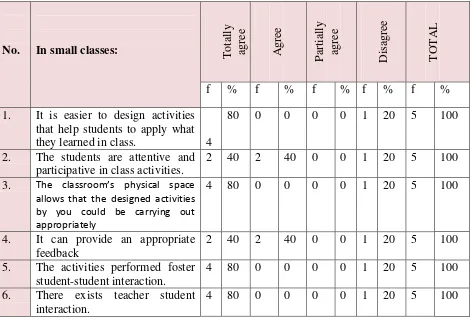
[image:30.595.83.554.449.767.2]Table 1
Teachers‟ Perceptions
No. In small classes: Tota
ll y agr ee Agr ee P
artially agr
ee Disag re e TOT AL
f % f % f % f % f %
1. It is easier to design activities that help students to apply what they learned in class. 4
80 0 0 0 0 1 20 5 100
2. The students are attentive and participative in class activities.
2 40 2 40 0 0 1 20 5 100
3. The classroom’s physical space
allows that the designed activities by you could be carrying out appropriately
4 80 0 0 0 0 1 20 5 100
4. It can provide an appropriate feedback
2 40 2 40 0 0 1 20 5 100
5. The activities performed foster student-student interaction.
4 80 0 0 0 0 1 20 5 100
6. There exists teacher student
24 7. It is easier to remember the
students‟ names 2 40 2 40 0 0 1 20 5 100
Author: Paulina Espinoza
Source: Teachers‟ questionnaire
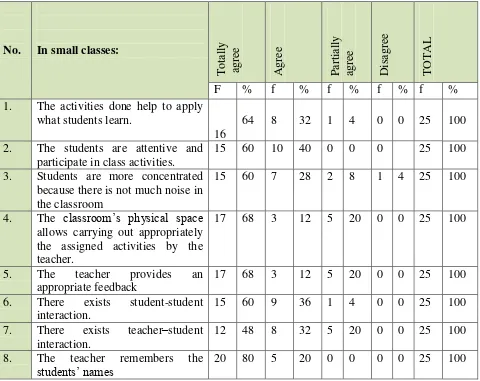
[image:31.595.82.562.239.620.2]Table 2
Students‟ Perceptions
No. In small classes:
Tota ll y a gr ee Agr ee P
artially agree Disag
re
e
TOT
AL
F % f % f % f % f %
1. The activities done help to apply what students learn.
16 64 8 32 1 4 0 0 25 100 2. The students are attentive and
participate in class activities.
15 60 10 40 0 0 0 25 100 3. Students are more concentrated
because there is not much noise in the classroom
15 60 7 28 2 8 1 4 25 100
4. The classroom‟s physical space
allows carrying out appropriately the assigned activities by the teacher.
17 68 3 12 5 20 0 0 25 100
5. The teacher provides an appropriate feedback
17 68 3 12 5 20 0 0 25 100 6. There exists student-student
interaction.
15 60 9 36 1 4 0 0 25 100
7. There exists teacher–student
interaction. 12 48 8 32 5 20 0 0 25 100
8. The teacher remembers the
students‟ names 20 80 5 20 0 0 0 0 25 100
Author: Paulina Espinoza
Source: Students‟ questionnaire
Regarding the first statement it is observed in table 1, based on teachers‟ questionnaire
25
facilitate the design activities that allow students to put into practice what they learned. While, only one teacher which represents 20% disagree with this statement.
Besides, based on students‟ questionnaire most of the students, sixteen of them which represent 64% totally agree that the activities in their small classes allow them to apply what they learned in the previous class. Besides, eight students (32%) agree and only one student which represents 4% of them, partially agree. However, none of the students surveyed disagreed with this statement.
Based on classroom observations, it is confirmed that in classes with few students it is easier for teachers to design activities that allow students to practice what they have learned; as for example, in the sixth class, the teacher was doing sentences with the perfect present tense for which students needed to remember the past participle of the verbs. The teacher wrote some verbs on the board, in three columns: present, past, and past participle, the last column had to be completed by each student. This activity allowed them to remember what they have learned in previous classes to correctly perform the exercises in class of that day. It is evident that with large classes, not all students can participate individually to see their mistakes and correct them, but with smaller classes it is possible to have the participation of all students and the support and feedback from their teacher.
Bray & Kehle (2011) state that class size is an important element in the success of
students‟ English learning. These authors consider a classroom with 20 or fewer students as a
small class, and those with more than 20 students as large. For them, small classes allow students to get favorable results; the main benefits small classes provide are: (a) students‟
26
participate in the activities proposed by the teacher during class; also, the teacher can give individual attention to students by identifying who needs more support in a particular task.
In relation to second statement, from teacher‟s questionnaire, it was found that one teacher which represents 20% disagree that the number of students affects the participation of students in the activities performed in class. On the other hand, two teachers (40%) totally agree that the number of students influence positively in the participation of the students in the classroom activities; in the same way, two teachers (40%) agree that classes with few students are better than large classes for the performance of activities.
Furthermore, based on table 1 on the students‟ questionnaire, it is observed that fifteen students which represent 60% totally agree that in small classes they are attentive and
participate during class activities; as well as, ten students which represent the 40% agree with this statement, and none of them partially agree or disagree.
Moreover, based on the classroom observations performed, it was noticed that in class with few students most of them were attentive because they knew that all had to participate in the activities planned by the teacher. Besides, depending on the topic and the sources used by the teacher, children were more or less interested.
In this way, Brown (2007) mentions that to keep students engaged in the English learning, teachers need to consider patterns, sounds, gestures, maps, jigsaws, summaries, symbols, multimedia, computer programs and visual aids, ask and answer questions, share experience, state concepts, role play, among others.
27
In relation with statement number three of table 2 of students‟ questionnaire, it was found that fifteen students who represent 60% totally agree that in small classes they are more concentrated because there is no much noise in the classroom, seven students which represent 28% agree, two students which represent 8% partially agree and only one student who
represent 4% disagree.
Regarding noise in the classroom Bray & Kehle (2011) mentioned that the noise affects on students‟ concentration and performance, so Bray & Kehle recommend that teachers should control the noise within the classroom by placing students away from air conditioners, fans, and other devices that impede student‟s concentration. Unfortunately, outside noise is not under the control of any English teacher, minimize external noise by closing the doors and windows of the class, to avoid noise of cars, planes, whistles, horns, and more.
Besides, classroom observation support the student‟s answers because it was noticed that in classes with few students they can concentrate better than in large ones, each student pay attention to the instructions and participate actively in all classroom activities. Also, it was noticed that in all classroom all doors and windows were closed to avoid the external noise of any type. Besides, students could listen to the teacher and answer without shouting and therefore avoiding discipline and concentration problems.
Regarding statement number four, on table 1 of teachers‟ questionnaire, it shows that two teachers which represent 40% totally agree that in small classes the classroom‟s physical
28
Besides, based on students‟ questionnaires, it was found that seventeen students,
which represent 68% totally agree that the physical space of the classroom allows carrying out appropriately the assigned activities; also, three students (12%) agree, five students (20%) partially agree, and any student disagree with this statement.
The results show that most of teachers agree that a class with few students in the classroom allows to develop all activities designed by teachers. This fact was confirmed during classroom observations since it was found that most classrooms have between 17 and 20 students per class. Besides, teachers said that they can develop all the activities planned; also, in classes with few students it is easier to perform activities because small classes allow all students to participate in all activities planned for each class. The activities observed included the use of songs, readings, and personal information as example the names and ages of each student, practice pronunciation, writing sentences and pair activities with question and answer to practice what they learned in class. Also, during the field observations it was found that the space of the classes was very adequate, which allows teachers to place the classroom seats in different ways according to the needs of students and the subject of each class.
During one of the observed schools, the position of school desks were always in groups of four, only the seats were placed individually when they had some test.
29
Regarding to statement number five, it is observed in table 1 of the teachers‟
questionnaire that forty percent of them (2) totally agree with the fact that it is easier to provide feedback to students in classes with few students. Besides, forty percent (2) agree with this statement. In contrast, twenty percent of teachers (only one) disagree.
While, on the students‟ questionnaires it is observed that seventeen students which represent 68% totally agree with the fact that in small classes an adequate feedback is provided during the class, three students which represent 12% agree, five students which represent 20% partially agree, and none of them disagree.
The majority of teachers during the field observation provided adequate feedback to students after each topic; in fact, the teacher asked to each student different questions concerning the same subject and repeating the correct pronunciation and meaning of new words learned.
Besides, giving feedback is very important in order to bring self-awareness and progress in any activity develop during the class because students continually need to know how they are doing, so providing feedback is one of the responsibilities of the teacher. One way of providing feedback can be by praising and encouraging students, by correcting them or by testing them; discussing and exchanging opinions, taking into account that feedback always can be done in a positive way. (Gower, et al 2005)
So, according to the field observations and the teacher‟s and students‟ questionnaires, the majority of teachers and students agree that it is easier to provide feedback when the number of students is small.
30
obtained that eighty percent of them (four teachers) totally agree and twenty percent (one teacher) disagree with this statement.
On the other hand, in statement number six of the students‟ questionnaire on table 2, it was found that fifteen students which represent 60% totally agree that in classes with few students there is interaction between them. Also, nine students which represent 36% agree, only one student which represents 4% partially agrees, and any student disagrees with this statement.
Besides, interaction with other students plays an important role in learning English as Lighbown & Spada (2006) say that the interaction with other learners allows them express their thoughts, opinions, and learn from each other when they are working together in a particular task. This type of interaction provides them an opportunity that any other way of interaction does because students can ask for confirmation or clarification, repetition with a questioning intonation; so in this way, they can learn languages forms, grammatical structures and specially vocabulary while they work with a partner.
In the same way, based on the observation performed the great majority of the teachers think that small classes allow students to more easily interact with each other, either in groups or pairs. Small classes have the advantage that in each planned activity every student can participate without having to wait for the next activity.
31
In the same way, in statement number seven on the students‟ questionnaire it was found that twelve students which represent 48% totally agree that there is teacher-student interaction, eight students which represent 32% agree, five students which represent 20% partially agree, and any student disagree with this statement.
Besides, based on classroom observations performed, it was found that in classes with few students interaction between teacher and students are more readily. In fact, it was noticed that with few students the teacher could allow the participation of all of them in each theme of class, so each student could give an example; also, the environment of the class allows the teacher to constantly interact with their students in each planned activity and students were motivated because they knew that everyone could participate every time.
Furthermore, teacher and student relationship is one of the aspects of classroom management as Marzano (2003) says that if the teacher maintains a good relationship of respect and trust with his pupils, they might work and learn more easily and without
disciplinary problems. So good teachers provide support and strong academic guidance but, at the same time taking into account the opinion of the learners based on their needs and desires for attempting to work as in a team.
Related to statement number seven on the teachers‟ questionnaire on table 1, it was found that two teachers which represent 40% totally agree that in small classes it is easier to
remember the students‟ names, two teachers which represent 40% agree, and any teacher
agrees or partially agrees with this statement and 20% disagree.
32
Based on classroom observations in small classes (17- 20 students per class) it was found that all teachers knew the names of all students and in many cases their last names to distinguish when two or more students had the same name; besides, it was also observed that teachers knew who child needed more support in reading, listening, speaking and writing and help in each case to improve these skills.
Therefore, based on teachers‟ questionnaires, students‟ questionnaires, and classrooms observations there are many benefits of teaching and learning English in small classes for both teachers and students. The most relevant ones found in this research were the activities done in small classes such as: read aloud with the whole class, sing a song, pair and group activities for complete a task and practice pronunciation of the new words learned, ask and answer questions according the level of the students, presentations, and games; which allow students to practice what they learn in previous classes; also, students in small classes are attentive and participate actively in all the activities done in class; students can concentrate better in classroom activities because there is not much noise in the classroom; the classroom space allows students to develop the activities assigned by the teacher adequately; the
teachers can give feedback in all activities planned; there is more interaction between students and between teachers and students and it is easier for the teacher to remember the students‟
names.
33 Table 3
Teachers‟ Perceptions
No. In small classes it is easier:
Tota ll y a gr ee Agr ee P artially agr ee Disag re e TOT AL
f % f % f % F % f % 8. Design and apply activities that allow
practicing the listening skill. 4 80 0 0 0 0 1 20 5 100 9. Design and apply activities that allow
practicing the speaking skill. 4 80 0 0 0 0 1 20 5 100 10. Design and apply activities that allow
practicing the reading skill.
3 60 1 20 0 0 1 20 5 100 11. Design and apply activities that allow
practicing the writing skills.
3 60 1 20 0 0 1 20 5 100 12. Design and apply group activities. 3 60 1 20 0 0 1 20 5 100 13. Design and apply individual activities. 2 40 2 40 0 0 1 20 5 100 14. Use technological resources. 4 80 0 0 0 0 1 20 5 100 15. Use didactical materials 4 80 0 0 0 0 1 20 5 100 Author: Paulina Espinoza
Source: Teachers‟ questionnaire
Table 4
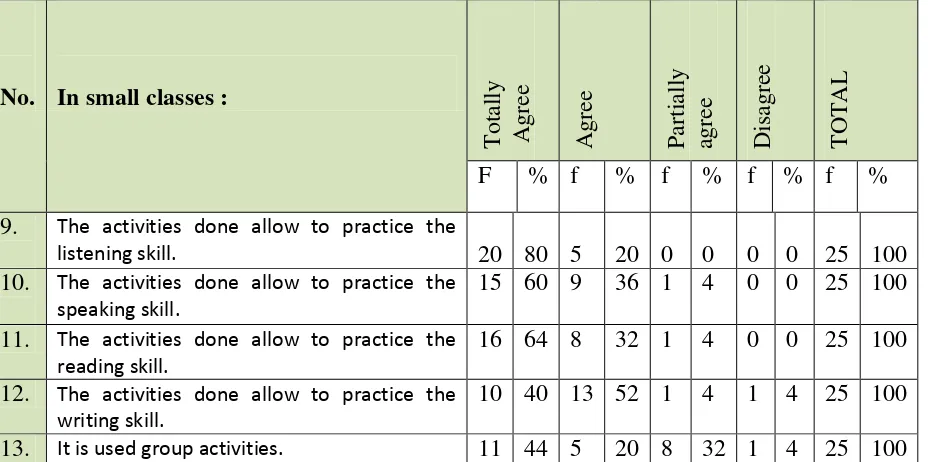
Students‟ Perceptions
No. In small classes :
Tota ll y A gr ee Agr ee P
artially agree Disag
re
e
TOT
AL
F % f % f % f % f % 9. The activities done allow to practice the
listening skill. 20 80 5 20 0 0 0 0 25 100
10. The activities done allow to practice the
speaking skill. 15 60 9 36 1 4 0 0 25 100
11. The activities done allow to practice the
reading skill. 16 64 8 32 1 4 0 0 25 100
12. The activities done allow to practice the
writing skill. 10 40 13 52 1 4 1 4 25 100
[image:40.595.85.549.536.767.2]34
14. It is used individually activities. 15 60 9 36 1 4 0 0 25 100 15. It is used technological resources. 20 80 5 20 0 0 0 0 25 100 16. It is used didactical materials. 15 60 9 36 1 4 0 0 25 100 Author: Paulina Espinoza
Source: Students‟ questionnaire
Related to statement number 8, on table 3 on the teachers‟ questionnaire, it was found that eighty percent of teachers (four) totally agree that in small classes it is easier to design and implement activities that allow practicing listening skills, none of the teachers agrees or partially agrees, and twenty percent (one teacher) disagrees with this statement.
Besides, statement number 9, from the students‟ questionnaire on table 4, it was found that twenty students, which represent 80%, totally agree that in small classes the activities carried out allow to practice the listening skill, five students, which represent 20%, agree and none of the students partially agrees or disagrees with this statement.
Similarly, in the questionnaire applied to students, they said that in their classes they did every day at least one listening activity, with songs, or listening a story to complete a determinate tasks, or listening for understanding.
Furthermore, during classroom observations it was found that listening activities were planned by teachers because most of the classes had CD with songs and vocabulary that students had to repeat; also, it can be added that small classes facilitate the participation of every student because they can repeat the correct pronunciation of the words they heard; in addition, this kind of activities help students to learn the proper pronunciation of new
35
to learn in a dynamic way. Besides, with listening activities all students can practice two skills at the same time as listening and speaking.
In this way, Nation and Newton (2009, p.37) suggest that “listening is a natural
precursor to speaking; the early stages of language development in a person‟s first language
(and in naturalistic acquisition of other languages) are depending on listening”, for this reason, several writers and researches have suggested that listening has an important role in the learning of a second or foreign language.
Regarding to statement number 9 showed on table 3 of the teachers‟ questionnaire, the results reveal that eighty percent of teachers (four) totally agree that in classes with few students it is easier to design and apply activities that allow practicing speaking skills. Any teacher agrees or partially agrees with this statement. In contrast, to one teacher which represent 20% who disagrees.
In the same way, related to statement number 10 on table 4 of the students‟
questionnaire it was found that fifteen students which represent 60% totally agree that in class with few students activities that allow them to practice speaking skills are performed, nine students which represent 36% agree with this statement, one student which represent 4% partially agree, and any student disagrees.
36
Regarding to statement number 10 on table 3 of the teachers‟ questionnaire, it was found that 60% of teachers (three) totally agree that in small classes it is easier to design and apply activities that allow practicing reading skills, one teacher who represent (20%) agree, while 20% of them (one teacher) disagree with this statement, and any teacher partially agree.
In the same way, regarding to statement number 11, on table 4 on the students questionnaire it was found that sixteen students which represent 64% totally agree that in small classes the activities done allow to practice reading skills. Eight students which represent 32% agree and one student which represents 4% partially agree, and any student disagrees with this statement.
In this sense, classroom observations support the results obtained from the teacher‟s
questionnaire because the classes were small; in fact it was observed that reading activities was implemented with the participation of all students, each student read a paragraph from the textbook they used every day in class, according to a topic chosen by the teacher and if the reading process finished learners began to read again in order to get everyone involved.
Small classes facilitate that the teacher can provide individual assistance to the needs of each student. Besides, it was noted that students of the higher grades (fifth and sixth) were able to identify and discuss the difficult words, phrases and concepts of the text because the readings used were according to the level of knowledge of students.
In this regard, Nunan (2000) classifies in a general way the teaching techniques into five main types as cognitive, interpersonal, linguistic, affective and creative. The cognitive teaching technique is based on activities in where students should infere, classify,
37
summarized while reading. The affective technique allows students share opinions, feelings and ideas about the subject with other classmates. Within the creative technique the main objective is when the students are working using brainstorming.
Regarding to statement number 11 on table 3 of the teachers‟ questionnaire, it was found that three teachers which represents 60% totally agree that in small classes it is easier to design and apply activities that allow practicing the writing skill, one teacher which represent 20% agrees with the statement, any teacher partially agree and one teacher which represent 20% disagree.
In relation with statement number 12, on table 4 of the students‟ questionnaire it was
found that ten students which represent 40% totally agree that in classes with few students activities that allow the practicing of writing skills are performed, thirteen students which represent 52% agree, one student which represent 4% partially agree and one student which represent 4% disagree.
Related to writing skills, Herrell & Jordan (2012, p.165) state that “one of the most challenging tasks for English language learners is acquiring writing skills. In order to support this daunting task, teachers must provide scaffolding, modeling, monitoring, and
encouragement”.
38
years old longer sentences were made using more tenses as the present and past perfect, and bearing in mind, the right writing present and past of regular and irregular verbs and the past participle.
Besides, the student‟s questionnaire confirms that most students think that in small classes it is easy to receive feedback from teachers to give them help, especially when someone writes a word poorly or when someone needs help to successfully complete a sentence, or part of a story; on the other hand, only a few students say that the number of students no matter to develop writing activities.
Regarding to statement number 12, on table 3 of the teachers‟ questionnaire, it was found that 60% of teachers (three teachers) totally agree that in small classes it is easy to design and apply group activities, 20% of them (one teacher) agree, 20% of them ( one teacher) disagree with this statement, and any teacher partially agrees.
In relation to statement number 13, on table 4 on students‟ questionnaire, it was found that eleven students which represent 44% totally agree that group activities are used in small classes, five students which represent 20% agree, eight students which represent 32% partially agree, and only one student which represent 4% disagree.
39
Also, students said that they feel comfortable when they work in groups with their peers because they are not afraid to make mistakes, learn from the mistakes of their peers, learn to value companionship, and especially because they feel motivated to learn. On the other hand, one teacher said that “it is the responsibility of the teacher to use the appropriate strategies to teach in both small and big classes”; so, this teacher thinks that the size of the class does not affect in the performance of group activities
Furthermore, related to group activities Kendall and Khuon (2005) state that although students receive instructions as a whole class to perform certain tasks, sometimes learners need to work in small groups to receive feedback from the teacher and to feel more
comfortable when they ask questions, which sometimes cannot be made in front of the whole class for reasons of shame or fear.
Regarding to statement number 13, on table 3 of the teachers‟ questionnaire it was found that 40% of teachers (two) totally agree that in small classes individual activities are used. 40% of teachers (two) agree, while 20% of them, one teacher, disagree, and any teacher partially agrees with this statement.
Besides, regarding to statement number 14 on table 4 of the students‟ questionnaire, it was found that fifteen students which represent 60% totally agree that individual activities are used in small classes. Nine students which represent 36% agree, one student which represents 4% partially agree and any of them disagree with this statement.
Besides, classroom observation supports that in small classes many individual activities can be developed for example: oral presentations, describing pictures using
students‟ own words, summarizing readings, asking and answering to questions, finding the
40
Also students‟ questionnaire shows that most of the learners think that in small classes
individual activities can be developed easily because there is more time spent in each student and teachers can monitor their individual work, and correct them when it is necessary.
In the same way, teachers that were surveyed argue that the small number of students facilitates the monitoring process of students‟ work; also, students can answer oral or written questions, with or without the teacher‟s help, and many individual speaking activities can be develop in each English class. To sum up individual activities facilitate the learning of certain activities that cannot be develop in groups.
In relation to statement number 14, on table 3 of the teachers‟ questionnaire, it was found that 80% of them (four) totally agree that in small classes it is easy to use technological resources. Any teacher agrees or partially agrees; while only 20% (one teacher) disagree with this statement.
Besides, regarding to statement number 15 of the students‟ questionnaire, it was found that twenty students which represent 80% totally agree that in classes with few students technological resources are used. Five students which represent 20% agree and any student partially agrees or disagrees with this statement.
During class observations, it was noted that technological resources allow teachers to provide, colorful, dynamic, and varied classes. The most observed technological resources in the different classes were: tape recorder, CD player, CDs with native-speakers‟ audios, power point presentations, electronic board, tablets, which motivate students‟ interaction and
41
for practicing grammar exercise, watch a film and learn the correct pronunciation, learn English or just for listening to fashion music that each student prefers.
Besides, students‟ questionnaires confirm that all learners feel comfortable with the
use of technology because they like computers and tablets to learn English or any other subject in the classroom.
Nowadays, technological resources need to be used in all English classes, in order to enhance the English teaching- learning process.
Regarding to statement number 15, on table 3 of the teachers‟ questionnaire it was found that eighty percent of the teachers (four) totally agree that in small classes it is easy to use didactic materials. Any teacher agrees or partially agrees with this statement. On the other hand, twenty percent (one teacher) disagree.
Regarding to statement number 16, on table 2 of the students‟ questionnaire it was
found that fifteen students which represent 60% totally agree that in classes with few students didactical materials are used. Nine students which represent 36% agree, one student which represents 4% partially agree, and any student disagree with this statement.
42
In the same way, according to the results obtained and the students‟ opinions, it is confirmed that small classes facilitate the use of didactical materials and it is both comfortable for teachers and students.
In this way, Harmer (2007) states that didactical resources are instruments that help us to achieve any goal; that is, supplementary materials help students develop the learning process. Therefore, this author suggests that teachers need to know what materials are available in the classroom and the types of materials that can be used in each class. He mentions that the types of didactical resources can be: permanent and technician. Permanent resources are the materials that the teacher has in hand and uses almost every day for
example: whiteboard, eraser, books, notebooks, pens, pencil, charts, flashcards, puppets, pointers, markers. Among the technician resources are audiovisual aids (computer, television, CD player, tapes, DVDs, overhead projectors and posters, cartoons strips, costumes, realia and field strips.), Computing media (multimedia programs, educative games, word
processor.). Therefore he concludes that learning how to use various types of resources is a major part of the modern teacher training.
Finally, based on teachers‟ questionnaire, students‟ questionnaires, and classroom observations there are many strategies and resources that can benefit to the teaching of English in small classes these are: activities that allow practicing listening skills such as dictoglos, leveled questions adjusting questioning strategies to the language level of students; activities that allow practice speaking activities such as: language focus lessons, collecting and processing words, verbal practice, and communication games creating opportunities for verbal interaction; activities that allow to practice readings skills such as: read, pair, and share working with a partner to negotiate the meaning, exploring a book to deepen
43
setting, moving into reading to foster comprehension, free voluntary reading, repeated reading; activities that allow practicing writing skills such as: preview/review building
vocabulary and concepts to support understanding; group activities such as: small groups and partners, cooperative learning; individually activities such as: predictable routines and signals, manipulative strategies, visual scaffolding providing language support through visual images; technological resources such as: multimedia presentations, handheld computers, tablets and smartphones and, of course, didactical material of all types can be used is small and large classes.
[image:50.595.80.546.430.669.2]How do students feel about learning English in small classes?
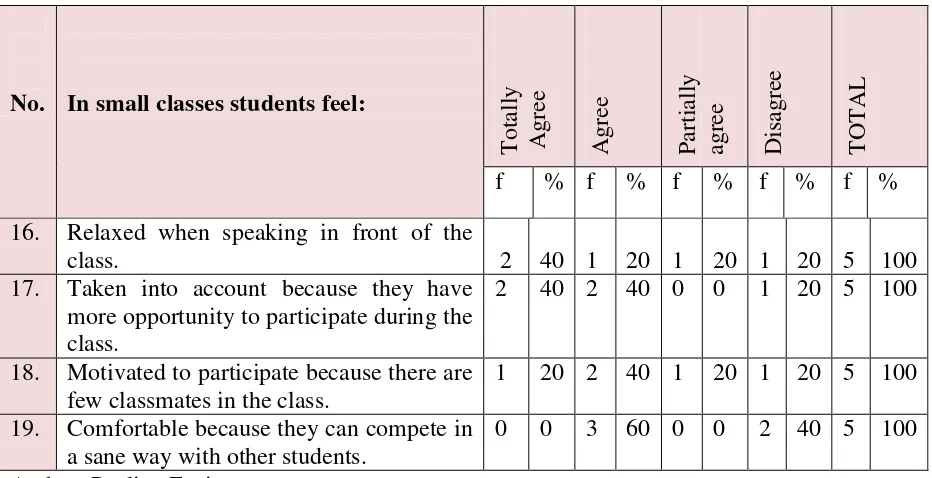
Table 5
Teachers‟ Perceptions
No. In small classes students feel:
Tota ll y A gr ee Agr ee P
artially agree Disag
re
e
TOT
AL
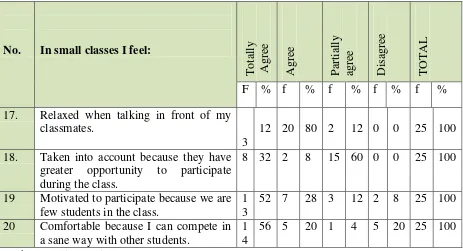
f % f % f % f % f % 16. Relaxed when speaking in front of the
class. 2 40 1 20 1 20 1 20 5 100
17. Taken into account because they have more opportunity to participate during the class.
2 40 2 40 0 0 1 20 5 100
18. Motivated to participate because there are
few classmates in the class. 1 20 2 40 1 20 1 20 5 100 19. Comfortable because they can compete in
a sane way with other students. 0 0 3 60 0 0 2 40 5 100 Author: Paulina Espinoza