http://journals.iztacala.unam.mx/index.php/amta/
ARTICLE
Disordered
eating
behaviors
in
Mexican
patients
with
and
without
type
2
diabetes
mellitus
Teresita
de
Jesús
Saucedo-Molina
a,∗,
Lita
Villalon
b,
Jessica
Zaragoza-Cortes
a,
Rodrigo
León
Hernández
c,
Zuli
Calderón
Ramos
aaÁreaAcadémicadeNutrición,InstitutodeCienciasdelaSalud,UniversidadAutónomadelEstadodeHidalgo,Mexico
bÉcoledesciencesdesaliments,denutritionetd’étudesfamiliales,Facultédessciencesdelasantéetdesservices
communautaires,UniversitédeMoncton,Canada
cFacultaddePsicología,UniversidadNacionalAutónomadeMéxico,Mexico
Received30October2014;accepted13March2015
Availableonline19June2015
KEYWORDS
Type2diabetes; Disorderedeating behaviors; Adults; Mexico
Abstract Theaimofthisworkwastocomparethedistributionofdisorderedeatingbehaviors (DEB)inMexicanadultpatients,withandwithouttype2diabetes.Across-sectionaldescriptive andcomparativefieldresearchwascarriedoutinasampleof169subjects(54%females;46% males)withameanageof47.9years.Thesamplewasmatchedintwogroups:patientswithtype 2diabetesandpatientswithoutdiabetes.DEBwereassessedwithavalidMexicanscalenamed EFRATA(EscaladeFactoresdeRiesgoAsociadosaTrastornosAlimentarios).Resultsconfirmed significantdifferencesinfoodandweightconcern(t=4.15,df152.09,p=0.000),normal eat-ingbehavior(t=4.03,df151.45,p=0.000)andemotionaleating(t=1.93,df160.76,p<0.05), EFRATA’sfactorsinwhichdiabeticsubjectsobtainedhighervaluesincomparisonwithno dia-beticpatients.Subjectswithoutdiabetesachievedhighervalueonlyinbingeeatingbehavior withstatistically significantdifference(t=2.11,df128.8,p<0.05)incontrastwithdiabetic patients.Sincethesefindingshavebeenopenthepossibilitytoproposespecificstrategiesthat encouragehealthyeatingbehaviors,bothinadultpatientswithandwithoutdiabetes. All RightsReserved© 2015Universidad NacionalAutónomade México,Facultad deEstudios Superiores Iztacala.ThisisanopenaccessitemdistributedundertheCreativeCommonsCC LicenseBY-NC-ND4.0.
∗Correspondingauthor.
E-mailaddress:[email protected](T.J.Saucedo-Molina).
PeerReviewundertheresponsibilityofUniversidadNacionalAutónomadeMéxico.
http://dx.doi.org/10.1016/j.rmta.2015.05.001
PALABRASCLAVE
Diabetestipo2; Conductas alimentarias deriesgo; Adultos; México
Conductasalimentariasderiesgoenpacientesmexicanosconysindiabetesmellitus tipo2
Resumen Elobjetivodeesteestudioconsistióencompararladistribucióndeconductas ali-mentariasderiesgoenpacientesmexicanosadultosconysindiabetestipo2.Seefectuóun estudiodecampodetipodescriptivoycomparativoenunamuestrade169sujetos(54%mujeres; 46%hombres)conunamediadeedadde47,9a˜nos.Lossujetosfuerondivididosen2grupos: pacientescon diabetes y pacientessin diabetes. Paramedir las conductas alimentariasde riesgoseempleólaEscaladeFactoresdeRiesgoAsociadosaTrastornosAlimentarios(EFRATA). Losresultadosconfirmarondiferenciassignificativasenpreocupaciónporelpesoylacomida (t=4,15,df152,09,p=0,000),conductaalimentaria normal(t=4,03,df151,45,p=0,000)y encomerporcompensaciónpsicológica(t=1,93,df160,76,p<0,05),factoresdelaEFRATAen losquelospacientesdiabéticosregistraronvaloresmásaltos.Encontrasteconlospacientes diabéticos,los sujetossindiabetes alcanzaronelvalor más altocon diferencia estadística-mentesignificativaenelfactorcomercompulsivo(t=2,11,df128,8,p<0,05).Apartirdeestos hallazgosseabrelaposibilidaddeproponerestrategiaspuntualesquefavorezcanconductas alimentariassaludables,tantoparapacientesadultosdiabéticoscomosindiabetes.
DerechosReservados©2015UniversidadNacionalAutónomadeMéxico,FacultaddeEstudios SuperioresIztacala.Esteesunartículodeaccesoabiertodistribuidobajolostérminosdela LicenciaCreativeCommonsCCBY-NC-ND4.0.
Introduction
Diabetes is one of the most devastating diseases of the century, with an economic burden both on families and on society. The incidence and prevalence of this disease haveincreasedprogressivelyintheentire world,and par-ticularly in America (World Health Organization, 2004). TheInternationalDiabetesFederation(2011)estimatesthat there are 366 million people with diabetes and another 280million areat identifiablyhigh risk ofdeveloping dia-betes,suchthattherewillbemorethan 552million with diabetesandanadditional398millionpeopleathighriskby 2030.Moreoverthreeoutoffourpeoplewithdiabetesnow liveinlowandmiddle-incomecountries.FurthertheWorld DiabetesFoundationestimatesthat1.1millionpeopledied ofdiabetesin2005.Nearly80%ofdeathsrelatedtodiabetes occur in countries with low and middle income; approxi-mately half of deaths by diabetes occur in people under 70yearsoldand55%ofthemarewomen(AmericanDiabetes Association,2009).
In Mexico, diabetes represents a public health prob-lem(Hernández-Ávila,Gutiérrez,&Reynoso-Noverón,2013) thataffects allsocial classes (Evaristo-Neto, Foss-Freitas, & Foss, 2010; Genz et al., 2014; International Diabetes Federation,2013).TheNationalHealthandNutritionSurvey (ENSANUT 2006; Olaiz-Fernándezet al., 2006) reporteda prevalenceofdiabetesof14%inthe20---79agegroup,which represents8millionMexicanswithdiabetesinthecountry. InHidalgoState,theprevalenceofdiabetesinadultsolder than20yearswas7.1%,beinghigherinwomen(7.9%)thanin men(5.9%).Recently,ENSANUT2012(Gutiérrezetal.,2012) hasreportedthatadults’proportionwithapriordiagnosisof diabeteswas9.2%,showinganimportantincreasecompared toENSANUT2006(7%;Olaiz-Fernándezetal.,2006).
Ontheotherhand,someresearchershadproposedthat disorderedeatingbehaviors(DEB)couldinstigate,atleast theoretically,theonsetoftype2diabetesmellitus(Cleator
et al., 2013; Mannucci et al., 1997). Furthermore, there havebeensuggestionsthatbingeeatingbehaviorsmay con-tribute to earlier onset of this disease, possibly via its impact onweight(Khalida, 2008; Mannucciet al., 2002). It isimportant tounderlinethat DEBareabnormaleating behaviorsthatincludebingeeatingwithlossofcontroland extremeweightcontrolbehaviors(i.e.,self-induced vomi-ting, dietary restraint anduse of diet, pills,laxatives, or diuretics)associatedwithan increasedsubsequent appari-tionofaneatingdisorders(ED)asanorexianervosa,bulimia nervosaorbingeeatingdisorder (AsociaciónAmericanade Psiquiatría,2002).
FewstudieshaveaddressedDEBinpatientswithtype2 diabetes;besidestheyhavebeenperformedononlyasmall number of patients (Kenardy,Mensch, Bowen, & Pearson, 1994)orinanobesesubpopulation(Mannuccietal.,2002). Bingeeatinghasbeenreportedtobefrequentamongtype2 diabeticpatients(Mannuccietal.,1997)ortohavea signif-icant positiverelationship withthispathology(Papelbaum etal.,2005).
Goebel-Fabbri(2008) has proposed that DEB are often well hidden and denied by diabetic patients; also they decreasetheir frequencyof glucosemonitoring,‘‘forget’’ tobringbloodglucoserecordstomedicalappointments,and alsofindwaystoinfluencebloodglucosemeterssothatthey record in-range blood sugars. Additionally, Goebel-Fabbri has identifiedthat the current goals of diabetes manage-mentincreasetherisktopresentDEB,precursorsofED.
Therefore,theaimofthisworkwastocomparethe dis-tributionofdisorderedeatingbehaviors(DEB)inasampleof Mexicanadult patients,withandwithout type2diabetes. Itishypothesizedthattherewillbeahigherprevalenceof DEBamongpatientswithtype2diabetesincomparisonto patients withoutthe pathology. Inaddition,we evaluated the association betweenbody mass index(BMI)and waist circumference(WC),withDEBinbothgroups.
Method
Participants
Mexican patients were recruited fromtwo health centers in HidalgoState(Pachuca andActopan). Across-sectional descriptive and comparative field research was carried out in a sample of 169 subjects (54% females; 46% males) with a mean age of 47.9 years (SD=±17.6). The sample was matched in two groups: patients with type 2 diabetes (46 females, 39 males); and patients without diabetes (46 females, 38 males). To classify participants, the presence of diabetes was considered when the fas-ting blood glucose level was ≤126mg/dL and confirmed bythepercentageofGlycosylatedHemoglobin(HbA1c)(no diabetes<6%,diabetes≥6%),asrecommendtheAmerican Diabetes Association (2009). The HbA1c was measured by NycoCardHbA1c-U-albumin-CRPtest(recertifiedbyNational GlycohemoglobineStandardizationProgram).
Disorderedeatingassessmenttool
Disorderedeatingbehaviors(DEB) wereassessed withthe EFRATA(EscaladeFactoresdeRiesgoAsociadosaTrastornos Alimentarios).Thisself-reportinginstrumentwasdeveloped andvalidatedforMexicanpopulationbyGómezPérez-Mitré (2000).TheEFRATAhasdemonstratedgoodreliability (Cron-bach’s Alpha 0.86 for males and 0.89 for females) and validity(criterionvalidityforthesinglefactorsrangingfrom 0.61to0.86).ThefivecrucialfactorsevaluatedwithEFRATA scale are:bingeeating,food andweightconcern, normal eating behavior, emotional eating, and dietary restraint. EFRATAisaLikertscalewithfiveresponseoptions:(1)never; (2)sometimes;(3)frequently(50%ofthetime);(4)very fre-quently(75%ofthetime);(5)always.Higherscoresindicate eatingproblems,exceptforanormaleatingbehaviorfactor, inwhichahighscorepointsoutnorisk.However,whenthis behavior is notfollowed correctly,it couldbecome arisk eatingbehavior.
Itisimportanttopointoutthatthebingeeatingfactor wasassessedaccordingtothediagnosticcriterionofDSM-IV (Asociación Americana de Psiquiatría, 2002). Food and weightconcernisassessedwithquestionsabout avoidable foods,suchas‘‘tortillas’’,pastaandbread.Normaleating behavior is measured asa jointof behaviorsthat help to maintainorimprovegeneralhealth,suchas,increased con-sumptionofvegetables,fruits,wholegrainsandwaterwhen itisfolloweddaily.Emotionaleatingreferstoeatinresponse toclearlylabeledemotionssuchassadness,depressionor anxiety.Asafinalpoint,dietaryrestraintdenotesdifferent unhealthyweightcontrolbehaviorssuchasskippingmeals, eating very little or eliminating foods considered ‘‘to be
fattening’’by thesubject. ForBodyMass Index(BMI)and waistcircumference(WC),thecategoriesrecommendedby theWorldHealthOrganization(2006)wereused.
TheprojectwasapprovedbytheComitéd’étiquedela recherchéaveclesêtreshumainsdelaFacultédesétudes supérieuresetdelarecherché (n◦ dossier0708-092), Uni-versité de Moncton, Canada. Participants were evaluated by two trained nutritionists to ensure the collection of reliabledata. Allparticipants signedan informedconsent form,andweretreatedaccordingtotheHelsinki declara-tion(AsociaciónMédicaMundial,2009).The subjectswere recruited and participated on a voluntary basis and all ofthem approved usingtheir data for researchpurposes. Comparisonsbetweenpsychometricscoresbyfactorswere included,asthiscouldenhancethepowertodetect differ-encesbetweengroups.
Statisticalanalysis
The software usedfor data entry and statistical analyses was SPSS version 20 for Windows. EFRATA’s factors were transformed into an index. To get this index, the items that formed each factor were averaged; then each aver-agewasre-categorizedconsideringtheoriginalratingofthe instrument(<1.5=1;1.5---2.5=2;2.6---3.5=3;>3.5=4).For comparisonbetweengroups(patientswithandwithout dia-betes)studentttestwasusedwithasignificancethreshold ofp<0.05.Spearman’scorrelationcoefficientswereapplied toidentifytherelationshipbetweenDEBandthenutritional statusindicators.
Results
In total sample, BMI distribution reported 26% normal weight,41%overweightand33%obese.BMImeaninpatients withdiabeteswas 28.29kg/m2 meanwhile innon-diabetic subjectswas28.09kg/m2,therewerenostatistical differ-ences.Itisimportanttopointoutthatwerefound similar percentages of patients withand without diabetes (over-weightandobese)outstanding 39%ofwomenwithobesity inbothgroups. Underweightsubjectswerenotfound.The distributionofBMIbysexandbygroupisshowninFig.1.
0.0%
Males with diabetes Females with diabetes Males without diabetes
Normal weight Overweight Obese
Females without diabetes 5.0%
15.0%
10.0% 20.0% 25.0% 30.0%
33.0%
23.0% 24.0% 44.0%
37.0% 39.0%
42.0% 41.0% 39.0%
29.0% 29.0%
20.0% 35.0%
40.0% 45.0% 50.0%
Table1 Percentagedistributionofwaistcircumferencebygroupandbysex.
Waistcircumferencecategories Females(n=92) Males(n=77)
Normal <80cm
Risk >80cm
Highrisk >88cm
Normal <94cm
Risk >94cm
Highrisk >120cm
Patientwithdiabetes 8.7% 91.3% 53.8% 38.5% 7.7%
Patientswithoutdiabetes 8.7% 15.2% 76.1% 55.3% 21.1% 23.7%
Distributionbysex 4.3% 12.0% 83.7% 54.5% 29.9% 15.6%
TheWCdistributioninTable1displaysthatfemaleswith andwithoutdiabetesreachedthehighestvaluesofhighrisk todevelop cardiovascular diseases (91.3%, 76.1%, respec-tively).In males, participants withdiabetes reportedthe highestpercentage(38.5%)ofrisktodevelopcardiovascular diseases.
Table2 showsthe percentagedistributionofDEB mea-suredbyEFRATA.Inthegroupwithdiabetes,thefoodand weightconcern factor achieved the highest frequency as
wellasnormaleatingbehavior.Maleswithdiabetesreported the highest frequencies for emotional eating behavior. Lastly,femaleswithoutdiabetesreportedbingeeatingand dietaryrestraintmostfrequently.
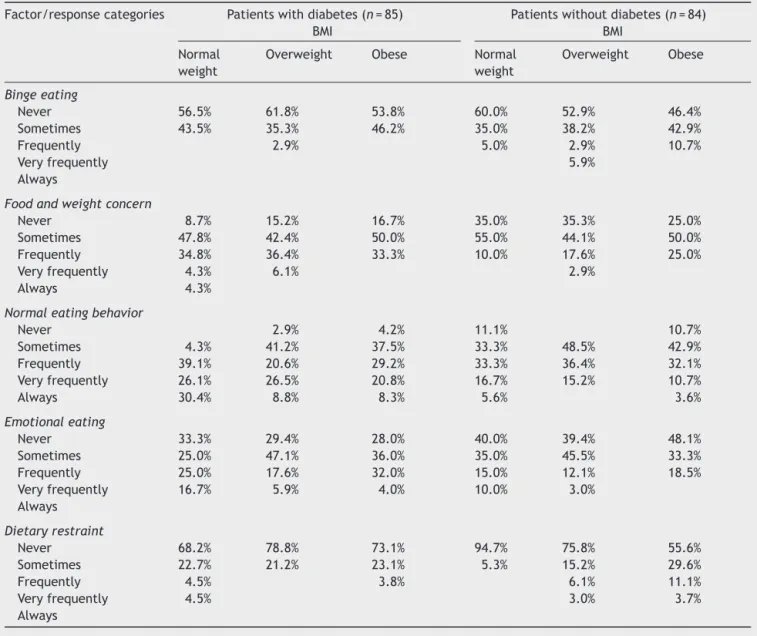
BasedontheBMI,Table3revealsthatpatientswith dia-betes,bothnormalweightandoverweight,reportedmost oftentohavefoodandweightconcern.Additionally,normal weightpatientswithdiabetesreportedthehighest frequen-cies of normal eating behavior and emotional eating. In
Table2 Distributionofdisorderedeatingbehaviorsinpatientswithandwithoutdiabetesbysex.
Factor/responsecategories Males(n=77) Females(n=92)
Patientswith diabetes
Patientswithout diabetes
Patientswith diabetes
Patientswithout diabetes
Bingeeating
Never 71.1% 60.5% 46.7% 45.5%
Sometimes 26.3% 34.2% 53.3% 43.2%
Frequently 2.6% 5.3% 6.8%
Veryfrequently 4.5%
Always
Foodandweightconcern
Never 18.4% 42.1% 9.5% 22.7%
Sometimes 42.1% 42.1% 50.0% 54.5%
Frequently 31.6% 15.8% 38.1% 20.5%
Veryfrequently 5.3% 2.4% 2.3%
Always 2.6%
Normaleatingbehavior
Never 2.8% 10.8% 2.2% 2.4%
Sometimes 25.0% 43.2% 33.3% 42.9%
Frequently 22.2% 32.4% 33.3% 35.7%
Veryfrequently 38.9% 8.1% 13.3% 19.0%
Always 11.1% 5.4% 17.8%
Emotionaleating
Never 30.8% 37.8% 29.5% 46.5%
Sometimes 33.3% 35.1% 40.9% 41.9%
Frequently 23.1% 21.6% 25.0% 9.3%
Veryfrequently 12.8% 5.4% 4.5% 2.3%
Always
Dietaryrestraint
Never 75.7% 75.7% 72.7% 71.4%
Sometimes 16.2% 18.9% 27.3% 16.7%
Frequently 5.4% 5.4% 7.1%
Veryfrequently 2.7% 4.8%
Table3 PercentagedistributionofpatientswithdisorderedeatingbehaviorsbasedondiabeticstatusandBMI.
Factor/responsecategories Patientswithdiabetes(n=85) BMI
Patientswithoutdiabetes(n=84) BMI
Normal weight
Overweight Obese Normal
weight
Overweight Obese
Bingeeating
Never 56.5% 61.8% 53.8% 60.0% 52.9% 46.4%
Sometimes 43.5% 35.3% 46.2% 35.0% 38.2% 42.9%
Frequently 2.9% 5.0% 2.9% 10.7%
Veryfrequently 5.9%
Always
Foodandweightconcern
Never 8.7% 15.2% 16.7% 35.0% 35.3% 25.0%
Sometimes 47.8% 42.4% 50.0% 55.0% 44.1% 50.0%
Frequently 34.8% 36.4% 33.3% 10.0% 17.6% 25.0%
Veryfrequently 4.3% 6.1% 2.9%
Always 4.3%
Normaleatingbehavior
Never 2.9% 4.2% 11.1% 10.7%
Sometimes 4.3% 41.2% 37.5% 33.3% 48.5% 42.9%
Frequently 39.1% 20.6% 29.2% 33.3% 36.4% 32.1%
Veryfrequently 26.1% 26.5% 20.8% 16.7% 15.2% 10.7%
Always 30.4% 8.8% 8.3% 5.6% 3.6%
Emotionaleating
Never 33.3% 29.4% 28.0% 40.0% 39.4% 48.1%
Sometimes 25.0% 47.1% 36.0% 35.0% 45.5% 33.3%
Frequently 25.0% 17.6% 32.0% 15.0% 12.1% 18.5%
Veryfrequently 16.7% 5.9% 4.0% 10.0% 3.0%
Always
Dietaryrestraint
Never 68.2% 78.8% 73.1% 94.7% 75.8% 55.6%
Sometimes 22.7% 21.2% 23.1% 5.3% 15.2% 29.6%
Frequently 4.5% 3.8% 6.1% 11.1%
Veryfrequently 4.5% 3.0% 3.7%
Always
thegroupwithoutdiabetes,participantsinoverweightand obese classes reported the highest percentages for binge eatinganddietaryrestraintratherthandiabeticpatientsin thesameBMIcategories.
To identify statistically significant differencesbetween patients with and without diabetes, student t test was used.Findingsconfirmedsignificantdifferencesinfoodand weightconcern(t=4.15,df152.09,p=0.000),normal eat-ingbehavior (t=4.03, df 151.45,p=0.000) andemotional eating(t=1.93,df 160.76,p<0.05),factors inwhich sub-jects withdiabetes obtained higher values in comparison with no diabetic patients. Subjects without diabetes got highervalue only inbinge eatingbehaviorwithstatistical differences(t=2.11,df128.8,p<0.05)incontrastwith dia-beticpatients.
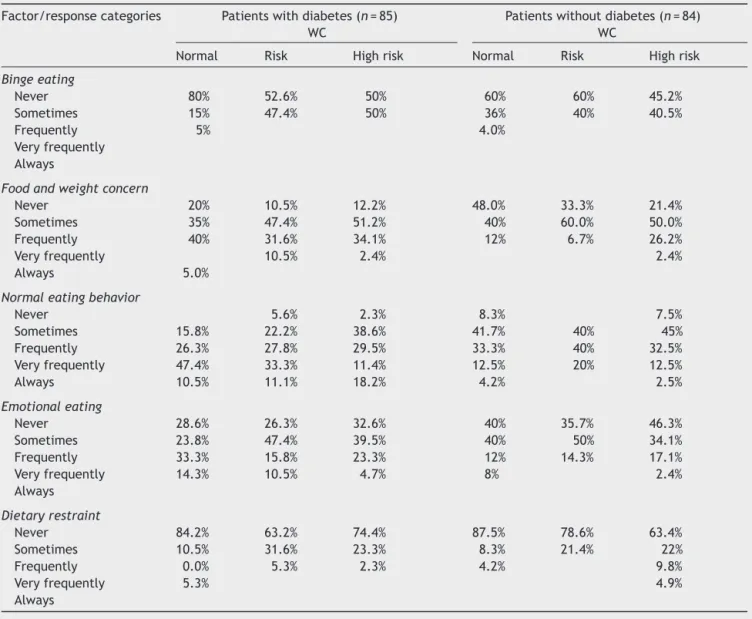
Table4revealsthatpatientswithandwithoutdiabetes andwithnormalWCfrequentlyhaveabingeeating behav-iorinsimilarpercentage(5%and4%,respectively).At the sametime,patientswithdiabeteswithnormalWCreported the highest percentages for foodand weightconcern,for
Table4 PercentagedistributionofpatientswithdisorderedeatingbehaviorsbasedondiabeticstatusandWC.
Factor/responsecategories Patientswithdiabetes(n=85) WC
Patientswithoutdiabetes(n=84) WC
Normal Risk Highrisk Normal Risk Highrisk
Bingeeating
Never 80% 52.6% 50% 60% 60% 45.2%
Sometimes 15% 47.4% 50% 36% 40% 40.5%
Frequently 5% 4.0%
Veryfrequently Always
Foodandweightconcern
Never 20% 10.5% 12.2% 48.0% 33.3% 21.4%
Sometimes 35% 47.4% 51.2% 40% 60.0% 50.0%
Frequently 40% 31.6% 34.1% 12% 6.7% 26.2%
Veryfrequently 10.5% 2.4% 2.4%
Always 5.0%
Normaleatingbehavior
Never 5.6% 2.3% 8.3% 7.5%
Sometimes 15.8% 22.2% 38.6% 41.7% 40% 45%
Frequently 26.3% 27.8% 29.5% 33.3% 40% 32.5%
Veryfrequently 47.4% 33.3% 11.4% 12.5% 20% 12.5%
Always 10.5% 11.1% 18.2% 4.2% 2.5%
Emotionaleating
Never 28.6% 26.3% 32.6% 40% 35.7% 46.3%
Sometimes 23.8% 47.4% 39.5% 40% 50% 34.1%
Frequently 33.3% 15.8% 23.3% 12% 14.3% 17.1%
Veryfrequently 14.3% 10.5% 4.7% 8% 2.4%
Always
Dietaryrestraint
Never 84.2% 63.2% 74.4% 87.5% 78.6% 63.4%
Sometimes 10.5% 31.6% 23.3% 8.3% 21.4% 22%
Frequently 0.0% 5.3% 2.3% 4.2% 9.8%
Veryfrequently 5.3% 4.9%
Always
Discussion
PercentagedistributionofBMIwassimilarinpatientswith andwithoutdiabetes(overweightandobese)butnearto40% ofwomenreportedobesityinbothgroups.Accordingto sam-ple age, it cannot be overlooked that women may be at menopausestage,situationthatinmanyoccasionspromotes bodyfatmodificationandweightgain(Lovejoy,Champagne, Jonge,Xie,&Smith,2008).
Althoughsomestudies(Mannuccietal.,1997)reported thatDEBareveryfrequentinpatientswithtype2diabetes, mainly binge eating (Kenardy et al., 2001), our research hypothesismustberejected,sincethedataofthisresearch showed other differences between patients with and withoutdiabetes.Forexample,bingeeatingwashigherin subjects without diabetes, mainly in obese participants. Thiswasalsothecasefordietaryrestraint.Itmustunderline thatdiabetic andnon-diabetic overweightsubjects inthe responseoption‘‘frequently’’(50%ofthetimes)achieved thesamepercentage(2.9%)ofbingeeating,confirmingthe resultsofMannuccietal.(2002)whodidnotfinddifferences
in the prevalence of this behavior between overweight diabetic and non-diabetic subjects, suggesting that type 2diabetes is notarisk factorfor bingeeating,aswellas Kenardyetal.(2001)whoproposedthatbingeeatingmay beanindependentriskfactortotype2diabetesmellitus.
ofthe kindsoffoods theyshouldeat.Onthe otherhand, diabetic patients with normal weight reported more nor-mal eating behavior than subjects without diabetes; this eventcouldexplainthat 33%ofmalesand24%offemales reported normal BMI, highervalues in contrastwith non-diabeticpatients(29% males,20%females).Usually, when individuals have been diagnosed withthe pathology, they change their lifestyle patterns, beginning by food intake, since that reducing energy intake with diet is the first, and probably most important therapeutic measure in the treatmentofdiabetes,mainlybecauseoverweightand obe-sityarecloselylinkedtoit(AmericanDiabetesAssociation, 2008).However,therelationshipbetweenbodymassindex, energybalanceanddiabetes seemsevenmorecomplexif oneconsidersthatspontaneousweightlossoftenoccurswith poorlycontrolleddiabetes(Weir&Bonner-Weir,2004).
Despitemorenormaleatingbehaviorwasreportedbythe groupwithdiabetes, theglucoseand HbA1clevelsof this groupwereabovenormal(152.5mg/dLand8.5%formales; 143.4mg/dL and 8% for females),reflecting poor control. Thisfindingcouldberelatedtohighscoresofemotional eat-ingasawayofcopingwiththeguiltyandanxietythatfollows poorself-controlandothernegativeemotionscausedbythe diagnosisofdiabetes,andworriesoffuturedevelopmentof complications(Choi,Rush,&Henry,2013).
Thesignificantcorrelationbetweenageandnormal eat-ing behavior in patients with diabetes might be because olderpeoplewanttoavoidfurthercomplicationsassociated withdiabetes and therefore change to a better lifestyle. With respect to BMI and WC and its negative association with normal eating behavior, some studies have reported thatirregularmealtimesincreasethepresenceofhighBMI andWCtoo(Newbyetal.,2003).
Inparticipantswithoutdiabetes,significantcorrelations wereobtained (age andemotional eating,BMI withbinge eating, food and weight concern and dietary restraint). ThesefindingsagreewithotherMexicanstudiesconducted withadolescentsandyoungadults,inwhichdatarevealed a trend topresent higher percentages of DEBas BMI and age increased(Saucedo-Molina & Unikel Santoncini,2010; Saucedo-Molina, Escamilla-Talón, Portillo-Noriega, Pe˜ na-Irecta, & Calderón-Ramos, 2008; Unikel, Saucedo-Molina, Villatoro,&Fleiz,2002).
As we know, WC is one of the best anthropometric indicators of abdominal visceral fat. Although the cause-and-effectassociationhasnotbeendefinitivelyestablished, the available evidence indicates that visceral fat is an importantlink betweenthe manyfacets ofthe metabolic syndrome:obesity,glucoseintolerance,hypertension, dys-lipidemia, insulin resistance, decreased HDL cholesterol concentrations and atherosclerotic cardiovascular disease (Wajchenberg,2000).Forthisreason,itisrelevanttopoint out the high percentage of participants without diabetes whofell in the high risk category according totheir WC. Betweenthem76.1%arefemalesand23%aremalesinwhich other significant correlationswere found withDEB (binge eating, food and weight concern and dietary restraint). Thesefindingsallowtoproposethat,ifthesesubjectsdid notmodifytheireatingbehaviors,loseweight,andin gen-eralchangetheirlifestyletheywouldsoonbepatientswith type 2 diabetes, not only because the excess of visceral abdominalfatandhighBMIareassociatedwiththisdisease,
but also because DEB have been proposed as a precur-sorofthepathology(Kenardy etal.,2001;Khalida, 2008; Papelbaumetal.,2005).
Conclusion
The results obtained demonstrate the need to continue working in this fieldonthe Mexican population, in which type2diabetes mellitusis amajorpublic healthproblem (Hernández-Ávilaetal.,2013;Olaiz-Fernándezetal.,2006; Gutiérrezetal.,2012).
Throughthesefindings,itispossibletoidentifypotential shortcomings(DEBisoftenoverlookedindiabeteseducation counselingsessions)andbeneficialfactorstopropose strate-giesthatencouragehealthyeatingandlifestylebehaviors, bothin patients withandwithout diabetes. Forexample, itwill be possible totailorcounseling sessionstoinclude psychotherapy, by a certified therapist, to address the emotionalandpsychologicalwell-beingofpatientswith dia-betes, or of patients with and without diabetes who are overweight,obeseorhavealargeWC.Itwillalsobepossible toincludediscussiononpsychologicalissuesduring individ-ualconsultationsandduringgroupcounselingsessionswitha multidisciplinaryteam(nutritionist,nurses,doctorsand psy-chotherapists)withpatientswithdiabetesorpatientswho areoverweight,obeseorhavealargeWC.
The current study has limitations. First, due to the cross-sectionalstudydesign,causalrelationshipscannotbe established.Second, thefindingscannotbegeneralizedto HidalgoState’spopulationbecausethestudywasnotcarried outwithaprobabilisticsample ofsubjectswithand with-out diabetes. Another limitation of this study is the lack of information about the type and frequency of physical activity,onmedication(e.g.meglitinidesandsulfonylureas, biguanides,␣-glucosidaseinhibitors,thiazolidinediones),or nutritionalsupplementstakenbytheparticipantsthatcan affectmoodoreatingbehaviors(e.g.antidepressants, anxi-olyticsorappetitesuppressants).Finally,theevolutionand chronicityofthe diabeteswere notidentifiedinthe sam-ple.Regardlessoftheselimitations,thecontributionsofthis researchareimportantbecauseit isthefirststudyofthis kindinHidalgoStateandithasledtoanewperspectivein type2diabetes.
Sources
of
support
This work was supported by the Faculté des études supérieures et de la recherche, Université de Moncton, Canada.
Ethical
disclosures
Protection of human and animal subjects.The authors declarethat the proceduresfollowed were inaccordance with the regulations of the responsible Clinical Research EthicsCommitteeandinaccordancewiththoseoftheWorld MedicalAssociationandtheHelsinkiDeclaration.
inthestudyhavereceivedsufficientinformationandhave given their informed consent in writing to participate in thatstudy.
Righttoprivacyandinformedconsent.Theauthorsmust haveobtainedtheinformedconsentofthepatientsand/or subjectsmentionedinthearticle.Theauthorfor correspon-dencemustbeinpossessionofthisdocument.
Conflict
of
interest
Theauthorsdeclarenoconflictofinterest.
Acknowledgments
We thank the participants in this study and the research assistant Lidiana Tavares Almeida,Master student at Uni-versité de Moncton in Canada, who conducted the data collection.Appreciationisalsoextended totheFacultyof Graduate Studies and the International Mobility Service, Université de Moncton, for research funds and mobility scholarshipforLidianaTavaresAlmeida.WealsothankPhD GildaGómezPérez-MitréforallowingustousetheEFRATA.
References
Affenito,S.G.,Backstrand,J.R.,Welch,G.W.,Lammi-Keefe,C.J., Rodriguez,N.R.,&Cynthia,H.C.A.(1997).Subclinicaland clin-icaleatingdisordersinIDDMnegativelyaffectmetaboliccontrol. DiabetesCare,20(2),182---184.
AmericanDiabetesAssociation(2008).Nutritionrecommendations and interventions for diabetes: A position statement of the American Diabetes Association. Diabetes Care, 31(Suppl. 1), 61---78.
AmericanDiabetesAssociation(2009).Diagnosisandclassification ofdiabetesmellitus.DiabetesCare,32(Suppl.1),562---567. AsociaciónAmericanadePsiquiatría.(2002).Trastornosdela
con-ductaalimentaria.InManualDiagnósticoyEstadístico delas EnfermedadesMentales-IV.TextoRevisado.Barcelona:Masson. AsociaciónMédica Mundial (2009). Manualde ÉticaMédica (2da Ed. [accessed20 Oct2014]). Available from: www.wma.net/ es/30publications/30ethicsmanual/pdf/ethicsmanuales.pdf Choi,S.E.,Rush,B.E.,&Henry,S.L.(2013).Negativeemotions
andriskfortype2diabetesamongKoreanimmigrants.Diabetes Educator,39(5),679---688.
Cleator,J.,Judd,P.,James,M.,Abbott,J.,Sutton,C.J.,&Wilding, J.P.H.(2013).Characteristicsandperspectivesofnight-eating behaviourinaseverelyobesepopulation.ClinicalObesity,4(1), 30---38.
Evaristo-Neto,A.D.,Foss-Freitas,M.C.,&Foss,M.C.(2010). Preva-lenceofdiabetesmellitusandimpairedglucosetoleranceina ruralcommunityofAngola.Diabetology&MetabolicSyndrome, 2,63.
Genz, J., Haastert, B., Müller, H., Verheyen, F., Cole, D., Rathmann, W., et al. (2014). Socioeconomic factors and effect of evidence-based patient information about pri-mary prevention of type 2 diabetes mellitus --- Are there interactions? BioMed Central Research Notes, 7, 541. http://dx.doi.org/10.1186/1756-0500-7-541
Goebel-Fabbri,A.E.(2008).Diabetesandeatingdisorders.Journal ofDiabetesScienceandTechnology,2(3),530---532.
GómezPérez-Mitré,G. (2000).Escala defactoresde riesgo aso-ciados a trastornos de la conducta alimentaria. Prevención primaria y factores de riesgo en trastornos alimentarios.
IN-305599(PAPIT) UniversidadNacional Autónomade México. 34507-H(CONACyT).
Gutiérrez, J. P., Rivera-Dommarco, J., Shamah-Levy, T., Villalpando-Hernández, S., Franco, A., Cuevas-Nasu, L., et al. (2012). Encuesta Nacional de salud y nutrición 2012. Resultadosnacionales.Cuernavaca,México:InstitutoNacional deSaludPública.
Hernández-Ávila, M., Gutiérrez, J. P., & Reynoso-Noverón, N. (2013).DiabetesmellitusenMéxico.Elestadodelaepidemia. SaludPúblicadeMéxico,55(Suppl.2),S129---S136.
International Diabetes Federation (2011). Global diabetes plan 2011---2021 [accessed 19 May 2014]. Available from: http://www.idf.org/global-diabetes-plan-2011-2021
International Diabetes Federation. (2013). IDF diabetes atlas
(6thed.).Availablefrom:www.idf.org/diabetesatlas
Johnson,F.,Pratt,M.,& Wardle,J.(2011).Dietaryrestraintand self-regulationineatingbehavior.InternationalJournalof Obe-sity,36,665---674.
Kenardy,J.,Mensch,M.,Bowen,K.,Green,B.,Walton,J.,&Dalton, M.(2001).Disorderedeatingbehavioursinwomenwithtype2 diabetesmellitus.EatingBehaviors,2(2),183---192.
Kenardy, J., Mensch, M., Bowen, K., & Pearson, S. A. (1994). A comparison of eating behaviors in newly diagnosed NIDDM patientsandcase-matchedcontrolsubject.DiabetesCare,17, 1197---1199.
Khalida,I.(2008).Eatingdisordersanddiabetes.Specialgroups. Psychiatry,7(4),179---182.
Lee,A.Y.(2013).Diabetescareforemergingadults:Transitionfrom pediatric toadultdiabetes caresystems. Annalsof Pediatric Endocrinology&Metabolism,18,106---110.
Lovejoy,J.C.,Champagne,C.M.,Jonge,L.,Xie,H.,&Smith,S. R.(2008).Increasedvisceralfatanddecreasedenergy expendi-tureduringthemenopausaltransition.InternationalJournalof Obesity,32,949---958.
Mannucci, E., Bardini, G.,Ricca, V., Tesi,F., Piani, F., Vannici, R., et al. (1997). Eating attitudes and behavior in patients withtypeII diabetes.Diabetes, Nutrition& Metabolism, 10, 275---281.
Mannucci, E., Tesi, F., Ricca, V., Pierazzuoli, E., Barciulli, E., Moretti, S.,et al. (2002). Eating behavior in obese patients with and without type 2 diabetes mellitus. International Journal of Obesity and Related Metabolic Disorders, 26(6), 848---853.
Newby,P.,Muller,D.,Hallfrisch,J.,Qiao,N.,Andres,R.,&Tucker, K. (2003). Dietary patterns and changes in body mass index andwaistcircumferenceinadults.AmericanJournalofClinical Nutrition,77,1417---1425.
Olaiz-Fernández,G.,Rivera-Dommarco,J.,Shamah-Levy,T.,Rojas, R., Villalpando-Hernández, S., Hérnandez-Ávila, M., et al. (2006). Encuesta nacional de salud y nutrición. Cuernavaca, México:InstitutoNacionaldeSaludPública.
Papelbaum,M.,Appolináiro,J.C.,DeOliveira,M.R.,Noema,E. V.C.,Kupfer,R.,&Ferreira,C.W.(2005).Prevalenceofeating disordersandpsychiatriccomorbidityinaclinicalsampleoftype 2diabetesmellituspatients.RevistaBrasileiradePsiquiatria, 27(2),135---138.
Pérez, A., Barriguete, J.A., & Rivera, T. (2005). Prevención de lasalteracionesde laconductaalimentariaengrupos especí-ficos:DiabetesMellitus.RevistaIberoamericanadePsicología, 13,84---87.
Saucedo-Molina, T. J., Escamilla-Talón, T. A.,Portillo-Noriega, I. E.,Pe˜na-Irecta,A.,&Calderón-Ramos,Z.(2008).Distribución einterrelacióndefactoresderiesgoasociadosatrastornosde la conducta alimentariaen púberes hidalguenses,hombres y mujeres, de 11a 15 a˜nos de edad. Revista de Investigación Clínica,60(3),231---240.
delgadezeíndicedemasacorporalenestudianteshidalguenses depreparatoriaylicenciaturadeunainstituciónprivada.Salud Mental,33(1),11---19.
Unikel,C.,Saucedo-Molina,T.J.,Villatoro,J.,&Fleiz,C.(2002). Conductasalimentarias de riesgoydistribución delíndicede masacorporalenestudiantesde13a 18a˜nos.SaludMental, 25(2),49---57.
Wajchenberg, B. L. (2000). Subcutaneous and visceral adipose tissue: Their relation to the metabolic syndrome. Endocrine Reviews,21(6),697---738.
Weir,G.C.,&Bonner-Weir,S.(2004).Fivestagesofevolving-cell dysfunctionduringprogressiontodiabetes.Diabetes,53(Suppl. 3),16---21.
World Health Organization (2006). Global data base on body mass index [accessed 30 Jan 2015]. Available from: http:// apps.who.int/bmi/index.jsp?introPage=intro3.html