
Didactic units and multimedia materials as useful tools for a virtual platform
114
0
0
Texto completo
(2) ii. Contents. Contents .................................................................................................................................. ii Charts ..................................................................................................................................... v Figures ................................................................................................................................... vi Introduction ............................................................................................................................ 7 Context of the Internship ...................................................................................................... 10 Functions into the Internship ................................................................................................ 10 Description of the institute ................................................................................................... 10 Justification .......................................................................................................................... 14 Objectives ............................................................................................................................. 16 General objective .................................................................................................................. 16 Specific Objective................................................................................................................. 16 Theoretical Framework ........................................................................................................ 18 Virtual platform .................................................................................................................... 19 Benefices and characteristics of virtual platforms ............................................................ 21 Types of virtual platforms ................................................................................................ 24 Didactic Unit ........................................................................................................................ 25 Components of a Didactic Unit ........................................................................................ 26.
(3) iii. Multimedia ........................................................................................................................... 29 Multimedia Material ............................................................................................................. 31 Advantages of Multimedia in Education .......................................................................... 33 Disadvantages of Multimedia in Education ..................................................................... 34 Principles to Develop Materials for Foreign Language Teaching ....................................... 35 1.. Materials should impact: ............................................................................................. 35. 2.. Materials should develop students` confidence. ......................................................... 35 Stages in the design of multimedia materials ................................................................... 37. Instructional Design ............................................................................................................. 41 Research Phases .................................................................................................................... 42 Phase 1. Needs analysis: ................................................................................................... 42 Phase 2. Designing: .......................................................................................................... 43 Phase 3 Development and Implementation. ..................................................................... 44 Phase 4 Assessment .......................................................................................................... 45 Phase 5 Publication........................................................................................................... 46 Development of the Internship ............................................................................................. 46 Need Analysis. ...................................................................................................................... 46 The instrument for data collection. ....................................................................................... 47.
(4) iv. Description of the survey.................................................................................................. 49 Characteristics of the survey respondents. ....................................................................... 50 Needs Analysis Results ........................................................................................................ 51 General conclusions of Need Analysis. ............................................................................ 55 Decisions based on the results of the Needs analysis ........................................................... 56 Development of the second phase in this Internship ............................................................ 57 Development and Implementation Phase 3 .......................................................................... 61 Description of pre and post test ............................................................................................ 61 Analysis of pre-test. .............................................................................................................. 63 Conclusions of the pre-test. .................................................................................................. 66 Implementation of the B-learning plan after pre-test ........................................................... 67 Analysis pre and post-tests results. ....................................................................................... 71 Conclusions .......................................................................................................................... 75 Bibliografía........................................................................................................................... 79 Annexes ................................................................................................................................ 84 Surveys ................................................................................................................................. 84 Students’ Survey ............................................................................................................... 84 Teachers’ Survey .............................................................................................................. 89.
(5) v. Pre-Test ................................................................................................................................. 94. Charts CHART 1. ....................................................................................................................................................................... 12 CHART 2. ....................................................................................................................................................................... 13 CHART 3. ....................................................................................................................................................................... 17 CHART 4. ....................................................................................................................................................................... 40 CHART 5. ....................................................................................................................................................................... 52 CHART 6. ....................................................................................................................................................................... 53 CHART 7. ....................................................................................................................................................................... 60 CHART 8. ....................................................................................................................................................................... 63 CHART 9. ....................................................................................................................................................................... 64 CHART 10. ..................................................................................................................................................................... 65 CHART 11. ..................................................................................................................................................................... 65 CHART 13. ..................................................................................................................................................................... 69 CHART 14. ..................................................................................................................................................................... 72 CHART 15. ..................................................................................................................................................................... 72.
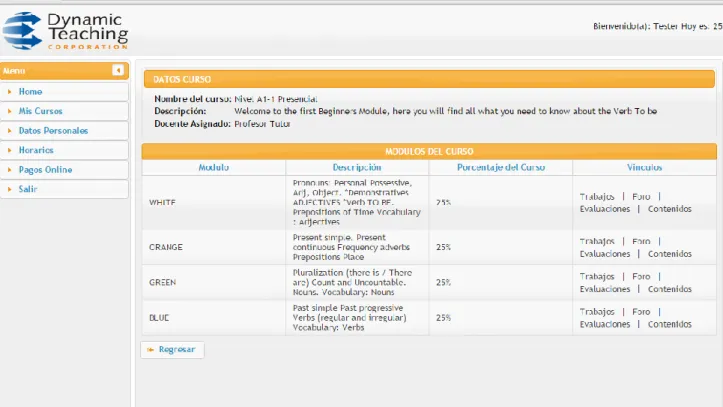
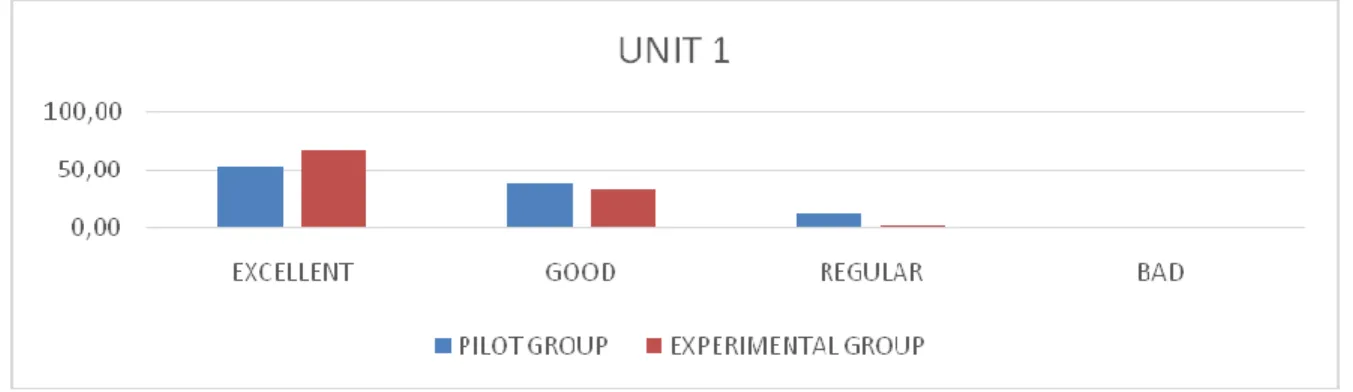
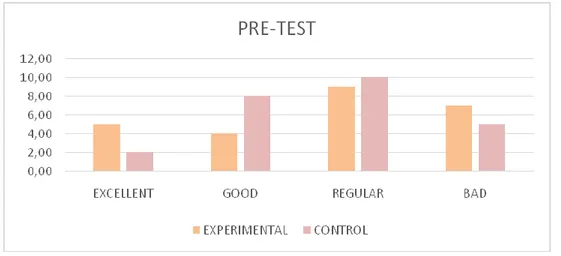
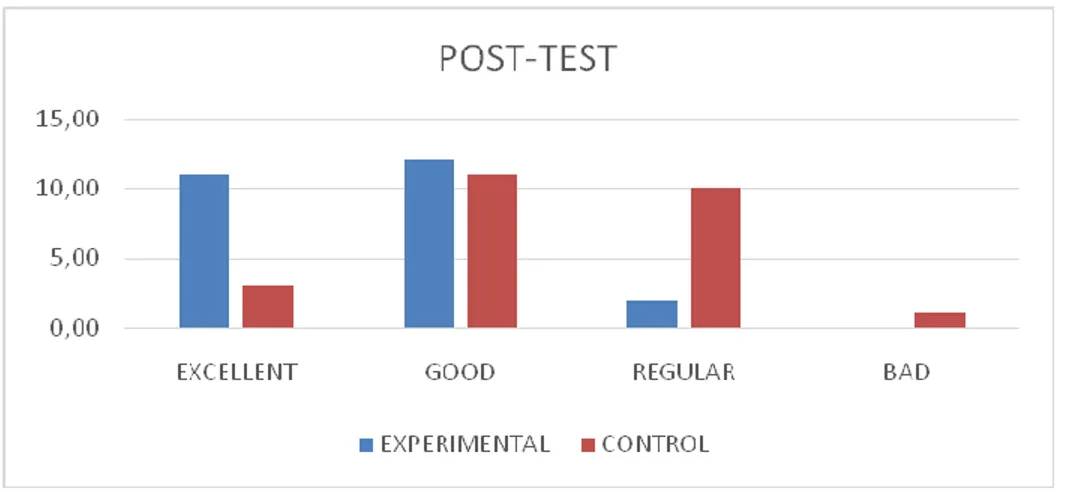
(6) vi. Figures. FIGURE 1. STEPS OF MULTIMEDIA STATED BY PATIÑO (2009). .................................................................................................. 31 FIGURE 2. MULTIMEDIA ELEMENTS PROPOSED BY GISBERT (1999). .......................................................................................... 39 FIGURE 3. DYNAMIC PLATFORM INDEX. ................................................................................................................................ 67 FIGURE 4. EVALUATION GRAPHIC OF UNIT 1. ......................................................................................................................... 70 FIGURE 5. PRE-TEST RESULTS.............................................................................................................................................. 73 FIGURE 6. POST-TEST RESULTS............................................................................................................................................ 74.
(7) 7. Introduction. This internship was carried out in Bogotá in a language institute called Dynamic Teaching Corporation registered with the District Education Officer Approval by Resolution No. 13013. This internship was also developed to obtain an academic degree for the academic program “Licenciatura en Educación Básica con Énfasis en Inglés” from Universidad Distrital Francisco José de Caldas. This internship sought to optimize the use of the virtual platform for A1-2 Level through didactic units and multimedia materials. The virtual platform used in this institute was not used properly by students within their learning process; this situation was evidenced through a report delivered by Administrative Department of Dynamic Teaching Institute in January, 2015 and for that reason the idea to improve the use of the virtual platform emerged. The first chapter of this internship report is about the description of the company, its branches and the academic programs offered into the English language program. Besides, there are the objectives which were achieved during the process of the internship. Finally, the reader can find the justification part of this research in which four aspects were taken into account; 1) the unsuitable use of Dynamic´s virtual platform by teachers and students, 2) the contents of this platform based on grammar activities only 3) the lack of the feedback of the activities hosted on the platform 4) the lack of a working plan where these activities are useful in classroom activities. This research sought to optimize the virtual platform in three ways; first designing activities with multimedia materials where students could improve their speaking and listening skills by.
(8) 8. applying some reading and writing exercises because the activities on that platform were focused on grammar only. Secondly, students could get the corresponding feedback of the activities done on the platform since Hot potatoes program allowed students to get it immediately. According to López Ogáyar & G. Níkleva (2012) Hot Potatoes activities allow students provide information return that helps both for work and evaluation, that is, they can design interactive tests with the student to make self-assessment acquired knowledge (p. 5) Consequently, the design of some multimedia materials such as; PowerPoint and Prezi presentations made the contents on the platform more appealing to the students. As Andresen & Den Brink (2013) affirmed, Multimedia is very helpful and fruitful in education due to its characteristics of interactivity, flexibility, and the integration of different media that can support learning, take into account individual differences among learners and increase their motivation (p.25) Finally, this research improved the use of this platform by students in A1-2 level through a Blearning plan designed by the intern where students took six hours in classroom activities (divided into theory and workshops explained previously in this paper) and at least two hours working on virtual platform, sometimes students worked on the platform more than two hours. The students doing this could receive a feedback and the intern-teacher incorporated the use of this platform into her classroom activities since she gave students homework that they had to do at home and then the activities hosted on the virtual platform would be evaluated in classroom. This working plan needed to be hosted on the virtual platform, but to make it understandable it was necessary to design the four didactic units with the contents in Dynamic program..
(9) 9. The second part of chapter one it is explained the steps that the intern followed and the methodology proposed by her which had five phases and activities based on the objectives proposed; phase (1) Needs Analysis, phase (2) Design of didactic units and multimedia materials, phase (3) Development and Implementation process, phase (4)Assessment process, and finally phase (5) publication. In the second chapter the reader will find the theories presented in the methodology proposed and the parameters which were included in this research process. Moreover, there are some keywords which made up the theoretical framework of this research such as: Virtual platform and its classifications, B-learning, Didactic Unit, definitions and Components of a Didactic Unit, and Multimedia materials and its Principles to develop materials for foreign language teaching. In the chapter three, there is the instructional design of this project and the explanation of the five phases proposed in this internship. What is more, the reader will find the schedule of the activities developed in this research which were presented in a chart with the timetable, the description of the survey applied in the need analysis, and the instruments used to get the data and finally the results of the need analysis. This chapter also explains the development of this internship, which started with the process of designing the didactic units and multimedia materials, then it is explained the steps that the intern took into consideration to apply the b-learning process that she proposed and finally, how the data analysis was developed through the analysis of the pre and posttest applied to check the students’ learning process before and after the implementation, the result of the.
(10) 10. rubrics applied to evaluate if the activities and multimedia materials used were good enough and finally the conclusions of the whole internship.. Context of the Internship. This internship was developed in a local language institute located in Bogotá, Colombia, and it was an enterprise work which sought to help the company to improve its teaching and learning strategies in English as a foreign language through the implementation of didactic units which incorporated the use of multimedia materials in most of the classrooms activities. This project was non-remunerated but it lasted six months which started on July 6th 2015 and finished on November 28th 2015. By that time the intern completed 420 hours requested by Agreement 031 November 26th 2013, Academic Council Distrital University. These hours were divided into 21 weeks, completing 20 hours per week, five days a week. See the annexes. Functions into the Internship To assist students in both classroom and the virtual platform To motivate students during their learning process through To carry out activities to improve students` communicative skills Description of the institute Dynamic Teaching Corporation is a private language institution which has been working for more than fifteen years with a special focus on the speaking skills aimed at fostering work and human development. This institute has Official Approval by the Secretary of Education of.
(11) 11. Bogotá (Resolution No. 13013). Its programs have been designed taking into account the Common European Framework (CEF) structure so that students can take A1 A2 AND B1 level. Dynamic teaching has the following programs which the reader can find on its webpage http://www.dynamic-teaching.edu.co/Programas-Ingles.html 1. Dynamic English face-to face class is the adult program which lasts 12 months during which students take six hours per week divided into two hours of theory and four hours of workshops 2. Dynamic blended or Dynamic ONLINE. This program seeks to apply new technologies in the teaching and learning processes. It is also an adult program which was developed in order to make easier the lives of those students who do not have time or enough time to take face-to face classes because of their jobs or university schedules. 3. Dynamic Kids. This program is for children between 5 and 13 years of age. It lasts 16 months divided into four levels: starters, movers, flyers, and flyers advanced. 4. Dynamic Proficiency. This program is focused on advanced students of English, and it seeks to improve English communicative skills for professionals, so at the end of this program students will obtain a B2 level. 5. French, Chinese-mandarin and Portuguese programs which last 10 months and have the same structure as the English face-to face class. As this research project was focused on working with adults, in chart 1 it is explained how this English program is divided..
(12) 12. Chart 1. English´s Adult program. Common European framework. Dynamic Level. Hours per level. A1-1. 60 hrs.. A1-2. 60 hrs.. A2-1. 60 hrs.. A2-2. 60 hrs.. B1. 120 hrs.. A1. A2. B1. Description of hours 2hrs theory + 4hrs workshop 2hrs theory+ 4hrs workshop 2hrs theory+ 4hrs workshop 2hrs theory+ 4hrs workshop 2hrs theory+ 6hrs workshop. Entire hours per week 6hrs 6hrs 6hrs 6hrs 10hrs. Entire time per month 2.5 months 2.5 months 2.5 months 2.5 months 3 months. Note. The chart was elaborated by the intern to summarize the hours and level in Dynamic teaching Program.. The syllabus of Dynamic Teaching Program is divided into four weeks each one has a color and each color has some specific grammatical tenses. Every week students must take 6 hours of class divided into 2 hours of theory and four hours of workshop. The platform used at Dynamic is a computer system on which application programs can run. These kinds of platforms are called own development platform because they do not have economic objectives, but more responsive to educational and pedagogical factors, and they are not usually disclosed to the general public. Charcas (2009) The theory part of this English program is the explanation of the grammatical aspects of English language and how to use them; this theory class is always taught on Mondays (the first day of the week) because the teachers explain the grammatical structure of the contents designed in the program and this class lasts 2 hours. After the theoretical class, the students take workshops in which they can practice the topics explained and they also improve at least one of.
(13) 13. the four linguistic skills in English such as; reading, writing, listening, and speaking. The following chart shows an example of the contents for A1-2 level and the topics that teachers explain in their theoretical class.. Chart 2. The syllabus of Dynamic Teaching Program for A1-2 level. White Week. Orange Week. Future will. comparative /Superlative 2nd conditional Modal verbs. Future be going to First conditional. Green Week Present perfect Past perfect Third conditional. Blue Week Present/ Past perfect progressive Adjectives -ed / -ing Indefinite pronouns Adverbs of manner. Note: each week has some grammatical topics which will be developed into the English program, for example in white week students practice will, be going to and first conditional. In orange week they practice comparatives and superlatives, second conditional and modal verbs etc.. The students can pass to the next level when they complete the necessary hours as shown in chart 1 (English´s Adult program). As soon as they complete those requiring hours, they must take and approve a test designed for each level into the academic program..
(14) 14. Justification. First and foremost and bearing in mind the reasons which motivated me to achieve this research, there are four important aspects which affected the function of the virtual platform; 1) the unsuitable use of Dynamic´s virtual platform by teachers and students, 2) the lack of a working plan in which these activities can be used in classroom activities 3) the contents of this platform based on grammar activities only, and 4) the lack of the feedback of the activities hosted on the platform. Dynamic Teaching Corporation as a private language institute decided to be involved in a world where the technology is a useful tool for business and education. In regard to this idea both departments implemented a virtual platform with two purposes: firstly, the students could practice at home what they had learned in class developing some exercises of this learning platform, and secondly, teachers could use the platform as an extra material to develop their classes. With these two ideas it was evidenced that neither teachers nor students used this platform properly. The unsuitable usage refers to inappropriate use of the virtual platform because of two reasons; 1. Teachers did not include the platform exercises into their classroom activities due to that the activities were focused on grammar only and besides, the format of those activities were made with Microsoft Word which is not interactive and didactic at all for students. 2. Students did not spend time to develop activities on the platform because its use was not mandatory or it was not a requirement within the English program. The first aspect mentioned previously “the unsuitable use of Dynamic´s virtual platform by teachers and students” emerged with a report delivered by academic department when it was.
(15) 15. shown that only 13 percent of 500 students into the adults’ English program had used the platform only once during a period of three months, this report was discussed in a teachers meeting in January, 2015 and with this information the idea to optimize the use of the virtual platform emerged. After the idea to work on the improvement of this virtual platform in order to make it much more functional, it was decided to apply two informal conversational interviews to one teacher and one student who had been in the process of implementation of this platform for ten months. These interviews were applied to search for the causes and the problems that both teacher and the student had found during the implementation of this virtual platform and in this way I could evidence other three aspects that emerged here; 2) the lack of a working plan where these activities were used in classroom activities 3) the contents of this platform based on grammar activities only 4) the lack of the feedback of the activities hosted on the platform. Afterward, two surveys were applied to verify if some of their opinions about the platform would be the same for other students and teachers. These surveys confirmed some of the problems that were evidenced in the interviews because most of the students affirmed that the exercises on this platform included grammar exercises only and this made it less appealing for them. Other aspects students affirmed was the lack of feedback that they were given when they developed activities of the platform and finally the use of this virtual platform was not a requirement within the program, so they did not spend time on it. Once the aspects required to improve this virtual platform were confirmed, It was established the general objective 1.To optimize the use of the virtual platform for A1-2 Level through didactic units and multimedia materials. Remember that the survey applied demonstrated the.
(16) 16. needs analysis in the institute. The level (A1-2) in Dynamic program was chosen because the moment the surveys were applied, most of the students were on level A1-1 (the first level in Dynamic English program) and in order to optimize the platform, it was necessary to focus on designing some multimedia materials and didactic units, but this process would have lasted at least one month. Objectives. General objective To optimize the use of the virtual platform for A1-2 Level through didactic units and multimedia materials Specific Objective To enhance students´ communicative skills in English by implementing the didactic units and multimedia materials To design a new B-learning process in order to improve the use of the virtual platform..
(17) 17. The development of this internship was presented into five phases explained in the following chart: Chart 3. The phases of the internship. Phases. Activities. Time. Needs analysis Phase 1. 1.2 To design and apply two surveys one for teachers and other for students to see the needs in the learning process and how often they both use the virtual platform. 1.3 to analyze the results of the surveys 1.4 To choose the students in my pilot group, control and experimental group.. 2.2 To define the objectives of the learning units taking into account both the content for Dynamic’s program and the steps suggested by authors in my theoretical framework.. Designing Phase 2. 2.3. To Identify the authoring systems that are going to be used in the design of multimedia materials 2.4 To design the multimedia materials using Prezi, Hot potatoes and PowerPoint. 2.5 to apply the units to pilot group and observe and to correct the mistakes found during this process.. Development and Implementation 3.3 To apply the didactic units to control and experimental group. Phase 3. 3.4 To observe the implementation process and to write the teacher`s diary. From November 28th to December 21st. Assessment Phase 4. 4.1 To apply and analyze the posttest to evaluate students´ knowledge. From October 1st to November 28th. 3.1 To design and apply four rubrics to analyze the students’ skills and how my students started before to implement this project. 3.2 To design and evaluate the pretest supported by the contents of English program.. From August 3rd to September 30th. 2.1 To design a new B-learning process in order to improve the use of the virtual platform.. From July 6th to July 31st. 1.1 To establish what factors affected the suitable use of the platform by applying two informal conversational interviews.. 4.2 To apply four rubrics to analyze the students’ skills after the implementation of the didactic units designed..
(18) 18. 4.3 To analyze and tabulate both pre and posttests. 4.4 To analyze and tabulate the rubrics before and after the implementation 5.1 To show the final work to the academic department. Publication Phase 5. 5.2 To write the final inform of the research. In the first column there are the names of each phase in the research process, in the second column the reader can find the objectives established, the third column there are the actions an processes developed and finally the time for each phase.. Theoretical Framework. In this part of the internship report the reader can find the theoretical bases and the principal concepts related to this research such as: Virtual platform, B-learning, Didactic unit, and multimedia materials. In the following paragraphs the concept of virtual platform and its characteristics will be introduced since the principal objective of this research is to optimize the use of the virtual platform for A1-2 Level through didactic units and multimedia materials. First at all it is necessary to define the meaning of optimization, this concept is basic too much of what we do in our daily lives: it is a desire to do better or be the best in one field or another. In some English dictionaries it is defined as a process to make something as effective, perfect, or useful as possible. As it was mentioned previously the used of the virtual platform at Dynamic Teaching institute was affected because students did not use it very often and the contents were focus on grammar only. Consequently to the idea in this research there are two important aspects to optimize Dynamic` virtual platform for A1-2 level; first one it was necessary to improve the exercises on the platform focusing them not only in grammar but also listening, reading and writing and specially speaking. So doing this this research could transform them into useful tools.
(19) 19. for teaching and learning process. Secondly, the exercises on the platform can be incorporated into classroom activities, and students can be involved in a much more motivational learning environment and they can get a feedback about their work. The following paragraphs explain the principal concepts in this research.. Virtual platform. As this project is focused on optimization of the use of a virtual learning platform it is necessary to explain what the meaning of virtual platform is. It found a wide range of very similar terms to define a virtual platform,so it is difficult to give a general name of this concept because currently there are multiple names and definitions for E-learning platforms. I will introduce some of the definitions provided by Sánchez Rodríguez (2009) who affirmed that a virtual platform is a system of education through Internet. He also quoted different names of a virtual platform included the following: virtual Learning environment (VLE), Learning Management System (LMS), Course Management System (CMS), Managed Learning Environment (MLE), Integrated Learning system (ILS), learning Support System (LSS) and learning Platform (LP). Other defitions about platform were stated by other authors: • IMS: stands for Instructional Management System. It is a "software that usually runs as a server that distributes educational or training content to students through a network, it supports.
(20) 20. collaboration between students and teachers, and records information on the academic performance of students. (Gómez, 2004) quoted by (Macías Álvarez , 2010) • LMS: Learning Management System. It is a learning management system in which you can organize and distribute course materials, develop discussion forums, make monitoring and evaluation of students. (Ortiz F, 2007) • VLE: Refers to virtual teaching-learning. Other names related to VLE we can find EVA in Spanish (Entornos Virtuales de Aprendizaje) Virtual Learning Environment or AVA (ambientes virtuales de aprendizaje). According to Salinas (2011), a virtual learning environment education is a hosted web space, consisting of a set of tools that allow the didactic interaction. Thus it is a constantly changing environment, and participatory learning space, where each member can use the tools for learning by providing content through their own participation. Moderators and participants interact in a common virtual environment where space and time are not a barrier to learning. (Chacón Ayala, 2012) The concept of virtual platform is widely used in distance language teaching or blended learning; this is one of the biggest advantages of this education system because people from all over the world can study anything without having to move from their homes. The platforms are used in virtual education because they offer an integrated environment that includes all the typical functions of a process of teaching and learning services asynchronous and synchronous information. The platforms themselves have the advantage of being adapted to the needs of the institution and has a relatively low and acceptable cost (Silvio, 2004).
(21) 21. Another definition of Virtual platforms proposed by González Mariño (2006) they are a program (application software) installed on a server, which is used to manage, distribute and control the activities of non-classroom training or e-learning of an institution or organization. What is more, Platforms are basically supports that manage content delivery and incorporate information resources such as chat. One of the most important characteristics of this platform is the interactivity because it is decisive to get a meaningful and collaborative learning. A virtual platform is also known as a virtual learning environment (VLE) or managed learning environment (MLE). It is a set of teaching and learning tools designed to enhance a student's learning experience by including computers and the Internet in the learning process. As a conclusion, virtual platform can be define as any base of technologies on which other technologies or processes are built and it gives users the ability to access via Internet, and it also incorporates computer systems, software, online services, and authoring systems.. Benefices and characteristics of virtual platforms. After clarifying what platform means, it is necessary to study the elements and characteristics that there must be on a platform to perform the functions expected of them. A virtual platform as Sánchez Rodríguez (2009) exposed must have a number of tools that are grouped as following: 1. Content distribution tools. teachers must provide a space in which to make available student information as file which can have different formats (HTML, PDF, TXT, ODT,.
(22) 22. PNG ...) and they can be arranged hierarchically (through folders /directories). It must have various forms to present content and information: links to files, Web pages, calendars, labels with various elements (Text, static and moving images ...) 2. Communication tools and synchronous and asynchronous collaboration. Students can communicate and they can communicate and work together through forums for discussion and exchange of information in chat rooms, internal messaging Course with ability to send messages individually and / or by group. 3. Monitoring and evaluation tool. Such as editable questionnaires, faculty to student assessment and self-assessment by themselves, tasks, activity reports of each student, qualification forms. 4. Tools Management and allocation of permissions. Which allow assign profiles within each course, registration and control access (this usually has done through authentication with username and password registered) users, etc. The principal components of a VLE package include curriculum mapping (breaking curriculum into sections that can be assigned and assessed), student tracking, online support for both teacher and student, electronic communication (e-mail, threaded discussions, chat, Web publishing), and Internet links to outside curriculum resources.(Whatls, 2011) Without doubt, there are many advantages and benefits offered by Information and Communication Technologies (ICT) as means for distance education. According to a study by the Organization for Economic Co-operation and Development (OECD, 2002) these are the main.
(23) 23. educational advantages offered by new technologies. 1. Independence in time and space: learn anywhere, anytime. 2. Access to education for all. 3. Access via Internet to educational resources and services constantly growing. 4. Potential for using a task-based fast search and retrieval software, or for research learning. 5. Teaching / distance learning through ICT In addition to this a virtual platform overcomes the barriers of space and limitations of rigid schedules and established traditional education. The incorporation of ICT in the classroom helps improve the following educational aspects, Services and custom teaching materials, Selfassessment and monitoring of student performance, Interactive access to teaching resources, and Interactive communication between the actors involved or influence educational processes. Virtual learning, as claimed by Torres Barzabal, Prieto Jiménez, & López Catalán (2012) is based mainly on possible training to a greater number of people in classroom training, at lower cost, without geographical limit or schedule, personalizing learning, where innovation, knowledge generation and speed of response, among others, are crucial. As a conclusion, a virtual platform offers multiples benefits: 1. It provides great flexibility with respect to hours of lessons. 2. Teachers can arrange shifts after hours, even overnight. 3. Both teachers and students can use several technologies in order to improve their teaching and learning process 4. Teachers can send their students an overview of topics covered during class..
(24) 24. Types of virtual platforms. Nowadays, there are several virtual platforms which depend on the use and function of each one, in consonance with Sánchez Rodríguez (2009) we can find comercial platforms, free software platform, and own development platforms. The first one are platforms which you have to pay a fee installation and / or maintenance that usually vary depending on the number of users and to be renewed from time to time (usually annual). They also satisfy the market demand elearning: enabling the creation of metacampus or megacampus, these platforms provide facilities for the integration of organizations, companies and universities in consortia for marketing online courses (Charcas Cuentas, 2009) The second platforms mentioned above are named “Free software” which is any program whose users enjoy these freedoms; Free software applied to educational contexts, offers possibilities that can help the process of teaching and learning based on the recipients, their needs, their level of training as it can be modified and adapted according to teachers` interests and objectives that they pursue (Romero, 2006). The last type of platform Own development platforms intend to be neither marketed as commercial nor mass distribution to a group of organizations, they do not pursue economic aims either , but they seek to provide educational and pedagogical factors. They are not usually known to the general public. One advantage of these platform in concordance with Sánchez Rodríguez, “Once planned the cost of their creation, the institution has its own application that can adjust and.
(25) 25. adapt at any time necessary. He is not conditioned, is not limited, does not depend on any company to make those adaptations, to have the programming source code” (2009.p 222) Consecuently to the principal objective of this research other of the principal concepts of this internship project is “the didactic unit” because it was as a useful tool to optimize the use of the virtual platform at Dynamic Teaching, the idea of designing these didactics units was to incorporate the activities on the platform with the classroom activities, and with this both of the teachers and students had a guide to know when and how to develop those multimedia materials.. Didactic Unit. This concept is difficult to define because it has difference definitions, and that concept depends on the language translation. There are several definitions such as: didactic unit, unit plan and teaching unit, so as a summary of those concepts I can say that a didactic unit is a collection of some lessons plan where teacher exposes the details of a course. In the unit the teacher describes step by step each lesson of the course, and teacher also has to bear in mind the regarding skills, time, objectives, Evaluation criteria. According to Garcia Aretio(2009) a unit is “un conjunto integrado, organizado y secuencial de los elementos básicos que conforman el proceso de enseñanza y aprendizaje (objetivos, contenidos, métodos y estrategias) con sentido propio, unitario y completo que permite a los estudiantes apreciar el resultado de su trabajo” (p. 1).
(26) 26. Another definition of didactic unit as a collection of many lessons which will be taught for a long period of time, in a unit plan is also important to show the main goals of a study unit and how lessons, evaluations and practical sessions connect to achieve the unit goals. What´s more Medina (1971) mentions a didactic unit “is a method of organization which provides in a better way the contents and activities in order to teach a subject or a specific topic”. Consequently to Sans (2002) quoted by (Urrego Peña & Valencia Corredor, 2013) explained “a didactic unit is a group of components where the activities are focused on a communicative aspect and the units are established depending on teaching methods”.. Components of a Didactic Unit. As the idea of this research is designing some didactics units where multimedia materials will be used, it is important to understand the features or components of a didactic unit and the procedures required when a unit is designed. The components of a didactic unit depend on teachers’ methods, perspectives and objectives. In the following pages some of the authors who proposed the principal elements included in a didactic unit will be quoted. In accordance with Diez (2007) these elements compose a didactic unit: 1. Unit description: where it is established previous knowledge of a specific area. 2. Objectives where teachers expect their students to acquire during and after the unit development..
(27) 27. 3. Learning contents: the topics will be developed in the unit 4. Activities sequence: the activities must be interrelated among them 5. Materials: which tools students use during their activities 6. Timing and space: where the activities will be developed. 7. Assessment criteria: teacher will evaluate whether students learnt or not On the other hand, Marote ( 2013) posted the usual structure in a didactic unit 1.. You have to justify your didactic unit and explain to who is addressed (secondary education, etc.), in what consists, what aspects covers, the kind of school in which the class will be given, level of difficulty and progressivity of activities…. 2.. The goal of the didactic unit and how the mark will be divided.. 3.. The objectives of the didactic unit. What the teacher wants to get from the students at the end.. 4.. Table of contents (according to the country’s educational system): grammar, vocabulary, phonology, speaking, writing, listening, reading, socio-cultural knowledge…. 5.. Methodology and methodological objectives. 6.. Resources and materials that will be used in class. 7.. Assumed knowledge of students. What the teacher thinks that the students know taking into account what they have learnt from previous years.. 8.. Anticipated problems: what kind of problems can present the didactic unit?.
(28) 28. 9.. Planning lesson, developing the type of exercise, the purpose of it, in what is based on, time managing and the interaction (teacher and students, work group, etc.). 10. Evaluation criteria. What will be evaluated and how? 11. Attention to students with specific educational needs: in this section, the teacher will have to take into account the extra material that students may need, maybe because they need a reinforcement or maybe because their level is upper than the rest of the classmates. On his part Rodriguez (2008) proposes the following aspects of a unit 1. The learning objectives, 2.Contents and 3.Evaluation criteria of the objectives given. Taking into account what the authors mentioned previously in this part of the theoretical framework, all of them coincide in the components of a didactic unit when they specify that a didactic unit has to include a short explanation of the topics and skills that students will be able to accomplish during the unit, the objectives related to the topics of the unit, the evaluation criteria in the learning process and the materials required in the development of the unit. In this research some of the components stated above were integrated: a) name of the unit: students can identify the topic that will be developed in the unit b) Objectives: what the goals that students will achieve at the end of the didactic unit c) Learning contents: what students will learn such as: grammar, socio-cultural aspects and lexical. d) Language samples: where students can follow a role model in a language context e) Meaningful task where students can analyze, think about solving problems.
(29) 29. f) Materials g) Evaluation criteria: In conclusion, a didactic unit is a way where we as teachers can organize the material, and the complete teaching/learning elements into a specific procedure and this procedure depends on some characteristics you have decided to incorporate.. Multimedia. The concept of multimedia is defined in many ways. Most of the definitions agree on the characteristic that multimedia contains texts, graphics, animations, video and sound in an integrated way and the content can be structured and presented differently. In the following paragraphs some of the definitions proposed by some authors will be presented.. Multimedia is the field concerned with the computer controlled integration of text, graphics, drawings, images, video, animation, audio, and any other media where every type of information can be represented, stored, transmitted and processed digitally.(Cardiff University, 2004) For their part Rockwell & Mactavish (2004-2005) “Multimedia is used to refer to the combination of text and images on a computer display terminal. Although text and images are in fact distinct carriers of information, hence media, this usage of multimedia is not preferred”. (p.2).
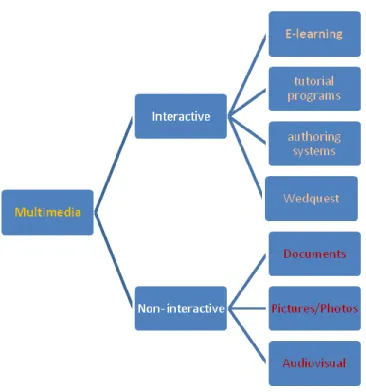
(30) 30. Moreover, Morales (2012) consider multimedia as the use of various types of means for transmitting, manage or present information to the user. Those means may be text, graphics, audio and video, among others. When the term is used in the field of computing, we refer to the use of software and hardware to store and present content, generally using a combination of text, photographs and illustrations, videos and audio. Consequently to what some authors stated in previous paragraph multimedia can be also linear and non-linear, the first one means that the content continues without any control by the user for instance, a video or a movie. And non-linear where the user can interact to the media and control some the elements in the presentation. Interaction is commonly viewed as stimulus response reinforcement encounters action is an integrated form between the learner and instruction. (STEMLER, 1997.p4) For his part Patiño (2009) posted that multimedia has two types non-interactive and interactive and he also mentioned that Multimedia teaching materials can be classified in tutorial programs of exercise, simulators, databases, builders, tool programs etc. In the following image is explained the two types of multimedia posted by him.
(31) 31. Figure 1. Steps of multimedia stated by Patiño (2009). This figure was elaborated by the intern to summarize the steps that the author mentioned.. Multimedia Material. It is a term applied to any object using simultaneously different forms of information content such as text, sound, images, animation and video to inform, train and entertain the user. It is also a media to store and present multimedia content. Within the group of multimedia materials, integrating various textual elements (sequential and hypertext) and visual (graphics, sound, video, animations ...) there are educational multimedia materials which are used for a purpose education..
(32) 32. Multimedia educational materials, such as teaching materials in general can perform multiple functions in the processes of teaching and learning. In concordance to Graells (2011.p12) the main functions that can be performed by multimedia educational materials are: 1. informative (Most of these materials, through their activities, present some contents that provide information, structuring of student´s reality) 2. Instructive and trainer (All multimedia teaching materials guide and regulate student learning because, explicitly or implicitly, promote certain actions directed towards this end.) 3. Motivational (The interaction with the computer itself is often motivating. Some programs also include elements to capture the students' attention, keep their interest and concentration on the most important aspects) 4. Evaluator (The possibility of immediate "feedback" of students´ responses and actions makes appropriate programs to evaluate them. This evaluation can be: Implicit when the student detects their mistakes and they can evaluate themselves from the answers that the computer gives. Explicit: the program presents reports assessing student performance.) 5. Explorative and experimental (Some programs offer students interesting environments to explore experiment, investigate, search for particular information, etc.) 6. Expressive and communicative (As the computers are machines that process symbols, we can represent our knowledge and communicate by using them. these materials also offer several opportunities to communicate. Students can express and communicate with the computer and with other partners through the program activities.) 7. Met linguistic (when students use multimedia materials they also learn about computer languages).
(33) 33. 8. Playful and innovative.. Advantages of Multimedia in Education. Certainly the use of these engaging and interactive multimedia materials especially with good guidance and combined with other resources including books, newspapers can support the teaching and group and individual learning. Some of its major contributions in this regard are: to provide information, stimulate interest, maintaining a continuous intellectual activity, learning guide, propose learning from mistakes, and facilitate the assessment and control, enabling individual work and in group (Graells, 2011,p15) Multimedia is very helpful and fruitful in education due to its characteristics of interactivity, flexibility, and the integration of different media that can support learning, take into account individual differences among learners and increase their motivation. Some authors quoted by(Gutiérrez Berumen, Gómez Zermeño, & García Mejía, 2013) have concluded that multimedia not only increase the level of vocabulary, but also offer advantages to facilitate the attention and address the different learning styles of students. In conclusion the multimedia materials can be useful in different aspects because the learning process becomes more dynamic by the implementation of several devices incorporating moving images, sounds texts etc. Students can also work individually, in pairs or in groups. Furthermore, the texts can be used in a way that students understand easier and this makes the classes less tedious and boring. In addition, students are highly motivated and motivation is one.
(34) 34. of the motor of learning, since it encourages students to think. On the other hand, motivation makes students spend more time working and therefore it is more likely they learn.. Disadvantages of Multimedia in Education. Besides the fact that multimedia materials provide several advantages in education, they also provide some disadvantages such as distraction, difficulty to elaborate those materials by teachers, lack of effort by students to do the activities, disorientation by learners about the contents, Time consuming, Technical problems etc.. According to Andresen & Den Brink (2013) described in their book some of disadvantages of multimedia in education in the following paragraph some of them will be quoted: Distraction: Often, confused presentations of the material can cause distraction due to conflict messages. Non-linear structured multimedia allows the user to follow the supplied links, which can distract from the topic to be learned. Low interactivity: Even though the interactivity between the learner and multimedia applications is increasing, it is still considered restricted compared to the elaborated humanhuman interactivity. No selective feedback: Feedback is generally very limited within computer-assisted learning packages. Generally, computers can’t substitute for person-to-person teaching, only enhance it. The feedback often provided is limited to right/wrong, and it does not support in learning strategies or further content explanations..
(35) 35. Time consuming: Using multimedia can be time consuming, especially the production of multimedia takes much time. Multimedia is portable: Paper-based notes can be read everywhere, on the bus, at the beach, etc., but web-based materials or multimedia materials require specific hardware devices. Finally, in any case is beard in mind that, with an acceptable quality, the key for educational effectiveness of these materials reside in a proper use of them in each specific situation.. Principles to Develop Materials for Foreign Language Teaching. The following characteristics must be considered by teachers when they design materials for foreign language teaching. These principles have been stated by Tomlinson (1998.2003.2011) 1. Materials should impact: Impact is achieved when materials have a noticeable effect on learners, which is when the learners’ curiosity, interest and attention are attracted. "The materials may impact through novelty topics and unusual images, variety of activities and issues, striking presentation material, such as different colors, spaces, images, etc. and new topics, interesting stories "(Tomlinson, 1998, p. 7). However, you should be aware that what may be shocking for a student to another may not, so it is important to "know very well students". 2. Materials should develop students` confidence. This can achieve through activities in which students can reflect, analyze and solve problems, but also be taken to exploit its capabilities and so to feel confident in expressing themselves. “It can also help if the activities encourage learners to use and to develop their existing extra-linguistic skills,.
(36) 36. such as those which involve being imaginative, being creative or being analytical” (Tomlinson, 2011, p. 10). 3. What is taught must be relevant and useful for students: it is important that the student feels learning things that serve or will serve through activities where he is the protagonist. It is therefore important to know what the student needs, what they really want to learn and how they want to learn. 4. Materials should expose students to authentic language: when students work on texts or materials that natives use in their diary life. According to Richards (2001), authentic materials refers to the use in teaching of texts, photographs, video selections, and other teaching resources that were not specifically prepared for pedagogical purposes. He argues that authentic materials may have positive effect on learner motivation because they are intrinsically more interesting and motivating than created materials. For her part Polio (2014) expresses the same feeling toward authentic materials, in which she stated “authentic materials are designed for real-life goals and native speakers’ communications”. 5. The materials should provide students with opportunities to use target language in order to achieve communicative purposes: "opportunities to use the language should be interactive and cause the negotiation of meaning.” (Tomlinson, 1998, p. 15). 6. The materials must include students’ learning style: They must be designed for various activities, trying to address all styles such as: visual (pictures), auditory (sounds) kinesthetic (physical), experiential (practice), analytical (one to one) dependent (the teacher or book), and independent (autonomous)..
(37) 37. 7. Materials should not rely too much on the controlled practice: according to Ellis, quoted in Tomlinson (1998), "the controlled practice has no long-term effects and It has no effects on fluency "(Tomlinson, 1998, p. 21) so it would be appropriate not to use this practice too much. 8. Materials should provide the opportunity for feedback: the feedback favors students insofar as it provides them with a better appropriation and use of language. According to Clariana, Ross, and Morrison (1991) quoted by STEMLER (1997). “Feedback is an important variable that is often ignored in multimedia software. Feedback can be defined as output, usually displayed on a screen; to tell students how successful they have been in solving problems or to provide information about the quality of their response to a test like event.”(p.5). Stages in the design of multimedia materials. Several discussions have been done about the instructional use of multimedia. However, a limited number of authors offer specific advice on the process, design and development of multimedia. For instance, Jolly and Bolitho, Tomlinson (1998) these authors proposed seven stages to be considered in the design of materials, but in the context of this internship were considered only some of them: 1. Identifying step (identification of a problem related to the needs of students) 2. Exploration stage (exploration of materials that exist and show the actual use of language) 3.Pedagogical realization (design of communicative activities with adequate.
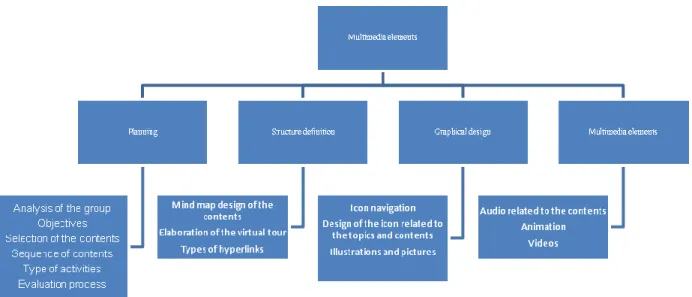
(38) 38. instructions for the development) 4. physical production (the material is designed, in terms of features physical and images, icons, letter size, etc.) 5 Use and Evaluation stage (the material is applied in the classroom to see if it is effective or not. This process helps identify whether the material should be improved or redesigned, depending on the effect you have had in the students). Besides, Herrera Álvarez (2014) followed five stages in the development of multimedia materials for her thesis; she took into account the following stages: instructional analysis, design, development, assessment and final product. For his part Gisbert (1999:320-321) quoted by Vilchez González(2007) contemplated four stages: planning, structuring, graphical design, and multimedia elements. See the following figure to summarize the steps..
(39) 39. Figure 2. Multimedia Elements proposed by Gisbert (1999). This figure is elaborated by the intern to summarize the steps proposed by this author in the development of the multimedia materials.. Additionally, Rodríguez (2007) argues that several authors offer specific process of designing multimedia presentations and he provided a practical process-oriented model for creating effective instructional multimedia presentations. This model according to him “has been used successfully by preserve teachers in a graduate course in multimedia production, this model was adapted from one used at an instructional development center at Florida State University” (p1).
(40) 40. Finally, the following chart shows a simple way to summarize what three authors proposed in the development of multimedia materials, in the context of this internship will be included the most important aspects and guidelines proposed by BellochOrtí (2015) Sarmiento Santana (2007); and Rodriquez (2007) these authors were chosen in order to develop this research because they joined the principles characteristics in the design of multimedia materials and coincide with the steps proposed by other expects who mentioned in this chapter of the internship. Chart 4. Comparison in the design of multimedia materials. Number of Steps first step. Sarmiento Santana (2007). Rodriguez (2007). BellochOrtí (2015). ANALYZE. ANALYZE. ANALYZE. Audience. Audience. Students. Needs Goals If the project is functional. Content Environment. second step Third step. DESIGN. DESIGN AND DEVELOPMENT. PEDAGOGICAL AND TECHNICAL DESIGN. Formulation of objectives. Needs and objectives. Objectives. Contents. Contents. DEVELOPMENT. IMPLEMENTATION. DEVELOPMENT. Selection and organization of contents. arrange for students to use the program as a plan. Elaboration of multimedia resources. step Fourth. Determination of technical, esthetical and pedagogical variables. integration of those multimedia resources. IMPLEMENTATION. EXPERIMENTATION AND VALIDATION OF THE PROGRAM.
(41) 41. Evaluation of the program analytically, and observation. Use of the materials Evaluation of those material EVALUATION. EVALUATION. EVALUATION. Develop evaluation plan. fifth step. Validation of the material. Gather evaluative data as students use the program. Validation of the materials and program in a general state.. Assess students´ learning and attitudes Revise the program. sixth step. ELABORATION OF FINAL PRODUCT. Note: in the first column there is the number of the steps that authors proposed to develop the multimedia materials. On the top of the chart there are the names of the authors and year they introduced these steps, and finally the words in bold represent the name of the steps in the design of materials.. Instructional Design. To begin with this internship project a possible problem that affects English learning process at Dynamic Teaching Corporation was pointed out. After a teachers´ meeting in January 2015, when it was discussed the lack of use of the virtual platform by students at Dynamic Teaching Corporation two informal conversational interviews were applied. These surveys helped the intern to write down some ideas to establish a research problem. Doing this process, the topic related to the use of the dynamic`s virtual platform and the creation of some exercises to nourish students` knowledge were emerged. As it was mentioned at the beginning of this paper, this research was developed on five phases:.
(42) 42. Research Phases. Phase 1. Needs analysis: This stage was developed during a period of four weeks, and it was divided in two parts: first, to establish what factors affected the suitable use of the platform two informal conversational interviews were applied (one for a teacher and the other for a student) the intention of these informal interviews were to look for important aspects to affect the properly use of the virtual platform. Doing this it was necessary to search for information about how to make an informal conversational interview, some steps proposed by Turner (2010) were taken into account 1. Preparation for the Interview because the researcher will keep in mind the study’s purpose and the general scope of the issues that he or she would like to discuss in the interview. 2. Selecting participants the importance of acquiring participants who will be willing to openly and honestly share information or “their story” (p.757) and 3. Constructing Effective Research Questions. In this part only two of the six types of questions were taken into account. Opinions/values (about what a person thinks about a topic) and Feelings (Feeling questions aim at eliciting emotions, feeling responses of people to their experiences and thoughts) what do you think about the virtual platform at Dynamic Teaching? What would you like to chance of the platform? What is your opinion of the exercises and the contents of the virtual platform? How do you feel using this platform? What would you change about this platform? The questions above were suggested by Patton (2002) The second part of this first phase, two surveys for both teachers and students were applied to verify the aspects that emerged from the two informal conversational interviews, these surveys.
(43) 43. also could validate the reasons mentioned in the justification of this project about the unsuitable use of Dynamic´s virtual platform by students. Finally, the last part of this phase three different groups of students; the pilot group, the experimental and control group were established. Phase 2. Designing: this phase is divided in three parts; first one is when the didactic units incorporating multimedia materials were designed, it was necessary to take into account the following questions to organize the didactic units 1. How were students going to demonstrate their knowledge? How would the information be presented? How would the teacher engage students in learning? How would the teacher start? What teaching strategies would the teacher use? What activities would students engage in? Why? How much time would be devoted to different parts of the lesson? What directions would the teacher need to give, how should the teacher present them? What materials would be needed and when would the teacher prepare and organize them? The second part of this phase sought to improve the contents of the platform through some multimedia materials, that`s why some authoring systems such as; hot potatoes, Prezi and PowerPoint presentations were used. It was also considered some important questions in the development of the unit; what are the tasks that the learner will be expected to perform during and at the end of instruction? Are there any prerequisites that the learners must possess before entering this unit? What is the hierarchy of the tasks expected to be performed? This phase lasted two months and both processes were done at the same time. In this phase there was also an Implementation process of the units to pilot group, some observations were made and the comments given by the students about the materials were given,.
(44) 44. a rubric was applied in order to see the structure and times spent during the development of the units, the parameters in this rubric were proposed by (Patios & Suárez, 1994) so decisions and correction of the mistakes were done during this piloting process. After designing these didactics units, a B-learning plan was designed. In consonance with Bartolomé (2004) Blended learning model allows to spend less time in the classroom, encourages a savings potential of physical spaces and increase student participation as responsible for their own learning. The idea of this B-learning plan was that students in experimental group could take six lessons in the classroom and work at least 2 hours on the platform to improve their learning process, but this work on the platform was optional at the beginning of the academic program the purpose of this new working plan was making the use of the platform mandatory, for that reason the intern had to talk to the coordinator and she gave the authorization to make students use the platform, even the coordinator convened a teachers´ meeting and she approved another rule when students applied for the test they needed to have minimum two hours of participation on this virtual platform every week, this participation was count checking the grades that students got as soon as they took the quiz. Once the didactics units and the multimedia materials were designed, The B-learning plan proposed (six hours classroom lessons and two hours online) and the implementation of the didactics units with the multimedia materials would be applied only for experimental group in the phase 3 (Development and Implementation) of this research. Phase 3 Development and Implementation. This stage sought to enhance students´ communicative skills in English by implementing the didactic Units and multimedia materials that is why a pre-test supported by the contents of English program and four rubrics were.
(45) 45. designed and applied to analyze the students’ skills and how the students started before to implement this project. After the implementation of the pre-test and the skills´ rubrics, the B-learning working plan and the didactic units with the multimedia materials were applied to the experimental group and during the process of implementation the teacher`s journal was written. The most important aspects stated by experts of didactic units and multimedia materials were written. The teacher´s journal helped the intern to evaluate better some aspects associates to the following topics; feedback obtained by the materials, Time consuming, the impact of the Materials, if the Materials help students develop confidence, The students use target language in order to achieve communicative purposes. the contents were evaluated and they showed if the topics exposed in the didactic units were related to the topics proposed in the academic program, if the students could express and share ideas, feelings and points of view through oral (in class) or in a writing way (in the forum). Teacher evaluated and tested constantly the multimedia materials incorporated in the development of the units with these journals and the students’ learning process in both groups control and experiment could be checked. According toVrasidas ( 2002) “the formative evaluation is the best way to test instructional materials when learners try them during the development process and get feedback from them” (p.10). Phase 4 Assessment this phase is the final evaluation of the implementation process in this research, in this phase a post-test and four rubrics to evaluate students´ communicative skills were applied and analysed. On the other hand, the rubric that had some indicators to measure the effectiveness of the didactic units were analysed because a comparison between the results obtained in the pilot group and the experimental group were made..
(46) 46. Phase 5 Publication this stage is the part where the four units designed would be hosted in an online learning environment and the final work was shown to the academic department because the idea was that this new working plan would be applied to the rest of the Dynamic´s program.. Development of the Internship. In this part of the paper it will be explained what happened to each phase and the steps developed during this research, it is necessary to start to the explanation of the first phase need analysis Need Analysis. Need analysis refers according to Weber (1985) cited in Brown (1995) "a Process of determining needs, gaps and deficiencies so far group of learners in a language”. With this process we can determine students´ Wants, desires, demands, expectation, and motivations in a learning process. It is a Procedure for collecting information about learners’ needs, lacks, constraints, and requirements (Brindley 1984). Once identified, these needs they can become the main design goals of a material, curriculum, testing, among others. For this research, the needs analysis was conducted for three purposes; the first one was to verify if the situation or issue initially raised was a problem (the unsuitable use of the platform and the activities on the platform were focussed on grammar only); second, to establish the true needs and interests both of students and teachers with regard to learning and teaching language and in terms of the support material to design the most interesting material for them; and the.
(47) 47. third, to define the purpose of this investigation. The needs analysis was conducted through two ways to data collect 1. Two informal conversational interviews and two surveys, the first interview was applied to one teacher and one student who had been for eight months in the process of the virtual platform. The second data collected was two surveys which were applied to ten students at A1-1 and six students at A1-2 level who were assigned by the coordinator by the time this research started. The teachers who participated in the survey had been working for more than 2 years at Dynamic Teaching Corporation Institute; the following paragraphs describe the instruments and the population.. The instrument for data collection.. At the beginning of this internship two informal conversations were applied to find some possible problems within the use of Dynamic Teaching’s virtual platform, The informal interview according to Patton quoted by Teddlie & Tashakkori (2003) it is a completely unstructured interview and the questions spontaneously emerge from the natural flow of things during fieldwork (p. 305) furthermore, it is the spontaneous generation of questions in a natural interaction, typically one that occurs as part of ongoing participant observation fieldwork (W. Turner, 2010). The second instrument chosen was the survey also named questionnaire, according to Hernandez, Fernandez and Baptista (2003) "it is a set of questions regarding one or more variables to measure " in this case, the variables were the kind of language that students wanted to learn and the support where the material should be designed (audio-visual, multimedia, audio,.
(48) 48. manual or web pages). A Survey research involves the collection of information from a sample of individuals through their responses to questions. The surveys questions can be open or close. In the context of this internship two surveys were applied for teachers and students, and the questions given were similar for both. Another instrument used during this research process was a journal, which according to Guy (2004) “it is a record of happenings, thoughts and feelings about a particular aspect of life. A journal can record anything related to the issue to which it pertains.” In this journal it was able to write and underline students´ attitudes towards the didactics units designed and multimedia materials and it was also evaluated the teaching methodology into the didactic units. Some aspects stated by experts related to advantages and disadvantages of multimedia materials and didactic units were also taken into account. Furthermore, five rubrics: the first four rubrics helped the intern to evaluate students’ communicative skills when this project started, so the information about how to evaluate the students’ communicative skills in reading, writing, listening and speaking were looked for. In this part some of the indicators proposed by different authors were included. The other rubric was made by checking some important aspects in the implementation of the didactics units, some of the aspects in this rubric were proposed by Patios & Suárez (1994) “A rubric is a scoring tool that explicitly represents the performance expectations for an assignment or piece of work. A rubric divides the assigned work into component parts and provides clear descriptions of the characteristics of the work associated with each component, at varying levels of mastery. Rubrics can be used for a wide array of assignments: papers,.
Figure
+3
Documento similar
Therefore, considering that the distribution of compact and large H II regions does not seem to depend on the galactocentric radius, that the observed scatter in metallicity is due
However, most indigenous children really have a strong wish to learn (as we will see), the problem is frustra- ting, when they want to go to school but can- not, people do not
However, growth is not always good for a company, and firms should therefore always make sure that the real growth ratio is close to the sustainable growth ratio; otherwise, a
Government policy varies between nations and this guidance sets out the need for balanced decision-making about ways of working, and the ongoing safety considerations
Thus, the main objective of this Master’s Dissertation is to make people aware of the importance of respecting different varieties and to propose a didactic unit based on
A) The online advertising market is not transparent enough, and it is not easy to access the bidding information associated by the advertisers. Therefore, the first challenge is to
For example, why is the modal mustn’t used to describe subjective prohibition (1.1.1) but not a subjective necessity that something is not the case (2.1.1)?; why is
However, as our analysis of music is not limited exclusively to instruments and players, we concentrate on other materials which are not traditionally interpreted as related
