
Improving IT service management using an ontology based and model driven approach
309
0
0
Texto completo
(2)
(3) To my parents, my husband Alfonso and our daughter Natalia.
(4)
(5) Cheshire Puss,' she began, rather timidly, as she did not at all know whether it would like the name: however, it only grinned a little wider. `Come, it's pleased so far,' thought Alice, and she went on. `Would you tell me, please, which way I ought to go from here?' `That depends a good deal on where you want to get to,' said the Cat. `I don't much care where--' said Alice. `Then it doesn't matter which way you go,' said the Cat. `--so long as I get somewhere,' Alice added as an explanation. `Oh, you're sure to do that,' said the Cat, `if you only walk long enough. Lewis Carroll, Alice's Adventures in Wonderland (Illustration by Sir John Tenniel).
(6)
(7) Resumen La adopción de marcos de trabajo de mejores prácticas que permiten la integración de las Tecnologías de la Información (TI) con el negocio, ayuda a las organizaciones a crear y compartir procesos de gestión de servicios de TI. Sin embargo, las guías y modelos publicados suelen especificarse en lenguaje natural o con representaciones gráficas que carecen de la semántica computacional necesaria para poder automatizar su validación, simulación e incluso su ejecución. En esta tesis se presenta Onto-ITIL, una propuesta basada en ontologías y en el enfoque de desarrollo de software dirigido por modelos que captura las mejores prácticas ofrecidas por ITIL (del inglés Information Technology Infrastructure Library), y destinada a facilitar la prestación de servicios de TI. El objetivo de Onto-ITIL es ayudar a los expertos del dominio a modelar e implementar procesos de gestión de servicios de TI evitando ambigüedades semánticas y contradicciones. La formalización de los procesos de gestión de servicios de TI en términos de ITIL constituye un primer paso para cubrir la brecha que se da entre el negocio y las TI. Para definir las ontologías se ha utilizado OWL (del inglés Web Ontology Language). Adicionalmente, se ha definido un conjunto de reglas basadas en SWRL (del inglés Semantic Web Rule Language) que permiten enriquecer la ontología con una serie de restricciones semánticas y de reglas de inferencia de conocimiento. Por último, la definición de un conjunto de consultas basadas en SQWRL (del inglés Query-Enhanced Web Rule Language) permite recuperar conocimiento obtenido con OWL e inferido a través de las reglas SWRL. Además de formalizar los procesos de gestión de servicios de TI en base a las buenas prácticas consideradas por ITIL, Onto-ITIL también permite compartir, reutilizar e intercambiar las especificaciones de dichos procesos a través de mecanismos automatizados que proporcionan ciertos marcos de trabajo de comercio electrónico, como por ejemplo, ebXML. Mediante la adopción del enfoque MDE (del inglés Model-driven Engineering), se ha utilizado un DSL (del inglés Domain Specific Language) basado en la ontología OntoITIL que sirve para implementar sistemas de información basados en flujos de trabajo.
(8) que dan soporte a los Sistemas de Gestión de Servicios de TI (SGSTI). Los modelos que se obtienen a partir de este lenguaje de modelado se pueden considerar modelos de alto nivel que han sido enriquecidos con conocimiento ontológico, y que están definidos exclusivamente en términos de lógica de negocio, es decir, que no presentan ningún aspecto arquitectónico o de plataforma de implementación. Con lo cual, de acuerdo con la arquitectura en cuatro capas propuesta por el OMG (del inglés Object Management Group), estos modelos se encontrarían a nivel CIM (del inglés Computation Independent Model). En resumen, la propuesta presentada en esta tesis permite: (i) formalizar el conocimiento asociado a los sistemas de gestión de servicios de TI en base a ontologías que recogen las buenas prácticas consideradas por ITIL; (ii) modelar la semántica de las actividades que definen los procesos de gestión de servicios de TI en forma de flujos de trabajo; (iii) generar de manera automática modelos de requisitos de alto nivel para implementar sistemas de información que se necesitan para dar soporte a dichos procesos; y (iv) a partir de los modelos anteriores, obtener modelos de más bajo nivel (llegando incluso al código de las aplicaciones) a través de transformaciones automáticas de modelos. La investigación llevada a cabo en esta tesis se ha validado mediante de la implementación de un caso de estudio real proporcionado por una compañía española que ofrece servicios de TI..
(9) Abstract Best practice frameworks, focused on the integration of business and Information Technology (IT), help organizations create and share effective IT Service Management (ITSM) processes. However, service management guidelines and models are commonly specified using natural language or graphical representations, both lacking the computational semantics needed to enable their automated validation, simulation or execution. This thesis proposes Onto-ITIL, an ontological and model-driven approach that captures the best practices provided by the IT Infrastructure Library (ITIL) framework. OntoITIL aims to help domain experts to model and implement ITSM processes avoiding semantic ambiguities, uncertainties and contradictions. Formalizing ITSM processes in terms of ITIL is as a first step towards bridging the current gap between business and IT. Onto-ITIL has been defined using the Web Ontology Language (OWL) and has been enriched with a set of rules defined using the Semantic Web Rule Language (SWRL) to provide semantic constraints and knowledge inference. The definition of a set of queries based on the Semantic Query-Enhanced Web Rule Language (SQWRL) enables the retrieval of knowledge from OWL and inferred by the SWRL rules. Onto-ITIL not only enables the formal specification of ITSM processes, but also to share, reuse, and interchange these specifications by automated means using e-business frameworks such as ebXML. Adopting a Model-driven Engineering (MDE) approach, a Domain Specific Language (DSL), based on Onto-ITIL, is used in order to implement workflow-based information systems that underpin ITSM Systems (ITSMSs). The resulting high-level models enriched with ontological knowledge are defined just in terms of the business logic, without any architectural or platform-specific consideration. That is, according to the OMG's four-layered architecture, the ontology-based workflow models could be placed at a Computation Independent Model (CIM) level..
(10) In summary, the approach presented in this thesis aims: (i) to formalize the knowledge associated to ITSMSs in terms of ontologies that gather ITIL best practices; (ii) to model the semantics of the activities associated to ITSM processes in terms of workflows; (iii) to automatically generate the high-level requirements models of the information systems needed to support these processes; and (iv) from the latter, to obtain lower-level models (and eventually code) by means of automated model transformations. The proposed approach has been validated using a real case study from a Spanish IT service provider..
(11) Contents 1. Introduction ...................................................................................................................... 1 1.1. Problem Statement ................................................................................................. 1. 1.2. Thesis Objectives ................................................................................................... 5. 1.3. Research Method.................................................................................................... 8. 1.4. Thesis Outline ........................................................................................................ 9. 2. State of the art ................................................................................................................ 11 2.1. Ontologies ............................................................................................................ 11. 2.2. The Business Process ........................................................................................... 16 2.2.1 Workflow ................................................................................................... 18 2.2.2 Business Process Modeling ....................................................................... 19 2.2.3 Ontologies for Business Process Modeling ............................................... 25. 2.3. The Software Development Process .................................................................... 29 2.3.1 Software Process Modeling ....................................................................... 30 2.3.2 Model-Driven Engineering ........................................................................ 31 2.3.3 Model-Driven Architecture........................................................................ 44 2.3.4 Matching Ontologies and Conceptual Models with Metamodels .............. 45. 2.4. IT Service Management ....................................................................................... 48 2.4.1 The Information Technology Infrastructure Library ................................. 50 2.4.2 ITSM Processes ......................................................................................... 53 2.4.3 Ontologies for ITSM .................................................................................. 55. 3. Onto-ITIL: An Ontology-based and Model-driven Approach for ITSMSs ................... 59 3.1. Introduction .......................................................................................................... 59. 3.2. Onto-ITIL Principles ............................................................................................ 60. 3.3. The Onto-ITIL Ontology...................................................................................... 63 3.3.1 The Service Lifecycle ................................................................................ 65 3.3.2 Specifications ............................................................................................. 65 3.3.3 Applications ............................................................................................... 66 3.3.4 Events ........................................................................................................ 67 3.3.5 Roles .......................................................................................................... 74 3.3.6 The ITSM Metrics Model .......................................................................... 76 3.3.7 Service Level Agreements ......................................................................... 80 3.3.8 The Onto-BPMN Ontology ....................................................................... 83. I.
(12) 4. Evaluation ...................................................................................................................... 89 4.1. Implementation of the Prototype .......................................................................... 89 4.1.1 Stage 1: Service Portfolio .......................................................................... 90 4.1.2 Stage 2: ITIL-compliant and Ontology-based IT Service Management .... 91 4.1.3 Stage 3: Business Process Modeling.......................................................... 91 4.1.4 Stage 4: Workflow Model Transformation ................................................ 91. 4.2. Case study: Implementation of an Incident Management System ....................... 92 4.2.1 The ITIL Incident Management Process.................................................... 92 4.2.2 The Incident Management Metrics Model ................................................. 97 4.2.3 The Incident Management Activity ........................................................... 99 4.2.4 XSL Transformation ................................................................................ 104 4.2.5 Ontology Queries, Rule-based Constraints and Knowledge Inference .... 109. 5. Conclusions and Future Research ................................................................................ 115 References ......................................................................................................................... 119 Appendix I. ITSM Ontology Concepts.............................................................................. 137 Appendix II. Glossary ....................................................................................................... 289. II.
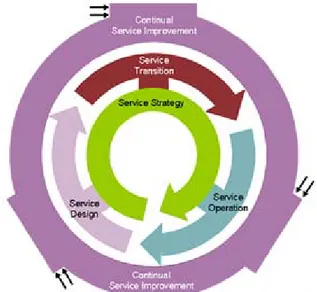
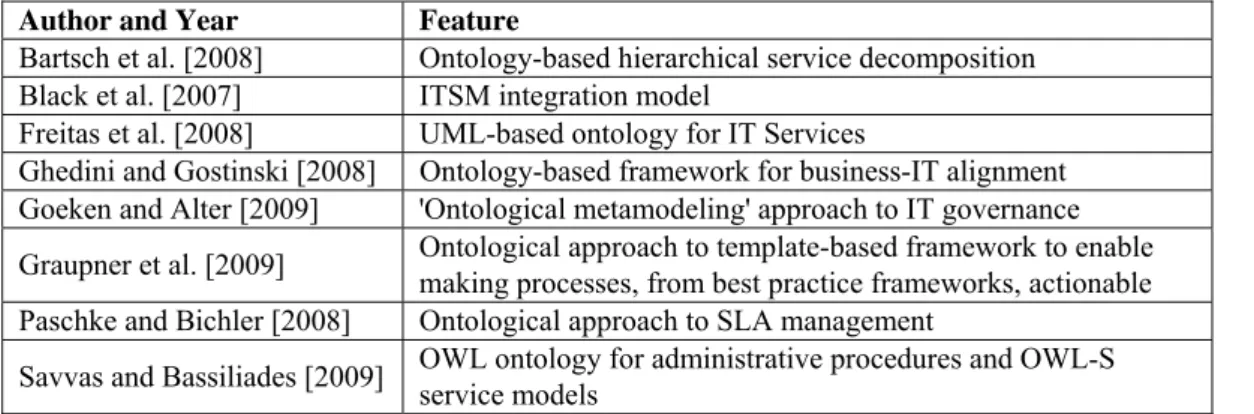
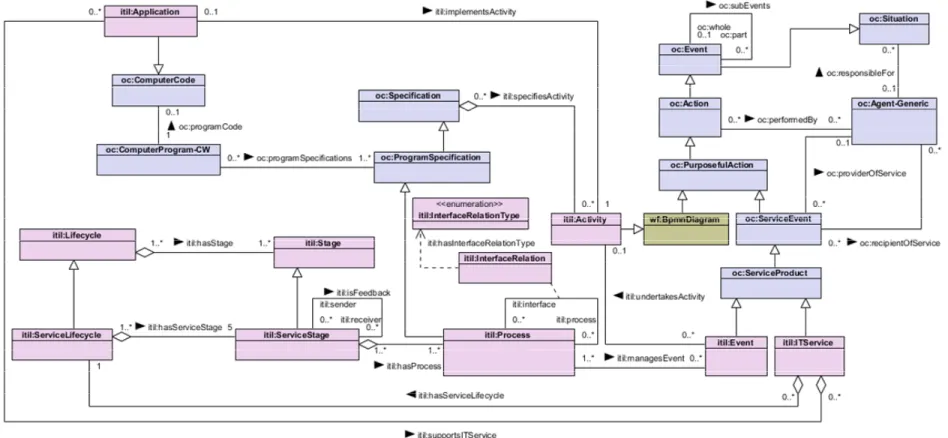
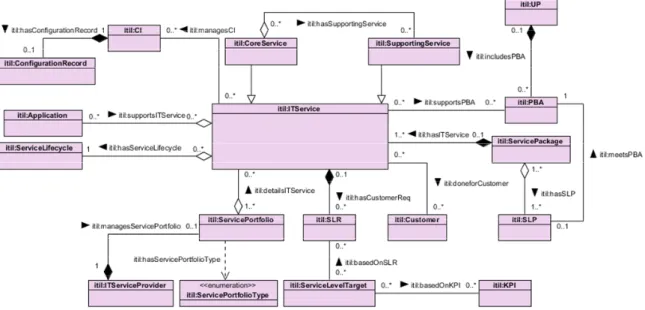
(13) List of Figures Figure 2.1 The software development process ............................................................................ 30 Figure 2.2 Basic MDE principles ................................................................................................ 32 Figure 2.3 Models and systems (adapted from [Bézivin, 2004]) ................................................ 34 Figure 2.4 OMG’s four-layers architecture (adapted from [Bézivin, 2004]) .............................. 35 Figure 2.5 Model transformations ............................................................................................... 42 Figure 2.6 MDA and the OMG’s four-layers metamodeling pyramid as depicted in [VicenteChicote & Alonso, 2007] .......................................................................................... 45 Figure 2.7 IT Service Management pyramid as depicted in [ISACA, 2008] .............................. 51 Figure 2.8 The ITIL service lifecycle.......................................................................................... 53 Figure 3.1 Onto-ITIL principles .................................................................................................. 61 Figure 3.2 UML class diagram representing an overview of the ITSM model defined by the Onto-ITIL Ontology .................................................................................................. 64 Figure 3.3 UML class diagram representing the Onto-ITIL event knowledge ........................... 69 Figure 3.4 UML class diagram representing the Onto-ITIL IT service knowledge .................... 71 Figure 3.5 UML class diagram representing the Onto-ITIL role knowledge.............................. 74 Figure 3.6 UML class diagram representing the Onto-ITIL metrics knowledge ........................ 77 Figure 3.7 UML class diagram representing the Onto-ITIL SLA knowledge ............................ 81 Figure 3.8 UML class diagram representing the Onto-BPMN Ontology ................................... 83 Figure 3.9 UML class diagram representing the Onto-BPMN Ontology (cont.) ........................ 84 Figure 3.10 UML class diagram representing the BPMN Metamodel as depicted in [Eclipse BPMN Modeler, 2011] ........................................................................................... 86 Figure 4.1 Architecture of Onto-ITIL ......................................................................................... 90 Figure 4.2 The itil:ICTD_IM_Process instance .......................................................................... 96 Figure 4.3 ICTD Incident Management Business Process ........................................................ 100 Figure 4.4 The itil:ICTD_IM_Activity instance ....................................................................... 101 Figure 4.5 The itil:ICTD_Pool_IncidentManagement instance ................................................ 102 Figure 4.6 The itil:ICTD_IncidentManagementSystem instance .............................................. 103 Figure 4.7 ITIL Activities Selection ......................................................................................... 104 Figure 4.8 Excerpt of the ICTD_IM_Activity.onto_itil file (Eclipse Text Editor) ................... 105 Figure 4.9 Excerpt of the ICTD_IM_Activity.bpmn file (Eclipse Refl. Ecore Model Editor) . 106 Figure 4.10 Excerpt of the ICTD_IM_Activity.bpmn file (Eclipse Text Editor)...................... 107 Figure 4.11 BPMN diagram related to the IM Activity (Eclipse Bpmn Diagram Editor) ........ 108. III.
(14) IV.
(15) List of Tables Table 2.1 Related work about Ontology-based business process modeling ............................... 26 Table 2.2 Key differences in ITIL ............................................................................................... 52 Table 2.3 RACI Matrix ............................................................................................................... 55 Table 2.4 Related work about Ontologies in association with ITSM.......................................... 55 Table 3.1 Mapping between ebXML constructs and Onto-ITIL constructs ............................... 82 Table 4.1 RACI matrix for the Incident Management process ................................................... 94 Table 4.2 Operational metrics for the Incident Management process ......................................... 97 Table 4.3 KPIs for the Incident Management process ................................................................ 97 Table 4.4 KPI objectives ............................................................................................................. 98 Table 4.5 CSFs for the Incident Management process ................................................................ 98 Table 4.6 Evalutation of the KPIs for the Incident Management process in the pilot project .... 99 Table 4.7 Mapping of Onto-ITIL Activity and BPMN constructs ............................................ 105. V.
(16) VI.
(17) Chapter 1. Introduction “Human beings obtain the most of their capacity when they are completely conscious of their circumstances.” Meditaciones del Quijote José Ortega y Gasset (1883-1955), Spanish philosopher. In this chapter we identify the problems that we want to solve. Then we describe motivations and objectives of this work, and the research method. Finally, we outline the structure of the thesis.. 1.1 Problem Statement Nowadays, IT Service Management (ITSM) is considered a fundamental and competitive task in organizations. The interest in ITSM has been motivated not only because of competition amongst companies, but also due to the interest organizations have in integrating Information Technology (IT) with the business they belong to as a corporative strategy. The best practices documented in several ITSM frameworks have motivated many companies to move from a product-oriented organization to a serviceoriented one. A process-based approach has been considered the most efficient and effective way to achieve this [itSMF, 2008]. An adequate process-based ITSM will allow the companies: (i) to continuously improve their processes; (ii) to achieve a significant improvement in perceived quality by customers; and (iii) to improve their IT strategy. Information is one of the most important assets for all organizations. Thus, IT services are decisive for good knowledge management, efficient decision making, and planning actions for the company [de Pablos et al., 2008].. 1.
(18) IT services are generating a cultural change in organizations since they allow integrating information systems in the business. IT services are required to evolve and rapidly adapt to the different companies’ new needs and technologies, even more taking into account the proliferation of shared IT services and outsourcing. However, the strategic opportunity that new technologies bring to companies is simultaneously the cause of the difficulties that arise in their management. A recognized solution to this problem is to implement an ITSM System (ITSMS) based on the ISO/IEC 20000:2005 Information technology – Service management standard. An ITSMS is a collection of interrelated and coordinated rules, principles and activities, structured in term of processes [Nextel, 2010]. The ISO/IEC 20000 standard [ISO/IEC, 2005a] [ISO/IEC, 2005b] establishes a rule for all of the organizations that offer IT services, not only to external customers but internal customers as well. Through the ISO/IEC 20000 standard, the internal and external suppliers for IT services are challenged to prove that their Service Management processes guarantees the quality their customers demand. ISO/IEC 20000 consists of two parts, under the general title ‘Information technology — Service Management’: . Part 1 – Specification [ISO/IEC, 2005a]. This part defines the requirements for IT service providers to implement an ITSMS in order to deliver managed IT services of an acceptable quality for their customers.. . Part 2 – Code of Practice [ISO/IEC, 2005b]. This part represents an industry consensus on quality standards for ITSM processes. These service management processes deliver the best possible service to meet business needs of customers, within agreed resource levels (i.e. service that is professional, cost-effective and with risks which are understood and managed).. IT service providers tend to find many difficulties to implement the ISO/IEC 20000 standard, especially Small and Medium-sized Enterprises (SMEs), which count on limited resources. However, there exist easier-to-adopt best practices, such as those defined in the Information Technology Infrastructure Library (ITIL) [ITIL website] or in the Control Objectives for Information and related Technology (COBIT) [ISACA, 2007].. 2.
(19) Currently, ITIL is the de facto standard for ITSM which allows integrating the business with IT by applying a process-oriented method. ITIL offers a detailed description of the most important processes to be carried out by IT service providers, including procedures, responsibilities, and task verification lists. Organizations can (wholly or partially) adopt ITIL, taking from it whatever they find of interest, and adapt it to their specific circumstances and needs. Since ITIL (especially the version 3) is strongly aligned with ISO/IEC 20000 [ISO/IEC, 2005a] [ISO/IEC, 2005b], ITIL can help companies guarantee the recognition of their capacities and can even become a key tool for ISO/IEC 20000 certification. Although the ISO/IEC 20000 standard does not depend on any specific business framework, it is based on the concepts and best practices defined in ITIL, offering a way to explore the guide of best practices. Meanwhile, COBIT is an IT governance framework and a set of supporting tools that allows IT service providers to bridge the gap between control requirements, technical issues, and business risks [ISACA website]. That is, COBIT provides best practices for the management of IT processes harmonizing practices and standards such as ITIL and the Project Management Body of Knowledge (PMBOK) [PMI website]. In this vein, COBIT provides guidance for executive management to govern IT within the enterprise [ISACA, 2009]. A detailed mapping of ITIL V3 with COBIT 4.1 is documented in [ISACA, 2008]. As mentioned earlier, the implementation of an ITSMS is a complex task for any organization. To address it, companies can start using ITIL to manage the IT services included in their Service Catalog to support their business processes. The Service Catalog, which is part of the Service Portfolio, comprises the main IT services provided by a company, individually described. The documents gathering these descriptions must follow a reference framework for enabling a fluent dialogue between the IT service provider and its potential and actual customers. However, these documents are commonly written using natural language or informal notations, frequently leading to ambiguities, contradictions, and misinterpretations. In addition, most IT service providers do not know what should be actually measured for each ITSM process in order to demonstrate its value or to operate in a cycle of continuous improvement [Steinberg, 2006]. Thus, the definition of metrics that can be used to measure and monitor the health and state of each ITSM process in order to demonstrate 3.
(20) the impacts and effects of ITSM practices is of major importance. Following the guiding principles of “If you do not measure it, you cannot manage it” [DeMarco, 2009] and “If you do not measure it, you cannot improve it”, without metrics, organizations cannot monitor the IT services they are trying to manage, and this should be unacceptable in any business organization [Steinberg, 2006]: any business unit, even IT, cannot operate without learning how to effectively govern itself. ITSMS is also closely related to information systems, as business information (and its automation) is essential for good service management. Information automation changes the way companies work, affecting its organizational model and business processes, more and more based on collaboration than on competition. According to their possibilities (available resources), organizations will sort the tasks involved in their IT processes and will automate the most crucial ones (i.e., those having a greater impact on their service improvement). There are several computer tools that allow automating the tasks or specific processes of a company (e.g., accounting, inventory management, payrolls, product design, financial simulation, etc.). In general, all these applications tend to work independently, although in some organizations it is necessary to integrate some of them [de Pablos et al., 2008]. Organizations can choose either to buy ‘standard’ applications available in the marketplace that meet their generic needs, or develop (or customize) applications that respond to the company’s specific needs. In this context, there are commercial Enterprise Application Integration (EAI) platforms (e.g., TIBCO1 or Websphere2), which enable the integration of business information and the generation of information systems. In the concrete area of ITSM based on ITIL, there exist several commercial tools that can help with the implementation of an ITSMS. The following list gathers some of them: . EasyVista3 (Staff&Line). . FrontRange ITSM Software4 (FrontRange Solutions). . OTRS ITSM5. 1. http://www.tibco.es/ http://www-01.ibm.com/software/websphere/ 3 http://www.staffandline.es/Front/inicio_3.php 4 http://www.frontrange.com/software/service-management/itsm/ 5 http://www.otrs.com/en/products/itsm/ 2. 4.
(21) . Remedy6 (BMC). . Service Manager software7 (HP). . Service Desk Manager8 (CA). . Tivoli9 (IBM). For an effective implementation of ITSM processes, organizations need to use computer tools. However, these tools should not be acquired or implemented hastily. Nowadays, the problem is not the lack of tools, but the lack of an adequate and clear tool selection, adoption and integration policy. The main reason for these is the lack of precise knowledge about the actual ITSM processes carried out by each company. Therefore, the first thing an organization must do is to understand and analyze the maturity of the processes that manage their different services and the relations among them. This is as important or even more, that the choice of the computer tools. Furthermore, organizations need to know which assets are providing value to them, and how. In Spain, more than 70% of IT service providers do not know the level of maturity of their ITSM processes [OZONA website]. A formal definition of these ITSM processes and their analysis can help organizations [OZONA website]: (i) know how their IT services are; (ii) define a list of deficiencies; and (iii) obtain part of the requirements that help them select or develop the most appropriate computer tools to support them. Finally, it is worth noting that the formal definition (conceptual modeling) of ITSM processes can serve as a base for their later implementation or adoption. This formalization can help in the analysis of ITSM processes, allowing IT service providers to establish the priorities when it comes to implement an ITSMS.. 1.2 Thesis Objectives This thesis proposes an Ontology Engineering (OE) and Model-Driven Engineering (MDE) approach for representing ITSMSs that formalizes the ITSM domain according 6. http://www.bmc.com/products/product-listing/53035210-143801-2527.html https://h10078.www1.hp.com/cda/hpms/display/main/hpms_content.jsp?zn=bto&cp=1-1185^12473_4000_100__ 8 http://www.ca.com/us/service-desk.aspx 9 http://www-01.ibm.com/software/tivoli/ 7. 5.
(22) to the ITIL V3 service management model. The proposed approach aims to allow IT service providers to implement ITSM processes related to an ITSMS, and help them to understand and manage the associated knowledge to improve the quality of their IT services. Our ontology-based and model-driven approach includes a basis for business decision making defining a set of ITSM Key Performance Indicators (KPIs) associated with ITIL processes. Also, through the tasks associated to the ITSM processes, companies can control both manual and automated activities with computer tools. Thus, the main objective of this thesis is to give a formal definition of ITSM best practices that allow IT service providers to obtain and manage the knowledge associated to their ITSM processes through an ITIL-based semantic model. This will facilitate the management and automatic generation of the software specifications associated to the information systems that support them. This main objective is composed of the following specific objectives: O1: To propose and justify representation systems that allow us: to formalize the knowledge associated to ITSM best practices based on ITIL, to formalize the definition of an ITSM metrics model, to formalize the definition of the tasks associated to each ITSM process. The definition of the process tasks makes up the computer semantics of the information system that can give it support, and to indicate the computer tools (applications) that have already been implemented or integrated to give support to each ITSM process. This will lead to the achievement of the following sub-objectives: o. O1.1: Offer higher quality services to customers and users with the agreed costs (both in the new and the modified services).. o. O1.2: Obtain a formal ITSMS model that enables organizations to understand and analyze the maturity of each of their ITSM processes. Modeling ITSM processes can offer IT service providers with a perspective on the organization that expands the current business views, towards more collaboration between the interested parties [Ould, 1995]. For example, as. 6.
(23) part of our ITSMS semantic model, the ITSM metrics model measures the quality and effectiveness of each ITSM process, providing a basis for its analysis and for business decision making in a well-defined manner. It is worth noting that the ITIL/ITSM terminology used throughout these work is aligned with the one adopted by the Spanish Association for Standardization and Certification,. AENOR10. o. O1.3: Obtain new knowledge about the ITSM processes offered by the company (added value).. o. O1.4: Assure that the IT services cover customer and user’s needs, reaching the objectives of satisfaction.. o. O1.5: Improve the communication between the staff that takes part of the IT services and the customers and users of these services.. o. O1.6: Increase the effectiveness and the efficiency of the internal processes associated to each IT service.. O2: To define a metamodel of the DSL that allows us obtaining models of ITSM process tasks (i.e., workflows). O3: To process the analysis models obtained from the ITSM process tasks in order to automatically generate the high-level software requirements of the information systems supporting the management of IT services. This will lead to the achievement of the following sub-objectives: o. O3.1: To obtain conceptual models of the information systems that support the ITSM processes associated with an ITSMS.. o. O3.2: From the former, to select or develop the most appropriate computer tools in order to help organizations improve their competitiveness.. 10. http://www.aenor.es/. 7.
(24) 1.3 Research Method This research carried out as part of this thesis has been developed through the following phases: 1.. Approach to the Problem As stated previously, the current difficulties to deal with ITSM give way in this research to posing a modeling approach for ITSMSs. The proposed approach aims to allow IT service provides to adopt ITSM best practices in a formal manner, independently, and with a common knowledge. It also aims to help them defining in a formal, automated and flexible way, the requirements of the information systems needed to automate certain tasks associated to their ITSM processes. For this purpose, the following steps were taken: To identify the existing alternatives for knowledge representation. To identify the existing alternatives for representing business information (namely, business processes). To review the related works in the field of knowledge representation and process modeling for ITSM best practices. To integrate the ITSM metrics model presented in [Steinberg, 2006] with the proposed modeling approach for ITSMSs based on ITIL. To review the related works in the field of MDE in order to generate high-level requirements models of the information systems that support the ITSM processes associated with an ITSMS. To identify the existing alternatives for model transformation.. 2.. Research Background A study on the technical state and related tasks is carried out. It is necessary to be able to understand and define the proposal of this thesis.. 8.
(25) 3.. Analysis and Design of the Approach A formal approach for ITSMSs is proposed following ITIL best practices complementing it with an ITSM metrics model.. 4.. Implementation of a Prototype A prototype is implemented that will allow to validate the approach designed in the previous point.. 5.. Evaluation of the Objectives Making use of the previous prototype, necessary tests are carried out. These tests will allow checking if and up to what point they abide to the objectives defined in this thesis.. 6.. Conclusions Finally, the conclusions reached are detailed after the evaluation of the objectives covered through the prototype, and which future tasks that can be carried out are outlined.. 1.4 Thesis Outline The remaining of this document is structured as follows: . Chapter 2 overviews the current state-of-the-art, providing basic concepts, theory and technologies related to ontologies, business process modeling, software modeling, and ITSM. In addition, it also reviews a number of existing ontology-based approaches related to the different domains of interest integrated into the proposed modeling approach for ITSMSs.. . Chapter 3 describes the foundations of Onto-ITIL: the proposed ontology-based and model-driven approach for ITSMSs based on the ITIL V3 Service Management Model.. . Chapter 4 details the implementation of the prototype that supports our modeling approach. It also describes the case study used to validate both the proposal and the prototype implemented to support it.. 9.
(26) . Finally, Chapter 5 draws the conclusions of the thesis. The chapter also outlines some areas for future research.. . In addition to the chapter structure described above, this document also includes two appendices: one describing the concepts included in the proposed ITSM Ontology, and the other including a Glossary of Terms.. 10.
(27) Chapter 2. State of the art “Innovation is created by an unprecedented disposition of old things.” Jacques Monod (1910-1976), French biochemist. In this chapter we describe the background information and fundamental issues about ontologies, model-driven software development, business processes, and ITSM, all related to our research. The complexity associated to performing quality services is of major importance. The adoption of a process-based ITSM approach has appeared to be a major challenge for many IT organizations that use it to organize themselves around technology. Integrating ontologies with a model-driven software development approach opens a window for the establishment of a systematic method in order to implement ITSMSs in a straightforward and well-defined manner.. 2.1 Ontologies The term 'ontology' arose from the branch of philosophy known as metaphysics, which deals with the nature of what exists (i.e., the real-world). The traditional goal of ontological inquiry is to divide the real-world into concepts (terms) in order to discover those fundamental categories or kinds that define the objects of the real-world. There are vast human-designed and human-engineered systems (e.g., manufacturing plants, businesses, military bases, universities, etc.), in which ontological inquiry plays a key role. In these human-created systems, ontological inquiry is primarily motivated by the need to understand, design, engineer, and manage such systems effectively. Consequently, it is useful to adapt the traditional techniques of ontological inquiry in the natural sciences to these domains as well [KBSI, 1994]. In this context, ontologies are explicit representations of a shared conceptualization [Gruber,. 11.
(28) 1995] [Uschold & Grüninger, 1996]. The term ‘shared’ indicates that an ontology captures some consensual knowledge, and the term ‘conceptualization’ means an abstract, simplified view of a shared domain of discourse (i.e., the real-world) [Gašević et al., 2006]. There may be several conceptualizations of the same domain and therefore several ontologies [Olivé, 2007]. More formally, an ontology defines the vocabulary of a problem domain and a set of constraints (axioms or rules) on how terms can be combined to model specific domains. A ontology is typically structured as a set of concept definitions and relations between them. Ontologies are machine-processable models that provide the semantic context, enabling natural language processing, reasoning capabilities, domain enrichment, domain validation, etc. Ontology Engineering (OE) is sometimes seen as the next silver bullet in knowledge modeling, aiming at avoiding conceptual ambiguities, advocating reuse and standardization, and serving as building blocks for more complex automated-reasoning systems [Chandrasekaran et al., 1999] [Gruber, 1991]. OE has shown to be useful for [KBSI, 1994]: (i) consensus building; (ii) object-oriented design and programming; (iii) component-based. programming;. (iv) user. interface. design;. (v) enterprise. information modeling; (vi) business process reengineering; and (vii) conceptual schema design. In addition, OE provides several benefits to organizations [KBSI, 1994]: 7. Enhanced understanding of a domain. The insights of ontological analysis are useful for: (i) problem identification (diagnosis); (ii) identification of problem causes (causal analysis); (iii) identification of alternative solutions (discovery and design); (iv) consensus and team building; and (v) knowledge sharing and reuse. 8. Business-IT alignment. The ontologies that result at the end of an ontology development effort can be used for: (i) information systems development, as ontologies provide a blueprint for developing more intelligent and integrated information systems; (ii) system development, as ontologies can be used as reference models for planning, coordinating, and monitoring complex product/process development activities; (iii) business process reengineering, as. 12.
(29) ontologies provide clues to identify focus areas for organizational restructuring and they suggest potential high-impact transition paths for restructuring. According to the level of generality, the following types of ontology are suggested in [Guarino, 1998]: . High-level (upper) ontologies. This kind of ontologies describes very general concepts like space, time, matter, object, event, action, etc., which are independent of a particular problem or domain.. . Domain ontologies. This kind of ontologies describes the vocabulary related to a generic domain (e.g., ITSM or business processes), by specializing the terms introduced in the top-level ontologies.. . Task ontologies. This kind of ontologies describes a generic task or activity (e.g., monitoring or measuring), by specializing the terms introduced in the toplevel ontologies.. . Application ontologies. This kind of ontologies describes concepts depending on both a particular domain and task, which are often specializations of both related ontologies. These concepts often correspond to roles played by domain entities while performing a certain activity.. Since the inception of the Semantic Web, in which ontologies are the principal resource to integrate and deal with online information, a new set of standards have been proposed. The Web Ontology Language (OWL) is one of such standards that belong to a family of knowledge representation languages prepared for the Semantic Web (although this language can be adopted in other domains, as we propose in this thesis). OWL has reached the status of World Wide Web Consortium (W3C) recommendation. From a technical point of view, OWL extends the Resource Description Framework (RDF) and RDF Schema (RDF-S), allowing us to integrate a variety of applications using the Extensible Markup Language (XML) as interchange syntax. Therefore, due to its RDF basis, OWL ontologies can be associated to any other form of information expressed on the Semantic Web, and it allows the integration of the resulting specifications with a variety. of. e-business. frameworks. (e.g.,. 13. the. electronic. business. using.
(30) XML (ebXML11) [OASIS, 2001]) and business modeling languages (e.g., Business Process Model and Notation (BPMN) [OMG, 2010a], both using the XML as interchange syntax in order to match organizations with the same business processes. An e-business framework is a standard for e-business that uses a data format to define data structures and data elements in a business context [Nurmilaakso, 2008]. The main objective of e-business frameworks is to standardize the exchange of electronic business data. The OWL Description Logics (OWL DL) [Baader et al., 2003] is a sublanguage of OWL. OWL DL is a family of logics for concept definitions and it is used to describe domain knowledge. OWL DL enables concept specification by rich and precise logical definitions [Baader et al., 2003]. One of the key capabilities of OWL DL is its ability to define all these classes in terms of necessary and sufficient conditions. New concepts can be defined by specifying property restrictions on existing concepts. Then, an inference engine can execute the ontology and compute the new inferred ontology class hierarchy, remarking inconsistent classes (e.g., a reasoner can test whether one class is subclass of another class or not). It is important to notice that reasoning in OWL DL is based on the Open World Assumption (OWA). This means that “(negative) conclusions drawn from a knowledge base must be based on information explicitly present in the knowledge base” [Knorr et al., 2011]. That is, it cannot be assumed that a piece of knowledge does not exist until it is explicitly stated in the knowledge base. In the Closed World Assumption (CWA), all non-provable expressions are assumed to be false. Because of the absence of a piece of knowledge should not be taken as an indication that the piece of knowledge is false, the decision to rely on the OWA appears to be natural in the World Wide Web domain. However, when an ontology-based reasoning is done in conjunction with data stored in a database, the CWA seems to be the better assumption. In a database, the data are usually considered to be complete in such a way that statements that are not present in the database should be taken as false. In some domains, the combination of open and closed world assumption is required. For example, in a clinical domain, OWA is needed in radiology and laboratory data (e.g., unless a tab test asserts a negative finding, we cannot make arbitrary assumptions about the results of the test). In this case, we can only be certain that some patient does not 11. http://www.ebxml.org/. 14.
(31) have a specific kind of cancer if the corresponding test has a negative result [Knorr et al., 2011]. However, CWA should be used with data about medical treatment to infer that a patient is not on a medication unless otherwise stated. Similar situations occur in other domains that have been explored in [Grimm & Hitzler, 2008]. OWL ontologies are composed of: (i) classes, as sets of individuals, (ii) individuals, as instances of classes (i.e., objects of the domain), and (iii) properties as binary relations between individuals. It is possible to specify property domains, cardinality ranges, and reasoning on ontologies. Also, some reasoners (e.g., Pellet12) can be used to infer additional facts about the knowledge that has been explicitly stated in OWL ontologies. Reasoning in OWL can be performed at a class, property, or instance level, and reasoning examples include class membership, equivalence of classes, consistency, classification of the information, obtaining additional properties using transitiveness or equivalence, etc. A related specification, the Semantic Web Rule Language (SWRL) [Horrocks et al., 2004], is based on RuleML13. The SWRL extends the OWL, providing logic-based rules and, in consequence, providing more expressiveness. Rules together with stored facts (knowledge base) are executed as inputs by the rule engine, which infers new facts as an output. In addition, if the rule engine infers new knowledge using forward chaining, this knowledge can be used for further inference. A combination of rules and ontologies would clearly yield a combination of the OWA and the CWA. However, rules are usually limited in their applicability to the different objects explicitly appearing in the knowledge base [Knorr et al., 2011]. Finally, the Semantic Query-Enhanced Web Rule Language (SQWRL) is a query language that enables to extract information from OWL ontologies [O'Connor & Das, 2009]. SQWRL is based on the SWRL and it uses the SWRL's semantic foundations as its formal support. SQWRL includes a set of operators that allow the definition of negation as failure, disjunction, counting, and aggregation functionality in the construction of retrieval specification.. 12 13. http://clarkparsia.com/pellet/ http://ruleml.org/. 15.
(32) Ontology Development Environments. Graphical ontology editors allow us to build formal ontologies. Graphical ontology development environments integrate an ontology editor with other tools and usually support multiple ontology representation languages. They are aimed at providing support for the whole ontology development process and for the subsequent use of the ontology [Corcho et al., 2002]. The open source Protégé14 tool is an example of a widespread ontology development environment. The Protégé-OWL editor is an extension of Protégé that provides support to OWL. The Protégé-OWL editor enables users to load and save OWL and RDF(S) ontologies, edit and visualize classes, properties, taxonomies and several restrictions, as well as class instances (i.e., the actual data in the knowledge base). It also includes the SWRLTab which is an extension for editing and executing SWRL rules in conjunction with the Jess15 rule engine.. 2.2 The Business Process The Compact Oxford English Dictionary defines process as “a series of actions or steps towards achieving a particular end.” In a business context, a process is the way for an organization “to organize work and resources (people, equipment, information, and so forth) to accomplish aims” [Sharp & McDermott, 2001] or the way for an organization “to achieve its business objectives” [Ould, 1995]. Different definitions about what is a business process are provided by several authors, although they are variations of the same issues. A business process is defined in [Hammer & Champy, 1993] as “a set of activities that, together, produce a result of value to the customer.” Another definition is found in [Sharp & McDermott, 2001], where a business process is defined as “a collection of interrelated work tasks, initiated in response to an event, achieving a specific result for the customer and other stakeholders of the process.” The event represents a specific request for the output generated by the process. The customer of the process is the recipient or beneficiary of the output produced by the business 14 15. http://protege.stanford.edu/ http://www.jessrules.com/. 16.
(33) process. The customer does not just refer to a customer purchasing goods or services but it may be a person, and organization, or even a broad marketplace. The customer of the process may be internal to the organization (e.g., the department that receives a newly hired employee). The flow of information and control of a business process may be arranged with a workflow. Develop Product, Hire Employee and Resolve Incident are examples of business processes. In [Marshall, 2000], a business process is “a set of tasks arranged to form workflow structures which define how an organization achieves its purpose.” Jacobson et al. [1995] provide another definition: “[...] a business process is the set of internal activities performed to serve a customer. The purpose of each business process is to offer each customer the right product or service (i.e., the right deliverable), with a high degree of performance measured against cost, longevity, service and quality.” Again, the term customer should be taken in a broad sense. The Workflow Management Coalition (WfMC) established in August 1993 is a nonprofit international body for the development and promotion of workflow standards (including a workflow reference model). The WfMC defines a business process as “a set of one or more linked procedures or activities which collectively realize a business objective or policy goal, normally within the context of an organizational structure defining functional roles and relationships. [...] a business process may consist of automated activities, capable of workflow management, and/or manual activities, which lie outside the scope of workflow management” [WfMC, 1999]. In short, we can define a business process as a way to organize work and resources which enables to achieve the aims through a set of activities that will be performed in certain order (i.e., workflow representation). The workflow of an actual process defines What (process’s purpose), How (activities), Who (resources) and When (activities’ order). On the other hand, Ould [1995] categorizes processes into three groups: . Core processes. Processes that are concerned with addressing external requests from an organization. Core processes directly add value in a way perceived by the customer of the business.. 17.
(34) . Support processes. Processes that concentrate on satisfying internal customers. Support processes might add value to the customers indirectly by supporting a core business process, or they might add value directly to the business by providing a suitable working environment.. . Management processes. Processes that manage both core and support processes, or manage planning at the business level.. The idea of core processes is to enhance customer satisfaction; the idea of support processes is to enhance the organization efficiency; and the idea of management processes is to enhance the organization structure [Mili et al., 2010].. 2.2.1 Workflow A workflow can be defined as “the automation of a business process, in whole or part, during which documents, information or tasks are passed from one participant to another for action, according to a set of procedural rules” [WfMC, 1999]. Workflow models can help defining the information systems needed to support the business [Eriksson & Penker, 2000]. Eshuis and Wieringa [2001] define a workflow model as a specification of an ordering on activities performed in an organization. Sharp and McDermott [2001] state that a workflow represents the flow of information and control in a business process. The workflow model depicts the three Rs, that is: (i) Roles: actors or process performers who participate in the process (that is, the resources); (ii) Responsibilities: individual tasks that each resource is responsible for; and (iii) Routes: flows of control that connect the tasks together and, therefore, define the path that each individual work item will take through the process. As every model, a workflow model is a simplified representation of the actual workflow. The following subsection briefly reviews some of the current approaches to business modeling.. 18.
(35) 2.2.2 Business Process Modeling Different modeling techniques have been used for years to assess and improve business processes [Recker et al., 2009] [Mili et al., 2010]. Business process models provide a simplified view or description of the business structure and capture the business core functions [Eriksson & Penker, 2000]. A business process model defines how work is to be done. Furthermore, business models provide a suitable communication means for all the stakeholders involved in the business process, helping them to detect and incorporate innovations and improvements. Since information systems are aimed at supporting the business, their development may be greatly improved if an appropriate business modeling support is provided. Business models do not necessarily include any detail about software systems. However, when a software system is designed to automate (part of) the business process, its requirements can be derived from (part of) the business model. That is, the requirements of the information systems needed to support the business can be derived from (part of) the business model [Kleppe et al., 2003]. Just as Kent [2002] points out, if we have not defined the process within which the artifacts of a particular project are intended to be used, it will be difficult to identify them. Therefore, we believe that success in software system development is difficult to obtain without appropriately supporting the business process (or processes) it will be integrated in. According to Ould [1995], Business Process Modeling (BPM) (also known as Business Process Management) is also useful for three basic purposes: 1. To describe a business process. A descriptive business process model acts as a work instruction to people in the organization. A descriptive business process model enables us: . to define a business process (“this is how we shall together handle customer complaints”),. . to communicate it to others (“this is how your work contributes to the IT department's goals”),. 19.
(36) . to share it across a group of people (“so, this is how we do things round here”), and. . to negotiate around it (“if you could do this, my life would be made much easier, in return I can...”).. 2. To analyze a business process. The properties of a business process model can be explored for further analysis. Such analysis is a common precursor to improving the organization by: . changing the ordering of activities,. . changing responsibilities for activities or decisions,. . changing scheduling mechanisms,. . increasing or decreasing the amount of parallel activity,. . removing or adding buffers or stores between steps in a business process,. . restructuring functions to align them better with the business process,. . etc.. 3. To enact a process. Given a data model, it is possible to store it in a database and automate it to generate forms and reports that the organization can use to add, modify or present data. That is, the data model can be 'executed'. In the same way, a computer system can receive a business process model and enact it that is, run the model, supporting the agents that participate in the business process, handling their agendas, supporting their interactions and, perhaps, playing its own part in the process. These enactment systems require a business process model which 'meaning' is sufficiently well defined as to allow them to enact the process without further human intervention to define it. The next motivations for choosing BPM are given in [Havey, 2005]: . Formalize existing process and identify needed improvements. Adopting BPM forces a business to think about and formalize its understanding of current business processes. This may help organizations identify certain improvements,. 20.
(37) such as the removal of certain steps, the automation of others, or the reengineering of (part of) a business process. . Facilitate automated, efficient process flow. Given that a process spans multiple activities, it is better when the time spent between them is significantly reduced. When BPM software drives the process flow, downtime between activities is almost zero, unless the software itself is down. BPM supports process parallelism, so that independent sequences of work can be performed concurrently in isolation of each other, with their results merged and synchronized later in the flow. A process controlled by phone calls or e-mails, for example, is bound to be significantly slower and prone to getting lost or stuck.. . Increase productivity and decrease head count. Recent BPM case studies point out that it is possible to get work done faster with fewer people. For example, a financial service department was able to reduce staff while decreasing processing time and increasing customer satisfaction [Plesums, 2002].. . Allow people to solve hard problems. Although BPM is often about removing or decreasing human participation in a business process, one of its benefits is its flexibility to use people to help fix problems.. . Simplify regulations and compliance issues. BPM helps business build auditable business processes that help organizations comply with several regulatory requirements. For example, in the IT sector, the implementation of the ISO/IEC 20000 standard [ISO/IEC, 2005a] [ISO/IEC, 2005b] has forced IT service providers to build new processes (or to improve existing ones) in order to manage the services they deliver to their customers.. There are several modeling languages that can be used to describe business processes. An up-to-date review of business process modeling languages can be found in [Mili et al., 2010]. According to the authors, business process modeling languages are classified in the next groups: . Traditional process modeling languages. Languages that mostly come from the Management Information System (MIS) tradition of Information Engineering. 21.
(38) (IE) and from work on Business Process Engineering (BPE). The most known languages that fall in this category are Petri nets [Silva, 1985] [Jensen, 1996], IDEF16, Event-driven Process Chain (EPC) [Scheer, 2000] and Resource Event Agent (REA) [McCarthy, 1982]. . Object-oriented languages. Languages that introduce a single abstraction (i.e., the object) which encapsulates both the static and dynamic views that characterize the analysis and design of information systems. The connection between the structure and the behavior of a system is also more natural in an object-oriented solution, where the notion of change of state is central [Pastor & Molina, 2007]. The most known language that falls in this category is the Unified Modeling Language (UML) [OMG, 2010c].. . Dynamic process modeling languages. Languages that are focused on the dynamic view of business processes. In terms of usage, they cover the full spectrum, from describing business processes for human consumption to enacting/executing business processes. All the dynamic process modeling languages emphasize a serialization format for model interchange, typically XML [Mili et al., 2010]. The most known languages that fall in this category are Business Process Model and Notation (BPMN) [OMG, 2010a] and the Web Services Business Process Execution Language (WS-BPEL) [Jordan & Evdemon, 2007] [OMG, 2010a].. . Process integration languages. Languages that are focused on the interactions between partners within the context of multientity business processes, as for example, within the context of business-to-business (B2B) commerce. For electronic interorganizational commerce to take place, the business partners need to have a shared understanding of the business messages and documents that need to be exchanged, the sequence of exchanges, and the expected results from each of the partners [Mili et al., 2010]. These languages typically focus on integration. mechanisms. in. terms. of. abstract,. technology-independent,. programming interfaces and data exchange formats. Languages in this category may also capture different semantics levels of the underlying processes [Mili et 16. http://www.idef.com/. 22.
(39) al., 2010]. The best-known languages that fall in this category are the electronic business using XML (ebXML) [OASIS, 2001] and RosettaNet17. The ebXML framework is an example of an e-business framework that has been standardized by means of the XML format. The vision of ebXML is to reuse predefined business process in such a way that organizations of any size and in any geographical location can meet and do electronic business with each other through the exchange of XML-based messages, where e-mail is used as the primary communication tool for collaboration. To do this effectively, ebXML provides an infrastructure for data communication interoperability, a semantic framework for commercial interoperability, and a mechanism that allows enterprises to find, establish a relationship, and conduct business with each other [OASIS, 2001]. In addition, ebXML provides a shared repository where businesses can discover each other’s business offering by means of partner profile information, a process for establishing an agreement to do business, and a shared repository for company profiles, business process specifications, and relevant business messages [OASIS, 2001].. BPMN. Nowadays, OMG’s Business Process Model and Notation (BPMN) is considered the de facto standard notation for business processes modeling, and it is possible to find several workflow management systems described using this notation. BPMN represents many years of effort by the Business Process Management Initiative (BPMI18) Working Group. The OMG has brought forth expertise and experience with many existing notations (e.g., EPCs, UML activity diagrams, UML EDOC business processes, IDEF, RosettaNet, and ebXML, among others) and has sought to consolidate the best ideas from these divergent notations into a single standard notation in terms of BPMN. Therefore, BPMN represents the amalgamation of best practices within the business modeling community to define the notation and semantics of collaboration, process, and choreography diagrams. The intent of BPMN is to standardize a business process model 17 18. http://www.rosettanet.org/ http://www.bpmi.org/. 23.
(40) and notation in the face of many different modeling notations and viewpoints. Doing so, BPMN provides a simple means of communicating process information to other business users, process developers, customers, and suppliers [OMG, 2010a]. BPMN provides businesses with the capability of understanding their internal procedures in a graphical notation, and give organizations the ability to communicate these procedures in a standard manner. Furthermore, the graphical notation facilitates the understanding of the performance collaborations and business transactions between the organizations. This ensures that businesses will understand themselves and the participants in their business [OMG/BPMI-BPMN website]. The primary goal of BPMN is to provide a notation readily understandable by all business users, including [OMG, 2010a]: (i) business analysts, who create the initial draft of the processes; (ii) technical developers, responsible for implementing the information systems aimed at supporting those processes; and (iii) business people, who manage and monitor those processes. Thus, BPMN helps bridging the gap between the business process design and their implementation. Another goal of BPMN is to ensure that XML languages, designed for the execution of business processes (e.g., WS-BPEL) can be visualized with a business-oriented notation. BPMN is provided with an internal model, which enables the generation of WS-BPEL. BPMN defines a Business Process Diagram (BPD), which is based on a flowcharting technique, tailored for creating graphical models of business process operations. A Business Process Model, then, is a network of graphical objects, which are activities (i.e., tasks) and the control flows that define their execution order. The lack of a standard metamodel associated to the BPMN graphical notation, has hindered the shared integration of formal BPMN models into different model-driven approaches. For example, formal model-to-model (M2M) transformations require that both the source and the target models are defined in terms of formal metamodels, since they are defined as mappings between the concepts included in both metamodels. To overcome this limitation, the OMG has adopted a specification of BPMN that includes a formal metamodel, which is currently in the finalization phase (at the time writing this thesis, BPMN 2.0 is in the beta phase). Also, the OMG has recently released the first version of the Business Process Definition Metamodel (BPDM) [OMG, 2008]. BPDM. 24.
(41) defines the abstract syntax (metamodel) of a modeling language, which associated concrete syntax is BPMN. However, the BPDM specification has not been yet extensively proved in real-world projects and, as a consequence, it is liable to change in the near future or even to fall into oblivion in favor of the BPMN metamodel. The last survey by BPTrends regarding the ‘State of Business Process Management 2010’ [Wolf & Harmon, 2010], reflects that, in addition to general standards such as ISO 9000 [ISO, 2005a] and the Capability Maturity Model Integration (CMMI) [2009], organizations are more interested in the adoption of BPMN (51%) and UML (24%) as notations for business process management/modeling. On the other hand, BPDM has very little or no interest to organizations and, as a consequence, BPDM support has been reduced since 2005 (from 10% to 7%). It is worth noting that WS-BPEL (the standard approach for moving from a process description to code) has hardly gained any additional support since 2005, while BPMN, which is sometimes considered a way of preparing to use WS-BPEL, has become very popular. The lack interest in WS-BPEL could be a result of the fact that this standard is incomplete and it cannot handle workflow problems appropriately, while nearly all process modeling vendors have adopted BPMN, which works well for analyzing and designing either business process models or software process automation designs [Wolf & Harmon, 2010]. The BPTrends BPM 2010 Market Survey report [Wolf & Harmon, 2010] summarizes information provided by 264 respondents who participated in BPTrends survey in the fall of 2009. The report analyzes the responses and compares them with the responses from the two previous BPTrends surveys conducted in 2007 and 2005, respectively. In all cases, the respondents represent a broad cross section of industries from around the world.. 2.2.3 Ontologies for Business Process Modeling The research efforts related to the definition of business processes in terms of ontologies have been summarized in Table 2.1. For example, the REA enterprise ontology [Geerts & McCarthy, 1999] [Geerts & McCarthy, 2000] is an evolution of the REA framework [McCarthy, 1982] in a shared data environment. In other words, the ontology is about understanding organizations by identifying operational-level resource categories, events and agents that form a basic ontology. The aim of the REA ontology. 25.
(42) is to provide an expressive language that allows users to capture and share enterprise knowledge [Sedbrook & Newmark, 2008]. The REA ontology defines the value chain as a set of business processes through which resources flow. This assumes that customer value is added to the resources within each business process. The value chain is intended to show total value and consists of value activities and margin. Value activities are the physical and technological activities performed by an organization [Dunn et al., 2005]. The value chain level of the REA ontology is constructed based on two concepts: duality and stockflow. Duality is an association between two or more events that coordinate an exchange of resources. Economic events represent either an increment or decrement in the value of economic resources. Stockflow is defined as the inflow or outflow of a resource. Stockflow relationships exist between events and resources. The REA ontology can provide a basis for service systems ontology, as it represents value transfer appropriately and has the potential of accommodating the characteristics of services. In this vein, Sicilia and Mora [2010] propose a REA enterprise ontology for service systems by means of extensions or refinements of the REA ontology[Sicilia & Mora, 2010]. Table 2.1 Related work about Ontology-based business process modeling. Author and Year Abramowicz et al. [2007] Berztiss [1999] Belhajjame & Brambilla [2009] Born et al.[2007] Di Francescomarino et al. [2011] Geerts and McCarthy [1999] Geerts and McCarthy [2000] Green et al. [2005] Joukhadar and Al-Maghout [2008] Prieto and Lozano-Tello [2009] Sicilia and Mora [2010] Shangguan et al. [2007] Thomas and Fellmann [2009] Walter and Ebert [2009]. Feature sBPMN ontology Ontological approach to business modeling Discovery of business processes by means of abstract business processes Semantic annotation in business process modeling based on sBPMN ontology for supporting modeling tools integration Semantic annotation in business process modeling based on a proposed BPMN ontology REA enterprise ontology Ontological evaluation of ebXML BPSS Ontological approach to business modeling Ontological approach to workflow modeling REA enterprise ontology for service systems Ontology-based business process modeling using eTOM and ITIL Semantic annotation in business process modeling Integrated metamodel of BEDSL+OWL. Walter and Ebert [2009] propose the Business Entities Domain-Specific Language (BEDSL). BEDSL is a Domain-Specific Language (DSL) aimed at business entity. 26.
(43) modeling. BEDSL is platform independent, focusing on representing business objects, like entities, their attributes and relationships. Since ontologies support the definition of constraints, rules and semantics, BEDSL is enriched by the integration with the ontology language OWL [Smith et al., 2004]. For semantic annotations in business process modeling, Thomas and Fellmann [2009] and Di Francescomarino et al. [2011] propose extensions of process modeling languages, such as BPMN [OMG, 2010a], using concepts of a formal ontology. The semantic process modeling proposed in [Thomas & Fellmann, 2009] uses the Suggested Upper Merged Ontology (SUMO) [Niles & Pease, 2001] for the ontology construction and OWL DL as the ontology language. The semantic annotation consists of connecting the process models and the model elements with other elements in the same ontology. The proposed information model is language independent and it is possible to use it for different modeling languages, although specific mapping and extensions should be defined. In [Di Francescomarino et al., 2011], the authors propose a framework for the collaborative specification of semantically annotated business processes. The proposed framework is based on the notion of a shared workspace aimed at obtaining annotated BPDs specified using BPMN, where each BPD element is considered as an instantiation of an element specified in their BPMN ontology [DKM website]. In the same context, Born et al. [2007] propose an approach for integrating semantics in modeling tools in order to support the graphical modeling of business processes with information derived from domain ontologies. For this purpose, the authors propose the use of an extended BPMN ontology (Semantic Business Process Modeling Notation – sBPMN –) [Abramowicz et al., 2007] to augment and annotate business process models. The sBPMN ontology adds meaning to each of the process elements and make then machine-processable. The proposed ontology also allows reasoning on the process description. The sBPMN ontology was created within the SUPER project19 . Prieto and Lozano-Tello [2009] propose a workflow model based on ontologies to represent management processes defined in terms of workflows. The authors remark that the application of ontologies in this field can provide several advantages such as exchange of tasks and workflow model reuse. 19. http://www.ip-super.org/. 27.
(44) Another approach is presented in [Shangguan et al., 2007]. In this case, they use ontologies to combine the Enhanced Telecom Operations Map (eTOM) and ITIL processes to analyze composite business processes. ITIL is used to improve the soundness and robustness of the eTOM-based business processes. This approach is focused on the application of the eTOM process framework for business process modeling for Telecommunication service providers. Belhajjame and Brambilla [2009] use ontologies to describe actual business processes in terms of abstract business processes. This approach is aimed at easing business process discovery in order to increase their reuse and, therefore, the overall design productivity. The authors model a business process by means of a workflow model specified using BPMN. They also use the terminology defined by WfMC [WfMC, 1999] and BPMI, and the concepts specified by BPDM [OMG, 2008]. The approaches presented in [Berztiss, 1999] and [Joukhadar & Al-Maghout, 2008] share the idea of adopting an ontological approach for the conceptualization of a business domain. Bertziss [1999] builds a discussion around a flexible generic domain model that can serve all enterprises performing similar functions. According to Berztiss, domain modeling can provide a general framework (i.e., the ontology) that then can be adapted to the specialized needs of individual enterprises. In [Joukhadar & Al-Maghout, 2008], the authors present a cost- and time-effective multilingual solution that improves agility in business application by enabling the domain expert to specify business rules directly in natural language. Different natural languages are supported thanks to the adopting of a novel approach to natural business rules understanding, based on the business models and enriched metadata provided by Elixir MDA Framework20. In order to understand a sentence written in natural language, it is necessary to count on a realworld model (i.e., the ontology) that represents the particular context in which the sentence is going to be evaluated. In another line of research, Green et al. [2005] show the potential utility of the BungeWand-Weber (BWW) representation model [Wand & Weber, 2003] to evaluate business process specifications for enterprise interoperability. The BWW representation model is a set of ontological constructs used to describe the real-world that allows users to 20. http://www.el-ixir.com/en/index.php. 28.
Figure

![Figure 2.4 OMG’s four-layers architecture (adapted from [Bézivin, 2004])](https://thumb-us.123doks.com/thumbv2/123dok_es/7315760.353694/51.892.149.753.448.788/figure-omg-four-layers-architecture-adapted-from-bézivin.webp)
![Figure 2.6 MDA and the OMG’s four-layers metamodeling pyramid as depicted in [Vicente-Chicote & Alonso, 2007] M0M3MMCIMMMPIMMMPSMCIMPIMPSM+Abstraction-M2M1MOFrepOfconformsToconformsToconformsToSystemModelMetamodelMeta-metamodel](https://thumb-us.123doks.com/thumbv2/123dok_es/7315760.353694/61.892.149.757.607.929/metamodeling-depicted-vicente-chicote-mmcimmmpimmmpsmcimpimpsm-abstraction-mofrepofconformstoconformstoconformstosystemmodelmetamodelmeta-metamodel.webp)
![Figure 2.7 IT Service Management pyramid as depicted in [ISACA, 2008]](https://thumb-us.123doks.com/thumbv2/123dok_es/7315760.353694/67.892.212.700.366.732/figure-service-management-pyramid-depicted-isaca.webp)
+7

Documento similar
A management system providing real distribution of management tasks with time and space independence
The required capacity to have users specifying a number of operations between MF results and define appropriate MOs, requires the introduction of particular concepts around
Now that the previously-mentioned transfer of the personnel attendance system from the management information system to the healthcare management information system (HMIS) has
In fact, KIM relies on a keyword-based IR engine for this purpose (indexing, retrieval and ranking). Our work complements KIM with a ranking algorithm specifically designed for
In a publication in the International Journal of Management and Decision Making [55] the “Circumplex Hierarchical Representation of Organization Maturity Assessment” (CHROMA) model
This implies a positive answer for RQ1, since it is possible to make an equivalence between a rating-based item-based CF system and an IR system by means of identifying the terms
Knowledge Applications Development for SMEs Business Management System Improvement ENTERprise Information Systems (pp.. Real Options in Management and Organizational Strategy: A
To provide additional evidence of the importance of each variable and, since most of them can also be considered categorical, the means of supplier quality assurance implementation
Therefore, it could be concluded that the implementation of a quality management purchasing initiative (supplier quality management, personnel management,
