103
Estudio De Las Necesidades De Formación
Lingüística Para La Docencia Universitaria En
Inglés
Mª Ángeles Martín del Pozo
11) Facultad de Educación de Segovia, Universidad de Valladolid
Resumen
104
Palabras clave:
formación del profesorado; docencia universitaria; educación bilingüe; análisis del discurso; didáctica de la lengua.Abstract
Teaching non linguistic disciplines through English is becoming a common practice at all educational levels. However, many questions remain unsolved. This paper centers on the description of lecturers discourse in bilingual degrees. Discourse markers and the academic functions of definition, explanation and hypothesis expression are analyzed in six lectures from the bilingual degree at Escuela universitaria de informática in Segovia. The analysis aims, firstly, to identify the main features of teaching discourse in these contexts. This may serve as a needs analysis for the design of a language course for content teachers. The study of the language spoken in the classroom and the proposal of five didactic sequences for the teaching of formal oral language frames this research within the area of language and literature didactics. On the other hand, the taxonomies of discourse markers and academic linguistic functions designed ad hoc for the study are a contribution to the area of classroom discourse analysis.
Keywords
:
Teacher education, higher education, bilingual education, discourse analysis, language teachingIntroduction
105 non linguistic disciplines in foreign language at all educational levels. This is known as CLIL (Content and Language Integrated Learning) in English and AICLE (Aprendizaje Integrado de Contenidos y Lengua Extranjera) in Spanish. The speed of development and the expansion of these practices have no precedents (Dafouz & Guerrini, 2009). This celerity of implementation implies praxis outpacing theory. Therefore CLIL conceptual and theoretical frameworks are still under construction and a “theory-lessness” (Dalton-Puffer, 2007: 10) permeates this trend. Heterogeneity in the practices is, in consequence, another relevant feature. However, some common elements can be identified (Coyle, Hood & Marsh, 2010; Dalton-Puffer, 2011) for a systematic and theory grounded approach to CLIL linguistic and methodological features.
In the middle of these new bilingual scenarios, one main issue which concerns both CLIL theorists and practitioners remains unsolved: CLIL teacher training. This concern is also considered a key factor for CLIL implementation and success. As Coyle et al. state “the key to future capacity building and sustainability is teacher education” (2010: 161). Debate continues about the required competences for these teachers. There is agreement in two main dimensions of education needed to teach in and through a second language: linguistic education and methodological education. The research results summarized in this paper are part of a doctoral thesis (Martín del Pozo, 2014b) which attempts to provide some knowledge about the first of such dimensions: the linguistic education of CLIL teachers.
State of the art
106 language competences in Europe. Therefore, discussion has focused on language level and language qualifications. For example, Lasagabaster and Ruiz de Zarobe (2010, p. 288) establish C1 as the minimum for both secondary and tertiary levels, even though a lower level may be allowed by official legislation. However, it is advisable to consider the warning that a teacher may master general language, the specific language of their subject but may not be competent in classroom language. Llinares and Whittaker (2011) found that secondary school teachers in Madrid lacked metalinguistic awareness, in spite of their high English proficiency in the language of their subject area. This deficiency seemed to be a hindrance for assisting students with the language of the specific domain. One of the implications derived from this study is that high language competence is not enough for an efficient teaching of contents.
The research findings summarized in this paper suggest that the debate would be more productive if attention focused on the type of language required for successful CLIL rather than concentrating on language qualifications. In order to determine what type of language is used and required in CLIL, an increasing number of researchers are approaching classroom discourse in CLIL and immersion contexts (Dafouz & Nuñez, 2010; Dalton-Puffer, 2007; Francomacaro, 2011; Llinares, Morton & Whittaker, 2011; Lyster, 2007, Sanchez García, 2010, inter alia). In addition, there are numerous studies related to other contexts where the student is not a native speaker of the language of instruction. Findings reveal what features of lecturer´s discourses seem to have a positive impact on lecture understanding and whose absence, on the contrary, hindrance oral comprehension in academic context (Eslami & Eslami- Rasekh, 2007; Flowerdew, 1994; Flowerdew & Tauroza, 1995; Fortanet 2004; Morell, 2004; Reza, Khodabakhshzade & Shirvan, 2012, inter alia).
107 contexts. One of the aims of merging both research lines is to obtain a deeper knowledge of the Cognitive Academic Linguistic Proficiency (CALP). This linguistic competence is exclusive of classroom discourse and indispensable for the learning of academic content through a foreign language (Cummins, 1984). The elements which constitute CALP remain insufficiently specified.
1. Methodology
1.1. Context
The data for my study were collected at Escuela Universitaria de Informática (Universidad de Valladolid, Campus Segovia, Spain) where
teaching through English was an optional practice from 2006 to 2012 (Martín del Pozo, 2008a, 2008b,). In this context `The shift towards L2 medium education in English does not correlate with the introduction of CLIL´ (Marsh & Laitinanen, 2005: 2). This means, there are not explicit language objectives neither at institutional nor at individual level at the university. Nonetheless, it is expected that students’ linguistic competence will benefit from the bilingual program Ingeniero técnico de informática de gestión.
The researcher´s connection with the Escuela Universitaria de Informática dates from 2003, when she taught English for computing for one
108 The subjects taught through English at Escuela de Informática range from Economics, Operating systems, software engineering, Maths, Physics, Information Systems, Programming and other related knowledge areas. The attitudes and perceptions of students and lecturers for the first two years of the experience were reported in Martin del Pozo (2008a y b) along with some narratives of lecturers’ difficulties, strategies and achievements.
1.2. Data collection
109
Table 1.
Corpus description
Lecturer Topic Recording time (minutes)
Number of words
EMI
experience (years)
Lecturer 1 Processes in operating system
31 2,580 2
Lecturer 2 Information representation in Quantum arithmetic
27 2,140 5
Lecturer 3 Consumer preferences 40 3,300 3
Lecturer 4 Graph theory 51 2,650 5
Lecturer 5 Basic concepts of mathematics
22 2,273 4
Lecturer 6 Gauss’s Theorem and applications
36 3,470 4
Total Number of lectures: 6 207 minutes 16, 413 words
1.3. Research questions
The following specific research questions attempt to fulfil the aim of describing lecturer’s discourses and identifying linguistic training needs.
1. How many occurrences of the discourse markers are there in the corpus?
2. What is the linguistic form of these discourse markers
3. How many occurrences of these academic functions are there in the corpus?
4. What is the linguistic form of these academic functions?
110
2. Methodology
The used methodology draws on case study, qualitative methodology and the specific areas of research in Language Didactics. As a case study, it is expected that knowledge of the particular (features of the discourse of six lecturers teaching through English in this specific context) will provide knowledge about the general (features of any lecturer teaching a non linguistic discipline through English). Data are qualitative; therefore categories need to be identified. The linguistic analysis of these date required the design of taxonomies based on previous models.
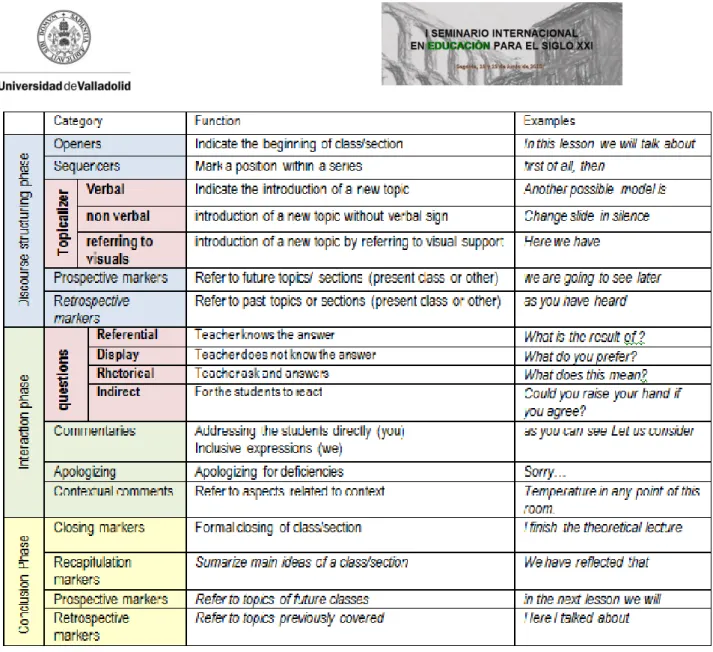
1. For the analysis of discourse makers (Young, 1994; Dafouz & Nuñez 2010),
111
112
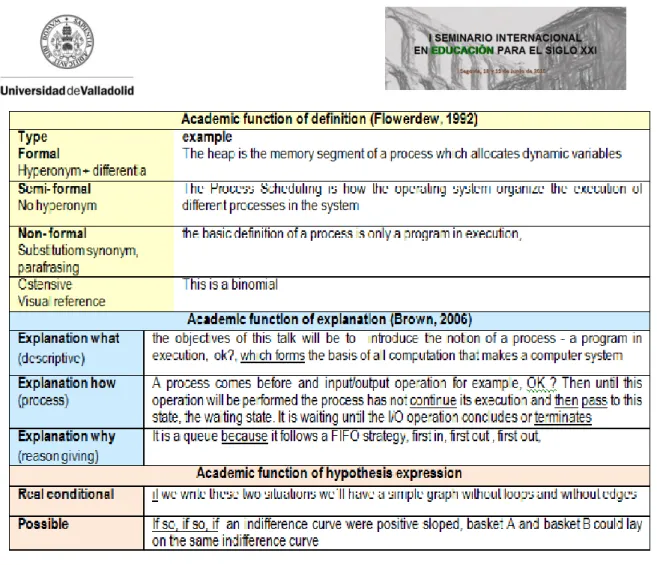
Figure 2: Academic Functions. Analysis grid developed from these taxonomies and some examples found in the corpus
Tough it will be mainly the qualitative analysis of the transcriptions what will provide insights into the main features of lecturers´ discourse and identifies training needs, quantitative information about the frequencies’ of these categories will also be considered.
113
3. Findings and pedagogical implications
3.1. Findings
Together these results provide important insights into the features of Spanish lecturers using English to teach content subjects. In addition, the findings answer the five research questions. As already said in the methodology section, we will make use of qualitative and quantitative information.
Regarding discourse markers, Figure 2 shows the prevalence of these markers to structure lectures. The frequencies and categories in the lecturers´ discourses provide useful information about individual linguistic needs. However, the comment and discussion in detail is far beyond the extension and scope of the present paper, which only attempts to provide a panoramic view of CLIL classrooms as valid contexts for educational research.
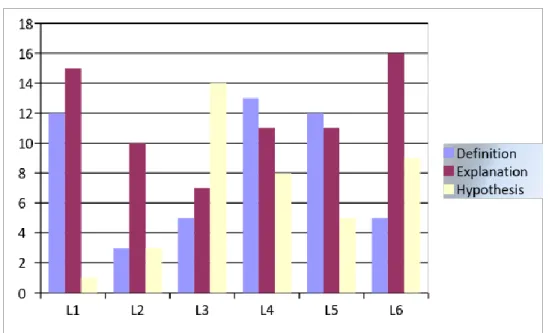
114 As concerns the qualitative features of the investigated discourse markers include: a lack of explicit signalling of phase transition; poor stylistic variety in this signalling; an interactional and conversational teaching style with impersonal forms outnumbering personal ones; multimodality, that is use of visual elements to support talk but without any explicit verbal reference to them. As regards academic functions, results show a significant explicit use of them and certain presence of signalling metalanguage. In spite of this, the linguistic form is relatively basic. Figure 4 shows the distribution per lecturer.
Figure 4. Distribution of academic functions per lecturer.
3.2. Pedagogical implications
115 The required training derived from the analysis can be summarized as follows:
1. Awareness of the importance of signalling lecture phases, of interactivity and of the use of visual support without detriment of the verbal language, so that comprehension is facilitated to students. 2. Linguist tools to signal lecture phases, linguistic resources to increase
interactivity and to efficiently refer to visual support.
3. Awareness of the types of academic functions, of their importance and of the assistance that metalanguage could provide.
4. Stylistic variety and more complex structures.
Figure 5 provides a more detailed specification of the needs and implications and the features of the discourse in the investigated lecturers.
Features of the six Spanish EMI lecturers investigated
Linguistic needs/
Pedagogical implications
Abundance of inclusive forms (we, our; very low frequency of impersonal forms.
1. Reinforce the production of impersonal structures Examples of good discursive,
teaching and communicative practices
Awareness, strengthen them, linguistic tools
Academic function of definition
2. Awareness of the different types 3. Awareness of the facilitator role of
metalanguage and of hyperonyms 4. Stylistic variety
Academic function of explanation
5. Awareness of the facilitator role of metalanguage
6. Stylistic variety of nexus and signalling nouns
Academic function of hypothesis expression
116
Figure 5. Summary of findings and pedagogical implications
3.3 Pedagogical intervention
This study aims to be a reactive analysis. The aim is to improve both the teaching practice of the CLIL lecturers and of those training them. Accordingly the study joins theory and practice by providing an instrument of didactic intervention. Dalton-Puffer (2007: 257) asserts that research results generated from Applied Linguistics should assist in the resolution of real classroom problems. Thus, the findings from our data and the theoretical foundations presented in the literature review are applied for the design of the instrument of didactic intervention for teacher training. This course consists of five didactic sequences which aim to draw together the aspects and advantages of a genre approach to lecture. With that purpose, the intervention highlights the explicit teaching of the investigated elements which make lecture and academic genre: discourse makers and the three observed academic functions. Besides, the instrument is intended for another of the perceived needs: language awareness about how the different disciplines use their specialized language and academic language for knowledge construction and communication.
Conclusion
117 We consider this research offers three main contributions to the field of bilingual education. The first of them are the findings in the investigated lecturers. Though they are very similar to those found in parallel and comparable educational contexts (Dafouz & Nuñez, 2010; Dalton-Puffer, 2007), the results themselves are a contribution in the sense that they provide an insight into the discursive features (Martín del Pozo, 2015).
We suggest that the obtained results recall one of the main advantages of corpus based research: `We can claim with some confidence that showing what does not occur, negative evidence if you wish, is one of the great benefits of a corpora approach, especially when we consider the pedagogical implications of these dispreferences´ (Swales & Malczewski, 2001: 161). Pointing at `what does not occur´ will provide dimensions of CLIL lecturers´ language competence which require reinforcement.
The proposed taxonomies (figures 1 and 2) for the analysis of lecturer’s discourse are a second contribution (Martín del Pozo, 2014a). These taxonomies merge categories from previous studies and categories driven from this corpus. The taxonomies could be valuable for a systematic observation of any other content lecturer teaching through English.
A third contribution is the course designed as a didactic intervention. These five didactic sequences target common shared linguistic needs for any university lecturer considering teaching through English.
118
References
Brown, G. & Atkins, M. (2006). Effective Teaching in Higher education. London: Routlege (first ed. 1998)
Coyle, D., Hood, P., & Marsh, D. (2010). Content and Language Integrated Learning. Cambridge, Cambridge University Press.
Cummins, J. (1984). Bilingualism and special education: Issues in assessment and pedagogy. Clevedon, England: Multilingual Matters.
Dafouz, E. & Guerrini, M. (eds.) (2009). CLIL across education levels: opportunities for all. Madrid: Richmond-Santillana Publishing.
Dafouz, E. & Núñez B. (2010). Metadiscursive devices in university lectures: A constrastive analysis of L1 and L2 performance. In C.Dalton-Puffer, T, Nikula, & U. Smit (eds.) Language use and language learning in CLIL classrooms. (pp. 213-231). Amsterdam; Philadelphia: John Benjamins.
Dalton-Puffer, C. (2007). Discourse in Content and Language Integrated Learning (CLIL). Amsterdam: John Benjamins.
Dalton-Puffer, C. (2011). Content and language integrated learning: from
practice to principles. Annual Review of Applied Linguistics, 31, 182-204.
Eslami, Z. R & Eslami-Rasekh, A. (2007). Discourse Markers in Academic Lectures. Asian EFL Journal, 9 (1), 22-38.
Flowerdew, J. (1994). Academic listening: research perspectives. Cambridge:
Cambridge University.
119 Fortanet, I. (2004). The use of `we´ in university lectures. Reference and
function. English for Specific Purposes, 23, 45–66.
Francomacaro, M.R. (2011). English as a Medium of Instruction at an Italian Engineering Faculty: an Investigation of Structural Features and Pragmatic Functions. University of Naples, Doctoral Thesis.
Llinares, A., Morton, T. & Whittaker, R. (2011). The Role of Language in CLIL. Cambridge: CUP.
Llinares A. & R. Whittaker (2011). Functions of language in CLIL secondary classes: a systemic functional approac . In C. Escobar, & L. Nussbaum (Eds.). Aprendre en una altra llengua (pp. 141- 161). Bellaterra: Barcelona: Servei de Publicacions de la Universitat Autònoma de Barcelona.
Lasagabaster, D. & Ruiz de Zarobe, Y. (Eds.) (2010). CLIL in Spain: Implementation, Results and Teacher Training. Newcastle: Cambridge Scholars Library.
Lyster, R. (2007). Learning and teaching languages through content: A
counterbalanced approach. Amsterdam/Philadelphia: John Benjamins
Marsh, D. & J. Laitinen (2005). Medium of instruction in European higher education: Summary of research outcomes of European Network for Language Learning Amongst Undergraduates (ENLU) Task Group 4. Jyväskylä: UniCOM, University of Jyväskylä.
Martín del Pozo, M.A. (2008a). Impartir asignaturas en inglés: su potencial para el desarrollo de competencias en alumnos y profesores de una ingeniería técnica, Jornadas Internacionales Universidad Politécnica de Madrid sobre innovación y convergencia Europea. Universidad
120 Martín del Pozo, M.A. (2008b). La enseñanza de contenidos en inglés: estudio de caso de una ingeniería técnica en la Universidad de Valladolid. Actas del I Congreso Internacional de Interacción comunicativa y enseñanza
de lenguas (pp. 381-388). Valencia: Universitat de Valencia.
Martín del Pozo, M.A. (2013). Formación lingüística del profesorado
universitario para la docencia en inglés. Revista de Docencia Universitaria 11 (3). 197-218.
Martín del Pozo, M.A (marzo, 2014a). A Framework for the analysis in CLIL lecturers discourse from a genre perspective. Comunicación presentada en el I Congreso Internacional Higher Education Perspectives on Content and Language Integrated Learning (27-28 marzo) Universidad de Vic. Martín del Pozo, M.A (2014b). Aproximación lingüístico didáctica al lenguaje
académico de la clase magistral en la formación del profesorado en contextos bilingües. Tesis doctoral. Universidad Complutense de Madrid- Martín del Pozo, M.A. (2015). The needs of a new EAP learner: CLIL teachers. In. P. Shrestha, (Ed.) Current Developments in English for Academic and Specific Purposes: Local innovations and global perspectives. (pp. 115-138). Reading: Garnett Education.
Morell, T. (2004). Interactive lecture discourse for university EFL students. English for Specific Purposes, 23, 325-338.
Reza, M., Khodabakhshzade, H. & Shirvan, M. (2012). The Effect of Metadiscourse on EFL Learners’ Listening Comprehension. Journal of Language Teaching and Research, 3, 3,452-457. doi:10.4304/jltr.3.3.452-457
121 Swales, J. M., & Malcewski, B. (2001). Discourse management and new episode flags in MICASE. In Simpson & Swales (Eds.), Corpus Linguistics in North America: Selections from the 1999 symposium (pp. 145-64). Ann Arbor: University of Michigan Press.